

The $23,000 Developer: Every Hidden Cost Your $12,000 Hiring Invoice Is Missing
The $12K invoice for a developer is not the cost of that developer. It is the visible part. The real number is typically $19,000 to $26,000 per year higher. This is every line item your finance team is not adding up.

Mukesh Ram
I founded Acquaint Softtech as a software development partner for companies that want to build software without the overhead of building an in-house engineering function. After 13 years of those conversations, the number I see misunderstood most consistently is the true cost of hiring a developer. The invoice says $12,000. The real cost is somewhere between $19,000 and $26,000, depending on where you hire and what your accounting actually captures.

- Founders and CTOs comparing in-house hiring against outsourcing or staff augmentation
- Finance teams trying to build an accurate developer hiring budget for 2026
- Engineering leads who have made the in-house vs offshore decision before and want to pressure-test the numbers
- Anyone who has been told offshore development is cheaper but cannot find the full side-by-side calculation
Most companies who hires developers for the first time makes the same mistake in their cost modelling: they compare salary or invoice rate without adding the full cost of employment. The result is a budget that looks right in January and looks wrong by June. This article builds the full cost model, line by line, so you know the real number before you make the decision.
The in-house vs staff augmentation comparison covers the strategic side of this decision in more detail. This article is the cost model that sits underneath that decision.
The $12,000 Invoice Is Not the Cost
Here is what most finance teams capture when they model a developer hire: salary or invoice rate, employer tax or NI contribution. Sometimes benefits. That is it.
Here is what the same finance team misses: recruitment cost, onboarding time, equipment and tooling, management overhead, productivity ramp, turnover risk, and office infrastructure. Each of these is real money. Most of them are invisible in the standard cost model because they are distributed across different budget lines or absorbed into other headings.
The calculation below uses a US-based mid-level developer at $85,000 base salary as the reference point. This is a realistic 2026 market rate for a developer with 3 to 5 years of experience in a major US metropolitan area.
Cost Category | US In-House | Offshore (India) | Notes |
Base salary / invoice | $85,000/yr | $38,400/yr | Mid-level. Offshore via structured vendor at $24/hr. |
Employer payroll tax | $6,500 to $8,000 | $0 | FICA, FUTA, state unemployment. Vendor absorbs offshore. |
Health and dental benefits | $6,000 to $14,000 | $0 | US employer contribution. Vendor covers offshore. |
Recruitment cost | $8,500 to $17,000 | $0 | Typically 10 to 20% of salary. One-time but real. |
Onboarding productivity loss | $4,000 to $8,000 | $1,200 | 8 to 12 weeks at 40% productivity for US. 3 to 4 wks offshore with structured process. |
Equipment and licences | $2,500 to $4,500 | $0 | Laptop, monitor, software licences. Vendor covers offshore. |
Management time overhead | $5,000 to $9,000 | $1,600 to $3,200 | US senior dev needs 2 to 4 hrs/wk of tech lead time. Offshore mid-level similar. |
Office space / remote setup | $3,000 to $8,000 | $0 | Allocation of office costs or home office subsidy. |
Annual turnover risk (prorated) | $6,000 to $12,000 | $0 to $800 | US average dev tenure 2.1 years. Offshore vendor absorbs replacement. |
TOTAL ANNUAL COST | $127,000 to $165,000 | $41,200 to $43,200 | Offshore rate assumes all-inclusive vendor pricing. |
The Number Most Companies Are Not Running A $85,000 base salary developer costs $127,000 to $165,000 per year in total employer cost. An equivalent offshore developer through a structured vendor costs $41,200 to $43,200 per year. The gap is $85,000 to $120,000 per developer per year. On a team of 3 developers, that is $255,000 to $360,000 per year in cost that does not appear in the salary line but is being spent regardless. |
Breaking Down Each Hidden Cost
Every line in the table above is real. Here is what each one means in practice, because these are the costs that get challenged when a CFO reviews the outsourcing proposal.
Recruitment cost: $8,500 to $17,000 |
The standard recruiter fee is 15 to 20% of the first year salary for a permanent hire. For a $85,000 developer, that is $12,750 to $17,000. Even if you recruit directly through job boards and LinkedIn, the advertising costs, screening time, and interview rounds cost the equivalent in internal hours. This is a one-time cost per hire but it is not a zero. And when a developer leaves after 18 months, you pay it again. |
Onboarding productivity loss: $4,000 to $8,000 |
A new developer typically runs at 30 to 50% of full productivity for the first 8 to 12 weeks while they learn the codebase, the team's patterns, and the product domain. The cost is the delta between what you are paying and what you are getting. At $85,000 base salary, 10 weeks at 40% productivity is roughly $6,500 in salary cost for partial output. |
Management overhead: $5,000 to $9,000 |
A mid-level developer requires 2 to 4 hours of tech lead time per week for task definition, code review, architectural guidance, and unblocking. At a fully-loaded tech lead rate of $120/hr, 3 hours per week for 50 weeks is $18,000 per year. This is typically not captured in the developer's cost because it is distributed across the tech lead's budget. But it is absolutely a cost of having that developer. |
Turnover risk: $6,000 to $12,000 |
The average US software developer tenure at one company is 2.1 years. Prorated across a year, the expected cost of replacement (recruitment, onboarding loss, knowledge transfer gap) works out to $6,000 to $12,000 per developer per year. Most companies model developer cost as a steady-state expense. The actual steady-state includes the turnover cycle. |
Benefits and employer tax: $12,500 to $22,000 |
This is the most visible hidden cost but still gets underestimated. Health insurance employer contribution of $500 to $1,200 per month, FICA at 7.65%, FUTA, state unemployment insurance, and any 401K match. On a $85,000 base, employer tax alone is $6,500 to $7,500 before benefits. |
Want the Full Side-by-Side for Your Specific Team Size?
Send me your current team structure: roles, seniority levels, and whether you are in the US, UK, or elsewhere. I will build the actual cost comparison for your situation, offshore versus in-house, with every line item. Most people who see the real number are surprised by how wide the gap is. The calculation takes about 20 minutes.
The Quality Question: Is Offshore Actually Comparable?

The cost gap is clear. The question most people push back on is quality. The honest answer is: it depends on the vendor structure and the engagement model, not on the developer's location.
A developer hired through a platform with no vetting process and no contractual accountability is a different product from a developer placed through a vendor with a 15-point technical assessment, named placement, IP assignment, and a performance replacement clause. The rate difference between those two products is real. The quality difference is equally real.
At Acquaint, all developers go through a multi-stage technical assessment before placement. If you want to understand what good offshore vetting looks like versus what a low-quality process looks like, our staff augmentation model covers the specific differences in what is included: named placement, direct access, IP assignment, and a 48-hour free replacement guarantee.
The variables that actually determine offshore quality
Vendor vetting depth: does the vendor run a multi-stage technical assessment or a 30-minute screen?
Named placement: is the developer profile provided before signing, or is it whoever is available?
Direct access: do you communicate with the developer directly, or through an account manager layer?
Replacement process: is the replacement guarantee contractual with a defined timeline and process?
IP assignment: is it in the contract from day one, or a negotiation after an issue arises?
None of these variables are location-specific. They are vendor-specific.
Location is not the quality driver. Contract structure is.
When In-House Is Still the Right Answer
I run a company that benefits when clients choose offshore. I should be clear about when they should not.
In-house hiring makes sense when the developer role requires deep, sustained immersion in the physical workplace culture: embedded product teams where co-location is a genuine differentiator, roles where regulatory or security compliance requires developer presence, or situations where the product is so domain-specific that onboarding an offshore developer would take longer than the engagement window.
For a large amount of software development work, particularly ongoing SaaS product development, feature delivery, API work, and system integration, the offshore model produces comparable quality at a structurally lower total cost. The self-assessment we built helps you identify which side of that line your specific situation sits on before you make the call.
The Real Offshore Cost: What Our Engagements Actually Include
When you hire remote developers through Acquaint softtech, here is what the monthly invoice actually covers, so you can build the real comparison yourself.
Developer salary and employment | All costs of employing the developer, including salary, employer contributions in India, benefits, and equipment. None of these appear on your invoice. |
Technical assessment and vetting | A multi-stage assessment before placement. The cost of finding and vetting the right developer is absorbed by the vendor, not passed to the client. |
Named placement and interview process | You interview the specific developer before committing. The developer you approve is the developer who starts. No bait and switch. |
NDA and IP assignment from day one | Both are in the standard contract. Every line of code written for your project belongs to you from the moment it is committed. |
Direct developer access | Slack or Teams, direct with the developer. No account manager layer. No relay delays. |
48-hour replacement guarantee | If the developer does not work out, replacement within 48 hours. The exiting developer participates in a structured knowledge transfer. |
Vendor quality accountability | Unlike an independent freelancer, a developer placed through Acquaint has their vendor's reputation behind their performance. We track sprint delivery rates and manage performance proactively. |
For Laravel-specific projects, our Laravel development service includes all of the above with developers who have passed a Laravel-specific technical assessment covering Eloquent optimisation, service provider architecture, queue management, and production deployment patterns.
Ready to See the Real Cost Comparison for Your Team?
Tell me your current team size, roles, and what you are trying to build over the next 6 months. I will put together the actual cost model for your situation: what in-house costs versus what offshore costs, with every line item, not just the invoice. Most clients who see this model make a faster decision because the number removes the ambiguity.
Frequently Asked Questions
-
What is the true total cost of hiring a software developer in the US in 2026?
For a mid-level developer at an $85,000 base salary, the total employer cost typically runs $127,000 to $165,000 per year when you include payroll taxes, benefits, recruitment cost, onboarding productivity loss, management overhead, equipment, and a prorated turnover allowance. The salary line is the most visible cost. It is not the largest proportion of the total.
-
How much cheaper is offshore development compared to in-house hiring?
For a comparable mid-level developer role, offshore through a structured India-based vendor typically costs $41,000 to $43,000 per year all-inclusive. Against a US in-house total cost of $127,000 to $165,000, the offshore saving runs $85,000 to $120,000 per developer per year. On a three-developer team, the annual saving is $255,000 to $360,000. These are real numbers from actual engagement costs, not theoretical figures.
-
Does offshore development actually produce the same quality as in-house?
When the vendor structure is correct, yes. The quality variables that matter are not location. They are vetting depth, named placement, contract structure, and vendor accountability. A developer placed through a rigorous vendor assessment, with IP assignment in the contract, direct client access, and a defined performance replacement clause, produces comparable quality to an equivalent in-house hire at a structurally lower cost.
-
What costs do companies most commonly miss when comparing in-house versus offshore?
Recruitment cost (10 to 20% of salary), onboarding productivity loss (8 to 12 weeks at partial output), management overhead (2 to 4 hours of senior tech lead time per developer per week), and turnover risk prorated annually. Together these typically add $25,000 to $45,000 per developer per year on top of the base salary and benefits line.
-
Is staff augmentation cheaper than hiring a freelancer?
For ongoing work, yes. A freelancer on an open marketplace carries no vendor accountability, no contract protections, and no replacement guarantee. The risk premium for freelancer work without these protections is real and shows up as rework cycles, knowledge gaps when the freelancer moves on, and IP disputes. A structured staff augmentation vendor charges a slightly higher rate than the cheapest marketplace option but the total engagement cost is consistently lower because the failure rate is lower.
-
How do I build a developer hiring budget that captures all the real costs?
Start with base salary or invoice rate, then add: employer payroll tax (7 to 10% in US), benefits contribution (7 to 16% of salary), recruitment cost (10 to 20% of salary, prorated over expected tenure), onboarding productivity loss (8 to 12 weeks at 30 to 50% productivity), management time (2 to 4 hours per developer per week at your tech lead's fully-loaded rate), and equipment and tooling ($2,500 to $4,500). Sum those and you have the real budget number. It is consistently 50 to 90% higher than the salary or invoice line alone.
-
Are there situations where the offshore saving is to good to be true?
Yes. When the offshore rate is significantly below market for the claimed seniority level, something is either overstated or excluded. Common versions: the developer is shared across multiple clients rather than dedicated to your project, the seniority claim is not backed by a verifiable profile, IP assignment requires negotiation rather than being in the standard contract, or the replacement guarantee is a sales promise with no contractual basis. The offshore saving is real when the vendor structure is legitimate. When the rate looks implausible, press for the specific developer profile, the contract terms, and reference clients before accepting it.
I love to make a difference. Thus, I started Acquaint Softtech with the vision of making developers easily accessible and affordable to all. Me and my beloved team have been fulfilling this vision for over 15 years now and will continue to get even bigger and better.
Table of Contents
Get Started with Acquaint Softtech
- 13+ Years Delivering Software Excellence
- 1300+ Projects Delivered With Precision
- Official Laravel & Laravel News Partner
- Official Statamic Partner
Related Reading
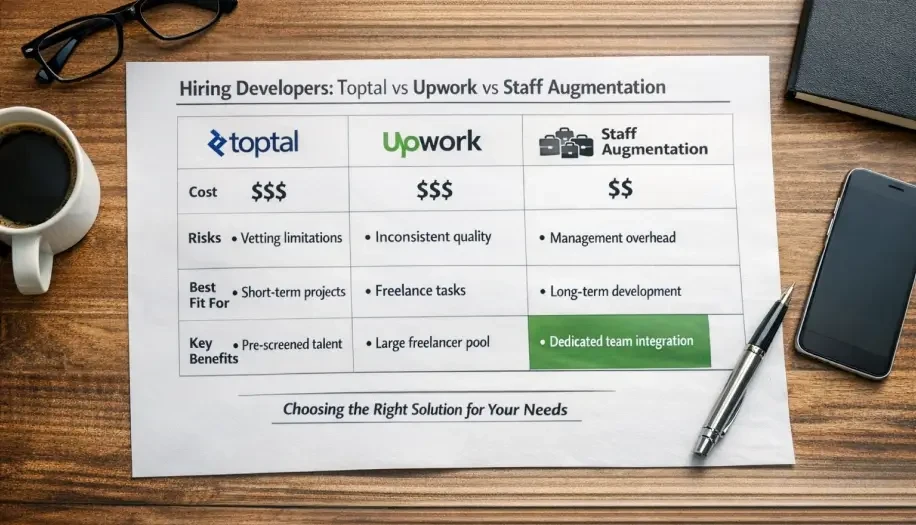
Toptal vs Upwork vs Staff Augmentation: An Honest CTO's Guide for 2026
Toptal, Upwork, and staff augmentation each solve a different problem. This honest vendor-side guide covers what each model actually costs, where each one breaks down, and which fits your situation.

Acquaint Softtech
March 16, 2026
API Development Cost in 2026: What Drives the Price, What to Budget, and Where Projects Overrun
Most API budgets are built around the endpoint list. That covers roughly 40% of the real work. Here is what the other 60% looks like and why it is almost always the part that causes overruns.

Chirag Daxini
April 2, 2026
Staff Augmentation vs Upwork vs Agency: Real Cost Breakdown for CTOs in 2026
Staff augmentation, Upwork, or a dev agency? The real cost difference in 2026 is bigger than most CTOs expect. Here are the actual numbers with zero fluff.