

Why Clutch Reviews Matter When Selecting Python Vendors
The star rating is not the signal. This guide shows you how to read Clutch reviews for Python vendors like an expert: 5 key signals, profile red flags, and a scorecard to evaluate any development company before signing.

Acquaint Softtech
Who This Guide Is For
This guide is written for CTOs, product managers, and technical leads who are actively shortlisting Python development vendors and have Clutch open in a browser tab. It is for people who know Clutch matters but are not sure what to actually do with what they see beyond checking the star rating.
If you are still building your evaluation framework, the guide on what to look for when hiring a Python development company provides the full criteria. This blog goes one level deeper: how to extract the right signals specifically from Clutch.
The Problem with How Most People Use Clutch
Most buyers check the star rating, scan two or three recent reviews, and move on. That takes about four minutes and misses almost everything Clutch actually contains.
A Clutch review is not a Yelp review. It is a structured, 500-word, human-verified interview with a client who worked directly with the vendor. The star rating is the least informative part of that document.
This guide shows you how to read a Clutch profile the way a senior procurement specialist would: systematically, skeptically, and with an eye for the signals that separate a genuine Python development partner from one that has simply managed its online presence well. For context on why vendor evaluation matters before you even reach Clutch, see the complete guide to hiring Python developers in 2026.
The core insightMost red flag guides treat all warning signs as equivalent and pre-engagement in timing. The reality is that different red flags appear at different moments in an engagement, carry different severity levels, and require different responses. A red flag spotted before signing requires renegotiation or disengagement. A red flag spotted mid-project requires escalation and process change. A red flag spotted post-delivery may require legal intervention. Knowing which phase you are in determines what your options are. |
What Makes Clutch Different from a Website Testimonial
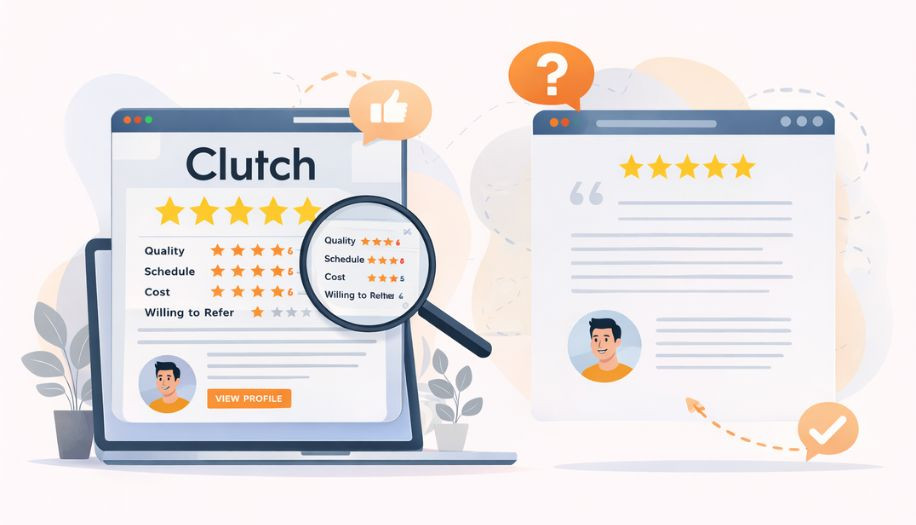
A vendor controls every word on their website. They curate testimonials, select which clients are featured, and remove anything unflattering. Clutch removes that control entirely.
Every review on Clutch undergoes a human-led verification process. The reviewer's identity is confirmed, the project's legitimacy is established, and the review is rejected if it does not meet Clutch's authenticity criteria. Critically, vendors cannot remove negative reviews that meet Clutch's guidelines.
Evaluation Dimension | Clutch Review | Website Testimonial |
What Clutch verifies | Reviewer identity, business legitimacy, project existence | Star rating or written testimonial |
Review length | 500+ words per review with structured Q&A | 1-3 sentences |
How reviews are collected | Phone interview or detailed online form by Clutch analyst | Self-submitted, unverified |
Can vendors remove reviews? | No. Negative reviews stay unless violating guidelines | Often yes, or disputed easily |
Project size weighted? | Yes. Larger project reviews carry more weight | No distinction |
What it reveals | Communication, process, post-launch support, scope handling | General satisfaction |
Red flags visible? | Yes. Negative patterns surface across multiple reviews | Rarely, if visible at all |
The practical implication: a vendor with 50+ verified Clutch reviews tells you something a vendor with 50+ curated website testimonials does not. The Clutch reviews survived a process designed to catch fabrication. The website testimonials survived only the vendor's own editorial judgment.
The Rating Threshold That Actually Matters
A 4.5-star rating with 20+ reviews is the minimum useful signal on Clutch for Python development vendors. Below that threshold, the sample is too small to be statistically meaningful.
Clutch's own methodology weights reviews by project size and complexity. A vendor with three reviews from small projects is structurally less informative than one with fifteen reviews from mid-to-large engagements, even if both show 5.0 stars.
What to look for in the numbersRating 4.5+ with 50+ reviews: meaningful signal. Rating 5.0 with 4 reviews: insufficient sample. Rating 4.7 with 40 reviews including two sub-4 ratings: this is actually the most credible profile type. Perfect scores across all reviews can indicate a vendor is only submitting reviews from clients they know are satisfied. |
5 Signals to Read Inside a Clutch Review (Instead of the Star Rating)
How the reviewer describes communication
Communication quality is the single most predictive variable in Python development engagement success. Clutch reviews almost always contain specific language about how the vendor communicated: proactively, reactively, or not at all. Words like 'they always kept us informed' and 'we never had to chase them for updates' signal partner-level communication. Words like 'communication could be improved' buried in an otherwise positive review are a genuine flag.
What good looks like: Reviewer says something like: 'They flagged a potential scope issue three weeks before the deadline and proposed a solution before we even noticed the problem.' That is a partner-level communication signal, not just a vendor completing tasks.
Whether the review mentions a problem and how it was handled
Reviews that describe only smooth delivery are the least informative. Every real engagement encounters friction: a scope gap, a timeline pressure, a technical constraint that was not anticipated. How a Python vendor handles those moments defines the quality of the partnership. A review that mentions a problem and then describes how the vendor resolved it is more credible and more useful than a review that reports nothing but praise.
What good looks like: Look for language like: 'There was a delay in one sprint because of a third-party API issue. The team flagged it immediately and proposed an alternative approach that kept us on track for the final deadline.'
Python-specific technical language in the review
A generic review praising 'great developers' and 'excellent communication' tells you very little about Python capability specifically. Reviews that mention Django, FastAPI, Flask, API performance, data pipelines, or ML deployment confirm that the reviewer actually worked with Python engineers on substantive Python problems, not just project managers who happened to be overseeing Python work.
What good looks like: Strong signal: 'Their FastAPI implementation handled our peak load of 15,000 concurrent requests without degradation. The team proactively suggested a Redis caching layer that reduced database load by 40%.' This describes real Python engineering, not generic software delivery.
Reviewer's role and company type
A CTO reviewing a Python backend engagement tells you more than a marketing manager reviewing the same engagement. The reviewer's role determines what they can credibly assess. Technical reviewers evaluate code quality, architectural decisions, and production performance. Non-technical reviewers evaluate project management and communication. Both are useful but require different weighting depending on what you are hiring for.
What good looks like: For Python development evaluation, prioritise reviews from: CTOs, VPs of Engineering, Technical Leads, and Founders with technical backgrounds. Secondary value comes from Product Managers. Reviews from non-technical executives provide communication signal but limited technical signal.
The timeline between reviews
A vendor with 30 reviews, all collected within a six-month window, is a different risk profile from a vendor with 30 reviews spread over three years. A burst of reviews in a concentrated period can indicate an aggressive review solicitation campaign, potentially triggered by a previous negative review the vendor wanted to bury in score averages. Sustained review accumulation over time reflects sustained client engagement and ongoing delivery.
What good looks like: Look at the review dates in the full list. A healthy pattern shows roughly consistent review cadence with recent additions. A suspicious pattern shows a gap of 18+ months, then a sudden cluster of five-star reviews.
Red Flags at the Profile Level (Before You Read a Single Review)
Several warning signals are visible on a Clutch profile before you open a single review. These are worth checking first to filter out profiles that do not merit deeper evaluation.
All reviews are 5.0 stars with no variance
Legitimate sustained delivery produces occasional 4.5 or 4.7 reviews. A vendor with 30 consecutive 5.0-star reviews has likely only submitted reviews from clients they know are fully satisfied. This is not fraud, but it is curation. The negative reviews that would balance the picture are missing because no unsatisfied client was asked to review.
No reviews mention the type of Python work performed
A Python vendor whose Clutch reviews describe 'great project management' and 'excellent team communication' without any mention of Django, FastAPI, data pipelines, or specific technical deliverables may not be a Python specialist at all. They may be a general agency that lists Python in their service lines without meaningful depth.
Recent review gap of 12 months or more
A vendor with an excellent review history that abruptly stops twelve or more months ago raises a specific question: what changed? Teams change, quality changes, and client retention changes. A review gap does not confirm a problem, but it warrants a direct question in the evaluation conversation: can you provide a reference from a project completed in the last six months?
Profile fields are incomplete or show round numbers
Clutch profiles include hourly rate, team size, minimum project size, and year founded. Fields that show round numbers (exactly 50 employees, exactly $25/hr) or remain blank are often self-reported estimates rather than verified data. Clutch clearly notes which fields are self-reported. Treat those fields as conversation starters, not verified facts, and validate them directly in your evaluation.
The Clutch Evaluation Scorecard: 8 Criteria to Apply to Any Python Vendor
Use this scorecard when comparing two or three shortlisted Python vendors on Clutch. Score each vendor against all eight criteria. A vendor that scores strong on six or more is worth advancing to a live evaluation conversation.
Clutch Evaluation Criterion | Strong Signal | Weak Signal |
Rating 4.5 or above | Minimum threshold | Walk away below 4.0 |
20+ verified reviews | Strong signal of sustained delivery | Below 10 is insufficient sample |
Reviews from last 12 months | Recency matters — team changes happen | All reviews 2+ years old is a concern |
Reviews mention specific frameworks (Django, FastAPI) | Python depth confirmed | Generic 'great developers' only is weak |
At least one review mentioning a problem and how it was resolved | Credibility signal | All 5-star perfection may indicate curation |
Review text is 200+ words with project details | Depth and specificity present | Short, vague reviews are low-value signals |
Client company name or industry visible | Verifiable reference possible | Anonymous-only reviews limit your diligence |
Reviewer role is CTO, PM, or technical lead | Technical credibility of feedback | C-suite non-technical reviewers miss code quality |
Clutch evaluation is one layer in a full vendor selection process. After Clutch, the next step is a structured discovery call and technical session. The questions to ask in that session are covered in the guide on questions to ask before hiring Python developers.
How Clutch Fits Into a Complete Python Vendor Evaluation
Clutch is not the end of the evaluation. It is the beginning of the shortlist.
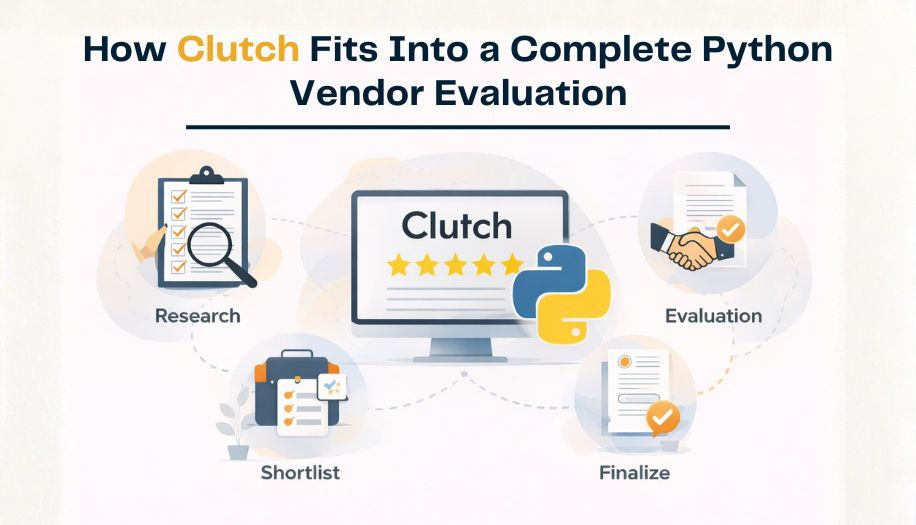
Step 1: Use Clutch to create a shortlist
Filter by Python or Django development, minimum 4.5 rating, minimum 15 reviews, reviewed in the last 12 months. This gives you a shortlist of 5 to 8 vendors worth deeper investigation.
Step 2: Read the reviews with the 5-signal framework
Do not read reviews in order of recency. Read the most-detailed review first, then the lowest-rated review, then the most recent. Apply the five signals from this guide to each one.
Step 3: Request a live reference call
A Clutch review is the starting point for a reference, not the reference itself. Ask the vendor to connect you with the client who left the most detailed Clutch review, not a new curated contact. Combine this with the partner evaluation framework to structure the live conversation.
Step 4: Verify technical claims in a live session
Clutch reviews confirm delivery quality and communication patterns. They do not confirm technical depth for your specific use case. A live technical session with the proposed developer is still required. The full vetting framework is in the Python developer hiring checklist.
What Clutch Reviews Cannot Tell You
Clutch reviews are structured around client experience, not technical quality. A client who is not a developer cannot assess whether the Python code delivered will scale, whether the architecture will create maintenance debt, or whether the test coverage is adequate.
This is the gap that makes Clutch necessary but not sufficient. Use it to filter for communication quality, delivery reliability, and client satisfaction. Use a live technical session to validate the dimensions Clutch cannot assess.
Clutch can confirm:
communication quality, timeline reliability, project management, and client relationship handling.
Clutch cannot confirm:
code quality, test coverage, architectural soundness, scalability of delivered systems, or Python framework depth.
Complement Clutch with:
a live technical session, an independent code review request, and a direct reference call with a past client from a comparable project.
For the pricing signals that Clutch also cannot evaluate, the guide on Python development pricing red flags covers the proposal and contract dimensions that require separate verification
Acquaint Softtech on Clutch: What Our Reviews Confirm
Acquaint Softtech is a Python development and IT staff augmentation company headquartered in Ahmedabad, India, with 1,300+ projects delivered globally. Our Clutch profile is publicly available and reflects the same review criteria this guide describes: verified reviewers, specific project details, and feedback that includes both what went well and how we handled complexity when it arose.
We encourage every prospective client to read our full Clutch reviews before contacting us, including the reviews that mention challenges. A vendor who welcomes that level of scrutiny before the conversation starts is already demonstrating a different posture from one who directs you to curated testimonials.
What our Clutch reviews specifically confirm
Communication patterns: how we surface blockers early, update clients proactively, and integrate into sprint cadences
Delivery reliability: timeline adherence on milestone-based engagements across different industries
Technical specificity: reviewers who mention Django, FastAPI, and data pipeline work by name
Post-launch engagement: clients who describe continued involvement after initial delivery
The Bottom Line: Clutch Is More Than a Star Rating
The companies that make good Python vendor decisions are not the ones who check the star rating. They are the ones who read the reviews for communication signals, problem-resolution stories, Python-specific technical detail, and reviewer credibility.
That takes twenty minutes per vendor, not four. It is also the twenty minutes that saves six months of recovery from a bad engagement.
For the complete hiring framework that Clutch evaluation feeds into, start with the complete guide to hiring Python developers.
See Acquaint Softtech's Verified Clutch Reviews.
Every review on our Clutch profile is independently verified. No curated testimonials. No hidden feedback. 1,300+ projects delivered. Read what real clients say before you decide.
Frequently Asked Questions
-
How many Clutch reviews is enough to trust a Python vendor?
Twenty verified reviews is a reasonable minimum for a meaningful signal. Below ten reviews, the sample is too small to draw reliable conclusions about sustained delivery quality. The volume threshold also depends on the vendor's age: a company that has been listed on Clutch for five years with 15 reviews tells a different story from one that has collected 15 reviews in 18 months.
-
Can a vendor manipulate their Clutch rating?
Clutch's own 2025 report acknowledges that fake reviews doubled between 2022 and 2023 and describes the proprietary software they built to detect them. The realistic answer is: less than most platforms, but not zero. The mitigation is to look for the pattern of reviews rather than the average score. Concentrated review bursts, all-5.0 profiles, and reviews that lack specificity about the actual Python work performed are all signals worth investigating.
-
Should I only look at Clutch, or use other platforms too?
Use Clutch as the primary B2B review source, supplemented by GoodFirms and Upwork for additional verified feedback. Do not rely on Google Reviews or the vendor's website testimonials as equivalent to Clutch verification. After Clutch, request a live reference call. For the complete evaluation process that follows Clutch shortlisting, the guide on hiring Python developers remotely and avoiding red flags covers the next steps.
-
What does a Clutch review tell me about Python code quality specifically?
Very little directly, because most reviewers are not developers. A Clutch review tells you about the quality of the working relationship: communication, delivery reliability, responsiveness to problems, and whether the client would hire the vendor again. Code quality, test coverage, and architectural soundness require a live technical session and ideally an independent code review. Clutch is the shortlisting filter; the technical session is the confirmation.
-
How does outsourcing Python development to India compare to Eastern Europe for risk profile?
The risk profile in Python development outsourcing is determined by the vetting process and engagement structure of the specific partner, not by geography. India-based vetted agencies with documented production Python portfolios, named-resource commitments, and transparent contracts carry a lower risk profile than Eastern European agencies without those structural elements, and vice versa. The rate advantage of India-based developers ($20 to $45 per hour versus $30 to $65 in Eastern Europe) is real, but the differentiator is the agency's vetting and accountability structure.
-
How should I use Clutch when comparing two Python vendors with similar ratings?
When overall ratings are comparable, the differentiators are review recency, reviewer seniority, Python-specific technical detail in the review text, and whether any reviews describe how problems were handled rather than just smooth delivery. A vendor with a 4.7 rating whose reviews specifically mention FastAPI, data pipelines, and proactive communication is stronger than a 4.8 vendor whose reviews describe general 'great team' experiences. From there, apply the complete hiring checklist to finalise the decision.
We’re Acquaint Softtech, your technology growth partner. Whether you're building a SaaS product, modernizing enterprise software, or hiring vetted remote developers, we’re built for flexibility and speed. Our official partnerships with Laravel, Statamic, and Bagisto reflect our commitment to excellence, not limitation. We work across stacks, time zones, and industries to bring your tech vision to life.
Table of Contents
Get Started with Acquaint Softtech
- 13+ Years Delivering Software Excellence
- 1300+ Projects Delivered With Precision
- Official Laravel & Laravel News Partner
- Official Statamic Partner
Related Blog

When Is Python Development Too Expensive? Pricing Red Flags That Signal a Bad Vendor
Not all expensive Python development is justified. This guide identifies the exact pricing red flags that signal a bad vendor, with real benchmarks, warning signs, and what fair Python pricing actually looks like in 2026.
Acquaint Softtech
March 26, 2026
How to Hire Python Developers Without Getting Burned: A Practical Checklist
Avoid costly hiring mistakes with this practical checklist on how to hire Python developers in 2026. Compare rates, vetting steps, engagement models, red flags, and more.
Acquaint Softtech
March 30, 2026
Total Cost of Ownership in Python Development Projects: The Full Financial Picture
The build cost is just the beginning. This guide breaks down the complete TCO of Python development projects across every lifecycle phase, with real benchmarks, a calculation framework, and 2026 data.
Acquaint Softtech
March 23, 2026India (Head Office)
203/204, Shapath-II, Near Silver Leaf Hotel, Opp. Rajpath Club, SG Highway, Ahmedabad-380054, Gujarat
USA
7838 Camino Cielo St, Highland, CA 92346
UK
The Powerhouse, 21 Woodthorpe Road, Ashford, England, TW15 2RP
New Zealand
42 Exler Place, Avondale, Auckland 0600, New Zealand
Canada
141 Skyview Bay NE , Calgary, Alberta, T3N 2K6
Your Project. Our Expertise. Let’s Connect.
Get in touch with our team to discuss your goals and start your journey with vetted developers in 48 hours.