

When Is Python Development Too Expensive? Pricing Red Flags That Signal a Bad Vendor
Not all expensive Python development is justified. This guide identifies the exact pricing red flags that signal a bad vendor, with real benchmarks, warning signs, and what fair Python pricing actually looks like in 2026.

Acquaint Softtech
The Most Expensive Python Project Is Usually the One with the Cheapest Quote
There is a specific kind of expensive in Python development that nobody talks about honestly. It is not the vendor who quotes $150 per hour. It is the vendor who quotes $40 per hour, wins the contract, and delivers a codebase so riddled with technical debt, undocumented decisions, and missing test coverage that the next team charges $80,000 to fix it.
That is not hypothetical. February 2026 analysis of 22 vendor red flags documented a Berlin startup that burned through €155,000 building a modular messaging client with a vendor who passed every early evaluation and never made it past beta. The root cause was not the technology. It was what the vendor’s pricing structure concealed about how the work would actually be done.
This guide is about both directions of wrong. It covers the genuine pricing red flags that signal a bad Python vendor, whether those red flags appear in the form of unjustified premiums, opaque fee structures, or suspiciously low quotes that transfer all the risk onto the client. By the end of this guide, you will be able to read a Python development proposal and know within minutes whether the pricing reflects competence and transparency or signals problems that will surface once work begins.
What Python Development Actually Costs in 2026: The Benchmark Context
Before identifying red flags, you need a baseline. A vendor whose pricing falls outside credible market ranges is a red flag in itself, in either direction. Here is what verified 2026 data shows.
December 2025 software development cost guide confirms that most development providers charge between $20 and $99 per hour, with $20 to $29 per hour as the most common bracket globally. July 2025 analysis places US software development at $100 to $200 per hour, India at $20 to $45 per hour, and Eastern Europe at $30 to $65 per hour. March 2026 guide confirms that senior India-based developers represent the most effective cost lever for quality-conscious teams, delivering comparable engineering output at 0.5x to 0.7x the cost of a full US team when properly vetted.
For full project costs, Benchmark places simple MVPs at $10,000 to $60,000, mid-range applications at $30,000 to $100,000, and enterprise-grade systems at $80,000 to $250,000 or more. 2026 data adds the 1.5x rule: if a vendor quotes $100,000 for initial scope, plan the realistic budget at $150,000 to $200,000 once hidden costs and inevitable scope changes are factored in. Any vendor who does not acknowledge this reality in their proposal is either not doing enough projects to know it, or is choosing not to tell you.
These benchmarks are your reference frame. A Python vendor proposing $250 per hour for a mid-level Django developer based in India is not expensive because the market is expensive. They are overcharging because their pricing is disconnected from market reality. A vendor proposing $15 per hour for a senior Python AI/ML engineer is not a bargain. They are pricing below the cost of the talent they are claiming to provide.
The 10 Python Development Pricing Red Flags That Signal a Bad Vendor
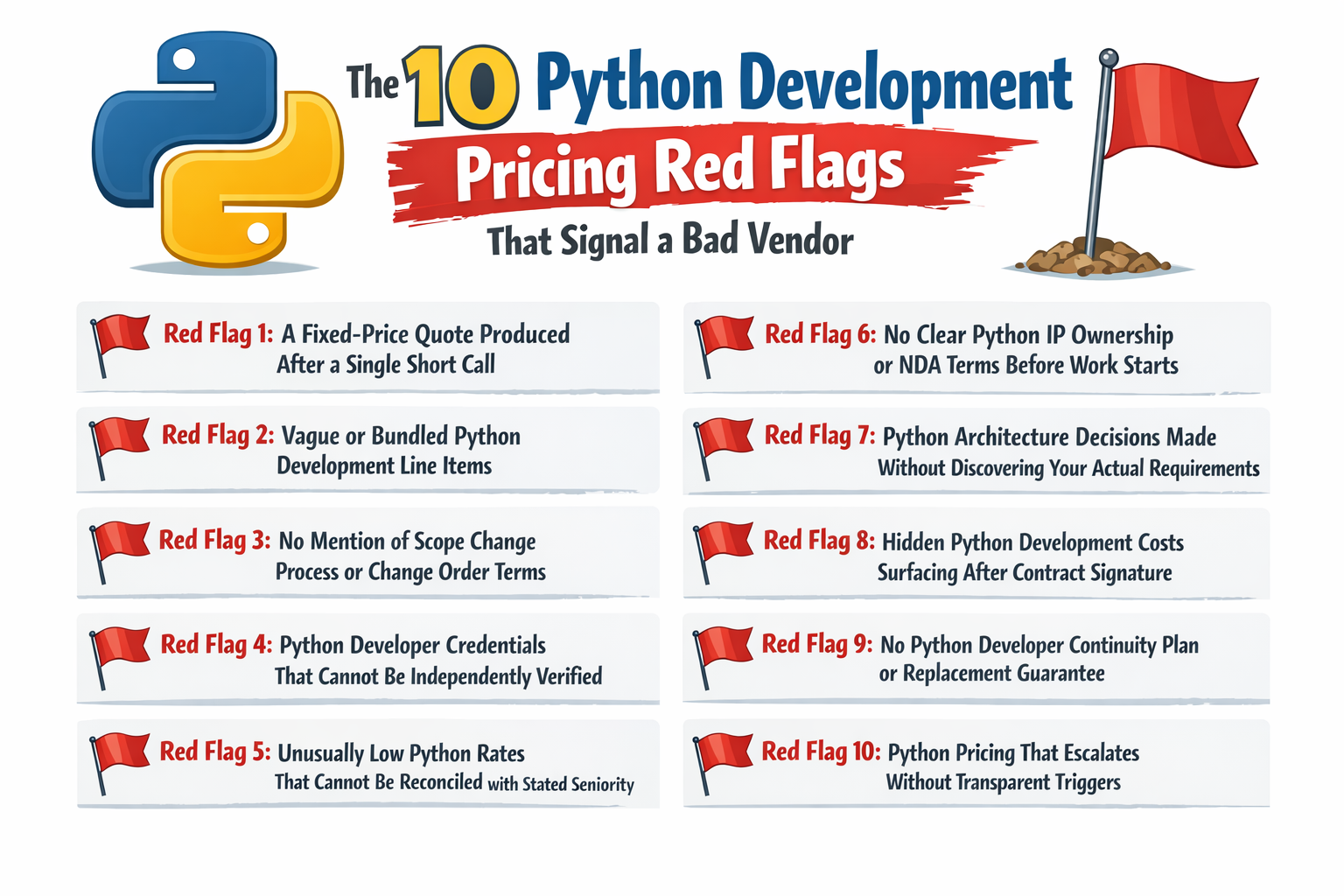
Red Flag 1: A Fixed-Price Quote Produced After a Single Short Call
A Python development quote that arrives within 24 to 48 hours of an introductory call, without a detailed requirements review, is not a project estimate. It is a sales tool designed to win the contract, not to accurately model the work.
2026 CTO vendor red flag analysis identifies superficial discovery as one of the 22 hard signals that separate confident promises from accountable partners: vendors who offer a fixed quote after a short call, without investing time in understanding your users, systems, or business constraints, are either overestimating to cover their unknown risk, or underestimating to win at any cost. Both outcomes are expensive.
The Nike supply chain case cited by Tymiq is instructive: $100 million in lost sales when supply chain software that passed every early evaluation did not fit real inventory flows. The vendor had pitched a solution before understanding the problem.
A credible Python development estimate requires a documented requirements review, explicit assumptions listed alongside the scope, phase-by-phase cost breakdown, and identification of integration dependencies and compliance requirements before a number is committed. Any vendor who skips this process to produce a faster quote is transferring the risk of their missing knowledge onto your project budget.
Red Flag 2: Vague or Bundled Python Development Line Items
A Python development proposal that reads “development: $45,000” without breaking that figure into roles, phases, or deliverables is a structural red flag.
Custom software development cost guide is direct about this evaluation criterion: get line-item breakdowns, understand what is covered and what costs extra, and clarify whether hosting, third-party services, and post-launch support are included. A vendor who cannot or will not break down their quote into specific line items either does not know what the project actually requires, or is obscuring categories that you would challenge if they were visible.
Legitimate Python development quotes show:
Developer hours by seniority level (junior, mid-level, senior, tech lead)
QA and testing allocation (typically 15 to 25% of development hours per 2025 cost breakdown)
Project management cost (typically 10 to 20% of total labour per 2026 guide)
Infrastructure setup and DevOps configuration
Third-party integration costs itemised per integration
Compliance architecture cost where applicable
Post-launch support terms and scope
If any of these categories are missing from a fixed-price Python quote, they are either excluded from the scope (in which case you will pay for them later) or absorbed into a contingency buffer that the vendor is not showing you.
Red Flag 3: No Mention of Scope Change Process or Change Order Terms
February 2026 software development hidden costs guide documents this precisely: change requests trigger formal revisions in fixed-price contracts, vendors charge additional fees for new features or updates, and even small changes affect budget and delivery plans. A vendor who does not address how scope changes will be handled in their proposal is leaving you to discover their change order pricing after work has started, when your negotiating position is weakest.
The specific question to ask before signing any Python development contract: how are change requests scoped, approved, and priced? The red flags in the answer are a change request process that is vague or verbal, change orders that are priced at a higher hourly rate than the base contract, and no defined approval threshold that distinguishes minor adjustments from formal scope changes.
2025 global development cost guide confirms that almost 28% of firms have increased their prices in 2025, driven by labour cost inflation and AI/ML capability demand. In this environment, a vendor who absorbs all scope change cost into their base quote is underpricing risk. A vendor who charges premium rates for every change order is extracting that risk premium repeatedly. Neither is transparent.
Red Flag 4: Python Developer Credentials That Cannot Be Independently Verified
A Python vendor who cannot or will not provide verifiable references from comparable engagements, client names that can be contacted, or public platform reviews (Clutch, Upwork, G2) is asking you to evaluate them on self-reported claims.
2026 CTO guide frames this as the superficial portfolio problem: vendors pitch a generic solution that could apply to anyone. The specific test they recommend is to ask for same-stack, same-industry project scope evolution documentation. For Python specifically, this means asking for references from comparable Django, FastAPI, or Python AI/ML projects, not a portfolio of technology logos.
The practical verification questions:
Can you provide two to three client references I can contact directly, from Python projects with comparable stack and complexity?
Do you have verifiable reviews on Clutch, Upwork, or G2 that I can read without your curation?
Can you share a documented post-mortem from a comparable Python project that went off-plan, and how you handled it?
A vendor who deflects these questions with NDAs for everything, references only clients you cannot contact, or has no public platform reviews for a company claiming years of experience is not managing client confidentiality. They are managing the evidence.
Red Flag 5: Unusually Low Python Rates That Cannot Be Reconciled with Stated Seniority
A Python rate that is significantly below the verified market range for the claimed experience level is not a competitive advantage. It is a pricing signal that demands an explanation.
December 2025 guide notes that most development providers charge between $20 and $99 per hour, with the most common bracket at $20 to $29 per hour. A vendor claiming to provide senior Python AI/ML engineers at $12 per hour is either misrepresenting the seniority level, using a bait-and-switch model where different developers deliver than those presented, or operating at a quality level incompatible with the senior designation.
January 2026 custom software cost guide confirms: sometimes cheap vendors use inexperienced junior staff, skip testing, or plan to deliver incomplete work and charge extra later. Teams across every market learn this lesson the hard way. The mechanism is consistent: underpriced proposals win contracts through headline rate, deliver at junior quality with senior billing, and either abandon the project or generate rework budgets that exceed the original quote.
The reconciliation test: if a Python vendor’s rate is more than 30 to 40% below the verified market range for the claimed location, experience level, and specialisation, the gap requires explanation. Ask specifically how they achieve that rate while maintaining the team composition they claim. If the explanation is unclear or relies on “we are simply more efficient,” it is a red flag.
Red Flag 6: No Clear Python IP Ownership or NDA Terms Before Work Starts
2026 development cost guide identifies code and IP ownership as a non-negotiable clarification before any Python development engagement begins: who owns the code and intellectual property? Any ambiguity here is a serious warning sign. December 2025 vendor evaluation guide states this without qualification: any reputable software partner should make it crystal clear that you own and control your data and code. And if they cannot, that is a red flag you cannot ignore.
For Python development specifically, IP ambiguity creates three distinct risks. First, a vendor who retains ownership of custom Python modules, ML models, or architectural components they have built for you holds leverage in any future renegotiation. Second, a vendor operating without a signed NDA creates confidentiality exposure around your product concept, data model, and business logic. Third, platform-based engagements where IP terms are governed by marketplace terms-of-service rather than explicit assignment create legal uncertainty that most clients only discover when they try to change vendors.
A credible Python development engagement signs a full NDA and IP assignment agreement before the first line of requirements is shared, not after the contract value is agreed. Vendors who resist this timing or who route it through platform terms rather than direct agreement are a red flag.
Red Flag 7: Python Architecture Decisions Made Without Discovering Your Actual Requirements
A Python vendor who recommends Django before asking what your concurrency requirements are, who proposes a microservices architecture for a three-feature MVP, or who specifies a technology stack in the first meeting without understanding your integration environment is making architecture decisions for reasons unrelated to your product.
2026 red flag analysis labels this the one-size-fits-all pitch: the vendor pitches a generic solution that could apply to anyone. In Python development, it manifests as a preferred stack presented as optimal regardless of what you are building. Django because the vendor knows Django. FastAPI because it is trending. A specific cloud architecture because they have a partnership with that cloud provider.
The financial consequence is documented by 2025 cost breakdown, drawing on McKinsey’s research: architecture becomes the next major cost determinant after scope, and short-term fixes, building isolated systems or adding functionality without integration, create a growing layer of indirect costs. The hidden tax of wrong architecture accumulates with every sprint built on top of it.
The right Python vendor does not propose a framework until they have understood the product’s concurrency model, data architecture requirements, team’s existing technology context, and realistic scaling trajectory. How framework choices map to long-term cost implications is covered in detail in the Python development architecture and frameworks guide, which documents the specific cost trade-offs of each major Python framework decision across the full product lifecycle.
Red Flag 8: Hidden Python Development Costs Surfacing After Contract Signature
A guide identifies the categories that consistently surface as hidden costs after a Python development contract is signed: project management overhead adds 10 to 20% to total labour, scope creep and revisions require a 20 to 50% buffer, and post-launch maintenance runs 15 to 20% of the initial build cost annually. A vendor who does not surface these categories before the contract is signed is either unaware of them (which means they have not done enough comparable projects to know the real cost structure) or is deliberately withholding them to win the contract.
Hidden software development costs guide confirms the mechanism: scope shifts create pressure on developers, quick fixes replace structured planning, and technical debt grows silently. Vendors who protect their profit margins by minimising effort on non-visible tasks, skipping testing, and accumulating technical debt pass those costs to the client in post-launch maintenance bills that nobody budgeted for.
The test before signing any Python development contract: ask the vendor to list five to ten cost categories that typically add to projects similar to yours that are not in the current quote. A vendor who answers that question confidently and specifically is experienced and transparent. A vendor who struggles to name any hidden cost categories either has not done enough comparable Python projects or is hoping you will not ask.
Red Flag 9: No Python Developer Continuity Plan or Replacement Guarantee
A Python vendor who cannot clearly answer what happens if your primary developer leaves mid-project is exposing you to a cost risk that materialises consistently across long-term engagements.
Recruiter’s 2026 hiring analysis places developer replacement cost at up to 21% of annual salary in direct costs. The indirect cost, measured in delayed delivery, codebase context reconstruction, and partial rewrites where the departing developer’s knowledge was not documented, is typically larger. For Python projects specifically, the accumulated understanding of the Django ORM model, the FastAPI service architecture, and the business logic decisions embedded in the codebase represents months of accumulated value that walks out with a departing developer if no continuity mechanism exists.
The questions to ask:
What is your process if my Python developer leaves mid-project?
Do you provide a free replacement developer?
What does the context handover process look like?
How is codebase knowledge documented to protect against individual departure?
A vendor whose answer is vague, who charges for the replacement process, or who places the knowledge transfer burden entirely on the client is offering a structural risk that grows with every sprint the original developer completes.
Red Flag 10: Python Pricing That Escalates Without Transparent Triggers
2026 SaaS Inflation Index report found that 60% of vendors deliberately mask their rising prices, making cost clarity in negotiations more difficult. While this refers primarily to software license vendors, the pattern applies directly to Python development vendors who embed price escalation mechanisms in retainer agreements or monthly engagement contracts without clear, measurable triggers.
Red flags in Python retainer and ongoing engagement pricing:
Annual rate increases not defined in the contract at signature
“Market rate adjustment” clauses with no ceiling or reference benchmark
Milestone payments that can be unilaterally revised based on vendor-defined scope interpretation
Change order rates that exceed the base contract rate without published justification
Post-launch support fees that escalate based on usage volume without defined caps
Transparent Python development pricing means rate escalation triggers are defined, benchmarked, and agreed before work begins, not discovered at renewal.
What Python Vendor Pricing Transparency Actually Looks Like
Having listed what red flags look like, it is worth being specific about what the absence of those flags looks like in practice.
Evaluation Criterion | Red Flag | Green Flag |
Quote production timeline | 24 to 48 hours after first call | After documented requirements review |
Line item detail | Bundled totals with no breakdown | Role-by-role, phase-by-phase itemisation |
Scope change process | Verbal or undefined | Written, rate-defined, threshold-governed |
Developer credentials | Self-reported, unverifiable | Public platform reviews plus direct client references |
Python rate vs market benchmark | More than 30 to 40% below stated location/seniority | Within verified market range with reconcilable explanation |
IP and NDA terms | After contract signature or platform-governed | Before any requirements sharing, explicitly assigned |
Architecture recommendation | First meeting, framework-first | After requirements discovery, justified by specific product needs |
Hidden cost disclosure | Absent from proposal | Proactively listed with percentage estimates |
Developer continuity | Undefined or chargeable | Free replacement with documented context handover |
Rate escalation | Vague market adjustment clauses | Defined triggers, benchmarked references, agreed caps |
The vendors who score green across all ten criteria consistently exist. They are not rare. Acquaint Softtech’s 1,293+ Upwork reviews and 35+ Clutch reviews are public, searchable, and contactable. The track record exists because the standards that produce it are structural, not situational.
When Python Development Is Genuinely Expensive and Why That Can Be Legitimate
Not all high Python development pricing is a red flag. There are legitimate reasons a Python development engagement costs more than a comparable project from a different vendor, and understanding those reasons protects against the reverse mistake: rejecting a credible provider because the price looks high compared to a low-quality alternative.
Specialisation commands a legitimate premium. A Python engineer with production-grade TensorFlow and PyTorch deployment experience, documented across live clinical or financial AI systems, costs more than a general Python backend developer. That premium reflects genuine, scarce capability. 2025 analysis confirms 28% of firms have increased Python AI/ML rates specifically driven by AI, blockchain, and cybersecurity capability demand. If the project requires those skills, the premium is legitimate.
Compliance architecture adds real, non-negotiable cost. A Python fintech or healthcare vendor who quotes 20 to 35% above a generic web application is reflecting the real cost of HIPAA, GDPR, or PCI-DSS compliance architecture designed in from the first sprint. 2026 enterprise analysis confirms this range. A vendor who quotes the same price for a regulated and an unregulated Python product of comparable feature scope is not offering a discount. They are deferring the compliance cost to the maintenance phase.
Discovery phase investment appears in the price. A Python vendor who invests in structured requirements discovery, architecture review, and risk-calibrated scoping before producing a proposal will quote slightly higher than a vendor who produces a headline number in 24 hours. That difference is not a premium. It is accuracy. The vendor who discovers the project is more complex than the initial brief reflects that in the quote. The vendor who does not discover it reflects it in the change orders.
Team continuity and IP protection have cost. A Python development partner who provides a 100% in-house team, multi-stage vetting, full IP assignment, free developer replacement, and 48-hour onboarding has built those capabilities at a cost that appears in their pricing. A vendor who provides none of those things can quote lower. The question is which total engagement cost is lower when the full lifecycle is calculated.
How to Evaluate a Python Development Vendor Before You Sign Anything
Taking everything above, here is a practical pre-signature checklist for evaluating any Python development vendor on pricing transparency and delivery credibility.
On the proposal itself: - Is the quote broken down by role, phase, and deliverable? - Are compliance requirements identified and priced where applicable? - Is the scope change process defined with specific pricing and approval thresholds? - Are post-launch maintenance costs modelled as a line item or acknowledged explicitly? - Are hidden cost categories (project management, QA, DevOps, infrastructure) accounted for?
On the vendor’s track record: - Can you access public reviews on Clutch, Upwork, or G2 without the vendor curating what you see? - Can you speak directly to at least two clients from comparable Python projects? - Does the vendor have documented case studies from projects with comparable stack complexity?
On IP and continuity: - Will the vendor sign a full NDA and IP assignment agreement before any requirements discussion? - Is there a defined developer replacement process with free replacement and documented context handover? - Are rate escalation triggers defined in the engagement terms before signature?
On technical credibility: - Does the vendor ask about your concurrency requirements, data architecture, and integration environment before proposing a framework? - Can the vendor explain the TCO implications of the framework they are recommending for your specific use case? - Does the vendor’s team have demonstrable production experience (not tutorial-level familiarity) in the frameworks they are proposing?
For a structured framework on evaluating Python developers across technical depth, communication quality, production experience, and engagement structure, the complete guide to hiring Python developers covers every evaluation criterion with the specific interview questions that separate candidates with real production experience from those with well-rehearsed answers.
Acquaint Softtech: Python Development Pricing With Nothing Hidden
Acquaint Softtech is headquartered in Ahmedabad, India, with 13 years of Python delivery experience, 1,300+ projects completed globally, and five-star ratings across Clutch (35+ reviews) and Upwork (1,293+ reviews, 98% job success rate).
Every Acquaint Softtech Python engagement is built on transparency across every criterion in this guide. Pricing is broken down by role and phase. The scope change process is defined before contracts are signed. IP assignment and NDA coverage take effect before any requirements are shared. Developer continuity is protected by a free replacement guarantee with complete context handover. The 100% in-house team means no subcontractor markup, no marketplace platform commission, and no bait-and-switch between presented and delivered engineers.
Acquaint Softtech Python Development Pricing (2026)
Engagement Model | Rate | What Transparent Pricing Includes |
Part-Time / Hourly | From $22/hr (up to 4 hrs/day) | Full NDA, IP from Day 1, no platform commission |
Full-Time Dedicated Python Developer | $3,200/month (176 hrs) | Continuity guarantee, 48-hr onboarding, sprint integration |
Fixed-Price Python Project | From $5,000 | Milestone-tied payments, zero overruns, defined scope change process |
Discovery Workshop | Custom scope | Requirements review before any development budget is committed |
The 40% verified cost savings versus US in-house Python hiring is grounded in location economics, not quality compromise. Every developer is multi-stage technically assessed, production-experienced, and presented with verifiable references before any client engagement begins.
Conclusion: Expensive Is Not the Problem. Opaque Is the Problem.
The real risk in Python development vendor selection is not the headline rate. It is the opacity that surrounds it.
A $150 per hour Python vendor who provides verifiable references, a fully itemised proposal, an explicit scope change process, IP assignment from Day 1, and a free developer replacement guarantee is not expensive. They are expensive per hour and cheap per outcome. A $35 per hour vendor who produces a bundled quote in 24 hours, cannot provide directly contactable references, has no IP assignment terms until after work starts, and offers no continuity plan is not cheap. They are cheap per hour and expensive per outcome.
2026 analysis puts it accurately: 31% of software projects get cancelled and over half blow past budgets or deadlines. Not because the technology is hard, though it is, but because early warning signs go unheeded. The 10 red flags in this guide are those warning signs, present in proposals before work begins, visible to buyers who know what to look for.
For the complete financial context that surrounds vendor pricing, the Python development TCO guide models the full five-year cost across every Python project type, and the Python development ROI calculator gives you the payback period framework that turns a vendor’s quote into an investment decision rather than a budget line.
Evaluating Python vendors and want a benchmark for what transparent pricing actually looks like?
Acquaint Softtech’s proposals are broken down by role, phase, and deliverable. IP assignment and NDA coverage take effect before any requirements are shared. Every developer is publicly reviewed on Clutch and Upwork. Developer continuity is guaranteed with free replacement.
Frequently Asked Questions
-
How do I know if a Python development quote is too expensive or too cheap?
Cross-reference the quote against verified 2026 market benchmarks. DevTrust’s December 2025 guide confirms most development providers globally charge $20 to $99 per hour, with India at $20 to $45 and the US at $100 to $200 per hour. A Python quote more than 30 to 40% above the verified market rate for the claimed developer location and seniority level requires a clear explanation of what additional value or capability justifies the premium. A quote more than 30 to 40% below the verified market rate for the claimed seniority is also a red flag: it signals either misrepresented seniority level, a bait-and-switch delivery model, or a quality floor incompatible with the senior designation. Both extremes signal problems.
-
What hidden Python development costs should every proposal include?
A complete Python development proposal should explicitly address project management overhead (10 to 20% of total labour per Gurkha Technology’s 2026 data), QA and testing allocation (15 to 25% of development hours per AgileEngine’s 2025 analysis), infrastructure setup and ongoing cloud operating cost, third-party integration cost per integration point, compliance architecture cost for regulated industries (20 to 35% addition per TechAhead 2026), post-launch maintenance reserve (15 to 20% of build cost annually), and contingency buffer (20 to 30% for scope change risk). A proposal that omits all of these categories and presents only development hours is not a complete estimate. It is a partial cost that will be completed through post-signature surprises.
-
What is the biggest Python development pricing red flag for startups specifically?
For startups, the biggest Python pricing red flag is a fixed-price quote produced without a detailed requirements review. Adevs.com’s 2026 custom software guide identifies the mechanism: some cheap vendors use inexperienced junior staff, skip testing, or plan to deliver incomplete work and charge extra later. For a startup that needs a Python MVP to validate a business assumption, an underpriced quote that delivers an untestable, poorly documented codebase does not save money. It destroys the budget and the timeline simultaneously. A startup’s minimum budget test is not “what is the cheapest Python quote available?” It is “what is the cheapest Python quote from a vendor whose delivery record is publicly verifiable?”
-
How should Python development pricing change if compliance is required?
Legitimately. A Python fintech or healthcare application requiring HIPAA, GDPR, PCI-DSS, or SOC 2 compliance architecture should cost 20 to 35% more than a comparable non-regulated Python application, per TechAhead’s 2026 enterprise analysis. Oski.site’s custom software guide confirms that healthcare software typically costs 30 to 50% more than comparable non-regulated applications. A Python vendor who quotes the same price for a regulated and an unregulated application of comparable feature scope is one of two things: either they are designing compliance in and absorbing the cost into their margin, or they are not designing it in at all and will deliver an application that cannot be used commercially in regulated industries. Ask explicitly: where is the compliance architecture cost in this proposal?
-
Why would a Python development vendor give an unusually low quote?
Three mechanisms produce unusually low Python development quotes, all of which transfer cost to the client rather than eliminating it. First, junior developers are presented as senior: the rate reflects junior capability, the project requires senior judgment, and the gap produces rework. Second, scope exclusions are not disclosed: testing, QA, documentation, deployment, and post-launch support are excluded from the base quote and billed separately at post-signature rates when the client has no leverage. Third, the vendor plans to use subcontractors or marketplace developers who are not the engineers presented during the sales process. In all three cases, the discount is not real. It is a deferral of cost to a point in the engagement where the client is least able to challenge it.
-
How do I verify a Python development vendor’s claimed experience before hiring them?
Five verification channels are available before any contract is signed. Public platform reviews on Clutch, Upwork, or G2 provide client-reported assessments of delivery quality, communication, and budget accuracy. Direct client references from comparable Python projects, where you speak to the contact rather than reading a curated testimonial, verify whether the vendor’s claimed capabilities matched the actual engagement experience. Technical interview of the specific developers proposed for your project, with production scenario questions and system design discussion, verifies whether claimed seniority is real. A documented post-mortem from a comparable Python project that went off-plan tests whether the vendor understands failure modes as well as successes. And a GitHub or code repository review of work the vendor produced, where permitted, provides direct evidence of code quality standards. The complete guide to hiring Python developers contains the specific technical interview questions that reveal production experience depth versus tutorial-level familiarity.
-
What questions should I ask about Python developer continuity before signing?
Ask five specific questions before any Python development contract is signed. What is your process when a developer assigned to my project leaves? Do you provide a free replacement developer? What does the context handover documentation cover? How is architectural knowledge documented throughout the engagement, not just at the end? And what is the replacement timeline, specifically in working days from departure to sprint-ready replacement? A vendor who answers all five questions specifically, with a documented process rather than a verbal reassurance, has built continuity into their operating model. A vendor who deflects with “our developers are very stable” or “we will cross that bridge if we come to it” is offering a platitude rather than a protection.
-
Is Python development from India always cheaper, and is cheaper the right framing?
India-based Python development is consistently 60 to 75% below US equivalent rates per Netclues’ 2025 global analysis, but cheaper is not the right framing for any Python development decision. The right framing is total engagement cost for equivalent quality output. An India-based Python vendor who is 70% cheaper than a US agency but requires three weeks of onboarding ramp-up, produces code with inadequate test coverage, and has no continuity guarantee is not 70% cheaper. They are cheaper on one line item with higher costs on three others. The India rate advantage is real and material when the vendor is properly vetted, operates with full IP protection, has a continuity guarantee, and brings production-tested engineering depth. Those conditions are not universal. They are the criteria that separate India’s strongest Python development partners from its cheapest ones.
We’re Acquaint Softtech, your technology growth partner. Whether you're building a SaaS product, modernizing enterprise software, or hiring vetted remote developers, we’re built for flexibility and speed. Our official partnerships with Laravel, Statamic, and Bagisto reflect our commitment to excellence, not limitation. We work across stacks, time zones, and industries to bring your tech vision to life.
Table of Contents
Get Started with Acquaint Softtech
- 13+ Years Delivering Software Excellence
- 1300+ Projects Delivered With Precision
- Official Laravel & Laravel News Partner
- Official Statamic Partner
Related Blog

The Complete Guide to Hiring Python Developers in 2026: Rates, Models, Vetting and Red Flags
A complete guide to hiring Python developers in 2026. Compare real hourly rates across India, Eastern Europe and the US, choose the right engagement model, vet candidates correctly, and avoid the red flags that cost companies months of wasted budget.
Acquaint Softtech
March 4, 2026
Python Development in 2026: Architecture Patterns, Frameworks and Real-World Industry Applications
Explore Python backend architecture patterns, framework comparisons (Django vs FastAPI vs Flask), scalability decisions, and real-world Python development use cases across healthcare, FinTech, SaaS, EdTech, and logistics in 2026.
Acquaint Softtech
March 4, 2026
Minimum Budget Required to Start a Python Development Project in 2026
What is the real minimum budget to start a Python development project in 2026? This guide breaks down costs by project type, team model, and engagement structure with verified benchmarks and no vague ranges.
Acquaint Softtech
March 25, 2026Your Project. Our Expertise. Let’s Connect.
Get in touch with our team to discuss your goals and start your journey with vetted developers in 48 hours.