

How to Hire Python Developers Without Getting Burned: A Practical Checklist
Avoid costly hiring mistakes with this practical checklist on how to hire Python developers in 2026. Compare rates, vetting steps, engagement models, red flags, and more.

Acquaint Softtech
The Gap Between Looking Good and Actually Delivering
Python is not a trend anymore. It is the foundation. According to the TIOBE Index, Python commands a 21.81% market share in early 2026, leading every other programming language by over 10 percentage points. The 2025 Stack Overflow Developer Survey placed Python adoption among professional developers at approximately 55%, its highest figure ever.
That dominance sounds like good news for hiring. It is not, at least not without a process.
The surface area of Python talent is enormous but depth is wildly uneven. Thousands of developers learned Python through bootcamps, Coursera, or university courses where it is taught first because it is approachable. They can write a loop, call an API, and populate a GitHub profile that looks solid in a screenshot. They list Python on their resume. They are not lying. But production Python work, especially performance-sensitive backend APIs, machine learning pipelines, or data engineering systems, requires experience that is genuinely hard to fake in a screening call and genuinely hard to find at the right price.
That is exactly where most hiring decisions fall apart. Companies get excited by a low rate or an impressive LinkedIn profile. Three months later they are managing missed deadlines, mounting technical debt, and a codebase that needs rebuilding.
This checklist covers every decision point in the hiring journey. If you want broader context first, the complete guide to hiring Python developers in 2026 from Acquaint Softtech covers rates, models, and the wider market in depth.
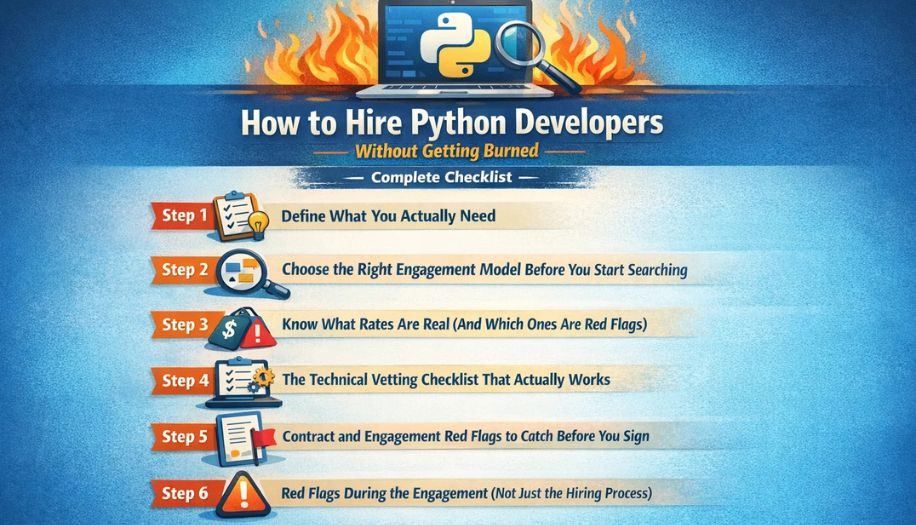
Step 1: Define What You Actually Need (Most Teams Skip This)
The single most avoidable hiring mistake is starting with a job post before you have a clear definition of the problem you need to solve. Hiring for a Python developer is like hiring for someone who knows numbers. It is technically accurate and operationally useless.
Before writing a single job description or shortlisting a single profile, answer these four questions precisely:
What will this developer spend 80% of their time building?
Django REST APIs, FastAPI microservices, data pipelines, ML model deployment, and data analytics dashboards all require meaningfully different Python skill sets. A developer strong in one area can be genuinely weak in another.
What is your timeline and project phase?
An MVP that needs to ship in eight weeks has different requirements than an existing production system that needs ongoing development. The engagement model, seniority level, and hiring channel all follow from this.
Do you need domain expertise alongside technical skill?
Python in healthcare requires knowledge of HL7 standards and HIPAA compliance. Python in fintech demands familiarity with PCI-DSS and audit trails. A generalist placed into a regulated domain without that context creates more risk than they resolve.
What does your current team look like?
A solo founder hiring a first developer needs someone who can operate independently and make architectural decisions. A technical team hiring a fifth engineer needs someone who follows existing patterns and integrates without disruption.
Understanding Python development architecture and frameworks will help you map the right skills to the right problem before you write a single job description.
Step 2: Choose the Right Engagement Model Before You Start Searching
The engagement model you choose shapes every downstream decision: where you search, what you pay, what contracts you sign, and how much risk you carry. Getting this wrong is expensive in both directions.
Freelancer or Independent Contractor
Best for short, well-scoped tasks. The visible rate looks low. The hidden costs include onboarding time, knowledge transfer gaps, unavailability when the project needs iteration, and the coordination overhead of managing an individual who is likely juggling three other clients simultaneously. A developer who disappears mid-project or delivers code only they can maintain is significantly more expensive than their hourly rate suggests.
Dedicated Developer from an Agency
Better for ongoing product development, team extension, or projects that require continuity. A vetted, dedicated Python developer from a reputable agency comes with accountability structures, backup resources if the primary developer becomes unavailable, and an organizational layer that manages HR, payroll, and performance. Rates from India-based agencies typically fall between $20 and $45 per hour, delivering comparable engineering output to US-based equivalents at 50% to 70% of the cost when properly vetted. This is why many growth-stage SaaS companies use Python staff augmentation as their first scaling move before building a full internal team.
Fixed-Price Project Engagement
Appropriate only when scope is extremely well defined upfront. Fixed-price contracts are seductive because they appear to cap your cost exposure. In practice, scope changes trigger formal change orders often priced at higher rates. The vendor who handles scope changes best explains their process in the proposal, not after the contract is signed.
Step 3: Know What Rates Are Real (And Which Ones Are Red Flags)
Python developer rates in 2026 vary more than most hiring managers realize. Geography remains the single biggest cost lever, but experience level, specialization, and engagement model all contribute. Here is what verified market data shows:
Region | Junior ($/hr) | Mid-Level ($/hr) |
United States | $40-$70 | $80-$120 |
Eastern Europe | $20-$35 | $35-$75 |
India (Agency) | $15-$25 | $25-$45 |
Note: Senior developers (6+ years) add $40-$80 per hour to the mid-level range in every region. The U.S. Bureau of Labor Statistics projects 17% growth in software developer roles through 2033, adding nearly 328,000 new positions. Python-specific demand in AI and data roles is growing even faster than that average.
Properly vetted India-based developers at reputable agencies have consistently delivered results comparable to Western equivalents, which is why Indian Python developers increasingly outperform individual freelancers on overall project value.
Step 4: The Technical Vetting Checklist That Actually Works
A good-looking GitHub profile and a confident interview are not a vetting process. Here is a checklist that separates candidates who know Python from candidates who can deliver in production.
Foundation Skills to Verify
Can they explain the difference between shallow copy and deep copy and when each creates bugs in production code?
Do they understand Python's Global Interpreter Lock (GIL) and how it affects multi-threaded applications?
Can they articulate when to use a generator versus a list, and why it matters for memory efficiency in large data sets?
Do they write meaningful unit tests that actually catch regressions, not tests that pass by design?
Framework and Infrastructure Depth
Ask which framework they would choose for a high-throughput async API and why. The reasoning matters as much as the answer.
Can they walk through how they would structure a Django application for a team of five developers maintaining it over two years?
Do they understand containerization, environment management, and deployment pipelines or do they consider those DevOps problems outside their scope?
Domain-Specific Probing
For ML or data roles: Can they explain model versioning, experiment tracking, and the difference between training infrastructure and inference infrastructure?
For API development: Have they built and maintained APIs under real production load? Can they describe a performance bottleneck they identified and resolved?
For data engineering: Can they articulate the trade-offs between batch processing and streaming pipelines in the context of tools like Apache Airflow or Apache Kafka?
The Practical Test That Filters Most Mismatches
Give candidates a take-home task that mirrors real work, not a LeetCode puzzle. A sample task might be: Here is a Django API endpoint with three bugs and one design pattern problem. Identify and fix all four. Explain your reasoning. The quality of explanation is as important as the fix.
Step 5: Contract and Engagement Red Flags to Catch Before You Sign
Technical vetting catches skill gaps. Contract review catches structural risks. Both matter equally. These are the clauses and patterns that lead to the worst outcomes:
No defined scope change process:
Every fixed-price contract without a documented change order procedure will eventually generate a dispute. The vendor who does not address this in their proposal is leaving you to discover their pricing after the work has started, when your negotiating position is weakest.
IP ownership that is ambiguous:
Some freelancer contracts and a surprising number of small agency contracts contain clauses that grant the developer joint ownership of code written during the engagement. All work product must be explicitly assigned to your entity in writing before a single line of code is committed.
No SLA on communication or delivery:
A contract that specifies deliverables but not response time, sprint cadence, or issue resolution timelines creates an accountability vacuum. Response time expectations, meeting cadences, and escalation processes should all be explicit in the agreement.
Vague termination clauses:
If it takes 90 days to exit an underperforming engagement, the cost of a bad hire is exponentially higher than the wasted salary. Termination should be possible with 30 days or less notice, with handoff obligations clearly defined.
Rates that do not hold:
Verbal agreements that differ from written contracts, or written contracts with escalation clauses buried in appendices, are among the most common sources of project cost overruns. Confirm that the rate in the proposal is the rate in the contract.
Step 6: Red Flags During the Engagement (Not Just the Hiring Process)
The hiring process is not the only moment to apply a checklist. The first 30 to 60 days of an engagement reveal the reality of what you hired. Watch for:
Reluctance to share code for review:
A developer who resists code review, requests for progress commits, or regular check-ins is a risk regardless of their credentials.
Deliverables that always just need one more day:
Chronically shifting delivery dates without proactive communication are an early indicator of scope management problems or skill mismatches that will compound over time.
Code that works but nobody else can maintain:
Working code that is undocumented, uses non-standard patterns, or was never reviewed is technical debt that will cost more to unwind than it would have cost to write correctly the first time.
A mismatch between the interview developer and the working developer:
In agency engagements specifically, confirm that the developer presented in the interview is the developer executing the work daily. Bait-and-switch staffing is the most common complaint in offshore development, and the most preventable with contractual language specifying named resources or approval rights for any substitution.
At Acquaint Softtech, across more than 1,300 software projects delivered globally, the engagements that succeed share one pattern: clear scope definition upfront, transparent communication cadences, and a vetting process that tests real production scenarios. The engagements that fail almost universally skip one of those three.
What Acquaint Softtech Offers
Acquaint Softtech is a software development and staff augmentation company based in India with over a decade of experience delivering Python projects across SaaS, healthcare, fintech, logistics, and data engineering. The team has delivered 1,300+ projects for clients across the US, UK, Europe, and Australia.
For companies looking to hire dedicated Python developers, Acquaint Softtech offers:
Vetted mid to senior Python developers at $15 to $45 per hour depending on experience and specialization
Dedicated team models where the developer works exclusively on your project during business hours
Transparent contracts with defined scope change processes, IP assignment to the client, and named resource commitments
Engagement models spanning staff augmentation, dedicated teams, and project-based outsourcing
Domain experience across Django, FastAPI, Flask, ML deployment, data pipelines, and API development
You can hire Python developers with a trial period through Acquaint Softtech, review case studies from comparable industries before engaging, and speak directly with the technical lead who will oversee your project.
Ready to Hire Python Developers the Right Way?
Get vetted Python developers at $15-$45/hr with transparent contracts, named resource commitments, and a 30-day trial period.
Frequently Asked Questions
-
What is the most common mistake companies make when hiring Python developers?
The most frequent mistake is starting the search before defining the actual problem. Companies write a generic job description, hire for Python experience, and end up with a developer whose skills do not map to the specific use case. A precise definition of the work should precede every hiring decision.
-
How do I know if a Python developer's rate is fair in 2026?
Use verified market benchmarks. India-based developers at reputable agencies typically range from $20 to $45 per hour. US-based developers range from $80 to $200 per hour. A quote more than 30 to 40% below market rate for the claimed seniority and location is a warning sign, not a deal.
-
What is the difference between hiring a freelance Python developer and a dedicated developer from an agency?
A freelancer offers flexibility and a low visible rate but typically manages multiple clients simultaneously and creates knowledge transfer risk. A dedicated developer from an established agency works exclusively on your project, comes with organizational accountability, and can be replaced with continuity if a performance issue arises.
-
What technical questions should I ask when vetting a Python developer?
Focus on production scenarios rather than theoretical knowledge. Ask how they would debug a memory leak in a long-running Python process, why they would choose FastAPI over Django for a specific use case, and how they handle database migrations in a live production system. The reasoning behind the answer matters more than the answer itself.
-
Is hiring offshore Python developers from India a reliable option in 2026?
Yes, provided the agency has a documented vetting process, reference projects in comparable domains, and transparent contracts that assign IP to the client and name the specific resource. India produces more than 1.5 million engineering graduates annually and its Python talent pool, particularly in backend development and ML engineering, is among the deepest globally.
-
How long should a Python developer trial period be before committing to a long-term engagement?
A 30-day paid trial on a defined deliverable is the standard for evaluating dedicated developer engagements. The trial should be structured around real work, not a synthetic test, and evaluated on communication quality, code quality under review, and adherence to agreed timelines.
We’re Acquaint Softtech, your technology growth partner. Whether you're building a SaaS product, modernizing enterprise software, or hiring vetted remote developers, we’re built for flexibility and speed. Our official partnerships with Laravel, Statamic, and Bagisto reflect our commitment to excellence, not limitation. We work across stacks, time zones, and industries to bring your tech vision to life.
Table of Contents
Get Started with Acquaint Softtech
- 13+ Years Delivering Software Excellence
- 1300+ Projects Delivered With Precision
- Official Laravel & Laravel News Partner
- Official Statamic Partner
Related Blog

The Complete Guide to Hiring Python Developers in 2026: Rates, Models, Vetting and Red Flags
A complete guide to hiring Python developers in 2026. Compare real hourly rates across India, Eastern Europe and the US, choose the right engagement model, vet candidates correctly, and avoid the red flags that cost companies months of wasted budget.
Acquaint Softtech
March 4, 2026
Python Development in 2026: Architecture Patterns, Frameworks and Real-World Industry Applications
Explore Python backend architecture patterns, framework comparisons (Django vs FastAPI vs Flask), scalability decisions, and real-world Python development use cases across healthcare, FinTech, SaaS, EdTech, and logistics in 2026.
Acquaint Softtech
March 4, 2026
Minimum Budget Required to Start a Python Development Project in 2026
What is the real minimum budget to start a Python development project in 2026? This guide breaks down costs by project type, team model, and engagement structure with verified benchmarks and no vague ranges.
Acquaint Softtech
March 25, 2026Your Project. Our Expertise. Let’s Connect.
Get in touch with our team to discuss your goals and start your journey with vetted developers in 48 hours.