

How Hotel Booking Engines Work: Search, Availability, Pricing, and Reservation Architecture
A hotel booking engine is not a search bar. It is an availability engine, a pricing decision system, a payment pre-authorisation layer, and a channel inventory synchroniser, all running simultaneously. This guide explains every architectural layer and how each one connects in a production system.

Manish Patel

- Hotel founders, GMs, and revenue managers are evaluating whether to build a custom booking engine or replace an underperforming off-the-shelf widget
- CTOs and product leads at hospitality tech companies who need to understand the full architectural scope before committing to a development timeline
- Software engineers working on a hotel booking system for the first time, who need the operational and technical logic explained end-to-end
- Investors and strategic advisors are evaluating a hospitality technology company's technical architecture for scalability and completeness
PAS Framework -- Problem / Agitate / Solution | |
PROBLEM | Hotels lose 15-25% of their revenue to OTA commissions on every booking. The booking engine that should be driving direct revenue instead sits as a thin widget on the website, with no dynamic pricing, no upsell logic, and no real-time channel sync. |
AGITATE | A hotel that processes 1,000 bookings per month at an average rate of $150 and 20% OTA commission pays $30,000 per month in commissions, $360,000 per year, for bookings that a well-built direct booking engine would have captured at a 2 to 3% payment gateway cost. The architecture to fix this is well understood. Most hotels simply have not built it. |
SOLUTION | A hotel booking engine is not a form. It is five connected systems: a search and availability engine, a dynamic pricing layer, a reservation state machine, a payment pre-authorisation handler, and a channel manager sync. This guide explains how each layer works and how to build them correctly. |
As Head of Tech & Client Success at Acquaint Softtech, a software product development company with over 1,300+ projects delivered across 13+ years, I have overseen the technical delivery of hotel booking engines, property management systems, and distribution platforms for hospitality operators across the US, UK, Australia, and UAE.
The hotel booking engine is a complex distributed system, and most legacy setups are still built on outdated 2010 architecture. It is not just a search form, but a system that defines how the hotel booking engine works architecture through real-time availability management, dynamic pricing, reservation state handling, payment pre-authorisation, and channel manager sync to avoid overbooking across platforms like Booking.com, Expedia, and Airbnb. This article explains how these components work together and how Acquaint Softtech builds scalable solutions for modern hospitality businesses.
Most hotel booking engine projects fail when treated as only a front-end system. The visible UI is just a small part, while the real complexity of how the hotel booking engine works lies in availability logic, pricing engine, concurrency control to prevent double bookings, payment pre-authorisation, and real-time OTA sync.
Teams that scope only the visible layer consistently discover the missing architecture mid-project and overspend by 60 to 100% on their original timeline. The dedicated software development teams that build production booking engines design from the invisible layer outward, availability model first, pricing engine second, UI third. The complete guide to hotel technology architecture starts with the Complete Guide to Travel and Hospitality Software Development. This sub-pillar goes deep on the booking engine layer, specifically, the component that determines how much direct revenue a hotel captures and how much it permanently donates to OTA commissions.
What a Hotel Booking Engine Actually Is
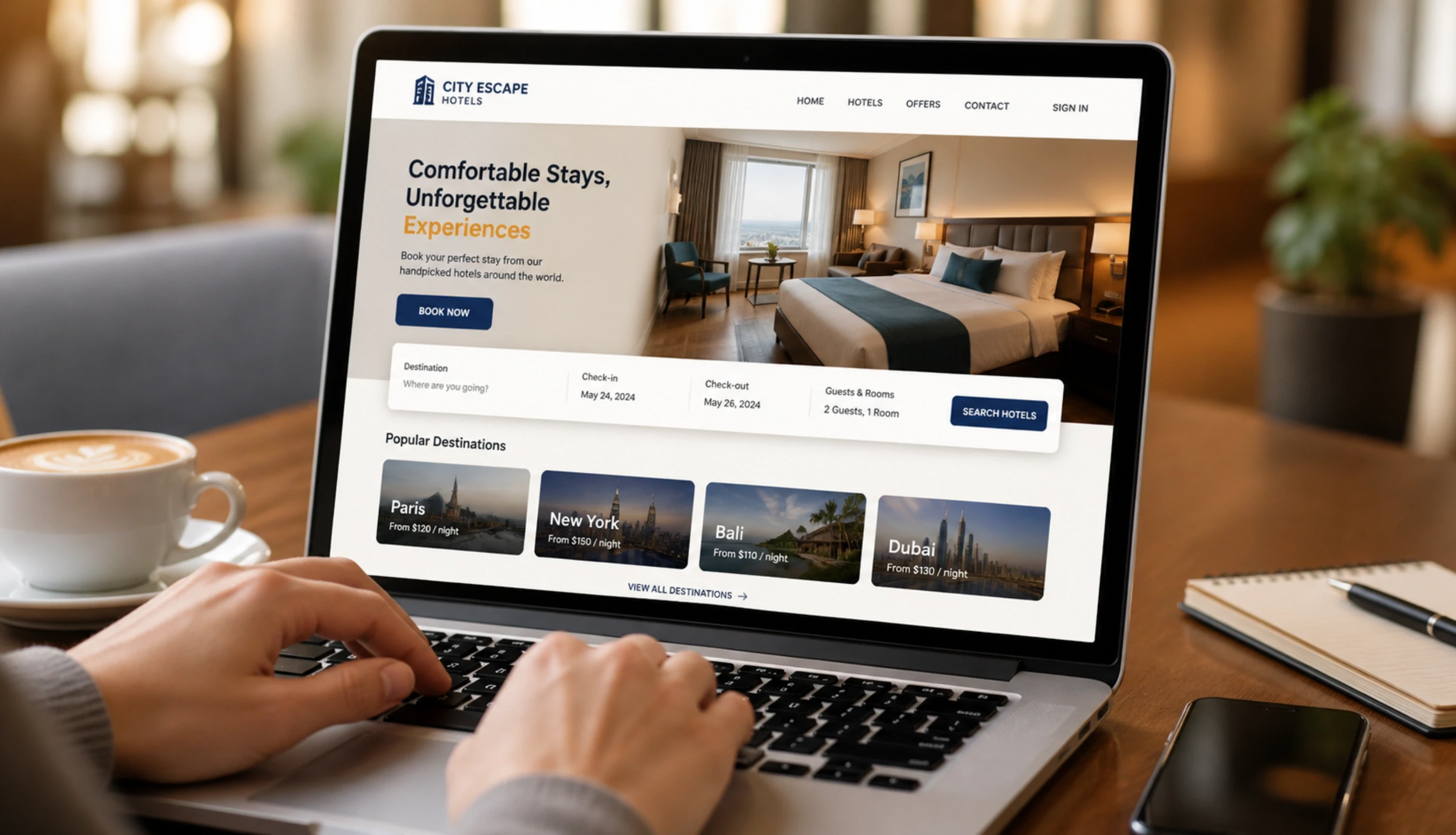
A hotel booking engine is the software component that allows a guest to search room availability, view current rates, select and configure a room type, complete a payment transaction, and receive a confirmed reservation, all in real time, without human intervention. This is the functional definition most people use. The technical definition is more useful for builders.
The definitional problem with 'booking engine' as a term
The travel industry uses 'booking engine' to describe anything from a simple contact form that emails a reservation request to a multi-property, multi-currency real-time reservation system with GDS integration. The functional gap between those two descriptions is enormous. For this guide, a hotel booking engine is a system with three non-negotiable properties: it reads availability in real time from a shared inventory store, it calculates and displays rates according to current demand and restriction rules, and it processes payment and creates a confirmed reservation record atomically, meaning both actions succeed together or neither does.
The five functional layers of a production booking engine
A production hotel booking engine has five main layers: search and availability, pricing, checkout, payment, and confirmation with PMS and channel manager updates. Each layer must work independently; otherwise, scaling and debugging become difficult in a monolithic system. Modern teams also enhance these systems using AI-driven optimization and automation, such as hiring AI ML engineers to improve pricing, demand prediction, and fraud detection.
The distinction from a channel manager
A channel manager distributes room availability outward to Booking.com, Expedia, Airbnb, and other OTAs. A booking engine receives reservation intent from the hotel's own website or app and converts it into a confirmed booking. The two systems connect at the inventory layer; every confirmed booking on either side reduces shared inventory.
What the booking engine is not
A booking engine is not a payment gateway. It uses one (Stripe, Adyen, or a local processor) but is not one itself. It is not a PMS. It creates reservations that the PMS then manages. It is not a channel manager. It synchronises with one but operates independently. These distinctions matter because teams that conflate the systems end up with architectural dependencies that prevent each component from being upgraded, replaced, or scaled without touching the others.
The Availability Engine: How Room Search Works Under the Hood
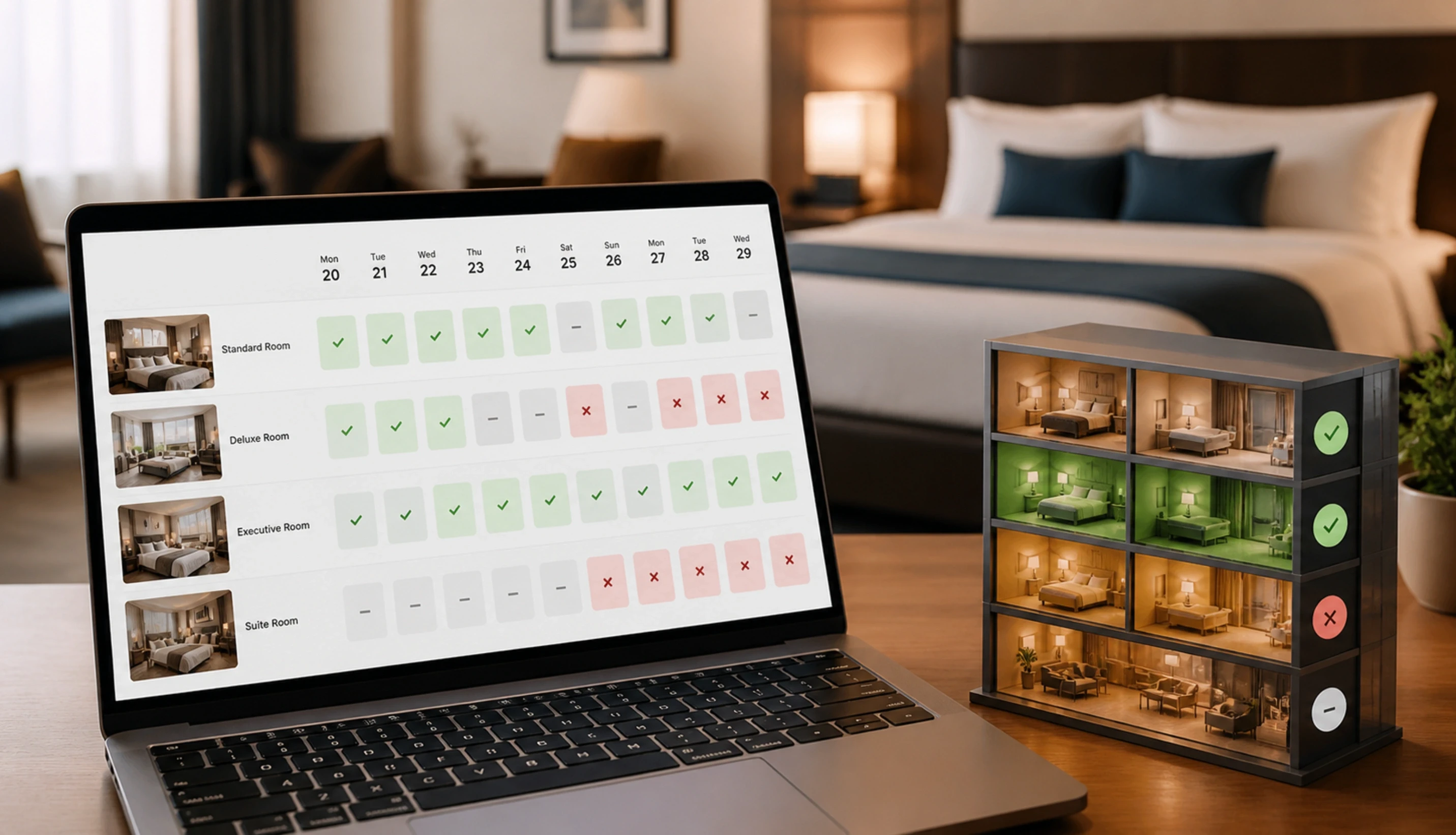
The availability engine is the most performance-sensitive and correctness-critical component of a hotel booking engine. Its job is to answer one question accurately, under concurrent load, in under 200 milliseconds: which room types have at least one available unit for the requested check-in to check-out date range? Acquaint Softtech's dedicated Laravel development team uses a specific database design pattern for availability that eliminates race conditions under high-concurrency peak season traffic.
The inventory data model
The foundational data model for hotel availability is a daily inventory table: one row per room type per date, with a count of available units. A 50-room property with 10 room types and a 365-day booking horizon has 3,650 rows in this table. A search for available rooms over a 3-night stay executes a query that finds all room types where the minimum available unit count across all nights in the stay range is greater than zero. This sounds simple. The complexity is in maintaining the accuracy of that unit count under concurrent booking sessions.
Race condition prevention: row-level locking
The race condition problem is specific: two guests searching for the last available room on the same date simultaneously both see availability, both proceed to checkout, and both complete payment. The hotel is now double-booked. The standard engineering solution is row-level locking with PostgreSQL's SELECT FOR UPDATE combined with a reservation hold system.
When Guest A selects a room, the system creates a temporary hold record and acquires a row lock on that inventory row. Guest B's search will see the hold and exclude that room type from results for the hold duration (typically 12 to 15 minutes). If Guest A completes payment, the hold becomes a confirmed reservation. If Guest A abandons checkout, the hold expires and the room returns to available inventory.
Caching strategy for search performance
In a hotel reservation system, raw database queries on availability for every search do not scale well. While a single hotel may handle this, large platforms or OTAs with high traffic require a different approach. The system separates read and write paths: a cached availability layer using Redis or Memcached serves search results and is refreshed every 60–120 seconds, while the live database is only used at checkout when a booking hold is created. This reduces database load by up to 95% while ensuring accurate inventory at the time of reservation.
Minimum stay, stop-sell, and restriction enforcement
Hotel availability is not binary. A room may have physical units available but be restricted by revenue management rules: minimum stay of 3 nights over a peak weekend, stop-sell for a specific date that is part of an event package, closed-to-arrival on a specific day, or maximum booking window. These restrictions are stored as a separate restriction table joined to the availability query. The availability engine returns not just a yes/no answer but the applicable rate plan IDs, the minimum stay requirement, and any arrival or departure restrictions, all of which feed the pricing in the next layer.
Need an Availability Engine Built to Handle Peak Season Load?
Acquaint Softtech's hotel technology team has built availability engines for properties from 20 rooms to multi-property portfolios of 500+. We deliver an architecture document and team structure within 48 hours. You review the design and interview the lead developer before any code is written.
Dynamic Pricing: How Hotel Rates Are Calculated in Real Time
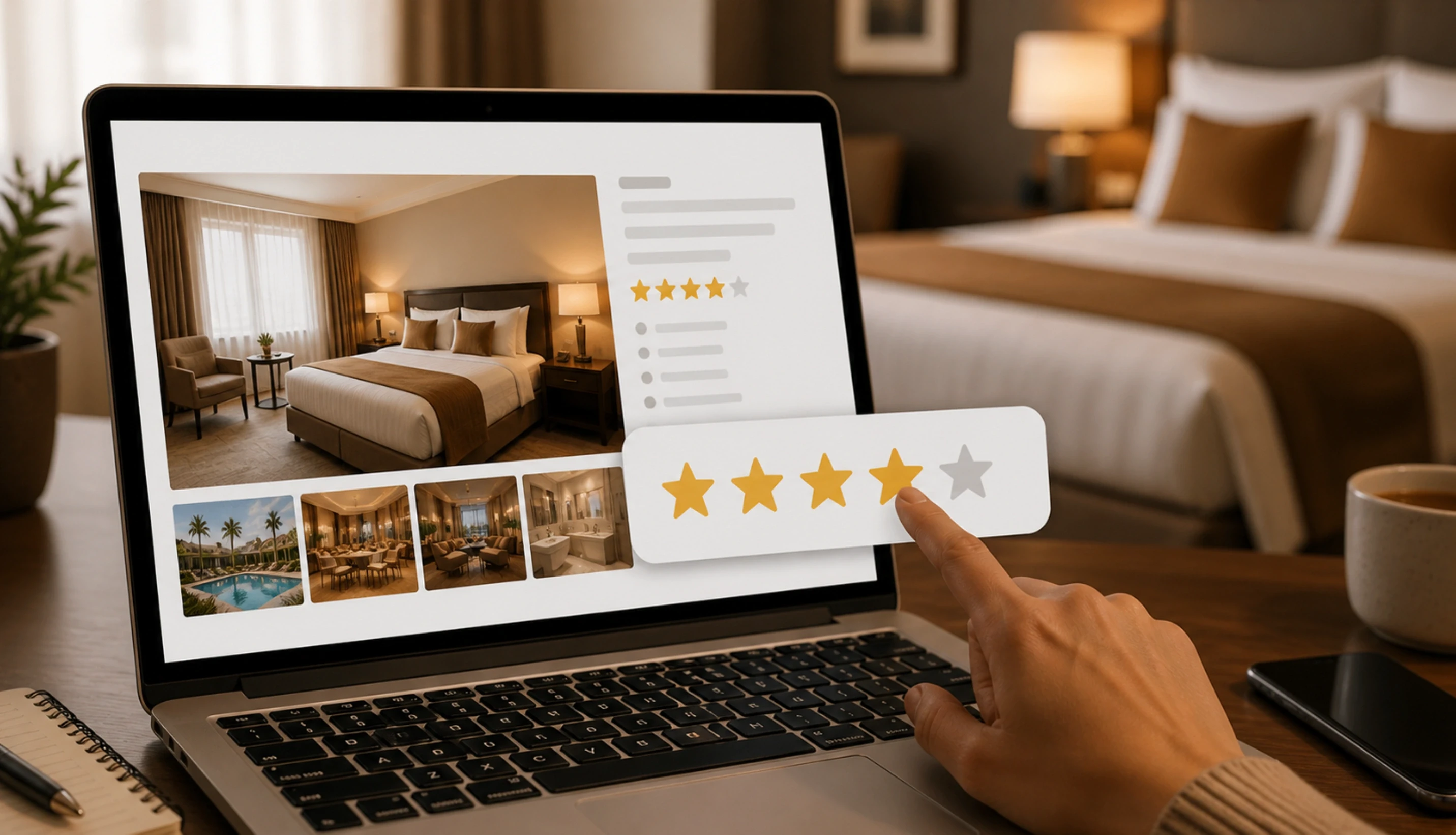
The pricing engine is what separates a modern hotel booking engine from a static rate sheet with a booking form. A static system displays the same rate regardless of demand, booking lead time, remaining availability, or competitor pricing. A dynamic pricing engine recalculates the displayed rate in real time based on a configurable set of signals and rules. This is where most hotels leave significant revenue on the table.
The BAR (Best Available Rate) is the pricing baseline
The BAR is the hotel's non-discounted published rate for a room type on a given date. It is the ceiling: no rate plan should display a higher rate than the BAR except for premium packages with clear added value. The BAR itself is not static; it is set by the revenue management function (either manually or by a Revenue Management System) and updated periodically. The booking engine reads the current BAR as its pricing starting point and then applies all subsequent modifications.
Rate plan logic and discount rules
Rate plans are rules that modify the BAR for specific conditions: a 10% early bird discount for bookings made 30+ days in advance, a 15% discount for minimum 5-night stays, a corporate rate for verified company codes, a non-refundable discount for guests willing to accept stricter cancellation terms, and a loyalty rate for registered members. The pricing engine evaluates all applicable rate plans for the current session (guest type, booking lead time, stay length) and returns the best qualifying rate. Rate plan evaluation must execute in under 20 milliseconds to avoid perceptible latency on the search results page.
Demand-based dynamic pricing rules
Beyond static rate plans, a demand-aware pricing engine adjusts the BAR itself based on real-time signals: occupancy percentage for the target dates (high occupancy triggers a rate increase), remaining inventory count (last 3 rooms available triggers a scarcity premium), booking pace (reservations arriving faster than historical average triggers an uplift), and booking window (close-in bookings for high-demand dates command a premium). These rules are configurable by the revenue manager and executed as a pricing decision tree that modifies the base rate before rate plan discounts are applied.
Integration with Revenue Management Systems
Enterprise hotels and hotel groups typically use a dedicated RMS (Revenue Management System), DeaS, Duetto, or a custom-built system that sets rates programmatically based on demand forecasts, competitor rate data, and historical booking patterns. The booking engine integrates with the RMS via API: the RMS pushes rate updates to the booking engine's rate table, and the booking engine reads current rates from that table rather than calculating them internally.
This architecture allows the revenue management function to operate independently of the booking engine's deployment schedule. Acquaint Softtech's AI development services team builds custom dynamic pricing engines for hotel groups that do not want to pay the $30,000 to $80,000 per year licensing cost of enterprise RMS platforms.
Displaying rates correctly: taxes, fees, and currency
The rate displayed to a guest at the search stage is the starting point for trust or abandonment. Hotels that display the BAR on the search results page and add taxes, resort fees, and service charges at the payment step see abandonment rates 20 to 35% higher than hotels that display the total inclusive rate from the first interaction.
The pricing engine must apply applicable tax rates by jurisdiction, add any mandatory fees (resort fee, city tax, service charge), and display the total in the guest's local currency using a live exchange rate feed. Rate display logic is a compliance issue in markets like the EU, where total price display is legally required.
The Reservation State Machine: From Search to Confirmed Booking
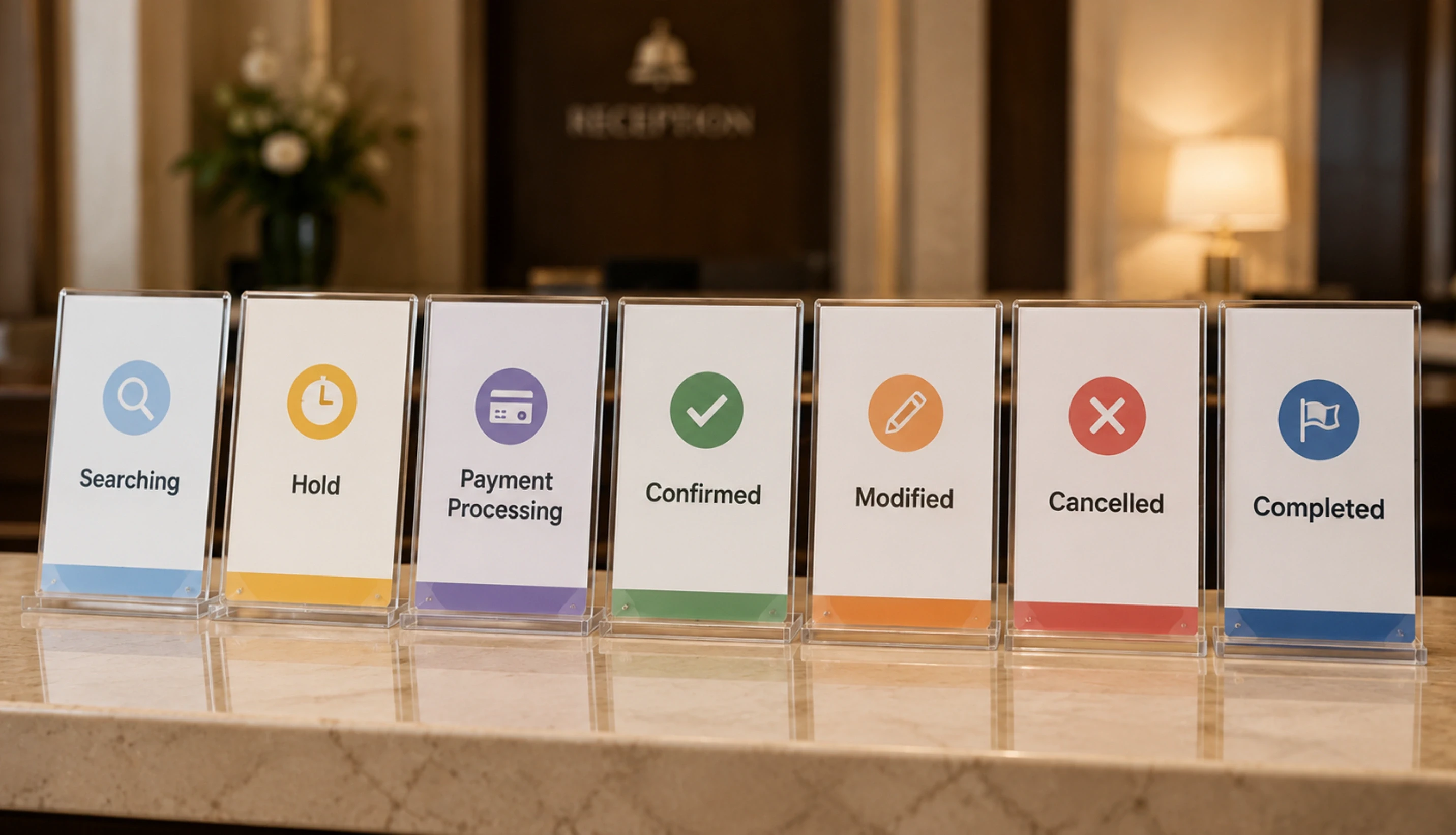
A hotel reservation is not a transaction. It is a state machine with a defined set of states, valid transitions between states, and side effects that trigger on each transition. Teams that implement reservations as a simple database record with a status field create systems that cannot handle cancellations, modifications, no-show processing, or overbooking resolution correctly. The reservation state machine is the architectural backbone that makes all downstream operations reliable.
The 7 reservation states
A production hotel booking engine manages reservations through these states:
Searching: The guest has submitted a search query. No inventory is held. No record exists.
Hold: Guest has selected a room and entered checkout. A temporary inventory hold is placed. The hold expires in 12 to 15 minutes if not converted.
Payment Processing: The guest has submitted payment details. Pre-authorisation is in flight. Inventory hold remains active.
Confirmed: Pre-authorisation succeeded. The reservation record is created. PMS notified. The channel manager's inventory has reduced. Confirmation email queued.
Modified: Guest has changed dates, room type, or occupancy after confirmation. Rate recalculated. Inventory delta adjusted. PMS updated.
Cancelled: The guest or hotel has cancelled. Pre-authorisation released or cancellation charge applied per policy. PMS notified. Inventory restored.
Completed: Guest has checked out. Final payment captured (if deferred capture model). Post-stay communication triggered.
Idempotent event handling
Every state transition must be idempotent: if the same transition is triggered twice (a common occurrence when payment webhooks retry on network failure), the second trigger must not create a duplicate reservation or a double charge. Idempotency is achieved by assigning a unique idempotency key to every transition request and checking for an existing record with that key before processing. This single architectural pattern prevents most of the double-booking and double-charge incidents that damage hotel booking systems in production.
Atomic payment and reservation creation
The most critical transition in the state machine is from Payment Processing to Confirmed. This transition must be atomic: payment success and reservation record creation must occur as a single unit. If payment succeeds but the reservation write fails (due to a database timeout, for example), the guest has been charged for a room that does not exist in the system. The engineering solution is a database transaction that wraps the reservation write and triggers a compensating payment void on transaction failure. This is a standard reliability pattern, also emphasised in software development outsourcing engagements, where Acquaint Softtech’s software product development team implements this using Laravel’s database transaction wrapper along with an event-sourced reservation record to ensure consistency across payment and booking states.
Cancellation policy enforcement
Cancellation policies are rate-plan-specific rules that determine what financial penalty (if any) applies when a guest cancels. Free cancellation up to 48 hours before arrival, 1-night penalty between 48 and 24 hours, non-refundable after 24 hours; these are the most common configurations.
The reservation state machine enforces the correct policy by evaluating the cancellation timestamp against the rate plan's policy rules at the moment of cancellation. The cancellation and refund engine guide covers the full architecture of the cancellation processing layer.
Channel Manager Integration: Preventing Overbooking Across OTAs
A hotel that distributes rooms across Booking.com, Expedia, Airbnb, and its own website has four separate sales channels simultaneously selling from the same physical inventory. Without a correctly architected channel manager integration, a room booked on Booking.com at 2:14 PM can still appear available on the hotel's own website at 2:15 PM. By 2:16 PM, both guests have confirmed reservations for the same room. This is the overbooking problem. The channel manager integration guide covers the full integration architecture. The key points relevant to booking engine design are below.
The two integration patterns: push vs pull
Channel manager integrations use two patterns. In push mode, the booking engine pushes rate and availability updates to the channel manager on every inventory change. The channel manager then distributes those updates to connected OTAs. In pull mode, the channel manager periodically queries the booking engine for current availability. Push mode is faster and more accurate -- OTAs receive inventory updates within 60 to 90 seconds of a booking event. Pull mode introduces lag proportional to the polling interval, typically 5 to 30 minutes, which creates overbooking windows during high-demand periods. Production hotel booking engines use push mode with a fallback pull for error recovery.
Inbound OTA reservation processing
When a guest books on Booking.com, Booking.com sends a reservation notification to the channel manager via webhook or API. The channel manager forwards this to the hotel's booking engine, which processes it as an inbound reservation event. This event must: validate that inventory is still available (a race condition window exists between the OTA accepting payment and the booking engine receiving the notification), create a confirmed reservation record in the hotel's system, reduce inventory in the shared availability store, notify the PMS, and send the hotel's own confirmation to the guest profile. The entire sequence must complete in under 5 seconds to meet OTA API response time requirements.
The inventory count model: allocation vs shared pool
Hotels can manage their channel inventory in two models. In the allocation model, each channel is assigned a fixed number of rooms. Booking.com gets 10 rooms, Expedia gets 8 rooms, and the direct channel gets 12 rooms. Overbooking is impossible within a channel, but rooms go unsold when one channel's allocation fills while another has empty rooms. In the shared pool model, all channels draw from a single inventory count. Maximum revenue yield but higher overbooking risk during the processing window between a booking event and the inventory update propagating to all channels. Most production booking engines implement the shared pool model with a buffer: the displayed availability count is 1 to 2 rooms lower than actual availability, providing an overbooking safety margin.
DevOps and reliability requirements
The channel manager integration is a high-criticality, real-time system. An outage in the integration layer during peak booking hours means reservations are confirmed on OTAs that do not exist in the hotel's system -overbookings accumulate silently until the integration recovers. The reliability architecture requires: health monitoring with 60-second interval checks, automatic reconnection with exponential backoff on connection failure, a dead letter queue for failed reservation events with manual review alerting, and a reconciliation job that runs every 4 hours, comparing OTA booking feeds against internal reservation records. Acquaint Softtech's DevOps engineering team implements this reliability stack as a standard component of every channel manager integration delivery.
Hotel Booking Engine vs OTA: The Structural Comparison
The decision to invest in a custom booking engine is ultimately a commission vs build-cost calculation. But the structural differences between owning a booking engine and relying on OTAs extend well beyond the commission rate. The table below maps each operational dimension. For the full direct booking strategy, the hotel direct booking strategy guide covers the full conversion optimisation layer on top of the technical architecture.
Dimension | Hotel Booking Engine | OTA (Booking.com / Expedia) |
Inventory ownership | Hotel controls all inventory, dates, rates, and restrictions directly. | OTA receives a feed; the hotel has no real-time direct control over how rates display. |
Commission cost | Zero commission on direct bookings. Payment gateway fee only (1.5 to 3%). | 15 to 25% commission per booking, depending on agreement tier. |
Guest data | Hotel owns full guest profile: email, preferences, stay history, loyalty status. | OTA owns the transaction data. The hotel often receives masked email addresses. |
Rate flexibility | Hotel sets BAR (Best Available Rate), packages, promotions, and stop-sells directly. | Rate changes propagate via the channel manager with a 2 to 15-minute lag. |
Upsell capability | Upsell modules (room upgrades, packages, add-ons) can be injected at any checkout step. | Limited to the OTA's own upsell framework. The hotel cannot customise the checkout path. |
Technology investment | $18,000 to $65,000 to build. Long-term ROI through direct booking growth. | No build cost. But every booking permanently transfers commission revenue to the OTA. |
Best fit | Independent hotels and groups with 500+ direct bookings per month or a loyalty programme. | Launch phase or markets where brand awareness does not yet drive organic direct search. |
The break-even calculation for most hotels is straightforward. A booking engine that costs $35,000 to build and converts 300 additional direct bookings per month at a $150 average rate pays for itself in under 8 months in commission savings alone. The compounding benefit, guest data ownership, loyalty programme eligibility, upsell capability, and repeat booking through the direct channel are not captured in the break-even calculation but consistently exceed it in practice. Based on Acquaint Softtech's delivery data across 1,300+ projects, hospitality technology clients who invest in a custom booking engine reduce their total OTA commission spend by 25 to 40% within the first 18 months of operation.
What Does a Hotel Booking Engine Cost to Build in 2026?
The cost of a hotel booking engine depends on three variables: the module scope at launch, the number of channels requiring integration, and whether a custom dynamic pricing engine is required or a manual rate management interface is sufficient for the first version. Before finalizing your integration strategy, consider these channel manager tips to ensure your technology stack aligns with your operational needs The table below maps Acquaint Softtech's current delivery rates to three engagement tiers.
Engagement Tier | Build Cost (USD) | Monthly Team Cost | Equivalent Agency / In-House | Timeline |
Standalone Booking Engine (core search + booking + payment) | $18,000 to $35,000 total project | $9,000 to $14,000/month (2 developers) | $35,000 to $55,000 (US agency rate) | 10 to 14 weeks |
Full Booking Engine + Channel Mgr (3 to 4 developers) | $38,000 to $65,000 total project | $18,000 to $28,000/month (3-4 developers) | $70,000 to $110,000 (US agency rate) | 14 to 20 weeks |
Enterprise Multi-Property Engine (5+ developers) | $75,000 to $140,000 total project | $32,000 to $50,000/month (5-6 developers) | $140,000 to $220,000 (US agency rate) | 20 to 30 weeks |
What the monthly team rate includes at Acquaint Softtech:
Full-stack development team (Laravel or Python backend, Next.js or React frontend, React Native mobile)
Availability engine with row-level concurrency controls and Redis caching layer
Channel manager integration (Booking.com, Expedia, Airbnb -- two-way push/pull)
Payment gateway integration with pre-authorisation and configurable capture timing
Reservation state machine with full 7-state lifecycle and cancellation policy enforcement
QA (Quality Assurance) and load testing against peak season traffic scenarios
AWS deployment with an auto-scaling group configured for flash sale traffic spikes
Developer replacement at no additional cost if any engineer leaves during the engagement
The rate the client pays is the rate. No employer overhead, no recruitment fees, no benefits administration. Based on Acquaint Softtech's delivery data, hotel technology clients save 40% on total development cost compared to building the equivalent team at US or UK market rates.
For hotel startups validating the direct booking concept before committing to a full build, Acquaint Softtech's MVP development services deliver a production-ready booking engine, coravailability search, rate display, basic checkout, Stripe integration, in 8 to 10 weeks at a small engagement rate.
Ready to See a Hotel Booking Engine Cost Estimate for Your Scope?
Share your property count, required channels, and whether dynamic pricing is in scope for version one. Acquaint Softtech delivers a team structure, developer profiles, and a fixed-scope cost estimate within 48 hours. You interview the lead developer before any engagement starts.
The 5 Questions That Tell You Whether to Build a Custom Booking Engine

These five questions filter the build-vs-buy decision for hotel booking engines. If you use a third-party booking widget (SynXis, Bookassist, RoomRaccoon), these questions tell you when that widget has reached its capability ceiling. If you are building a hospitality technology product, they tell you the minimum scope needed for market viability. The product discovery workshop Acquaint Softtech runs before every booking engine engagement converts the Yes answers into a specific module scope and architecture plan.
Are you losing more than 15% of your revenue to OTA commissions on bookings your direct channel should be capturing, and wondering how much is a hotel worth when direct booking revenue and guest data ownership are factored in?
Yes: The commission bleed is financing the custom build. A booking engine that costs $35,000 and shifts 300 bookings per month from OTA to direct at a $150 average rate pays for itself in 7 to 8 months. No: Your OTA mix is appropriate for your current booking volume. Build when the commission cost exceeds the build cost on a 12-month horizon.
Does your current booking widget prevent you from implementing rate plans, packages, or upsell logic the way your revenue model requires?
Yes: The capability ceiling of third-party widgets is a genuine constraint on revenue strategy. A custom engine gives you complete control over rate plan logic, package bundling, upsell sequencing, and cancellation policy configuration. No: Your current rate structure fits within the widget's capabilities. The ROI case for a custom build requires a revenue trigger beyond the capability argument.
Is guest data ownership a strategic priority - loyalty programme, personalised communication, repeat booking optimisation?
Yes: OTAs provide masked email addresses and minimal guest data on booked guests. A custom booking engine captures full guest profiles at the point of booking: real email, preferences, stay history, and loyalty eligibility. Every direct booking compounds the guest data asset. No: If repeat booking and loyalty are not in your current commercial strategy, guest data ownership is not yet a trigger. Build when the strategy requires it.
Do you operate or plan to operate multiple properties that need centralised inventory and rate management?
Yes: Multi-property booking engines require a centralised inventory model, a property selector in the search flow, cross-property availability display, and chain-level rate management. No third-party widget handles this at the architectural depth required for a portfolio above 3 properties. A custom build is the only viable path. No: A single-property widget is appropriate. The multi-property booking engine guide covers the specific architecture required when you reach multi-property scale.
Is the booking engine itself a revenue-generating product, or are you building for other hotels, not just your own?
Yes: If you are building a hospitality technology product, a SaaS booking engine, a white-label booking platform, or a multi-tenant reservation system, a custom build is not optional. Your differentiation is the engine itself. Acquaint Softtech's staff augmentation services allow hospitality tech startups to embed pre-vetted engineers with booking engine domain knowledge into their existing team at pace. No: You are building for your own operation only. The decision rests on questions 1 through 4.
Technology Stack: What Acquaint Softtech Uses to Build Hotel Booking Engines
The table below documents the specific technology decisions Acquaint Softtech makes for hotel booking engine projects in 2026 and the reasoning behind each choice. These are not recommendations for every team -- they reflect the stack that Acquaint Softtech has tested in production across multiple hotel booking engine deployments. The Python development team and the MERN stack team are both options, depending on the client's existing infrastructure and team preferences.
Layer | Recommended Technology | Why |
Backend API | Laravel (PHP) or Django (Python) | Event-driven architecture maps to the booking state machine. Laravel is Acquaint Softtech's Official Partner stack. |
Availability engine | PostgreSQL with row-level locking + Redis cache | Row-level locking prevents double-booking under concurrent sessions. Redis serves cached availability in under 50ms. |
Search/filtering | Elasticsearch with geo-distance queries | Handles faceted search (amenity filters, map radius, price range) at sub-100ms response time for large property sets. |
Frontend | Next.js (SSR for SEO) or React SPA | Next.js server-side rendering ensures search results are indexed. React SPA for logged-in booking flow where SEO is not needed. |
Mobile app | React Native | Shares the same booking API. Enables native Apple Pay / Google Pay and biometric checkout without a separate backend. |
Payment processing | Stripe or Adyen with pre-authorisation | Pre-auth holds funds without charging. Capture happens at check-in or a configurable time before arrival. |
Channel manager sync | Webhooks + idempotent event queue | Incoming OTA reservation events processed idempotently prevent double-bookings during high-concurrency periods. |
Acquaint Softtech is an Official Laravel Partner, one of fewer than 20 globally, which means every Laravel-backed hotel booking engine engagement carries partner-level access to framework support, security updates, and pre-release documentation. The decision to use Laravel over other PHP frameworks for hotel booking systems is driven by its event-driven architecture (the Eloquent event system maps directly to the reservation state machine), its built-in queue system (reservation confirmation events and email sequences are dispatched asynchronously), and its database transaction support (the atomic payment and reservation creation pattern).
Answered Yes to 3 or More Decision Questions? Let Acquaint Softtech Scope Your Booking Engine.
Share your property count, current OTA commission spend, and integration requirements. Acquaint Softtech delivers a booking engine scope document, team structure, and developer profiles within 48 hours. You interview the proposed lead developer before any engagement starts. No retainers, no minimums on the first conversation.
Frequently Asked Questions
-
What is a hotel booking engine, and how does it differ from an OTA?
A hotel booking engine allows guests to search availability, view room rates, and book directly through a hotel’s website or app instead of relying on third party OTAs. It gives hotels better control over bookings, guest data, pricing, and the overall booking experience. A complete booking engine also includes reservation management, payment processing, pricing logic, and channel manager integrations.
-
How does room availability work in a hotel booking engine?
Room availability is tracked through a daily inventory table. To avoid double booking when multiple users select the last room, the system places a temporary hold (12–15 minutes) with row-level locking. If payment is completed, it becomes a confirmed booking; otherwise, the hold expires, and the room is released back to inventory.
-
How are hotel rates calculated dynamically?
Hotel pricing is managed by a pricing engine that builds on a base rate (BAR) using layered rules. It applies discounts like early booking, corporate, or loyalty rates, then adjusts prices based on demand, occupancy, and booking speed. It also enforces restrictions like minimum stay, closed dates, and stop-sell rules. In larger setups, a Revenue Management System (RMS) updates rates via API, separating pricing logic from the booking engine.
-
How much does a hotel booking engine cost to build in 2026?
Booking Engine Type
Estimated Cost
Timeline
Standalone Booking Engine
$18K–$35K
10–14 weeks
Advanced Multi Property System
$38K–$65K
14–20 weeks
Enterprise Grade Platform
$75K–$140K
20–30 weeks
These estimates are based on Acquaint Softtech’s offshore delivery model, which is typically lower in cost compared to US and UK agencies.
-
How long does it take to build a hotel booking engine?
A basic hotel booking engine usually takes 10 to 12 weeks, while a full production system with channel manager integration and dynamic pricing takes around 14 to 20 weeks. The biggest development challenges are typically payment gateway and channel manager integrations, not the frontend design.
-
What technology stack is best for building a hotel booking engine?
Acquaint Softtech builds hotel booking engines using Laravel or Django for backend development, PostgreSQL and Redis for inventory management, and React or Next.js for web frontends with React Native for mobile apps. Laravel is commonly preferred for handling booking workflows, payment transactions, and event driven reservation systems. Channel manager integrations are managed through webhook based event queues to prevent duplicate bookings.
-
How does a booking engine prevent overbooking?
Overbooking prevention in a hotel booking engine depends on three key layers: availability buffers during search, database level inventory locking during checkout, and real time channel manager synchronization across OTAs after booking confirmation.
-
What happens to my booking engine code if the engagement with Acquaint Softtech ends?
Every Acquaint Softtech engagement gives the client full ownership of the codebase, infrastructure configuration, database schema, and API documentation. There is no vendor lock in or ongoing access fee, and clients can independently manage the platform after delivery. Post launch support and maintenance services are available optionally for upgrades, bug fixes, and new features.
I lead technology and client success at Acquaint Softtech with one goal in mind. Deliver work that feels personal, reliable, and worthy of long term trust. I stay close to both our clients and our developers to make sure every project moves with clarity, quality, and accountability.
Table of Contents
Get Started with Acquaint Softtech
- 13+ Years Delivering Software Excellence
- 1300+ Projects Delivered With Precision
- Official Laravel & Laravel News Partner
- Official Statamic Partner
Related Blog
The Complete Guide to Travel & Hospitality Software Development in 2026
Most travel and hospitality platforms fail not because the idea was wrong, but because the technology architecture was underplanned. This guide explains every platform type, cost tier, and technology decision your team needs to make before writing the first line of code.

Acquaint Softtech
May 6, 2026
How to Create a Travel Website that Inspires Wanderlust
Discover the step-by-step process of creating a travel website that inspires wanderlust. The tips given in this blog are tried and tested to get success.

Mukesh Ram
August 23, 2023.webp "The Complete Guide to FinTech Software Development in 2026")
The Complete Guide to FinTech Software Development in 2026
Complete guide to fintech software development 2026: all five verticals, compliance architecture, real build sequences, AI capabilities, and fintech development cost, from 1,300+ delivered projects.
Acquaint Softtech
May 6, 2026India (Head Office)
203/204, Shapath-II, Near Silver Leaf Hotel, Opp. Rajpath Club, SG Highway, Ahmedabad-380054, Gujarat
USA
7838 Camino Cielo St, Highland, CA 92346
UK
The Powerhouse, 21 Woodthorpe Road, Ashford, England, TW15 2RP
New Zealand
42 Exler Place, Avondale, Auckland 0600, New Zealand
Canada
141 Skyview Bay NE , Calgary, Alberta, T3N 2K6