

The Complete Guide to Travel & Hospitality Software Development in 2026
Most travel and hospitality platforms fail not because the idea was wrong, but because the technology architecture was underplanned. This guide explains every platform type, cost tier, and technology decision your team needs to make before writing the first line of code.

Acquaint Softtech
PROBLEM
Travel platforms fail because teams misjudge architecture. 60% of custom travel builds under-deliver at launch due to wrong tech-stack choices, missing real-time sync, or scope misalignment between business model and platform type.
AGITATE
The cost of a wrong architectural decision in travel software is a complete rewrite at scale. Booking engines that collapse under peak load. OTAs that are overbooking because channel sync fails. Revenue systems built on static pricing that leave 30% of yield on the table. Every wrong call costs real revenue.
SOLUTION
This guide gives CTOs, founders, and product leaders a complete architecture reference for every major travel and hospitality platform type in 2026, with costs, tech stacks, decision frameworks, and real engineering context from 1,300+ projects delivered.
As a software development partner with over 1,300 projects delivered across 13 years, Acquaint Softtech has worked with travel marketplaces, hotel chains, OTA startups, and vacation rental platforms across the US, UK, Australia, and the UAE. The challenge for most product teams in 2026 is not the shortage of travel technology options; it is the shortage of clarity about which platform type fits which business model, what each system component actually does at an engineering level, and how much it costs to build correctly with a team that has done it before.
This travel hospitality software development guide 2026 is designed to solve that gap by bringing everything into one place. It delivers full clarity on platform types, booking engine architecture, OTA data flows, property management systems, revenue management AI, technology stack decisions, 2026 cost benchmarks, and a 5-question decision framework that maps your business model to the right first build.

- Founders and product leads building a travel marketplace, OTA, or hotel booking platform for the first time who need a complete systems overview before starting development.
- CTOs and engineering managers are evaluating whether to build a custom booking engine or integrate with an existing SaaS solution, and need a technology comparison grounded in real architecture.
- Hospitality operators whose current PMS or booking software has outgrown its original design and who need to understand migration paths and realistic build costs.
- Agencies and transformation leads taking a travel or hospitality client from a legacy reservation system to a cloud-native, API-first architecture in 2026.
The travel and hospitality software market includes different platform types with unique architectures, not just one “booking platform.” A hotel system, OTA, and rental marketplace all work differently, so choosing the right type before development is important to avoid scaling issues and extra costs. This guide explains each option and helps in making the right decision. Before exploring individual platform types, teams should review Acquaint Softtech's approach to end-to-end software product development, which covers the discovery, architecture, and phased delivery model that every travel platform project should begin with.
What Is Travel & Hospitality Software? The Full Ecosystem Defined
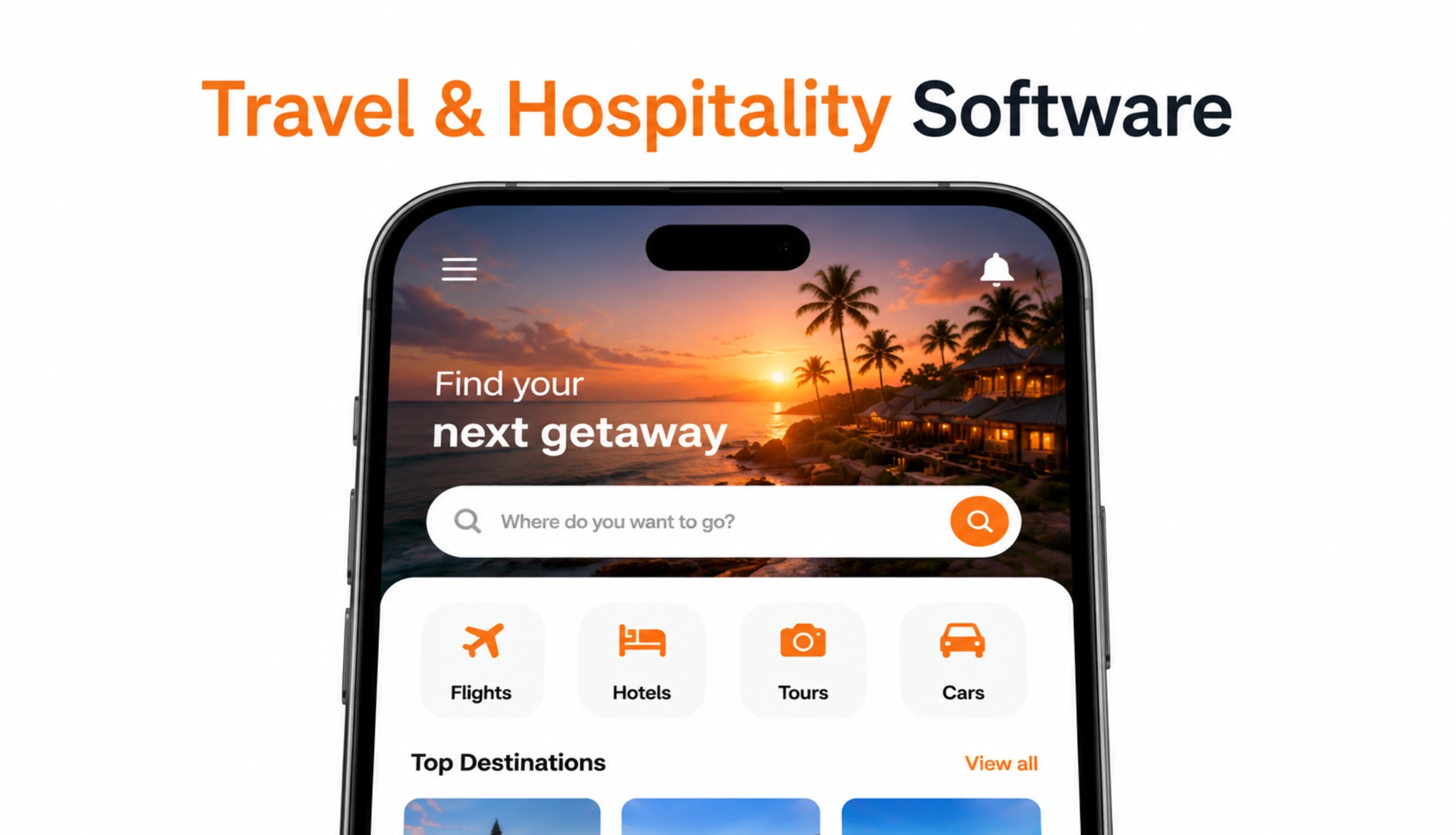
Travel and hospitality software is the category of digital systems that manage the search, booking, pricing, inventory, payment, and operational coordination of travel products: hotel rooms, flights, car rentals, vacation packages, tours, activities, and restaurant reservations. The ecosystem spans consumer-facing interfaces, supplier-facing management tools, and the middleware that connects them in real time.
The defining characteristic of travel software, compared to most other software verticals, is its dependency on real-time data synchronization. Inventory availability, pricing, and booking status must be consistent across multiple distribution channels simultaneously. A room sold on Booking.com must be immediately unavailable on Expedia, on the hotel's own website, and in the property management system's front desk view. Failure to achieve this synchronization produces overbooking, revenue loss, and guest complaints — the three most expensive outcomes in hospitality operations.
The Core Layers of the Travel Technology Stack
Distribution layer. Where travel products are sold. This includes OTA websites and apps, hotel direct booking engines, metasearch platforms (Google Hotels, Trivago, Kayak), and GDS (Global Distribution Systems: Sabre, Amadeus, Travelport). Each channel requires a different integration format and pricing logic.
Inventory management layer. Where availability is controlled. Hotel rooms, airline seats, car rental units, and tour slots each have their own inventory model. A channel manager reads from the PMS and distributes updated availability to all connected distribution channels within seconds of a booking confirmation.
Pricing and revenue management layer. Where dynamic pricing happens. Hotel room rates change based on occupancy, day of the week, competitive rates, lead time, and event demand. Airlines use complex yield management algorithms. Even tour operators adjust pricing based on demand signals. This layer is where poorly designed systems leave the most measurable revenue on the table.
Operations layer. The back-of-house software: property management systems for hotels, crew scheduling for airlines, fleet management for car rentals. These systems run the operational logistics that make the travel product deliverable after the booking is made.
Guest experience layer. Pre-arrival communication, in-stay apps, loyalty programs, and post-stay feedback systems. In 2026, this layer has become a significant competitive differentiator as travelers expect WhatsApp, push notification, and in-app service request capabilities from mid-market properties, not only luxury brands.
Market Context: Travel Technology in 2026
According to the UNWTO (United Nations World Tourism Organization), digital travel bookings account for over 60% of global travel revenue in 2025, with mobile bookings exceeding 40% in major markets. The travel technology market is projected to reach $12.5 billion in 2026. AI-powered personalization, real-time dynamic pricing, and conversational search interfaces have shifted from differentiators to competitive requirements in the OTA and hotel direct booking segments.
Acquaint Softtech's development services are now actively deployed in travel platforms for demand forecasting, personalization engines, and conversational booking experiences.
The 6 Core Platform Types: What Each One Does and Who Needs It
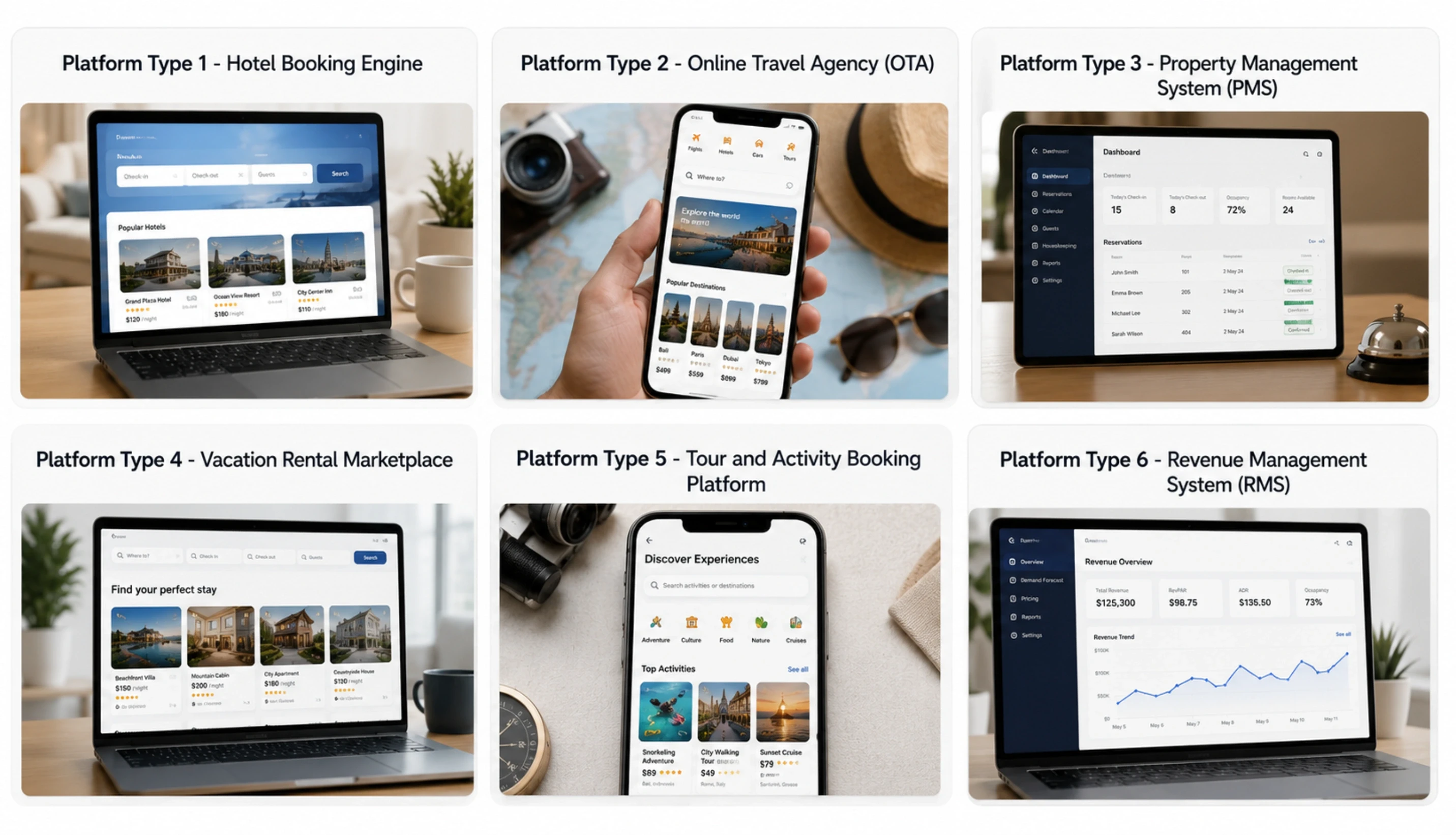
Travel and hospitality platforms fall into six distinct categories. Each serves a different business model and requires a different technical approach. Understanding these categories before writing a product specification prevents scope inflation, architectural mismatch, and the expensive rewrites that follow.
Platform Type 1 - Hotel Booking Engine
A hotel booking engine is the reservation system embedded directly into a hotel's own website or app. Its purpose is to enable direct bookings, bypassing OTA commissions (typically 15% to 25% of room revenue). The booking engine connects to the PMS to read live availability, applies the hotel's own rate plans, accepts payment, and generates confirmation. Building a custom booking engine is the primary technology investment for hotels growing their direct channel. The engineering challenge is maintaining real-time parity with OTA inventory while offering direct-only incentives (breakfast inclusions, loyalty points, early check-in). A hotel generating $5M in annual OTA bookings saves $750,000 to $1.25M per year by shifting 15 percentage points to direct, the justification for a $50,000 to $90,000 custom build is clear.
Platform Type 2 - Online Travel Agency (OTA)
An OTA is a marketplace that aggregates travel inventory from multiple suppliers and sells it to consumers. Booking.com, Expedia, and Agoda are the dominant examples. Building an OTA requires a supplier-side API integration layer, a consumer-facing search and booking interface, a payment and commission management engine, and a dispute resolution system. OTA architecture is the most complex in travel software because it requires supply-side (supplier management, content, rates) and demand-side (search, personalization, checkout) systems operating simultaneously at scale. Teams considering OTA development should review Acquaint Softtech's software development outsourcing services to understand the engagement model that suits multi-year platform builds.
Platform Type 3- Property Management System (PMS)
A PMS is the operational software for a hotel or hospitality property. It manages front desk operations (check-in, check-out, room assignment), housekeeping workflows, maintenance requests, billing, and reporting. Modern PMS platforms also function as the central inventory hub that feeds availability to the booking engine and connected OTAs. Acquaint Softtech's Laravel development services team builds PMS API layers that connect existing operational workflows to modern distribution channels, enabling properties to modernize without replacing their entire system.
Platform Type 4 - Vacation Rental Marketplace
A vacation rental marketplace is a two-sided platform connecting property owners with short-term rental guests. Airbnb, Vrbo, and HomeAway are the category examples. Building this type of platform requires a host-side self-service portal, a guest-side search and booking interface, a trust and safety layer (identity verification, review systems, damage deposits), and a complex payment flow managing host payouts, platform fees, and refunds. The two-sided marketplace architecture means supply and demand sides must be built in parallel, each with distinct user experiences. A dedicated development team is the correct engagement model because both sides of the marketplace need concurrent engineering attention.
Platform Type 5 - Tour and Activity Booking Platform
A tour and activity platform manages the reservation of experiences: guided tours, museum tickets, cooking classes, adventure activities, and transfers. The inventory model differs from hotel rooms because activities have time-slot-based availability (9 am departure vs 2 pm departure) rather than date-range availability. The platform must manage capacity limits per slot, multi-participant bookings, voucher generation, and often a supplier network of independent operators across multiple cities. The search logic is simpler than an OTA, but the booking workflow is more event-driven; cancellations, weather contingencies, and operator rescheduling require dedicated workflow automation.
Platform Type 6 - Revenue Management System (RMS)
A revenue management system is a data-driven pricing engine that adjusts accommodation or travel product rates dynamically based on demand signals, competitive pricing, and yield optimization rules. Modern RMS platforms use machine learning to set rates per room type per day, taking inputs from occupancy history, booking pace, competitor rate data, and external event calendars. Building a custom RMS requires custom AI development services because rule-based pricing alone cannot compete with modern algorithmic yield management. A well-implemented RMS typically increases RevPAR (Revenue per Available Room) by 8% to 15% in the first operating year.
How Booking Engines Actually Work: Architecture, Components, and Data Flow
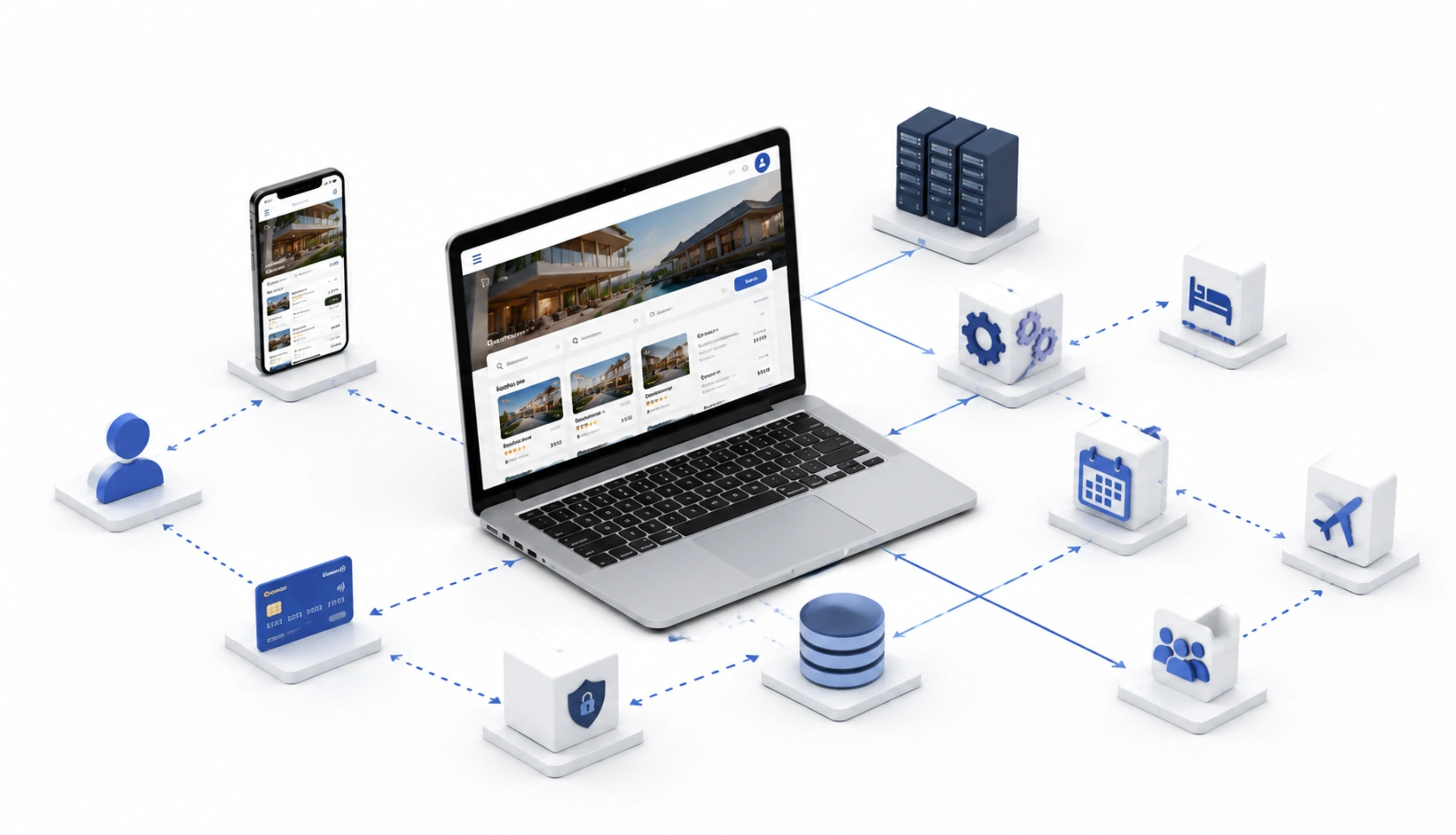
A booking engine is not a single application. It is a coordinated system of components that must operate in near-real time, handling hundreds of concurrent search requests during peak periods. Understanding the architecture prevents the most common failure: building a monolithic system that works in staging but fails under production load on the first busy weekend.
For teams building scalable booking systems, backend performance and database optimization play a critical role. You can also explore PostgreSQL and Django ORM at Scale Query Optimisation Patterns That Matter to understand how high-traffic systems handle query performance and avoid bottlenecks.
The 6 Components of a Production Booking Engine
Component 1: Search and Availability Engine. The user enters destination, check-in, check-out dates, and guest count. The search engine queries the inventory database for available room types, applies rate plan logic to calculate prices, and returns results. Under peak load, New Year's Eve, school holiday openings, flash sale events, this component must handle 500 to 2,000 concurrent queries without degradation. Elasticsearch is the standard search layer, with Redis caching for frequently queried availability windows (the next 30 days for popular properties accounts for 70% of all queries).
Component 2: Rate and Pricing Engine. The pricing engine applies the hotel's rate plan rules to the base room price. Rate plans control who sees what price: a member rate for loyalty members, a corporate rate for business travelers, a non-refundable discount, and a breakfast-included package. The engine must apply rules in the correct priority order and calculate final prices including taxes, fees, and mandatory resort charges. This component is where most booking engines introduce revenue-impacting bugs: a rate plan applied to the wrong customer segment produces either revenue loss or customer complaints.
Component 3: Inventory Lock Mechanism. When a guest selects dates and initiates checkout, the booking engine places a soft hold on the selected room type for a defined session window (typically 10 to 20 minutes). This prevents a second guest from booking the same room during the payment process. The inventory lock must be distributed and atomic; it must work correctly even when multiple servers handle concurrent sessions. Redis with TTL (Time-to-Live) locks is the standard implementation. Without this component, high-traffic booking events produce double-bookings.
Component 4: Payment Gateway Integration. The booking engine integrates with a payment processor (Stripe, Adyen, Braintree) to handle card authorization, 3D Secure verification, pre-authorization holds, and settlement. Hotel bookings require nuanced payment flows: partial payment at booking, balance charged at arrival, or full pre-payment with a refund policy. The payment layer must also handle multi-currency transactions and comply with PCI-DSS (Payment Card Industry Data Security Standard) Level 1 requirements.
Component 5: Booking Confirmation and Communication Engine. On successful payment, the system creates a reservation record, decrements inventory, and sends confirmation to the guest via email and optionally SMS or WhatsApp, then notifies the PMS. The communication layer must be asynchronous and fault-tolerant: if the email service fails, the booking must not fail. A queue-based system (RabbitMQ, AWS SQS) handles this reliably.
Component 6: Channel Manager Integration. If the hotel sells rooms through OTAs, the booking engine must connect to a channel manager that pushes availability updates to Booking.com, Expedia, and other connected channels within seconds of a booking. This two-way sync is the most technically demanding part of hotel technology, and the source of most overbooking incidents when implemented incorrectly or deferred to a later version.
Build vs. Integrate: Booking Engine Decision Matrix
Dimension | Build Custom | Use SaaS / White-Label |
Initial cost | $40,000 to $120,000, depending on scope | $5,000 to $20,000 setup plus monthly fee |
Time to first booking | 4 to 8 months | 4 to 12 weeks with configuration |
Rate plan flexibility | Unlimited custom logic per property | Constrained by the vendor's rate plan model |
OTA sync control | Custom API integration, fully owned | Depends on the vendor's channel manager partnerships |
Scalability ceiling | None — scales to any traffic with correct architecture | Scales within the vendor's infrastructure limits |
Data ownership | Full — all data in your systems | Data stored or accessible to the vendor |
Best fit | Hotel chains, high-volume properties, OTAs | Independent hotels, boutique properties, early MVPs |
The decision to build or integrate a booking engine comes down to three variables: booking volume, rate plan complexity, and the strategic value of direct-channel guest data. Properties with fewer than 200 rooms and under 5,000 annual bookings rarely justify a full custom build. Properties managing multiple room types, a loyalty program, and a direct booking target above 40% of total revenue typically require a custom system to reach those targets. For properties at this inflection point, Acquaint Softtech's product discovery workshop produces a validated build-or-integrate recommendation in 2 to 3 days, before any development budget is committed.
Building a Travel Platform? Start With the Right Architecture.
Acquaint Softtech delivers a detailed system architecture review and developer team structure within 48 hours of your project brief. You review the team composition and interview developers before any engagement begins. 1,300+ projects delivered. 48+ Clutch reviews.
OTA Architecture: How Online Travel Agencies Are Built at Scale
An OTA (Online Travel Agency) is architecturally different from a hotel booking engine. Where a booking engine serves one supplier to many consumers, an OTA serves many suppliers to many consumers simultaneously. The architectural challenge is multiplied: inventory aggregation from heterogeneous sources, multi-supplier pricing normalization, search relevance across millions of listings, and financial reconciliation across thousands of supplier relationships.
The Supplier Integration Layer
Every OTA begins with a supplier integration problem. Hotel inventory arrives via API connections to individual PMS platforms, channel managers, or GDS connections. Each data source delivers availability and pricing in different formats, at different frequencies, and with different reliability profiles. Building a supplier normalization layer that converts heterogeneous inputs into a consistent internal schema is typically the most time-intensive phase of OTA development, and the one most frequently underestimated in project briefs. Acquaint Softtech's team of dedicated backend developers has built supplier normalization pipelines handling 50,000 to 200,000 availability updates per hour across distributed hotel inventories. Each major supplier API integration (Booking.com connectivity, an Amadeus GDS connection, a large PMS API) requires 6 to 12 weeks of development and end-to-end testing under realistic data volumes.
Search Index Architecture
The search experience on an OTA must return results in under 2 seconds, even when querying millions of active listings. Search latency above 3 seconds reduces booking conversion by measurable amounts. Amazon's internal data, now referenced across e-commerce, established that each 100ms of additional latency reduces conversion by 1%. For a travel platform, the compounding effect over a booking session is significant.
The search index is built on Elasticsearch, pre-indexed with availability data that is updated asynchronously from the real-time inventory layer. This separation of search index from live inventory is the architectural decision that makes OTA search fast while reflecting near-current availability. Acquaint Softtech's MERN stack developers build the search layer as a standalone microservice from day one, preventing the search bottleneck that kills OTA performance at scale.
The Consumer Experience Layer
The consumer-facing layer of an OTA includes destination search with autocomplete, a date and guest count selector, property listing pages with photo galleries and review aggregations, checkout with saved payment methods, and post-booking management (cancellation, modification, rebooking). Each component carries its own conversion optimization requirement.
The listing page is the highest-impact conversion point: photo quality, review score display, price transparency, and mobile rendering speed each contribute to whether the user books or bounces. Acquaint Softtech's React JS development services team builds the consumer interface as a high-performance single-page application with server-side rendering for SEO-critical pages (destination landing pages, property detail pages).
Payment and Commission Engine
OTAs operate on a commission model: the consumer pays the OTA, the OTA remits the net amount to the supplier after deducting its commission (typically 15% to 25% for hotels, 10% to 15% for tours). The payment engine must handle multi-currency transactions, supplier payment scheduling (weekly or biweekly payouts), dispute resolution workflows, and refund processing when cancellations occur. This engine requires dedicated financial engineering, and teams should plan 3 to 4 months of development on the payment layer alone for a full OTA build.
OTA platforms require strong DevOps practices to handle multiple integrations and continuous deployment. A slow deployment pipeline can delay releases and impact revenue. This guide on Deployment Pipeline Taking Hours What Hiring a DevOps Engineer Cuts It Down To explains how optimizing CI/CD improves platform stability and speed.
OTA vs. Booking Engine: Key Architecture Differences
Dimension | Hotel Booking Engine | OTA Platform |
Supplier count | 1 (the hotel itself) | 100 to 100,000+ suppliers |
Inventory source | PMS direct integration | Channel managers, GDS, direct APIs |
Search complexity | Single-property availability | Multi-supplier, multi-city, multi-product |
Payment flow | Guest pays hotel (direct) | Guest pays OTA; OTA pays supplier minus commission |
Primary tech challenge | Inventory lock and channel sync | Supplier normalization and search at scale |
Build timeline (MVP) | 3 to 5 months | 6 to 9 months |
Typical cost range | $18,000 to $90,000 | $60,000 to $300,000+ |
Teams working through OTA architecture for the first time should also review how staff augmentation services can supplement an existing product team during the supplier integration phase, which typically requires specialist API engineering not available in generalist development teams.
Mapping an OTA or Marketplace Architecture? We Have Done This Before.
Acquaint Softtech has built supplier integration layers, multi-currency payment engines, and high-traffic search architectures for travel platforms across the US, UK, and Australia. We deliver a team structure and architecture proposal within 48 hours. You interview before you commit.
Hotel Management System (PMS) Components: The Full Operational Scope
-components-the-full-operational-scope.webp "Hotel Management System (PMS) Components: The Full Operational Scope")
A hotel management system (HMS), also called a property management system (PMS), is the central operational platform for a hospitality property. It is not a booking system. It is an operating system. Its primary users are front desk staff, housekeeping supervisors, maintenance teams, and revenue managers, not guests.
The 7 Core Modules of a Full PMS
Module 1 Front Desk. Manages check-in, check-out, room assignment, stay extension, early departure, and walk-in registration. The front desk module displays live room status (clean, dirty, out of order, occupied) and allows instant room swaps. It connects to the room inventory layer and updates availability in real time. Every front desk action must reflect in the booking engine and channel manager within seconds.
Module 2 Reservation Management. Holds all confirmed bookings, including their source channel, rate plan, special requests, and payment status. Reservations from the booking engine, OTAs, and manual entries all flow into this module. The reservation record is the master data object that every other PMS module references.
Module 3 Housekeeping. Manages room cleaning workflows. After check-out, rooms are queued for cleaning based on priority: early check-in requests, VIP guests, and vacant dirty rooms. Housekeeping staff receive room assignments on a mobile app, update status on completion, and flag maintenance issues. Supervisors see real-time room status across the entire property. This module reduces the front desk hold time that guests experience when their room is not ready.
Module 4 Maintenance. Tracks maintenance requests, preventive maintenance schedules, and equipment histories. Guests submit requests via the guest app (Wi-Fi fault, AC issue). The module assigns requests to maintenance staff, tracks resolution time, and escalates unresolved items. Average resolution time visible in the management dashboard is a key property quality metric.
Module 5 Revenue Management and Reporting. Generates operational reports: occupancy rate, ADR (Average Daily Rate), RevPAR (Revenue per Available Room), booking pace, and channel contribution analysis. Modern PMS platforms integrate with standalone revenue management systems to receive pricing recommendations and automatically update rate plans via API.
Module 6 POS Integration. Hotel charges from the restaurant, spa, room service, and minibar must post to the guest's folio automatically and settle at checkout. POS integration connects the hotel's food and beverage, spa, and retail systems to the PMS so all guest charges consolidate in one bill, the single bill experience that premium guests expect.
Module 7 Guest Communication. Manages pre-arrival, in-stay, and post-stay communication. Pre-arrival messages (online check-in invitation, upsell offers, local recommendations), in-stay service requests, and post-stay feedback surveys are all managed from this module. WhatsApp, SMS, and email integration is standard for mid-market and above properties in 2026.
Build Scope Reality Check: Full PMS from Scratch
Building a full PMS from scratch requires 8 to 14 months of development with a team of 4 to 6 engineers. Properties that need a PMS but do not require custom logic for every module should evaluate IT staff augmentation services to extend their existing technology team with specific PMS module expertise, rather than rebuilding entirely from scratch. A modular build approach, starting with reservation management, front desk, and housekeeping, then adding revenue management and POS integration, reduces time to first value to 4 to 5 months.
Technology Stack for Travel Platforms in 2026
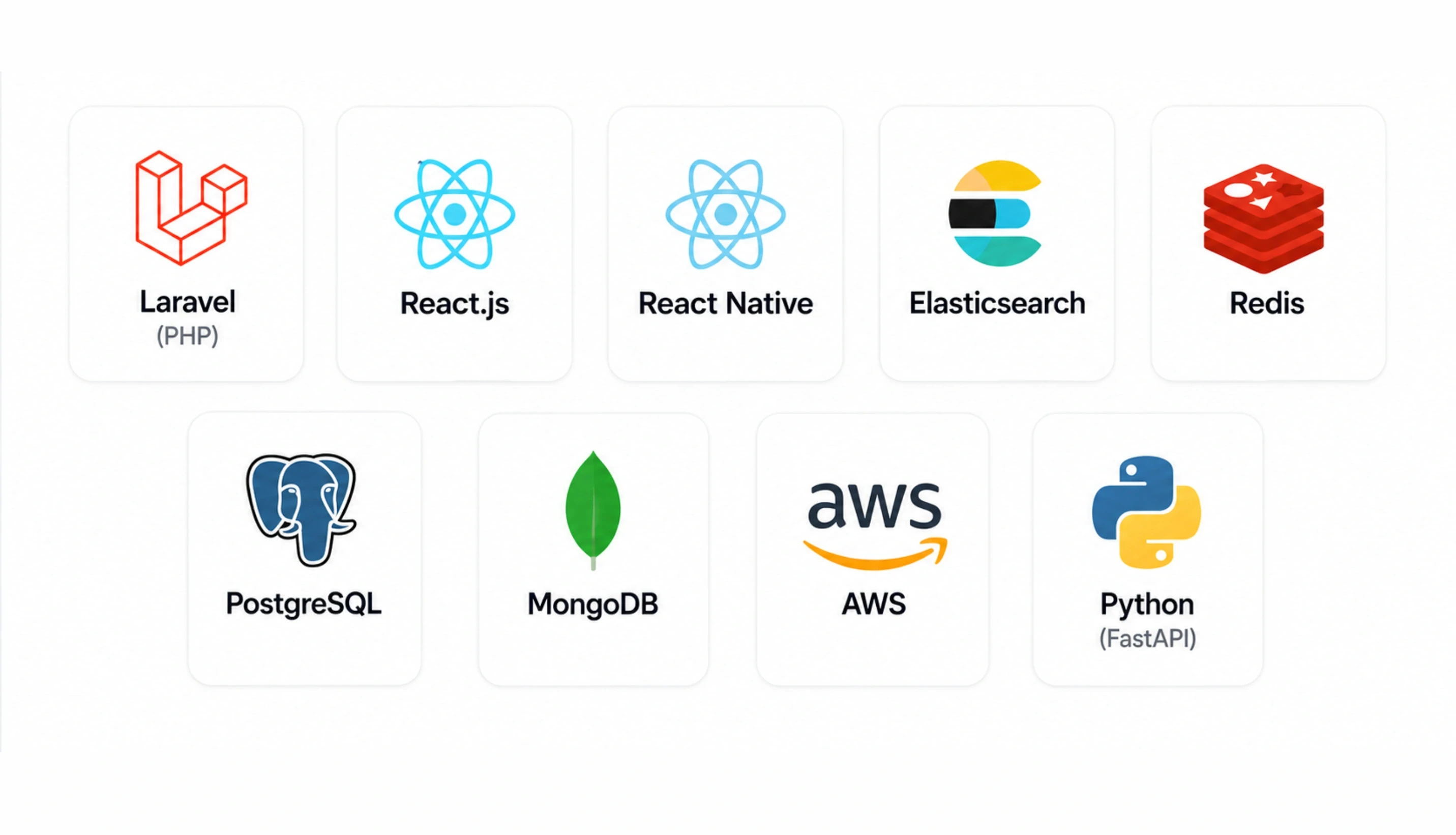
The technology stack for a travel platform is not a single correct answer. It is a set of architectural decisions, each with tradeoffs based on team expertise, platform scale, and performance requirements. The following reference stack is based on Acquaint Softtech's delivery data across 1,300+ projects, including travel and hospitality platforms across the US, UK, and Australia.
Backend Framework
Laravel (PHP) remains the dominant choice for booking engine backends, PMS APIs, and OTA supplier integration layers in 2026. As an Official Laravel Partner, Acquaint Softtech uses Laravel for its mature queue management, API development, and database abstraction ecosystem. Laravel's queue system (Redis driver) handles the asynchronous inventory sync, communication dispatch, and payment webhook processing that travel platforms depend on. For revenue management systems and machine learning components, Python (Django or FastAPI) is the backend choice, where the scientific computing ecosystem is non-negotiable. Node.js is appropriate for high-concurrency, real-time features: WebSocket connections for live availability updates and chat-based booking interfaces.
Frontend Framework
React.js is the standard for consumer-facing travel interfaces. Its component architecture matches the modular nature of travel UI: search form, availability calendar, room detail card, checkout form, and booking management dashboard. For mobile, React Native app development handles cross-platform guest-facing apps (booking, in-stay service requests, loyalty dashboards) and staff-facing tools (housekeeping, maintenance) without maintaining separate iOS and Android codebases. Vue.js is a viable alternative for teams with existing Vue expertise building less complex booking interfaces where React's overhead is not justified.
Database Architecture (Polyglot Strategy)
Travel platforms require a polyglot database strategy rather than a single database choice. PostgreSQL for transactional data (reservations, payments, user accounts, rate plans), ACID compliance is non-negotiable for financial transactions. Elasticsearch for the search index (property search, availability queries across large inventories). Redis for caching and session management (rate caching, inventory locks, session tokens). MongoDB for unstructured content (property descriptions, photo metadata, guest preference profiles). Acquaint Softtech's Django and Python developers and backend engineers with database schemas that separate read-heavy (search, availability lookup) from write-heavy (booking creation, inventory update) workloads from day one, preventing the read/write contention that degrades performance at peak traffic.
Infrastructure and DevOps
Travel platforms experience some of the most predictable and violent traffic spikes in all of software: holiday booking windows, school holiday openings, flash sale launches. AWS is the dominant infrastructure provider, using EC2 auto-scaling groups, RDS for managed PostgreSQL, ElastiCache for Redis, and CloudFront for CDN delivery. Acquaint Softtech's DevOps engineers with provisioning infrastructure using Terraform for reproducibility and implement load testing protocols simulating 10x normal traffic before seasonal peaks. A well-architected travel platform handles a 5x to 10x traffic spike without manual intervention; this is the standard that any production-grade travel platform should be designed to meet.
Choosing the right CI/CD pipeline is as important as selecting the tech stack. For a deeper comparison, read GitHub Actions vs Jenkins vs GitLab CI: Which CI CD Tool Should You Hire a DevOps Engineer to Implement, which helps teams decide the best deployment strategy based on scale and complexity.
AI and Personalization Layer
In 2026, AI is no longer optional for travel platforms competing at scale. Personalization engines use guest booking history, search behavior, and preference data to rank search results individually. Conversational search interfaces powered by LLM (Large Language Model) integration allow guests to describe trips in natural language rather than filling form fields. Revenue management systems use ML models for demand forecasting and competitive rate recommendations. Acquaint Softtech's Laravel AI development services and custom AI team covers the full stack from LLM integration to custom ML model development for travel demand prediction and pricing optimization.
Reference Technology Stack: Travel Platforms 2026
Layer | Recommended Technology | Alternative | When to Switch |
API Backend | Laravel (PHP) | Node.js / FastAPI | Real-time WebSocket features or ML-heavy |
Consumer Frontend | React.js | Vue.js | Smaller team with existing Vue expertise |
Mobile | React Native | Flutter | Cross-platform with heavy native UI needs |
Search Index | Elasticsearch | Algolia | Under 10,000 listings; lower ops overhead |
Cache & Locks | Redis | Memcached | Simple caching with no distributed lock needs |
Transactional DB | PostgreSQL | MySQL | Team expertise: PostgreSQL preferred for JSONB |
Content DB | MongoDB | PostgreSQL JSONB | Simple content; avoid MongoDB for transactions |
Infrastructure | AWS | Google Cloud / Azure | Team cloud expertise dictates |
ML/AI | Python (FastAPI) | Node.js + OpenAI API | LLM integration only (no custom model training) |
The specific stack is confirmed in the initial architecture review before any code is written. Acquaint Softtech does not prescribe a stack before understanding the platform type, team expertise, traffic expectations, and budget constraints. The table above represents defaults, not mandates.
Validating Your Tech Stack Before Development Begins?
Acquaint Softtech's architecture review covers tech stack selection, database design, infrastructure planning, and team structure for travel platforms. Delivered within 48 hours. 70+ engineers in-house across all travel-relevant stacks. You interview before you commit.
What Does Travel & Hospitality Software Development Cost in 2026?

Development cost in the travel and hospitality sector varies by platform type, team composition, and scope. The following ranges are based on Acquaint Softtech's delivery data across projects in the US, UK, Australia, and UAE, using dedicated development teams with 70+ multi-stack engineers deployed from India.
Platform Type | Scope Summary | Cost Range (India) | Timeline | US/UK Equivalent |
Hotel Booking Engine (basic) | Direct booking, PMS integration, payment, confirmation | $18,000–$35,000 | 3–5 months | $55,000–$110,000 |
Hotel Booking Engine (full) | Loyalty, channel manager, multi-currency, upsell | $50,000–$90,000 | 5–8 months | $150,000–$270,000 |
Property Management System | Front desk, housekeeping, maintenance, POS, reporting | $70,000–$130,000 | 8–14 months | $210,000–$400,000 |
OTA Platform (MVP) | 2–5 supplier integrations, search, booking, payment | $60,000–$100,000 | 6–9 months | $180,000–$300,000 |
OTA Platform (scale) | 50+ integrations, AI search, full payment engine | $150,000–$300,000+ | 12–18 months | $450,000–$900,000+ |
Vacation Rental Marketplace | Host portal, guest booking, trust & safety, payouts | $80,000–$150,000 | 8–12 months | $240,000–$450,000 |
Revenue Management System | ML pricing, competitor monitoring, rate push | $40,000–$80,000 | 4–7 months | $120,000–$240,000 |
What the Monthly Rate Includes at Acquaint Softtech
Senior or mid-level engineer with verified travel or hospitality domain experience (booking engines, OTA integration, PMS modules)
Full-time dedicated allocation to the client's project, not shared across multiple accounts
Daily standups, sprint planning, and retrospective participation under client direction
Code review and QA by a senior technical lead as part of the engagement
NDA and IP ownership, Non-Disclosure Agreement in place from day one; all intellectual property belongs to the client
Replacement within 48 hours if any engineer's performance does not meet the agreed standards
48-hour deployment, first engineer on sprint within 48 hours of brief approval
The rate the client pays is the rate. No additional employer overhead, benefits, or HR costs on top.
Get a Cost Estimate for Your Travel Platform in 48 Hours
Acquaint Softtech provides a detailed team structure, technology recommendation, and project cost estimate within 48 hours of a brief. No obligation. You interview developers before any engagement begins. 1,300+ projects delivered. 48+ Clutch reviews.
The 5 Questions That Tell You What to Build First

Most travel platform projects fail not from lack of funding or technical talent, but from building the wrong thing first. The following decision framework maps business model to build priority - structured as decision questions with binary Yes/No outcomes, following the format that produces the clearest engineering direction.
Are you selling your own inventory or aggregating someone else's?
Yes (your own inventory): Build the booking engine first. Your inventory is the product. The booking engine is what converts browsers into paying guests. Without it, all other technology has nothing to sell. Prioritize availability engine, rate plan logic, payment integration, and channel manager sync in the first build phase.
No (aggregating others' inventory): Build the supplier integration layer and search index first. Without reliable, up-to-date inventory from partners, the consumer interface has nothing to show. An OTA with excellent UI but empty or stale search results is not viable. The supplier normalization pipeline is the highest-value engineering investment at this stage.
Is your revenue model transactional (commission per booking) or subscription?
Transactional: Prioritize checkout conversion from day one. Every percentage point of checkout abandonment at 1,000 bookings per day costs measurable revenue. Invest early in a fast, multi-device checkout with saved payment methods, clear pricing with no hidden fees, and a visible trust signal (cancellation policy, secure payment badge). A 5% checkout abandonment reduction at $200 average booking value and 500 daily checkouts = $182,500 additional annual revenue.
Subscription (SaaS model for hotels or suppliers): Prioritize supplier tooling and onboarding. The value to subscribing hotels or operators is in the management dashboard, reporting, and operational efficiency tools. Build the supplier dashboard and analytics engine before the consumer interface. Supplier adoption drives the inventory density that makes the consumer side work.
Does your platform require real-time availability or can you work with cached data?
Real-time required (hotels, flights synced across OTAs): Invest in a distributed inventory lock system and asynchronous channel sync from the start. Do not defer this to version two. The cost of retrofitting real-time inventory management into a platform that was built without it is typically greater than building it correctly from the beginning. Acquaint Softtech's software development outsourcing services include architecture consultation, specifically on real-time inventory design for travel platforms.
Cached data acceptable (fixed-capacity tours, set departure experiences): A simpler inventory model is appropriate. Capacity management with a static slot calendar, updated on each booking, is achievable in a shorter timeframe and with a lower budget. This distinction saves 6 to 8 weeks of engineering effort on the inventory layer alone for tour and activity platforms.
What is your booking volume expectation at launch and at 12 months?
Under 100 bookings per day at launch, under 1,000 at 12 months: A modular monolith architecture is appropriate. Do not build microservice complexity before you have the operational maturity to manage it. A well-structured monolith serves this scale with lower infrastructure cost and simpler debugging.
Over 1,000 bookings per day at launch or immediate high-volume supplier partnerships: Design for microservices from the start: separate the search layer, inventory layer, payment layer, and communication layer as independent services from day one. Retrofitting a monolith to handle this load is more expensive than correcting the initial architecture.
Do you have an existing engineering team or are you building from zero?
Existing team, partial capacity: Staff augmentation services are the right model. Add 2 to 4 pre-vetted engineers to your existing team within 48 hours. No 6-month hiring process. No employer overhead. Close the capacity gap without displacing your existing team's velocity.
No existing team: A dedicated software development team provides a fully managed structure with a technical lead, engineers, and QA under client direction. The team deploys within 48 hours and operates under the client's sprint cadence from day one. Minimum engagement is typically 6 months for a meaningful travel platform build.
Answered Yes to 2 or More? Let's Define Your Build Roadmap.
Acquaint Softtech maps your business model to a specific platform architecture and phased build roadmap. We send a team structure and first-phase scope within 48 hours. 70+ engineers. 13+ years in software delivery. You interview before you commit.
Common Misconceptions About Travel Software Development
The travel and hospitality technology sector carries more technical misconceptions per project brief than most other industries Acquaint Softtech serves. These misconceptions consistently delay launches, inflate budgets, and produce platforms that require significant rework at the worst possible time: when the product first gets traction.
Misconception 1: A booking form is a booking engine.
Reality: A form that captures travel dates and sends an email notification is not a booking engine. A production booking engine manages live inventory availability, applies rate plan logic, processes payment with pre-authorization, generates a booking reference, sends multi-channel confirmation, decrements inventory, and syncs with connected OTA channels within seconds. The difference in development complexity is roughly 6 months and $30,000 to $60,000 in additional scope. Teams that discover this distinction after building a 'booking form' typically face a full rebuild at the point where their first commercial partner or hotel chain requests a real integration.
Misconception 2: OTA integration is a single API connection.
Reality: Each major OTA (Booking.com, Expedia, Agoda, Airbnb) has a different API specification, different rate plan structure, different content requirements, and different notification protocols. Connecting to three major OTAs typically requires 6 to 12 weeks of dedicated integration work per OTA, including testing under realistic inventory volume. A channel manager reduces this effort by normalizing access to multiple OTAs through a single connection - but introduces dependency on the channel manager's uptime and data fidelity, which is a risk that must be designed around.
Misconception 3: Dynamic pricing means lowering prices when rooms are empty.
Reality: Dynamic pricing is bidirectional. A well-implemented RMS raises prices during high demand (events, holidays, low remaining availability) and lowers them during low demand (mid-week, off-season, slow booking pace). Hotels that implement dynamic pricing only to discount underperforming properties that also use it to capture demand spikes. A properly configured RMS typically increases RevPAR by 8% to 15% in the first operating year - the upside is in raising rates at the right moment, not just discounting at the wrong one.
Misconception 4: A travel platform MVP can skip infrastructure planning.
Reality: Travel platforms experience some of the most predictable and violent traffic spikes in all of software: holiday booking windows, flash sale events, and last-minute deal notifications. An MVP built on a single server with no auto-scaling, no database read replicas, and no CDN will not survive its first successful marketing campaign. Infrastructure for a travel MVP should include basic auto-scaling, a CDN for static assets, and Redis caching from day one. The additional cost is $500 to $2,000 per month in cloud infrastructure. The cost of not having it is a launch-day outage during the highest-traffic moment of the year.
Teams working through platform architecture for the first time should consider a product discovery workshop with Acquaint Softtech, which surfaces these misconceptions in a structured 2 to 3-day session and produces a validated architecture brief before any development budget is committed. Teams serving US passengers should reference the US Department of Transportation's aviation consumer protection regulations.
Ready to Build Without the Rework? Talk to a Travel Tech Specialist.
Acquaint Softtech delivers a full architecture review, technology recommendation, and team structure for your travel or hospitality platform within 48 hours. 1,300+ projects delivered. 70+ engineers in-house. IP belongs to you from day one. You interview before you commit.
Frequently Asked Questions
-
How much does it cost to build a travel booking platform in 2026?
The cost of travel software development in 2026 typically ranges from $18,000 for a basic hotel booking engine to $300,000 or more for a full-scale OTA with multi-supplier integrations and AI features. The biggest cost factor is the platform type and complexity. Development timelines usually range from 3 to 14 months, and a clear discovery phase can help avoid 20% to 40% extra rework costs.
-
What features does a hotel booking engine need?
A production-ready booking engine should include search and real-time availability, pricing and rate management, inventory locking to prevent double bookings, secure payment gateway integration, and booking confirmation via email or SMS. Channel manager integration is critical for syncing inventory across OTAs. Additional features like loyalty programs, upsells, and multi-currency support can improve business performance.
-
What is the best tech stack for travel platforms in 2026?
A common and reliable tech stack includes Laravel or Node.js for backend development, React.js for frontend, and React Native for mobile apps. PostgreSQL is used for data storage, Elasticsearch for search functionality, and Redis for caching and session handling. AWS is the preferred cloud platform, while Python is widely used for AI and pricing optimization systems.
-
How long does it take to build an OTA platform?
A basic OTA platform with limited integrations can be built in 6 to 9 months using a small team. A more advanced OTA with multiple supplier integrations, AI-powered search, and full backend systems can take 12 to 18 months. Supplier API integration is the most time-consuming phase and requires careful planning to avoid delays.
-
Can I build a travel platform using a white-label or SaaS solution instead of custom development?
Yes, SaaS or white-label solutions are suitable for smaller businesses with standard requirements, such as hotels with fewer rooms or simple pricing models. However, they come with limitations in customization, scalability, and data ownership. For larger businesses or unique platforms, custom development is a better long-term choice.
-
What compliance requirements apply to travel software?
Travel platforms must follow multiple compliance standards depending on their market. PCI-DSS is required for secure payment processing, GDPR for handling user data in Europe, and PSD2 for secure online payments. In some regions, additional rules apply for refunds and customer rights, so compliance should be built into the system from the start.
-
What is the difference between a channel manager and a booking engine?
A booking engine is used for direct reservations from a hotel’s website or app, while a channel manager distributes room inventory across multiple platforms like OTAs and keeps availability updated in real time. Both systems serve different purposes but work together to prevent overbooking and manage distribution efficiently.
-
Is it possible to add AI capabilities to an existing hotel booking system?
Yes, AI can be integrated into existing systems to improve personalization, pricing, and search experience. Features like recommendation engines, demand forecasting, and dynamic pricing can be added through APIs. Modern systems can support AI integration within a few months, while older systems may need some upgrades first.
We’re Acquaint Softtech, your technology growth partner. Whether you're building a SaaS product, modernizing enterprise software, or hiring vetted remote developers, we’re built for flexibility and speed. Our official partnerships with Laravel, Statamic, and Bagisto reflect our commitment to excellence, not limitation. We work across stacks, time zones, and industries to bring your tech vision to life.
Table of Contents
Get Started with Acquaint Softtech
- 13+ Years Delivering Software Excellence
- 1300+ Projects Delivered With Precision
- Official Laravel & Laravel News Partner
- Official Statamic Partner
Related Reading

How to Create a Travel Website that Inspires Wanderlust
Discover the step-by-step process of creating a travel website that inspires wanderlust. The tips given in this blog are tried and tested to get success.

Mukesh Ram
August 23, 2023
The Complete Guide to PropTech Software Development in 2026
PropTech is not a real estate website with a login. It is a system of record that manages listings, leases, ledgers, and work orders on a single accountable platform. Here is what it costs, how it is built, and how to pick a partner in 2026.
Acquaint Softtech
May 4, 2026
Software Development Outsourcing - India vs. Latin American & Europe
Develop a cutting-edge solution for your business. Find out which is the best country to outsource to.
Mukesh Ram
December 12, 2023India (Head Office)
203/204, Shapath-II, Near Silver Leaf Hotel, Opp. Rajpath Club, SG Highway, Ahmedabad-380054, Gujarat
USA
7838 Camino Cielo St, Highland, CA 92346
UK
The Powerhouse, 21 Woodthorpe Road, Ashford, England, TW15 2RP
New Zealand
42 Exler Place, Avondale, Auckland 0600, New Zealand
Canada
141 Skyview Bay NE , Calgary, Alberta, T3N 2K6