

How to Build a Neo Bank: Licensing, Architecture, KYC AML, and Launch Roadmap
Building a neo-bank in 2026 starts with one decision that determines everything else: BaaS consumer or direct licence. This guide covers both paths, licensing, ledger design, KYC/AML, feature roadmap, tech stack, and real cost data.

Manish Patel
How to Build a Neo-Bank in 2026
Building a neobank app in 2026 follows two paths: (1) BaaS Consumer, use a Banking-as-a-Service partner's licence, infrastructure, and rails, then build your UX and product logic on top (3–9 months to first user); or (2) Direct Licence, apply for your own EMI or banking licence, build or licence a core banking system, and own the full stack (18–42 months). The right path depends on the funding stage, target market, and long-term unit economics.
Neobank app development cost: $18,000–$32,000/month for a full-stack team of 4–6 engineers at Acquaint Softtech. MVP timeline: 18–28 weeks on BaaS path.

- Founders choosing between BaaS-based neo-bank or direct banking license.
- CTOs designing core banking, ledger, and KYC/AML architecture.
- Product teams planning compliant feature roadmaps for digital banking.
- Teams evaluating neo-bank development vendors in India.
- Non-technical founders understanding core banking systems before building.
As Head of Tech & Client Success at Acquaint Softtech, a neobank app development company, India founders across the US, UK, Australia, and UAE rely on me. I oversee the technical delivery of digital banking products from initial architecture through regulatory go-live. Building a neo-bank is categorically different from building any other FinTech product: the compliance surface is wider, the data model tolerates zero errors, and the licensing timeline can extend your product roadmap by 12–36 months if you make the wrong path decision in week one.
This is the operationally complete guide to how to build a neobank app in 2026. It covers the licensing decision framework with real timelines, the core banking ledger architecture that cannot be changed post-launch, the 5-layer KYC/AML pipeline, the complete neobank app features list mapped to the launch phase, the neobank app tech stack by component, the neobank app development cost by engagement tier, and a week-by-week launch roadmap.
The master reference for all FinTech verticals is the Complete Guide to FinTech Software Development in 2026. If you need to understand the payment processing layer inside your neo-bank, read the How Payment Gateways Work guide first.
The Decision That Determines Everything: BaaS vs Direct Licence
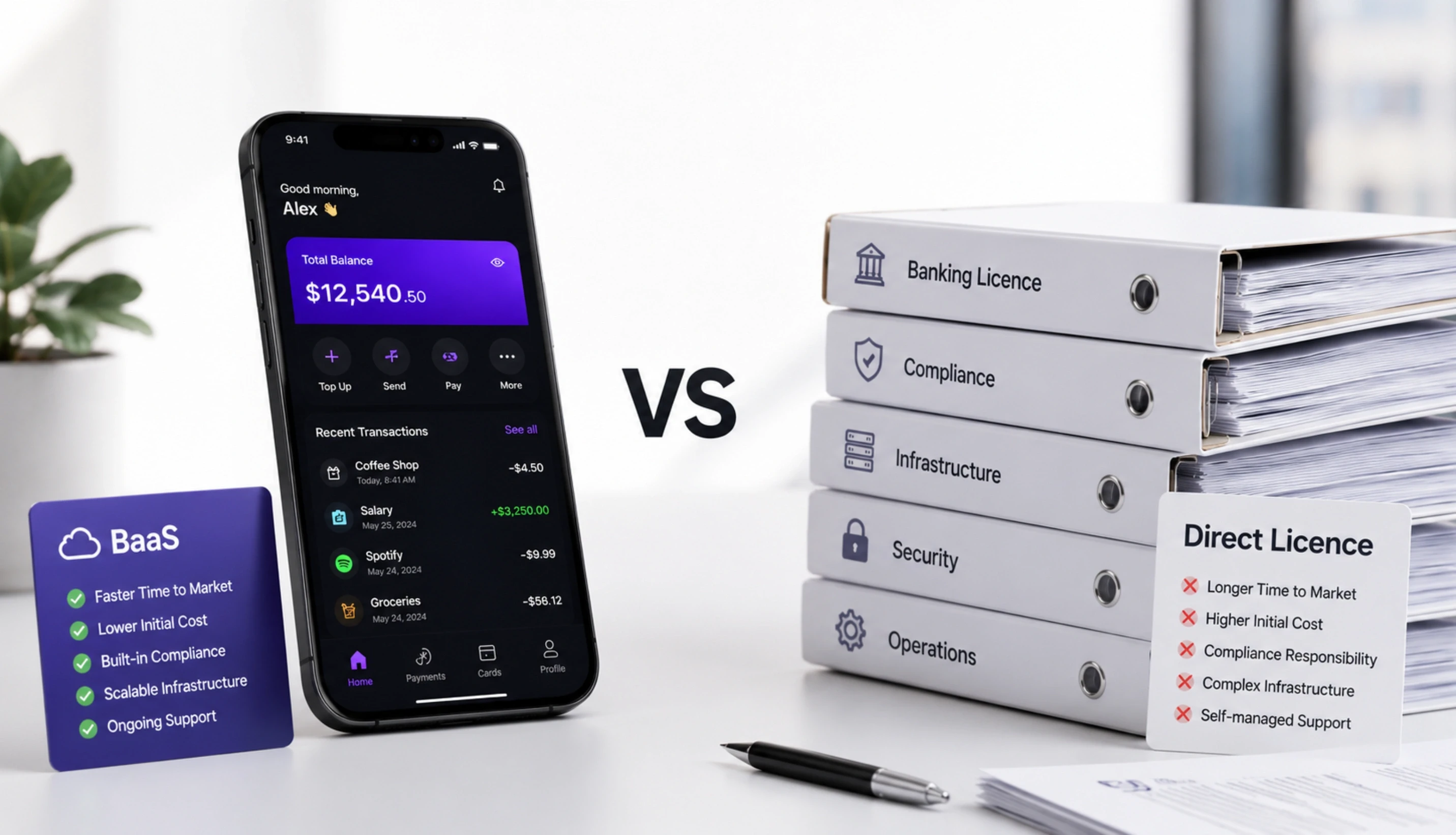
Every neo-bank build starts with the same decision, and getting it wrong costs 12 to 36 months. The choice between consuming a Banking-as-a-Service platform and applying for a direct banking or EMI (Electronic Money Institution) licence is not a product decision. It is a funding, timeline, and regulatory strategy decision that must be resolved before any architecture work begins. The comparison below covers the decision on every dimension that matters operationally.
Dimension | BaaS Consumer Path | Direct Licence Path |
Regulatory timeline | 2–8 weeks (use BaaS partner's existing licence) | 12–36 months: EMI licence (EU/UK); banking licence (US/India varies by state/RBI) |
Time to first live user | 3–9 months from contract to production | 18–42 months from application to first user |
Minimum viable funding | $500K–$2M (pre-seed to seed viable) | $5M–$20M+ (Series A minimum for most markets) |
Transaction economics | BaaS fees: $0.10–$0.50 per transaction + margin compression on interchange | Direct interchange revenue: 0.5%–1.8% per card transaction; no BaaS margin |
Product flexibility | Constrained by the BaaS provider's API surface and product roadmap | Complete control, any product, any market, any feature set |
Compliance ownership | Shared: BaaS owns core; you own KYC data security, AML monitoring, your user terms | Full ownership of all compliance obligations: KYC, AML, CTR/SAR filing, audits |
Infrastructure cost | Zero capex on banking infrastructure; pay-per-use BaaS model | Core banking system: $200K–$2M+ for licensed CBS or build cost for custom |
Engineering complexity | Mediu: focus on UX and product logic above the BaaS API layer | Very high: ledger, card management, payments rails, and settlement, all built custom |
Exit/migration risk | High: BaaS provider dependency; migration is a complex, multi-month project | Low: owns all infrastructure; no single-vendor dependency on banking rails |
Best for | Early-stage products validating product-market fit; niche banking propositions; embedded banking in existing apps | Products at scale ($10M+ GMV/month); neobanks targeting direct interchange economics; products requiring unique regulatory positioning |
The Decision Principle
Start on BaaS. The BaaS path is not a compromise; it is the correct architecture for a pre-revenue or early-revenue neo-bank. BaaS fees become uneconomic only when monthly transaction volume exceeds approximately $5M–$10M, at which point the interchange economics of a direct licence begin to justify the licensing timeline and compliance overhead. Build the product on BaaS, validate product-market fit, then pursue a direct licence at Series A or Series B. This is the pattern followed by most successful neo-banks in the UK (Monzo started on a BaaS partner before receiving its own banking licence), the EU, and India.
The Major BaaS Providers: What They Cover and What They Leave to You
BaaS Provider | Geography | What They Cover | What You Build | Per-Transaction Cost |
Railsbank (Railsr) | UK / EU / US | EMI licence (UK/EU), card issuing (Mastercard/Visa), account ledger, payment rails (Faster Payments, SEPA) | UX, product logic, KYC front-end, customer support, AML monitoring rules configuration | $0.10–$0.30 per transaction + monthly platform fee |
Marqeta | US / UK / EU / AU | Card issuing platform, real-time authorisation, spending controls, webhook events | KYC pipeline, account management UI, customer portal, AML monitoring | Interchange share + per-transaction fee (varies by contract) |
Unit | US only | FDIC-insured accounts, ACH, wire, debit card issuance, transaction monitoring infrastructure | UX, onboarding, KYC integration, product features above the API layer | $0.25–$0.50 per account per month + transaction fees |
Solarisbank | Germany / EU | BaFin banking licence, SEPA payments, card issuing, IBAN provisioning | UX, KYC/AML configuration, product logic, customer service | Monthly licence fee + per-transaction volume pricing |
Cashfree / RazorpayX | India | RBI PA licence (payments), payouts, account management, UPI integration | User onboarding KYC (Aadhaar/PAN), product UI, AML monitoring | Per-transaction fees varying by product (0.1%–1% range) |
Regulatory Reference
UK neo-banks using the BaaS path operate under the BaaS provider's FCA Electronic Money Institution authorisation. India-based neo-banks operate under their BaaS partner's RBI Prepaid Payment Instrument (PPI) licence. In both jurisdictions, the platform company remains responsible for KYC data security and AML monitoring obligations under the partner agreement - these do not transfer to the BaaS provider.
The Core Banking Ledger: The Architecture Decision You Cannot Undo
The ledger is the technical core of every banking product. It is not a feature. It is the system of record for every financial fact about every customer account, and its design determines what is mathematically possible in your product forever after. Getting the ledger architecture wrong on a BaaS platform means fixing it while live financial data is accumulating. Getting it wrong on a direct licence means a regulatory audit finding.
To execute this level of precision without delays, many teams rely on flexible scaling models like staff augmentation services, which allow you to onboard experienced FinTech engineers quickly and ensure your core banking architecture is built correctly from day one.
Double-Entry Bookkeeping - Non-Negotiable
Every financial event in a banking system affects at least two ledger accounts: a debit to one and a credit to another of equal amount. A customer deposit is a debit to the bank's cash account and a credit to the customer's current account liability. A payment is a debit to the customer's account and a credit to the beneficiary's account (or to a suspense account pending clearing).
A system that tracks only one side of each transaction is not a ledger; it is a balance sheet with no audit trail. Double-entry is the mechanism that makes reconciliation possible and regulatory audits survivable.
Integer Monetary Storage - The Rule With No Exceptions
Every monetary amount in the ledger must be stored as an integer representing the smallest currency unit: 1 GBP = 100 pence; 1 USD = 100 cents; 1 INR = 100 paisa; 1 EUR = 100 cents; 1 BTC = 100,000,000 satoshi. Floating-point storage (FLOAT or DOUBLE columns in the database) introduces rounding errors that accumulate across millions of transactions. A £0.001 rounding error per transaction becomes £1,000 across 1,000,000 transactions, a real balance discrepancy with real regulatory consequences. There are no exceptions to this rule.
Immutable Audit Log - Append-Only, Always
Every ledger entry must generate an immutable audit log record. The audit log is append-only: once written, records cannot be modified or deleted. Each record contains: transaction ID, timestamp (UTC, microsecond precision), actor (user ID or system process), affected account IDs, debit amount, credit amount, balance before, balance after, transaction type, reference ID (external), and the ID of the authorising event (e.g., payment instruction).
This structure allows point-in-time reconstruction of any account's complete financial history, a requirement for FCA CASS audits, RBI inspections, and fraud investigations.
Eventual Consistency for Reporting, Strict Consistency for Balances
Account balance reads must be strongly consistent; a customer must always see the correct available balance, not a stale cached value. Reporting queries (transaction history, monthly statements, analytics) can tolerate eventual consistency.
The architecture implication: use PostgreSQL row-level locking for balanced update transactions; use a read replica or a separate OLAP data store (e.g., Redshift, BigQuery) for reporting. Never run analytical queries on the primary ledger database; they compete with transaction processing for I/O and introduce unpredictable latency spikes.
For teams that lack in-house architectural leadership, opting for virtual CTO services can help define the right data consistency strategy, database design, and scalability approach early in the build.
The Core Ledger Database Schema: What Every Table Must Contain
Table | Required Columns | Purpose | Critical Constraint |
accounts | id, customer_id, account_type, currency, status, created_at, closed_at | Represents a customer's financial account (current, savings, card, or loan). One customer may have multiple accounts. | account_type must be an enum, not a free text field. Prevents invalid account type proliferation. |
ledger_entries | id, account_id, transaction_id, entry_type (DEBIT/CREDIT), amount_pence (INTEGER), balance_before_pence, balance_after_pence, created_at, created_by | The core double-entry record. One transaction creates ≥2 ledger entries. | amount_pence and balance columns must be INTEGER. NOT NULL enforced at the DB level. |
transactions | id, reference_id, type, status, initiated_by, initiated_at, completed_at, description, metadata (JSONB) | Groups ledger entries belonging to the same financial event. Parent of ledger_entries. | status transitions must be validated: PENDING → PROCESSING → COMPLETED / FAILED. No direct PENDING → COMPLETED. |
audit_log | id, entity_type, entity_id, action, actor_id, actor_type, before_state (JSONB), after_state (JSONB), timestamp, ip_address, session_id | Immutable record of every state change across all financial entities. | INSERT only — no UPDATE or DELETE permitted at DB level. Enforce via row-level security policy. |
holds | id, account_id, amount_pence (INTEGER), reason, expires_at, released_at, related_transaction_id | Represents reserved funds (e.g., pending card authorisation, disputed amount). Available balance = balance − active holds. | Expired holds must be auto-released by a scheduled job. Unreleased expired holds inflate the frozen balance incorrectly. |
The KYC/AML Pipeline: Building Identity Verification That Regulators Accept
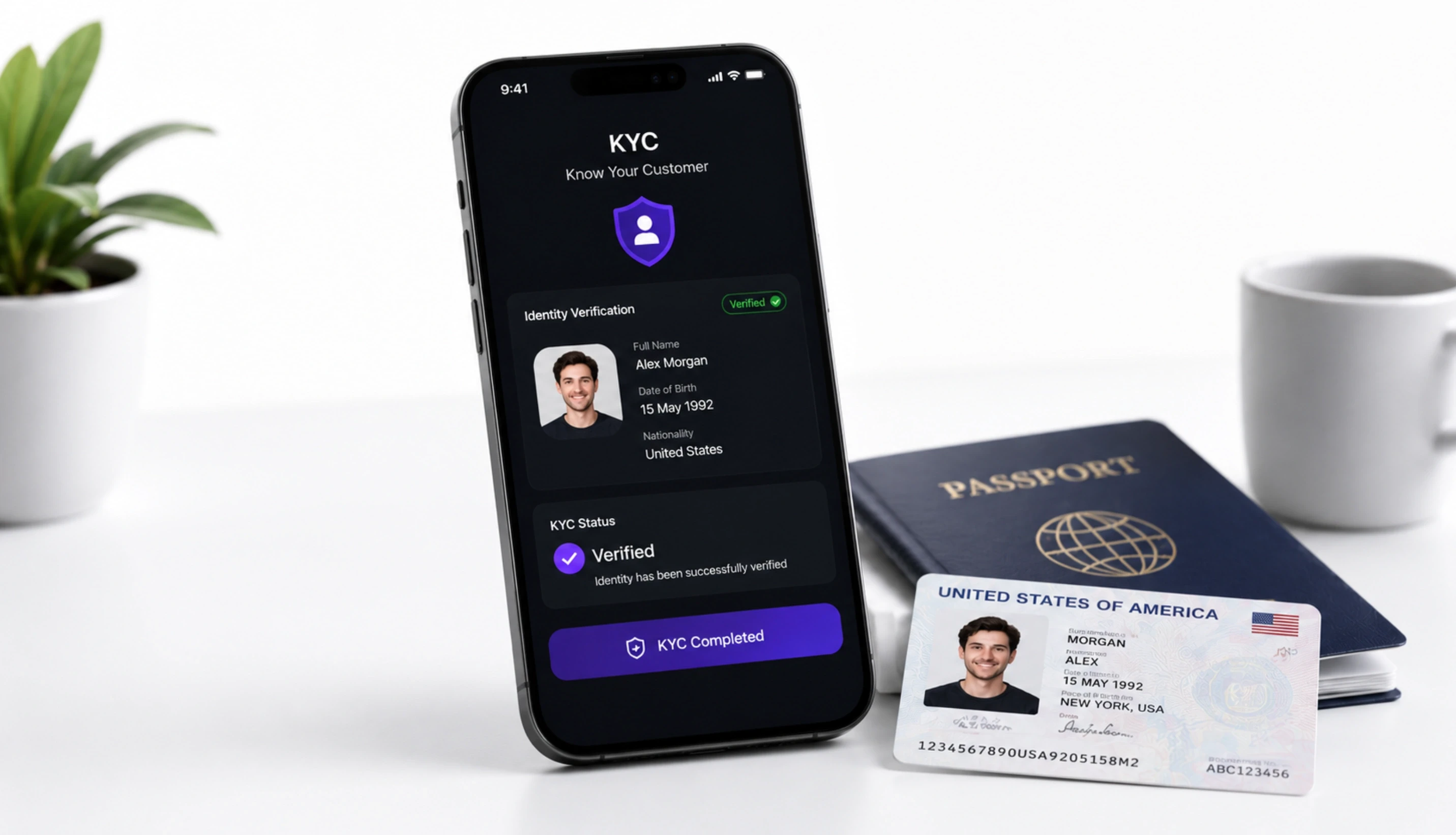
KYC (Know Your Customer) and AML (Anti-Money Laundering) compliance is where most neo-banks underestimate the scope. It is not a single API integration. It is a five-layer verification and monitoring architecture that touches the data model, the user onboarding flow, the transaction processing layer, the alert management system, and the regulatory reporting pipeline. Every layer must be present before the first live user is onboarded.
Layer 1: Document Verification and Liveness Detection
Providers: Onfido / Jumio / Shufti Pro / Digilocker (India) / iDenfy
Captures government-issued ID (passport, driving licence, national ID), extracts identity data (name, date of birth, ID number, expiry), assesses document authenticity using ML-based analysis, and performs liveness detection - a biometric check confirming the person submitting the document is physically present and not presenting a photo, video, or deepfake.
Output: Verification outcome: APPROVED / REJECTED / MANUAL_REVIEW. Confidence score. Extracted PII. Document classification.
Timeline & Cost: Sandbox: 1–2 weeks. Production access: 2–4 weeks. Pricing: $1–$4 per verification at volume.
Layer 2: Sanctions Screening and PEP Check
Providers: ComplyAdvantage / Dow Jones / LexisNexis / Refinitiv World-Check
Screens the applicant's name, date of birth, and nationality against: OFAC SDN List (US), HM Treasury Sanctions List (UK), EU Consolidated Sanctions List, UN Security Council Consolidated List, and PEP (Politically Exposed Person) databases covering 1,200+ government positions across 190+ countries. Must run at onboarding and on a scheduled basis as lists update (typically daily).
Output: Match / No Match result per list. Fuzzy match score for name variations. PEP designation with role and jurisdiction.
Timeline & Cost: API response: <500ms. Setup: 1–2 weeks. Ongoing: $0.05–$0.25 per screening.
Layer 3: Risk Scoring and Customer Due Diligence (CDD)
Providers: Custom rules engine (built in-house) + provider data inputs
Assigns a risk score to each applicant based on: geography (high-risk jurisdictions), occupation, transaction volume declared, PEP status, source of funds declaration, and any adverse media hits. Determines the level of due diligence required: Standard CDD for low-risk customers; Enhanced Due Diligence (EDD) for high-risk, PEPs, or high-value accounts (triggered at onboarding and periodically during the relationship).
Output: Risk tier: LOW / MEDIUM / HIGH. Assigned CDD level. Review queue assignment for EDD cases.
Timeline & Cost: Build time: 4–8 weeks for rules engine. No API cost - data inputs from Layers 1 and 2.
Layer 4: Real-Time Transaction Monitoring
Providers: Featurespace / NICE Actimize / ComplyAdvantage TM / Custom rules engine
Monitors every transaction in real time for AML red flags: structuring (multiple transactions just below CTR reporting thresholds), rapid velocity (unusual transaction frequency for account type), unusual geography (transactions from sanctioned jurisdictions), round-number patterns (common in money laundering), and counterparty risk (payments to/from flagged accounts). Generates alerts for human review when rules are triggered.
Output: Alert queue with risk score, triggering rule, transaction detail, and recommended action (ALLOW / REVIEW / BLOCK).
Timeline & Cost: Rule evaluation: <200ms per transaction. Build for custom engine: 6–10 weeks. SaaS TM provider: $0.005–$0.02 per transaction.
Layer 5: Regulatory Reporting (CTR, SAR, STR)
Providers: Internal compliance team + reporting interface
Generates mandatory regulatory reports: Currency Transaction Reports (CTR, US) for cash transactions >$10,000; Suspicious Activity Reports (SAR, US/UK) when money laundering is suspected; Suspicious Transaction Reports (STR, India) filed with FIU-IND. Must interface with FinCEN (US), NCA (UK), or FIU-IND (India) submission systems. Report generation must be automated - manual extraction at any scale is a compliance risk.
Output: Structured XML/JSON reports in jurisdiction-specific format, submitted to regulator within required timeframe (CTR: 15 days; SAR/STR: 30 days in most jurisdictions).
Timeline & Cost: Build time for reporting module: 4–6 weeks. Legal review of SAR templates: 2–4 weeks.
Building a Neo-Bank? Start With a KYC/AML Architecture Review.
Acquaint Softtech scopes the complete KYC/AML pipeline for your target jurisdiction — including provider selection, data model design, and regulatory reporting architecture — within 48 hours of your brief. Our discovery workshop delivers the compliance register before the first sprint begins.
Neobank App Features List: What to Build for Launch, What to Defer
Every neo-bank product is pulled toward feature bloat by investor pressure and competitive benchmarking. The antidote is a disciplined compliance-first feature classification: every proposed feature belongs to one of three categories, compliance-mandatory (cannot launch without it), launch-recommended (significantly improves activation and retention), or post-MVP (valuable but deferrable). The classification below is based on Acquaint Softtech's delivery experience across digital banking builds for the UK, EU, India, US, and Australia.
As the product evolves beyond MVP, maintaining system stability during upgrades becomes equally critical. Leveraging version upgrade services ensures your neo-bank platform stays secure, compatible with third-party integrations, and aligned with evolving compliance requirements without disrupting live operations.
Feature | Category | Phase | Compliance Driver / Business Reason |
|---|---|---|---|
KYC onboarding (document verification + liveness) | Compliance-Mandatory | Pre-Launch | Required by FCA, RBI, and FinCEN before any account can be opened. No exceptions. |
Sanctions + PEP screening | Compliance-Mandatory | Pre-Launch | OFAC, HM Treasury, and EU Consolidated List checks must run during onboarding and continuously afterward. |
Double-entry ledger | Compliance-Mandatory | Pre-Launch | Core banking requirement. Without this, balances cannot be audited and regulatory approval is not possible. |
Immutable audit log | Compliance-Mandatory | Pre-Launch | Required for FCA CASS audits and RBI inspections. Cannot be retrofitted into a live banking system. |
AML transaction monitoring | Compliance-Mandatory | Pre-Launch | Mandatory before live transactions begin. CTR/SAR filing obligations start with the first transaction. |
Multi-factor authentication (MFA) | Compliance-Mandatory | Pre-Launch | Required under PSD2 SCA (EU/UK), RBI 2FA mandate (India), and FTC security guidelines (US). |
Account dashboard (balances + transactions) | Launch-Recommended | Sprint 1 | Core banking UX. Compliance systems come first architecturally, but this defines the usable product. |
Domestic transfers (SEPA, Faster Payments, UPI, ACH) | Launch-Recommended | Sprint 1 | Essential banking utility. One payment rail is enough for MVP; additional rails can follow later. |
Debit card issuance (virtual first) | Launch-Recommended | Sprint 1–2 | Virtual cards launch faster with BaaS providers. Physical cards require longer operational lead times. |
Push notifications (payments + security alerts) | Launch-Recommended | Sprint 1 | Important for fraud detection and transaction confirmations. Required in some jurisdictions. |
Biometric authentication (Face ID / fingerprint) | Launch-Recommended | Sprint 1 | Standard mobile banking expectation and supports SCA compliance for high-value transactions. |
Spending categories + transaction search | Launch-Recommended | Sprint 2 | Improves engagement and retention, though not directly compliance-related. |
Savings pots / goals | Post-MVP | Sprint 3+ | Valuable engagement feature but introduces additional ledger complexity. |
International transfers (SWIFT / FX) | Post-MVP | Sprint 3+ | Requires correspondent banking relationships and FX liquidity management. High operational complexity. |
Physical card issuance | Post-MVP | Sprint 2–3 | Virtual cards validate the product first. Physical cards add fulfilment and manufacturing costs. |
Overdraft / credit facility | Post-MVP | Sprint 4+ | Requires separate lending licences and significantly expands compliance obligations. |
Business accounts / SMB banking | Post-MVP | Phase 2 | Requires business KYC, UBO verification, and separate operational workflows. |
Open Banking / account aggregation | Post-MVP | Sprint 4+ | Requires PSD2 AISP/PISP authorisation or equivalent regulatory approval. |
Neobank App Tech Stack: Architecture by Component
The neobank app tech stack is not a single framework choice; it is a component architecture where each layer has specific requirements driven by the compliance and performance needs of banking systems. The stack below reflects Acquaint Softtech's standard architecture for digital banking builds, refined across 1,300+ projects.
Architecture Layer | Technology Choice | Why for Neo-Banking | Key Requirement Satisfied |
Core Banking API | Python (FastAPI) + Celery | FastAPI provides async request handling for concurrent account queries; Celery manages background settlement, notification, and AML monitoring tasks without blocking the API thread. | Sub-200ms account balance reads; async settlement processing; AML monitoring as background tasks |
Ledger and Accounts Database | PostgreSQL 15+ | ACID compliance with row-level locking for concurrent balance updates. JSONB columns for flexible transaction metadata. Native support for financial audit patterns. Point-in-time recovery (PITR) for regulatory reconstruction. | Strong consistency for balance reads; immutable audit log support; PITR for regulatory requirements |
Read Replica / Reporting Store | PostgreSQL Read Replica + Redshift/BigQuery | Read replicas serve transaction history queries without competing with write operations. Separate OLAP store for monthly statements, analytics dashboards, and regulatory reports. | Balance consistency on primary; analytical workload isolation; statement generation at scale |
KYC/AML Event Processing | Apache Kafka + Python consumers | Kafka decouples KYC events (document uploaded, verification completed, sanctions result received) from the synchronous onboarding flow. Enables replay for failed events and audit log of all KYC state transitions. | Event-driven KYC pipeline; full replay capability; decoupled AML monitoring from transaction processing |
Card Management | BaaS provider API (Marqeta/Railsr) or Carta Worldwide | Card issuance, real-time spending authorisation, and transaction webhooks are handled by the provider. Internal card management service translates provider events to ledger entries and sends push notifications. | Real-time authorisation (<100ms); instant virtual card issuance; spending controls |
Mobile App (iOS + Android) | React Native + TypeScript | Single codebase with access to secure enclave (Face ID/Touch ID) for biometric auth. Offline balance display with background sync. Certificate pinning for all banking API calls to prevent MITM. | Biometric SCA compliance; offline capability; certificate pinning for API security |
Web Dashboard (Admin + Compliance) | React JS + TypeScript | Compliance officer dashboard (AML alert review, customer risk tier management), operations dashboard (failed transactions, holds management), customer service portal (transaction dispute initiation). | Compliance alert review UX; customer service tooling; audit log viewer |
Notifications | Firebase (push) + Twilio (SMS) + SendGrid (email) | Real-time transaction notifications via push (<1s delivery target). SMS for OTP during 2FA and high-value transaction approval. Email for statements, regulatory notices, and account alerts. | Sub-1s push delivery; SMS OTP for SCA compliance; email for regulatory communications |
Infrastructure | AWS (EKS + RDS + KMS + WAF + CloudTrail) | PCI-DSS and SOC 2 compliant managed services. KMS for encryption key management. CloudTrail provides immutable infrastructure audit log. WAF protects banking API endpoints from OWASP Top 10. | PCI-DSS infrastructure; key management; network-level security; infrastructure audit trail |
CI/CD and Security Scanning | GitHub Actions + Snyk + OWASP ZAP + Terraform | Automated security scanning on every commit (Snyk for dependencies, ZAP for DAST). Infrastructure-as-code via Terraform ensures reproducible, auditable infrastructure. Zero-downtime deployments via blue-green strategy. | Security scanning in pipeline; reproducible infrastructure; zero-downtime deployments for always-on banking product |
Acquaint Softtech’s software product development team for neo banking engagements, which brings together experienced Python backend engineers, React Native mobile developers, and DevOps engineers who manage secure AWS banking infrastructure. Each team is structured to support high-performance financial systems, ensuring compliance, scalability, and fast iteration. A dedicated project manager oversees sprint planning, delivery timelines, and compliance milestone tracking to keep the build aligned with regulatory and product goals.
The team is deployment-ready, with the first engineer onboarding within 48 hours of engagement confirmation, enabling founders to move from planning to execution without delay. For structured delivery and consistent execution, you can also hire a project manager to support streamlining communication, managing risks, and ensuring a timely product launch.
Evaluating the Right Tech Stack for Your Neo-Bank?
Acquaint Softtech returns a proposed architecture diagram, tech stack recommendation by component, and team structure for your specific neobank product within 48 hours. No commitment required to receive the architecture review.
The Week-by-Week Neo-Bank Launch Roadmap (BaaS Path)
.webp "The Week-by-Week Neo-Bank Launch Roadmap")
The BaaS consumer path is the correct first build for most neo-banks. The roadmap below covers the BaaS path from contract to first live user — 26 weeks for a well-scoped, well-resourced team. This is not a generic software development schedule: every phase is sequenced to match the compliance dependencies that govern what can be built when.
Phase 1 Wks 1–3 | Phase 2 Wks 4–8 | Phase 3 Wks 9–14 | Phase 4 Wks 15–19 | Phase 5 Wks 20–23 | Phase 6 Wks 24–26 |
Foundation: BaaS onboarding + Compliance register + Data model | KYC/AML Pipeline: Doc verify + Sanctions + Risk scoring + Audit log | Core Product: Ledger + Accounts + Transfers + Card issuance | Mobile App: React Native + Biometric auth + Push notifs | Security + Testing: Pen test + Load test + BaaS UAT | Launch: Beta users + Monitoring + Compliance sign-off |
Phase 1 - Foundation (Weeks 1–3)
Execute BaaS partner agreement (Railsr/Marqeta/Unit/Solarisbank, legal review: 2–3 weeks)
Complete compliance register: document every regulatory obligation by jurisdiction (KYC rules, AML thresholds, CTR/SAR timelines, data residency requirements)
Finalise data model: ledger schema (double-entry), accounts table, audit log table, holds table, all reviewed by a FinTech architect before any development begins
Establish AWS environment: VPC, RDS PostgreSQL, EKS cluster, KMS keys, CloudTrail logging, infrastructure-as-code via Terraform from day one
Integrate BaaS sandbox: obtain test credentials, verify API connectivity, map BaaS webhook events to internal ledger entry types
Phase 2 - KYC/AML Pipeline (Weeks 4–8)
Integrate document verification provider (Onfido sandbox → production: allow 3–4 weeks for production approval)
Build liveness detection flow in mobile app (React Native)
Integrate sanctions + PEP screening (ComplyAdvantage or LexisNexis): real-time at onboarding + nightly scheduled rescreening
Build risk scoring rules engine: geography, occupation, declared source of funds, PEP flag → assigns CDD level
Implement audit log: append-only PostgreSQL table with row-level security policy preventing UPDATE/DELETE
Build an AML transaction monitoring rules engine (Phase 1 rules: structuring, velocity, geography). TM provider integration if using SaaS.
Build compliance officer dashboard: alert review queue, customer risk tier management, manual override workflow
Phase 3 - Core Product (Weeks 9–14)
Build account management API: create account, get balance, get transaction history, close account
Implement domestic payments: SEPA (EU), Faster Payments (UK), UPI (India), or ACH (US) via BaaS API, translate BaaS payment events to ledger entries
Build transfer initiation flow: beneficiary management, payment limits, confirmation screens, idempotency key handling
Integrate card issuance via BaaS: virtual card provisioning (<2 minutes from KYC approval), spending controls, transaction webhooks → ledger entries
Build settlement reconciliation: a scheduled job that matches BaaS-reported settlements against ledger entries, flags discrepancies for operations review
Build a notification system: FCM push for real-time transaction events, Twilio SMS for OTP, SendGrid for statements
Phase 4 - Mobile App (Weeks 15–19)
Build React Native iOS and Android app: onboarding flow (KYC), account dashboard (balance, recent transactions), transfer initiation, card management
Implement biometric authentication: Face ID / Touch ID via React Native Keychain, secure enclave storage for auth tokens
Implement certificate pinning: prevent MITM attacks on banking API calls from mobile
Implement push notification handling: foreground and background handlers for transaction events and security alerts
Build transaction detail view: merchant name, category, amount, status, reference, dispute initiation button
Phase 5 - Security and Testing (Weeks 20–23)
External penetration test: OWASP Top 10 coverage, mobile app pen test (OWASP Mobile Top 10), API security assessment
Load testing: simulate 10x expected peak transaction volume, validate sub-200ms balance read response time under load
BaaS UAT: complete the BaaS provider's mandatory technical validation before production access is granted
Regulatory compliance review: legal counsel reviews KYC documentation, AML policy, and T&Cs against target jurisdiction requirements
Remediate all critical and high findings from pen test (medium findings: risk-accepted or scheduled post-launch)
Phase 6 - Launch (Weeks 24–26)
Soft launch to beta cohort (100–500 users): real KYC, real accounts, real transactions in production
24/7 monitoring: AWS CloudWatch alarms on ledger discrepancies, failed KYC rates, AML alert volume, API error rates
Compliance sign-off: compliance officer confirms KYC pipeline, AML monitoring, and audit log are functioning as documented
Incident response runbook: documented procedures for fraud event, data breach, ledger discrepancy, and BaaS outage
Public launch: marketing activation, press announcement, referral programme
Neobank App Development Cost in 2026: Three Engagement Tiers
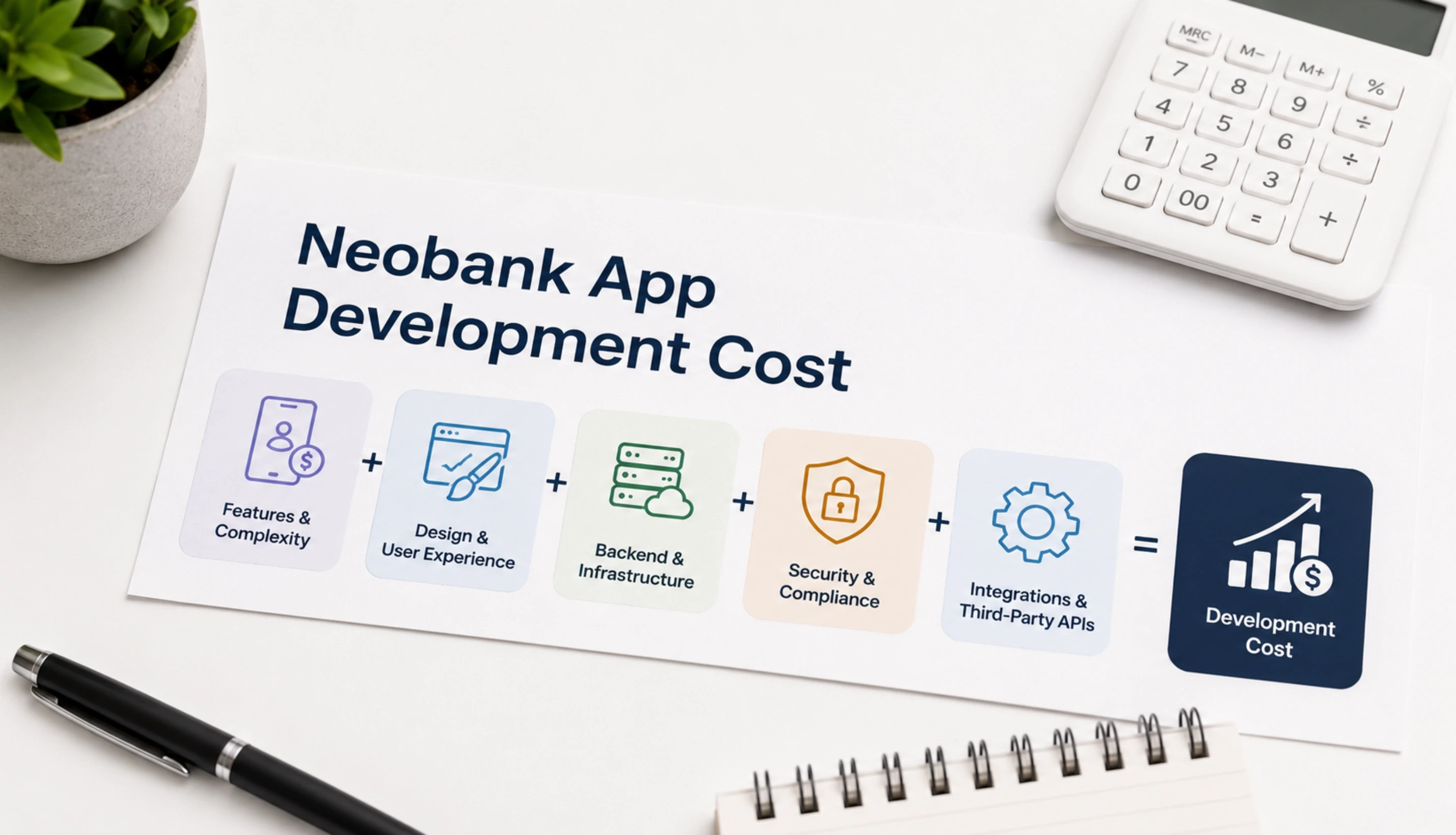
Neobank app development cost has three components that must all be budgeted: engineering team cost, third-party platform and compliance cost, and BaaS platform fees (if applicable). The three engagement tiers below cover the full range of neo-bank builds from BaaS MVP to a direct-licence core banking platform
Tier 1 - BaaS Consumer MVP Neo-bank MVP on BaaS platform. KYC/AML pipeline, ledger, accounts, domestic payments, virtual card, mobile app. One jurisdiction. One currency. |
Team Composition: 4–5 engineers: Python backend (2), React Native (1), DevOps (0.5), QA (0.5) + Tech Lead |
Monthly Team Cost (Acquaint Softtech): $18,000–$26,000/month |
Equivalent In-House Cost: $48,000–$68,000/month |
Annual Team Cost Saving: $360,000–$504,000 vs in-house |
BaaS Platform Fee: $0.10–$0.50 per transaction + monthly platform fee ($500–$5,000/month at MVP scale) |
KYC Provider Cost: $1–$4 per verification (Onfido/Jumio) |
AML Transaction Monitoring: $0.005–$0.02 per transaction OR in-house rules engine (one-time build cost included in team cost above) |
MVP Timeline: 18–28 weeks to first live user |
Total First-Year Budget (all-in): $380,000–$650,000 (team + BaaS + compliance + third-party providers) |
Tier 2 - Multi-Market BaaS Product Neo-bank on BaaS across 2–3 markets (e.g., UK + EU + India). Multi-currency, physical cards, savings features, open banking integration, business accounts. |
Team Composition: 6–8 engineers: Python backend (2–3), React Native (1–2), DevOps (1), QA (1), PM (0.5) + Tech Lead |
Monthly Team Cost (Acquaint Softtech): $28,000–$42,000/month |
Equivalent In-House Cost: $75,000–$110,000/month |
Annual Team Cost Saving: $564,000–$816,000 vs in-house |
BaaS Platform Fee: Multiple BaaS relationships — $0.08–$0.40 per transaction per market |
FX and Multi-Currency: Liquidity management API (Currencycloud/Wise Business API): $200–$1,000/month + per-conversion fee |
Regulatory: Multi-jurisdiction legal review: $20,000–$60,000 one-time + ongoing compliance counsel |
Timeline to Multi-Market MVP: 28–40 weeks |
Tier 3 - Direct Licence Core Banking Platform Neo-bank with direct EMI or banking licence. Custom core banking system (or licensed CBS), direct card scheme membership, own payment rails, full compliance ownership. |
Team Composition: 10–15 engineers: backend (4–5), mobile (2), DevOps (2), security specialist (1), QA (2), PM (1) + Tech Lead + Compliance Architect |
Monthly Team Cost (Acquaint Softtech): $45,000–$70,000/month |
Equivalent In-House Cost: $120,000–$185,000/month |
Annual Team Cost Saving: $900,000–$1,380,000 vs in-house |
Licensing Fees: EMI licence (UK FCA): £50,000 application + ongoing regulatory fees; Banking licence (India RBI): INR 200Cr minimum capital; US MTL: varies by state ($1,000–$100,000 per state |
Core Banking System (CBS): Licensed CBS (Mambu, Thought Machine Vault, Temenos): $50,000–$300,000/year licence; Custom build: included in team cost above |
Card Scheme Membership: Visa/Mastercard principal membership: $25,000–$75,000 application + annual fees |
Timeline to First Licensed User: 32–52+ weeks (excluding licensing process, which runs in parallel from Month 1) |
What Every Acquaint Softtech Monthly Rate Includes
All assigned engineers across backend, mobile, and DevOps, with no hidden staffing costs
Dedicated tech lead who owns architecture decisions, code review, and sprint quality
QA and security testing are integrated into every sprint, not billed separately
Compliance architecture review and integration checklist at engagement start
NDA executed at engagement start as a contract term, not a negotiation point
IP ownership: client owns all code, infrastructure scripts, and documentation from day one
48-hour deployment for the first engineer and for any team scaling or replacement requirement
For the specific hire resources on a neo-bank team: hire Python developers for the core banking API, hire React Native developers for the mobile banking app, hire DevOps engineers for the AWS banking infrastructure, and hire Django developers for the compliance officer and admin dashboards. Each role directly supports a critical layer of the neo banking architecture, from transaction processing to secure deployment and compliance workflows.
To build a reliable core banking system, you can hire Python developers who are experienced in financial data handling, API performance, and scalable backend systems. For mobile-first banking experiences, it is essential to hire React Native developers who can deliver secure, high-performance apps across both iOS and Android platforms.
To manage infrastructure, security, and continuous deployment pipelines, you should hire DevOps developers with expertise in AWS, CI CD, and cloud compliance standards. For internal tools such as compliance dashboards and admin panels, it is best to hire Django developers who can build secure, data-driven web applications aligned with regulatory requirements.
Neo-Bank Go-to-Market Readiness Checklist: 24 Questions Before You Launch
A neo-bank is not ready to launch when the features work in a demo. It is ready to launch when all 24 items below are confirmed. This checklist is used by Acquaint Softtech's team at the end of Phase 5 (Security and Testing) before recommending production go-live to any digital banking client.
✓ Compliance and Regulatory
KYC pipeline tested with real documents across all document types accepted in the target market
Sanctions and PEP screening confirmed live against all required lists (OFAC, HM Treasury, EU, UN, FIU-IND)
AML monitoring rules reviewed and signed off by compliance counsel — not just by engineering
CTR/SAR/STR reporting templates reviewed by legal counsel and tested in pre-production
Data retention policy implemented: 5–7 year minimum, jurisdiction-specific requirements documented
Privacy policy and Terms & Conditions reviewed by legal in all launch jurisdictions
✓ Architecture and Data Integrity
Ledger double-entry verified: test suite confirms every debit has a matching credit on the same transaction
Integer monetary storage confirmed: no FLOAT or DOUBLE columns in any financial table
Immutable audit log verified: UPDATE and DELETE blocked at database level via row-level security policy
Balance reconciliation passed: ledger balance matches BaaS provider balance for all test accounts
Idempotency confirmed: duplicate transaction submission returns original response without creating duplicate entry
Settlement reconciliation tested: test batch matches BaaS settlement report exactly
✓ Security
Penetration test completed by independent third party: all critical and high findings remediated
Certificate pinning is active on the mobile app for all banking API endpoints
Webhook signature verification implemented and tested with invalid signature payloads
MFA / biometric authentication tested on iOS and Android across target device range
TLS 1.3 confirmed on all API endpoints; TLS 1.2 endpoints documented and risk-accepted where required
Incident response runbook written, reviewed, and rehearsed by the operations team
✓ Operations and Monitoring
CloudWatch / Datadog alarms configured for: ledger discrepancy, failed KYC rate spike, AML alert volume, API error rate, BaaS outage
On-call rota established: named engineer on-call for production incidents 24/7
Compliance officer dashboard live and tested: AML alert review queue, customer risk tier management, manual override
Customer support process documented: how disputed transactions, frozen accounts, and KYC failures are handled
BaaS provider UAT completed and sign-off certificate received — required for production access in most BaaS agreements
Beta cohort agreement in place: 100–500 invited beta users with explicit beta T&Cs before public launch
For teams where multiple items on this checklist are incomplete: Acquaint Softtech's discovery workshop services produce a gap analysis against this checklist as a first deliverable, with a prioritised remediation plan and team structure to address each gap within the budget and timeline constraints of the specific product.
Ready to Build Your Neo-Bank? 48-Hour Team Deployment.
Acquaint Softtech has delivered digital banking builds for clients across the US, UK, Australia, and UAE, from BaaS MVPs to direct-licence core banking platforms. Share your neobank brief, and we will return a team structure, compliance register outline, and cost estimate within 48 hours. You interview every engineer before the first sprint begins.
Frequently Asked Questions
-
How much does it cost to build a neobank app in 2026?
BaaS Platform Type
Estimated Team Cost
Typical Timeline
Consumer BaaS MVP
$18,000–$26,000/month
18–28 weeks
Multi Market BaaS Platform
$28,000–$42,000/month
Depends on scope
Direct Licence Core Banking Platform
$45,000–$70,000/month
Enterprise scale
The first year budget for a BaaS MVP, including compliance, KYC, and platform fees, typically ranges from $380,000 to $650,000.
-
What features does a neobank app need at launch?
Compliance-mandatory at launch (cannot go live without these): KYC onboarding with document verification and liveness detection, sanctions and PEP screening, double-entry ledger, immutable audit log, AML transaction monitoring, and multi-factor authentication.
Launch-recommended for the first production sprint: account dashboard, domestic transfers (one payment rail), virtual debit card, push notifications, and biometric authentication. Post-MVP (can be deferred): savings pots, international transfers, physical card, overdraft facility, business accounts, and open banking integrations
-
How long does neobank app development take?
On the BaaS consumer path: 18–28 weeks from contract to first live user for a single-market MVP with a dedicated 4–5 engineer team. Multi-market BaaS product: 28–40 weeks. Direct-licence core banking platform: 32–52+ weeks for the engineering build, running in parallel with the licensing process, which takes an additional 12–36 months for FCA EMI or equivalent authorisation. The single biggest timeline risk on any path is third-party API production access, KYC providers, BaaS partners, and card schemes all have approval processes that must start before development begins.
-
What is the best tech stack for a neobank app?
Core banking API: Python (FastAPI) for async transaction handling and ML-based AML monitoring integration. Database: PostgreSQL with row-level locking for strong consistency on balance reads — ACID compliance is non-negotiable. Event processing: Apache Kafka for decoupled KYC and AML event pipelines. Mobile: React Native for a single iOS/Android codebase with secure enclave biometric authentication.
Infrastructure: AWS (EKS, RDS, KMS, CloudTrail) for PCI-DSS compliant managed services. The data model decision matters more than the language: integer monetary storage and double-entry bookkeeping are architectural requirements that must be confirmed before framework selection.
-
Should I use a BaaS provider or apply for my own banking licence?
For pre-Series A neo-banks: use BaaS. The 12–36 month licensing timeline on the direct path will exhaust the runway before product-market fit is validated. BaaS enables a first live user in 3–9 months, which is the only timeline that matters at the early stage. The trade-off, BaaS fees ($0.10–$0.50 per transaction) and reduced product flexibility is acceptable until monthly GMV exceeds $5M–$10M, at which point the direct-licence economics begin to justify the licensing investment. Start on BaaS, validate the proposition, then pursue a direct licence at Series A with data to support the application.
-
What is a core banking ledger, and why does it matter?
A core banking ledger is the system of record for every financial fact about every account in the bank. It implements double-entry bookkeeping, every debit has a corresponding credit of equal amount, and maintains an immutable audit trail of every state change. The ledger determines what is mathematically verifiable about the bank's financial position at any point in time. A neo-bank without a correctly designed ledger cannot produce a reliable balance, cannot pass a regulatory audit, and cannot reconcile with its BaaS provider's settlement reports. It is not a feature; it is the product.
-
What KYC requirements apply to a neo-bank in the UK and India?
UK: FCA requires KYC under the Money Laundering Regulations 2017. All customers must be identity-verified before account opening. Enhanced Due Diligence required for PEPs, high-risk jurisdictions, and high-value accounts. Annual risk-based CDD review required for all customer relationships. SAR filing to the NCA for suspected money laundering.
India: RBI PPI Master Directions require full KYC (Aadhaar OTP or biometric + PAN) for full KYC PPI accounts (maximum balance: ₹200,000). CERSAI check for PEP screening. STR filing to FIU-IND within 7 days of suspicion. Both jurisdictions require liveness detection for remote onboarding.
-
Can I build a neobank with an India-based development partner?
Yes. Acquaint Softtech delivers neo-banking builds for clients in the UK, US, Australia, UAE, and India, operating under their respective regulatory frameworks. The compliance obligations sit with the licensed entity in the operating jurisdiction, not the development partner.
Acquaint Softtech signs an NDA and Data Processing Agreement before the first meeting, and IP ownership is assigned to the client from day one as a contract term. The architectural decisions, ledger design, KYC pipeline, and AML monitoring- are made collaboratively based on the target jurisdiction's regulatory requirements, with the client's legal counsel validating the compliance framework.
I lead technology and client success at Acquaint Softtech with one goal in mind. Deliver work that feels personal, reliable, and worthy of long term trust. I stay close to both our clients and our developers to make sure every project moves with clarity, quality, and accountability.
Table of Contents
Get Started with Acquaint Softtech
- 13+ Years Delivering Software Excellence
- 1300+ Projects Delivered With Precision
- Official Laravel & Laravel News Partner
- Official Statamic Partner
Related Blog
.webp "The Complete Guide to FinTech Software Development in 2026")
The Complete Guide to FinTech Software Development in 2026
Complete guide to fintech software development 2026: all five verticals, compliance architecture, real build sequences, AI capabilities, and fintech development cost, from 1,300+ delivered projects.

Acquaint Softtech
May 6, 2026
How Payment Gateways Work: Transaction Flow, APIs, and Settlement Explained
A payment gateway is not a checkout button. It is a 7-step transaction pipeline that authenticates, routes, scores, and settles every card payment in under 2 seconds. Here is exactly how it works.

Ahmed Ginani
May 11, 2026
Laravel 12 for SaaS & Fintech: Scalable, Secure, Compliant
Explore how Laravel 12 powers SaaS, fintech, and regulated industry apps with compliance, modularity, and secure architecture.
Acquaint Softtech
July 1, 2025India (Head Office)
203/204, Shapath-II, Near Silver Leaf Hotel, Opp. Rajpath Club, SG Highway, Ahmedabad-380054, Gujarat
USA
7838 Camino Cielo St, Highland, CA 92346
UK
The Powerhouse, 21 Woodthorpe Road, Ashford, England, TW15 2RP
New Zealand
42 Exler Place, Avondale, Auckland 0600, New Zealand
Canada
141 Skyview Bay NE , Calgary, Alberta, T3N 2K6