

How to Compare Multiple Python Development Vendors Side-by-Side
Compare multiple Python development vendors side-by-side with a weighted scoring framework. Real 2026 criteria, a ready template, and smart tie-breakers.

Acquaint Softtech
Introduction: Why Side-by-Side Scoring Beats Gut Feel
Most CTOs evaluate Python development vendors the same way they shop for a used car. Three quotes, one call with each, a gut feel about trust, and a decision based on the impression of the last conversation. The problem is that Python outsourcing decisions involve dozens of variables, and the human brain is terrible at holding more than four or five of them in working memory at once. That is exactly why the vendor that remembered your team's name wins over the vendor that had better engineers.
The stakes are not small. According to the 2026 IT outsourcing playbook by TekRecruiter citing ConnectBit's market data, the global IT outsourcing market is projected to grow at 10.99% CAGR to reach $777 billion by 2028, with 76% of executives now outsourcing IT functions. At this scale, picking the wrong Python vendor is not just a slow start. It is a budget write-off and a six-month product delay.
A weighted scoring framework solves the memory problem. It forces every stakeholder to rank what matters before the sales calls start, scores each vendor consistently against those priorities, and produces a defensible decision that your CFO, your legal team, and your future self will all accept. This guide walks through how to build and use that framework for any Python development vendor comparison in 2026.
If you have not yet shortlisted vendors, start with the complete guide to hiring Python developers in 2026 to understand the market. Then come back to this scoring framework to compare the three to five vendors that made your shortlist.
Step 1: Define Your Evaluation Criteria Before Any Sales Call
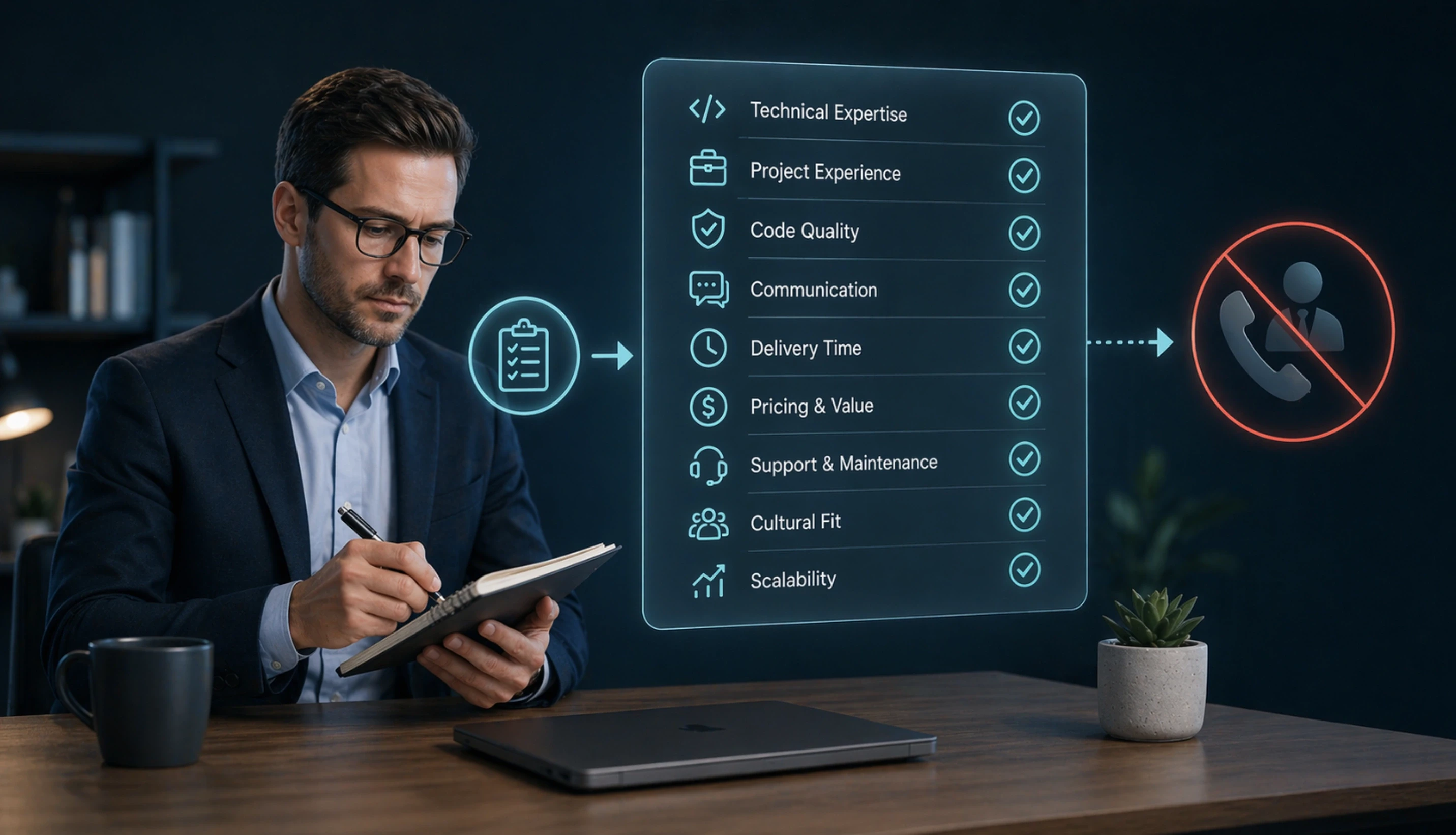
The single most expensive mistake in vendor comparison is letting the sales conversation define what matters. Sales teams are trained to shift the conversation toward their strengths. Your scoring criteria need to be locked before the first pitch deck opens.
A strong Python vendor scoring framework uses six evaluation categories. These are the categories that correlate with actual delivery outcomes, not surface impressions.
Technical capability:
Python expertise depth, framework fluency (Django, FastAPI, Flask), production experience in your domain, senior engineer availability.
Engagement model fit
Whether the vendor supports staff augmentation, dedicated team, or fixed-price structures that match your project stage.
Contract and IP protection
IP assignment timing, NDA coverage, SLA specifics, termination clause fairness, breach remedies.
Communication and process
Timezone overlap, response time commitments, sprint cadence, project management discipline.
Cost structure
Hourly rate transparency, hidden fees, billing cadence, escalation rules. Not just the headline number.
References and track record
Verified client testimonials, case studies in your industry, Clutch or G2 reviews, reachable references.
For the deeper due-diligence framework that sits behind each of these categories, the guide on how to evaluate a Python development partner walks through the specific questions and evidence to collect for each one.
Step 2: Assign Weights That Reflect Your Real Priorities
Not every criterion carries the same weight. A SaaS product in active development cares more about technical capability and communication than lowest cost. An internal tool with a defined scope cares more about cost and contract clarity than senior engineer depth. Your weights should reflect the project, not a generic template.
The standard weighting pattern in professional RFP processes is useful as a starting point. Procurement Tactics' 2026 RFP evaluation guide notes that technical expertise is commonly assigned the highest weight at 30% because it is essential to successful implementation, with costs following at 20% to balance quality with budget. Adjust from there based on what your project actually requires.
Here is a realistic weighting distribution for a typical Python development engagement in 2026. The percentages are starting points, not absolutes. Debate them with your stakeholders before you finalise.
Table: Recommended Weighting for a Typical Python Development Engagement
Evaluation Category | Suggested Weight | When to Increase |
|---|---|---|
Technical capability | 30% | Complex product, senior engineers critical |
Contract and IP protection | 20% | Enterprise compliance, regulated data |
Communication and process | 15% | Distributed team, tight sprint cadence |
Cost structure | 15% | Fixed budget, early-stage startup |
Engagement model fit | 10% | Unclear scope, evolving requirements |
References and track record | 10% | First-time outsourcing, enterprise risk |
Step 3: Build the Scorecard With a Consistent Scoring Scale
A weighted framework only works if every evaluator scores on the same scale. The industry-standard approach is a 0 to 5 scoring band with clear definitions at each level, so that two people reviewing the same vendor proposal land within a point of each other.
The Responsive analysis of RFP evaluation criteria confirms that the weighted scoring approach is the dominant framework for strategic sourcing projects, because it breaks down evaluation by question or section and assigns a value to each. That structure is what keeps a three-vendor comparison objective rather than a popularity contest.
Table of Standard 0 to 5 Scoring Scale for Vendor Evaluation
Score | Definition | Example |
|---|---|---|
0 | Does not meet requirement | No Python senior engineers available |
1 | Partially meets, major gaps | One senior engineer, others junior |
2 | Meets baseline requirement | Adequate team, no standout strength |
3 | Meets fully, solid delivery expected | Strong team, production track record |
4 | Exceeds requirement in some areas | Senior team plus domain expertise |
5 | Exceeds requirement across the board | Senior team, domain depth, references |
Multiply each score by the category weight to get a weighted point total. The vendor with the highest weighted total is the front-runner on paper. The front-runner on paper still has to pass the tie-breaker round, which matters more than the raw total.
Step 4: Use the Side-by-Side Vendor Scorecard
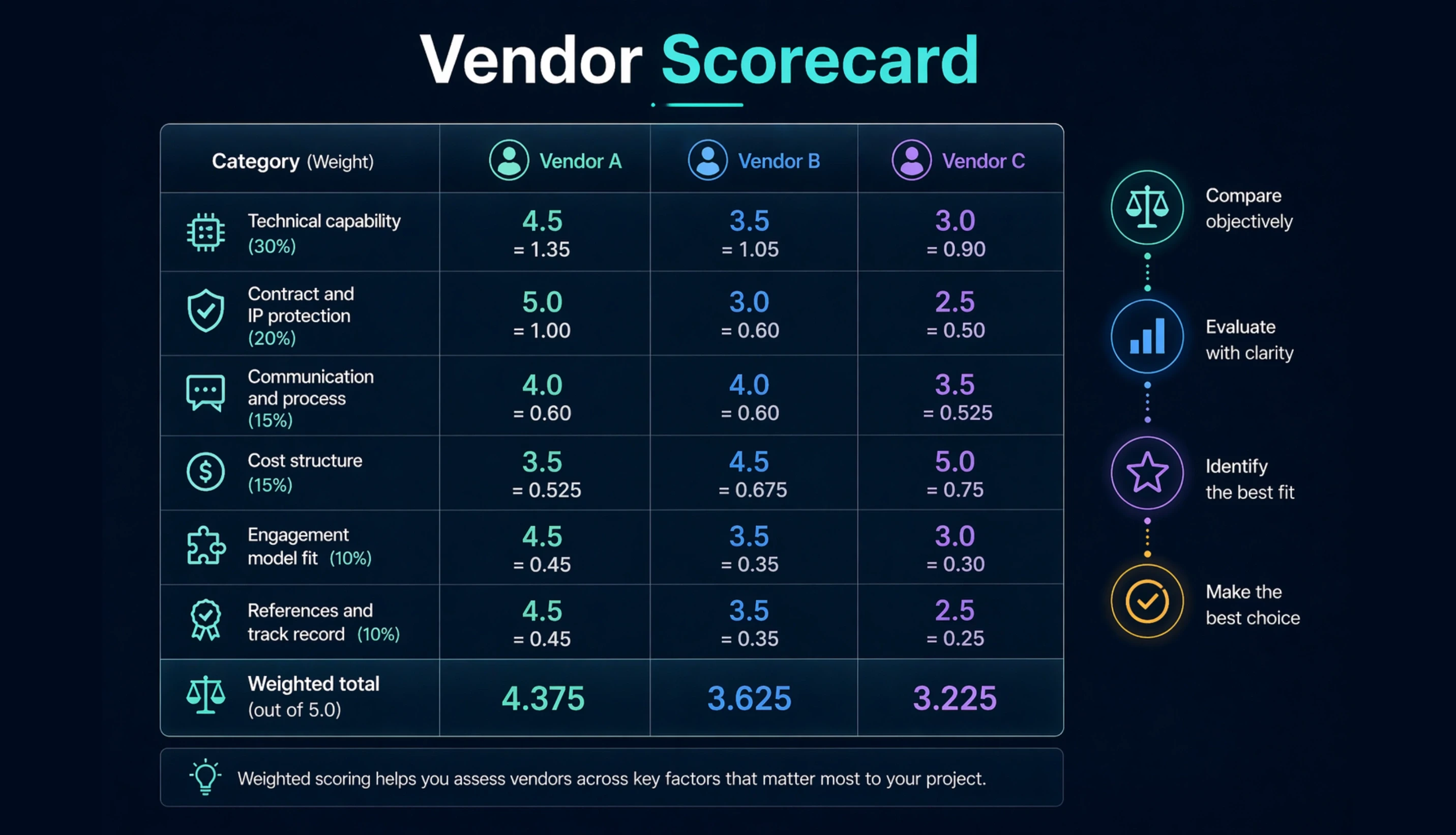
Copy this scorecard into a spreadsheet. List your shortlisted vendors across the top. Score each category on the 0 to 5 scale. Multiply by the weight. Total the weighted points per vendor. The table below shows the template with three example vendors for a typical Python engagement.
Table: Example Python Vendor Scorecard (Weighted Scoring)
Category (Weight) | Vendor A | Vendor B | Vendor C |
|---|---|---|---|
Technical capability (30%) | 4.5 = 1.35 | 3.5 = 1.05 | 3.0 = 0.90 |
Contract and IP protection (20%) | 5.0 = 1.00 | 3.0 = 0.60 | 2.5 = 0.50 |
Communication and process (15%) | 4.0 = 0.60 | 4.0 = 0.60 | 3.5 = 0.525 |
Cost structure (15%) | 3.5 = 0.525 | 4.5 = 0.675 | 5.0 = 0.75 |
Engagement model fit (10%) | 4.5 = 0.45 | 3.5 = 0.35 | 3.0 = 0.30 |
References and track record (10%) | 4.5 = 0.45 | 3.5 = 0.35 | 2.5 = 0.25 |
Weighted total (out of 5.0) | 4.375 | 3.625 | 3.225 |
In this example, Vendor A wins on technical capability and contract protection but loses ground to Vendor C on headline rate. The weighted framework surfaces the full picture. Vendor C is cheaper but scores lower on every quality dimension. The framework tells you what your instinct might have missed: the cheaper vendor creates more risk than the savings justify.
Need a Benchmark Vendor for Your Scorecard?
Acquaint Softtech is the vendor most shortlists benchmark against. 1,300+ projects delivered. Pre-vetted Python engineers. IP assignment before the first commit. Transparent pricing from $20/hour. No agency markup.
Step 5: Apply the Tie-Breakers When Scores Are Close
When two vendors score within 0.3 points of each other on a 5-point scale, the weighted total alone is not decisive. Use these tie-breakers in order to pick the winner.
Reference call quality:
Did the reference describe specific production wins and specific failure recoveries, or did they offer generic praise? Specificity predicts real experience.
Named developer commitment:
Will the vendor name the specific developer who will work on your project in the contract? Bait-and-switch is the most common Python outsourcing complaint.
Exit clause fairness:
A vendor confident in their delivery accepts a 30-day termination clause. A vendor hiding weaknesses fights for 90 days.
Response time during evaluation:
If they take three days to answer an email during the sales cycle, they will take longer during delivery.
Willingness to do a paid trial:
A vendor who refuses a 30-day paid trial on a real deliverable is telling you something about their confidence in the team they will assign.
For the full detection framework on warning signs across pre-engagement, mid-project, and post-delivery phases, the guide on red flags when outsourcing Python development covers how each signal maps to a real risk.
Step 6: Avoid the Common Scoring Mistakes
Even a well-designed scoring framework fails when the scoring is done sloppily. Watch for these patterns.
Anchoring on the cheapest vendor. Cost should rarely exceed 20% of total weight. A 50% cost weight produces decisions that look smart on the procurement summary and expensive on the delivery ledger.
Letting one stakeholder dominate scoring. Different evaluators weight differently. Average the scores across three to five people, then discuss variance above 1 point before finalising.
Accepting marketing claims as evidence. Five-star ratings on the vendor's own website are not references. Verified Clutch or G2 reviews, reachable named clients, and live case studies are.
Ignoring the scorecard once sales charm kicks in. The vendor who wins the charm contest is not always the vendor who ships the product. Stick to the scorecard total unless you have a documented reason to override.
Scoring on future promises rather than current capability. What the vendor will do after you sign is different from what the vendor does today. Score on evidence, not aspirations.
Step 7: Adjust the Framework by Engagement Model
The scoring framework is the same, but the emphasis shifts based on the engagement model you are evaluating. The right fit depends on project stage, scope clarity, and how much product context the work requires over time.
Table : Category Weight Adjustments by Engagement Model
Category | Fixed Price | Dedicated Team | Staff Augmentation |
|---|---|---|---|
Technical capability | 25% | 35% | 35% |
Contract and IP protection | 25% | 20% | 15% |
Communication and process | 10% | 20% | 25% |
Cost structure | 20% | 10% | 10% |
Engagement model fit | 10% | 10% | 10% |
References and track record | 10% | 5% | 5% |
If you are still deciding between engagement models before comparing vendors, the Python hiring models comparison breaks down the trade-offs across staff augmentation, dedicated team, and fixed-price outsourcing so you can weight this framework correctly.
Signals That Do Not Fit the Scorecard But Still Matter
Some signals do not appear on a formal scorecard but predict delivery quality strongly. Track them as a side-note during evaluation.
How quickly they share a technical lead's calendar:
Vendors that hide their senior engineers behind account managers during sales usually hide them during delivery too.
Whether they propose a discovery call before the proposal:
A vendor who submits a detailed proposal without understanding your product is guessing, not scoping.
How they describe past failures:
A vendor who claims no failed projects is either lying or inexperienced. Both are risks. A vendor who describes a specific recovery is showing you their real process.
Their comfort with a paid trial period:
A 30-day paid trial with a real deliverable is the single best predictor of long-term fit. Vendors who resist it should drop on your list.
The questions to ask before hiring Python developers guide covers the conversation framework that surfaces these signals without sounding confrontational.
How Acquaint Softtech Performs on This Framework
Acquaint Softtech is a Python development and IT staff augmentation company based in Ahmedabad, India, with 1,300+ software projects delivered globally across healthcare, FinTech, SaaS, EdTech, and enterprise platforms. We operate under the hiring framework described in the complete guide to hiring Python developers, and we perform strongly on every dimension of this scoring framework.
Technical capability:
Pre-vetted senior Python engineers across Django, FastAPI, Flask, TensorFlow, PyTorch, and data engineering pipelines.
Contract and IP protection:
IP assignment signed before the first commit, NDA coverage that survives termination, 30-day exit clause standard.
Communication and process:
Working hours overlap with US, UK, Europe, and Australia client schedules. Response time commitments written into the contract.
Cost structure:
Transparent pricing from $20/hour. No agency markup. No hidden fees. Fixed-budget projects from $5,000.
References and track record:
Verified Clutch reviews, reachable client references, and case studies including a GDPR-compliant analytics platform for BIANALISI, Italy's largest diagnostics group.
To put the framework into practice, you can hire Python developers with profiles shared in 24 hours and a structured evaluation process that removes the friction most vendor decisions get stuck on.
The Bottom Line
Comparing Python development vendors without a scoring framework is how good teams end up with the wrong partner. The vendor who charms the sales call is not always the one who ships the product. A weighted scorecard forces the comparison onto the dimensions that predict delivery, not the dimensions that predict likeability.
Six categories. Weights that reflect your project. A 0 to 5 scale applied consistently. Tie-breakers when scores are close. That is the framework. It takes an afternoon to build and saves six months of delivery pain. Build it once. Use it every time.
Comparing Python Vendors and Want a Structured Evaluation?
Book a free 30-minute consultation. We will walk through your scoring framework, help you pressure-test the weights, and give you an honest read on where Acquaint Softtech fits against your shortlist. No sales pitch. Just a structured conversation.
Frequently Asked Questions
-
How many Python development vendors should you compare for an accurate evaluation?
Ideally, you should compare 3 to 5 Python development vendors side-by-side. Comparing fewer than three limits your ability to benchmark technical capabilities, pricing, and delivery models. On the other hand, evaluating more than five vendors often leads to decision fatigue and inconsistent scoring.
-
What criteria matter most when comparing Python development companies?
When comparing Python development vendors, focus on criteria that directly impact delivery quality. The most important factors include:
Technical expertise in Python frameworks like Django and FastAPI
Experience in similar industries or project types
Code quality and architecture approach
Communication and project management process
Scalability and team structure
-
How long does it take to properly compare Python development vendors?
A structured vendor comparison typically takes 2 to 4 weeks for 3 vendors. This includes initial discussions, technical evaluation, proposal comparison, and internal decision-making.
-
What red flags should immediately disqualify a Python development vendor?
Any vendor showing the following issues should be considered a high risk:
Weak understanding of Python architecture or scalability
Inability to demonstrate live production applications
Over-reliance on freelancers instead of a stable in-house team
Lack of clear communication or delayed responses during evaluation
Any evaluation score below 2.0 in critical areas like engineering quality
A strong sales pitch cannot compensate for weak technical execution.
-
Should you share your evaluation framework with Python vendors?
Yes, sharing your scoring framework is highly recommended. It helps vendors understand your priorities, such as performance, scalability, or budget constraints. This leads to more relevant proposals and allows for a fair, apples-to-apples comparison across multiple Python development companies.
-
Is a paid trial project necessary before finalizing a Python vendor?
Yes, a paid trial (typically 2 to 4 weeks) is one of the most effective ways to validate a vendor. It allows you to assess:
Code quality in real conditions
Communication and responsiveness
Ability to meet deadlines
Problem-solving approach
For businesses outsourcing Python development, a paid trial significantly reduces long-term risk.
-
Should you prioritize a full-stack team or a Python-only vendor?
If your project involves frontend, APIs, and backend systems, choosing a full-stack development team with Python expertise is often more efficient. It reduces coordination issues, speeds up delivery, and ensures better system integration compared to managing multiple vendors.
We’re Acquaint Softtech, your technology growth partner. Whether you're building a SaaS product, modernizing enterprise software, or hiring vetted remote developers, we’re built for flexibility and speed. Our official partnerships with Laravel, Statamic, and Bagisto reflect our commitment to excellence, not limitation. We work across stacks, time zones, and industries to bring your tech vision to life.
Table of Contents
Get Started with Acquaint Softtech
- 13+ Years Delivering Software Excellence
- 1300+ Projects Delivered With Precision
- Official Laravel & Laravel News Partner
- Official Statamic Partner
Related Blog

When Is Python Development Too Expensive? Pricing Red Flags That Signal a Bad Vendor
Not all expensive Python development is justified. This guide identifies the exact pricing red flags that signal a bad vendor, with real benchmarks, warning signs, and what fair Python pricing actually looks like in 2026.
Acquaint Softtech
March 26, 2026
How to Hire Python Developers Without Getting Burned: A Practical Checklist
Avoid costly hiring mistakes with this practical checklist on how to hire Python developers in 2026. Compare rates, vetting steps, engagement models, red flags, and more.
Acquaint Softtech
March 30, 2026
Total Cost of Ownership in Python Development Projects: The Full Financial Picture
The build cost is just the beginning. This guide breaks down the complete TCO of Python development projects across every lifecycle phase, with real benchmarks, a calculation framework, and 2026 data.
Acquaint Softtech
March 23, 2026India (Head Office)
203/204, Shapath-II, Near Silver Leaf Hotel, Opp. Rajpath Club, SG Highway, Ahmedabad-380054, Gujarat
USA
7838 Camino Cielo St, Highland, CA 92346
UK
The Powerhouse, 21 Woodthorpe Road, Ashford, England, TW15 2RP
New Zealand
42 Exler Place, Avondale, Auckland 0600, New Zealand
Canada
141 Skyview Bay NE , Calgary, Alberta, T3N 2K6
Your Project. Our Expertise. Let’s Connect.
Get in touch with our team to discuss your goals and start your journey with vetted developers in 48 hours.