

Minimum Budget Required to Start a Python Development Project in 2026
What is the real minimum budget to start a Python development project in 2026? This guide breaks down costs by project type, team model, and engagement structure with verified benchmarks and no vague ranges.

Acquaint Softtech
The Number Everyone Wants. The Context Nobody Gives
Search “how much does Python development cost” and within thirty seconds you will find ranges spanning from $8,000 to $500,000 depending on who you ask. Every number is technically defensible. None of them are useful without the context that determines where on that spectrum your specific project lands.
The reason those ranges exist is not evasion. It is that the minimum viable budget for a Python development project depends on four variables that differ substantially across every organisation asking the question: what you are building, who builds it, where they are located, and how completely your requirements are defined before development starts. Change any one of those variables and the minimum budget shifts meaningfully.
This guide gives you the actual numbers, grounded in verified 2026 data from multiple sources, structured by project type and team model so you can locate your specific situation rather than stare at an unhelpful range. By the end, you will know the realistic minimum budget for your Python project, what that budget actually buys you, where the floor sits, and where underbudgeting creates costs that exceed the savings.
One clarification before we get into numbers: Python itself costs nothing. It is open-source. What businesses pay for is the engineering skill, time, infrastructure, and planning required to build something useful with it. According to PythonIndia’s 2025 cost guide, Python is free and among the top five programming languages as of 2025 per Statista. The cost is entirely in the work done with it.
Why Most Python Development Budgets Start Too Low
Before the project type breakdown, it is worth understanding the mechanism through which Python projects consistently open with insufficient budgets.
Gurkha Technology’s custom software development cost guide for 2026 puts it directly: software projects that go drastically over budget are almost always projects that were drastically underestimated on Day 1. They recommend applying a 1.5x rule: if a quote comes in at $100,000 for initial scope, plan the realistic budget at $150,000 to $200,000 once hidden costs and inevitable scope changes are factored in.
The components that cause this gap are consistent across projects:
Development cost is typically only 60 to 70% of first-year total cost, per February 2026 custom software guide. The remaining 30 to 40% comes from infrastructure, maintenance, QA, security, and integration work that does not appear in most initial estimates.
Teams that skip the discovery and planning phase overspend by an average of 40 to 60%, according to 2026 enterprise software development cost analysis. Most do not find out until they are three months into development, already past the point of easy correction.
March 2026 MVP budget guide confirms that teams skipping discovery spend 30 to 50% more on rework during development. A $3,000 to $15,000 investment in discovery routinely saves ten times that amount in avoided rework.
Compliance requirements, where applicable, add 20 to 35% to the base estimate per analysis. A Python fintech MVP that would cost $40,000 as a generic web application can reach $60,000 to $80,000 once regulatory compliance, security hardening, and audit trails are included, per industry context benchmarks.
Understanding these additions is not cause for alarm. It is cause for accurate budgeting, which is the difference between a Python project that launches and one that stalls when the money runs out.
Minimum Python Development Budget by Project Type (2026)
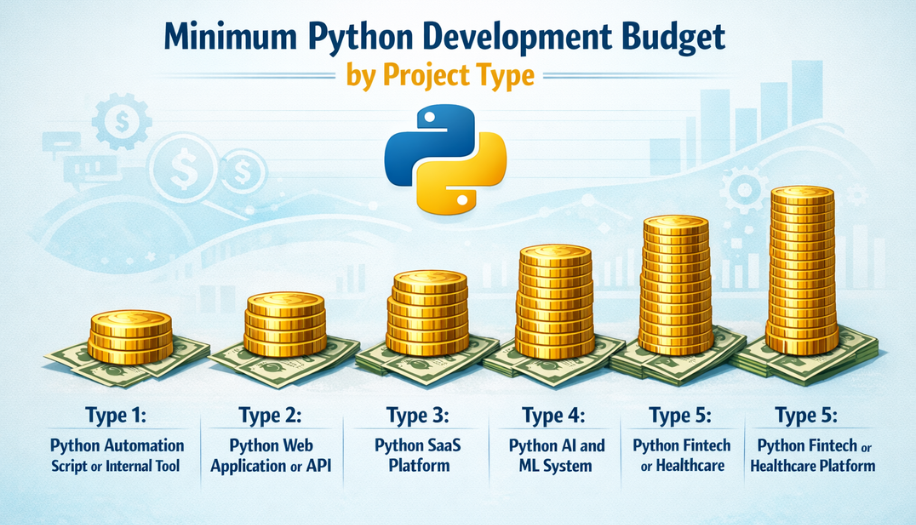
The following ranges are grounded in verified 2025 and 2026 benchmark data from multiple independent sources. Each range represents the realistic minimum for a properly scoped, vetted-team Python engagement at the lower end, and a more complex version of the same project type at the upper end.
Type 1: Python Automation Script or Internal Tool
This is the entry point for Python development budgets. Internal automation tools, data processing scripts, report generation systems, and workflow automation tools that serve internal teams rather than external customers.
Minimum budget: $5,000 to $20,000
At the low end, a Python script that automates a specific, well-defined internal process can be built in 40 to 80 hours at $22 to $60 per hour depending on the developer model chosen. At the higher end, an internal tool with a basic UI, database integration, and user authentication crosses into the $15,000 to $20,000 range.
PythonIndia’s 2025 cost breakdown places internal Python tools at $10,000 to $50,000 depending on integration complexity and reliability requirements, noting that while internal tools may not need polished user interfaces, they still require reliability and security.
What this budget buys: a functional tool that eliminates a defined manual process. What it does not buy: scalable architecture, multi-user access control, audit logging, or anything the team decides to add after launch. Those additions start a new budget conversation.
Type 2: Python Web Application or API (Simple to Mid-Complexity)
Django or FastAPI-powered web applications serving external users, REST APIs consumed by mobile apps or third-party services, basic customer portals, and content platforms.
Minimum budget: $15,000 to $60,000
December 2025 MVP cost guide breaks down a simple Python web MVP across phases: $3,000 to $27,500 for pre-development discovery and planning, $6,000 to $45,000 for design and prototyping, and the development phase representing the largest cost centre. The total for a simple to mid-complexity Python web application, with user authentication, core features, basic payment integration, and a reliable backend, comes in at $15,000 to $60,000.
January 2026 MVP development cost analysis narrows this further: on average, MVP cost falls between $20,000 and $120,000 covering everything from lean validation products to fully functional MVP software. The lower end of that range represents a Django or FastAPI application with three to five core features, minimal third-party integrations, and a straightforward deployment architecture.
An MVP should have three to five core features, not fifteen. Every feature beyond the core three to five adds 10 to 20% to the budget. The minimum budget for a Python web application is achievable only when scope discipline holds.
Type 3: Python SaaS Platform (MVP Stage)
Multi-tenant SaaS products with subscription billing, user management, role-based access control, a feature set that delivers genuine value to paying users, and a backend capable of handling concurrent users reliably.
Minimum budget: $25,000 to $80,000
As per March 2026 web app development cost guide places simple web apps at $20,000 to $70,000 and medium complexity at $80,000 to $180,000. A Python SaaS MVP with subscription billing, multi-tenancy, and a core feature set falls at the upper end of the simple range and the lower end of medium, putting the realistic minimum at $25,000 to $45,000 for a lean build and $50,000 to $80,000 for a more complete product.
The architecture decisions made at this budget level carry long-term TCO consequences. Multi-tenancy in Django, for example, requires schema design decisions in the first sprint that become expensive to reverse. 2025 software development cost breakdown notes that SaaS platforms from $30,000 to $90,000 require multi-tenancy, secure payments, and scalable cloud infrastructure. Skimping on the architecture at the minimum budget level produces technical debt that costs multiples of the saving to remedy later.
For teams at this project stage, the Python framework and infrastructure choices made at the start of the build determine not just the minimum budget but the full three-year TCO. The Python development architecture and frameworks guide breaks down the specific architecture and framework decisions (Django vs FastAPI, monolith vs microservices, sync vs async) and their cost implications across the full product lifecycle, which is essential reading before any SaaS budget is finalised.
Type 4: Python AI and ML System
Machine learning models, predictive analytics platforms, NLP pipelines, computer vision systems, recommendation engines, and data engineering platforms built on Python’s AI stack.
Minimum budget: $20,000 to $150,000
The range here is wider because the complexity spectrum is wider. At the low end, integrating an existing AI model or API (OpenAI, Google Cloud Vision, a pre-trained scikit-learn model) into a Python application costs $20,000 to $50,000 for the integration layer, data pipeline, and application wrapper.
March 2026 AI development cost analysis puts the cost of AI development at $5,000 to $50,000 for simple systems, $50,000 to $150,000 for moderate ML projects, and $150,000 to $1,000,000 or more for complex LLM or computer vision systems. A Python ML system that trains custom models on proprietary data sits in the $50,000 to $150,000 range at minimum, primarily driven by data pipeline architecture, model training infrastructure, and the iterative calibration cycles that deliver clinical or business-grade reliability.
2025 cost breakdown positions AI/ML products at $20,000 to $500,000 and beyond, with R&D-heavy requirements demanding data pipelines, model training, and GPU-optimised infrastructure at the higher end. Integrating existing models versus developing custom ones is the single largest budget fork in Python AI development.
Ongoing costs matter more for Python AI than for any other project type. A analysis recommends budgeting 17 to 30% of initial costs annually for model fine-tuning, infrastructure scaling, AI model monitoring, compliance updates, and post-deployment support. A Python ML system with a $60,000 build cost carries $10,200 to $18,000 per year in ongoing operational cost from Year 1.
Type 5: Python Fintech or Healthcare Platform
Regulated-industry Python applications requiring GDPR, HIPAA, PCI-DSS, or SOC 2 compliance architecture, audit logging, data encryption, and penetration-tested security from the first sprint.
Minimum budget: $40,000 to $150,000
The minimum for regulated-industry Python development is not driven by feature count. It is driven by compliance architecture cost, which is non-negotiable and consistently underestimated.
2026 enterprise software analysis quantifies this precisely: HIPAA, SOC 2, GDPR, and FedRAMP can add 20 to 35% to a base estimate. 2026 cost estimation guide places HIPAA assessment at $5,000 to $20,000 and SOC 2 at $20,000 to $50,000 as standalone compliance costs. Framework confirms directly: a fintech MVP that would cost $40,000 as a generic web app may reach $60,000 to $80,000 once regulatory compliance, security hardening, and audit trails are factored in.
Acquaint Softtech’s Python healthcare engagement with BIANALISI SPA, documented at acquaintsoft.com/blog/python-healthcare-analytics-bianalisi-case-study, carried a $49,999 project investment for a GDPR-compliant predictive analytics platform. That figure included compliance architecture designed in from Day 1, not retrofitted, which is a key reason the project delivered 75% reporting time reduction within budget.
The Budget Components That Determine Where Your Python Project Lands
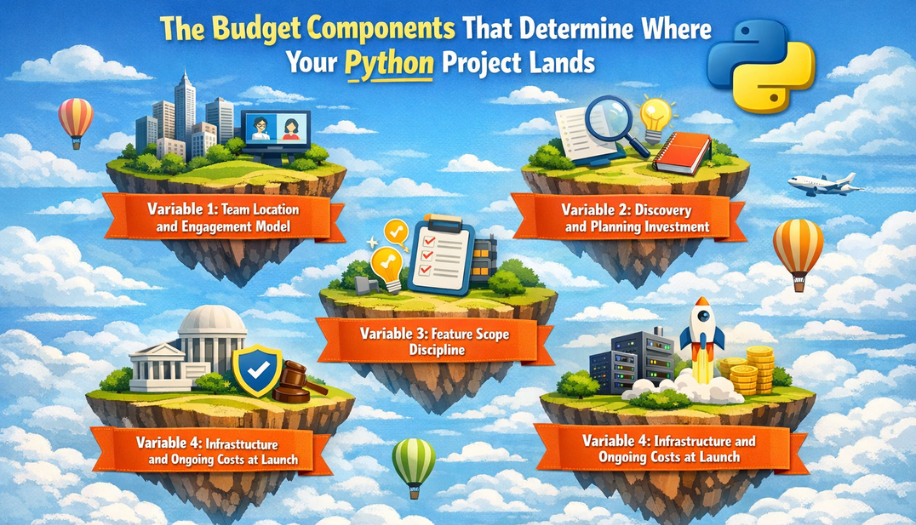
Within each project type range above, five variables determine whether your Python project sits at the minimum or significantly above it.
Variable 1: Team Location and Engagement Model
This is the single largest lever on the minimum Python development budget. 2025 MVP guide confirms: hire offshore developers from India or Eastern Europe to cut costs by 60 to 70%.
Team Model | Hourly Rate Range | Monthly Full-Time Equivalent | Budget Implication |
US/UK in-house or agency | $100 to $250/hr | $17,000 to $43,000/month | Highest cost, lowest budget leverage |
Eastern Europe agency | $45 to $100/hr | $7,700 to $17,200/month | Moderate savings, EU timezone advantage |
India vetted partner (Acquaint Softtech) | From $22/hr | $3,200/month (full-time dedicated) | 60 to 75% savings, largest minimum budget reduction |
Marketplace freelancer (Upwork, Toptal) | $30 to $150/hr | Variable, no continuity guarantee | Apparent savings offset by hidden costs |
The India vetted partner model represents the most significant minimum budget reduction without sacrificing production-grade quality. At $3,200 per month for a full-time dedicated Python developer through Acquaint Softtech, a three-month Python SaaS MVP that would cost $51,000 with a US agency costs $9,600 in development labour. The minimum budget drops by over $40,000 on the developer cost line alone.
Variable 2: Discovery and Planning Investment
Teams that invest in a structured discovery phase before development starts consistently spend less overall. Enterprises that skip discovery overspend by 40 to 60%. 2026 software cost guide recommends budgeting 5 to 10% of total project cost for discovery as a prerequisite for accurate estimation of everything else.
Discovery does not increase the minimum budget. It reveals the real minimum budget and eliminates the cost of discovering it during development, where changes are five to ten times more expensive.
Variable 3: Feature Scope Discipline
The most controllable variable in Python project minimum budget is how many features are in scope for the first build. March 2026 guide states this without ambiguity: every feature beyond the core three to five adds 10 to 20% to the budget. Cutting non-essential features can reduce a $200,000 project down to a manageable $60,000 MVP test.
The minimum budget for any Python project is achievable only when the feature scope is held to its genuine minimum. The question to ask of every feature in the initial backlog: does this feature validate the core assumption, or does it improve the product for users we have not yet acquired? If the answer is the latter, the feature does not belong in the minimum budget build.
Variable 4: Infrastructure and Ongoing Costs at Launch
February 2026 guide specifies that cloud infrastructure and hosting runs $500 to $10,000 per month depending on scale, third-party API fees add to monthly operating cost, and security audits run $5,000 to $25,000 annually. Development cost is only 60 to 70% of first-year total cost.
For minimum-budget Python projects, right-sizing infrastructure from the start is critical.Monthly infrastructure costs for an MVP typically run $100 to $500 per month, with the instruction to not over-provision at the MVP stage. Starting with a $200 per month AWS or GCP setup and scaling as user volume grows is a significant budget advantage over sizing for peak scale before any users exist.
Variable 5: Compliance and Regulatory Requirements
For non-regulated Python projects, compliance cost is minimal. For fintech, healthcare, and any product handling personal data in the EU, compliance is a fixed cost floor that does not compress regardless of how lean the build is. Include it in the minimum budget calculation or discover it mid-build at two to three times the cost of designing it in from the start.
The Minimum Budget Decision Matrix
Use this matrix to identify the realistic minimum budget for your specific Python project before any vendor conversations begin.
Python Project Type | Non-Regulated | Fintech / Healthcare | AI/ML Component Added |
Automation tool or internal script | $5,000 to $20,000 | $15,000 to $35,000 | Add $15,000 to $40,000 |
Simple web app or API | $15,000 to $35,000 | $35,000 to $70,000 | Add $20,000 to $60,000 |
SaaS MVP (3 to 5 core features) | $25,000 to $55,000 | $50,000 to $90,000 | Add $25,000 to $75,000 |
Full SaaS platform (post-MVP) | $55,000 to $120,000 | $90,000 to $200,000 | Add $40,000 to $100,000 |
AI/ML analytics platform | $35,000 to $100,000 | $70,000 to $200,000 | Core cost (see Type 4 above) |
All figures assume a vetted offshore India-based development partner. US or UK agency rates will increase these figures by two to five times. All figures assume proper discovery phase investment. Projects starting without discovery should add 20 to 40% to the figures above to account for rework cost.
What Happens When the Python Development Budget Is Set Too Low
The data on this point is direct. MVP cost analysis identifies three consistent reasons startups fail their Python projects: running out of money by overspending on unnecessary features, spending resources in wrong areas while ignoring user feedback, and underestimating costs for hosting, compliance, or post-launch fixes.
An underbudgeted Python project does not simply cost more than planned. It produces one of three specific failure modes:
Feature incompleteness at launch. When the budget runs out before the core feature set is complete, the product launches in a state that cannot validate the business assumption it was built to test. The minimum budget has been spent but the minimum viable product has not been reached. This failure mode is the most expensive because the entire budget is sunk with no usable output.
Technical debt that prevents scaling. A Python project built at absolute minimum budget with a junior team and no architecture review ships a codebase that works at 100 users and breaks at 1,000. The cost of rearchitecting a production system with live users is multiples of the cost of getting the architecture right the first time. Analysis confirms that early investments in scalability reduce long-term costs tied to technical debt, downtime, and redevelopment.
Compliance retrofitting in regulated industries. A Python fintech or healthcare MVP built without compliance architecture because it “wasn’t budgeted yet” must retrofit that architecture before it can be used commercially. Retrofit compliance work consistently costs two to three times what designed-in compliance would have, because it requires touching code across every layer of an application that was not built with compliance in mind.
Understanding where you are building within the framework set out in the Python development architecture and frameworks guide before the first sprint begins is how teams avoid all three of these failure modes. Architecture correctness at the start is not a luxury for larger budgets. It is the highest-leverage investment in any Python development budget regardless of size.
How Acquaint Softtech Delivers Python Development at Minimum Viable Budget
Acquaint Softtech is headquartered in Ahmedabad, India, with 13 years of Python delivery experience, 1,300+ projects completed globally, and five-star ratings across Clutch (35+ reviews) and Upwork (1,293+ reviews, 98% job success rate).
The 40% verified cost savings versus US in-house Python hiring is not a rate comparison. It is a minimum budget compression mechanism. Projects that would require $80,000 with a US agency are deliverable at $20,000 to $30,000 with Acquaint Softtech’s dedicated India-based Python team without changing the quality of the architecture, the depth of the vetting, or the IP protection terms.
Fixed-price Python projects start at $5,000 for a well-scoped, defined deliverable. That is the real entry point for Python development with a vetted, production-experienced team and full NDA from Day 1.
Acquaint Softtech Python Development Pricing (2026)
Engagement Model | Rate | Minimum Budget Entry Point |
Part-Time / Hourly | From $22/hr (up to 4 hrs/day) | From $440/week for focused Python work |
Full-Time Dedicated Python Developer | $3,200/month (176 hrs) | $3,200 per month, 48-hour start |
Fixed-Price Python Project | From $5,000 | Hard budget ceiling, milestone payments |
Discovery Workshop | Custom scope | 5 to 10% of estimated project budget |
Every engagement: 100% in-house Python team, zero freelancers or subcontractors, full NDA and IP assignment from Day 1, free developer replacement with complete context handover, 48-hour onboarding to sprint-ready.
Python stack: Django, FastAPI, Flask, TensorFlow, PyTorch, scikit-learn, LangChain, PostgreSQL, Redis, MongoDB, AWS, GCP, Azure, Docker, Kubernetes, React, Next.js.
For teams evaluating which hiring model and engagement structure gives them the most Python development at their minimum budget, the complete guide to hiring Python developers covers vetting criteria, engagement model trade-offs, and the specific interview questions that reveal whether a Python developer’s production experience matches their rate.
Conclusion: The Right Minimum Budget Is the One That Builds Something Usable
The minimum budget for a Python development project in 2026 is not a fixed number. It is the lowest investment that produces a usable, maintainable, deployable Python product within your specific project category, built by a team with the production experience to make the architecture decisions that will not cost you multiples of the saving to fix later.
For most Python projects, the biggest minimum budget lever is team location and engagement model. At $3,200 per month for a full-time dedicated Python developer through Acquaint Softtech, or $5,000 for a defined fixed-price build, the minimum budget threshold drops significantly below what the same quality of engineering costs with a US or UK team.
The second biggest lever is discovery investment. Teams that spend 5 to 10% of their project budget on structured planning before the first sprint produce more accurate minimum budgets and fewer mid-project surprises. Teams that skip discovery discover the real scope of their Python project during development, at five to ten times the cost of finding it during planning.
The third lever is scope discipline. Every Python feature beyond the core three to five that makes the product usable adds 10 to 20% to the minimum budget. The minimum viable Python product is a product definition question before it is a budget question.
For the complete financial picture beyond the build budget, read the Python development TCO guide for lifecycle cost modelling, the Python development ROI calculator for payback period analysis, and the Python development cost comparison across fixed price, dedicated team, and staff augmentation for pricing model selection.
Frequently Asked Questions
-
What is the minimum budget to start a Python development project in 2026?
The realistic minimum budget for a Python development project in 2026 starts at $5,000 for a simple, well-defined automation script or internal tool built with a vetted offshore development partner. A Python web application or simple API requires a minimum of $15,000 to $25,000. A Python SaaS MVP with subscription billing and multi-tenancy starts at $25,000 with an offshore partner and $60,000 to $80,000 with a US or UK agency. Python AI/ML projects start at $20,000 for API integration builds and $50,000 to $70,000 for custom model development. Fintech and healthcare Python platforms have a compliance-driven minimum of $40,000 to $60,000 regardless of feature scope. These figures assume a proper discovery phase investment and a vetted development partner. Projects without discovery should add 20 to 40% to account for rework cost.
-
Why do Python development budgets consistently run over their initial estimates?
Three structural factors drive Python budget overruns. First, development cost represents only 60 to 70% of first-year total cost per Cozcore’s 2026 analysis: infrastructure, QA, security, and integration work account for the remaining 30 to 40% and are frequently absent from initial estimates. Second, teams that skip the discovery phase overspend by 40 to 60% according to TechAhead’s 2026 enterprise analysis, because hidden requirements and integration complexity are discovered during development rather than before it. Third, scope creep affects 52% of all projects per PMI research, with each feature added beyond the original specification adding 10 to 20% to the budget. Budget overruns are predictable and preventable. They require upfront investment in planning rather than optimism.
-
What is the minimum Python development budget for a startup or early-stage product?
For a startup validating a product idea, the minimum Python development budget depends on what validation requires. A clickable prototype in Figma costs $3,000 to $5,000 and lets you validate the concept with real users before writing a single line of code, per Ardura Consulting’s March 2026 guide. A lean Python MVP with three to five core features, basic authentication, and a functional backend starts at $15,000 to $25,000 with an experienced offshore team. Research from Startup Genome cited by Raftlabs’ 2026 MVP cost guide shows that successful startups spend approximately 50% of their initial development budget on improvements in the first year after launch. Minimum budget planning must include that post-launch iteration cost or the product will stall before reaching product-market fit.
-
Does the choice of Python framework affect the minimum budget?
Yes, significantly. Django’s batteries-included architecture ships faster on simpler applications, reducing initial build cost. A CRUD-heavy business application in Django ships 30 to 40% faster and cheaper than the same application in a microservices-based FastAPI architecture, per Ardura Consulting’s framework selection guidance. However, Django’s architecture creates constraints that increase the cost of scaling later, making it a lower minimum budget with higher TCO risk on products that need to scale. FastAPI’s async architecture costs more to implement correctly at the minimum budget stage but reduces infrastructure TCO at scale. Choosing the wrong Python framework for the product’s actual requirements is one of the most expensive minimum-budget mistakes because the correction cost comes during the most expensive phase of the product lifecycle. The Python development architecture and frameworks guide maps framework choices to their budget and TCO implications in detail.
-
How much should the discovery phase cost for a Python project?
A Python project discovery phase typically costs 5 to 10% of the total estimated project budget, per Of Ash and Fire’s 2026 software cost guide. For a $50,000 Python SaaS MVP, that means $2,500 to $5,000 for a structured discovery engagement that produces an architecture design, data model, feature prioritisation, compliance requirement identification, and a risk-calibrated sprint plan. Teams that invest in discovery recover that cost in the first three to four weeks of development by avoiding the rework cycles that consume 30 to 50% more budget on projects that skip it. Acquaint Softtech’s discovery workshop is structured as a fixed-scope engagement that produces all of these outputs before the development budget is committed. Book a discovery workshop for your Python project before setting the development budget.
-
What is the minimum infrastructure budget for a Python application at launch?
Monthly infrastructure costs for a Python MVP typically run $100 to $500 per month at launch per Ardura Consulting’s guidance, assuming AWS, GCP, or Azure with appropriate right-sizing, CI/CD pipeline, monitoring, and SSL configuration. This figure scales significantly as user volume and data volume grow: a Python SaaS platform serving 50,000 concurrent users carries infrastructure costs far above the MVP baseline. The instruction is clear: do not over-provision infrastructure at the MVP stage. Start at the $100 to $500 per month range and implement auto-scaling that grows billing with actual usage rather than theoretical peak capacity. Annual maintenance and security patching adds 15 to 20% of the original development cost per year, per McKinsey research cited, and belongs in any minimum budget calculation from Day 1.
-
How do I get accurate Python development estimates before committing a budget?
An accurate Python development estimate requires a detailed requirements conversation, a documented scope, identification of major assumptions, and a phase-by-phase cost breakdown, per Cozcore’s February 2026 custom software guide. An estimate produced in 48 hours without a detailed requirements conversation is a sales tool, not a project plan. Evaluation criteria for a credible Python development estimate: the vendor has reviewed comparable prior projects, the estimate is broken down by phase and role rather than a single headline number, major assumptions are explicitly documented, compliance requirements are identified and priced, and the contingency buffer is sized based on documented risk frequency rather than a flat 10% convention. For a practical framework on choosing the right Python developer and evaluating estimates critically before commitment, the complete guide to hiring Python developers covers both the evaluation process and the specific red flags that signal an undercooked estimate.
-
Is $5,000 a realistic minimum budget for Python development?
Yes, for a well-defined, isolated Python deliverable: a specific automation script, a single API endpoint with documentation, a data processing tool with defined input and output formats, or a bug-fixing and audit engagement on an existing Python codebase. At Acquaint Softtech, fixed-price Python projects start at $5,000 and are covered by full NDA, IP assignment, and milestone-based payments from Day 1. What $5,000 does not buy is a multi-feature web application, a SaaS platform, an AI/ML system, or any Python project requiring architecture decisions that will carry long-term TCO consequences. Attempting to build a $25,000 product on a $5,000 budget produces either an unusable partial build or a technical debt problem that costs $40,000 to fix. Budget correctly for what you are actually building, use the project type ranges in this guide to locate your minimum, and resist the pressure to set a budget before the scope is understood.
We’re Acquaint Softtech, your technology growth partner. Whether you're building a SaaS product, modernizing enterprise software, or hiring vetted remote developers, we’re built for flexibility and speed. Our official partnerships with Laravel, Statamic, and Bagisto reflect our commitment to excellence, not limitation. We work across stacks, time zones, and industries to bring your tech vision to life.
Table of Contents
Get Started with Acquaint Softtech
- 13+ Years Delivering Software Excellence
- 1300+ Projects Delivered With Precision
- Official Laravel & Laravel News Partner
- Official Statamic Partner
Related Blog

The Complete Guide to Hiring Python Developers in 2026: Rates, Models, Vetting and Red Flags
A complete guide to hiring Python developers in 2026. Compare real hourly rates across India, Eastern Europe and the US, choose the right engagement model, vet candidates correctly, and avoid the red flags that cost companies months of wasted budget.
Acquaint Softtech
March 4, 2026
Python Development in 2026: Architecture Patterns, Frameworks and Real-World Industry Applications
Explore Python backend architecture patterns, framework comparisons (Django vs FastAPI vs Flask), scalability decisions, and real-world Python development use cases across healthcare, FinTech, SaaS, EdTech, and logistics in 2026.
Acquaint Softtech
March 4, 2026
Monthly Retainer vs Project-Based Pricing for Python Development: Which Model Saves More?
Monthly retainer or project-based pricing for your Python project? This guide breaks down real costs, scope creep risks, cash flow impact, and the decision framework that most teams get wrong.
Acquaint Softtech
March 24, 2026Your Project. Our Expertise. Let’s Connect.
Get in touch with our team to discuss your goals and start your journey with vetted developers in 48 hours.