

How to Validate Your SaaS Idea Before Writing Code
To validate a SaaS idea before writing code, you test four things in order: that the problem is real and painful, that a specific audience has it, that there is genuine demand, and that people will pay. You do this with customer interviews, a landing page, and a no-code or concierge MVP, not by building software. The goal is evidence that people want and will pay for the solution. Roughly 42% of startups fail because they build products nobody wants, and validation is how you avoid becoming one of them.

Chirag Daxini
Why Most SaaS Ideas Fail Before They Ever Had a Chance. You have an idea you believe in, and every instinct says start building. The danger is that building feels like progress while teaching you nothing about whether anyone wants the product. Founders routinely spend months and their savings on software, launch to silence, and only then discover the market was never there. Acquaint Softtech's discovery workshop services exist precisely because this happens so often.

- You have a SaaS idea and feel the urge to start building immediately.
- You are about to spend real money on development but are not sure anyone wants it.
- You want to know whether your idea solves a problem people will pay for.
- You are a first-time founder and do not know how to test an idea properly.
- You want to avoid being one of the startups that builds something nobody needs.
- You want to reach development with a validated, de-risked idea.
The hard truth is that roughly 42% of startups fail because they build something nobody wants, and code is the most expensive way to find that out. The fix is to validate the SaaS idea first, proving the problem, the audience, the demand, and the willingness to pay before development begins. Teams that pair validation with software product development reach the build stage already knowing real people want the product.
This guide walks through validation step by step, the same sequence used before any code is written. The guide Laravel SaaS Architecture: From MVP to Scale in 2026 makes the same point from the engineering side: you build an MVP to validate the idea, and speed matters more than elegance at month one.
What It Means to Validate a SaaS Idea
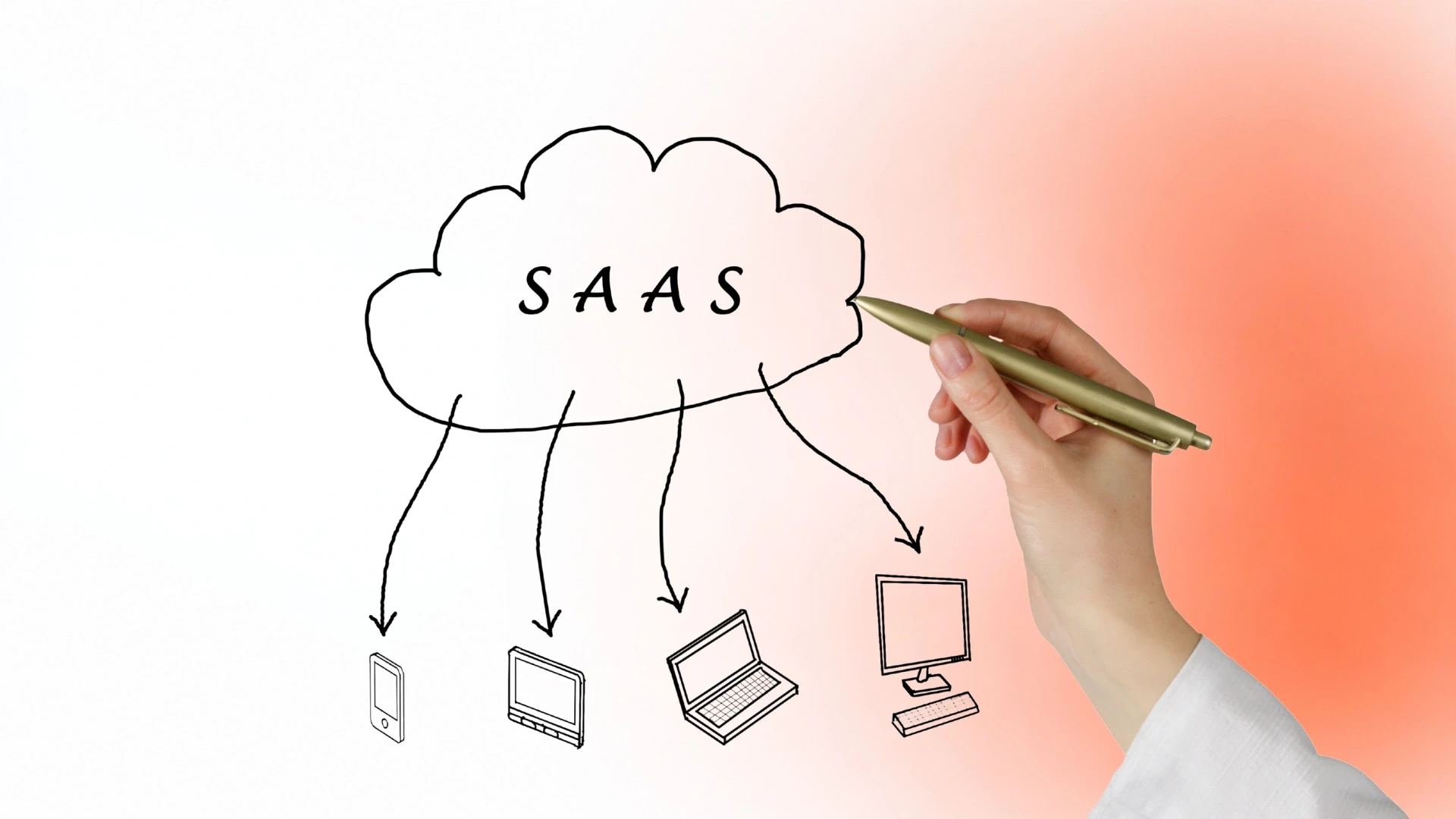
What is SaaS idea validation?
To validate a SaaS idea means to gather real evidence that a specific group of people has a problem worth solving and will pay for your solution, before you build it. It is the deliberate replacement of assumptions with facts. Validation is not asking friends if your idea sounds good; it is testing it against the behaviour of real potential customers.
Understanding how to validate a SaaS idea explained at this level matters because most founders confuse encouragement with evidence. A friend saying nice idea is not validation. A stranger handing over their email, their time, or their money is.
Why does validation matter so much?
The validated SaaS idea benefits are measured in money and time saved. Validation is far cheaper than building, so testing an idea for a few hundred dollars can save you from a failed build costing tens of thousands. It also sharpens the product, because the act of validating reveals which features matter and which you imagined.
Around 63% of SaaS startups that launch a validated MVP reach product-market fit within the first year, a dramatically better rate than building blind. Acquaint Softtech's dedicated software development teams only begin building once this evidence exists, because a validated idea makes every later engineering decision cheaper and clearer.
The validate SaaS idea trends 2026 favour faster, leaner validation: no-code tools, landing-page tests, and AI-assisted research compress what used to take months into weeks. The guide How to Outsource SaaS Product Development Without Losing Control explains how to engage a development partner only once the idea is proven, so you never pay to build the wrong thing.
Founders who hire remote developers after validating get more for their budget, because they brief the team on a defined, de-risked product rather than a guess.
Step 1: Validate the Problem, Not the Solution
Why start with the problem instead of the product?
Validation begins with the problem, because a SaaS product only succeeds if it solves a real, painful problem for someone. Founders fall in love with their solution and forget to check that the problem is genuine, urgent, and common enough to build a business on. The first job is to prove the problem exists independently of your idea.
The way to do this is customer-discovery interviews, talking to people in your target market about their current workflow and frustrations, without pitching your solution. You are listening for a problem they already feel and already try to solve, not testing whether they like your idea.
What questions actually reveal a real problem?
Good discovery questions ask about the past and the present, not the hypothetical future. Ask what the most frustrating part of their current process is, what they do about it today, and how much time or money it costs them. Avoid asking whether they would use your product, because people are unreliable at predicting their own future behaviour.
A problem is worth solving when people describe it unprompted, already spend time or money working around it, and show real frustration. Acquaint Softtech's product discovery services structure this problem-discovery phase so founders surface genuine pain rather than polite agreement.
The guide Introduction to SaaS Development reinforces that every successful SaaS product starts by solving a specific, real problem for a clearly defined user.
Founders who later hire dedicated developers build far more useful products when the problem was validated first, because the team builds against a proven pain rather than an assumption.
Have an Idea? Validate It Before You Build It.
Acquaint Softtech runs discovery workshops that test your SaaS idea before development, so you build only what users want. 1,300+ projects delivered. Teams deployed within 48 hours.
Step 2: Validate the Audience Who Has the Problem
Why is defining the audience part of validation?
A problem is only useful if a specific, reachable group of people has it. Validating the audience means identifying exactly who suffers the problem most acutely, because a SaaS product aimed at everyone usually appeals to no one. The narrower and clearer your ideal customer, the easier everything that follows becomes. If you are building scalable web applications for such audiences, you can hire MEAN stack developers from Acquaint Softtech to accelerate development.
This is where you define your ideal customer profile: the role, the company size, the industry, and the situation that makes the problem urgent for them. A sharp profile tells you who to interview, where to find them, and how to talk to them.
How do you know you have the right audience?
You have found the right audience when a specific group consistently describes the same problem in the same way, and when you can actually reach them through a channel you can afford. An audience you cannot reach is not a market, no matter how real their problem.
The validated SaaS idea features of this step are practical: a written customer profile, a list of places that the audience gathers, and a repeatable way to contact them. Acquaint Softtech's software development outsourcing teams use this profile later to keep the build focused on one well-understood user rather than a vague everyone.
The guide Monetisation Strategies for SaaS Products shows how a clearly defined audience shapes the pricing and revenue model that follows validation. Founders who hire SaaS developers with a sharp customer profile in hand get a product built for a real segment, which is far easier to market and sell than a generic tool.
Step 3: Validate Demand With a Landing Page Test
How do you test demand without a product?
Once you know the problem and the audience, you test whether there is real demand, and you can do it without building anything. A landing page that describes your solution and invites visitors to sign up is the classic, cheap demand test. Real people giving you their email is a far stronger signal than anyone saying they like the idea.
You drive a small amount of targeted traffic to the page, through ads or posting where your audience gathers, and measure how many visitors sign up. The sign-up rate tells you whether the promise resonates enough for people to act.
What does a landing page test actually measure?
The landing page measures whether your value proposition is compelling enough to convert a stranger into an interested lead. It tests the message as much as the idea, and a weak result can mean the positioning is wrong rather than the idea, which is itself useful to learn early.
This is one of the best SaaS idea best practices because it produces a quantifiable result, a conversion rate, for a small spend and a few days of work. Acquaint Softtech's software product development teams treat a healthy landing-page conversion as one of the green lights that an idea is worth building.
The guide Best Software Development Outsourcing Companies underscores that validating demand before committing budget is what separates capital-efficient founders from the rest. Founders who hire web developers to build a quick landing page get a professional demand test live in days, which is all the engineering this stage needs.
Step 4: Validate Willingness to Pay (the Only Proof That Counts)
Why is willingness to pay the real test?
Interest is cheap; payment is proof. The strongest possible validation is someone paying real money, even a small amount, before the full product exists. Until money changes hands, every other signal is encouraging but unproven, because people who say they would pay often do not when the moment comes.
The principle is that charging real money validates intent in a way that free never can. If you are building or validating such a product, you can also hire MERN stack developers through Acquaint Softtech. Someone willing to pay $50 a month now might pay $150 at launch, while someone interested only if it is free will never become a customer.
How do you test payment before the product is built?
You can test willingness to pay with pre-orders, a paid pilot, or a founding-member offer at a discounted rate, being honest that the product is early. Even a handful of people paying a reduced founding price is far stronger evidence than hundreds of free sign-ups.
Targeting five to ten paying beta customers is a common and powerful bar, because real payment from real users removes almost all doubt about demand. Acquaint Softtech's dedicated development team engagements often begin right after a founder secures these first paying commitments, because that evidence justifies the build. Founders who hire MVP developers after securing paying commitments build with confidence, because the riskiest question- will anyone pay, is already answered.
Step 5: Validate the Solution With a No-Code or Concierge MVP
How do you test the solution without building software?
Before writing code, you can test whether your specific solution actually solves the problem using a no-code or concierge MVP. A no-code MVP builds a working-enough version with tools like Bubble or Softr instead of custom code. A concierge MVP delivers the outcome manually behind the scenes while the customer experiences the result. In a concierge MVP, you do by hand what the software will eventually automate.
If your idea is automated reporting, you manually create those reports for your first paying customers, learning exactly what matters before automating anything. You can also explore scalable delivery models through white label software development as you move toward productisation.
Why is a no-code or concierge MVP so valuable?
These approaches let you deliver real value and charge real money without the cost and time of building software, so you learn what to build from actual usage rather than guesswork. You discover which features are essential and which you imagined, which sharpens the eventual build dramatically.
This is the validated SaaS idea architecture of the lean approach: prove the solution manually or with no-code, then build only the version that real usage has shown you. Acquaint Softtech's product scoping services help founders translate what a concierge or no-code MVP taught them into a precise scope for the real product.
Founders who hire Laravel developers to build the real product after a no-code MVP hand over a tested blueprint, which makes the engineering faster and cheaper.
Turn a Validated Idea Into a Real Product
Acquaint Softtech takes your validated idea through discovery and into a scoped, buildable MVP. Up to 40% lower cost than Western agencies. Teams deployed within 48 hours.
Reading the Signals: What Validated Actually Looks Like

How do you know your idea is genuinely validated?
Validation is not a single yes; it is a pattern of consistent positive signals across the steps. Your idea is validated when the problem shows up unprompted in interviews, a defined audience consistently feels it, a landing page converts, and, above all, real people pay before the full product exists.
The clearest signal is repeated, paid commitment from your target customer. When five to ten of the right people pay real money for an early version, you have evidence no amount of positive conversation can match.
What signals are false positives to ignore?
Beware encouragement that costs the giver nothing. Friends praising the idea, social media likes, and people saying they would definitely use it are not validation, because none of them required the person to act. These false positives feel good and prove nothing.
Equally, treat a failed test as valuable data, not failure: learning an idea has no demand for a few hundred dollars is a win compared to learning it after a costly build. Acquaint Softtech's product strategy consulting teams would rather a founder discover a weak signal during validation than during a launch that consumed their budget.
Founders who hire product developers only after seeing genuine paid signals avoid the most common and expensive startup mistake of all.
From Validation to a Scoped Build: The Discovery Bridge

What happens after the idea is validated?
Validation tells you the idea is worth building; discovery turns it into a plan for what to build. The discovery phase is where the validated problem, audience, and learnings become a defined scope, a feature list, and an architecture, before any production code is written. Skipping it sends even a validated idea into an unfocused build.
Most strategic decisions, positioning, pricing direction, core workflows, and scalability approach are made during discovery, not after a prototype exists. This is where validation pays off, because every decision is grounded in what you learned rather than guessed.
Why is the discovery bridge so important?
Discovery prevents the costly detours that come from building without a plan, mapping the user journey, prioritising features, and defining the smallest sellable version. Done well, it ensures the MVP is the right thing, not just a small thing. Acquaint Softtech's discovery and scoping services run this structured phase, so founders reduce uncertainty and align product, business, and architecture before development begins.
Founders who hire an MVP team through discovery move into development with a clear, validated scope, which is what keeps the build on time and on budget.
Cost, Timeline, and Tools to Validate a SaaS Idea
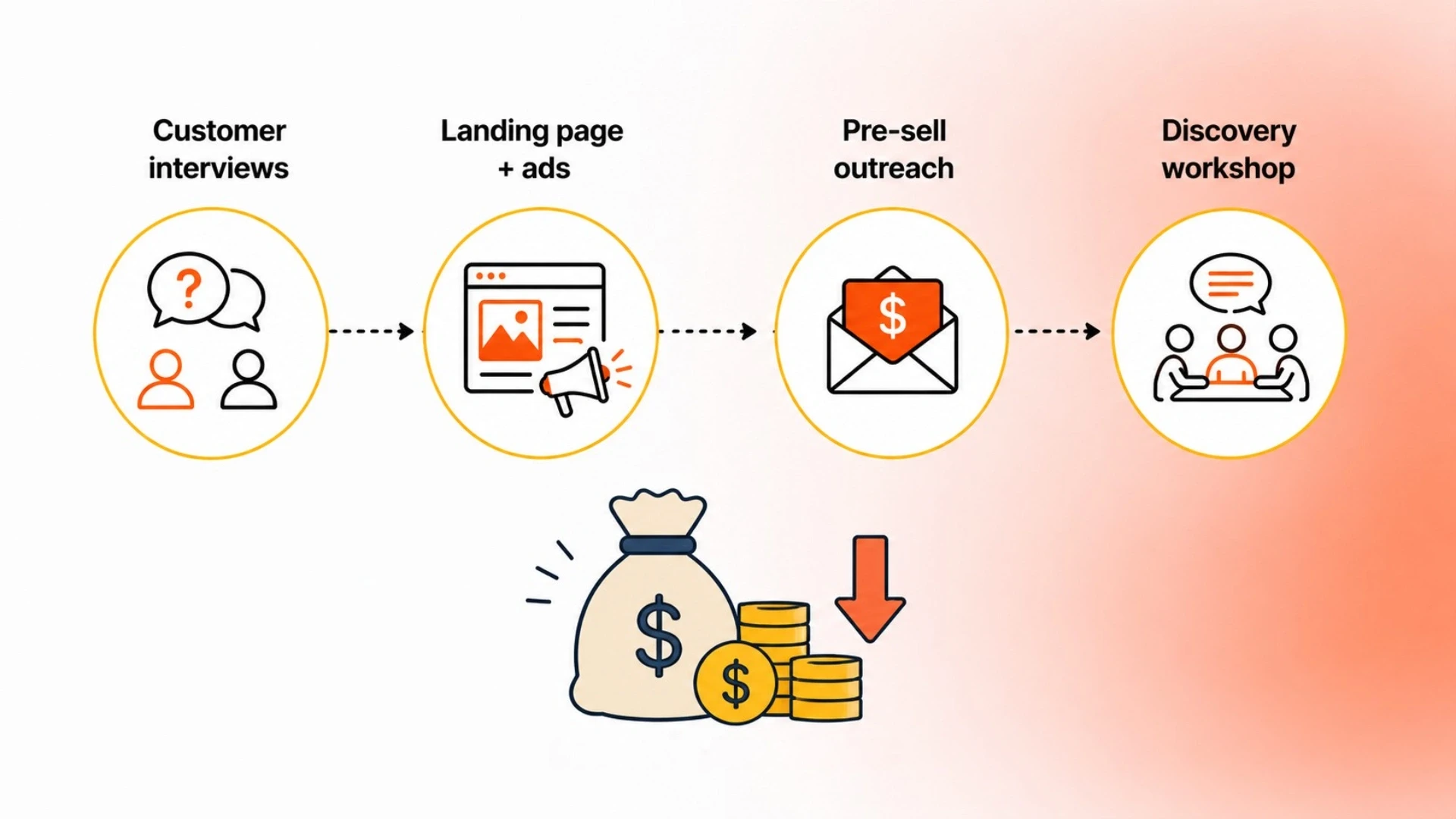
How long does it take to validate a SaaS idea?
Validation is fast compared to building, which is the whole point. A focused founder can move through problem and audience validation, a landing-page test, and first paying commitments in a matter of weeks, long before any development timeline begins.
Validation Stage | Typical Timeline | Relative Cost |
Problem + audience interviews | 1 to 2 weeks | Lowest (your time) |
Landing page + demand test | 1 to 2 weeks | Low (ad spend) |
No-code / concierge MVP + paid pilot | 2 to 6 weeks | Moderate |
How much does it cost to validate a SaaS idea?
Validation is usually the lower-cost part of building a SaaS product. Customer interviews may cost nothing beyond your time, while landing-page tests, ads, and no-code prototypes can range from a few hundred to a few thousand dollars. A full SaaS build can cost $25,000 to $150,000+ depending on its scope and complexity.
At Acquaint Softtech, fixed-project MVP development starts from $5,000, giving teams a practical starting point before moving into a larger SaaS build. The final cost depends on the features, integrations, and requirements of the product.
What tools are best to validate a SaaS idea?
The best validation tools are no-code and lightweight. Use a landing-page builder like Carrd, Webflow, or see this Unbounce vs ClickFunnels comparison to pick the best fit, a form tool like Typeform for interviews and waitlists, and a no-code app builder like Bubble or Softr for a working MVP. For payment, Stripe handles pre-orders and founding-member charges.
None of this is the eventual production stack; it is throwaway tooling whose only job is to produce evidence. Once validated, a custom SaaS idea solution and the real build can be scoped properly. For senior product guidance during this phase, Acquaint Softtech offers a virtual CTO service so founders get experienced input before committing to a custom software development engagement.
Case Study: A Validation-First Launch With Acquaint Softtech
CASE STUDY: B2B SaaS Founder, Validation Before Build
Client: A first-time founder in the UK with an idea for a niche workflow tool for a specific professional services audience, with limited savings to invest.
Situation: The founder arrived ready to commission a full build, with a long feature list and a fixed budget that would have been almost entirely consumed by version one. They were confident the idea was good but had never tested it with a paying customer, and the planned scope was based entirely on their own assumptions about what the audience wanted.
Diagnosis: Acquaint Softtech advised against building immediately. The idea was promising but unvalidated, and the proposed scope was far larger than a first version needed. The recommendation was a short validation phase before any code, to confirm the problem, the audience, and willingness to pay, and to cut the scope to what users actually needed.
What the Validation Phase Involved:
• Customer-discovery interviews with the target audience to confirm the problem was real, urgent, and common.
• A landing page describing the solution, with a small ad spend to measure genuine sign-up demand.
• A concierge MVP where the core outcome was delivered manually to a handful of early users for a founding-member fee.
• A discovery workshop that turned the validation learnings into a tightly scoped MVP feature list.
• A revised build plan covering only the validated core, deferring most of the original feature list.
Outcome: Validation revealed that two of the founder's planned headline features were not what users cared about, while a smaller capability they had treated as minor was the real draw. The concierge MVP secured several paying founding members, proving willingness to pay before any code existed. The scoped MVP that followed cost a fraction of the original plan and shipped faster, built around what users had actually paid for. The founder reached launch with paying customers already in place and most of their budget preserved for growth rather than spent on unwanted features.
Engagement and Timeline: A short validation and discovery phase preceded development. Deployed within 48 hours of the brief for the build phase. The validation phase saved the founder from building a larger, wrong product.
For founders weighing whether to validate or build first, the guide Best Software Development Outsourcing Companies on acquaintsoft.com covers how to choose a partner who will tell you the truth about your idea. Founders can also hire startup developers who work validation-first, so the build begins only once the idea is proven.
Join 200+ Companies Who Built the Right Thing With Acquaint Softtech
From validating an idea to shipping a scoped MVP, Acquaint Softtech helps founders build only what users want and pay for. 4.9/5 on Clutch. 50+ verified reviews. Premier Verified.
Frequently Asked Questions
-
What does it mean to validate a SaaS idea?
Validating a SaaS idea means gathering real evidence that a specific audience has a problem worth solving and will pay for your solution, before you build it. You test the problem, audience, demand, and willingness to pay using interviews, a landing page, and a no-code or concierge MVP, replacing assumptions with facts.
-
How do you validate a SaaS idea before writing code?
Validate in order: confirm the problem is real through customer interviews, define the audience who has it, test demand with a landing page, prove willingness to pay with pre-orders or a paid pilot, and test the solution with a no-code or concierge MVP. The goal is evidence people want and will pay for it, gathered without building software.
-
Why is validating a SaaS idea important?
Because roughly 42% of startups fail by building products nobody wants, and code is the most expensive way to discover that. Validation is far cheaper than building, sharpens the product, and dramatically improves your odds. Around 63% of startups launching a validated MVP reach product-market fit within their first year.
-
What is the difference between a concierge MVP and a no-code MVP?
A no-code MVP builds a working-enough product with tools like Bubble or Softr instead of custom code. A concierge MVP delivers the outcome manually behind the scenes while the customer experiences the result. Both let you charge real money and learn what to build without writing software.
-
How much does it cost to validate a SaaS idea?
Validation can cost just a few hundred to a few thousand dollars, while a full SaaS build may reach $25,000 to $150,000+. At Acquaint Softtech, MVP development starts from $5,000 without compromising development quality, making it easier to validate your idea before committing to a larger build.
-
How long does it take to validate a SaaS idea?
Validation is fast. Problem and audience interviews take one to two weeks, a landing-page demand test another one to two weeks, and a no-code or concierge MVP with a paid pilot two to six weeks. A focused founder can validate an idea in weeks, long before a development timeline begins.
-
What counts as real validation versus a false signal?
Real validation is behaviour that costs the person something: giving an email, their time, or above all, their money. False signals are friends praising the idea, social media likes, and people saying they would use it, none of which require action. Repeated paid commitment from your target customer is the strongest proof.
-
What tools are best to validate a SaaS idea?
Use a landing-page builder like Carrd or Webflow for demand tests, Typeform for interviews and waitlists, a no-code builder like Bubble or Softr for a working MVP, and Stripe for pre-orders. These are throwaway tools whose only job is to produce evidence, not the eventual production stack.
With over 11 years of experience in web application development and project management, I excel in leading cross-functional teams to deliver innovative digital solutions. My expertise spans eCommerce platforms, ERP systems, and JS & PHP-based frameworks, including WordPress, React JS, and Laravel. As a Technical Project Manager, I specialize in strategic planning, system design, and end-to-end project execution, transforming complex ideas into scalable, high-impact applications.
Table of Contents
Get Started with Acquaint Softtech
- 13+ Years Delivering Software Excellence
- 1300+ Projects Delivered With Precision
- Official Laravel & Laravel News Partner
- Official Statamic Partner
Related Blog
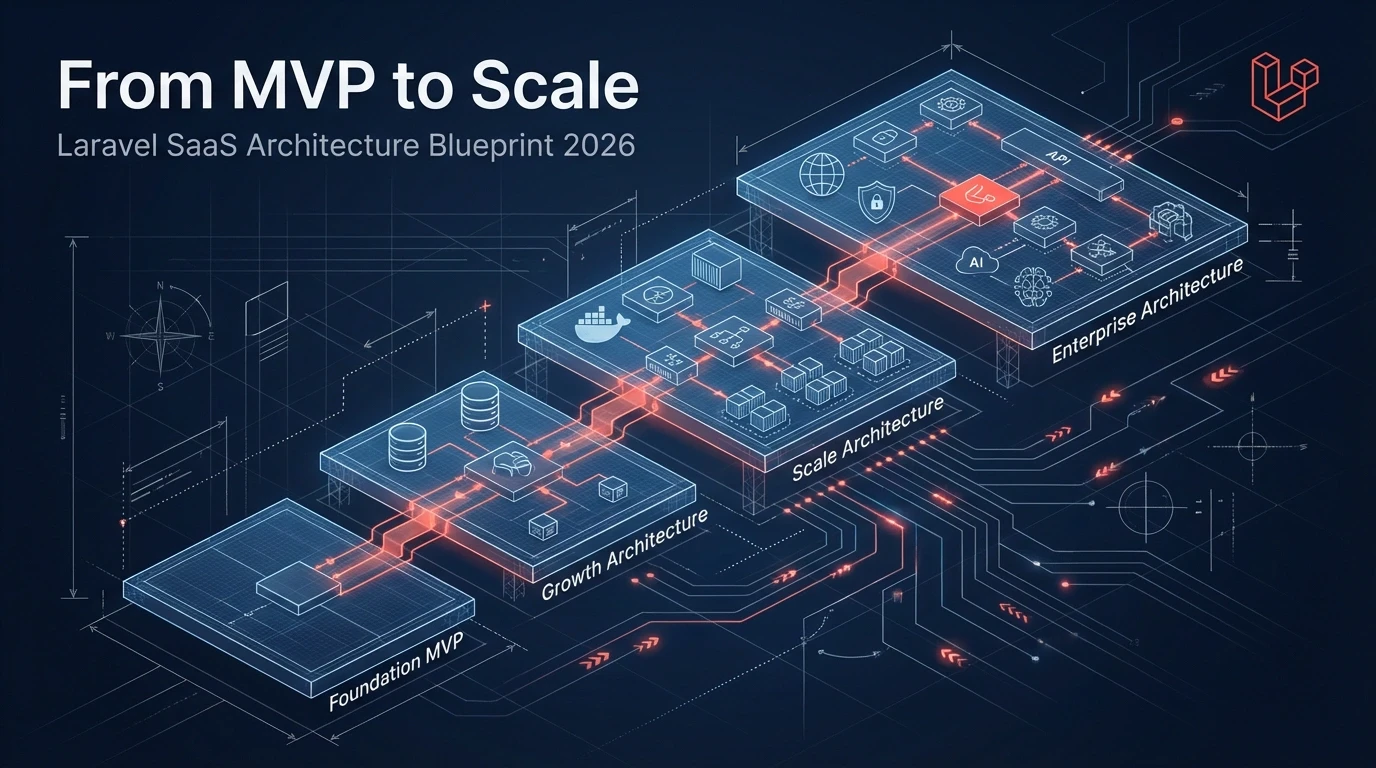
From MVP to Scale: The Laravel SaaS Architecture Blueprint for 2026
From MVP to 100K users, the architecture decisions that felt small at month one become expensive at month twelve. Here is the Laravel SaaS blueprint we use across 200+ Laravel projects.

Acquaint Softtech
March 10, 2026
How to Outsource SaaS Product Development Without Losing Control
The fear of losing control is the main reason founders delay outsourcing SaaS development by 6 to 12 months. Here are the 6 mechanisms that keep you in charge of product direction while a vendor manages delivery.

Mukesh Ram
April 20, 2026
Top Software Development Outsourcing Companies
Choosing the right software development outsourcing company is no longer just a cost decision, it is a strategic move that directly impacts product speed, scalability.According to Deloitte’s Global Outsourcing Survey, over 76% of companies outsource IT functions, including development, QA, and UI/UX, while data from Market.us research reports shows the global outsourcing market was valued at USD 534.9 billion in 2024 and is projected to reach USD 940 billion by 2034, highlighting its rapid adoption across industries.
However, identifying the right software development outsourcing partner remains a major challenge, as hundreds of vendors claim similar expertise without proven delivery depth. To simplify this process, we analyzed 100+ software development outsourcing companies across trusted directories and client review platforms, focusing on key factors such as technical capability, real-world project delivery, communication standards, and long-term scalability support.

Zubair Pateljiwala
April 2, 2026India (Head Office)
203/204, Shapath-II, Near Silver Leaf Hotel, Opp. Rajpath Club, SG Highway, Ahmedabad-380054, Gujarat
USA
7838 Camino Cielo St, Highland, CA 92346
UK
The Powerhouse, 21 Woodthorpe Road, Ashford, England, TW15 2RP
New Zealand
42 Exler Place, Avondale, Auckland 0600, New Zealand
Canada
141 Skyview Bay NE , Calgary, Alberta, T3N 2K6