

How to Write a Software Development Brief That Gets Accurate Proposals, Not Optimistic Ones
The brief that says 'we need a web application' gets 30 proposals ranging from $15K to $400K. The brief that defines scope precisely gets 5 comparable ones. The difference is 7 specific sections most briefs are missing.

Chirag Daxini
As a project manager of acquaint softtech, a software development partner with 1,300+ projects delivered, I review client briefs every week. The ones that produce accurate proposals look very different from the ones that produce optimistic ones. The gap between those two categories is not writing ability. It is knowing which 7 sections to include. Most briefs have 2 or 3 of them. This article gives you all 7.

- Founders and product managers writing a brief to send to software development vendors for the first time
- CTOs who have received wildly varying proposals for the same scope and want to understand why
- Technical leads who need a brief template that produces comparable quotes rather than incomparable ones
- Anyone who has had a software project overrun its budget and traced it back to an incomplete original brief
The brief that says 'we need a web application that allows users to log in, view their data, and export reports' produces a estimate ranging from $15,000 to $400,000 from different vendors. Not because the vendors are dishonest. Because the brief is describing the happy path only. Authentication, data model complexity, export format requirements, mobile support, security compliance, performance requirements, and third-party integrations are all decisions hiding inside that one sentence.
The full cost breakdown for API development covers what gets missed in API-specific briefs. This article covers the broader brief framework that applies to any software development project.
Section 1: Why Vague Briefs Produce Optimistic Proposals

A developer quotes what they are asked to build. If the brief describes features but not architecture, they quote feature development. If it describes the happy path but not error handling, they quote the happy path. If it mentions user authentication but not user roles and permissions, they quote basic authentication.
This is not vendor dishonesty. It is scope interpretation. The vendor interprets the brief as narrowly as the brief allows. The client interprets the proposal as covering everything they intended. The gap between those two interpretations produces change requests.
The solution is not a longer brief. It is a brief that answers the specific questions developers actually need answered before they can quote accurately. The 7 sections below are those questions.
If you are also evaluating which vendor to send the brief to, the vendor selection guide covers the criteria for building and evaluating your shortlist before the brief goes out.
Section 2: The 7-Section Brief Framework
Each section answers a question that, if left unanswered, becomes a scope assumption in the quote. When that assumption is wrong, it becomes a change request.
Section 1: What the product does and who it is for |
Describe the product in one paragraph without technical language. Who uses it. What they do with it. What problem it solves. This sounds obvious but most briefs skip it or bury it. A developer who understands the product context makes better scoping decisions than one who only knows the feature list. In some cases, when background research or documentation is missing, teams look for ways to use PaperWriter for students to better structure their initial materials before turning them into a clear brief. |
Include: a one-paragraph product description, the primary user type, and what the user is trying to accomplish. If there are multiple user types with different access levels, list them here. |
Section 2: Core features with acceptance criteria |
Not a bullet list of feature names. Each feature with a brief description of what done looks like. A login feature that requires two-factor authentication, password reset, social login via Google, and role-based access to four different dashboard views is not the same scope as a basic login feature. The difference in that description alone can be $8,000 in development. |
Include: each core feature, a one to two sentence description of the expected behaviour, and any specific requirements that are non-negotiable (for example: must work on mobile, must support dark mode, must integrate with Stripe). |
Section 3: Technical requirements and constraints |
What tech stack, if you have a preference. Hosting environment. Browser and device support. Performance requirements (expected user volume, page load time targets). Compliance requirements (GDPR, HIPAA, PCI). Existing systems the new product must integrate with. |
Include: preferred stack (or openness to recommendation), hosting environment, minimum browser/device support, user volume expectations at launch and at scale, and any regulatory compliance requirements. |
Section 4: Integrations |
List every third-party service the product needs to connect to. Payment gateways, CRMs, email platforms, analytics, communication tools, existing internal systems. Each integration is its own scoping item. A brief that says 'standard integrations' produces quotes that exclude the integrations the client considers standard. |
Include: every third-party service, the integration direction (the product sends data to it, receives data from it, or both), and whether real-time sync or batch processing is acceptable. |
Section 5: Timeline and constraints |
The date you need the product by, whether that date is fixed or flexible, and why. A fixed launch date for a marketing campaign requires different scoping decisions than a flexible timeline. Developers scope differently for hard deadlines. |
Include: target launch date, flexibility of that date, any specific milestone dates within the project, and any calendar constraints (holidays, planned team absences, existing sprints that cannot be interrupted). |
Section 6: Budget range |
This is the section most clients omit because they are worried about anchoring the vendor. It is also the section that most reduces proposal variance. A brief with a budget range produces proposals that fit within it. A brief without one produces proposals at every price point, none of which tell you what you actually get for your specific budget. |
Include: a realistic budget range, whether that range is firm or exploratory, and your priority if there is a trade-off between timeline and cost. |
Section 7: Success criteria |
How will you evaluate whether the project was delivered successfully? Not just the feature list, but the business outcomes. User registration targets. Page load time benchmarks. Error rate thresholds. Performance under load. Defining these upfront gives the vendor something to design toward rather than something to discover at launch. |
Include: measurable success criteria for the key features, expected performance benchmarks, and any specific technical quality standards (test coverage, documentation, code review requirements). |
Want Us to Review Your Brief Before It Goes to Vendors?
We review briefs as part of our pre-engagement process and flag the sections that will produce scope ambiguity. Most briefs we review are missing 2 to 4 sections from this framework. Catching those gaps before the quotes come in saves a round of clarifications and produces a more accurate budget estimate. Send us the brief.
Section 3: The Brief in Practice, A Before and After
Here is the same project described two ways. The first is how most briefs are written. The second is what the 7-section framework produces.
Typical Brief (produces $15K to $400K range) | 7-Section Brief (produces $80K to $110K range) |
We need a web platform for managing client projects. Users should be able to log in, create projects, assign tasks, and generate reports. We want a clean modern design and good performance. Timeline is 4 months. Budget flexible. | Project management SaaS for 3 to 50 person agencies. 2 user types: admin and team member. Admin creates projects, assigns tasks, sets deadlines, views time reports. Team member logs hours, views assigned tasks. Core features with acceptance criteria listed. Stack: Laravel backend, React frontend. Integrations: Stripe for billing, Slack for notifications, Google Calendar. 500 users at launch, 5,000 at 12 months. Budget $80K to $120K. Launch Q3 2026. |
The second brief does not take longer to write. It takes about 3 hours of structured thinking versus 30 minutes of stream of consciousness. The return on those 2.5 extra hours is proposals you can actually compare, a budget that holds, and a vendor relationship that starts with shared understanding rather than shared assumptions. For a discovery workshop that helps you produce this level of brief with structured facilitation, our discovery workshop service covers the full process.
Section 4: What Happens to Vague Briefs on the Vendor Side
I want to show you what happens inside a vendor when they receive a vague brief. Not to excuse under-quoting, but because understanding the vendor perspective helps you write briefs that close the interpretation gap.
When a developer receives a brief that says 'users should be able to log in,' they make one of three decisions: quote the simplest possible authentication implementation, quote the most common implementation they have done before, or ask a clarifying question (which most do not, because it slows the sales process).
The quote that comes back is for whichever of those three interpretations the developer defaulted to. Not for what the client intended. The client reads the quote, assumes it covers their intent, and discovers the gap when the change request arrives.
Our Laravel development team always asks a clarifying questions before quoting any complex scope. But the 7-section framework means those questions get answered in the brief rather than in a back-and-forth. The brief becomes the reference document for the entire engagement, not just for the initial quote.
Section 5: The Most Common Brief Mistakes and How to Fix Them
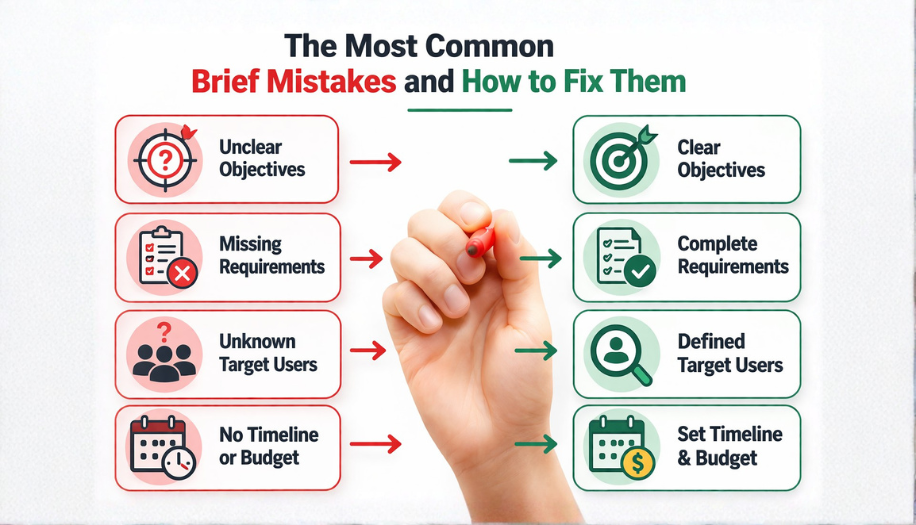
Feature list without acceptance criteria | 'User registration' as a feature covers: email/password registration only, OR email, Google, and LinkedIn login, OR all three plus phone number verification, OR all of that plus email confirmation workflow. Each interpretation is a different scope. Fix: for every feature, write one sentence describing what done looks like from the user's perspective. |
Omitting the budget range | The most common omission. Clients worry that sharing a budget anchors the vendor's pricing. In practice, omitting the budget produces proposals at every price point with no ability to compare what each one buys. Fix: include a range and frame it as exploratory if you are uncertain. A range of $50K to $100K is not an anchor. It is a shared scope boundary. |
Listing integrations without direction or requirements | 'Integrate with Stripe' covers: basic one-time payment processing, subscription billing with multiple tiers, marketplace payment splits with vendor payouts, and SCA compliance for European users. Fix: for each integration, describe what data flows in which direction and any specific requirements that are non-negotiable. |
No performance or volume requirements | A system designed for 100 concurrent users is architecturally different from one designed for 10,000. Without this information, developers scope for their default assumption. Fix: include user volume at launch and at expected scale 12 months later. Include page load time requirements if you have them. |
Timeline without context | 'Ready in 4 months' means different things depending on whether the 4 months is firm or aspirational, whether there are milestones within it, and whether the developer is expected to deliver a full product or a scoped MVP. Fix: state the target date, whether it is fixed, the reason (investor demo, marketing campaign, contract obligation), and what a minimum viable delivery looks like if the full scope cannot fit the timeline. |
For the staff augmentation model where a developer joins your team rather than a vendor delivering a fixed project, the brief becomes a technical onboarding document. The staff augmentation model requires a brief that documents your codebase architecture and sprint process rather than a full project specification. The sections differ but the principle is the same: the developer can only work with the context you provide.
Already Have a Brief? We Will Tell You What Is Missing.
Send us your current brief document. We review it against the 7-section framework and return a specific list of what is missing and what ambiguities will produce scope disputes. This is a 24-hour turnaround and it costs nothing. It saves you from a budget overrun.
Section 6: The Brief as a Living Document
A software development brief is not a fixed document. It is the starting point of a conversation. The best briefs evolve through the initial vendor call, the discovery phase, and the first sprint as context accumulates and assumptions get tested.
What matters is that the evolution is documented. When a scope decision changes during development, it should be captured in a brief update or a formal change request, not absorbed into the project without record. A most common source of budget overruns is not scope creep. It is undocumented scope evolution that becomes disputed scope at invoice time.
For larger projects where the brief complexity justifies a structured workshop before development begins, our version upgrade service produces a full technical specification, architecture recommendation, and sprint plan. For projects where the scope is clear and the team is right, the dedicated development team model lets you ship the first sprint within 2 weeks of engagement start.
For the equivalent of this framework applied specifically to upgrade and modernisation projects, the Laravel version upgrade cost guide covers what the brief needs to include for upgrade scoping specifically.
Ready to Send a Brief That Gets Accurate Proposals?
Use the 7-section framework above, then send the brief to us. We review it, flag any remaining ambiguities, and come back with a specific quote within 48 hours. Not a range. A number with a clearly defined scope. That is what an accurate brief makes possible.
Frequently Asked Questions
-
How long should a software development brief be?
Long enough to answer all 7 sections. Short enough to be read in one sitting. In practice, most complete briefs run 2 to 5 pages. More than 5 pages usually means the brief has become a specification, which is a different document and typically comes after the initial quote rather than before it. The brief should answer enough questions to produce comparable quotes. The specification answers enough questions to begin development.
-
Should I include a budget range in my brief?
Yes. It is the most commonly omitted section and the one that most reduces proposal variance. A brief with a budget range produces proposals within that range. Without it, you will receive proposals from $20,000 to $200,000 for the same description, and none of them tell you what you actually get for your specific budget. Frame the budget as a range and note whether it is firm or exploratory.
-
What is the difference between a brief and a technical specification?
A brief is the document you send to get initial quotes. It describes what you need at a level of detail that allows a developer to estimate the scope. A technical specification is the document produced after the vendor is selected and the discovery phase is complete. It describes how the product will be built at the implementation level. A brief takes hours to write. A specification takes days to weeks.
-
Should I send the same brief to every vendor on my shortlist?
Yes. Sending the same brief to all shortlisted vendors is the only way to produce comparable proposals. If you customise the brief for each vendor, you end up comparing proposals that cover different scopes, which makes price comparison misleading. Send identical briefs and evaluate the proposals against the same criteria.
-
What happens if I do not know the answers to some of the 7 sections?
Document what you know and flag what you do not. A brief that says 'user volume at launch: unknown, planning for 100 to 500 concurrent users as a working assumption' is more useful than a brief that omits the section. The working assumption gives the developer something to scope against while signalling that the final answer may adjust the estimate.
-
How detailed should the feature acceptance criteria be?
Detailed enough that two different developers reading the same criteria would produce the same implementation. A useful test: if you read the acceptance criteria back to someone unfamiliar with the project, could they describe what the feature does without asking any questions? If not, add a sentence.
-
Can I write a brief without a technical background?
Yes. The 7-section framework is intentionally non-technical. The brief describes what the product does and who uses it, not how it is built. The how is the vendor's job. Your job is to describe the what with enough specificity that the vendor can scope it accurately. Technical language is not required. Specific language is.
With over 11 years of experience in web application development and project management, I excel in leading cross-functional teams to deliver innovative digital solutions. My expertise spans eCommerce platforms, ERP systems, and JS & PHP-based frameworks, including WordPress, React JS, and Laravel. As a Technical Project Manager, I specialize in strategic planning, system design, and end-to-end project execution, transforming complex ideas into scalable, high-impact applications.
Table of Contents
Get Started with Acquaint Softtech
- 13+ Years Delivering Software Excellence
- 1300+ Projects Delivered With Precision
- Official Laravel & Laravel News Partner
- Official Statamic Partner
Related Reading

API Development Cost in 2026: What Drives the Price, What to Budget, and Where Projects Overrun
Most API budgets are built around the endpoint list. That covers roughly 40% of the real work. Here is what the other 60% looks like and why it is almost always the part that causes overruns.
Chirag Daxini
April 2, 2026
Security Blueprint for Enterprise Laravel Applications
A complete Laravel application security blueprint covering authentication hardening, input validation, dependency auditing, CSP headers, secrets management, and CI/CD security scanning.
Chirag Daxini
March 16, 2026
Cloud Deployment Strategies for Laravel Applications
How to choose and implement a cloud deployment strategy for Laravel - AWS vs GCP vs Azure, managed services vs containers, infrastructure as code with Terraform, and the practical trade-offs at each deployment tier.
Chirag Daxini
March 6, 2026India (Head Office)
203/204, Shapath-II, Near Silver Leaf Hotel, Opp. Rajpath Club, SG Highway, Ahmedabad-380054, Gujarat
USA
7838 Camino Cielo St, Highland, CA 92346
UK
The Powerhouse, 21 Woodthorpe Road, Ashford, England, TW15 2RP
New Zealand
42 Exler Place, Avondale, Auckland 0600, New Zealand
Canada
141 Skyview Bay NE , Calgary, Alberta, T3N 2K6