

InsurTech Industry Trends 2026: AI, Embedded Insurance, Climate Risk, and Regulatory Shifts
The defining InsurTech trends of 2026 are four converging forces: AI moving from pilots to production across underwriting and claims, embedded insurance growing into a major distribution channel, climate risk reshaping how risk is priced, and regulation tightening around AI and data. Together they mark a shift from InsurTech as a disruptor to InsurTech as the operational infrastructure of insurance.

Mukesh Ram
As the CEO and Founder of Acquaint Softtech, I see through our software product development work that InsurTech is no longer just disrupting the industry; it is becoming the foundation of modern insurance.
In 2026, the challenge is not choosing whether to innovate but choosing the right investments. AI, embedded insurance, and climate-driven pricing are reshaping the market, and companies that move from experimentation to execution will be the ones that stay ahead.

- You are an insurance leader who needs a clear, current read on where the industry is heading.
- You are planning a 2026 technology roadmap and want to invest behind the right trends.
- You are an InsurTech founder positioning your product against where the market is moving.
- You keep hearing about AI, embedded, and climate risk and want the signal, not the noise.
- You want to know not just what is changing, but what to actually do about it.
Having advised carriers, MGAs, and InsurTech founders on technology strategy across the US, UK, Europe, Australia, and New Zealand, the pattern is consistent: the winners treat these trends as engineering and operating decisions, not slogans. Acquaint Softtech's software product development practice turns these trends into working platforms, and the full engineering picture is set out in the complete guide to InsurTech software development. For the AI that now anchors most of these shifts, the AI development services team builds the models and infrastructure behind the trend.
This report frames 2026 as four converging forces- AI, embedded insurance, climate risk, and regulation, explains the real signal behind each, shows where they meet, and ends with what insurers and founders should actually do. It is written for the leader who wants clarity, not noise, going into the year.
The Big Picture: From Disruption to Infrastructure
The single most important InsurTech trend of 2026 is not any one technology; it is a change in role. For a decade, InsurTech was framed as a disruptor, startups attacking incumbents. In 2026, the framing has flipped: InsurTech has become the infrastructure that all insurers, incumbent and challenger alike, now run on. The interesting question is no longer whether to adopt these technologies but how to operationalise them, which is why the year's defining word is deployment, not disruption.
What are the 2026 insurtech trends?
In 2026, InsurTech is driven by four forces: AI going into production, embedded insurance scaling distribution, climate risk reshaping pricing, and stricter regulation around data and AI. Together, they are turning InsurTech into the core operating system of modern insurance.
Acquaint Softtech helps insurers act on this shift by building the operational platforms these trends require, not slideware about them. The build work is delivered through the dedicated software development teams model, where engineers translate a trend into a running system.
Because the shift is toward infrastructure, the underlying architecture matters more than ever. Acquaint Softtech's backend development services build the API-first, data-centric foundation that lets an insurer adopt each of these trends without re-platforming for every one.
The technical foundation behind the infrastructure shift APIs, microservices, event streaming, and cloud, is detailed in the modern core insurance platform development guide, which explains the platform that makes operationalising these trends possible.
Force 1: AI Moves From Pilots to Production
AI is the dominant force in InsurTech in 2026, but the focus has shifted from experimentation to execution. Nearly 75% of InsurTech funding now targets AI solutions that deliver measurable business outcomes, from faster underwriting to accelerated claims processing.
The real winners are not the companies talking about AI, but those deploying it at scale with robust engineering teams, often supported by specialists such as dedicated MEAN stack developers. Acquaint Softtech helps insurers turn AI from a concept into a production-ready advantage through scalable platforms and integrations powered by its expertise in hire MEAN stack developers services.
Is AI taking over insurance?
AI is not replacing insurance, but powering its core operations. In 2026, it is moving from pilots to large-scale production, with claims, underwriting, and fraud detection becoming faster and more automated, reducing processes from days to minutes and pushing straight-through processing toward 70–90%. While humans still handle complex decisions, AI is increasingly managing routine work and driving major efficiency gains, with McKinsey estimating up to $1.1 trillion in annual value for the industry.
Acquaint Softtech builds AI that reaches production and stays accurate, the implementation capability that separates measurable ROI from AI branding. The models and serving infrastructure are delivered through the AI development services, which focus on getting models into live operations rather than leaving them in notebooks.
Production AI depends on data and ML engineering as much as modelling. Acquaint Softtech's AI and ML engineering team builds the pipelines, feature stores, and monitoring that keep an insurance AI system reliable at scale.
The detailed view of how AI works across underwriting, claims, fraud, and customer service is in the modern insurance underwriting guide, which shows the production-AI patterns behind this trend.
Reading about AI is not the same as shipping it.
Acquaint Softtech has delivered 1,300+ projects in 13+ years and deploys a dedicated InsurTech team within 48 hours of a brief. Book a call, and we will map which 2026 trend will move your numbers first.
Force 2: Embedded Insurance Becomes a Real Channel
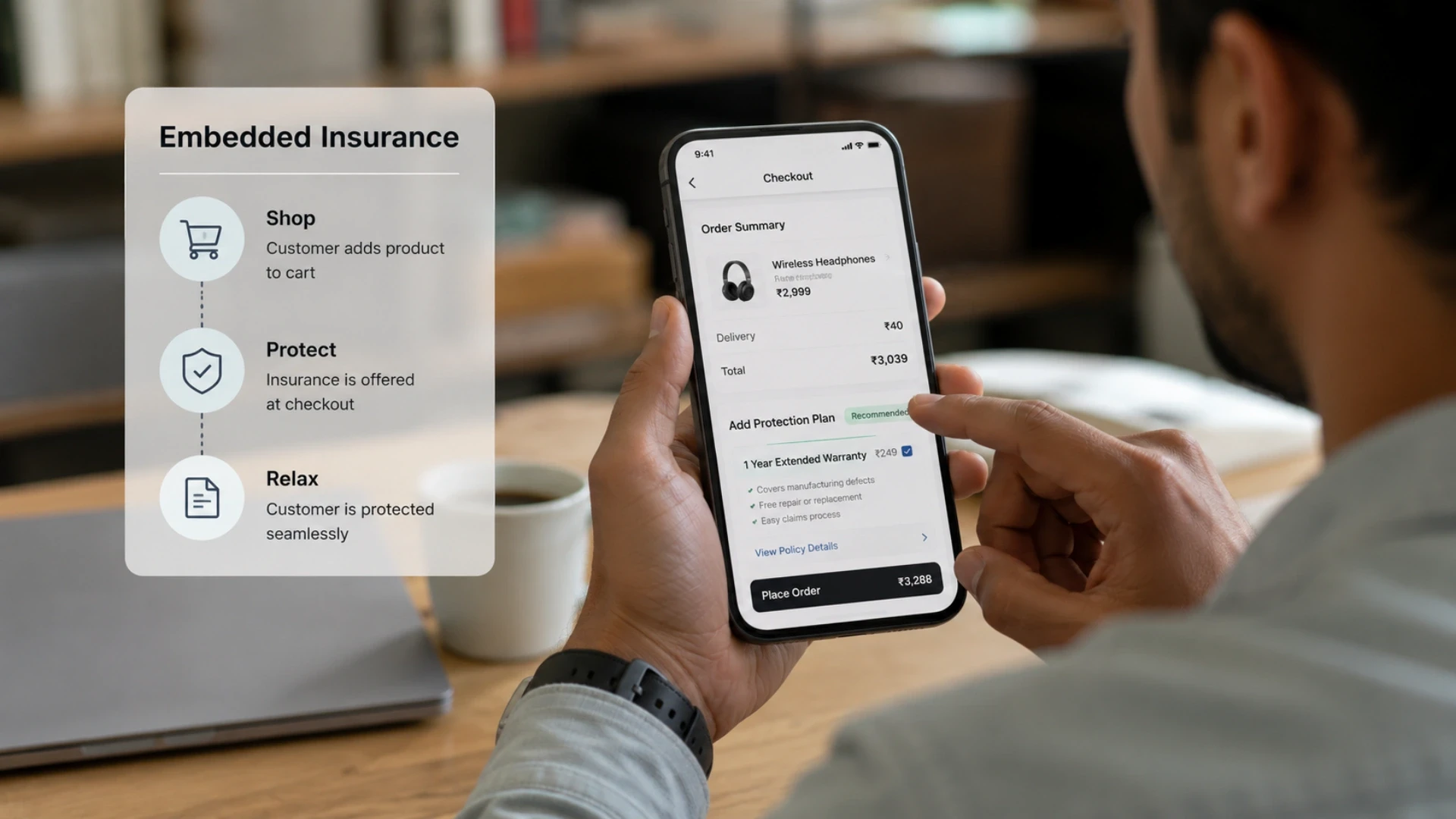
Embedded insurance, coverage placed inside another company's purchase journey, has graduated in 2026 from concept to measurable distribution channel. It is no longer just insurance at checkout; it is coverage delivered inside someone else's customer experience, in travel, e-commerce, mobility, and SaaS. API-first architectures now let InsurTech providers connect into fintech platforms, health apps, and marketplaces, and capital is flowing to back it, including carrier-backed funding for embedded automotive coverage.
What is embedded insurance growth in 2026?
Embedded insurance is rapidly growing, with Deloitte projecting up to $700 billion in global P&C sales by 2030. In 2026, it is evolving from simple checkout add-ons into fully integrated coverage embedded within travel, auto, and SaaS customer journeys. This shift is powered by APIs, seamless integrations, and scalable platforms often built by teams such as MERN Stack developers, making embedded insurance both a commercial and engineering-driven distribution channel.
CASE STUDY
SOC 2 Type II Becomes the Deal Gatekeeper in InsurTech
Challenge
An InsurTech company had a live product, active customers, and a carrier partnership moving toward final integration. The product was stable, APIs were ready, and early traction was strong. But during the final security review, the carrier requested a SOC 2 Type II along with proof of encryption, access control, audit logging, and continuous monitoring.
The issue was timing. SOC 2 Type II requires 12+ months of continuous evidence, so it could not be produced on demand. The partnership process stalled despite product readiness.
Market Reality
Across InsurTech, this pattern is becoming common. Carrier and enterprise buyers now treat SOC 2 Type II as a minimum entry requirement, not a post-deal formality. Without it, even strong products get paused at the security review stage.
Solution
The company shifted to a compliance-first build approach. Instead of treating security as a final step, they implemented encryption, role-based access control, MFA, audit logs, and continuous monitoring from day one. This ensured that SOC 2 Type II evidence started accumulating automatically with every system action.
Outcome
After a full evidence cycle, the platform became SOC 2 Type II ready. When the carrier review resumed, security validation was completed smoothly, and the partnership moved forward without further compliance delays.
Key Learning
SOC 2 Type II is not a certification to prepare for later. It is a continuous system requirement that must start at launch. In InsurTech, compliance readiness is now a direct factor in whether deals close or stall.
Acquaint Softtech builds the partner-facing APIs and widgets that let coverage embed inside a partner's checkout, the technical core of an embedded strategy. This is delivered through the white label software development practice, which builds the embeddable, brandable components partners integrate.
Embedded distribution lives or dies on clean, reliable APIs that partners can integrate quickly. Acquaint Softtech's hire Python developers team builds the API-first services that make a coverage offer appear seamlessly inside a partner platform.
The full architecture of embedded and API-driven distribution is covered in the insurance claims automation guide, whose automated, high-volume patterns suit the efficient servicing that embedded products require.
Force 3: Climate Risk Reshapes Pricing and Prevention

Climate risk has become a real-time pricing challenge in 2026, with natural catastrophe losses exceeding $100 billion annually for multiple years. Insurers are moving beyond traditional claims models toward prevention, real-time risk monitoring, and dynamic pricing. To support this shift, many carriers are investing in scalable digital platforms and choosing to hire Laravel developers who can build data-driven insurance systems capable of adapting to rapidly changing risk conditions.
How does climate change affect insurance?
Climate change is increasing insurance losses, leading to higher premiums, stricter coverage, and limited availability in high-risk areas. Insurers are responding with advanced data like satellites, IoT, and climate models, along with parametric insurance that pays out automatically based on triggers. The focus is shifting from just paying claims to actively preventing risk.
Parametric products depend on real-time data triggers and automated payouts, which is an engineering capability. Acquaint Softtech's hire DevOps developers team builds the streaming data infrastructure that turns a weather trigger into an instant, automated payout.
How climate and property data flow into risk scoring, and prevention is detailed in the modern insurance underwriting guide on AI-driven risk assessment, which covers the geospatial and IoT data pipelines climate-aware insurers depend on.
Build One Platform. Stay Ready for Every InsurTech Trend.
Do not fund four disconnected trend projects. Acquaint Softtech builds unified, data-centric InsurTech platforms at up to 40% less than Western agencies, with a 95% sprint delivery rate. Book a call and get a trend-to-roadmap plan in one session.
Force 4: Regulation Tightens Around AI and Data
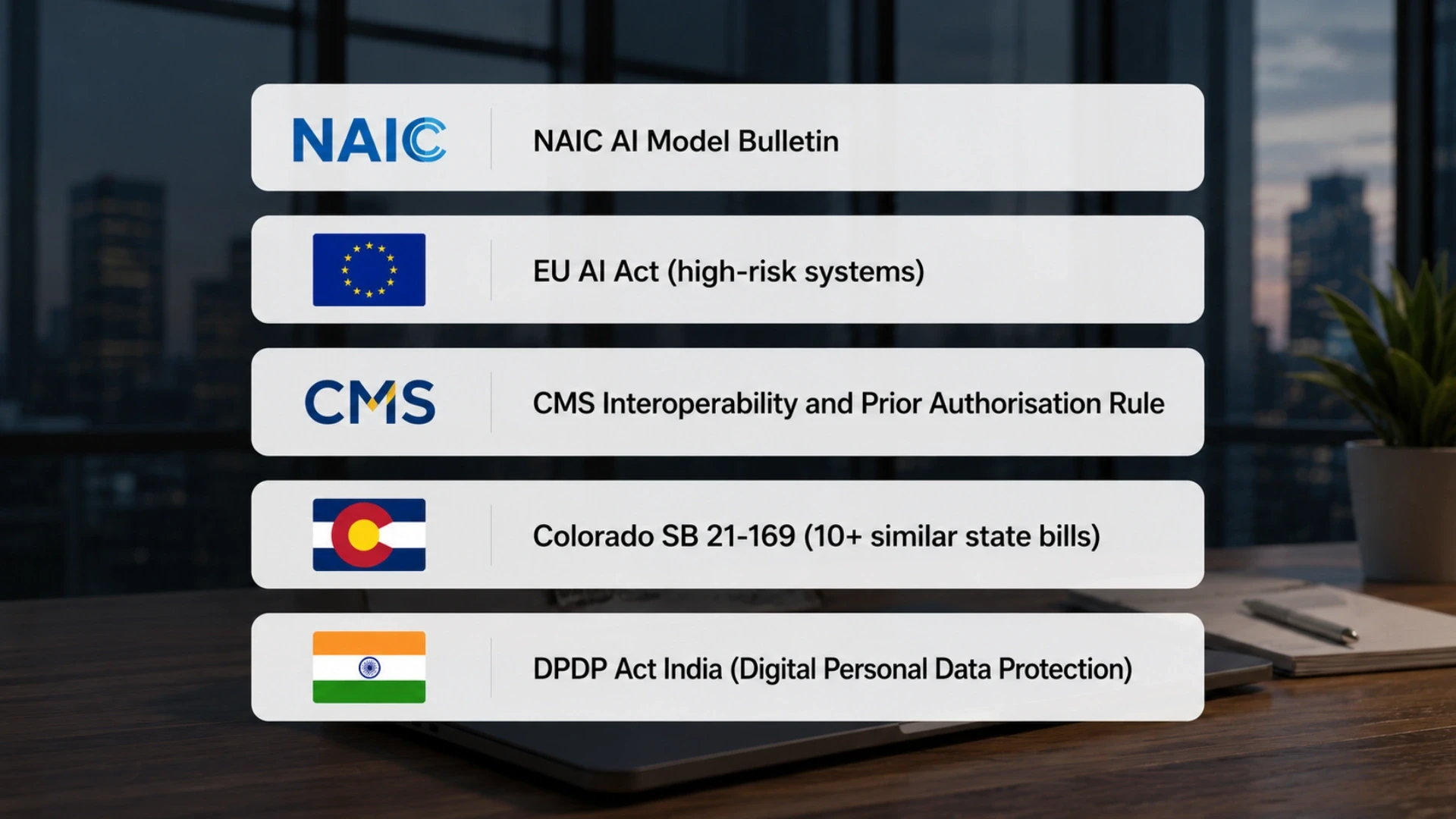
As AI becomes central to insurance, regulators are demanding more than accuracy. Models must be explainable, auditable, and compliant with growing rules around transparency and risk. To meet these requirements, many insurers choose to hire Django developers to build secure, scalable, and regulation-ready platforms.
What regulatory shifts are reshaping insurtech in 2026?
The biggest regulatory shift is the push for AI governance and auditability. Regulations like the EU AI Act and NAIC guidelines require insurers to make AI decisions explainable, monitor bias, and maintain audit trails. As AI adoption grows, compliance is becoming a built-in requirement of AI systems rather than a separate process.
Acquaint Softtech builds explainability, bias monitoring, and audit logging into AI systems from the first model, so they are defensible to a regulator by design. This responsible-AI engineering is delivered through the software development outsourcing model, which provides engineers who build governance into the system rather than around it.
Mapping a decentralised, multi-jurisdiction regulatory surface requires specialist capacity. Acquaint Softtech's staff augmentation adds compliance-experienced engineers within 48 hours to build the controls each jurisdiction demands.
Where the Forces Converge: Continuous, Embedded, Governed Insurance
The four forces are not separate trends competing for attention; they reinforce each other and point toward one destination. AI makes underwriting continuous rather than annual. Embedded distribution puts insurance at the moment of need. Climate data feeds the AI and demands real-time response.
Regulation insists all of it be governed and explainable. Put together, they describe an insurance that is continuous, embedded, and governed, and the insurers building toward that combined picture will outpace those treating each trend in isolation.
How do the 2026 insurtech trends fit together?
They converge on a single operating model. Continuous underwriting, powered by AI and streaming data including climate signals, replaces the static annual assessment. Embedded distribution, powered by API-first architecture, places that continuously-priced coverage inside the customer's journey.
And a governance layer, demanded by regulation, makes every AI-driven decision explainable and auditable across all of it. The common foundation is a modern, data-centric, API-first, governed platform. An insurer that builds that foundation can adopt all four trends as features of one system, while an insurer that chases them as four projects ends up with four disconnected systems and a much larger bill.
2026 Force | What It Pushes Toward | Shared Foundation |
AI to production | Continuous, automated decisions | Data platform plus MLOps |
Embedded insurance | Coverage at the point of need | API-first architecture |
Climate risk | Real-time pricing and prevention | Streaming data and models |
Regulation | Explainable, governed decisions | Audit and governance layer |
Acquaint Softtech builds the single modern platform on which all four forces run, rather than four disconnected trend projects. This unified approach is delivered through the software product development practice, which designs the data-centric, API-first, governed foundation the convergence requires.
For insurers modernising an existing platform to support these trends rather than starting fresh, the path is incremental. Acquaint Softtech's version upgrade services modernise a legacy core toward the data-centric, API-first model the convergence demands without a risky big-bang rewrite.
The architecture that makes this convergence possible is detailed in the budget required to start a Python development project guide, which frames how to invest in a foundation that carries multiple trends rather than one.
What Insurers and Founders Should Do in 2026

Trends are only useful if they change what you do. The practical takeaway from 2026 is to stop treating AI, embedded, climate, and regulation as four separate initiatives and start building the one platform they all depend on, then sequence adoption by where the return is fastest.
For most insurers that means putting AI into production where the feedback loop is short, building API-first so embedded distribution and partner integration are possible, ingesting climate and external data into pricing, and making governance a design constraint from the start.
What should insurers do about 2026 insurtech trends?
Act on four priorities.
First, get AI into production with measurable ROI rather than running more pilots, starting with claims or fraud where returns come fastest.
Second, build or adopt API-first architecture so embedded distribution and partner ecosystems are open to you.
Third, bring climate and external data into underwriting to price risk accurately as losses mount.
Fourth, build governance and explainability into every AI decision from the start, because regulation is tightening in parallel with adoption. The unifying move is to invest in one modern, data-centric platform rather than four disconnected projects, and to partner with engineers who have built these systems before.
Acquaint Softtech helps insurers and founders turn this list into a sequenced, costed roadmap, then builds it. The strategic scoping is delivered through the discovery workshop service, which converts the year's trends into a concrete plan in four to six weeks.
For organisations that need senior technical leadership to own the trend-to-roadmap decisions, Acquaint Softtech's virtual CTO services provide fractional CTO engagement to set strategy and sequencing across all four forces.
Keeping a platform current as these trends keep evolving through 2026 and beyond requires ongoing capacity, which Acquaint Softtech provides through support and maintenance services, covering model updates, new data sources, and regulatory changes after launch.
Build the Future of Insurance With Confidence
Join 200+ technology companies that have scaled with Acquaint Softtech. Trend-ready InsurTech platforms delivered at up to 40% less than Western agencies, with a 4.9/5 rating from 50+ verified Clutch reviews. Book a call and leave with a 2026 roadmap, no obligation.
Frequently Asked Questions
-
What are the 2026 InsurTech trends?
The 2026 InsurTech trends include AI moving into production, embedded insurance growth, climate risk reshaping pricing, and stricter regulation. Together, they make InsurTech the core infrastructure of modern insurance.
-
Is AI taking over insurance in 2026?
AI is not replacing insurance but powering it as an operational engine. It reduces underwriting time from days to minutes and automates up to 70–90% of routine processing, while humans handle complex decisions.
-
What is embedded insurance in 2026?
Embedded insurance is a fast-growing distribution model where coverage is integrated into customer journeys like travel, SaaS, and e-commerce. Deloitte projects it could reach $700B globally by 2030.
-
How does climate change impact insurance?
Climate change increases catastrophe losses above $100B annually, leading to higher premiums and tighter coverage. Insurers now use parametric models and data-driven pricing to improve risk prevention.
-
Why is regulation a key InsurTech trend?
Regulation is tightening due to AI adoption, with frameworks like the EU AI Act and NAIC requiring explainable and auditable models. Compliance is now a core design requirement, not an afterthought.
-
What is the biggest InsurTech shift in 2026?
The biggest shift is from disruption to infrastructure. InsurTech is no longer experimental; it is becoming the foundational operating system of insurance, with 75% of funding focused on AI.
-
How should insurers prepare for 2026 trends?
Insurers should build a single API-first, data-driven platform and prioritize AI production, embedded integration, climate data usage, and strong governance. Execution should follow ROI-driven sequencing.
-
Why is embedded insurance important?
Embedded insurance improves conversion by offering coverage at the point of need. It is powered by APIs and is becoming a strategic channel rather than just a checkout add-on.
-
How is AI changing underwriting?
AI reduces underwriting time from days to minutes and improves straight-through processing up to 70–90%. It uses real-time data to improve pricing accuracy and risk selection.
I love to make a difference. Thus, I started Acquaint Softtech with the vision of making developers easily accessible and affordable to all. Me and my beloved team have been fulfilling this vision for over 15 years now and will continue to get even bigger and better.
Table of Contents
Get Started with Acquaint Softtech
- 13+ Years Delivering Software Excellence
- 1300+ Projects Delivered With Precision
- Official Laravel & Laravel News Partner
- Official Statamic Partner
Related Blog
.webp "The Complete Guide to InsurTech Software Development in 2026")
The Complete Guide to InsurTech Software Development in 2026
InsurTech software is not a fintech variant with policy fields. It is a policy-centric, regulator-accountable platform that runs quote, bind, issue, endorse, pay, and report as one system.

Acquaint Softtech
May 5, 2026
Modern Core Insurance Platform Development: Policy Admin, Billing, Claims, and Distribution
A core insurance platform is not four separate systems patched together with APIs. It is one shared data model where policy administration, billing, claims, and distribution each own a defined domain and fire events that the others consume. Teams that build four separate systems discover the gap at the worst possible moment: renewal time, first major claim, or regulator audit.

Manish Patel
May 14, 2026
Insurance Claims Automation: FNOL, Straight-Through Processing, and AI-Driven Adjudication
AI-driven claims automation reduces claim processing costs from $15–$22 to $3–$5 and cuts turnaround time from 14 days to under 24 hours. Explore the complete 2026 claims automation architecture, from FNOL intake to AI fraud detection and adjudication.
Manish Patel
May 21, 2026India (Head Office)
203/204, Shapath-II, Near Silver Leaf Hotel, Opp. Rajpath Club, SG Highway, Ahmedabad-380054, Gujarat
USA
7838 Camino Cielo St, Highland, CA 92346
UK
The Powerhouse, 21 Woodthorpe Road, Ashford, England, TW15 2RP
New Zealand
42 Exler Place, Avondale, Auckland 0600, New Zealand
Canada
141 Skyview Bay NE , Calgary, Alberta, T3N 2K6