

Kubernetes vs AWS ECS: Which Container Orchestration for Your SaaS Platform in 2026?
Kubernetes and AWS ECS both run containers at scale, but they are built for different stages. Here is what a DevOps engineer recommends and what each costs for UK, European, and US SaaS teams.

Taukir katava
As a DevOps Engineer at Acquaint Softtech, a software development partner, the Kubernetes vs ECS question comes up in almost every new AWS engagement with SaaS companies in the UK, Europe, and the US. Both services run containers at production scale. The decision is about operational complexity versus flexibility, and it depends almost entirely on the stage and scale of the product. This guide gives the honest comparison, the decision framework a DevOps engineer uses, and the cost implications of each choice for teams in different markets.

- SaaS CTOs on AWS in the UK, Europe, or US deciding between ECS and Kubernetes before committing to a platform
- Engineering leads currently on ECS who are evaluating whether to migrate to Kubernetes as the product scales
- Teams on standalone Docker wanting to choose the right orchestration platform for their first containerised deployment
- Founders hiring a DevOps engineer and wanting an informed recommendation on ECS versus Kubernetes for their specific product stage
AWS ECS and Kubernetes both schedule and manage containers at scale. The operational difference is in how much infrastructure the DevOps engineer manage directly. ECS abstracts cluster management: AWS runs the scheduling layer and the team manages task definitions and services. Kubernetes exposes the full orchestration layer: the team configures pods, deployments, replica sets, services, ingress, RBAC, network policies, and more. More control means more capability and more complexity.
For teams who have already decided on Kubernetes and are choosing the managed Kubernetes service, the AWS EKS setup and management guide covers the full EKS setup and ongoing management cost. This article covers the decision between ECS and Kubernetes for teams who have not yet committed.
What Each Platform Is: Plain Definitions
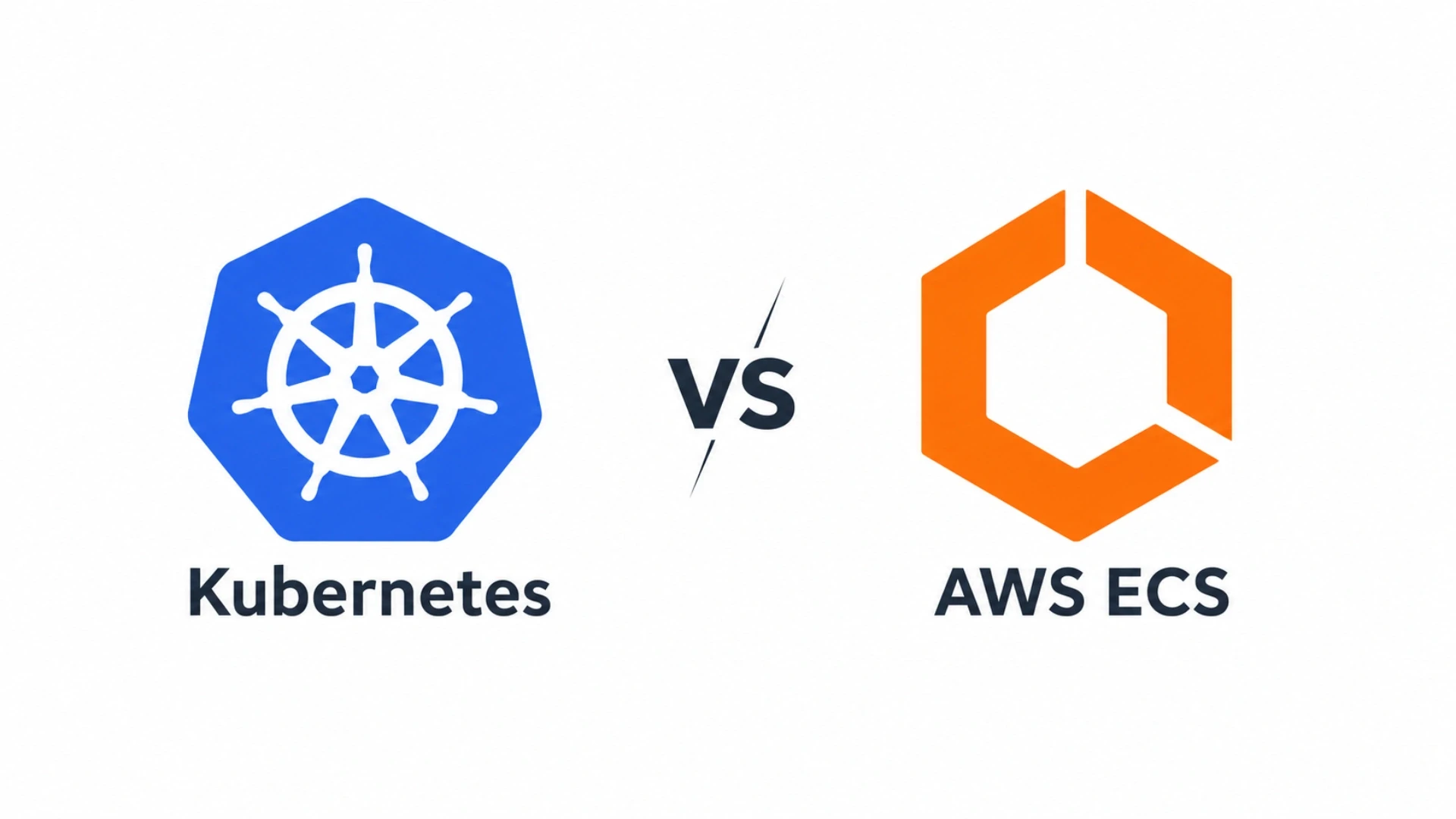
AWS ECS (Elastic Container Service)
ECS is AWS's native container orchestration service. You define tasks (container definitions with CPU, memory, port mappings) and services (how many task replicas to run, load balancer configuration, auto-scaling policy). AWS runs the scheduling layer.
Two launch types:
Fargate: AWS manages the underlying compute. No EC2 instances to configure. Simplest to operate. You pay per task CPU and memory.
EC2: You manage EC2 instances in an ECS cluster. More control, lower cost.
Integration: native AWS. IAM task roles, ALB integration, CloudWatch logging, AWS Secrets Manager, ECR image registry. Everything works without extra configuration.
Learning curve: low. Engineers familiar with AWS can operate ECS within days.
Kubernetes (via AWS EKS)
Kubernetes is an open-source container orchestration platform. EKS is AWS-managed Kubernetes where AWS runs the control plane. You manage worker nodes and all Kubernetes resources: pods, deployments, services, ingress, HPA, RBAC, network policies.
Capabilities beyond ECS:
Advanced scheduling: pod affinity, anti-affinity, topology spread constraints.
Rich ecosystem: Helm, ArgoCD, Prometheus, Kyverno, Falco, Karpenter.
Multi-cloud portability: same YAML runs on EKS, AKS, or GKE.
Fine-grained networking: network policies, service meshes (Istio, Linkerd).
Integration: requires additional tooling to match ECS native AWS integration. IRSA for IAM, Load Balancer Controller for ALB, External Secrets for Secrets Manager.
Learning curve: high. Requires a dedicated DevOps engineer with EKS production experience.
The 10-Dimension Comparison
Here is the full comparison across the 10 dimensions that matter most when a DevOps engineer are choosing between ECS and Kubernetes for a SaaS platform.
Dimension | AWS ECS | Kubernetes (EKS) | Verdict for most SaaS |
Operational complexity | Low: task definitions, services | High: pods, deployments, services, ingress, RBAC, network policies | ECS at early/mid stage |
Scaling granularity | Service-level auto-scaling | Pod-level HPA + cluster-level Karpenter | Kubernetes (more precise) |
Cost (compute) | Fargate premium; EC2 competitive | EC2 + EKS control plane $73/month; Spot via Karpenter | Kubernetes (more cost control at scale) |
Setup time (DevOps engineer) | 1 to 3 days for production setup | 8 to 14 days for production EKS setup | ECS (faster to value) |
Multi-cloud portability | AWS only | EKS, AKS, GKE, on-prem (same YAML) | Kubernetes (portable) |
Native AWS integration | Seamless: IAM, ALB, CloudWatch, ECR | Requires: IRSA, ALB Controller, External Secrets | ECS (less configuration) |
Ecosystem and tooling | Limited: AWS-native tooling | Rich: Helm, ArgoCD, Prometheus, Falco, Karpenter | Kubernetes (broader ecosystem) |
Service mesh support | Limited (App Mesh, less adoption) | Full: Istio, Linkerd, Cilium | Kubernetes |
Security controls | IAM task roles, VPC networking | Full stack: PSS, NetworkPolicies, Gatekeeper, Falco | Kubernetes (more controls) |
Right for service count | 1 to 10 services | 5+ services, best value at 10+ | Depends on stage |
For teams evaluating Kubernetes readiness specifically, the Kubernetes for startups guide covers the 5 signals that indicate a startup is ready to move to Kubernetes from ECS or standalone Docker.
UK, European, or US SaaS: Not Sure Whether ECS or Kubernetes Is Right? Get a DevOps Recommendation.
Tell Acquaint Softtech your service count, current AWS setup, team size, and expected growth. A vetted DevOps engineer will recommend the right platform for your stage and send a matched profile within 24 hours.
The Decision Framework: When to Choose Each
The right answer is almost never 'Kubernetes is better'. It are 'Kubernetes is right for this stage'. Here is the decision framework a DevOps engineer applies.
Choose ECS when |
Service count: 1 to 10 services. Team: 1 to 3 engineers. Timeline: production infrastructure needed in 1 to 2 weeks. Budget: limited DevOps time available. AWS dependency: comfortable with AWS lock-in, no multi-cloud requirement. Compliance: basic SOC 2 controls are sufficient (ECS with proper IAM, VPC, and Secrets Manager satisfies most SOC 2 requirements without the full Kubernetes security stack). |
Choose Kubernetes (EKS) when |
Service count: 5 or more services and growing. Deployment frequency: 10+ deploys per day across services. Team: dedicated DevOps engineer available or in the hiring plan. Capability needs: advanced scheduling, pod-level autoscaling, GitOps, admission controller policies, or multi-cloud portability. Compliance: full SOC 2 or ISO 27001 with Kubernetes-specific controls. Growth trajectory: the product will reach 15+ services within 12 months. |
Start on ECS, migrate to Kubernetes later |
This is the most common realistic path. A team with 3 services starts on ECS Fargate (minimal DevOps overhead, fast setup). When the product grows to 8+ services and deployment complexity increases, the team migrates to EKS. The migration follows a parallel approach: EKS cluster built alongside ECS, services migrated one at a time, ECS decommissioned after full migration. A DevOps engineer runs this migration in 4 to 8 weeks with zero production downtime. |
For teams who have decided on Kubernetes and want to understand the migration process, the Docker to Kubernetes migration guide covers the 6-phase parallel migration approach with zero production downtime.
Currently on ECS and Wondering When to Move to Kubernetes?
UK, European, and US teams: tell Acquaint Softtech your service count, your ECS setup, and your expected growth. A DevOps engineer will advise whether now is the right time to migrate and send a migration plan if it is.
Cost Comparison: ECS vs Kubernetes for UK, European, and US Teams in 2026

The cost difference has two components: the AWS infrastructure cost and the DevOps engineer cost by region. Here is the honest comparison.
Infrastructure cost comparison (10-service SaaS platform, monthly)
ECS Fargate (10 services, 0.5 vCPU / 1GB each, 3 replicas): Compute: approx $1,320/month. Simpler to operate. Higher per-unit cost.
ECS EC2 (5x m5.large, on-demand): approx $395/month | Spot: approx $154/month
Kubernetes EKS (4x m5.large nodes, mixed Spot/on-demand): EKS control plane $73 + nodes approx $200 + monitoring approx $80 = approx $353/month
Key insight: ECS EC2 and EKS are comparable in infrastructure cost for 10 services.
ECS Fargate is significantly more expensive but requires less DevOps overhead.
DevOps cost dimension | ECS Fargate | ECS EC2 | Kubernetes EKS |
Initial setup time | 1 to 2 days | 2 to 4 days | 8 to 14 days |
Setup cost (Acquaint Softtech $22/hr) | $176 to $352 | $352 to $704 | $1,408 to $2,464 |
UK in-house equivalent | GBP 80-110k/yr fully loaded | GBP 80-110k/yr | GBP 80-110k/yr |
Germany/Netherlands in-house | EUR 85-120k/yr fully loaded | EUR 85-120k/yr | EUR 85-120k/yr |
US in-house equivalent | $130-180k/yr fully loaded | $130-180k/yr | $130-180k/yr |
Acquaint Softtech monthly retainer | $1,600-2,400/month (part-time) | $2,400-3,200/month | $3,200/month |
Acquaint Softtech's hire DevOps developers service provides pre-vetted engineers experienced in both ECS and Kubernetes production setups. Starting at $22/hour or $3,200/month.
For the full DevOps rate comparison across the UK, Europe, and the US, the DevOps engineer cost guide covers what each price tier delivers.
For Kubernetes security controls that apply once you move from ECS, the Kubernetes container security guide covers the 8-layer security stack that EKS requires and ECS partially handles natively.
Individual DevOps engineer on a monthly retainer through our staff augmentation model. Starting at $22/hour or $3,200/month. Available in 48 hours.
For teams building their first containerised SaaS product, Acquaint Softtech's software product development service covers the full product team including DevOps platform selection.
Need a DevOps Engineer Who Knows Both ECS and Kubernetes? Acquaint Softtech Has Both.
Pre-vetted DevOps engineers experienced in ECS Fargate, ECS EC2, and Kubernetes EKS. UK, European, and US companies served. Starting at $22/hour or $3,200/month. Platform recommendation in week 1. Matched profile in 24 hours.
Frequently Asked Questions
-
What is the difference between Kubernetes and AWS ECS?
Kubernetes is a full container orchestration platform with a rich ecosystem: pods, deployments, HPA, RBAC, network policies, Helm, ArgoCD, and more. AWS ECS is a simpler AWS-native container orchestration service with less operational complexity and native AWS integration. Kubernetes is more powerful, more portable, and more complex to operate.
-
Which is cheaper, Kubernetes or ECS in 2026?
It depends on the launch type. ECS Fargate is the most expensive compute option per unit (approx $1,320/month for 10 services). ECS EC2 and Kubernetes EKS are comparable in infrastructure cost for 10+ services (both approx $350 to $400/month). The real cost difference is in DevOps time: ECS requires less management overhead.
-
When should a SaaS startup use ECS instead of Kubernetes?
ECS is right when: you have fewer than 10 services, your team lacks Kubernetes expertise, you need production infrastructure in 1 to 2 weeks, and you are comfortable with AWS lock-in. ECS Fargate requires the least DevOps overhead of any container orchestration option.
-
When should a SaaS startup move from ECS to Kubernetes?
Consider moving when: you have 8 or more services, your deployment frequency is high, you need pod-level autoscaling (HPA), you want multi-cloud portability, or you are preparing for enterprise clients who expect Kubernetes-native infrastructure maturity. The migration is a 4 to 14 week parallel process with no production downtime.
-
How much does it cost to hire a DevOps engineer for ECS or Kubernetes in the UK and Europe?
A UK-based senior DevOps engineer costs GBP 80,000 to 110,000 per year fully loaded. In Germany or the Netherlands, the equivalent is EUR 85,000 to 120,000. Acquaint Softtech provides pre-vetted DevOps engineers experienced in both ECS and Kubernetes at $22/hour or $3,200/month, delivering the same technical capability at a significant cost saving.
-
How long does it take to migrate from ECS to Kubernetes?
A 5 to 10 service ECS-to-EKS migration takes 4 to 8 weeks with a parallel approach: EKS cluster built alongside ECS, services migrated one at a time, ECS decommissioned after validation. Each service's ECS task definition is converted to a Kubernetes Deployment and Helm chart. Zero production downtime throughout the migration.
-
What DevOps skills are needed for ECS versus Kubernetes?
ECS: AWS CLI, ECS task definitions, IAM task roles, ALB integration, CloudWatch. Most AWS-experienced DevOps engineers can operate ECS within a week. Kubernetes: EKS, Helm, kubectl, RBAC, network policies, Prometheus, ArgoCD. Requires dedicated EKS production experience. When hiring, ask specifically for EKS production experience, not just Kubernetes familiarity.
Taukir Katava is a DevOps Engineer at Acquaint Softtech with 4+ years of experience across AWS, Azure, and GCP. He specialises in Kubernetes cluster administration, CI/CD pipeline automation, and cloud infrastructure design for high-traffic platforms. Taukir writes about the practical side of production DevOps: what infrastructure decisions cost and what they actually deliver.
Table of Contents
Get Started with Acquaint Softtech
- 13+ Years Delivering Software Excellence
- 1300+ Projects Delivered With Precision
- Official Laravel & Laravel News Partner
- Official Statamic Partner
Related Reading
Helm Charts and Kubernetes Deployment Automation: What a DevOps Engineer Builds in 2026
Helm turns Kubernetes deployments from 20 YAML files per service into a single versioned command. Here is what a DevOps engineer builds with Helm, what gets automated, and what it costs in 2026.
Taukir katava
June 12, 2026
Kubernetes Cost Optimisation With Spot Instances: How a DevOps Engineer Reduces Your Cloud Bill by 60 to 80%
AWS Spot Instances reduce Kubernetes node costs by 60 to 80%. Here is what a DevOps engineer configures to make Spot work safely in a production K8s cluster and what you save.
Taukir katava
June 10, 2026
Container Security on Kubernetes: What a DevOps Engineer Implements to Protect Production in 2026
A default Kubernetes cluster has significant security gaps. Here is the 8-layer security stack a DevOps engineer implements to protect production Kubernetes workloads and what it costs.
Taukir katava
June 22, 2026India (Head Office)
203/204, Shapath-II, Near Silver Leaf Hotel, Opp. Rajpath Club, SG Highway, Ahmedabad-380054, Gujarat
USA
7838 Camino Cielo St, Highland, CA 92346
UK
The Powerhouse, 21 Woodthorpe Road, Ashford, England, TW15 2RP
New Zealand
42 Exler Place, Avondale, Auckland 0600, New Zealand
Canada
141 Skyview Bay NE , Calgary, Alberta, T3N 2K6