

From Manual Deployments to Automated Pipelines: What a DevOps Engineer Builds in 30 Days
Manual deployments slow teams down and introduce human error on every release. Here is exactly what a DevOps engineer automates first, the 30-day sequence, and the 2026 cost.

Taukir katava
As a DevOps Engineer at Acquaint Softtech, a software development partner, the most common starting point for a new DevOps engagement is a team still doing manual deployments. A developer SSHs into a server, pulls the latest code, restarts the service, and hopes nothing breaks. This process works until it does not. It fails at scale, introduces human error on every release, and blocks the team from shipping more than once or twice a week. This article covers what a DevOps engineer automates first, what the 30-day build sequence looks like, and what it costs in 2026.

- Development teams whose deployment process still involves manual steps on a live server
- CTOs who want to move to automated CI/CD but have not started and need a roadmap
- Engineering leads who have tried to automate deployments and got stuck at a specific step
- SaaS founders preparing to hire a DevOps engineer and wanting to understand what the first 30 days produces
Manual deployments accumulate risk with every release. Each deployment is a human task with a sequence of steps that can be performed inconsistently, skipped under time pressure, or executed in the wrong order. A developer who has done the same deployment 50 times still make mistakes on release 51. Automation eliminates the human variable entirely. The pipeline either passes and deploys, or it fails with a specific error. There is no grey area and no human judgment required at release time.
The business cost of having no CI/CD pipeline at all, including how to calculate what manual deployments cost your team per week, is covered in the no CI/CD pipeline cost guide. This article focuses on the automation process itself: what gets built and in what order.
What Manual Deployments Actually Cost: The Numbers
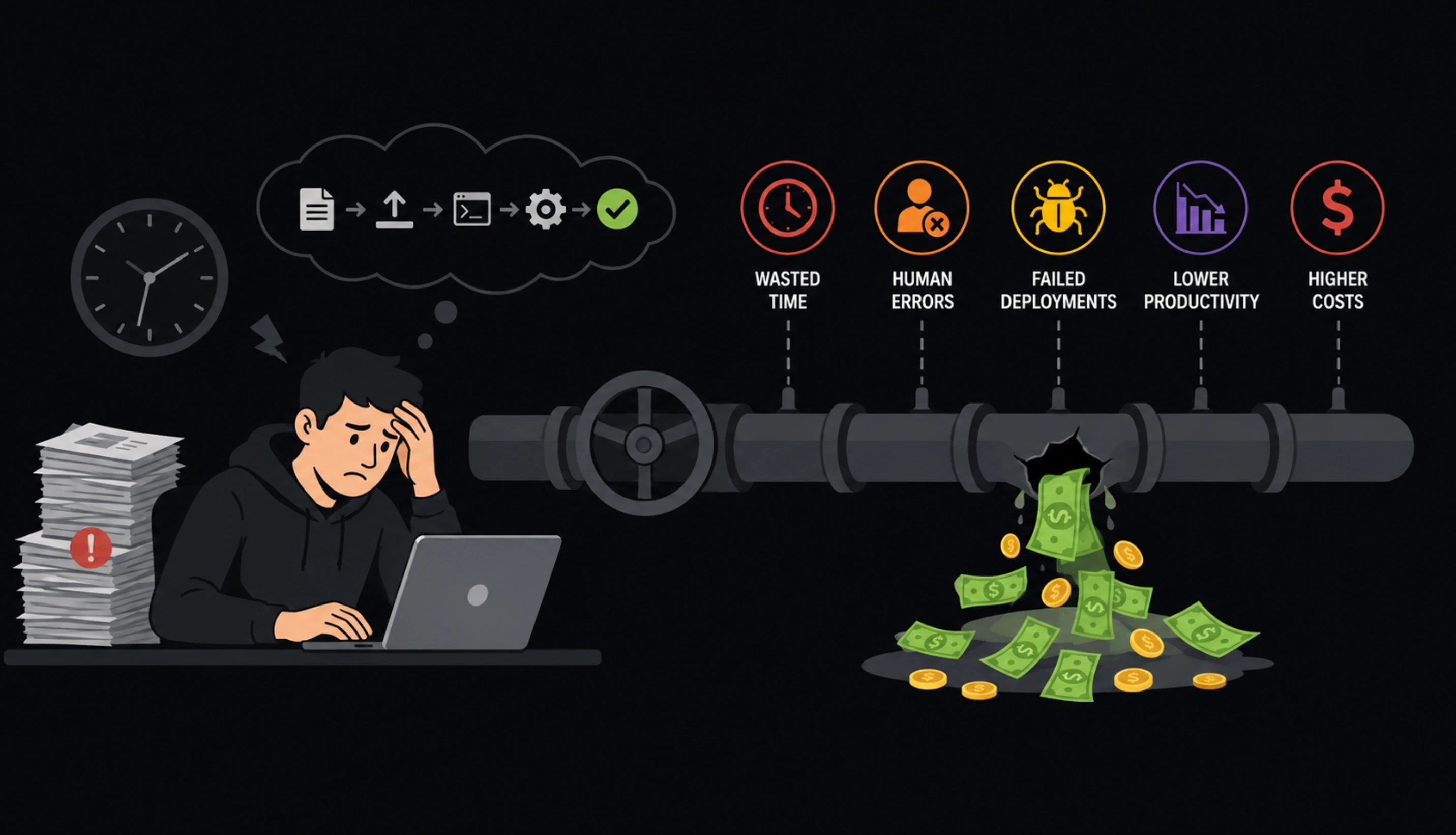
Before building anything, a DevOps engineer quantifies what the manual deployment process is currently costing. This baseline justifies the automation investment and sets the improvement targets.
How to calculate your manual deployment cost
Step 1: Count how many deployments your team does per week.
Step 2: Measure how long each deployment takes from commit to live (include coordination time).
Step 3: Count how many people are involved in each deployment.
Step 4: Count how many deployment-related incidents occur per month.
Example calculation for a 5-developer team:
3 deployments per week x 45 minutes each x 2 people involved = 270 developer-minutes/week
At $60/hour blended rate: $270/week = $14,040/year in deployment coordination cost alone.
Add 1 deployment-related incident per month at 4 hours to resolve: $2,880/year in incident cost.
Total: $16,920/year in manual deployment overhead.
A DevOps engineer engagement at $22/hour for 30 days (160 hours) = $3,520.
Payback period: 2.5 months.
If your deployment pipeline already exists but is slow rather than manual, the deployment pipeline fix guide covers what a DevOps engineer diagnoses and cuts in the first 30 days.
Still on Manual Deployments? Calculate What It Is Costing You First.
Tell Acquaint Softtech your team size, deployment frequency, and how long each deployment takes. A vetted DevOps engineer will calculate the exact cost of your current process and show you what automated CI/CD saves. This conversation takes 15 minutes.
What a DevOps Engineer Automates First: The 30-Day Sequence
Not everything get automated at once. A DevOps engineer prioritises the changes that eliminate the most risk and recover the most developer time for the least implementation effort. Here is the sequence that delivers the highest impact fastest.
Week 1: Source control hygiene and environment setup
Before automating anything, a DevOps engineer reviews how code moves from development to production. Are branches properly structured? Is there a staging environment? Is the production server accessible only through a deployment process or also through direct SSH? Week 1 fixes the foundation so automation does not simply move a broken process into a pipeline.
Week 2: First automated pipeline (build and test)
The first pipeline stage is automated: code is pushed to the main branch, a runner picks it up, dependencies are installed, and the test suite runs. If tests pass, the build artifact is produced. If tests fail, the developer is notified immediately. No deployment yet. The goal of week 2 is a passing build on every commit, visible to the whole team.
Week 3: Automated staging deployment
The pipeline is extended to deploy automatically to a staging environment on every successful build from the main branch. The staging deployment is fully automated: no SSH, no manual steps. The developer pushes code and the staging URL reflects it within minutes. Smoke tests or health checks confirm the deployment succeeded.
Week 4: Production deployment pipeline with gates
Production deployment is automated but gated. A manual approval step (or a passing suite of integration tests) is required before the pipeline deploys to production. Rollback is configured: if the production deployment fails a health check, the previous version is restored automatically. By the end of week 4, the team deploys to production by clicking Approve, not by SSHing into a server.
For teams choosing which CI/CD tool to implement during this process, the CI/CD tool comparison guide covers GitHub Actions, Jenkins, and GitLab CI across eight dimensions so the tool decision is made before the build starts.
What Gets Built in 30 Days: The Complete Deliverable List
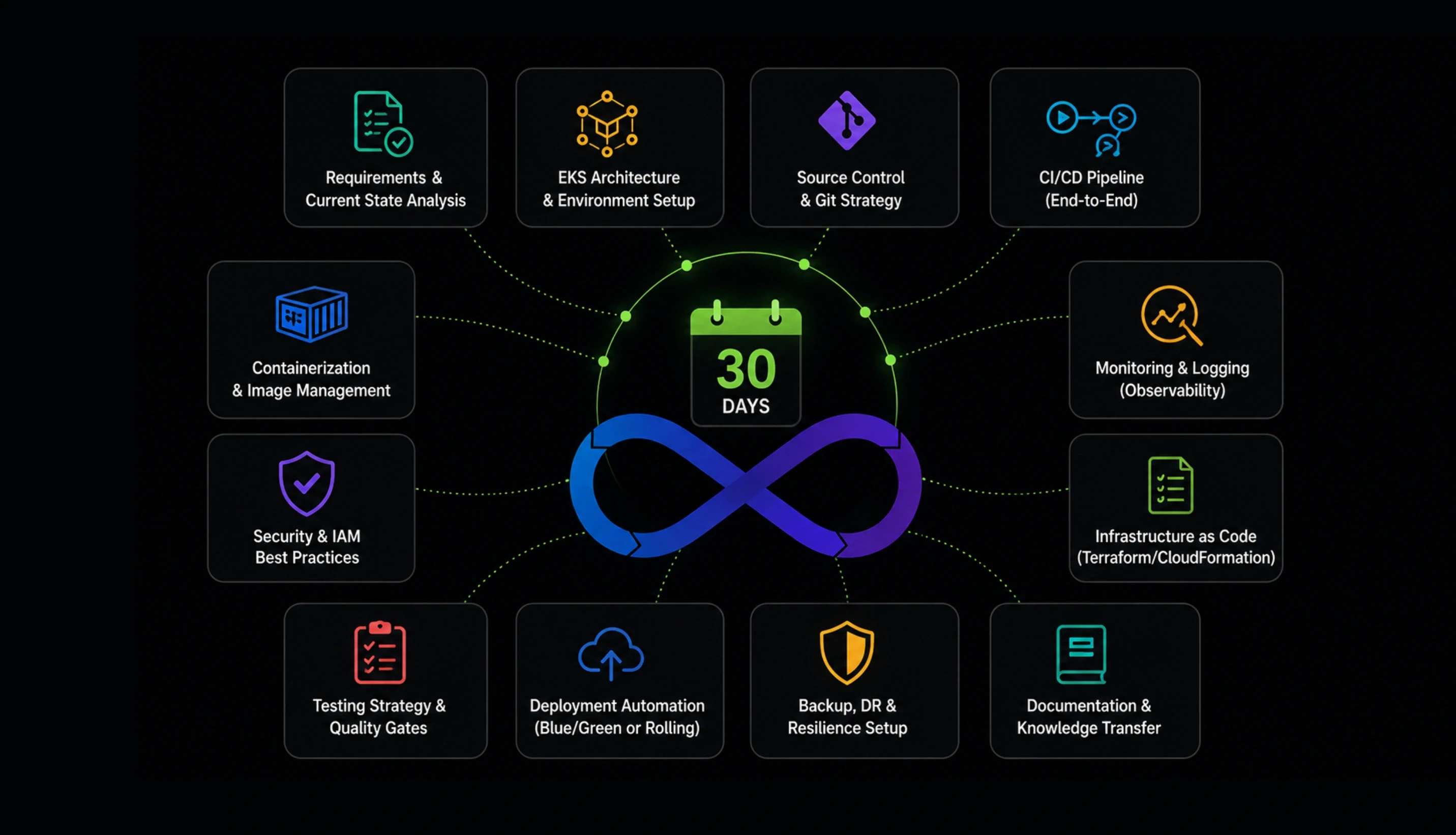
At the end of a 30-day automation engagement, a DevOps engineer delivers a specific set of artefacts. Here is the complete list so you know exactly what to expect.
Deliverable | Tool / Technology | When Delivered |
Source control branch structure | GitHub / GitLab / Bitbucket | Week 1 |
Build pipeline (dependencies + compile) | GitHub Actions / GitLab CI / Jenkins | Week 2 |
Automated test runner | Jest, PyTest, PHPUnit (as applicable) | Week 2 |
Staging deployment automation | CI/CD + SSH deploy or container push | Week 3 |
Health check and smoke test | curl / custom script / Postman | Week 3 |
Production deployment with approval gate | CI/CD environment protection rules | Week 4 |
Automated rollback on failure | CI/CD + server rollback script | Week 4 |
Deployment notifications | Slack / email on success and failure | Week 4 |
Pipeline documentation and runbook | Markdown in repository | Week 4 |
What It Costs in 2026
The cost of a manual-to-automated deployment engagement depends on the complexity of the existing infrastructure and the CI/CD tool selected. Here are the honest numbers at Acquaint Softtech rates.
Scenario | DevOps Engineer Time | Cost at $22/hour |
Simple: 1 server, 1 app, GitHub Actions | 15 to 20 days | $2,640 to $3,520 |
Standard: staging + production, GitHub Actions or GitLab CI | 20 to 25 days | $3,520 to $4,400 |
Complex: multiple services, Jenkins, custom gates | 25 to 30 days | $4,400 to $5,280 |
Monthly retainer (ongoing CI/CD ownership) | Full-time, rolling | $3,200/month starting |
Acquaint Softtech's hire DevOps engineers service provides vetted engineers who have moved teams from manual deployments to fully automated CI/CD pipelines across AWS, Azure, and GCP. Profiles delivered in 24 hours.
For the full rate comparison by region and seniority, the DevOps engineer cost guide covers what each price tier delivers in a deployment automation engagement.
Ready to Move From Manual to Automated Deployments in 30 Days?
Tell Acquaint Softtech your current stack, how many environments you deploy to, and which CI/CD tool you prefer. A DevOps engineer will send a week-by-week plan for your specific setup within 48 hours.
Common Mistakes When Moving From Manual to Automated Deployments
The transition from manual to automated deployments introduces specific failure patterns that do not exist in purely manual processes. Knowing what these are before starting prevent the most expensive ones.
Automating a broken process |
If the manual deployment process is inconsistent or relies on undocumented server state, automating it produces a pipeline that fails unpredictably. A DevOps engineer spends the first week documenting and stabilising the manual process before automating it. Automation of a broken process produces automated failures at higher speed. |
Skipping the staging environment |
Teams that deploy directly from build to production are trading deployment risk for speed. A staging environment that mirrors production is not optional. It is the gate that catches the configuration differences and environment-specific failures that do not appear in local development. |
No rollback configuration |
An automated deployment that fails and cannot roll back automatically is worse than a manual deployment that failed. The developer now needs to SSH into the server and manually fix a state that the pipeline left broken. Automated rollback is not optional - it is what makes automation safer than manual deployment. |
Treating the pipeline as set-and-forget |
A CI/CD pipeline degrades over time if nobody owns it. Tests become flaky and are disabled rather than fixed. Pipeline duration creeps up as dependencies are added. A DevOps engineer on a monthly retainer treats pipeline health as a tracked metric and prevents this degradation before it becomes a problem. |
For individual DevOps engineer capacity on a monthly retainer, Acquaint Softtech's staff augmentation model provides a dedicated engineer in your standup in 48 hours, starting at $22/hour.
For a managed DevOps team covering automation and broader infrastructure, our dedicated development teams service provides the full team structure.
Ready to Automate Your Deployments? Acquaint Softtech Has DevOps Engineers Available Now.
Pre-vetted DevOps engineers who have moved teams from manual SSH deployments to fully automated CI/CD pipelines. Starting at $22/hour on a monthly retainer. Matched profile in 24 hours. Engineer in your standup in 48 hours.
Frequently Asked Questions
-
How do you move from manual to automated deployments?
A DevOps engineer documents the existing manual process, sets up a CI/CD pipeline tool (GitHub Actions, Jenkins, or GitLab CI), automates the build and test stages first, then extends to staging deployment, then production with a gate and rollback. The full transition takes 20 to 30 days for a standard application.
-
How long does deployment automation take?
A DevOps engineer moves a team from manual to automated deployments in 20 to 30 days depending on infrastructure complexity. Staging automation is typically live by end of week 3. Production automation with rollback is live by end of week 4.
-
What does a DevOps engineer automate first?
The build and test stage. Automating compilation and test execution first gives the team immediate value: every commit is validated automatically. This is the foundation every other automation step depends on and it requires no changes to production infrastructure.
-
How much does deployment automation cost at Acquaint Softtech?
A standard deployment automation engagement takes 20 to 25 days at $22/hour. Total cost: $3,520 to $4,400. This is typically absorbed into the first sprint of a monthly retainer engagement rather than billed as a standalone project.
-
Can I keep deploying manually while the automation is being set up?
Yes. A DevOps engineer builds the automated pipeline in parallel with your existing manual process. The manual process continues until the automated pipeline is verified. The cutover happens when the automated pipeline is confirmed to produce the same deployment outcomes as the manual process.
-
What is the ROI of deployment automation?
For a 5-developer team doing 3 manual deployments per week at 45 minutes each: the automation saves 270 developer-minutes per week. At $60/hour blended rate, that is $270/week or $14,040/year. A 30-day DevOps engagement at $22/hour costs $3,520. Payback period: approximately 2.5 months.
-
Do I need a DevOps engineer just to automate deployments?
Not necessarily. A senior developer with CI/CD experience can set up a basic pipeline. A DevOps engineer is the right hire when: you have multiple environments, complex infrastructure, or you want someone who treats deployment automation as their primary focus rather than a side task alongside feature development.
Taukir Katava is a DevOps Engineer at Acquaint Softtech with 4+ years of experience across AWS, Azure, and GCP. He specialises in Kubernetes cluster administration, CI/CD pipeline automation, and cloud infrastructure design for high-traffic platforms. Taukir writes about the practical side of production DevOps: what infrastructure decisions cost and what they actually deliver.
Table of Contents
Get Started with Acquaint Softtech
- 13+ Years Delivering Software Excellence
- 1300+ Projects Delivered With Precision
- Official Laravel & Laravel News Partner
- Official Statamic Partner
Related Reading
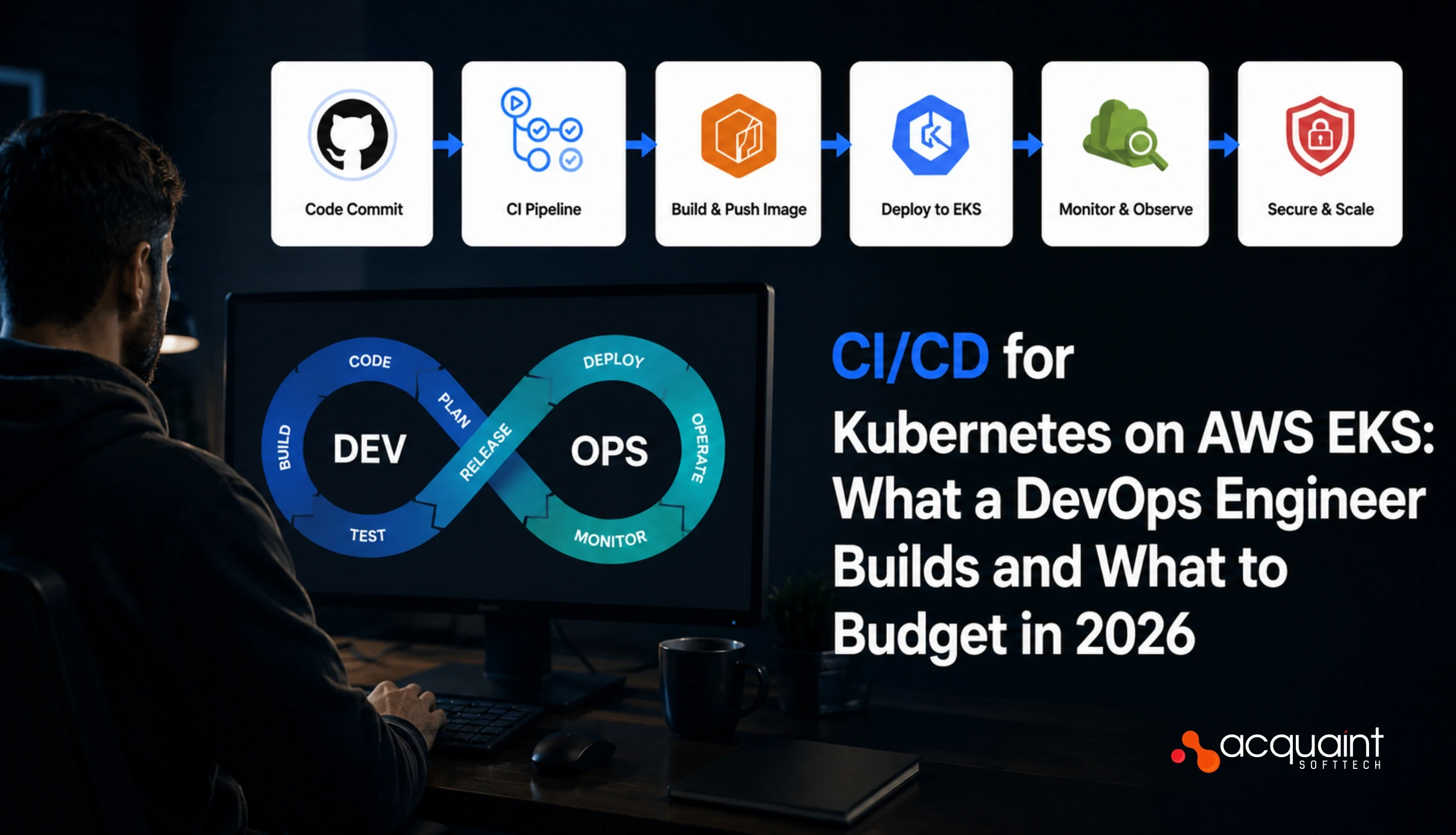
CI/CD for Kubernetes on AWS EKS: What a DevOps Engineer Builds and What to Budget in 2026
CI/CD for Kubernetes on AWS EKS requires more than a standard pipeline. Here is what a DevOps engineer builds, which tools they choose, and what to budget in 2026.
Taukir katava
May 13, 2026
App Crashes Every Traffic Spike: The Infrastructure a DevOps Engineer Builds to Stop It
If your app crashes every time traffic spikes, the problem is infrastructure gaps, not code. Here is what a DevOps engineer diagnoses, builds, and delivers in the first 30 days.
Taukir katava
May 7, 2026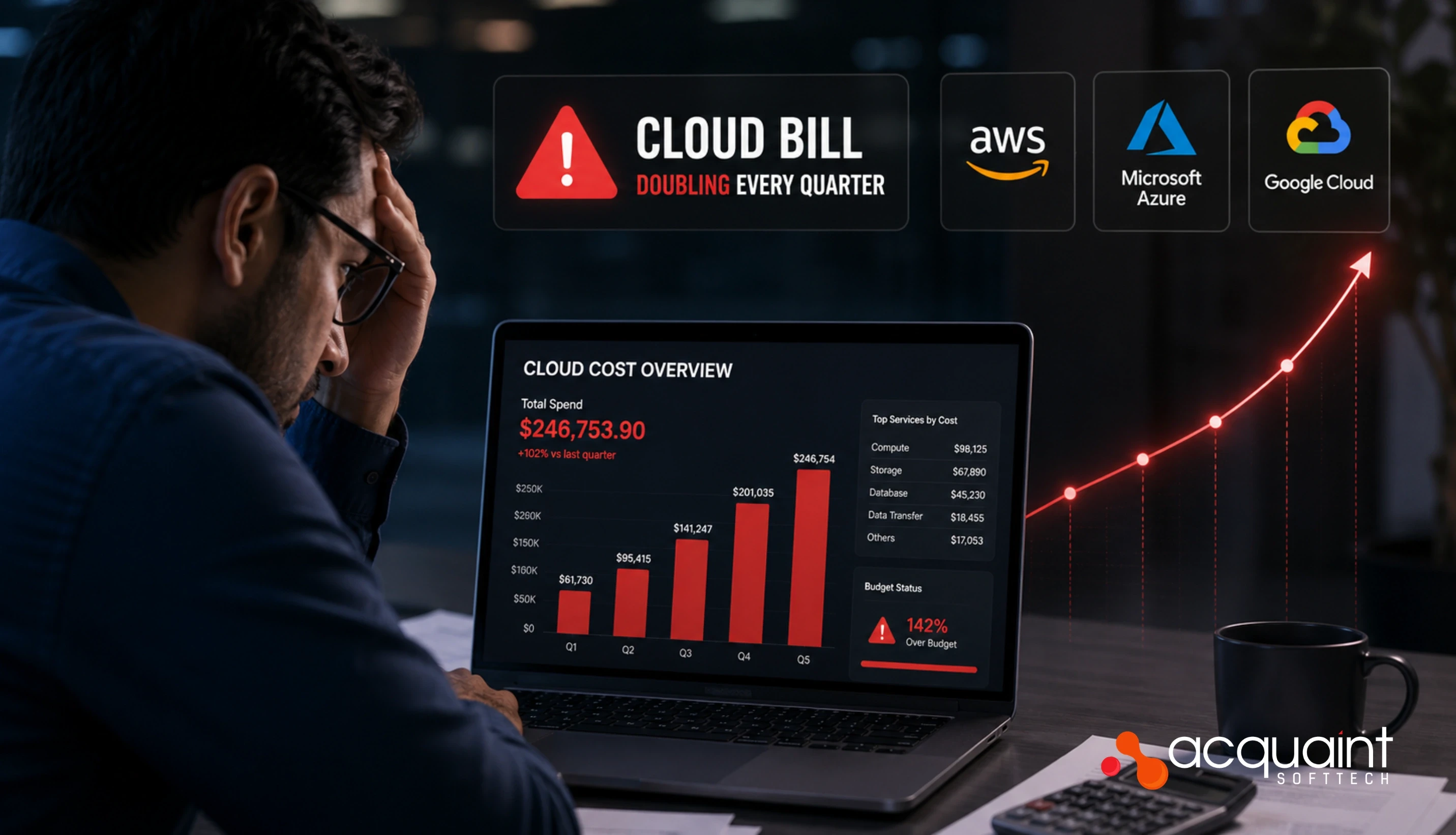
Cloud Bill Doubling Every Quarter: What a DevOps Engineer Finds and Fixes in 30 Days
AWS bill doubling every quarter without a clear reason? A DevOps engineer typically finds 20 to 40% of cloud spend as waste. Here are the 7 categories they fix first.
Taukir katava
May 8, 2026India (Head Office)
203/204, Shapath-II, Near Silver Leaf Hotel, Opp. Rajpath Club, SG Highway, Ahmedabad-380054, Gujarat
USA
7838 Camino Cielo St, Highland, CA 92346
UK
The Powerhouse, 21 Woodthorpe Road, Ashford, England, TW15 2RP
New Zealand
42 Exler Place, Avondale, Auckland 0600, New Zealand
Canada
141 Skyview Bay NE , Calgary, Alberta, T3N 2K6