

Monthly Retainer vs Project-Based Pricing for Python Development: Which Model Saves More?
Monthly retainer or project-based pricing for your Python project? This guide breaks down real costs, scope creep risks, cash flow impact, and the decision framework that most teams get wrong.

Acquaint Softtech
The Pricing Decision Nobody Gets Right on the First Try
Most Python development pricing decisions happen backwards. A company decides it needs a platform built, gets a quote, compares it to a monthly rate, picks the one that looks cheaper on paper, and then spends the next six to twelve months discovering why that comparison was flawed.
The question is not which pricing model has the lower number. It is which pricing model aligns with the nature of the Python project, the stability of its requirements, the expected duration of the engagement, and the realistic risk profile of what can go wrong. Get that alignment right and the chosen model saves money. Get it wrong and it costs money in ways that were never in the original budget discussion.
This guide gives you the framework to get it right. You will get the mechanics of each model, the real cost implications that most comparisons miss, a direct comparison across seven decision factors, worked financial examples for three Python project types, and a clear decision guide for your specific situation.
How Python Development Pricing Models Actually Work
Before comparing them, it helps to be precise about what each model actually means in a software context, because the terminology is used loosely across the industry.
What Project-Based Python Pricing Means in Practice
Project-based pricing, also called fixed-price pricing, means you define a scope, agree on a price for delivering that scope, and the vendor delivers to specification. Payment is typically structured in milestones tied to deliverable stages: a percentage at kickoff, a percentage at design or architecture sign-off, a percentage at development completion, and a final payment at launch.
According to PricingLink’s 2025 pricing model comparison, the key characteristics of project-based pricing are price certainty for the client (they know the exact cost upfront, reducing budget anxiety), clear scope (forces detailed scoping and definition of deliverables before work begins), and an efficiency incentive for the development team. When the scope is stable and well-defined, this model produces predictable outcomes.
The significant caveat is the word “stable.” Research published by StopScopeCreep in February 2026 found that scope creep affects 52% of all projects, with the average cost overrun attributable to scope changes sitting at 27% per PMI data. On a $50,000 fixed-price Python project, 27% scope creep translates to $13,500 in change orders, renegotiations, or stalled delivery that nobody budgeted for.
Fixed-price Python development also carries a built-in risk premium. 2026 software development cost guide confirms that custom software development cost is typically 10 to 20% higher with fixed pricing due to risk premiums the development partner prices into the quote to protect against scope uncertainty. A Python project quoted at $60,000 fixed-price might have been quoted at $50,000 to $54,000 on a time-and-materials or retainer basis, because the fixed-price quote absorbs the vendor’s cost risk.
What Monthly Retainer Python Development Means in Practice
A monthly retainer for Python development means the client pays a fixed recurring fee, typically monthly, for a pre-agreed block of engineering capacity. The development partner provides dedicated Python developers who work within the client’s sprint process, respond to the evolving product roadmap, and deliver features, maintenance, and improvements on an ongoing basis without requiring formal scope changes for each new requirement.
2026 software development pricing models guide, the retainer model offers predictable cost per month and allows ongoing development without renegotiating contracts. It is flexible by design: requirements can evolve, priorities can shift within a sprint, and new features can be added to the backlog without triggering a change order process.
The tradeoff is that retainers require more discipline around scope management from the client side. Productive.io’s professional services pricing guide for 2026 identifies the core retainer risk: retainer agreements become a problem when clients overuse the access, shift priorities without notice, or push scope boundaries without triggering a new agreement. When scope is not tracked tightly, teams end up delivering more than they charge for, and margins disappear without anyone noticing.
At Acquaint Softtech, the monthly retainer model for Python development starts at $3,200 per month for a full-time dedicated Python developer, covering 176 hours of sprint-integrated development. That rate is fixed, predictable, and includes no platform commission, no marketplace markup, and no variable fee structure.
The 5 Real Cost Differences Between Python Retainer and Project-Based Pricing
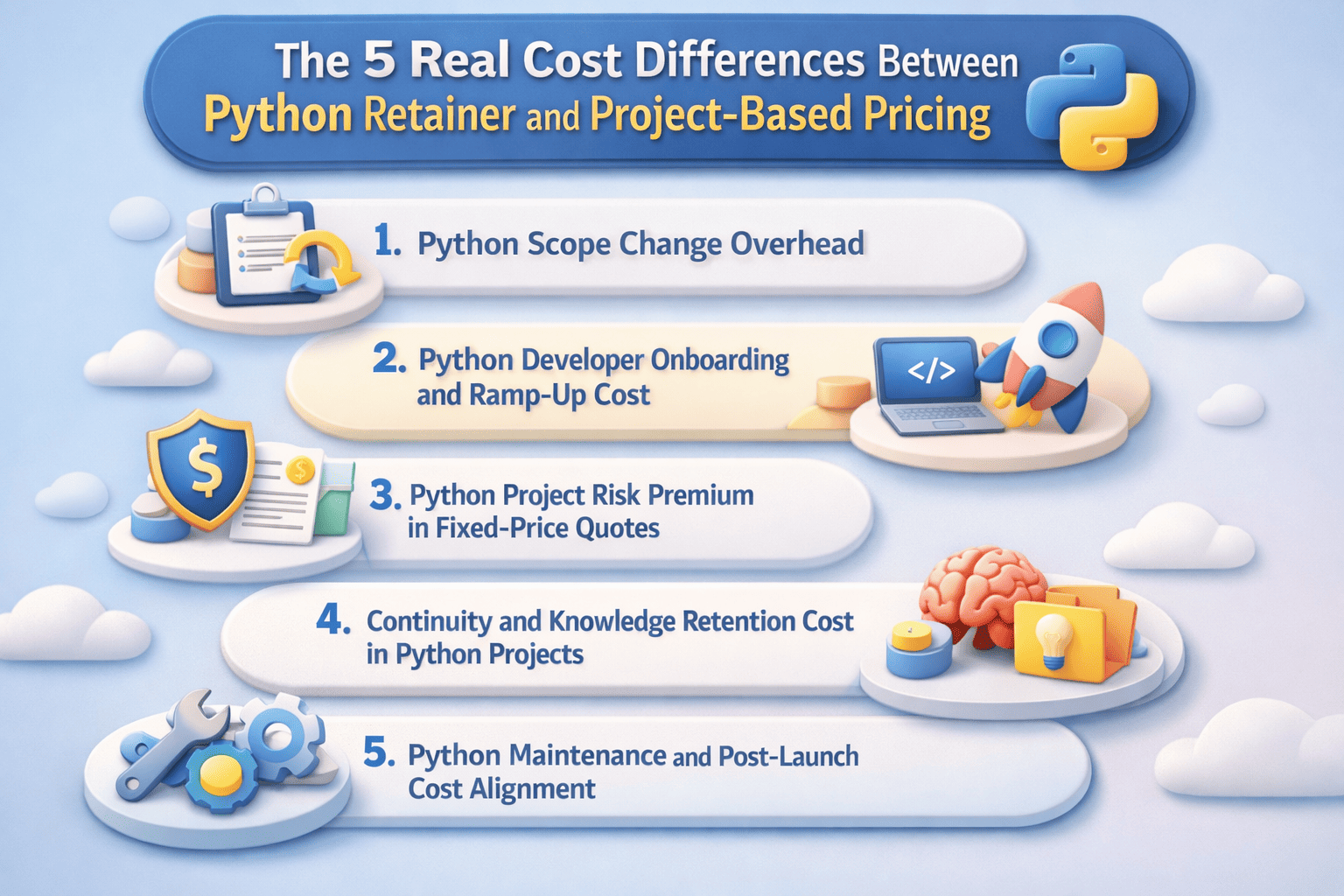
The headline rates are the easy part. The real cost differences emerge in five categories that neither a fixed-price quote nor a retainer monthly rate explicitly names.
Cost Difference 1: Python Scope Change Overhead
This is the largest single cost variable in the retainer versus project-based comparison for Python development.
On a project-based engagement, every requirement change that falls outside the original specification triggers a formal change order. The change order process takes time (scoping, negotiation, approval), costs money (the change order itself adds to the contract value), and introduces delay (no development happens on the changed feature until the order is approved). Research from StopScopeCreep found that projects without a formal change control process are twice as likely to fail compared to those with one. And yet even with a formal process, the overhead of managing scope changes on a fixed-price Python project is a real cost that does not appear in the original budget.
On a monthly retainer, a new requirement is a backlog item. It goes into the sprint at the next prioritisation session. There is no negotiation, no change order, no delay while a contract amendment is processed. For Python SaaS platforms and AI systems where the product roadmap evolves continuously based on user feedback and market conditions, this distinction represents tens of thousands of dollars in administrative overhead avoided over a twelve-month engagement.
Cost Difference 2: Python Developer Onboarding and Ramp-Up Cost
This cost category affects project-based Python engagements significantly more than retainer arrangements, and it is almost never modelled in either type of budget.
On a project-based engagement with a fixed timeline, developer ramp-up time reduces the effective hours available for feature delivery. If a six-month Python project requires two weeks of onboarding before productive development begins, that is two weeks of paid developer time that produced no deliverable output. Daily.dev Recruiter’s 2026 hiring analysis found offshore freelancers typically need four to eight weeks to reach full productivity. On a fixed-price engagement, that ramp cost is embedded invisibly in the vendor’s pricing. On a marketplace engagement, it burns paid hours at full rate.
Acquaint Softtech’s 48-hour onboarding eliminates this cost category for retainer engagements. Python developers are sprint-ready in two days because they arrive multi-stage assessed, tooling-aligned, and onboarding-managed by the agency rather than by the client’s internal team.
Cost Difference 3: Python Project Risk Premium in Fixed-Price Quotes
As noted above, fixed-price Python development typically carries a 10 to 20% risk premium above time-and-materials or retainer pricing for equivalent scope. This premium exists because the development vendor is absorbing the risk that the project takes longer or costs more than estimated.
From the client’s perspective, this premium is not necessarily irrational. Certainty has value. But it is important to understand what is being purchased: cost certainty for a defined scope, not cost certainty for the overall Python product roadmap. When the scope changes, the certainty disappears and the premium was paid for something that did not materialise.
On a retainer arrangement, no risk premium is embedded in the rate. The client pays for actual capacity used, at a transparent monthly rate, with full visibility into what is being delivered. The risk of scope evolution is absorbed through the flexibility of the model rather than priced into a contingency buffer.
Cost Difference 4: Continuity and Knowledge Retention Cost in Python Projects
Project-based Python engagements have a structural continuity problem. A development team assembled for a six-month project disperses when the project ends. The knowledge they accumulated about the codebase, the architectural decisions, the edge cases handled, and the business logic encoded goes with them. If the client needs additional development six months later, a new team starts from near zero.
Retainer clients often lead to stronger creative output and better work-life balance because the team can focus on delivery and refining service quality rather than constantly onboarding new contexts. In Python development, the equivalent is that retainer teams build accumulated product knowledge that compounds into delivery speed. A retainer Python developer in month six is significantly more productive than the same developer in month one because they understand the Django ORM schema, the FastAPI service architecture, the deployment pipeline, and the business rules that shape every technical decision.
That accumulated knowledge has real financial value. Losing it at the end of a project-based engagement and repurchasing it at the start of the next one is a cost that rarely appears on any invoice but shows up consistently in slower delivery cycles on subsequent engagements.
Cost Difference 5: Python Maintenance and Post-Launch Cost Alignment
Fixed-price Python projects have a defined end. The maintenance work that follows launch, the dependency updates, the bug fixes, the performance optimisations, the feature iterations, exists outside the original contract and requires either a new project-based engagement (with all its associated overhead and risk premium) or an informal arrangement that is typically less structured and more expensive per unit of work.
Monthly retainers for Python development are structurally aligned with the post-launch reality of software products. The same team continues. The same sprint process handles both new features and maintenance tasks. The institutional knowledge from the build phase informs maintenance decisions without a handover cost. For Python products that will require ongoing investment beyond launch day, which describes most SaaS platforms, AI systems, and data engineering pipelines, retainer-based engagement is the more cost-efficient long-term model.
Direct Comparison: Python Monthly Retainer vs Project-Based Pricing
Decision Factor | Project-Based Python Pricing | Monthly Retainer Python Development |
Cost predictability | High for defined scope, low when scope changes | High per month, variable over time as roadmap evolves |
Scope change handling | Formal change orders, negotiation required | Backlog item, no contract amendment needed |
Risk premium in pricing | 10 to 20% above T&M for equivalent scope | None embedded in rate |
Developer continuity | Ends with the project | Ongoing, accumulated product knowledge |
Onboarding overhead | Per engagement (4 to 8 weeks marketplace avg) | Once (48 hours at Acquaint Softtech) |
Post-launch maintenance | New contract required, new overhead | Same engagement, same team, no transition |
Best engagement length | 4 to 16 weeks | 3 months and above |
Best requirement stability | High (fully defined before work starts) | Medium to low (evolving roadmap) |
Suited for Python project type | MVP, migration, isolated feature build | SaaS, AI/ML, data platform, ongoing product |
Scope creep vulnerability | High (affects 52% of fixed-price projects) | Low (managed through sprint prioritisation) |
Senior team management overhead | Higher (client manages PM, QA alignment) | Lower (agency-managed sprint integration) |
Total cost over 12 months | High if scope evolves (27% avg overrun) | Predictable and typically lower |
Worked Financial Examples: Which Python Pricing Model Saves More?
Example A: Python MVP Build for a B2B SaaS Product
Scenario: A startup needs a Django-based SaaS MVP with user authentication, subscription billing, a core workflow module, and a REST API. Scope is well-defined. Timeline is twelve weeks.
Project-Based Option: - Fixed-price quote: $28,000 (includes 10 to 15% risk premium on $24,000 estimated scope) - Risk: One significant scope change during development adds $4,200 in change orders (PMI’s 27% average overrun applied to the base scope) - Actual cost at delivery: $32,200 - Timeline impact: Change order processing adds two weeks
Monthly Retainer Option (Acquaint Softtech): - $3,200/month x 3 months = $9,600 - Same scope delivered in three months of dedicated sprint work - Two additional requirement changes absorbed within the sprint without change orders - Total cost at delivery: $9,600
Verdict for this scenario: Monthly retainer is significantly cheaper for an MVP with well-resourced sprint capacity, even when scope is relatively stable. The fixed-price premium and typical scope change overhead make the project-based option more expensive on a comparable delivery basis. For teams that want maximum cost certainty and have no internal technical capacity to manage a retainer engagement, the fixed-price model provides a risk ceiling. For teams that can manage a sprint process, the retainer delivers the same output at lower cost.
Example B: Python SaaS Platform at Growth Stage (12-Month Roadmap)
Scenario: An established SaaS company needs ongoing Python development across three product themes over twelve months: new feature delivery, performance optimisation, and third-party integrations. Requirements evolve monthly based on user feedback.
Project-Based Option: - Three separate fixed-price engagements (one per product theme) - Each engagement requires its own scoping, quoting, and negotiation cycle: estimated 3 to 4 weeks per engagement - Each engagement carries a 10 to 15% risk premium - Each new engagement requires developer onboarding: estimated 2 to 3 weeks ramp-up - Estimated total cost across three engagements: $120,000 plus $25,000 in scope change orders - Effective weeks lost to scoping, onboarding, and change order cycles: 15 to 18 weeks of a 52-week year
Monthly Retainer Option (Acquaint Softtech): - $3,200/month x 12 months = $38,400 - One onboarding cycle (48 hours, one time) - Scope evolves continuously without contract overhead - All three product themes addressed within a single coherent delivery context - Developer knowledge compounds over 12 months, increasing sprint velocity in H2 - Total cost: $38,400
12-Month Cost Saving with Retainer: $106,600
This example represents a Python SaaS company with a realistic ongoing development need. The compounding cost of repeated project-based engagements, each with its own overhead, ramp, premium, and scope change exposure, is the most common source of Python development overspend that nobody models in advance.
Example C: Python AI/ML Analytics Platform (Complex, Evolving Requirements)
Scenario: A healthcare company is building a Python ML analytics platform using scikit-learn and Pandas. Requirements are technically complex, partially discovered during development, and expected to evolve significantly based on clinical team feedback.
Project-Based Option: - Fixed-price quote for estimated scope: $65,000 - Scope uncertainty premium: 15 to 20% embedded in quote ($9,750 to $13,000) - Actual scope change volume on a complex ML project: research from PmpWithRay’s 2026 scope creep guide shows that scope creep can cost up to four times the initially expected development cost on projects with high requirement uncertainty - Realistic total: $75,000 to $110,000+ with scope-driven overruns on a complex ML project
Monthly Retainer Option (Acquaint Softtech): - $3,200/month x 7 months = $22,400 (6 to 7 months for comparable scope with a dedicated senior Python ML developer) - No scope change premiums - Clinical feedback incorporated into sprints without change orders - Acquaint Softtech’s Python AI/ML team has production experience across scikit-learn, Pandas, TensorFlow, and PyTorch - Total: $22,400
Cost Saving with Retainer: $52,600 to $87,600
The framework and architecture choices made during this kind of Python AI engagement, particularly around model versioning, data pipeline design, and inference serving, have significant TCO implications. For teams planning a Python ML system, the Python development architecture and frameworks guide covers the specific architectural decisions that shape cost across the full lifecycle, not just the build phase.
When Project-Based Python Pricing Actually Wins
The monthly retainer is not the universal answer. There are specific Python project scenarios where the project-based model is the right choice, and being honest about those scenarios matters.
Project-based Python pricing is the right choice when:
Requirements are fully defined and documented before development starts, with explicit exclusions agreed alongside inclusions
The engagement is genuinely time-limited with no expected post-launch development requirement
The client has no internal technical capacity to manage a sprint process or review developer output
The Python project is a one-time migration, audit, or isolated integration with a stable API specification
The budget approval process requires a hard cost ceiling that cannot be accommodated by a monthly model
The project is under four to six weeks in duration, making the overhead of setting up a retainer engagement disproportionate
In these scenarios, the fixed-price model’s certainty benefit outweighs the risk premium and scope overhead costs. A Python API integration with a stable specification, a database migration with documented schema, or a single-feature build with a complete requirements document are all appropriate candidates.
The complete guide to hiring Python developers covers engagement model selection in detail alongside vetting criteria, team structure decisions, and the handover considerations that affect both project-based and retainer arrangements.
The Hybrid Python Pricing Model: Getting the Best of Both
The most experienced Python development buyers eventually arrive at the same conclusion: neither model is universally superior, and the right answer for many products is a structured hybrid.
A 2025 comparison guide describes the most effective hybrid approach as project for onboarding and retainer for ongoing: charge a fixed fee for an initial setup, architecture, or discovery phase, then transition the client to a monthly retainer for implementation and ongoing management. This model optimises cost by combining the certainty of a scoped initial engagement with the flexibility and cost efficiency of a retainer for the delivery and maintenance phases.
For Python development specifically, this looks like a discovery workshop engagement (a defined, fixed scope) that produces the architecture design, data model, and sprint plan, followed by a retainer engagement that executes against it. The discovery workshop service at Acquaint Softtech is structured exactly this way: a defined planning engagement that produces a risk-calibrated scope and TCO model, followed by a retainer or dedicated team engagement that delivers against it with full sprint integration from Day 1.
Many software companies adopt a hybrid approach, using fixed pricing for initial discovery and design phases, then switching to time and materials or retainer for development and testing. This strategy is not a compromise. It is the most sophisticated approach to Python development pricing, combining cost certainty where scope is knowable with cost flexibility where requirements evolve.
Acquaint Softtech: Python Development Pricing Structured to Save More
Acquaint Softtech is headquartered in Ahmedabad, India, with 13 years of Python development delivery experience, 1,300+ projects completed globally, and five-star ratings across Clutch (35+ reviews) and Upwork (1,293+ reviews, 98% job success rate).
Both pricing models are available at Acquaint Softtech, structured to align with the specific Python project type rather than a one-size-fits-all preference. The 100% in-house team means no marketplace markup, no freelancer risk premium, and no platform commission passed through to either model.
Acquaint Softtech Python Development Pricing (2026)
Model | Rate | What It Covers | Best Python Project Type |
Monthly Retainer (Full-Time) | $3,200/month | 176 hrs, dedicated Python developer, sprint-integrated | SaaS, AI/ML, data platforms, ongoing product |
Monthly Retainer (Part-Time) | From $22/hr | Up to 4 hrs/day, focused Python work | Maintenance, audits, specific feature sets |
Fixed-Price Python Project | From $5,000 | Defined scope, milestone payments, zero overruns | MVP, migration, isolated builds |
Discovery Workshop | Custom scope | Architecture, TCO model, sprint plan before build | Pre-project planning before either model |
Every engagement includes: Full NDA and IP assignment from Day 1. Free Python developer replacement with complete context handover. 48-hour onboarding to sprint-ready. Pre-vetted engineers only. No freelancers, no subcontractors. 40% cost savings verified versus US in-house Python hiring.
Python stack: Django, FastAPI, Flask, TensorFlow, PyTorch, scikit-learn, LangChain, PostgreSQL, Redis, MongoDB, AWS, GCP, Azure, Docker, Kubernetes, React, Next.js.
Conclusion: The Python Pricing Model That Saves More Is the One That Fits Your Product Stage
There is no universally cheaper Python development pricing model. There is a model that fits the nature of your Python project and saves money because that fit is correct, and a model that creates friction, overhead, and unexpected cost because the fit is wrong.
For Python projects with stable, fully defined requirements and a clear end date, project-based pricing provides cost certainty at a premium that is worth paying. For Python products that will evolve based on user feedback, market conditions, or emerging technical requirements, which describes the majority of SaaS platforms, AI systems, and data pipelines, monthly retainer pricing eliminates the overhead, risk premium, and continuity costs that make fixed-price engagements progressively more expensive as the engagement extends.
52% of all projects experience scope creep, with only 29% of projects completed on time and on budget per the Standish Group’s CHAOS report. For the 71% of projects that do not meet both criteria, the question of which pricing model was chosen determines whether the overspend was contained by the model’s structure or amplified by it.
Acquaint Softtech’s 1,300+ completed Python projects span both models, across fintech, healthcare, SaaS, AI, and data engineering. That delivery history is available as a planning input before any budget is approved. For more context on how Python project costs compound across the lifecycle beyond the initial build, read the Python development TCO guide and the Python development ROI calculator for the complete financial picture.
Frequently Asked Questions
-
Is monthly retainer pricing cheaper than project-based pricing for Python development?
For Python projects lasting three months or more with evolving requirements, monthly retainer pricing is consistently cheaper when total engagement cost is calculated rather than headline rates compared. The fixed-price model embeds a 10 to 20% risk premium, generates change order overhead when scope evolves (52% of projects with an average 27% cost overrun), and requires repeated onboarding cost for sequential engagements. Monthly retainer pricing eliminates all three of these cost categories. For short, well-scoped Python builds under six weeks, fixed-price is competitive or lower due to the relative overhead of setting up a retainer engagement.
-
What is scope creep and how does it make fixed-price Python projects more expensive?
Scope creep is the expansion of a Python project’s requirements after development has started without corresponding adjustments to budget or timeline. Research from PmpWithRay’s 2026 project management guide found that scope creep can cost up to four times the initially expected development cost on projects with high requirement uncertainty, and that 62% of projects experience budget overruns primarily due to uncontrolled scope expansion. On a fixed-price Python project, scope creep manifests as change orders, renegotiation delays, and relationship friction. On a monthly retainer, the same scope evolution is handled within the sprint without a contract amendment, making retainer engagements structurally more resilient to the requirement changes that are normal in any real-world Python product.
-
How does Acquaint Softtech’s monthly retainer model work for Python projects?
At Acquaint Softtech, a monthly retainer for Python development means a dedicated, pre-vetted Python developer embedded in your sprint process at $3,200 per month for full-time (176 hours) or from $22 per hour for part-time work. The developer is 100% in-house, operates under full NDA and IP assignment from Day 1, and is onboarded within 48 hours of requirements being finalised. The engagement uses your tools (Jira, GitHub, Slack), follows your sprint cadence, and requires no change orders for evolving requirements. Monthly retainer engagements include a continuity guarantee: if the developer leaves for any reason, a free replacement with complete codebase context handover is provided within 48 hours. See the dedicated Python development team model for the full engagement structure.
-
When does fixed-price Python development make more sense than a monthly retainer?
Fixed-price Python development makes more sense when: requirements are completely documented before work starts and are stable throughout the engagement; the project has a clear end date after which no further development is needed; the client lacks internal technical capacity to manage a sprint process; the budget approval process requires a hard cost ceiling; or the engagement is under four to six weeks in duration. Typical examples include a one-time Python API integration with a stable specification, a database migration with a fully documented schema, a security audit, or a defined MVP with all feature requirements agreed before development begins. For these scenarios, the cost certainty of a fixed-price engagement outweighs the risk premium.
-
What is the hybrid Python pricing model and when should I use it?
A hybrid Python pricing model combines a fixed-price discovery or architecture phase with a retainer delivery phase. The fixed-price phase scopes the Python project, produces the architecture design, data model, and sprint plan, and provides cost certainty for the planning investment. The retainer phase executes against that plan with the flexibility to accommodate evolving requirements without change orders. A 2025 analysis recommends this hybrid approach as the most effective structure for clients with defined initial needs who will require ongoing implementation support. At Acquaint Softtech, the discovery workshop is structured as the fixed-price phase, producing a risk-calibrated Python project scope and TCO model before the retainer engagement begins. Book a discovery workshop to start this process.
-
How does Python developer continuity differ between retainer and project-based models?
On a project-based Python engagement, the development team disperses at project completion. Accumulated knowledge of the codebase, architecture decisions, and business logic leaves with them. Any subsequent development requires a new team, new onboarding, and a knowledge reconstruction period that consumes paid developer time before meaningful output resumes. On a monthly retainer, the same developer continues through launch and beyond, building accumulated product knowledge that increases delivery speed over time. The productivity of a retainer Python developer in month six is materially higher than in month one because they understand the full system context. Retainer engagements foster closer relationships with compounding benefits. In Python development, those compounding benefits are faster sprint velocity, fewer re-explanation cycles, and better architecture decisions informed by accumulated context.
-
How does the Python framework choice affect which pricing model is more appropriate?
The relationship between Python framework choice and pricing model is real but often overlooked. Django’s monolithic architecture, for example, creates stronger continuity requirements than a microservices-based FastAPI deployment: Django applications accumulate ORM schema decisions, business logic rules, and admin configurations that require deep codebase understanding to modify safely. A project-based engagement that ends at Django MVP launch and then restarts with a new team for post-launch development pays a significant knowledge reconstruction cost. FastAPI microservices are more modular and therefore more tolerant of team transitions between project phases. For teams building on Django or complex Python ML architectures, the continuity benefits of a retainer model carry even higher value. The Python development architecture and frameworks guide maps framework choices to their ongoing maintenance and team continuity requirements in detail.
-
What should I look for in a Python development partner regardless of pricing model?
Regardless of whether you choose a monthly retainer or a project-based model, five things determine whether a Python development partner delivers or disappoints. First, vetting depth: multi-stage technical assessment covering system design, production debugging, and Python framework depth rather than a single code submission. Second, IP protection: a full NDA and IP assignment agreement signed before any code is written. Third, continuity guarantee: a clear answer to what happens if your Python developer leaves mid-engagement, including a free replacement and context handover process. Fourth, sprint integration capability: the ability to work inside your tools and sprint process rather than operating as an external vendor who delivers at the end of a cycle. Fifth, production experience: developers who have shipped real Python products to real users, not tutorial-level familiarity with frameworks. The complete guide to hiring Python developers covers each of these evaluation criteria with specific interview questions and red flags to watch for.
We’re Acquaint Softtech, your technology growth partner. Whether you're building a SaaS product, modernizing enterprise software, or hiring vetted remote developers, we’re built for flexibility and speed. Our official partnerships with Laravel, Statamic, and Bagisto reflect our commitment to excellence, not limitation. We work across stacks, time zones, and industries to bring your tech vision to life.
Table of Contents
Get Started with Acquaint Softtech
- 13+ Years Delivering Software Excellence
- 1300+ Projects Delivered With Precision
- Official Laravel & Laravel News Partner
- Official Statamic Partner
Related Blog

The Complete Guide to Hiring Python Developers in 2026: Rates, Models, Vetting and Red Flags
A complete guide to hiring Python developers in 2026. Compare real hourly rates across India, Eastern Europe and the US, choose the right engagement model, vet candidates correctly, and avoid the red flags that cost companies months of wasted budget.
Acquaint Softtech
March 4, 2026
Python Development in 2026: Architecture Patterns, Frameworks and Real-World Industry Applications
Explore Python backend architecture patterns, framework comparisons (Django vs FastAPI vs Flask), scalability decisions, and real-world Python development use cases across healthcare, FinTech, SaaS, EdTech, and logistics in 2026.
Acquaint Softtech
March 4, 2026
Total Cost of Ownership in Python Development Projects: The Full Financial Picture
The build cost is just the beginning. This guide breaks down the complete TCO of Python development projects across every lifecycle phase, with real benchmarks, a calculation framework, and 2026 data.
Acquaint Softtech
March 23, 2026Your Project. Our Expertise. Let’s Connect.
Get in touch with our team to discuss your goals and start your journey with vetted developers in 48 hours.