

ROI Calculator for Python Development: How to Estimate Payback Period Before You Start
Before you spend a dollar on Python development, know what you will get back. This guide gives you the exact formulas, real benchmarks, worked examples, and a step-by-step Python ROI calculation framework for 2026.

Acquaint Softtech
Why Most Python Development Budgets Get Approved Without a Single ROI Number
Walk into most budget conversations about a Python development project and ask for the ROI model. What you will usually get is a slide deck showing features, a project timeline, a development cost estimate, and a vague reference to efficiency gains. What you will rarely get is a number. A specific, calculated figure that answers the only question a CFO or board member actually cares about: when does this investment pay for itself, and what does it return after that?
The absence of that number is not a coincidence. Python development ROI is genuinely harder to model than a marketing spend or a piece of capital equipment. The benefits are distributed across cost savings, productivity gains, revenue uplift, error reduction, and technical debt prevention. Some of those benefits are immediate. Some accrue over years. Calculating all of them into a single coherent investment case requires a framework that most technical teams do not have and most non-technical stakeholders do not know to ask for.
This guide provides that framework. You will get the formulas, the benchmarks, worked calculation examples for three different Python project types, a breakdown of the cost inputs that most estimates miss, and a practical payback period model you can run on your own project before a single sprint is planned.
The data referenced throughout comes from verified 2025 and 2026 sources. The examples draw on real Python project outcomes, including Acquaint Softtech’s documented engagements. None of the numbers in this guide are made up. All of them are testable.
The Financial Case for Python Development in 2026: Why the ROI Opportunity Is Significant
Before getting into the calculation framework, it helps to understand the scale of the ROI opportunity that Python development represents in 2026, because the benchmark data answers the question of whether a Python project is worth calculating at all.
successful Python automation deployments generate average annual cost savings of $2,005,143 across documented implementations. The average Python automation project costs $100,000 to $200,000 to implement. At those figures, the ROI ratio is approximately 10:1 to 20:1 over the first year of operation.
Real-world Python deployment data from specific function areas includes:
Customer service Python automation: 80% time saving and 95% error reduction, generating $300,000 in annual cost savings with a two-month payback period
Finance function Python automation: 60% time saving and 88% error reduction, generating $200,000 in annual savings within three months of deployment
Document processing Python automation: companies processing 5,000 invoices monthly save $38,000 to $97,000 annually, with a 3 to 6-month payback period and Year 1 ROI of 200 to 400% (Source: Floowed Document Automation Analysis 2026)
On the broader enterprise AI and automation side, a 2025 IBM global study of 2,000 CEOs found that firms moving AI and Python automation from pilots to production-scale processes achieve an average ROI of 1.7x, with cost savings of 26 to 31% across supply chain, finance, and customer operations.
Python’s role in these returns is structural, not incidental. TensorFlow, PyTorch, scikit-learn, Pandas, FastAPI, and Django power the platforms through which these savings are generated. When companies invest in Python development, they are investing in the infrastructure that makes those returns computable. For a deeper look at how Python framework and architecture choices directly affect project cost and delivery timelines, read the complete Python development architecture and frameworks guide.
That is the case for doing the calculation. Now here is how to do it.
The Core Python Development ROI Formula (And Why Simple ROI Is Not Enough)
Most discussions of software ROI start and end with the basic formula:
ROI = ((Total Benefit minus Total Investment) / Total Investment) x 100
That formula is necessary but insufficient for Python development decisions. It tells you what percentage return you generated on an investment you have already made. It does not tell you when you break even, how sensitive the return is to cost overruns or benefit shortfalls, or whether two projects with different timelines and risk profiles are genuinely comparable.
For Python development investment decisions, three financial metrics are needed together.
The 3 Financial Metrics Every Python Development Investment Needs
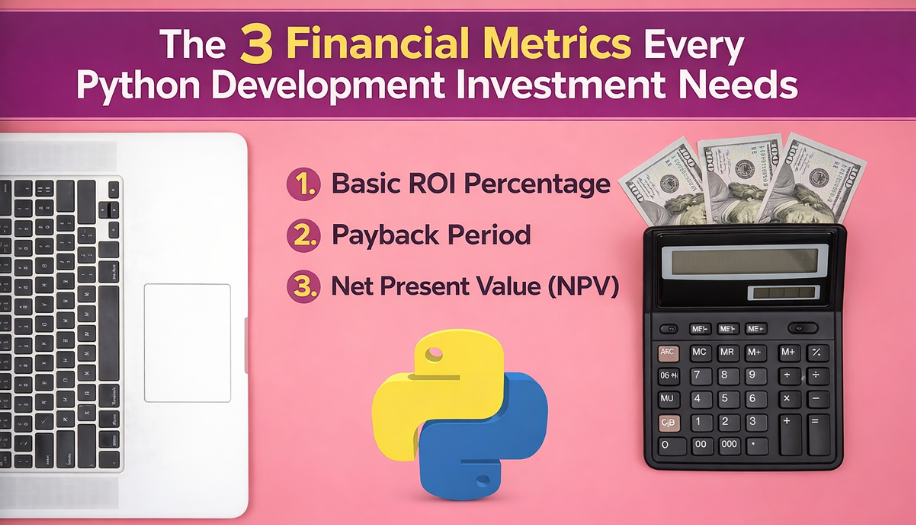
1. Basic ROI Percentage
This tells you the total return as a percentage of the investment. Use it for comparison and reporting.
Formula: ROI = ((Annual Benefit x Years) minus Total Investment) / Total Investment x 100
Example: A Python automation project costs $80,000 to build and generates $120,000 in annual savings. Three-year ROI = (($120,000 x 3) minus $80,000) / $80,000 x 100 = 350%
2. Payback Period
This tells you how quickly the investment recovers its cost. According to SoFi’s payback period analysis (September 2025), a shorter payback period indicates lower risk. For custom software, payback periods typically range from months for simple automation tools to 2 to 3 years for large enterprise systems.
Formula: Payback Period (months) = Total Investment / Monthly Net Benefit
Example: $80,000 investment, $10,000 monthly benefit (from $120,000 annual savings). Payback Period = $80,000 / $10,000 = 8 months
3. Net Present Value (NPV)
This accounts for the time value of money, meaning that $120,000 received in year three is worth less than $120,000 received today. NPV is the most financially rigorous metric for Python development decisions that extend beyond twelve months. NPV is typically the most reliable primary decision tool for substantial, long-duration software investments.
Formula: NPV = Sum of (Cash Flow in Year T / (1 + Discount Rate) to the power of T) minus Initial Investment
A full NPV calculation requires a financial modelling tool for multi-year projects. For the purposes of this guide, the payback period and basic ROI percentage are sufficient for pre-project evaluation. NPV becomes important once a project is approved and a detailed financial model is being built.
Step 1: Calculate the True Total Cost of Your Python Development Project
The single most common ROI calculation error is underestimating the investment side of the equation. According to PMToolkit’s 2025 PM ROI calculator analysis, counting only engineering time underestimates true Python project cost by 30 to 50%.
Here is a complete Python development cost checklist, structured by category.
Python Development Direct Costs
Cost Category | What to Include | Typical % of Project Budget |
Developer time | Hours x hourly rate, all seniority levels | 40 to 55% |
Project management | Internal PM time or external PM cost | 10 to 15% |
QA and testing | Manual and automated testing resource | 10 to 15% |
Infrastructure setup | Cloud setup, servers, CI/CD pipeline configuration | 8 to 12% |
Third-party tools and licenses | APIs, libraries, SaaS integrations | 5 to 10% |
Design and UX | If applicable to your Python project type | 5 to 8% |
Security and compliance | GDPR, HIPAA, PCI-DSS architecture where applicable | 5 to 20% (regulated industries) |
Contingency buffer | Evidence-based (not instinct-based; see planning blog) | 10 to 20% |
Python Development Hidden Costs Most Budgets Miss
Beyond the direct categories above, three cost inputs consistently distort Python development ROI calculations.
Internal team time. Every hour your internal engineers spend in requirements meetings, sprint reviews, and code reviews is an investment in the Python project that does not appear on the vendor invoice. At a $100/hour equivalent cost for senior internal engineers, a three-month Python project with weekly sprint ceremonies and daily standups consumes 40 to 60 hours of internal team time per month, or $12,000 to $18,000 over the project. That belongs in the investment calculation.
Onboarding and ramp-up cost. A Python developer who takes four weeks to reach full productivity costs you 40% of a month’s rate before meaningful output begins. Through a structured partner like Acquaint Softtech, onboarding is 48 hours. On a marketplace freelance engagement, the same ramp can run four to eight weeks. At $3,200 per month for a full-time dedicated Python developer, the difference between 48-hour onboarding and four-week onboarding is approximately $2,400 in paid time before the first meaningful commit.
Post-launch maintenance cost. Python applications require ongoing maintenance: security patches, dependency updates, performance monitoring, and feature iterations. Industry benchmarks typically place annual maintenance cost at 15 to 25% of the original development cost. A Python platform built for $80,000 will likely cost $12,000 to $20,000 per year to maintain. This ongoing cost belongs in any multi-year ROI model.
Step 2: Calculate the True Total Benefit of Your Python Development Project
The benefit side of the Python development ROI equation is where most calculations are incomplete. Benefits fall into four categories, and most teams only calculate the first one.
Python Development Benefit Category 1: Direct Cost Reduction
This is the most straightforward category. Python automation and platform development reduces the cost of doing something that currently requires manual effort or expensive tooling.
Quantification method: (Hours of manual work eliminated per month) x (hourly cost of that work) = monthly cost saving
Worked example: A finance team currently spends 120 hours per month on data reconciliation that will be automated by a Python pipeline. At an average all-in employee cost of $45/hour, the monthly saving is $5,400, or $64,800 per year. A finance function Python automation generates an average of $200,000 in annual savings, primarily from this category.
Python Development Benefit Category 2: Revenue Enablement
For Python SaaS platforms, customer-facing APIs, and e-commerce systems, the benefit includes revenue that becomes possible because the platform exists, not just cost that is eliminated.
Quantification method: (New recurring revenue enabled by the platform) + (Conversion rate improvement x existing traffic x average contract value)
Worked example: A Python-built SaaS product that converts 500 trial users per month at a $200/month subscription generates $100,000 in monthly recurring revenue from zero. Not all of that is attributable to the Python development investment (the business model, marketing, and product decisions matter too), but the development investment is the prerequisite for the revenue existing at all.
According to PMToolkit’s 2025 ROI analysis, core product features typically deliver 150 to 300% ROI with an 8 to 12-month payback period. Nice-to-have features deliver 50 to 150% ROI with a 12 to 18-month payback period. These benchmarks apply directly to Python platform development investment decisions.
Python Development Benefit Category 3: Error Reduction and Quality Improvement
Python automation and data processing systems reduce error rates in ways that carry direct financial value. In healthcare, reduced diagnostic errors prevent costly misdiagnoses. In finance, reduced reconciliation errors prevent regulatory penalties and write-offs. In e-commerce, reduced order processing errors reduce customer service costs and return rates.
Quantification method: (Current error rate x volume x cost per error) minus (Post-Python error rate x volume x cost per error) = annual error reduction saving
Worked example: A Python-built order processing system handles 10,000 orders per month. Current error rate is 2% (200 errors). Average cost per error (customer service, reprocessing, refund) is $25. Monthly error cost before Python: $5,000. Post-Python error rate drops to 0.2% (20 errors). Monthly error cost after Python: $500. Annual saving from error reduction alone: $54,000.
Python customer service automation achieves a 95% error reduction. At that rate, the error reduction saving frequently becomes one of the largest single line items in the Python development ROI calculation.
Python Development Benefit Category 4: Strategic and Competitive Value
This category is the hardest to quantify and the most commonly ignored. It includes the value of moving faster than competitors, the ability to serve customers that manual processes could not reach, data assets generated by Python analytics platforms, and the reduction in technical risk that comes from replacing fragile manual processes with reliable automated ones.
For the purposes of pre-project ROI calculation, conservative practice is to calculate only Categories 1 through 3 and treat Category 4 as the margin of safety. If the ROI is positive without counting strategic value, the strategic value makes it better. If the ROI only works when strategic value is included, the investment case is weaker than it appears.
Step 3: Run the Python Development Payback Period Calculation
With both sides of the equation populated, the payback period calculation is straightforward.
Payback Period (months) = Total Python Development Investment / Monthly Net Benefit
The discipline is in the completeness of both inputs.
Worked Example A: Python Internal Process Automation
Scenario: A logistics company automates its shipment tracking reconciliation process with a Python data pipeline.
Investment Component | Amount |
Python development (3 months, dedicated developer at $3,200/month) | $9,600 |
Internal team time (20 hrs/month x $60/hr x 3 months) | $3,600 |
Infrastructure setup (AWS, monitoring) | $2,400 |
Post-launch maintenance reserve (first year) | $3,000 |
Total Python Development Investment | $18,600 |
Benefit Component | Monthly Amount |
Manual reconciliation hours eliminated (80 hrs x $35/hr) | $2,800 |
Error reduction saving (50 errors/month x $15/cost) | $750 |
Total Monthly Net Benefit | $3,550 |
Payback Period = $18,600 / $3,550 = 5.2 months Year 1 ROI = (($3,550 x 12) minus $18,600) / $18,600 x 100 = 129%
Worked Example B: Python SaaS Platform Build
Scenario: A startup builds a B2B SaaS platform using Django and FastAPI through Acquaint Softtech’s fixed-price Python project model.
Investment Component | Amount |
Acquaint Softtech fixed-price Python project | $25,000 |
Internal product management time (15 hrs/month x $80/hr x 5 months) | $6,000 |
Third-party integrations and API licences | $3,600/year |
Post-launch maintenance (15% of build cost per year) | $3,750/year |
Total Year 1 Python Development Investment | $38,350 |
Benefit Component | Monthly Amount |
SaaS subscriptions (60 customers at $150/month average, by month 6) | $9,000 |
Less: customer acquisition cost (not a Python ROI cost) | Excluded |
Monthly Net Revenue Enabled by Python Platform | $9,000 |
Payback Period (from launch) = $38,350 / $9,000 = 4.3 months post-launch
Note: This example assumes the SaaS product reaches 60 paying customers by month 6 after launch, which is a business assumption, not a Python development assumption. Sensitivity analysis (discussed in Step 4) should test what happens to payback period if that customer target is missed by 30 to 50%.
Worked Example C: Python Healthcare Analytics Platform
Scenario: Based on Acquaint Softtech’s documented Bianalisi engagement, a diagnostics company builds a Python-powered predictive analytics platform. Full details are at acquaintsoft.com/blog/python-healthcare-analytics-bianalisi-case-study.
Documented project investment: $49,999 Documented outcome: 75% reduction in reporting time, earlier detection of diagnostic risk patterns, estimated reporting labor saving equivalent of 200+ hours per month at the team level.
Investment Component | Amount |
Python platform development (Acquaint Softtech) | $49,999 |
Internal clinical and IT team time | Estimated $12,000 |
Compliance and GDPR architecture | Included in build cost |
Annual maintenance | Estimated $8,000/year |
Total Year 1 Python Development Investment | ~$70,000 |
Benefit Component | Monthly Amount |
Reporting time reduction (200 hrs x $40/hr average clinical staff) | $8,000 |
Error reduction in diagnostic data processing (estimated) | $2,000 |
Earlier risk detection value (conservative clinical estimate) | Not quantified |
Total Monthly Net Benefit | $10,000 |
Payback Period = $70,000 / $10,000 = 7 months Year 1 ROI = (($10,000 x 12) minus $70,000) / $70,000 x 100 = 71%
This is a conservative estimate that excludes the clinical value of earlier diagnostic risk detection, which is not easily monetised but is the primary driver of the engagement’s strategic importance to BIANALISI SPA.
Step 4: Run a Python Development ROI Sensitivity Analysis
A single ROI number is a point estimate. Every assumption in the calculation carries uncertainty, and the decisions worth making are those that hold up even when assumptions are wrong. This is where sensitivity analysis earns its place in Python development ROI planning.
Sensitivity analysis tests what happens to the payback period and ROI when key variables change. For Python development projects, the three variables that most frequently differ from initial estimates are development cost (overruns average 45% per McKinsey), benefit realisation timing (benefits often arrive later than planned), and benefit magnitude (actual savings frequently differ from estimates).
Python Development ROI Sensitivity Table
Run this table on your own numbers by changing the assumption percentage in Column 1 and recalculating payback period.
Scenario | Change in Assumption | Impact on Payback Period |
Base case | Development cost and benefits as estimated | As calculated |
Cost overrun (moderate) | Development cost increases 20% | Payback period extends by 20% |
Cost overrun (severe) | Development cost increases 45% (McKinsey average) | Payback period extends by 45% |
Benefit delay | Benefits start 2 months later than planned | Payback period extends by 2 months |
Benefit shortfall (moderate) | Benefits 20% lower than estimated | Payback period extends by 25% |
Benefit shortfall (severe) | Benefits 40% lower than estimated | Payback period extends by 67% |
Best case | Development cost 10% under, benefits 10% higher | Payback period compresses by 18% |
The purpose of this table is not to discourage Python development investment. It is to identify which assumptions are load-bearing. If the project still has a positive ROI in the “severe cost overrun plus moderate benefit shortfall” scenario, it is a robust investment. If the project only works in the base case or best case, the risk profile needs to be addressed before the budget is approved.
This kind of scenario analysis is what separates organisations that consistently achieve software ROI from those that consistently report disappointment. The financial rigour is not bureaucracy. It is the discipline that makes Python development investments work.
Step 5: Understand What Reduces Python Development ROI (And How to Prevent Each)
Knowing the ROI formula is useful. Knowing what destroys it before the project delivers is more useful.
According to research cited in our previous analysis on Python project cost planning, McKinsey and Oxford found that large IT projects run an average of 45% over budget, deliver 56% less value than predicted, and take 7% longer than planned. Each of those three failures directly attacks the ROI calculation.
5 Python Development ROI Killers and Their Specific Cost Impact
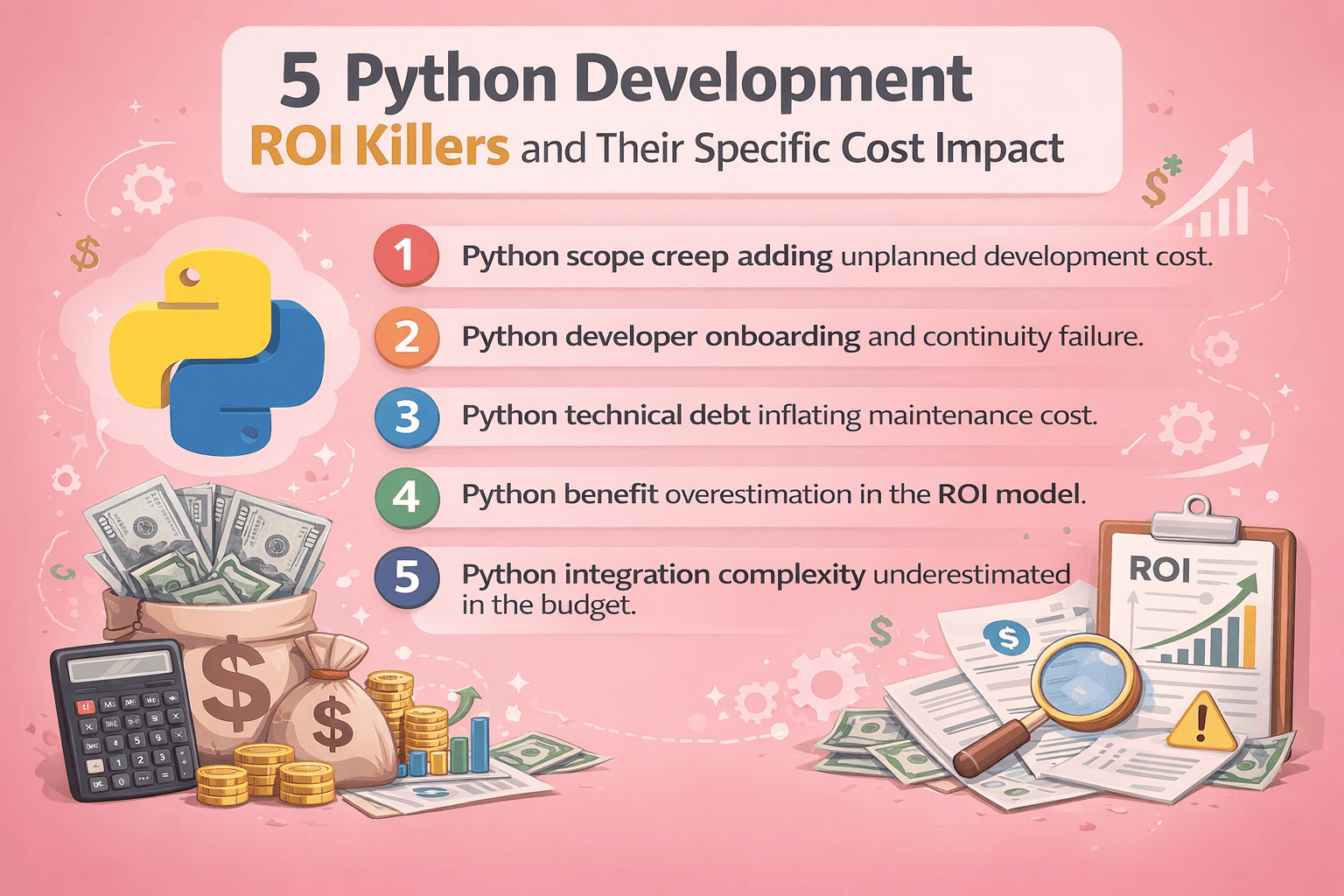
1. Python scope creep adding unplanned development cost. PMI research puts scope creep at 52% of all projects, with an average budget overrun of 27% on affected projects. On a $50,000 Python project, 27% scope creep adds $13,500 to the investment without adding corresponding benefit. Payback period on Example A stretches from 5.2 months to 6.9 months. Prevention: case-study-grounded scoping, explicit exclusions list, formal change control process.
2. Python developer onboarding and continuity failure. A Python developer who ramps over four weeks instead of 48 hours costs approximately 20% of a month’s rate in efficiency loss. A mid-project departure restarts onboarding and can require partial Python codebase rewrites. Prevention: vetted dedicated partner with continuity guarantee and 48-hour onboarding. Explore Acquaint Softtech’s dedicated Python development team model for how continuity is protected structurally.
3. Python technical debt inflating maintenance cost. A Python application built without proper documentation, test coverage, and clean architecture design costs more to maintain than the 15 to 25% benchmark figure. Technical debt from a poorly scoped Django ORM model, an undocumented FastAPI integration, or an untested ML pipeline module shows up as ballooning maintenance cost in years two and three, reducing the multi-year ROI significantly. IBM’s Rule of 100 establishes that a production bug costs 100x what a planning-stage design issue would have. Prevention: vetted developer with production experience, structured code review process, and clean architecture discipline from sprint one.
4. Python benefit overestimation in the ROI model. Benefits estimated without reference to comparable project actuals are systematically optimistic. A 40% benefit shortfall relative to the base case estimate extends the payback period by 67% in the sensitivity table above. Prevention: benchmark benefit estimates against documented comparable Python project outcomes rather than theoretical efficiency calculations.
5. Python integration complexity underestimated in the budget. Third-party integrations consistently consume more sprint capacity than initial estimates reflect. A Python fintech platform that integrates three payment processors, a fraud detection API, and a regulatory reporting system is substantially more complex than the integration count implies. Prevention: read documented case studies from comparable Python fintech integration projects before the sprint plan is locked. See how Acquaint Softtech’s Python development services approach integration complexity in regulated industry builds.
Python Development ROI Benchmarks by Project Type (2026 Reference Data)
Use these benchmarks to sense-check your own Python project ROI calculations. All figures are drawn from verified 2025 and 2026 sources.
Python Project Type | Typical Investment Range | Typical Annual Benefit | Typical Payback Period |
Python process automation (internal) | $15,000 to $80,000 | $50,000 to $200,000 | 2 to 8 months |
Python document processing system | $20,000 to $60,000 | $38,000 to $97,000 | 3 to 6 months |
Python SaaS platform (MVP) | $25,000 to $80,000 | Revenue-dependent | 4 to 12 months post-launch |
Python ML/AI system | $50,000 to $200,000 | $200,000 to $2,000,000 | 3 to 18 months |
Python healthcare analytics | $40,000 to $150,000 | Compliance + efficiency savings | 6 to 12 months |
Python fintech compliance platform | $60,000 to $200,000 | Risk reduction + efficiency | 8 to 18 months |
How Acquaint Softtech Structures Python Development Engagements to Protect ROI
Every variable in the Python development ROI equation is addressable. Development cost overruns can be prevented by fixed-price or structured time-and-materials engagement with proper scoping. Onboarding efficiency can be guaranteed to 48 hours with a vetted partner. Developer continuity can be protected with a free replacement guarantee. Technical debt can be controlled with production-experienced, thoroughly vetted engineers. Integration complexity can be scoped accurately with reference to comparable prior project actuals.
Acquaint Softtech is headquartered in Ahmedabad, India, with 13 years of Python delivery experience, 1,300+ projects completed globally, and five-star ratings across Clutch (35+ reviews) and Upwork (1,293+ reviews, 98% job success rate). Every Python engagement starts with a cost and scope model grounded in comparable project actuals. Every developer is 100% in-house, multi-stage assessed, and covered by full NDA and IP assignment from Day 1.
Acquaint Softtech Python Development Pricing (2026)
Engagement Model | Rate | How It Protects Python ROI |
Part-Time / Hourly | From $22/hr (up to 4 hrs/day) | Low commitment entry point, 48-hour start |
Full-Time Dedicated Python Developer | $3,200/month (176 hrs) | Predictable monthly cost, no onboarding drag, continuity guarantee |
Fixed-Price Python Project | From $5,000 | Hard cost ceiling, milestone-tied payments, zero overrun risk |
The 40% cost savings versus US in-house Python hiring, verified across 1,300+ global projects, is directly a Python development ROI input: lower investment denominator for the same or higher benefit numerator produces better ROI and shorter payback periods.
For Python projects where the ROI model depends on cost certainty, the fixed-price model at Acquaint Softtech removes the development cost overrun risk category entirely. For Python projects where scope evolves over time, the dedicated full-time model provides the cost predictability of a fixed monthly rate with the flexibility of an evolving product roadmap.
Read about the full Python development services model, compare the cost models across fixed price, dedicated team, and staff augmentation, and explore offshore Python developer rate benchmarks by region for a complete investment picture.
Conclusion: The Python Development ROI Calculation Is Not Optional
A Python development investment without an ROI model is not a business decision. It is a guess with a budget attached to it.
The data from 2025 and 2026 makes the return opportunity clear. Python automation delivers documented annual savings from $200,000 in finance functions to $300,000 in customer service. Python document processing systems achieve payback periods of 3 to 6 months. Python ML and AI platforms generate ROI ratios that the IBM 2025 CEO study quantified at an average of 1.7x for organisations that successfully deploy to production scale.
The ROI is available. What determines whether any individual Python project captures it comes down to three things: how accurately the investment is calculated (including the 30 to 50% of costs that most teams miss), how rigorously the benefit case is grounded in comparable project actuals rather than optimistic estimates, and how well the development engagement is structured to prevent the five ROI killers that turn positive projections into overrun reports.
The framework in this guide gives you the formulas, the benchmarks, the worked examples, and the sensitivity analysis structure to calculate your Python development ROI before the first sprint is planned. Use it on your next Python project before the budget conversation, not after.
For Python development engagements where cost predictability is a prerequisite for ROI accuracy, explore Python development services at Acquaint Softtech, compare Python development cost models, and review why India-based Python developers deliver stronger ROI than high-rate freelancers for the full investment picture.
Building a Python ROI model and want cost inputs grounded in real project actuals?
Acquaint Softtech brings 1,300+ completed Python project outcomes to every scoping conversation. Get a planning discussion grounded in comparable project data, not guesswork.
Frequently Asked Questions
-
What is a good ROI for a Python development project?
According to benchmark data from PMToolkit’s 2025 ROI analysis, core product Python features typically deliver 150 to 300% ROI with an 8 to 12-month payback period. Python automation projects in customer service and finance functions have documented ROI ratios of 200 to 1,000% in the first year, driven by the scale of labor cost savings relative to development investment. A Python project with a payback period under 12 months and a multi-year ROI above 150% is generally considered a strong investment. A payback period under 6 months is excellent. Projects with payback periods beyond 24 months require more careful sensitivity analysis and strategic justification.
-
How do I calculate the payback period for a Python development project?
The formula is: Payback Period (months) = Total Python Development Investment / Monthly Net Benefit. Total investment must include development cost, internal team time, infrastructure setup, third-party tool costs, and post-launch maintenance reserve. Monthly net benefit must include direct cost savings from labor reduction, error rate reduction savings, and revenue enabled by the platform. According to PMToolkit’s analysis, counting only engineering time underestimates true Python project cost by 30 to 50%, which systematically overstates ROI. The discipline is in completing both sides of the equation before running the formula.
-
What costs do most teams miss when calculating Python development ROI?
The three most consistently missed Python development cost inputs are internal team time (requirements meetings, sprint reviews, and code reviews at $80 to $100/hour equivalent cost), onboarding and ramp-up time for the Python developer (4 to 8 weeks at full rate for marketplace freelancers versus 48 hours with a vetted partner), and post-launch maintenance cost (typically 15 to 25% of build cost per year). Together these three categories add 30 to 50% to the true investment cost. Excluding them produces a ROI calculation that looks better than the project actually delivers, which leads to budget approvals that downstream teams cannot justify.
-
How does Python staff augmentation affect the ROI calculation compared to hiring a freelancer?
Python staff augmentation through a vetted partner like Acquaint Softtech reduces the investment side of the ROI equation in three specific ways: 48-hour onboarding eliminates the 4 to 8-week ramp cost that marketplace freelancers incur; the free developer replacement continuity guarantee eliminates the 21% of annual salary equivalent replacement cost when a developer leaves mid-project; and the multi-stage technical vetting process reduces rework cost, which according to CloudQA’s 2025 data consumes 30 to 50% of sprint capacity in poorly managed Python projects. All three of these reduce the total investment input to the ROI formula, which increases ROI and compresses payback period without changing a single line of Python code. For a full breakdown of hiring models, vetting criteria, and what to look for before engaging a Python developer, read the complete guide to hiring Python developers. Compare engagement models at acquaintsoft.com/staff-augmentation.
-
What Python project types have the fastest payback periods?
Based on 2025 to 2026 benchmark data, Python internal process automation projects have the fastest documented payback periods, typically 2 to 8 months. Document processing automation using Python achieves 3 to 6-month payback periods with Year 1 ROI of 200 to 400%. Customer service Python automation has demonstrated 2-month payback periods in documented deployments. Python SaaS platforms have longer payback periods that depend heavily on business adoption rate but typically reach payback 4 to 12 months post-launch. Python ML and AI systems have the widest payback range, from 3 months for targeted automation to 18+ months for large enterprise AI platforms, reflecting the broader range of investment and complexity.
-
How should I handle uncertainty in Python development ROI calculations?
Through sensitivity analysis: test what happens to your payback period when development cost increases 20% (moderate overrun), when benefits arrive 2 months later than planned, and when benefits are 20% lower than estimated. According to BaytechConsulting’s 2025 CFO guide, financial forecasts for software projects are inherently uncertain, and the most credible investment cases evaluate best case, worst case, and most likely case scenarios. If the Python project still has an acceptable ROI in the worst case scenario, it is a robust investment. If it only works in the best case, the risk profile needs to be addressed, either by reducing investment through a more cost-effective development model, or by finding additional benefit categories to strengthen the numerator.
-
What is the difference between Python development ROI and total cost of ownership (TCO)?
ROI measures return relative to investment over a defined period. Total Cost of Ownership (TCO) measures all costs associated with owning and operating a Python application over its full lifecycle, including development, maintenance, infrastructure, upgrades, and eventual replacement. TCO is the more complete view for long-lived Python systems. For a Python SaaS platform or analytics system expected to operate for five to seven years, the TCO includes annual maintenance costs that can equal or exceed the original build cost over that period. According to Enji.ai’s 2025 software ROI measurement guide, TCO reflects the true investment and includes all expenses throughout the application’s lifecycle, making it the right denominator for multi-year Python ROI calculations.
-
How does Acquaint Softtech help with Python development ROI planning before the project starts?
Acquaint Softtech’s discovery workshop process takes client Python project requirements through comparative scoping against relevant prior project data, integration complexity benchmarking, compliance requirement identification, and evidence-based contingency planning. The output is a documented scope, a risk-calibrated budget, and an investment model that reflects what comparable Python projects actually cost and delivered, not first-principles estimates. This process directly addresses the planning phase decisions that McKinsey and BCG identify as the primary driver of Python project cost overruns. Book a discovery workshop at acquaintsoft.com/discovery-workshop-services or start with a free consultation at acquaintsoft.com/contact-us.
We’re Acquaint Softtech, your technology growth partner. Whether you're building a SaaS product, modernizing enterprise software, or hiring vetted remote developers, we’re built for flexibility and speed. Our official partnerships with Laravel, Statamic, and Bagisto reflect our commitment to excellence, not limitation. We work across stacks, time zones, and industries to bring your tech vision to life.
Table of Contents
Get Started with Acquaint Softtech
- 13+ Years Delivering Software Excellence
- 1300+ Projects Delivered With Precision
- Official Laravel & Laravel News Partner
- Official Statamic Partner
Related Blog

The Complete Guide to Hiring Python Developers in 2026: Rates, Models, Vetting and Red Flags
A complete guide to hiring Python developers in 2026. Compare real hourly rates across India, Eastern Europe and the US, choose the right engagement model, vet candidates correctly, and avoid the red flags that cost companies months of wasted budget.
Acquaint Softtech
March 4, 2026
Python Development in 2026: Architecture Patterns, Frameworks and Real-World Industry Applications
Explore Python backend architecture patterns, framework comparisons (Django vs FastAPI vs Flask), scalability decisions, and real-world Python development use cases across healthcare, FinTech, SaaS, EdTech, and logistics in 2026.
Acquaint Softtech
March 4, 2026Your Project. Our Expertise. Let’s Connect.
Get in touch with our team to discuss your goals and start your journey with vetted developers in 48 hours.