

Online Pharmacy Platform Development: Prescription Upload, Verification, and Delivery
An online pharmacy platform lets patients upload prescriptions, which licensed pharmacists verify before dispensing medicines for delivery or pickup. In the USA, it must comply with HIPAA, DEA regulations, the Ryan Haight Act, and state pharmacy licensing requirements.

Acquaint Softtech
Building an online pharmacy platform is not like building an e-commerce store with a medication category. The moment a platform facilitates the dispensing of prescription medication, it enters one of the most regulated digital commerce environments in healthcare. A patient uploading a photo of a paper prescription triggers a chain of pharmacist, regulatory, and logistics obligations that a standard marketplace is not designed to handle. Most pharmacy platform builds that fail do so because the development team understood the user experience problem but underestimated the compliance architecture required to execute it legally at scale.
Every prescription dispensed through the platform requires a licensed pharmacist review before fulfilment; automated AI dispensing without pharmacist sign-off is not legally permissible in any US state. Getting the compliance architecture right from the first sprint is not optional. Acquaint Softtech's custom pharmacy and healthcare software development services have delivered regulated pharmaceutical platforms for clients across Europe, including Affordable Medicines Europe, which represents 120 or more pharmaceutical companies in 23 countries of the European Economic Area.

- You are building an online pharmacy or medicine delivery platform from scratch.
- You need to understand DEA, HIPAA, and state pharmacy law at the architecture level.
- You want to know how prescription verification works technically in a compliant system.
- You need real cost data before presenting an online pharmacy budget to investors.
- You are evaluating a pharmacy software development partner and need a verification framework.
The global e-pharmacy market reached $60.0 billion in 2022 and is projected to reach $255.6 billion by 2030 at a CAGR of 20.4 percent (2023 to 2030). Pharmacy software benefits for healthcare extend beyond patient convenience: digital prescription management reduces dispensing errors by up to 60 percent compared to manual paper-based processes, and automated drug interaction checking prevents an estimated 45,000 adverse drug events annually in the USA.
This article covers the complete pharmacy platform development landscape: the three platform models and which one your project is, the prescription pipeline from upload through dispensing, the pharmacist verification workflow, drug interaction safety architecture, delivery logistics, integration requirements, tech stack, and verified cost data. For the full healthcare software context, read the Complete Guide to Healthcare Software Development in 2026. For HIPAA compliance requirements that apply to every pharmacy platform, the HIPAA Compliance for Software Developers: The Complete 2026 Checklist covers every technical safeguard required for PHI-handling systems.
Building an online pharmacy platform? Start with a team that understands pharmaceutical compliance.
Acquaint Softtech has built regulated pharmaceutical software for clients across Europe, including Affordable Medicines Europe (representing 120+ pharmaceutical companies in 23 EU/EEA countries). 1,300 or more projects. 4.9/5 on Clutch from 50+ verified reviews. Deploy within 48 hours.
The Online Pharmacy Compliance Landscape: What Regulates Every Build Decision
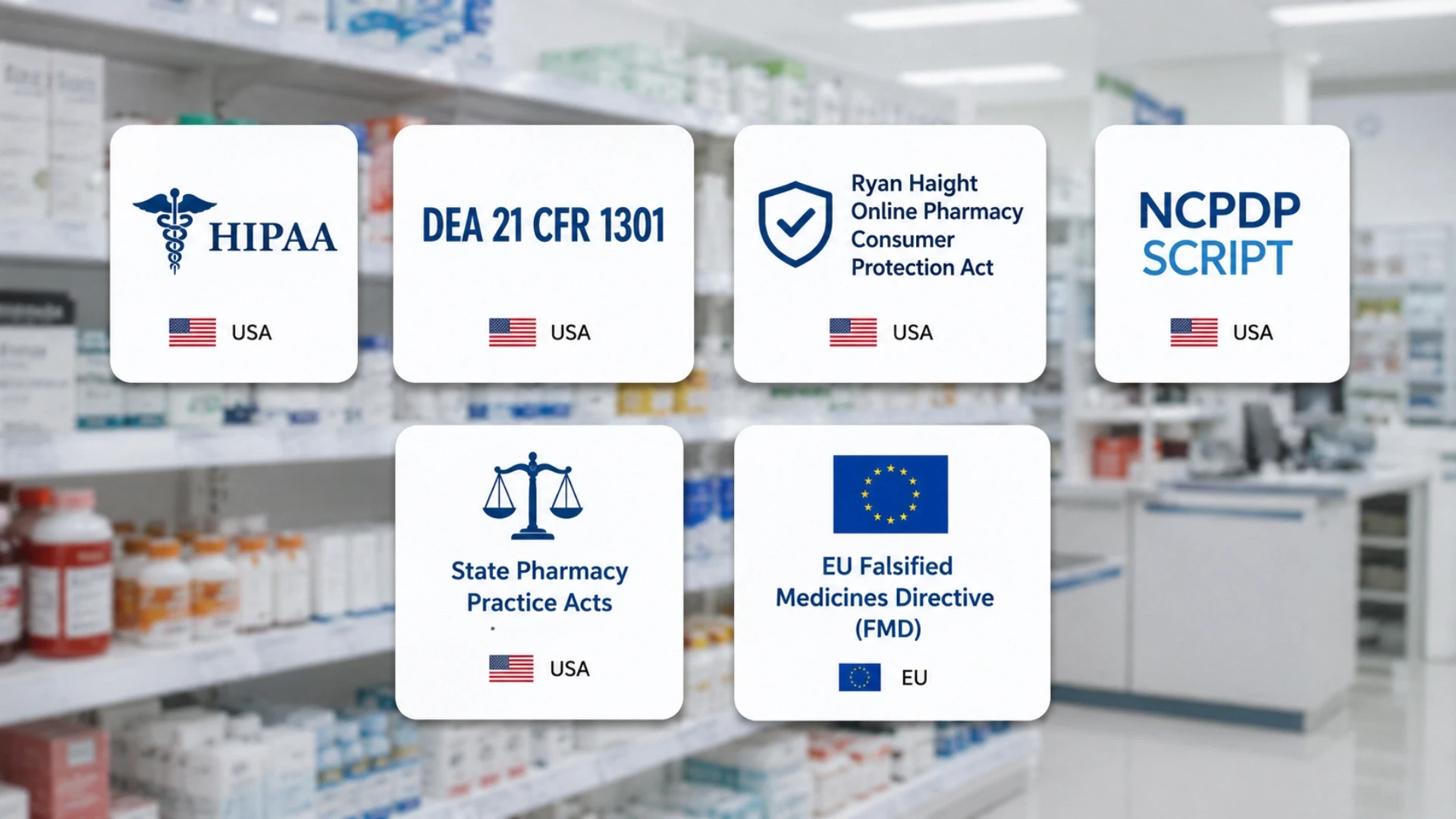
What is pharmacy software in the context of online dispensing? It is a regulated platform where every architectural decision is constrained by at least four overlapping legal frameworks. Understanding these frameworks before architecture design is not a legal formality. It is the prerequisite for building a system that can legally operate.
Regulation | Region | Requirement |
HIPAA Security and Privacy Rules | USA | Data encryption, access control, audit logs. |
DEA 21 CFR 1301 | USA | Pharmacy licensing and controlled substance tracking. |
Ryan Haight Online Pharmacy Consumer Protection Act | USA | Limits online prescribing of controlled substances. |
NCPDP SCRIPT Standard | USA | Standardized electronic prescription exchange. |
State Pharmacy Practice Acts | USA | State-specific pharmacy licensing requirements. |
EU Falsified Medicines Directive (FMD) 2011/62/EU | EU | Medicine serialization and verification. |
Platform Design Constraint: Pharmacist Review Is Non-Delegatable
A licensed pharmacist must review and approve every prescription before dispensing occurs. This is not a workflow preference; it is a legal requirement under the pharmacy practice laws of every US state and the equivalent legislation in the UK, EU, and Australia. AI can assist with prescription reading, data extraction, and drug interaction checking. AI cannot substitute for the pharmacist sign-off. Any platform architecture that routes around pharmacist review is not a compliant pharmacy system; it is an unregistered drug distributor.
Source: National Association of Boards of Pharmacy (NABP) Verified Pharmacy Program; Delaware Board of Pharmacy Dispensing Regulations §5.1; Oklahoma Administrative Code §535:15-19-4; Texas Administrative Code §291.29. These regulations require pharmacist verification and professional review before prescription dispensing.
Acquaint Softtech's virtual CTO services include a pharmacy compliance architecture review as the first deliverable for all online pharmacy engagements, mapping jurisdiction-specific requirements before any feature is scoped.
Three Platform Models: Which One Are You Actually Building?

The first decision in online pharmacy platform development is not which features to build. It is which platform model to build, because the compliance architecture, integration requirements, and development cost are fundamentally different for each.
Model 1: Single-Pharmacy Digital Storefront
A licensed brick-and-mortar pharmacy building a digital ordering and delivery channel for its existing patient base. The pharmacy already holds state pharmacy board licenses. The platform handles prescription upload, pharmacist review (by the pharmacy's own staff), order fulfilment from the pharmacy's own inventory, and last-mile delivery. This is the simplest compliance model because the licensure is already in place.
Development cost: $50,000 to $120,000. Timeline: 3 to 6 months. This model is appropriate for independent pharmacies, regional pharmacy chains, and hospital pharmacy departments building patient-facing ordering tools.
Model 2: Multi-Pharmacy Aggregator Platform
A marketplace platform that connects patients with multiple pharmacy partners, similar to how food delivery aggregators connect restaurants with diners. The platform itself does not hold pharmacy licenses — it routes orders to licensed pharmacy partners. The compliance obligation shifts: the platform must implement a robust pharmacy partner vetting and onboarding process, ensure each partner holds the state licenses required for the patient's location, and provide audit trails that allow each dispensing event to be attributed to the responsible licensed pharmacist.
Development cost: $120,000 to $350,000. Timeline: 6 to 12 months. This model requires significantly more complex backend architecture: multi-pharmacy routing logic, per-partner licence verification, split payment and commission systems, and pharmacy-side portals with individual pharmacist authentication.
Model 3: Specialty or Telemedicine-Integrated Platform
A platform that combines online consultation with a prescribing physician and pharmacy fulfilment in a single patient journey. The most complex compliance model because it integrates two regulated activities: the telemedicine consultation (subject to state telehealth laws and, for controlled substances, the Ryan Haight Act) and the pharmacy dispensing (subject to state pharmacy laws and DEA regulations). Both must be compliant independently, and the handoff between them must preserve the clinical record chain.
Development cost: $200,000 to $500,000 or more. Timeline: 10 to 18 months. Acquaint Softtech's dedicated software development teams have built telemedicine platforms and pharmaceutical regulatory systems. The discovery workshop services include a platform model selection analysis as a standard deliverable before any development is scoped.
The Prescription Pipeline: Upload, Verify, Dispense, and Deliver

Understanding how to build pharmacy software starts with understanding the prescription pipeline, the end-to-end data flow that a prescription follows from patient submission to medication delivery. Every compliance and integration decision maps to a specific step in this pipeline.
1. Patient identification and authentication. Patient authenticates with MFA. For controlled substance orders, additional identity verification (government ID matching) is required before the prescription workflow begins. HIPAA requires unique patient identifiers throughout.
2. Prescription upload or electronic receipt. Patient uploads a photo or PDF of a paper prescription, submits a refill request for a medication already in the system, or the platform receives an electronic prescription via NCPDP SCRIPT from a prescribing physician's e-prescribing system. AI-assisted OCR reads handwritten prescriptions and extracts structured data (patient name, prescriber NPI, drug name, quantity, dosage, instructions) for pharmacist review.
3. Insurance verification. For platforms handling insurance, real-time eligibility verification queries the patient's insurance plan to confirm coverage, co-pay amount, and whether the prescribed medication is on formulary. The NCPDP D.0 claim standard is used for electronic insurance adjudication.
4. Pharmacist review and verification queue. The extracted prescription data, alongside the original image or NCPDP SCRIPT record, enters the pharmacist's verification queue. The pharmacist reviews the prescriber's NPI (verified against the NPI Registry at nppes.cms.hhs.gov), the prescription's clinical validity, and the drug interaction check results. The pharmacist approves or rejects. This step cannot be automated or bypassed.
5. Drug interaction and safety check. Automated drug interaction checking against the patient's active medication list runs before and during pharmacist review. The First Databank or Lexicomp clinical decision database is the industry standard. Results are presented to the pharmacist, not to the patient, as a clinical decision support tool.
6. Dispensing and order fulfilment. Pharmacist approval triggers the dispensing event logged to the audit trail with pharmacist ID, timestamp, and NPI. For controlled substances, the dispensing event is reported to the state PDMP (Prescription Drug Monitoring Programme). Inventory is decremented. Packaging and labelling instructions are generated.
7. Delivery or pickup. The order enters the logistics pipeline: last-mile delivery with real-time tracking, cold chain management for temperature-sensitive medications, or in-store pickup with digital notification. Proof of delivery is captured (signature or OTP) and logged to the compliance audit trail.
Key Insight:
The prescription pipeline is a compliance audit trail, not just a workflow. Every event from patient submission through pharmacist approval and delivery confirmation must be logged with a timestamp, user ID, and outcome. This audit trail is what a DEA or state pharmacy board investigation will request first. Design the audit trail before you design the user interface.
Pharmacist Verification Workflow: The Non-Delegatable Step
The pharmacist verification workflow is one of the most critical components of an online pharmacy platform, yet it is often under-engineered because it is not visible in customer-facing demos. While patients experience a seamless ordering process, pharmacists rely on an efficient verification queue to review prescriptions safely and at scale.
Building this workflow requires expertise in secure, scalable applications, which is why many healthcare companies choose to hire MEAN stack developers for regulated pharmacy software projects.
What the pharmacist verification queue must provide
Full prescription image or NCPDP SCRIPT record, displayed without compression or cropping that might obscure dosage or prescriber signature
AI-extracted structured data alongside the original image, prescriber name, NPI, DEA number (if controlled substance), drug name, NDC code, quantity, dosage, and refill authorisation, with the source highlighted for cross-reference
Prescriber NPI verification status from the NPPES NPI Registry, with real-time lookup confirming the prescriber's active licence and speciality
Patient's full active medication list from the platform's records and, where FHIR integration exists, from the patient's EHR — to enable drug interaction checking in clinical context
Drug interaction alerts from the clinical decision support database, clearly flagged by severity level (contraindicated, major, moderate, minor) with references
A one-click approve or reject action that requires the pharmacist's authenticated session; no approval without active session
A mandatory rejection reason field that generates a patient notification, a prescriber notification where clinically appropriate, and an audit log entry
For multi-pharmacist operations, the queue must support assignment routing (distributing incoming prescriptions across available pharmacists by state licence), workload visibility (each pharmacist can see queue depth), and escalation for complex cases. A pharmacist who has approved a prescription cannot retroactively unapprove it without a documented override event.
Acquaint Softtech's Laravel developers build pharmacist verification interfaces with the session-tied approval pattern as standard: every approval action is cryptographically linked to the authenticating pharmacist's session, making the audit trail tamper-evident and legally defensible. The team's React Native developers build the pharmacist mobile interface for on-call review outside the pharmacy, with MFA at every session start.
Quality documentation and audit readiness
Verification workflows only hold up if they’re documented in a way an inspector can follow. State boards of pharmacy and the DEA can request dispensing records, error logs and evidence of corrective action, and a platform that stores these in scattered databases turns every audit into an engineering project. Build documentation as a first-class system: every dispensing error, near-miss and customer complaint should be logged with a timestamp, an owner and a resolution trail, the same way regulated manufacturers handle deviations in a digital quality management system. Platforms serving pharmacies that work with compounding facilities or manufacturers will also be asked about upstream quality processes, so tamper-evident audit trails and role-based signatures (the 21 CFR Part 11 pattern) are worth designing it from day one rather than retrofitting after your first inspection finding.
Drug Interaction Checking and Safety Layer Architecture
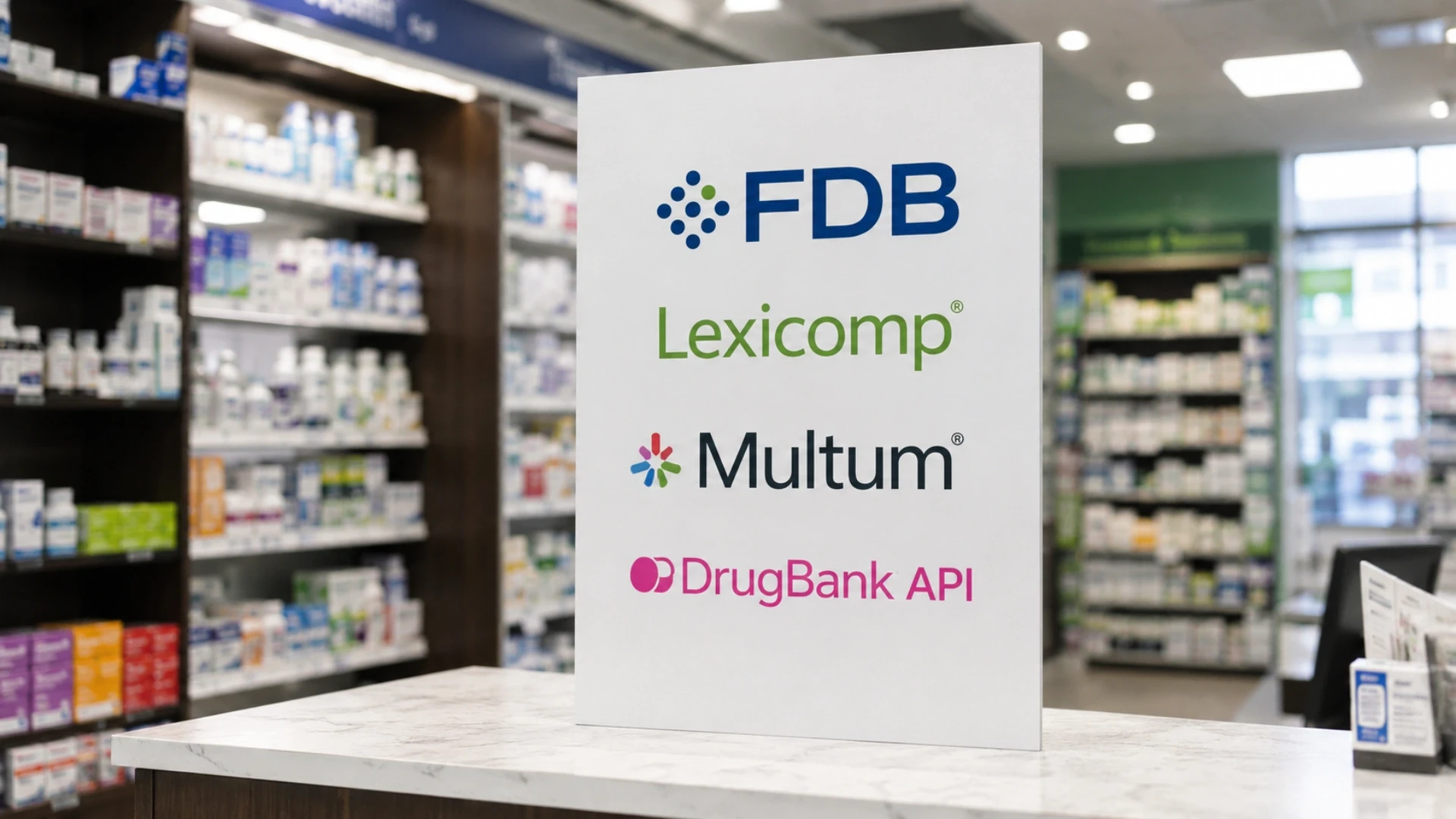
Drug interaction checking is a clinical safety requirement, not a feature. An online pharmacy platform that dispenses medications without a drug interaction check is a liability event waiting to happen. The architecture of the safety layer determines whether interaction alerts are clinically useful to pharmacists or become noise they dismiss.
Clinical decision support database options
Database | Key Use | Notes |
FDB | Drug interactions & dosing alerts | Leading US pharmacy database |
Lexicomp | Clinical drug information | Popular in hospitals |
Multum | Interaction & allergy checks | Integrated with Cerner |
DrugBank API | Drug data & interactions | Lower-cost, wellness-focused |
For a regulated online pharmacy dispensing prescription medication, First Databank or Lexicomp is the appropriate choice. DrugBank is appropriate for consumer health information apps that do not facilitate dispensing. Using a lower-tier interaction database in a dispensing platform creates a clinical liability risk that a licensed pharmacist's sign-off does not fully indemnify.
The interaction check runs at two points: when the prescription is uploaded (automated background check against the patient's active medication list) and when the pharmacist reviews the verification queue (the results are surfaced as a clinical decision support panel, not as a gate that blocks the pharmacist from approving). The pharmacist must be able to see the alert, document a clinical reason for proceeding if the interaction is acceptable in the patient's clinical context, and approve. Acquaint Softtech's Python developers build the API integration layer for clinical decision support databases, including the severity classification logic and the documentation workflow for pharmacist overrides.
Delivery Operations: Last-Mile Logistics, Cold Chain, and Proof of Delivery

Medication delivery is not the same as package delivery. Pharmacy delivery software must handle regulatory requirements that standard last-mile logistics platforms do not: controlled substance signature requirements, temperature-sensitive cold chain for refrigerated medications, and proof of delivery that is legally valid for the jurisdiction in question.
Last-mile delivery architecture
The delivery module manages driver assignment (internal fleet or third-party logistics API integration), real-time order tracking for patients, estimated delivery window calculation, and a driver-facing mobile app with delivery instructions specific to medication type. For platforms using third-party delivery APIs (Dunzo, DoorDash Drive, Uber Direct), the integration must ensure that the delivery partner has signed a BAA covering the PHI contained in the delivery manifest.
The cluster article Pharmacy Delivery App Development: Last-Mile Logistics for Medications covers the delivery-side architecture in full, including route optimisation, driver onboarding, and multi-pharmacy last-mile logistics.
Cold chain management for refrigerated medications
Insulin, biologics, certain vaccines, and hormone therapies require cold chain transport between 2 and 8 degrees Celsius. A pharmacy platform that handles these medication categories must track temperature at the packaging stage, use validated insulated packaging for the expected transit time and ambient temperature, require delivery within the validated cold chain window, and capture temperature log evidence at proof of delivery. Cold chain violation is a dispensing quality failure that must be reported and documented.
Proof of delivery and controlled substance signatures
Standard parcel delivery accepts a photo of the package at the door as proof of delivery. Pharmacy delivery has additional requirements. For controlled substances, a patient signature (wet or digital) is required at delivery in most jurisdictions. For all medications, the signature or OTP must be linked to the specific prescription record in the audit trail. A delivery confirmation without a prescription-level reference is not a compliant proof of delivery for a dispensing event.
Acquaint Softtech's MERN stack developers build real-time delivery tracking dashboards and driver-facing mobile apps for pharmacy delivery operations. All delivery confirmation events are logged to the pharmacy compliance audit trail with timestamp, GPS coordinates, and signature reference.
Integration Map: EHR, NCPDP, Insurance, and Payment Systems
An online pharmacy platform is one of the most integration-intensive healthcare products. It must connect to prescriber systems, insurance payers, clinical databases, government registries, and payment processors simultaneously. Each integration is a compliance surface and a development cost.
Integration | Standard/Protocol | Role |
e-Prescribing | NCPDP SCRIPT | Receive electronic prescriptions |
Insurance Claims | NCPDP D.0 | Verify eligibility and process claims |
PDMP | PMP InterConnect / State APIs | Check controlled substance history |
NPI Verification | NPPES API | Verify prescriber credentials |
EHR Integration | HL7 FHIR R4 | Access medication history and labs |
Clinical Decision Support | FDB / Lexicomp API | Check drug interactions and allergies |
Payments | Stripe / Braintree | Process secure payments |
Delivery Logistics | DoorDash Drive / Dunzo API | Manage delivery and tracking |
The NCPDP SCRIPT integration is the most technically complex integration for platforms targeting the US market. Every prescribing physician's EHR must have a bilateral agreement and technical configuration to transmit e-prescriptions to the pharmacy platform. Platforms without NCPDP SCRIPT integration rely entirely on photo uploads, which increases pharmacist verification time and creates a manual data entry step that introduces transcription error risk. Organizations looking to accelerate development timelines often evaluate white label software development solutions to reduce implementation effort while maintaining compliance and integration flexibility.
For teams building FHIR integration to retrieve patient medication history from EHRs, the How Telemedicine Apps Work: Architecture, Data Flow, and System Design Explained covers the FHIR R4 resource model and SMART on FHIR authorization that pharmacy platforms use for EHR data access.
Tech Stack and Architecture for Online Pharmacy Platforms in 2026
What is the best tech stack for pharmacy software in 2026? The pharmacy platform tech stack is shaped by three constraints: regulatory audit trail requirements, integration with healthcare data standards (NCPDP, FHIR, HL7), and the real-time logistics data demands of delivery operations. Standard e-commerce tech stacks are not designed for any of these three constraints.
Layer | Technology | Purpose |
Backend API | Laravel | Secure APIs, RBAC, audit management |
Frontend | React.js / Next.js | Patient and prescriber portal |
Mobile Apps | React Native | Cross-platform patient and pharmacist apps |
OCR & AI | Python + Textract/Tesseract | Prescription data extraction |
Clinical Support | Python + FDB/Lexicomp APIs | Drug interaction checks |
Database | PostgreSQL + AES-256 | Encrypted PHI and prescription storage |
Audit Logs | CloudTrail / SIEM | Compliance and activity tracking |
Delivery Tracking | Node.js + WebSockets | Real-time order tracking |
Cloud Infrastructure | AWS HIPAA-Eligible Services | Secure hosting, storage, and compliance |
Acquaint Softtech holds Official Laravel Partner status and deploys the full pharmacy tech stack across Laravel, React.js, React Native, and Python for online pharmacy platform clients. The team's DevOps engineers configure HIPAA-eligible AWS infrastructure for all pharmacy builds, including encrypted S3 buckets for prescription images, RDS instances with column-level encryption, and CloudTrail for immutable audit logging.
Case Study: Pharmaceutical Regulatory Compliance Platform Affordable Medicines Europe
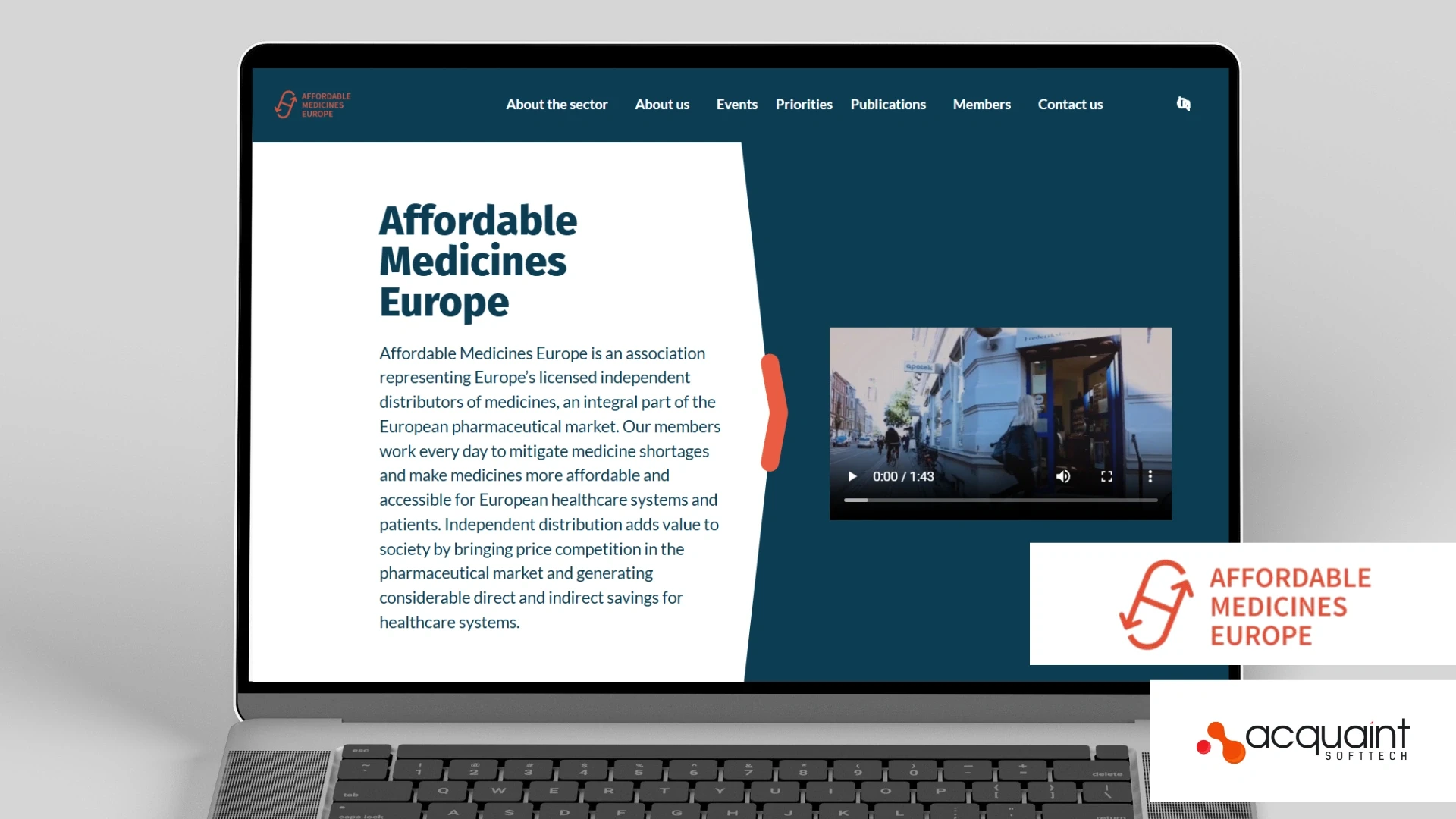
The following is drawn from a verified Clutch client review. Affordable Medicines Europe represents parallel importers and exporters of pharmaceuticals, including 120 or more companies operating in 23 countries of the European Economic Area. Their mission is regulatory compliance in cross-border pharmaceutical trade.
Client: Affordable Medicines Europe, an association of parallel importers and exporters of pharmaceuticals, representing 120 or more companies in 23 EU/EEA countries
Reviewer: Senior Policy Advisor, Affordable Medicines Europe
Project: Secure regulatory compliance and member data platform, centralising sensitive operational and member-related pharmaceutical data with fine-grained access control
Technology: Laravel backend with role-based permission system, secure APIs with authentication and authorisation layers, audit trails for sensitive operations, React.js frontend
Team: 2 to 5 Acquaint Softtech engineers
Clutch Verified: Yes, submitted via Clutch platform, publicly verifiable on Acquaint Softtech's profile
The challenge
Affordable Medicines Europe operates in one of the most regulated segments of the pharmaceutical supply chain: cross-border parallel importation of medicines within the EU/EEA. Member companies handle sensitive pharmaceutical trade data, regulatory documentation, and price compliance evidence across 23 countries. The organisation needed to centralise this data in a secure web platform with strict role-based access controls, ensuring member companies could only access data relevant to their own operations, while maintaining full audit traceability of every sensitive action for regulatory compliance purposes.
This challenge directly mirrors the core engineering problem in online pharmacy platform development: a system where multiple regulated parties (in this case, member pharmaceutical companies; in a pharmacy platform, prescribers, pharmacists, patients, and delivery personnel) access the same underlying data with radically different access permissions, where every access event must be traceable for regulatory audit.
What Acquaint Softtech built
A Laravel-driven backend architecture supporting fine-grained access control across multiple user roles and organisations, the same multi-role RBAC pattern required in any online pharmacy platform serving prescribers, pharmacists, patients, and administrators simultaneously
Role-based permission systems ensuring each member company could access only data relevant to their regulatory duties, directly analogous to the pharmacist-specific prescription queue with session-tied approval that a dispensing platform requires
Secure APIs with authentication and authorisation layers, the same API security architecture that protects prescription data, patient PHI, and NCPDP SCRIPT transmissions in an online pharmacy system
Audit trails on every sensitive operation, enabling administrators to retrieve the full access and modification history, identical in design to the dispensing audit trail required by DEA and state pharmacy board regulations
Verified outcomes
Centralised sensitive pharmaceutical operational data across 23 countries into a single secure platform
Role-based access controls introduced without compromising usability for member company staff
Full traceability of sensitive pharmaceutical data actions for compliance and regulatory audit purposes
Raised client confidence in handling sensitive data, automating access checks, streamlining onboarding, and facilitating audits
"Acquaint Softtech undertook the project with a good knowledge of the regulatory environment and the actual operational requirements. The team built a Laravel-driven backend with role-based permission systems, secure APIs, and frontend integrations. The platform raised our confidence in handling sensitive data, automating access checks, streamlining onboarding, and facilitating audits."
Senior Policy Advisor, Affordable Medicines Europe | Clutch Verified Review | Verified on Clutch.co
View the full Acquaint Softtech portfolio and all 60+ verified client reviews.
Pharmacy software development company India: Fixed-scope proposal in 2 weeks.
Acquaint Softtech has built regulated pharmaceutical platforms for European pharma associations, including Affordable Medicines Europe. HIPAA compliance, role-based pharmacist access, audit trails, and NCPDP/FHIR integration experience. $25 to $49/hour, Clutch-verified.
Pharmacy Software Development Cost in 2026
The pharmacy software development cost in 2026 depends on the platform's complexity, regulatory scope, integrations, and geographic coverage. Solutions designed for the US and European markets typically require compliance with healthcare regulations, prescription management standards, security requirements, and third-party healthcare integrations, which significantly influence development costs.
Platform Scope | Timeline | Estimated Development Cost (USD / EUR) |
Single Pharmacy Platform (prescription management, pharmacist review, delivery) | 3–6 months | $50K–$120K (€45K–€110K) |
Multi-Pharmacy Marketplace (partner onboarding, order routing, billing) | 6–12 months | $120K–$350K (€110K–€320K) |
Telemedicine-Integrated Pharmacy Platform (e-prescribing, consultation, dispensing) | 10–18 months | $200K–$500K+ (€180K–€460K+) |
Enterprise Pharmacy Chain Platform (multi-region operations, insurance processing, prescription monitoring) | 12–20 months | $350K–$800K+ (€320K–€740K+) |
What pharmacy projects consistently underestimate
Licensing and regulatory compliance: Pharmacy licensing, pharmacist supervision requirements, and country or state-specific regulations must be addressed before launch.
E-prescribing integrations: Connecting with electronic prescribing networks and healthcare systems increases both implementation costs and project timelines.
Prescription monitoring systems: Integration with controlled-substance monitoring programs often requires additional development and compliance work.
Clinical decision support databases: Drug interaction checking, allergy screening, and medication safety tools usually require licensed third-party databases with recurring annual fees.
Healthcare interoperability: Integrations with EHRs, EMRs, insurance providers, and healthcare APIs add complexity and testing requirements.
Security and data protection: HIPAA, GDPR, encryption, audit logging, and patient data safeguards require dedicated engineering effort.
Cold-chain medication delivery: Platforms supporting temperature-sensitive medications must account for logistics, monitoring, and operational infrastructure beyond software development.
Custom pharmacy software development services at Acquaint Softtech deliver at $25 to $49 per hour (verified on Clutch), representing 40 percent average cost savings versus Western agency rates. Hire developers for pharmacy software through the staff augmentation model for flexible team scaling across intensive integration phases such as NCPDP SCRIPT and PDMP.
Hire developers for pharmacy software: pharmaceutical compliance expertise included.
Acquaint Softtech builds online pharmacy platforms with HIPAA-compliant prescription pipelines, session-tied pharmacist verification, NCPDP SCRIPT integration, and audit trails designed for DEA and state pharmacy board compliance. 4.9/5, 50+ Clutch reviews. $25 to $49/hour.
Frequently Asked Questions
-
What features should pharmacy software include?
Pharmacy software should include secure prescription uploads, pharmacist verification, drug interaction checking, insurance claims processing, patient medication records, real-time delivery tracking, PDMP reporting, and tamper-proof audit logs to ensure compliance and patient safety.
-
How much does pharmacy software development cost in 2026?
Pharmacy software development costs range from $50,000 to $120,000 for a single-pharmacy platform and $200,000 to $500,000+ for telemedicine-integrated solutions. Final costs depend on compliance requirements, integrations, and platform complexity.
-
How long does it take to build pharmacy software?
A pharmacy software project typically takes 3 to 18 months. Single-pharmacy platforms require 3 to 6 months, while multi-pharmacy and telemedicine platforms may take 6 to 18 months, including compliance planning.
-
Can AI replace pharmacist review in online pharmacy software?
No. AI can assist with prescription reading, fraud detection, and drug interaction checks, but a licensed pharmacist must legally review and approve every prescription before dispensing medication.
-
What is NCPDP SCRIPT and why is it important?
NCPDP SCRIPT is the U.S. standard for electronic prescription transmission between healthcare providers and pharmacies. It enables secure e-prescribing, reduces manual data entry, and supports Medicare Part D compliance.
-
Does an online pharmacy platform require DEA compliance?
Yes. If controlled substances are dispensed, pharmacies must comply with DEA regulations, maintain dispensing audit trails, support PDMP reporting, and meet federal controlled substance requirements.
-
What is the Ryan Haight Act for online pharmacies?
The Ryan Haight Act regulates online prescribing of controlled substances. It generally requires an in-person medical evaluation before controlled substance prescriptions can be issued through telemedicine services.
-
What is the best tech stack for pharmacy software development?
A modern pharmacy platform typically uses Laravel or .NET for the backend, React.js and React Native for web and mobile applications, PostgreSQL for secure data storage, Python for OCR and AI features, and AWS HIPAA-eligible infrastructure.
-
What are the key features of hospital pharmacy software?
Hospital pharmacy software includes prescription management, medication inventory tracking, automated dispensing workflows, compliance reporting, patient medication records, drug interaction alerts, and secure access controls to improve patient safety.
-
Why is pharmacy software important for modern pharmacies?
Pharmacy software automates prescription processing, inventory management, billing, insurance claims, compliance reporting, and patient communication. It improves operational efficiency, reduces medication errors, and enhances patient care.
We’re Acquaint Softtech, your technology growth partner. Whether you're building a SaaS product, modernizing enterprise software, or hiring vetted remote developers, we’re built for flexibility and speed. Our official partnerships with Laravel, Statamic, and Bagisto reflect our commitment to excellence, not limitation. We work across stacks, time zones, and industries to bring your tech vision to life.
Table of Contents
Get Started with Acquaint Softtech
- 13+ Years Delivering Software Excellence
- 1300+ Projects Delivered With Precision
- Official Laravel & Laravel News Partner
- Official Statamic Partner
Related Blog

Custom Healthcare Software Development: An End-to-End Guide
Custom healthcare software is revolutionizing the medical industry by providing tailored solutions that enhance patient care, streamline processes, and improve security. Discover the benefits, challenges, and step-by-step guide to building effective custom healthcare software. Learn how expert developers can help you stay ahead in the evolving healthcare landscape.

Mukesh Ram
February 27, 2025
HIPAA Compliance for Software Developers: The Complete 2026 Checklist
HIPAA is not a security features module you bolt on before launch. It is a pattern of engineering decisions that starts at repository creation and never stops. This checklist is the one Acquaint Softtech applies to every healthcare build: 12 rules, 7 technical safeguards, and the 2026 penalties for ignoring them.

Sanjay Prajapati
May 25, 2026India (Head Office)
203/204, Shapath-II, Near Silver Leaf Hotel, Opp. Rajpath Club, SG Highway, Ahmedabad-380054, Gujarat
USA
7838 Camino Cielo St, Highland, CA 92346
UK
The Powerhouse, 21 Woodthorpe Road, Ashford, England, TW15 2RP
New Zealand
42 Exler Place, Avondale, Auckland 0600, New Zealand
Canada
141 Skyview Bay NE , Calgary, Alberta, T3N 2K6