
HIPAA Compliance for Software Developers: The Complete 2026 Checklist
HIPAA is not a security features module you bolt on before launch. It is a pattern of engineering decisions that starts at repository creation and never stops. This checklist is the one Acquaint Softtech applies to every healthcare build: 12 rules, 7 technical safeguards, and the 2026 penalties for ignoring them.

Sanjay Prajapati
As Head of Business at Acquaint Softtech, a software development partner with 1,300 plus projects delivered across 13 years, I have sat across from enough HealthTech founders at the wrong end of a compliance audit to know the pattern. The HIPAA compliance software development checklist is either done on day one or paid for in month eleven, and the month eleven version costs three to five times more.
Over the last decade, our teams have shipped HIPAA-ready platforms for clinics, hospital groups, and HealthTech startups across the United States, the United Kingdom, Australia, and the United Arab Emirates.
This checklist is the one Acquaint Softtech's engineering and compliance leads apply at the start of every custom healthcare software product development engagement, and it is the standard we measure any handed-over codebase against.

- CTOs and engineering leads building healthcare software need a practical HIPAA checklist.
- HealthTech founders preparing for SOC 2 audits or enterprise deals.
- Product teams tasked with achieving HIPAA compliance without clear guidance.
- Procurement teams verifying if vendors are truly HIPAA-compliant or just claiming it.
THE RISK Most teams approach HIPAA as a pre-launch task. They build the product, run a last-sprint 'HIPAA audit,' and discover the data model leaks Protected Health Information (PHI), the audit trail is missing, consent was never versioned, and at least three vendors have no Business Associate Agreement (BAA) in place. The rebuild takes 4 to 7 months. The launch slips. Investors lose patience. | THE SAFEGUARD Bake compliance into the architecture from sprint one. Use the 12 engineering rules and 7 technical safeguards in this checklist as non-negotiable baseline requirements before writing a single line of application code. The marginal cost of doing it right on day one is less than 15 per cent of the build time. The cost of retrofit is 300 to 500 per cent. |
The confusion around HIPAA exists because the rule is written for organisations, not for code. The Security Rule tells you to protect electronic Protected Health Information (ePHI) with 'reasonable and appropriate' safeguards, which is legally adequate and technically unhelpful. This article translates the rule into the exact engineering decisions Acquaint Softtech's teams make on every build.
For the wider landscape this checklist sits inside, including architecture, costs, and build strategy, see our master guide to healthcare software development. This sub-pillar is the compliance layer of that guide.
The first section is the official reset on what HIPAA actually covers at the code layer. Skipping it is the reason most teams get one of the twelve rules wrong by accident. Teams already clear on HIPAA basics can jump to section 3 for the technical safeguards.
What HIPAA Actually Covers at the Code Layer
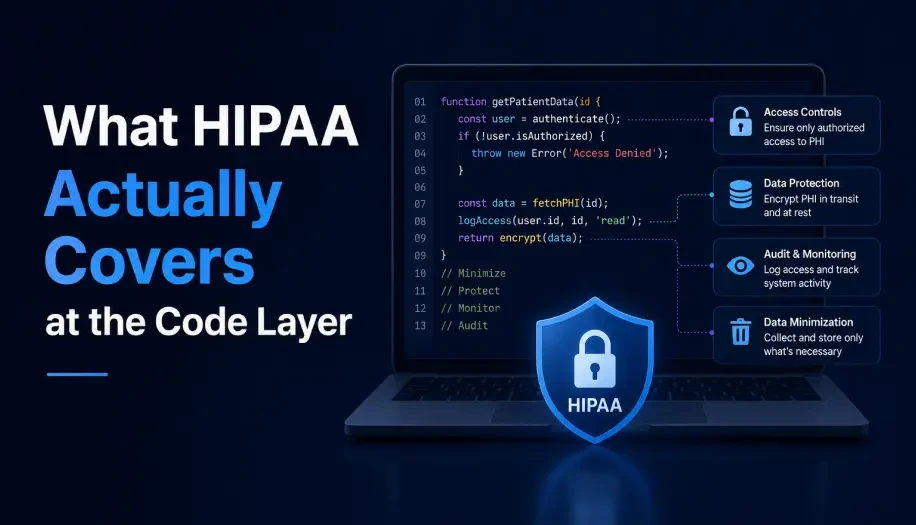
HIPAA is composed of several rules, but only three directly shape how developers write code. The Privacy Rule governs how Protected Health Information (PHI) is used and disclosed. The Security Rule governs how electronic PHI is protected with administrative, physical, and technical safeguards.
The Breach Notification Rule governs what happens when protection fails. The United States Department of Health and Human Services maintains the official reference. Developers should read the Security Rule sections on Technical Safeguards (45 Code of Federal Regulations 164.312) at least once; that is the section your code must satisfy.
Who HIPAA applies to
HIPAA applies to Covered Entities (healthcare providers, health plans, healthcare clearinghouses) and their Business Associates (vendors handling PHI on their behalf). If the software company you work for builds software that touches PHI for a covered entity, you are a Business Associate, and HIPAA obligations flow to you contractually through the BAA.
What counts as PHI
The 18 identifiers defined by HIPAA include name, geographic subdivisions smaller than a state, dates directly related to an individual, phone numbers, email addresses, Social Security numbers, medical record numbers, health plan beneficiary numbers, account numbers, device identifiers, Internet Protocol (IP) addresses, biometric identifiers, full face photographs, and any other unique identifying number, characteristic, or code. If your system touches any of these linked to a health context, you are handling PHI. Assume everything is PHI unless proven otherwise by a de-identification expert.
The three responsibilities every developer must own
Confidentiality: ensure PHI is accessible only to those authorised to access it.
Integrity: ensure PHI is not improperly altered or destroyed.
Availability: ensure PHI is accessible and usable on demand by authorised persons.
These three are the developer's core obligations. Every engineering decision on a healthcare build should be traceable back to one of them. When external engineering capacity is needed for sensitive compliance-heavy workloads, clients typically hire DevOps engineers from Acquaint Softtech who have shipped HIPAA-eligible Kubernetes clusters before, not general-purpose infrastructure generalists.
The 2026 Penalty Tiers (Know What's at Stake)
.webp "The 2026 Penalty Tiers")
The Office for Civil Rights (OCR) enforces HIPAA and publishes penalty tiers annually. The 2026 figures below are adjusted for inflation from the base tiers set in the Health Information Technology for Economic and Clinical Health (HITECH) Act. These are per-violation maximums; a single breach involving thousands of records can multiply quickly.
Tier | Penalty Range | Description |
|---|---|---|
Tier 1 | $137 – $68,928 per violation | Organization was unaware of the violation despite reasonable diligence |
Tier 2 | $1,379 – $68,928 per violation | Violation occurred due to reasonable cause, not willful neglect |
Tier 3 | $13,785 – $68,928 per violation | Violation caused by willful neglect but corrected within the required timeframe |
Tier 4 | $68,928 – $2,067,813 per violation | Violation caused by uncorrected willful neglect, with possible criminal penalties |
The figures above are the regulatory floor. The commercial floor is usually worse: enterprise clients walk away, insurance premiums rise, and the reputational recovery cycle averages 18 to 24 months.
The 7 Technical Safeguards Every Healthcare App Must Ship
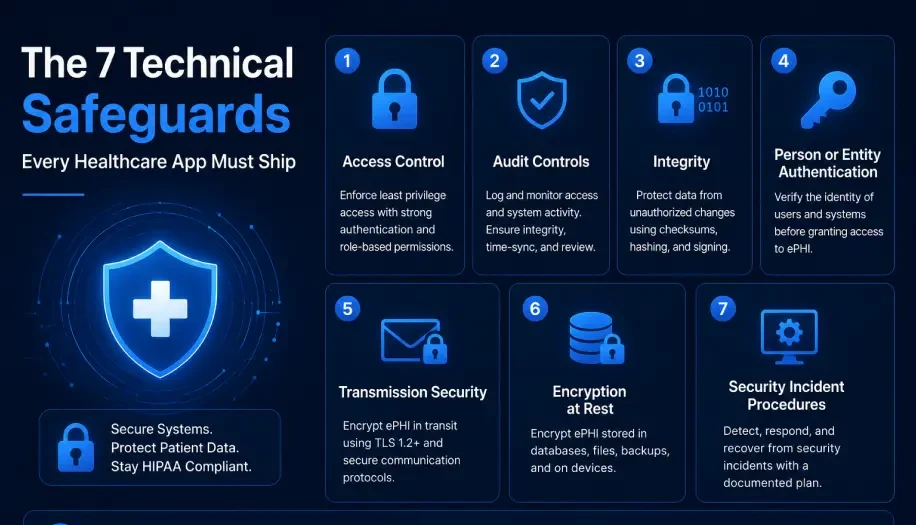
The HIPAA Security Rule at 45 Code of Federal Regulations 164.312 defines specific technical safeguards. Below are the seven that translate directly into engineering tasks. Each is presented as a Rule Card with the engineering requirement. These are not optional, though HIPAA itself marks some as 'addressable'. In practice, 'addressable' means you must implement it or formally document why an equivalent alternative is appropriate, and auditors rarely accept the alternative.
Unique User Identification
Every user accessing the system must have a unique identifier. No shared accounts, no service accounts for human users, no 'admin' or 'clinic1' logins shared across staff. Tie every action in the audit log to an individual identified human. Implement: per-user authentication, role-based access, identity provider integration where possible (Single Sign-On).
Emergency Access Procedure
A documented, auditable mechanism for accessing PHI during an emergency when normal authentication flows may fail. Implement: 'break-glass' user roles that grant expanded access with immediate alerting to a compliance officer, mandatory post-incident review, and automatic expiry after the emergency window.
Automatic Logoff
Terminate electronic sessions after a predetermined period of inactivity. Implement: idle session timeout (15 minutes for clinical dashboards is the industry norm, 5 minutes for kiosk or shared-device setups), re-authentication requirement on resume, and immediate session invalidation on logout across all devices.
Encryption and Decryption
Implement mechanisms to encrypt and decrypt electronic PHI. Implement: Transport Layer Security (TLS) 1.3 for data in transit everywhere, including internal service-to-service traffic, Advanced Encryption Standard (AES) 256 for data at rest, customer-managed keys with rotation, and field-level encryption for the most sensitive fields (mental health diagnoses, human immunodeficiency virus status, substance use).
Audit Controls
Record and examine activity in information systems that contain or use PHI. Implement: an append-only, immutable audit log that captures who accessed what PHI record, when, from where (IP), on what device, and what action was taken. Retention: six years minimum. Logs must themselves be encrypted and protected from modification, including by administrators. Most healthcare teams can't staff a 24/7 SOC in house, which is why some pair this audit layer with an agentic SOC and MXDR setup that triages alerts and flags anomalies continuously without adding analysts.
Integrity Controls
Protect electronic PHI from improper alteration or destruction. Implement: versioning on clinical records, cryptographic hashes for critical documents, soft-delete patterns instead of hard deletes, and scheduled data integrity verification. The clinical record is a legal document; it cannot be silently overwritten.
Transmission Security
Guard against unauthorised access to electronic PHI that is being transmitted over a network. Implement: TLS 1.3 on all external and internal traffic, mutual Transport Layer Security (mTLS) between internal services, certificate pinning on mobile clients, short-lived JSON Web Tokens for session authentication, and no PHI in Uniform Resource Locator (URL) query strings, ever.
Want Acquaint to Audit Your Technical Safeguards?
Send us your current architecture diagram and a sample of your audit log schema. A senior compliance engineer will map your implementation against the 7 safeguards above and flag the top 3 risks. No cost for the review. Turnaround: 48 hours. If you choose to remediate with Acquaint, the review credit rolls into the engagement.
The 12 Engineering Rules: Acquaint Softtech's Checklist
The seven safeguards above define what the law requires. The twelve rules below are what Acquaint Softtech's engineering leads require on top, because the law's minimum is not a production standard. Each rule is paired with the risk it addresses and the safeguard that implements it.
Rule | Risk | Safeguard |
|---|---|---|
Rule 1 | PHI exposed in application logs | Use structured logging with PHI filtering and HIPAA eligible logging infrastructure |
Rule 2 | Compromised service exposes PHI database | Apply least privilege access and row level security |
Rule 3 | PHI leaked to analytics or tracking vendors | Use HIPAA compliant vendors with payload filtering and BAAs |
Rule 4 | Real PHI pushed to staging or public repositories | Use synthetic datasets and block PHI through security scanning |
Rule 5 | PHI stored insecurely on mobile devices | Encrypt local storage and enable remote wipe with session expiry |
Rule 6 | Developers receive excessive PHI access | Enforce role based access control and compliance reviews |
Rule 7 | PHI sent to public AI or LLM services | Use HIPAA compliant AI providers and de identify PHI |
Rule 8 | PHI exported through insecure email | Restrict exports and provide secure in platform sharing |
Rule 9 | PHI retained longer than compliance allows | Implement automated retention and deletion policies |
Rule 10 | Unencrypted backups stored in non compliant regions | Encrypt backups and use HIPAA eligible storage regions |
Rule 11 | Malicious SDK or dependency leaks PHI | Pin dependencies and run automated security analysis |
Rule 12 | Multi region deployment misses HIPAA settings | Use Infrastructure as Code with automated compliance che |
These twelve rules map directly to the audit findings Acquaint Softtech sees when reviewing failed HealthTech builds. Fifteen out of eighteen rebuilds we conducted in 2024 and 2025 had at least four of them wrong. For a deeper operational treatment, see our cluster pieces on encryption standards for healthcare apps and HIPAA-compliant cloud hosting: AWS vs Azure vs GCP.
The Developer-Level Implementation Checklist
.webp "The Developer-Level Implementation Checklist")
The list below is the one Acquaint Softtech's tech leads print and hand to every new engineer joining a HealthTech project on day one. It is organised by phase so it can be used as a progress tracker.
Phase 1 - Repository and Environment
Repository is private with branch protection and signed commits required
Pre-commit hooks scan for secrets, PHI patterns, and hardcoded credentials
Separate HIPAA-eligible cloud account for production, separate for staging
No production PHI ever copied to staging or development environments
Synthetic PHI generator set up for realistic but fake test data
Secrets managed through AWS Secrets Manager, Azure Key Vault, or HashiCorp Vault never in code
Phase 2 - Authentication and Access Control
Unique user identifier per human, no shared accounts
Multi-factor authentication required for all users with PHI access
Role-based access control with minimum necessary applied per role
Session tokens are short-lived JSON Web Tokens with refresh flow
Automatic session timeout configured (15 minutes clinical, 5 minutes shared device)
Break-glass role defined with alerting and post-incident review
Quarterly access review automation with unused-grant revocation
Phase 3 - Data Protection
TLS 1.3 on all external traffic, mutual TLS on internal service traffic
AES-256 at rest with customer-managed keys and scheduled rotation
Field-level encryption on the most sensitive PHI columns
Database backups encrypted with separate keys and HIPAA-eligible storage region
No PHI in URL query strings, logs, or client-side caches beyond active session
Mobile app local cache encrypted with device-bound key and remote-wipe capable
Phase 4 - Auditing and Monitoring
Append-only audit log for every PHI read, write, export, and failed access attempt
Audit log retention configured for 6 years minimum, immutable storage
Security Information and Event Management (SIEM) configured with PHI-specific alerts
Intrusion detection on all PHI-bearing services
Quarterly penetration test by an external HIPAA-aware security firm
Breach detection playbook documented and tested via tabletop exercise
Phase 5 - Vendor and Integration
Business Associate Agreement signed with every vendor touching PHI
Third-party library inventory maintained with monthly vulnerability scan
No PHI transmitted to vendors without BAA (analytics, error tracking, LLM, email)
Vendor offboarding procedure includes PHI deletion attestation, while an IT offboarding checklist helps standardize internal user account deprovisioning and secure access removal.
Software Composition Analysis runs on every build
Outbound network access from PHI-handling services is restricted by an allowlist
Phase 6 - Documentation and Audit Readiness
Written HIPAA risk assessment updated annually
Privacy Impact Assessment completed for each major feature
Data flow diagrams up to date and reviewed quarterly
Incident response plan documented and tested twice a year
Breach notification procedure documented with 60-day timeline
Employee HIPAA training completed and tracked
Security Officer and Privacy Officer named and reachable
Need a Team That Already Runs This Checklist?
Acquaint Softtech's HealthTech engineers have been through HIPAA-aware development training and have shipped compliant platforms across the US, UK, Australia, and the UAE. Average team tenure on healthcare accounts: 24 plus months. Developer deployment within 48 hours. You interview before you commit.
Business Associate Agreements: The Vendor Trap
A Business Associate Agreement (BAA) is a contract between a Covered Entity and a Business Associate that requires the Business Associate to safeguard PHI. Under HIPAA, if your platform touches PHI on behalf of a Covered Entity, you are a Business Associate, and you need a BAA with them.
If your platform, in turn, shares PHI with subprocessors (cloud providers, analytics tools, payment processors, video Software Development Kit providers, LLM APIs), you need BAAs with each of them as well. This chain is where most startups fail their first audit.
The vendors that must have a BAA signed before they see PHI
Cloud infrastructure providers (AWS, Azure, Google Cloud Platform), they all offer HIPAA-eligible services and sign BAAs on request
Database-as-a-service providers, if used (MongoDB Atlas, managed PostgreSQL variants), only HIPAA-eligible tiers
Email providers (SendGrid, Postmark, Amazon Simple Email Service), HIPAA plans only
Error tracking and monitoring (Datadog, Sentry, New Relic) all offer HIPAA configurations
Analytics tools (Mixpanel, Amplitude), HIPAA plans only, never the free tier
Customer support tools (Zendesk, Intercom), HIPAA configurations required
Video calling (Twilio Programmable Video, Zoom Healthcare, self-hosted mediasoup/Janus), BAA required
AI and LLM providers (OpenAI, Anthropic, Google), only where BAA is offered, else de-identify first
Payment processors handling health-related invoicing (Stripe offers HIPAA through specific configurations)
Document storage, e-signature, and fax services
The practical rule: if a vendor will not sign a BAA, they cannot touch PHI. There is no workaround. No amount of 'but we anonymise it first' holds up in an audit if the anonymisation is not certified by a qualified expert under the HIPAA Safe Harbour or Expert Determination methods.
For partners building through offshore teams, the BAA chain extends to the development vendor itself. Acquaint Softtech executes Business Associate Agreements with HealthTech clients as standard practice, and treats BAA-bound staff as a distinct personnel tier with dedicated training. For the contractual structure in depth, see our guide to Business Associate Agreements for software vendors and to structuring offshore healthcare software development outsourcing with NDAs and BAAs.
Multi-Region Compliance: HIPAA Plus GDPR Plus NHS
Most HealthTech platforms scale beyond a single jurisdiction within their first 36 months. Building for HIPAA only and then retrofitting General Data Protection Regulation (GDPR) or United Kingdom National Health Service (NHS) standards is expensive.
Building for the strictest requirement from day one is cheaper. The table below compares the three regulatory regimes Acquaint Softtech's teams most commonly work within.
Dimension | HIPAA (US) | GDPR (EU) | NHS DSPT (UK) |
Scope | PHI handled by Covered Entities and Business Associates | Personal data of EU residents, broader than health | Health and care data on NHS networks |
Consent | Implied for treatment, explicit for marketing | Explicit, granular, revocable | Explicit with specific NHS templates |
Data residency | No strict requirement | EU or adequacy-approved region | UK-preferred, EU-acceptable with controls |
Breach notification | 60 days to individuals, HHS, media | 72 hours to the supervisory authority | Per the NHS Data Security and Protection Toolkit timeline |
Right to erasure | Not absolute | Yes, with exceptions | Subject to clinical retention rules |
Penalty cap | $2,067,813/year (2026) | 4% global turnover or €20M | NHS contract termination, public naming |
Audit frequency | Risk-based, event-driven | Risk-based, continuous | Annual DSPT submission |
The engineering consequence: build the consent service, audit service, and data residency controls to satisfy the strictest of the three applicable regimes. Adding a region then becomes a configuration change, not an architectural rewrite. For teams building multi-region platforms, the cluster piece on multi-country healthcare compliance: HIPAA plus PIPEDA plus GDPR walks through the specific engineering changes.
What HIPAA Adds to Development Cost in 2026
The honest answer to 'how much does HIPAA compliance add to development cost' is: 12 to 18 per cent on day one, or 300 to 500 per cent as a retrofit. The table below shows the breakdown for a typical Acquaint Softtech HealthTech build in 2026.
Compliance Element | Added Effort | Typical Cost Range (USD) |
HIPAA-eligible cloud setup and Infrastructure as Code | 2 to 4 weeks | $8,000 - $18,000 |
Audit log service, retention pipeline, SIEM integration | 3 to 5 weeks | $12,000 - $28,000 |
Consent service, versioned templates, revocation flow | 2 to 3 weeks | $6,000 - $14,000 |
Encryption infrastructure, key management, field-level encryption | 2 to 4 weeks | $9,000 - $20,000 |
Role-based access control and access review automation | 2 to 3 weeks | $7,000 - $15,000 |
Risk assessment, Privacy Impact Assessments, documentation | 1 to 2 weeks | $4,000 - $9,000 |
Quarterly penetration testing (external vendor) | Recurring | $12,000 - $30,000/yr |
BAA negotiation and vendor vetting across the stack | 1 to 2 weeks | $3,000 - $7,000 |
These numbers are included in Acquaint Softtech's HealthTech engagement quotes, not charged separately. The rate the client pays is the rate. No additional employer overhead on top. Ongoing maintenance for compliance-heavy platforms is covered under our support and maintenance services for healthcare platforms. Teams that need a fractional senior compliance lead before committing to a full build often start with our virtual Chief Technology Officer services.
Ready to Build a HIPAA-Compliant Platform Without the Retrofit Tax?
Tell us about your HealthTech product, target users, and timeline. A senior compliance-aware architect will return a proposal with a transparent team structure, the exact HIPAA controls that will ship in sprint one, and a fixed weekly rate. Typical turnaround: 48 hours. You interview every developer before they join the team.
Frequently Asked Questions
-
What does HIPAA require for healthcare apps?
HIPAA requires healthcare applications that handle electronic Protected Health Information (ePHI) to implement administrative, physical, and technical safeguards sufficient to ensure the confidentiality, integrity, and availability of that data.
At the code layer, this translates to unique user authentication, role-based access control, automatic session logoff, encryption in transit and at rest, an immutable audit log, integrity controls, and transmission security. The rule also requires a signed Business Associate Agreement with every vendor that touches PHI, and a documented risk assessment updated at least annually.
-
How do you make a health app HIPAA compliant?
Bake compliance into the architecture from sprint one. Start with a HIPAA-eligible cloud account, Infrastructure as Code, and a clearly drawn five-layer architecture with PHI boundaries. Implement the seven technical safeguards in section 3 of this article, the twelve engineering rules in section 4, and the phase-by-phase checklist in section 5.
Sign Business Associate Agreements with every vendor that touches PHI. Keep an append-only audit log. Run a quarterly penetration test. The work is non-trivial but bounded; retrofit is three to five times the cost of building it correctly from the start.
-
What are the penalties for HIPAA violations in 2026?
Penalty Level
Impact
Lowest Tier
Starts at $137 per violation
Highest Tier
Up to $2,067,813 per violation per year for uncorrected willful neglect
Criminal Penalties
Up to $250,000 in fines and 10 years imprisonment
Business Impact
Enterprise contract loss, higher insurance costs, and reputational damage can exceed regulatory penalties by 2–4x
-
How much does HIPAA compliance add to development cost?
Building HIPAA compliance into a healthcare platform from sprint one typically adds 12 to 18 per cent to development cost, or roughly $60,000 to $140,000 on a standard production build. Retrofitting compliance onto an existing platform that was not designed for it costs 300 to 500 per cent of that, because the database schema, audit infrastructure, consent flow, and integration boundaries all have to be restructured. Acquaint Softtech includes these compliance elements in the engagement quote; they are not charged separately after the fact.
-
Do I need a Business Associate Agreement with my development vendor?
Yes, if the development vendor or any of its personnel will see, process, store, or transmit Protected Health Information during the engagement. A Business Associate Agreement is a legal contract required by HIPAA that flows compliance obligations down to the vendor.
Acquaint Softtech signs BAAs as standard practice with every HealthTech client, and executes subprocessor BAAs with any downstream tooling used. If a vendor refuses to sign a BAA, they cannot work on the PHI-handling parts of your platform. This is not negotiable.
-
Can offshore development teams build HIPAA-compliant software?
Yes, when the offshore vendor has signed Business Associate Agreements in place, personnel-level HIPAA training, separation of HIPAA-bound teams from general-purpose teams, controlled access to PHI-handling environments, and a documented incident response chain.
Acquaint Softtech has delivered HIPAA-compliant platforms to clients in the United States, the United Kingdom, Australia, and the United Arab Emirates for over 13 years. Geography is not the determining factor. Process discipline, contract structure, and engineering practice are.
-
Is HIPAA compliance the same as SOC 2 or ISO 27001?
No, though they overlap substantially. HIPAA is a United States federal regulation specific to protected health information. SOC 2 is a voluntary attestation of security, availability, processing integrity, confidentiality, and privacy controls, widely required by enterprise buyers. ISO 27001 is an international information security management standard.
A well-designed HealthTech platform typically pursues all three, because enterprise healthcare buyers ask for HIPAA plus SOC 2, and international expansion often needs ISO 27001. The controls overlap roughly 60 to 70 per cent, and Acquaint Softtech's compliance engineering practice is structured to cover all three in parallel.
-
What happens if my platform has a HIPAA breach?
HIPAA requires notification within 60 days of breach discovery to each affected individual, to the Secretary of Health and Human Services, and in some cases to the media if the breach affects more than 500 individuals in a state or jurisdiction. The Office for Civil Rights may open an investigation, which can result in a corrective action plan, monetary penalties, and mandatory public disclosure.
I am Sanjay Parjapati, a developer at heart and a Head of business by work. My journey started with coding and helped me grow towards becoming a head of business which led me to focus on dual skills, i.e. technical know-hows and the business know-hows. My journey of 10+ years has helped me grow immensely from a professional viewpoint.
Table of Contents
Get Started with Acquaint Softtech
- 13+ Years Delivering Software Excellence
- 1300+ Projects Delivered With Precision
- Official Laravel & Laravel News Partner
- Official Statamic Partner
Related Blog
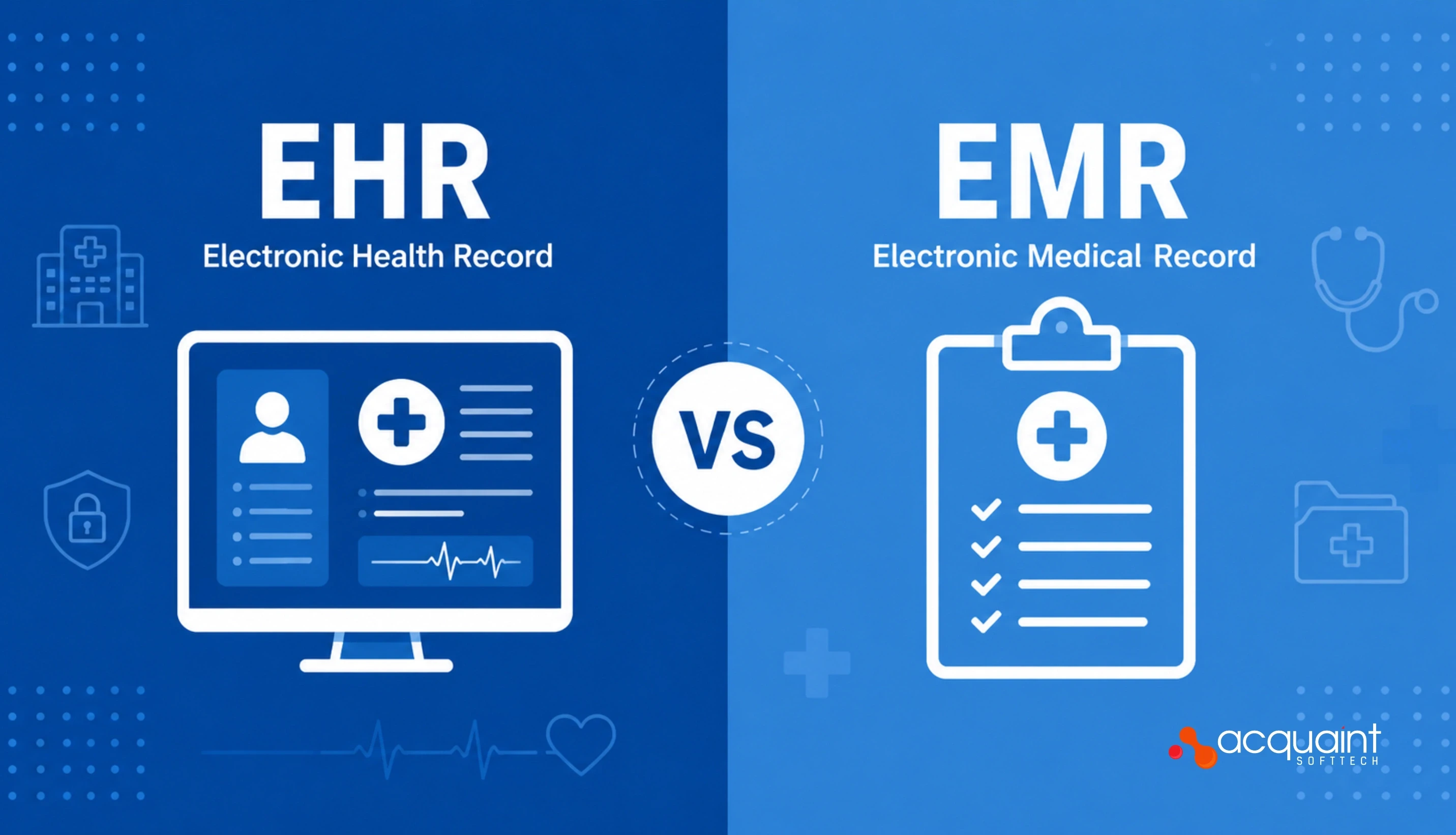
EHR vs EMR: What's the Actual Difference and Which Should You Build
Most people use EHR and EMR interchangeably. They are not the same system. One is a digital filing cabinet for a single practice. The other is a longitudinal health record that follows the patient across their entire care journey. Picking the wrong one costs founders 9 to 14 months of rework. Here is how to choose correctly the first time.

Ahmed Ginani
May 15, 2026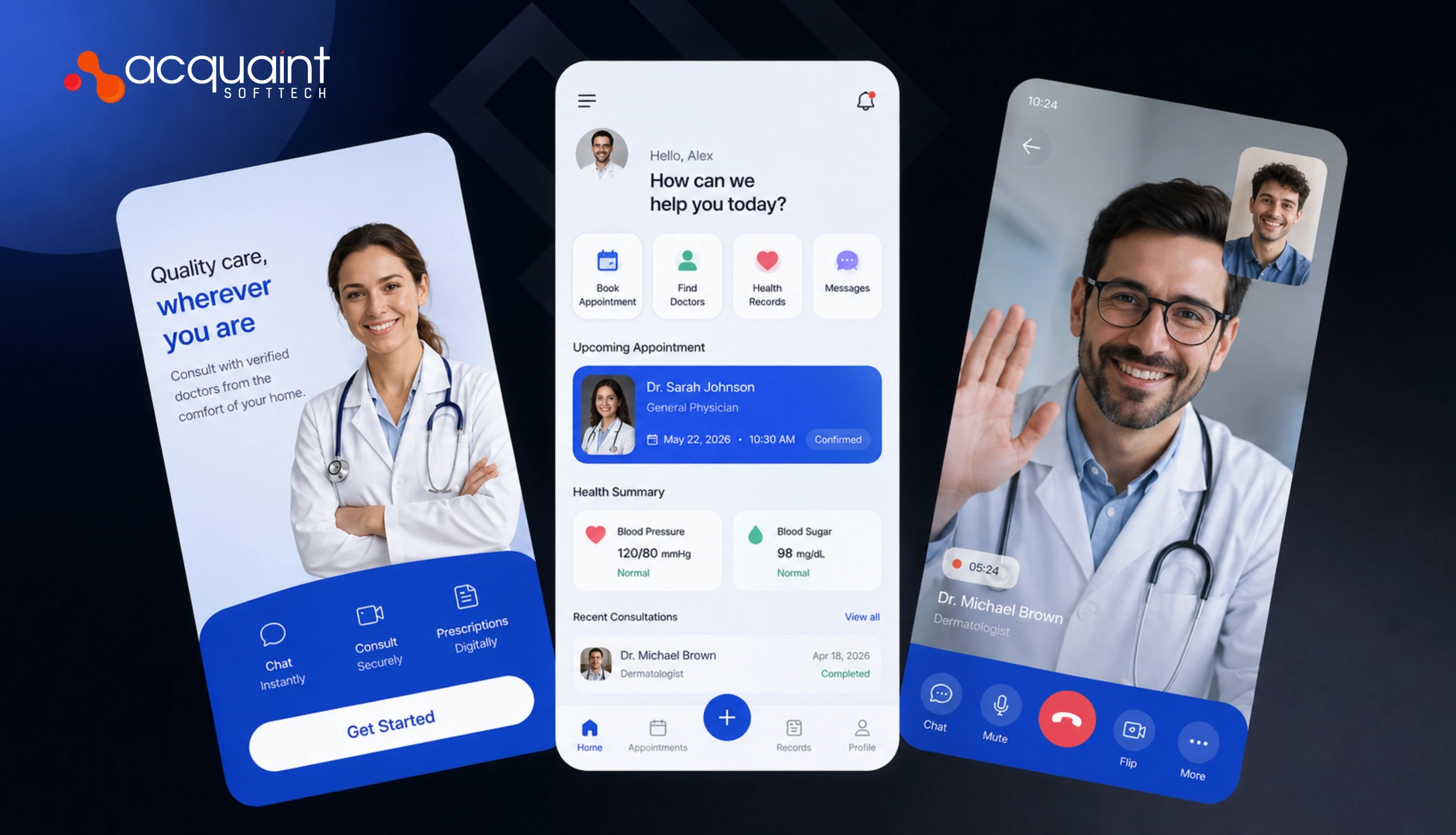
How Telemedicine Apps Work: Architecture, Data Flow, and System Design Explained
A telemedicine app is not a video call with a medical logo. It is a distributed system that moves protected health information between four environments in under 200 milliseconds while staying inside HIPAA boundaries. Here is exactly how it works, layer by layer, with the tech stack, the data flow, and the numbers that matter.

Manish Patel
May 8, 2026
The Complete Guide to Healthcare Software Development in 2026
Healthcare software development in 2026 is not a single discipline. It is six distinct product categories, each with its own compliance perimeter, integration burden, and cost curve.