

Python Development RFP Template: Exact Questions to Send Before You Shortlist a Vendor
Stop asking for quotes. Start sending RFPs. This guide gives you 50+ Python-specific questions across 7 sections, a response scoring framework, and red flags to catch in vendor replies before you shortlist.

Acquaint Softtech
Who This Guide Is For
This guide is for CTOs, Product Managers, and technical leads who are preparing to evaluate multiple Python development vendors and want a structured way to collect comparable, useful responses instead of vague proposals.
If you are still deciding what type of engagement model to use before sending an RFP, start with the Python hiring models comparison first. Once you know whether you need staff augmentation, a dedicated team, or project outsourcing, this template will be more useful.
Why an RFP Beats Asking for a Quote
According to PMI's 2025 project success data, software development projects succeed only 54% of the time, with unclear requirements and poor vendor alignment as two of the most cited failure causes. A quote request produces a number. An RFP produces evidence. Worth knowing, though: vendors increasingly draft that evidence with AI tools like Inventive AI, which is exactly why the structure of your questions matters more than ever.
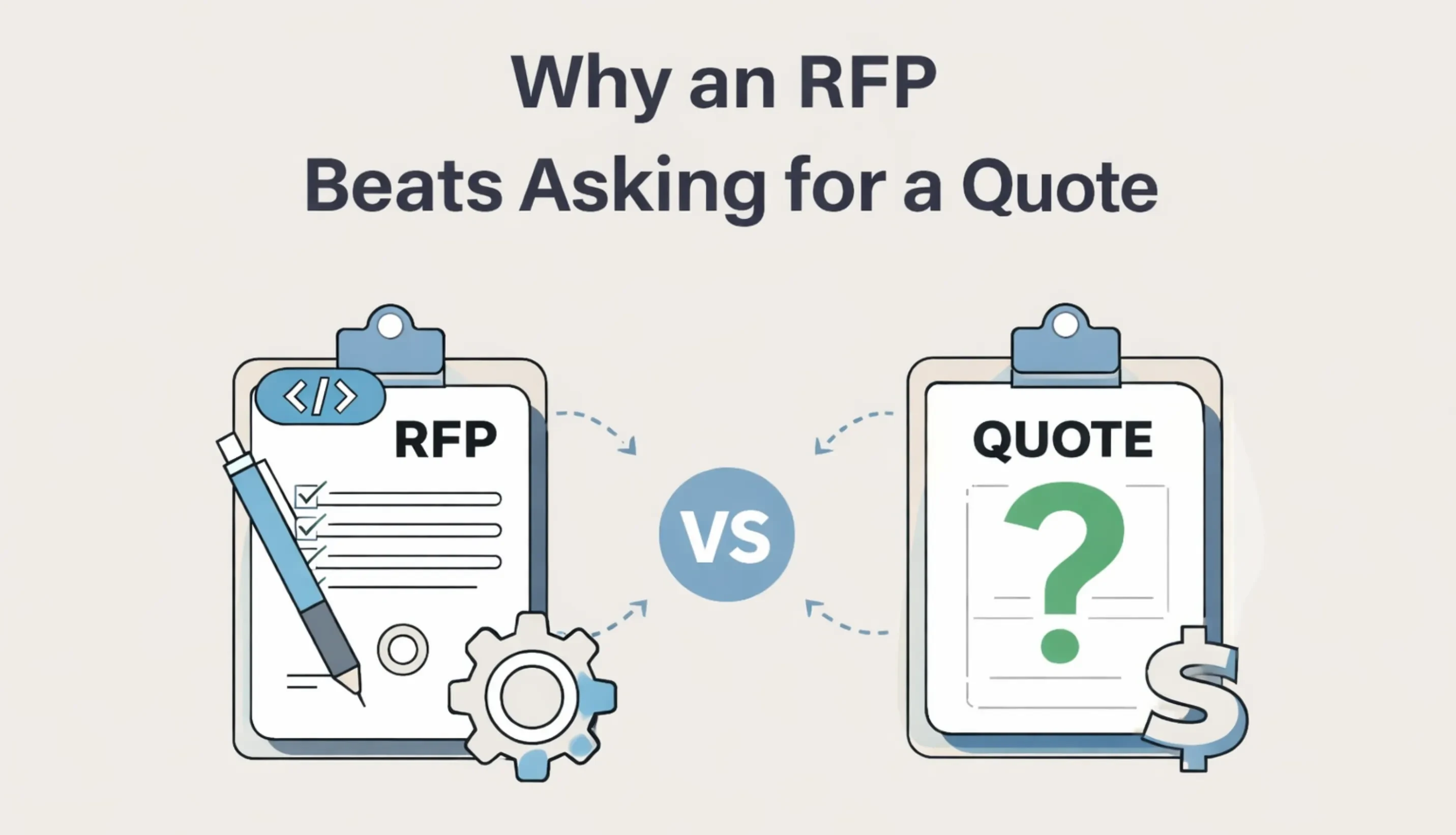
When you ask vendors for 'a quote,' each one interprets your requirements differently. You end up comparing proposals that answer different questions. An RFP gives every vendor the same structured questions, so your evaluation compares answers, not assumptions.
The RFP also forces clarity on your side before you send it. The process of writing good RFP questions surfaces gaps in your own requirements that would have become expensive scope disputes mid-project. For context on what good vendor evaluation looks like after you receive responses, see the complete guide to hiring Python developers.
The right number of vendorsResearch from Loopio's 2026 RFP Trends Report found that top-performing procurement teams achieve win rates of 60% or higher using structured go/no-bid qualification frameworks rather than sending RFPs widely. Four to six pre-qualified Python vendors is the right number. Enough for competitive comparison, small enough to evaluate thoroughly. |
Define These Before You Send the RFP
An RFP is only as useful as the clarity you bring to it. Vendors who receive vague briefs produce vague proposals. Before writing a single question, confirm you have these four things defined.
1. Project type and scope
Is this an API backend, a data pipeline, an ML system, or a SaaS platform? Vendors need to know which Python specialisation is required. A Django generalist and a FastAPI ML engineer are different hires with different rate ranges.
2. Engagement model
Do you need a fixed-price project, a dedicated developer, or staff augmentation? The model determines the contract structure, pricing format, and accountability terms you should be evaluating. If unsure, the IT staff augmentation model at Acquaint Softtech explains when staff augmentation works better than project outsourcing.
3. Budget range
Share a range in the RFP. Vendors who receive no budget guidance either overprice to leave margin or underprice to win and recoup through change orders. A stated range filters out mismatches before they waste your time.
4. Timeline and decision criteria
Tell vendors when proposals are due, when you will shortlist, and how you will score responses. Transparency about evaluation criteria produces better proposals because vendors optimise for what you actually care about.
The Python Development RFP Template: 7 Sections, 50+ Questions
Copy these sections directly into your RFP document. Each section contains the exact questions to send. Adapt the wording to your context but do not remove questions just because they feel uncomfortable to ask. The uncomfortable questions are almost always the most revealing.
Section 1: Company and Team Overview
These questions establish basic credibility and filter out vendors who cannot provide specific, verifiable answers. A vendor who cannot answer Q1.4 concretely has not worked on production Python systems at meaningful scale.
Provide your company name, founding year, team size, and headquarters location.
How many full-time Python developers are currently on your team? Are they employees or contractors?
How many Python-specific projects have you delivered in the last 24 months? Provide a breakdown by framework (Django, FastAPI, Flask, other).
Describe the largest Python system your team has maintained in production. What was the scale (users served, requests per second, data throughput)? What was your team's specific responsibility?
What Python certifications, framework partnerships, or verified third-party ratings does your team hold? Provide Clutch, GoodFirms, or Upwork profile links.
Section 2: Technical Capability and Framework Depth
Generic answers to these questions disqualify a vendor faster than any other section. A Python specialist can name specific libraries, describe architectural trade-offs, and reference real production decisions. A generalist cannot.
Which Python web frameworks does your team use in production? For each framework, provide one case study describing the use case, the scale, and why that framework was chosen over alternatives.
When would you choose FastAPI over Django for a new project, and what conditions would reverse that decision? Provide a specific example where you made this choice.
How does your team handle database migrations in a live Django application with zero downtime? Describe the specific approach you use.
Describe your approach to Python dependency management, virtual environments, and reproducible builds across development and production.
What is your team's approach to async programming in Python? Describe a scenario where you used asyncio or Celery in production and what problem it solved.
For AI or ML projects: describe your MLOps practice. How do you version models, track experiments, and monitor model performance drift in production?
What is your CI/CD pipeline for Python projects? Name the tools you use and describe a specific pipeline configuration from a recent project.
Section 3: Team Assignment and Delivery Structure
This section exists specifically to prevent bait-and-switch. Every question here tests whether the vendor will assign the people they are presenting to you, or different people after the contract is signed.
Who specifically will work on our project daily? Please provide the name, CV, GitHub profile, and a brief description of their most recent Python production project.
Will the same developer who participated in the RFP evaluation process be the developer executing the work? If not, explain the substitution process.
What is your process if the assigned developer becomes unavailable mid-project? Who replaces them, what is the handoff process, and does replacement cost the client anything?
What is the seniority breakdown of the team you are proposing for this project? What percentage of time will senior developers vs junior developers spend on our codebase?
How many other client projects will the assigned developer be working on simultaneously during our engagement?
Section 4: Pricing, Engagement Model, and Contract Terms
Proposals without itemised pricing are impossible to compare fairly and almost always generate change order disputes. Every question here is designed to surface hidden costs and structural misalignments before the contract is signed.
Provide pricing broken down by developer role (junior, mid, senior), phase (discovery, development, testing, deployment), and deliverable. Do not provide a single lump sum.
What is your engagement model? Is pricing fixed-price, time-and-materials, milestone-based, or retainer? If multiple models are available, describe the trade-offs between them.
How are scope changes handled after the contract is signed? Describe the approval process, how change orders are priced, and what constitutes a scope change versus a clarification.
Who owns the intellectual property and code produced during this engagement from the date of creation? Provide the specific clause language you will include in the contract.
What is your NDA process? When does it take effect relative to sharing project requirements?
What are your payment terms and milestone structure? What triggers each payment, and what constitutes acceptance of a milestone?
What is your termination clause? How much notice is required, what handoff obligations apply, and what deliverables must be completed before termination takes effect?
Section 5: Communication, Process, and Project Management
Communication patterns set in week one persist for the entire engagement. This section tests whether the vendor has a defined process or is improvising.
What is your sprint structure for Python development engagements? Describe the cadence, ceremonies, and how your team integrates with an existing client engineering team.
What communication channels and tools do you use? What is your guaranteed response time during agreed working hours?
How do you handle a situation where a sprint deliverable will not be ready on time? At what point do you escalate, and what does the escalation process look like?
What documentation do you produce during development? Describe what is included in your code documentation standard and architectural decision records.
What does your code review process look like? Is it mandatory before merging, who conducts it, and what quality gates are required to pass?
What timezone overlap can you commit to for daily standups and code review windows with our team?
Section 6: Security, Compliance, and Domain Experience
For regulated industries or products handling sensitive data, a vendor without specific compliance experience creates legal and operational risk. These questions surface that gap before it becomes expensive.
Has your team built Python applications for regulated industries (healthcare, fintech, legal, education)? If yes, describe the compliance requirements you implemented and how.
How do you handle personally identifiable information (PII) at the code level in Python applications?
What security standards or frameworks does your team follow during Python development? Describe a specific security review or penetration test from a past project.
Do your standard contracts include data processing agreements (DPAs) for GDPR compliance? If not, are you able to add them?
What is your data breach notification process if a security incident occurs during the engagement?
Section 7: References, Track Record, and Post-Launch Support
Written testimonials are not references. This section specifically requests verifiable, live contact-based evidence of delivery quality from comparable past projects.
Provide two to three case studies from Python development projects comparable in scope and industry to ours. Each case study must include: client name or anonymised description, Python framework used, project scale, your specific role, and measurable outcome.
Can you provide direct contact information for a past client from a project comparable to ours? We will conduct a brief reference call, not a written reference check.
Describe the most complex technical problem your team solved on a recent Python project. What was the problem, what did you try first, and what was the final solution?
What is your policy for post-launch support? Describe what is included in your standard post-delivery support, at what cost, and for how long.
If we want to extend the engagement or scale the team after the initial project, what is your process and typical timeline for adding developers?
How to Score the Responses You Receive
Use a weighted scoring matrix, not gut feel. Define your scores before proposals arrive so you are comparing vendors against fixed criteria, not against each other.
Evaluation Criterion | Weight % | Strong Response | Weak Response | Action if Weak |
Technical depth and Python specificity | 25% | Strong = framework names, scale metrics, production examples | Weak = generic capability claims | Eliminate if vague |
Team quality: named developer + credentials | 20% | Strong = CV provided, independent tech session offered | Weak = 'senior team' with no specifics | Renegotiate if unnamed |
Pricing transparency and model fit | 20% | Strong = breakdown by role, phase, deliverable | Weak = lump sum with no structure | Request itemisation |
Scope change and contract terms | 15% | Strong = written process defined proactively | Weak = 'we are flexible' with no specifics | Walk away if IP unclear |
Communication and process quality | 10% | Strong = specific SLA, cadence, tools named | Weak = 'we communicate well' with no detail | Flag as risk |
References and verifiable track record | 10% | Strong = live reference call offered from comparable project | Weak = written testimonials only | Downgrade shortlist position |
After scoring, shortlist the top two or three vendors for a live technical session. The scoring tells you who is worth your time. The technical session tells you who can actually deliver. The questions for that session are in the guide on questions to ask before hiring Python developers.
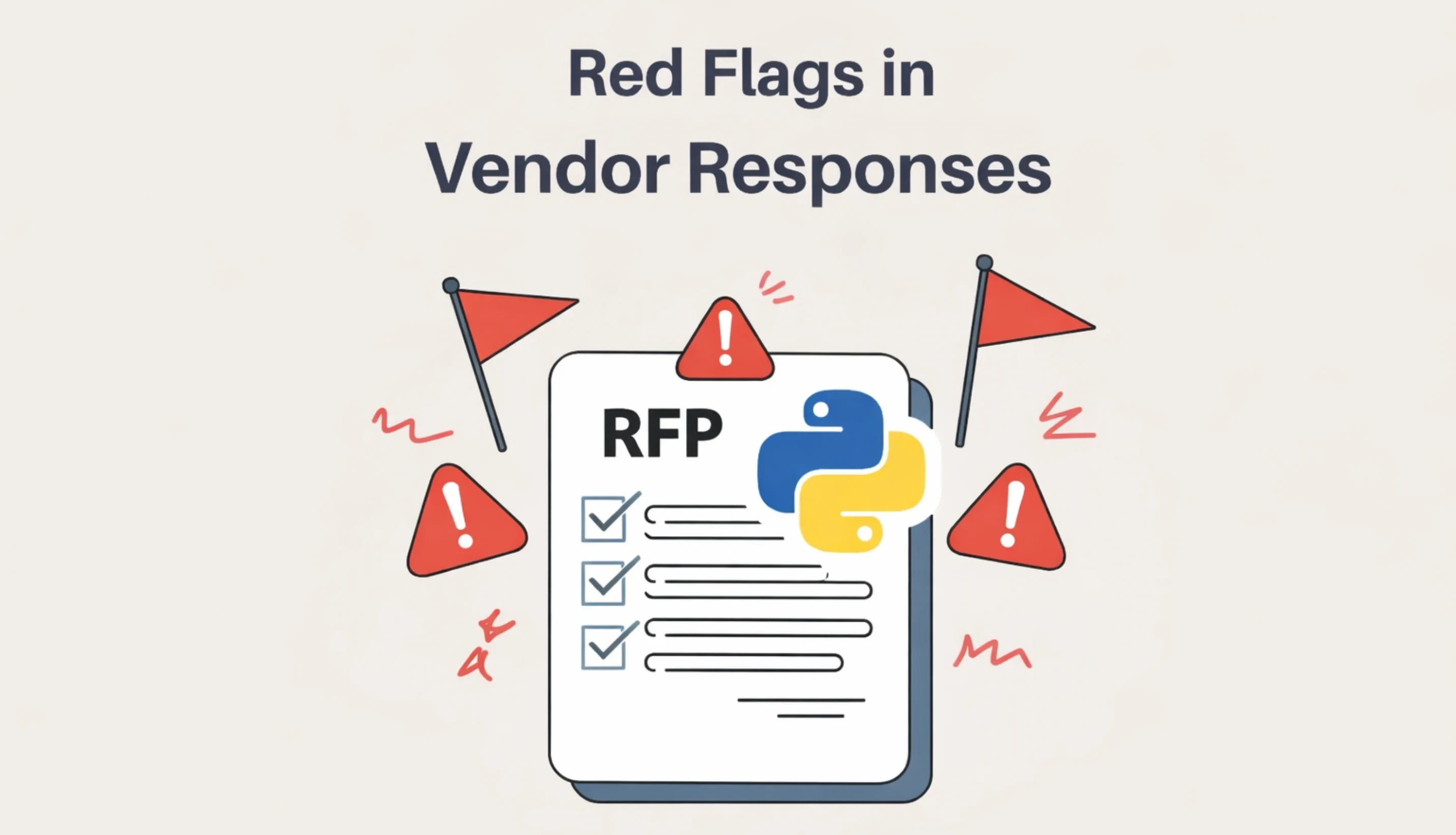
Red Flags in Vendor Responses: What the Proposal Is Actually Telling You
How a vendor responds to your RFP is as informative as what they say. These patterns in proposal responses signal problems that will be more expensive to fix after the contract is signed.
What the Vendor Said in the Proposal | What It Actually Signals |
Vendor confirms every timeline without clarifying questions | They are winning the proposal, not scoping the project |
Proposal does not mention the developer assigned to your project | Bait-and-switch risk is high |
IP ownership is not addressed or deferred to 'standard terms' | You may not own your own code |
Pricing is a single lump sum with no role or phase breakdown | Hidden escalations will follow |
No scope change process described before you asked | Change orders will be expensive and opaque |
Reference contacts provided as written testimonials only | Curated feedback, not verifiable delivery history |
Python framework experience is generic: 'we work with all frameworks' | No depth in the specific stack you need |
Timeline is 30-50% shorter than competitors for identical scope | Underscoping to win, overcharging to deliver |
For a deeper breakdown of the red flags specific to remote Python vendor evaluation, the guide on hiring Python developers remotely and red flags to avoid covers the post-RFP evaluation stage.
What Happens After the RFP: The Shortlisting Process
The RFP narrows your list. It does not make the final decision. After scoring responses, the next steps follow a specific sequence.
Step 1: Score and shortlist
Apply the weighted scoring matrix to every proposal. Eliminate vendors who score below 60 out of 100, or who received a Walk Away rating on any criterion.
Step 2: Clarification round
For shortlisted vendors, send follow-up questions on any RFP response that was incomplete or required interpretation. This tests responsiveness and willingness to provide specifics.
Step 3: Live technical session
Conduct an independent technical session with the specific developer proposed for your project. This session should test live problem-solving, not prepared presentations. The Python development partner evaluation guide covers what to test and how to score the session.
Step 4: Reference call
Call, not email, a past client from a comparable project. Ask specifically how the vendor handled scope changes, what the code quality was like after delivery, and whether they would hire them again.
Step 5: Contract review before signing
Before signing, verify that the contract contains the clauses your RFP required: IP assignment, named resource commitment, scope change process, communication SLA, and termination terms. The full contract checklist is in the Python developer hiring checklist.
What Acquaint Softtech's RFP Response Looks Like
Acquaint Softtech is a Python development and IT staff augmentation company based in Ahmedabad, India, with 1,300+ projects delivered globally. When we receive a structured RFP, here is how we respond to each section.
Company overview:
We provide verified Clutch and Upwork profiles, team size breakdown of 100% in-house developers, and framework-specific project counts from the last 24 months.
Technical capability:
We name the specific frameworks, describe the architectural decision-making process from real projects, and provide GitHub repositories or staging environments for verification where possible.
Team assignment:
We name the specific developer proposed for your project, provide their CV and production history, and include a named-resource clause in every contract. Substitution requires written client approval.
Communication and process :
We provide a written communication SLA with response time commitments, sprint cadence, code review requirements, and escalation process as part of every engagement agreement.
Security and compliance:
Our team has delivered Python projects for healthcare, fintech, and legal industries. We can describe specific compliance implementations including HIPAA data handling, GDPR field-level encryption, and PCI-DSS audit logging.
References:
We connect shortlisted clients directly with past clients on live calls. We do not provide written testimonials as a substitute for live reference conversations.
The Bottom Line: An RFP Is Not Bureaucracy. It Is Risk Management.
Companies that shortlist Python vendors based on quotes are comparing assumptions. Companies that shortlist based on structured RFP responses are comparing evidence.
The template in this guide gives you 50+ Python-specific questions across seven sections that expose bait-and-switch risk, IP ambiguity, scope change misalignment, and communication gaps before any contract is signed. Use it for every Python development vendor evaluation regardless of engagement size.
The full hiring decision framework, from defining requirements through signing a contract, is in the complete guide to hiring Python developers.
Send This RFP to Acquaint Softtech. See What a Structured Response Looks Like.
We respond to every section of a Python development RFP with named developers, production case studies, transparent pricing by role and phase, and a written scope change process. 1,300+ projects delivered. Starting at $20/hr.
Frequently Asked Questions
-
How long should a Python development RFP be?
Long enough to get comparable responses, short enough that good vendors respond. For a mid-complexity Python engagement, a well-structured RFP covering the seven sections in this guide typically runs 4 to 6 pages. Longer than that and response quality drops as vendors write to word count rather than substance. Shorter than that and you will receive proposals that are not comparable.
-
Should I share my budget in the RFP?
Yes. Sharing a budget range produces more useful proposals. Vendors who know your ceiling will propose the best solution within it rather than over-engineering to maximise revenue or under-delivering to minimise cost. A range like $40,000 to $70,000 sets boundaries without locking you into a number. Vendors who cannot work within that range will self-select out, saving everyone time.
-
How many vendors should I send the RFP to?
Four to six pre-qualified vendors is the right number. Pre-qualify by applying a simple filter before sending the RFP: verified Clutch or GoodFirms profile, at least 15 reviews, evidence of Python-specific production work in a comparable industry.
-
How long should I give vendors to respond to the RFP?
Two to three weeks for a mid-complexity Python development RFP. Vendors who respond in under 48 hours to a detailed RFP are either reusing a generic proposal template or have not thought carefully about your specific requirements. Both are signals worth noting.
-
What if a vendor refuses to answer some RFP questions?
Selective non-response is itself a response. A Python vendor who declines to name the assigned developer, refuses to specify IP ownership in writing, or says scope change pricing will be discussed after contract signature is telling you exactly how the engagement will be managed.
-
Should I use the same RFP for staff augmentation and project outsourcing?
No. Staff augmentation and project outsourcing require different questions and different evaluation criteria. For staff augmentation, Section 3 (team assignment) is the most critical because you need to verify the specific developer's capability.
We’re Acquaint Softtech, your technology growth partner. Whether you're building a SaaS product, modernizing enterprise software, or hiring vetted remote developers, we’re built for flexibility and speed. Our official partnerships with Laravel, Statamic, and Bagisto reflect our commitment to excellence, not limitation. We work across stacks, time zones, and industries to bring your tech vision to life.
Table of Contents
Get Started with Acquaint Softtech
- 13+ Years Delivering Software Excellence
- 1300+ Projects Delivered With Precision
- Official Laravel & Laravel News Partner
- Official Statamic Partner
Related Blog

When Is Python Development Too Expensive? Pricing Red Flags That Signal a Bad Vendor
Not all expensive Python development is justified. This guide identifies the exact pricing red flags that signal a bad vendor, with real benchmarks, warning signs, and what fair Python pricing actually looks like in 2026.
Acquaint Softtech
March 26, 2026
How to Hire Python Developers Without Getting Burned: A Practical Checklist
Avoid costly hiring mistakes with this practical checklist on how to hire Python developers in 2026. Compare rates, vetting steps, engagement models, red flags, and more.
Acquaint Softtech
March 30, 2026
Total Cost of Ownership in Python Development Projects: The Full Financial Picture
The build cost is just the beginning. This guide breaks down the complete TCO of Python development projects across every lifecycle phase, with real benchmarks, a calculation framework, and 2026 data.
Acquaint Softtech
March 23, 2026India (Head Office)
203/204, Shapath-II, Near Silver Leaf Hotel, Opp. Rajpath Club, SG Highway, Ahmedabad-380054, Gujarat
USA
7838 Camino Cielo St, Highland, CA 92346
UK
The Powerhouse, 21 Woodthorpe Road, Ashford, England, TW15 2RP
New Zealand
42 Exler Place, Avondale, Auckland 0600, New Zealand
Canada
141 Skyview Bay NE , Calgary, Alberta, T3N 2K6
Your Project. Our Expertise. Let’s Connect.
Get in touch with our team to discuss your goals and start your journey with vetted developers in 48 hours.