

Rewrite vs Refactor When Should You Rewrite vs Refactor Your Python Application?
When to rewrite versus refactor your Python application in 2026. The decision framework with real cost ranges, criteria, and why big-bang rewrites fail.

Acquaint Softtech
Introduction: The Decision Every Scaling Python Team Eventually Faces
Every Python application that has been in production long enough reaches the same moment. The codebase that ships features in weeks now takes months. Engineers who join the team need quarters to become productive. Bug fixes in one place break things in another. The senior engineer who held the architecture in their head has left. Tests are slow, flaky, or missing. The team gathers in a room and somebody finally says it: maybe we should just rewrite this thing. The temptation is real, the frustration is justified, and the decision that follows is one of the most consequential a software organization can make. Get it right and the application becomes shippable and maintainable again. Get it wrong, and the rewrite project that was supposed to fix everything becomes the project that nearly killed the company. This guide is about how to make this decision deliberately rather than emotionally.
The foundational warning on this decision is old enough to vote and still applies. In his April 2000 essay Things You Should Never Do, Part I, Joel Spolsky called the decision to rewrite code from scratch the single worst strategic mistake that any software company can make, using Netscape as the cautionary tale: their decision to rewrite the browser from version 4.0 to version 6.0 produced a three-year delay between releases during which their market share collapsed. The argument turned on two points that have aged exceptionally well: the crufty-looking parts of any production codebase often embed hard-earned knowledge about corner cases, weird bugs, and customer-specific behavior that the new codebase has to rediscover painfully, and the complete rewrite is a multi-year distraction from improving the existing product, which hands competitive advantage to anyone shipping incrementally. Twenty-six years later, the warning still applies more often than not.
This guide covers when you should refactor your Python application (almost always), when a rewrite is genuinely the right answer (rarely, but it does happen), how to use the strangler fig pattern as the middle path that handles most situations Spolsky did not anticipate, and how to staff the work without the multi-year project that became the cautionary tale. It is written for engineering leaders, CTOs, and senior Python developers staring at a codebase that needs to change and trying to decide how much change is the right amount.
If you are also building the team that will execute the refactor or rewrite, the complete guide to hiring Python developers in 2026 sets the wider context. Both refactor and rewrite work specifically require senior engineers who can read the existing code accurately before changing it, which is a profile meaningfully more senior than greenfield Python development.
The Critical Distinction: Refactor vs Rewrite
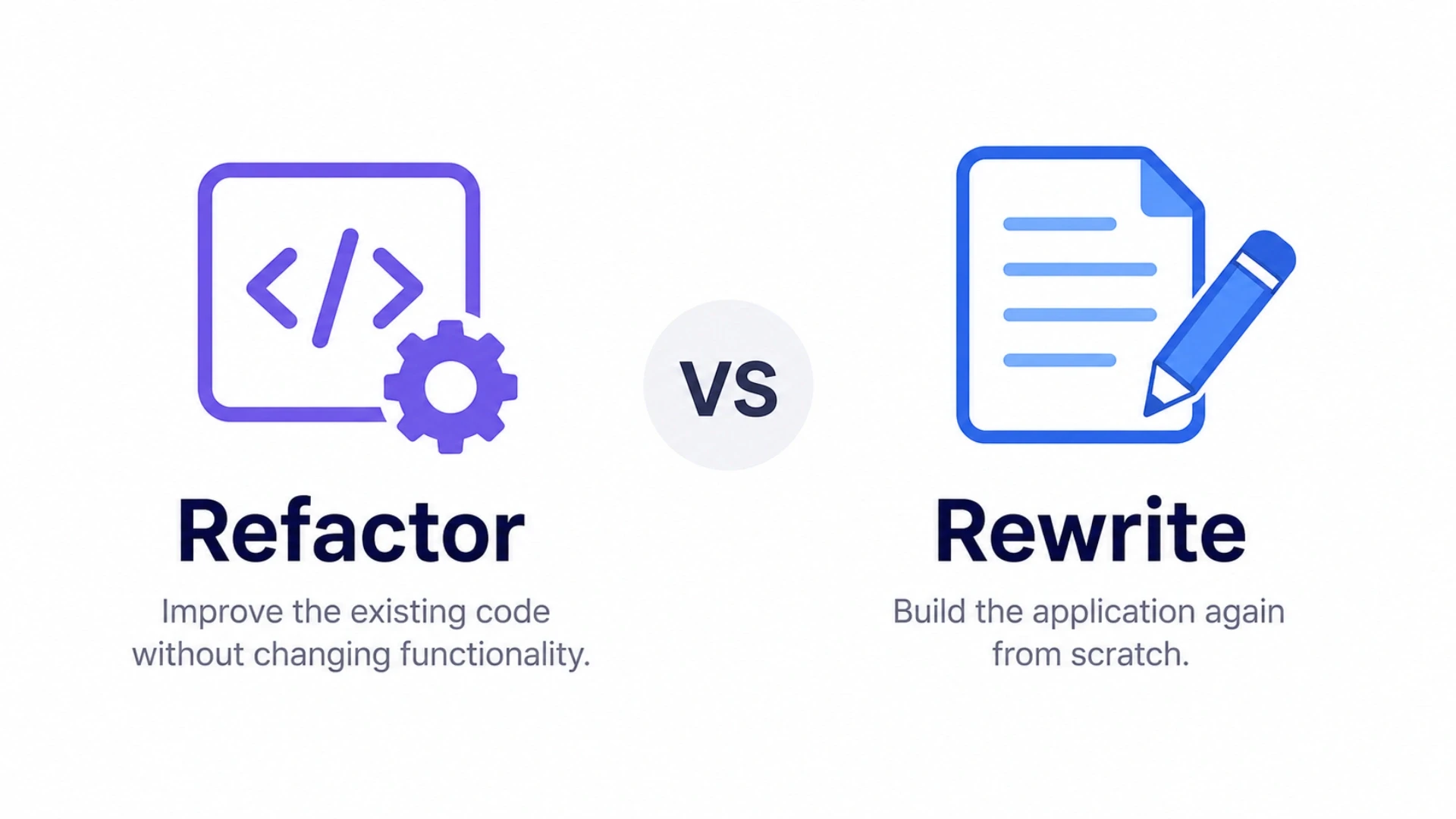
Engineers and managers often use the words refactor and rewrite interchangeably, which is the source of considerable downstream confusion in planning meetings. They are not the same thing. They have different costs, different timelines, different risks, and they fit different situations. Getting the distinction clear before the decision is made is the first step in making it well.
Refactor vs Rewrite, Side by Side
Dimension | Refactor | Rewrite |
|---|---|---|
What changes | Code structure | Code and (often) architecture |
What stays the same | External behavior | Possibly nothing |
Typical duration | Weeks to months | Months to years |
Typical cost (Python app) | $10K to $100K | $100K to several million |
Risk profile | Lower, incremental | Higher, multi-quarter bet |
Feature delivery | Continues throughout | Often pauses or slows |
Embedded knowledge | Preserved | Must be rediscovered |
When it fits | Almost always | Rarely, but does exist |
Refactoring: What It Actually Is
Refactoring is improving the internal structure of code without changing its external behavior. The application does exactly the same things from the outside; the code that does them is cleaner, more readable, more testable, and easier to extend. Refactoring is incremental, low-risk, and reversible at every step. It runs in parallel with feature delivery, not as an alternative to it. Refactoring is the cheapest, lowest-risk way to address technical debt in any codebase that is still functioning, and for the overwhelming majority of cases where a team is considering a rewrite, the right answer is a disciplined refactoring program instead.
Rewriting: What It Actually Is
Rewriting is starting over with the explicit intention of building a new codebase that replaces the old one. Architecture can change. Frameworks can change. The data model can change. The application's external behavior is intentionally not the constraint, because if it were, you would refactor. Rewriting is months to years of work where, for most of that time, the old system continues to operate while the new one is built. It is multi-quarter capital deployment with no business value delivered until cutover, and a real possibility that the cutover never happens cleanly. It is sometimes the right answer. It is almost never the cheap, fast answer the team thinks it will be.
When to Refactor (and Why It Wins Almost Every Time)
Refactoring is the default answer for the situation most teams find themselves in. The application works, customers use it, revenue depends on it, but the team is increasingly slowed down by the code's accumulated debt. This is the situation refactoring was invented for, and the patterns that make it work are well documented across decades of practice.
Refactor When...
The application still does what it should. Customers use it. Revenue depends on it. The functionality is roughly the right functionality, even if the code that delivers it is messy. Refactoring preserves the working business logic while cleaning up the structure around it.
You can write tests around current behavior. Characterization tests that capture exactly what the existing code does, including its quirks, are the safety net that makes refactoring safe. Without this, refactoring is just rewriting at higher risk.
The pain is structural, not architectural. Long methods, tight coupling, duplicated code, missing abstractions, unclear naming. These are exactly what refactoring addresses well. SOLID principles, design patterns, and clean code techniques have decades of practice behind them.
You need to keep shipping features. Refactoring runs in parallel with feature work. Every time you touch a piece of code, leave it slightly better than you found it. Over months, this compounds into a dramatically cleaner codebase without ever halting delivery.
The team's frustration is real but bounded. People are unhappy with specific pain points (slow tests, brittle modules, the part of the codebase nobody wants to touch). They are not unhappy with the entire architecture or the framework choice.
Why Refactor Wins Almost Every Time
It preserves embedded knowledge. The crufty-looking parts of your codebase often embed hard-earned knowledge about corner cases and weird bugs. Refactoring reorganizes that knowledge into cleaner forms; rewriting throws it away and forces the team to rediscover it under deadline pressure.
Risk is bounded per change. Each refactoring step is small, reversible, and verifiable through tests. The blast radius of a mistake is small. Big-bang rewrites have no such property: a mistake in the new system can stall the entire migration.
Value is delivered continuously. Each refactored module is shipped to production immediately and contributes to delivery velocity. Rewrites deliver no business value until cutover, which is months or years away and may never arrive cleanly.
Team learning is incremental. Engineers learn the codebase deeply by refactoring it. Rewrites concentrate the learning into the first few months and then make the team execute on assumptions that may not survive contact with production traffic.
This pattern is consistent with the broader architectural lessons from production Python systems. The backend architecture lessons from real Python case studies walks through how Instagram, Spotify, Netflix, and other production Python teams improved their systems through years of incremental architectural evolution rather than big-bang rewrites, with the modular monolith pattern as the consensus default when refactoring rather than rewriting is the goal.
Considering a Python Rewrite But Not Sure It Is the Right Call?
Acquaint Softtech has guided Python teams through the rewrite-versus-refactor decision across SaaS, FinTech, healthcare, and enterprise platforms. Our first deliverable on a modernization engagement is an honest assessment of which approach actually fits your situation, with the discipline to recommend refactoring when that is the right call, even when it earns us less revenue than a rewrite would.
When a Rewrite Is Actually the Right Answer
Even with Spolsky's warning still echoing across the industry, there are situations where a rewrite is genuinely the right answer. According to a 2026 legacy code modernization guide by Augment Code, Joel Spolsky's rewrite warning remains a common reference point for why big-bang rewrites lose embedded knowledge and stall delivery, and the same guide identifies the discipline that makes the rare justified rewrite work: lock current behavior with characterization tests before changing anything, map system dependencies before designing replacements (system mapping is often the first scaling bottleneck on large codebases), and prepare rollback mechanics before writing a single line of replacement code. Legacy refactors and rewrites alike fail when teams attempt them from scratch without these foundations.
Rewrite Is Defensible When...
When a Python Rewrite Is Genuinely the Right Answer
Trigger | Why Refactor Cannot Solve It | Examples |
|---|---|---|
Foundational tech is end-of-life | Cannot refactor away from the platform itself | Python 2 EOL, deprecated framework |
Wrong fundamental architecture | The structure itself is the problem | Synchronous app that must be async |
Product strategy has changed | New product needs different system | B2C app becoming B2B platform |
Codebase is genuinely abandoned | Nobody understands it, no tests exist | Inherited code, original team gone |
Small application (under 20K LOC) | Rewrite is faster than refactor archaeology | Internal tool, prototype scaled too far |
Compliance requirements changed | Existing architecture cannot retrofit | HIPAA, PCI-DSS, SOC 2 new requirements |
The Conditions That Make a Rewrite Survivable
You can keep the old system running for the duration. If the existing system collapses before the rewrite finishes, the rewrite has effectively failed. Plan for the old system to be maintained, patched, and running for the entire multi-quarter rewrite timeline, including the months after the planned cutover when issues surface.
You have engineering capacity to operate two systems. The team needs to maintain the old codebase, build the new one, run both in parallel during transition, and manage data sync between them. This requires roughly 1.5 to 2 times the engineering capacity that just running the old system needs. Without that capacity, the rewrite stalls.
You can survive 18 to 36 months of slower competitive velocity. During a rewrite, the team's velocity on new product features slows significantly. If your market is moving fast and competitors are shipping, that velocity dip can lose customers faster than the rewrite delivers benefits. Netscape's rewrite cost them their market.
You have characterization tests for the legacy system. Without tests that capture exactly what the legacy system does, the rewrite has no reference for correctness. Behavior will drift, bugs will surface in production months in, and the team will spend the second half of the project rediscovering the legacy system's logic.
Leadership commits to the multi-year horizon. Rewrites that get cancelled at month 9 or 14 are pure waste. The decision to rewrite must come with multi-year executive commitment that survives changes in leadership, budget pressure, and the inevitable mid-project moments when progress looks slow.
The same logic applies across legacy modernization decisions in other stacks, and the same disciplines (characterization tests, incremental delivery, parallel operation, rollback readiness) translate directly. For comparison with how the decision plays out in another major framework upgrade scenario, the analysis on Laravel application modernization walks through the same refactor-versus-rewrite framework applied to PHP and Laravel codebases.
The Middle Path: Strangler Fig and Incremental Replacement
Spolsky's original essay framed the choice as binary: refactor or rewrite, no middle ground. Two decades of practice have produced a third option that Spolsky did not consider in 2000, and that handles most situations where teams feel that pure refactoring is not enough but a big-bang rewrite is too risky. It is the strangler fig pattern, named after the fig tree that grows around its host until the original is gradually replaced.
How Strangler Fig Splits the Difference
Build the new system alongside the old, not instead of it. Introduce a routing layer (façade) between users and the existing application. Build new functionality in the new system. Migrate existing functionality piece by piece. The old system shrinks while the new system grows.
Each migrated piece is independently shippable and reversible. Migrate authentication, then notifications, then reporting, then search. Each migration delivers value when it ships and can be rolled back to the legacy system if something goes wrong. This is the property big-bang rewrites lack.
Feature delivery continues throughout. New features land in the new system. Existing features remain available in the legacy system until they are migrated. The business never has the multi-quarter blackout that pure rewrites impose, which is what gets rewrites approved by leadership in the first place.
Embedded knowledge is preserved during migration. By migrating piece by piece, the team has the opportunity to understand exactly what each legacy component does before replacing it. The hard-earned knowledge that big-bang rewrites lose is captured during the migration of each component.
Active decommissioning is non-optional. Strangler fig only works if migrated functionality is actively removed from the legacy system as it moves to the new one. Without enforced decommissioning, both systems grow indefinitely, producing the worst possible outcome: two codebases to maintain forever.
When Strangler Fig Is the Right Middle Path
The strangler fig pattern is the right answer when the codebase is large enough that pure refactoring cannot move it fast enough (typically 100,000+ lines), but the application is too business-critical and too widely used to risk a big-bang rewrite. It is also the right answer when only specific parts of the application need fundamental change while others are fine as they are, which is a far more common situation than the all-or-nothing framing suggests. Most enterprise Python modernization in 2026 ends up using strangler fig patterns somewhere, because pure refactor and pure rewrite both leave important options on the table.
The architectural foundation that makes strangler fig migrations work, including how to design the routing façade, the new services, and the data synchronization between old and new, is covered in detail in the analysis on how to build a scalable Python backend , which walks through the patterns that support both new Python applications and the modernized targets of strangler fig migrations.
How Acquaint Softtech Approaches the Rewrite-Versus-Refactor Decision

Acquaint Softtech is a Python development and IT staff augmentation company based in Ahmedabad, India, with 1,300+ Python projects delivered globally, including many engagements that began as proposed rewrites and ended (more profitably for the client) as disciplined refactoring programs or strangler fig migrations. Our approach follows the framework in the complete guide to hiring Python developers, with senior Python engineers who can read existing code accurately, write characterization tests, and execute the refactor, rewrite, or strangler fig path that actually fits the situation.
Honest assessment first, always. Our first deliverable on a modernization engagement is an honest evaluation of refactor versus rewrite versus strangler fig. We have told clients to refactor when refactor was the right call, even though rewrite engagements pay us more. The cheapest rewrite is the one you do not need to do.
Characterization testing as a foundation. Whichever path is chosen, the first phase is locking current behavior with characterization tests. This is the single most reliable predictor of modernization success, and the discipline that makes the difference between a clean migration and a project that ships subtle bugs into production for months.
Senior engineers fluent in both modernization paths. Refactoring requires engineers who can read messy code well and improve it incrementally. Rewriting requires engineers who can extract intent from legacy code and rebuild it correctly. Strangler fig requires both. Our engagement teams are staffed with engineers experienced across these patterns.
Transparent pricing from $20/hour. Dedicated Python engineering teams from $3,200/month per engineer, roughly 40% less than equivalent US in-house hiring, with full IP assignment and NDA from day one and a free replacement guarantee on dedicated engagements.
The engagement model matters specifically for modernization work, where continuity across the multi-quarter timeline determines whether the project survives team transitions. The analysis on Python staff augmentation vs dedicated team vs outsourcing walks through which model fits refactor, rewrite, and strangler fig work specifically, and why dedicated teams almost always outperform other models for these multi-quarter engagements.
To get senior Python engineers with modernization experience onto your refactor-versus-rewrite assessment quickly, you can hire Python developers with profiles shared in 24 hours and a defined onboarding plan within 48.
The Bottom Line
Joel Spolsky's 2000 warning still applies in 2026: rewriting a functioning Python application from scratch is almost always the wrong answer. The crufty-looking code embeds hard-earned knowledge about corner cases that the new system will have to rediscover painfully. The multi-year rewrite hands competitive advantage to anyone shipping incrementally. The team's emotional frustration with messy code is real but is not the same as a business case for starting over. Refactor, almost always. It runs in parallel with feature delivery, preserves embedded knowledge, bounds risk per change, and compounds into a dramatically cleaner codebase over months without ever halting the business.
Rewrite only in the specific situations where it is defensible: foundational technology is end-of-life, the fundamental architecture is wrong for what the application needs to be, product strategy has changed, the codebase is genuinely abandoned, the application is small enough that rewrite is faster than archaeology, or compliance has changed in ways the existing architecture cannot accommodate. When rewrite is the right call, survive it by keeping the old system running, sizing the team for the parallel-operation cost, writing characterization tests before changing anything, and securing multi-year executive commitment. Most situations that look like rewrite candidates are better served by strangler fig, which preserves the old system while incrementally replacing it. Choose the path deliberately rather than emotionally, staff it with engineers who can read existing code accurately, and the modernization delivers what the business needs without the multi-year project that became the cautionary tale.
Need an Honest Refactor-vs-Rewrite Assessment for Your Python App?
Book a free 30-minute modernization assessment. Tell us about your Python codebase, the pain points your team is feeling, and the pressure driving the conversation, and we will give you an honest answer: whether to refactor, whether to rewrite, whether to apply strangler fig somewhere, and what the realistic cost and timeline are for each path. No sales pitch. Just senior engineers who have executed all three and know how to read the situation.
Frequently Asked Questions
-
Should I rewrite or refactor my Python application?
Refactor in almost all cases. Joel Spolsky's foundational warning from 2000 still applies in 2026: rewriting is the single worst strategic mistake most software companies make, because crufty-looking code embeds hard-earned knowledge and rewrites are multi-year distractions that hand competitive advantage to whoever ships incrementally.
-
What is the difference between refactoring and rewriting?
Refactoring improves the internal structure of code without changing its external behavior. The application does exactly the same things from outside; the code is cleaner. Refactoring is incremental, low-risk, runs in parallel with features, and preserves embedded knowledge. Rewriting starts over with the explicit intention of building a new codebase that replaces the old one. Architecture, frameworks, and data models can all change. Rewriting is months to years of multi-quarter capital deployment with no business value until cutover, and a real possibility that cutover never happens cleanly.
-
How much does rewriting versus refactoring a Python application cost?
A refactoring program on a typical Python application runs $10,000 to $100,000 depending on codebase size and team configuration, delivered as ongoing work that runs in parallel with feature delivery rather than as a discrete project. A rewrite runs $100,000 to several million dollars depending on application size, complexity, and team location, delivered as a multi-quarter project with no business value until cutover. The cost difference reflects the risk and timeline difference: refactoring is incremental delivery, rewriting is a multi-year capital deployment.
-
When is a rewrite actually the right answer?
Six situations make a rewrite defensible. Foundational technology is end-of-life (Python 2, deprecated frameworks). The fundamental architecture is wrong for the current and future needs (synchronous app that must be async, monolith that must serve distinct tenants). Product strategy has changed enough that the existing system is solving the wrong problem
-
What is the strangler fig pattern and when does it fit?
Strangler fig is the middle path Spolsky did not consider in 2000. Introduce a routing façade between users and the existing application, build new functionality in a new system, and migrate existing functionality piece by piece while feature delivery continues. Each migrated piece is independently shippable and reversible. It fits when the codebase is too large for pure refactoring to move it fast enough (100,000+ lines) but too business-critical to risk a big-bang rewrite. Most enterprise Python modernization in 2026 ends up using strangler fig patterns somewhere, because pure refactor and pure rewrite both leave important options on the table.
-
What conditions make a rewrite survivable when it is the right call?
Five conditions that distinguish survivable rewrites from disasters. You can keep the old system running for 18 to 36 months including the months after planned cutover when issues surface. You have roughly 1.5 to 2 times the engineering capacity needed to operate the old system, because the rewrite team must maintain both systems and the migration between them. You can survive 18 to 36 months of slower competitive velocity, which is what cost Netscape its market. You have characterization tests for the legacy system before starting. And leadership commits to the multi-year horizon, surviving changes in leadership and budget pressure.
We’re Acquaint Softtech, your technology growth partner. Whether you're building a SaaS product, modernizing enterprise software, or hiring vetted remote developers, we’re built for flexibility and speed. Our official partnerships with Laravel, Statamic, and Bagisto reflect our commitment to excellence, not limitation. We work across stacks, time zones, and industries to bring your tech vision to life.
Table of Contents
Get Started with Acquaint Softtech
- 13+ Years Delivering Software Excellence
- 1300+ Projects Delivered With Precision
- Official Laravel & Laravel News Partner
- Official Statamic Partner
Related Blog
How to Hire Python Developers Without Getting Burned: A Practical Checklist
Avoid costly hiring mistakes with this practical checklist on how to hire Python developers in 2026. Compare rates, vetting steps, engagement models, red flags, and more.
Acquaint Softtech
March 30, 2026
Total Cost of Ownership in Python Development Projects: The Full Financial Picture
The build cost is just the beginning. This guide breaks down the complete TCO of Python development projects across every lifecycle phase, with real benchmarks, a calculation framework, and 2026 data.
Acquaint Softtech
March 23, 2026
Python Developer Hourly Rate: What You're Actually Paying For
Python developer rates range $20-$150+/hr in 2026. See what experience, specialisation & hidden costs actually determine the price. Save 40% with vetted offshore talent.
Acquaint Softtech
March 9, 2026India (Head Office)
203/204, Shapath-II, Near Silver Leaf Hotel, Opp. Rajpath Club, SG Highway, Ahmedabad-380054, Gujarat
USA
7838 Camino Cielo St, Highland, CA 92346
UK
The Powerhouse, 21 Woodthorpe Road, Ashford, England, TW15 2RP
New Zealand
42 Exler Place, Avondale, Auckland 0600, New Zealand
Canada
141 Skyview Bay NE , Calgary, Alberta, T3N 2K6
Your Project. Our Expertise. Let’s Connect.
Get in touch with our team to discuss your goals and start your journey with vetted developers in 48 hours.