

SLAs in Python Development Contracts: What Must Be Included to Protect Your Project
Most Python development contracts have no SLA. That is where projects go wrong. This guide covers 8 non-negotiable SLA clauses, priority tier definitions, breach remedies, and the exact language to demand before signing.

Acquaint Softtech
Who This Guide Is For
This is for CTOs, product managers, and founders who are reviewing or about to sign a Python development contract and have never seen a proper SLA section in one.
It is also for teams who have already experienced a vendor disappearing mid-sprint, delivering late without warning, or producing code nobody else can maintain, and want to know what contract language would have prevented it. If you are still in the vendor selection phase, start with the complete guide to hiring Python developers first.
The Problem: Most Python Contracts Have No SLA
The standard Python development contract covers deliverables, payment, and IP. It rarely says anything specific about how fast the vendor must respond to a blocker, what happens when a sprint deliverable is missed, or who is responsible when a production bug goes unfixed for three days.
According to AWS's definition of SLAs, a service level agreement is a contract that outlines a level of service a supplier promises to deliver, with defined metrics and consequences for failure. Without one, you have a contract that describes what will be built but says nothing about how reliably or responsively.
That gap is where most Python outsourcing failures happen. Not because the code was bad, but because the vendor's accountability window was undefined.
The real cost of a missing SLAOrganizations using structured KPI tracking in development engagements are 2.5x more likely to deliver projects on time and within budget. Downtime alone costs enterprises $300,000 to $400,000 per hour. A vague contract produces vague accountability. A contract with specific SLA language produces specific behaviour. |
What an SLA Covers in a Python Development Engagement
An SLA in a software context is not the same as an uptime guarantee. For Python development, it covers four things: how fast the vendor responds, how quickly issues get resolved, what quality standards apply during delivery, and what happens when any of those commitments are missed.
The challenge specific to Python development outsourcing is that many clients do not know these terms exist or that they can negotiate them. Vendors who omit SLA language from their standard contracts are not always being deceptive. They are often relying on the client not asking.
This guide gives you the exact clauses to ask for. It builds on the Python vendor evaluation checklist and adds the contractual layer that protects you after the vendor is selected.
8 Non-Negotiable SLA Clauses for Python Development Contracts
These eight clauses must appear in any Python development contract you sign, whether it is a staff augmentation engagement, a dedicated team arrangement, or a fixed-price outsourcing project. Adapt the specific metrics to your project's requirements, but do not remove any clause entirely.
Clause 1: Communication Response Time SLA
Why it matters: A vendor who takes three days to respond to a question about a blocked sprint has effectively paused your project. Without a written response time, you have no standing to escalate or enforce anything.
What to write: Define maximum response times by channel and working hours. Specify what happens if the response time is breached (escalation contact, written acknowledgement required).
Example language: "The vendor will acknowledge all messages sent via the designated project channel within 4 hours during agreed working hours (9am–6pm, Monday–Friday in IST). For production incidents classified as P1 or P2, response must occur within 30 minutes regardless of working hours."
Clause 2: Standup and Sprint Ceremony Commitment
Why it matters: A vendor who confirms sprint participation verbally and then skips standups without notice is providing a level of service that has no consequences unless your contract defines the expectation.
What to write: Name the ceremonies (daily standup, sprint planning, sprint review), the agreed timezone, and the maximum number of unannounced absences before a formal escalation is triggered.
Example language: "The assigned developer will attend daily standups at [agreed time] in [timezone] with no more than two unexcused absences per month. Absence notice must be provided at least 2 hours in advance. Three consecutive unexcused absences trigger a formal review under Clause 7 (Breach Remedies)."
Clause 3: Code Quality and Review Standards
Why it matters: Delivered code that works but is undocumented, untested, and unmaintainable costs you in every sprint that follows. A quality standard clause sets a floor that the vendor is accountable to.
What to write: Specify minimum test coverage (commonly 70% on critical paths), mandatory docstrings on non-trivial functions, peer review before merge, and what happens if a code audit reveals below-standard delivery.
Example language: "All Python code delivered under this engagement must meet the following standards: minimum 70% unit test coverage on API endpoints and business logic, docstrings on all functions exceeding 10 lines, peer review approved by at least one senior developer before merging to main. Client may request an independent code audit at any sprint boundary."
Clause 4: Bug Fix Priority and Resolution Time SLA
Why it matters: Without a defined bug severity framework, every bug is treated as medium priority. A production crash sits in the same queue as a cosmetic UI issue. That costs you more than just time.
What to write: Define four priority tiers (P1 through P4) with specific response and resolution time commitments for each. Include an escalation path for P1 and P2 issues that bypasses normal sprint planning.
Example language: "P1 bugs (production system down, data loss risk): response within 30 minutes, resolution target within 4 hours. P2 bugs (core feature broken, workaround unavailable): response within 2 hours, resolution target within 8 hours. P3 and P4 bugs follow standard sprint prioritisation with confirmation within 24 hours."
Clause 5: Named Developer and Substitution SLA
Why it matters: Bait-and-switch is the most common complaint in Python development outsourcing. The senior developer who was in the pitch presentation has no contractual obligation to do the work unless your contract says so.
What to write: Name the specific developer. Define approval rights for substitution. Set a maximum handover period if substitution is approved.
Example language: "Developer [Name] is designated as the primary resource for this engagement. Any substitution requires written client approval a minimum of 5 business days in advance. In the case of unplanned departure (illness, resignation), the vendor must notify the client within 24 hours and propose an equivalent replacement within 5 business days, including CV and reference."
Clause 6: Proactive Blocker Escalation SLA
Why it matters: The most expensive project failures are caused by blockers that were known for weeks before they affected a deadline. A vendor who absorbs problems silently until the delivery date is optimising for their short-term convenience at your long-term cost.
What to write: Define when a developer must escalate a blocker, not when the deadline is missed, but when the risk is first identified. Specify the escalation format and the client's right to replan based on early disclosure.
Example language: "The developer will surface any risk to sprint delivery within 24 hours of identifying it. Risk disclosure must include: the nature of the blocker, what has been attempted, estimated impact on delivery timeline, and proposed resolution options. Late disclosure of a known blocker that causes a missed sprint deadline is a breach of this SLA."
Clause 7: Knowledge Transfer and Documentation SLA
Why it matters: When an engagement ends or a developer departs, the knowledge locked in their head is your technical debt. A documentation SLA converts that implicit knowledge into an asset your team can use.
What to write: Specify what documentation must be produced (architecture decision records, API documentation, deployment runbook, known issues list), at what frequency during the engagement, and what constitutes acceptable completion at handoff.
Example language: "The vendor will maintain a project wiki updated at minimum every two weeks, covering: architecture decisions and their rationale, known technical constraints, third-party integrations and credentials inventory, and open issues with current status. At engagement end, a formal handoff session of no less than 2 hours is required with client's designated technical lead."
Clause 8: SLA Breach Remedies and Consequences
Why it matters: An SLA without a consequence is a suggestion. If the vendor misses communication response times, skips standups, or delivers below-quality code with no defined outcome, there is no financial or contractual incentive to change the behaviour.
What to write: Define what constitutes a breach, what the remedy is (service credit, sprint rollover, sprint payment hold), and at what threshold a pattern of breaches triggers the right to terminate without penalty.
Example language: "A breach of any SLA metric three or more times within a single calendar month entitles the client to a 10% service credit on that month's invoice. Five or more breaches in any 30-day period entitle the client to terminate the engagement with 7 days' notice and no early termination penalty, with full handoff obligations applying."
The Priority Tier Framework: What to Put in Your SLA
Copy this framework directly into your contract's SLA section. Adapt the time commitments to your project's criticality. A consumer-facing SaaS product requires tighter P1 response than an internal analytics tool.
Priority | Definition | Response Time | Resolution Time | Escalation Path |
P1 Critical | Production system down, data loss risk, security breach | 15-30 minutes | 2-4 hours | Full team, vendor escalation |
P2 High | Core feature broken, significant performance degradation | 1-2 hours | 8 hours | Senior developer + PM |
P3 Medium | Non-critical feature broken, workaround exists | 4-8 hours | 48 hours | Assigned developer |
P4 Low | Minor UI issues, cosmetic bugs, feature requests | 24-48 hours | Next sprint | Backlog + standard queue |
The most important row in this tableP1 is the one that costs you the most when undefined. A production Python API serving 50,000 daily users going down costs tens of thousands per hour. A vendor who has no defined P1 obligation in their contract is not obligated to treat it as a priority. Write the 30-minute response commitment in the contract before you need it. |
Specific vs Vague: What to Demand and What to Reject
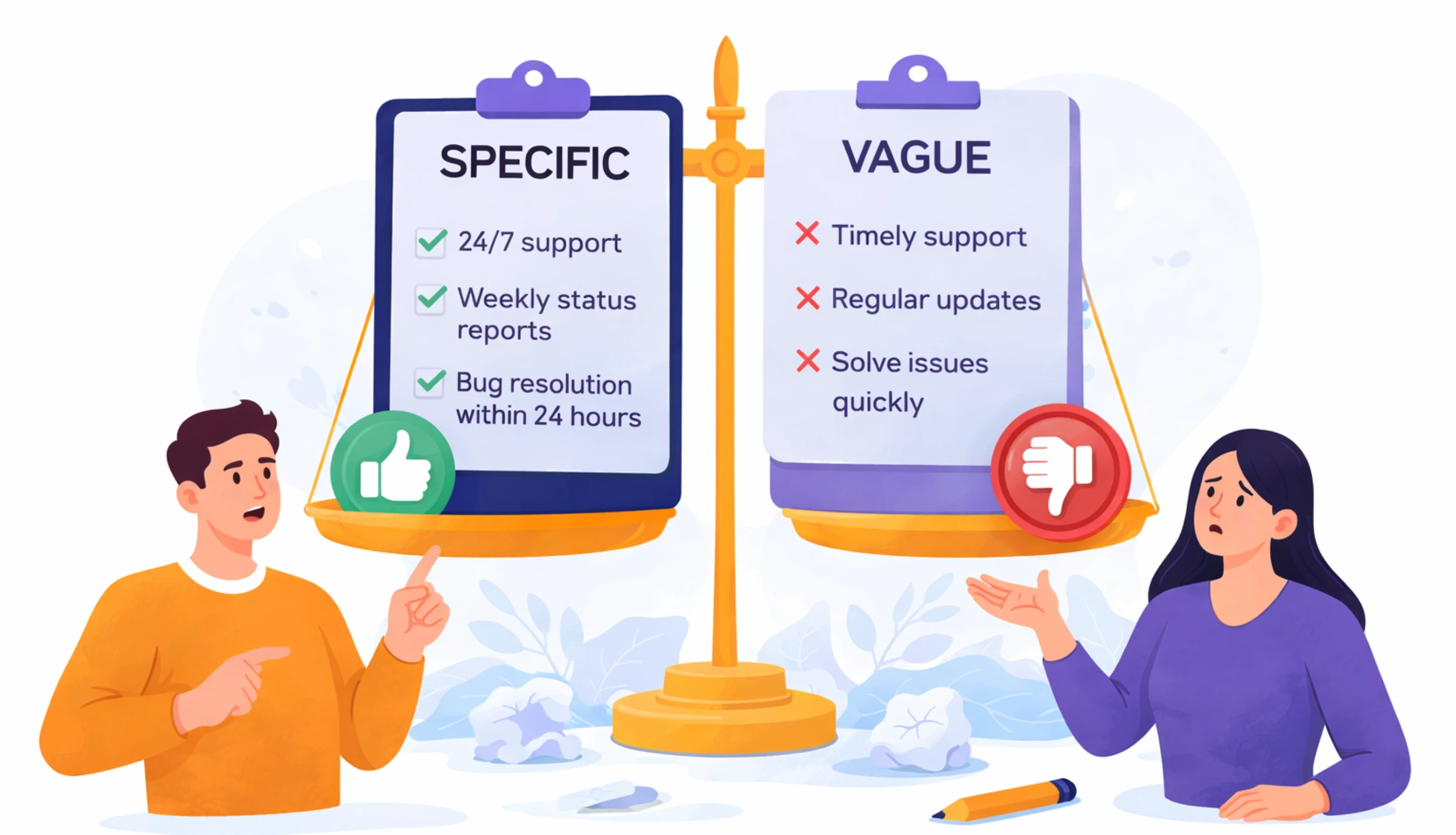
The difference between a protective SLA and a useless one is specificity. Every cell in the Vague column below is language that appears in real Python development contracts. None of it is enforceable.
SLA Dimension | Demand This (Specific) | Do Not Accept This (Vague) |
Response time (blockers) | 4 hours maximum during working hours | 'We'll respond as soon as possible' |
Daily standup commitment | Named window, e.g. 9am–10am IST | 'Morning time, flexible' |
Code review turnaround | 24 hours on non-urgent PRs | No stated turnaround |
Bug fix: P1 issues | 2–4 hours resolution commitment | 'We'll prioritise critical bugs' |
Sprint delivery | Written acceptance criteria per story | 'We deliver at end of sprint' |
Knowledge transfer | Documented handoff at engagement end | 'We'll make the transition smooth' |
IP assignment timing | Before first line of code | 'Covered in standard terms' |
Replacement on developer departure | Replacement within 5 business days | 'We'll handle it if it happens' |
SLA breach consequence | Written service credit or sprint rollover | No stated consequence |
Vendors who resist adding specific language to these clauses are telling you something important: they do not want to be held to a specific standard. For context on what other contract red flags look like before you reach the SLA discussion, see the guide on Python development pricing red flags.
How SLAs Differ Across Python Engagement Models
The clauses above apply to all Python development contracts, but the emphasis shifts depending on the engagement model you are using.
Staff Augmentation
The most critical SLAs are Clause 1 (response time), Clause 2 (standup commitment), and Clause 5 (named developer). You are embedding a developer into your team, and their communication and attendance patterns directly affect your sprint velocity. For the full model comparison, see the Python hiring models comparison.
Dedicated Development Team
Clauses 3 (code quality), 7 (documentation), and 8 (breach remedies) become more important when a team is running extended sprints over multiple months. Code quality debt compounds. Documentation gaps become critical when the team scales or a developer departs.
Fixed-Price Project Outsourcing
Clause 4 (bug priority tiers) and Clause 6 (proactive escalation) are highest priority here, because fixed-price contracts create the strongest incentive for vendors to absorb problems silently rather than surface them as scope changes. The Python development cost breakdown across models provides the pricing context to understand why vendors behave this way.
How Acquaint Softtech Handles SLAs
Acquaint Softtech is a Python development and IT staff augmentation company based in Ahmedabad, India, with 1,300+ projects delivered globally. Every engagement agreement includes written SLA commitments on the eight clauses described in this guide.
Response time:
4-hour response commitment during working hours, 30-minute response for P1 production issues, documented in writing before the engagement starts.
Named developer:
The developer named in the agreement is the developer who starts on day one. Any substitution requires written client approval. Free replacement guarantee if the developer departs.
Code quality:
Mandatory peer review before merge, docstring standards, and test coverage requirements are part of every engagement's delivery standards, not courtesy commitments.
Breach remedies:
Service credit provisions, sprint rollover rights, and termination without penalty on breach thresholds are included in every Acquaint Softtech contract.
Knowledge transfer:
Documentation requirements, architecture decision records, and formal handoff sessions are contractual deliverables, not afterthoughts.
The Bottom Line
Most Python development contracts fail not because of bad code, but because of undefined accountability.
The SLA is the section of the contract that converts a vendor relationship into a structured accountability framework- especially when you hire Python developers for critical projects.
Eight clauses. Written commitments. Specific language. Defined consequences. That is the difference between a contract that describes a project and a contract that protects your investment when hiring Python developers remotely.
Before signing, use our complete Python development partner evaluation guide that covers full due diligence from hiring Python developers to SLA negotiation.
Every Acquaint Softtech Engagement Comes with a Written SLA.
Response times. Code review cadence. Escalation paths. Replacement guarantees. IP assignment before day one. Not promises. Written. 1,300+ projects delivered. Starting at $20/hr.
Frequently Asked Questions
-
Does a Python development contract really need an SLA?
Yes, and most do not include one. A contract without an SLA tells you what will be built. It says nothing about how fast blockers get resolved, what happens when a sprint is missed, or who you call when the production API goes down at 2am. That gap is where projects fail.
-
What response time should I put in the SLA?
4 hours for standard questions during working hours. 30 minutes for P1 production incidents. These are industry-standard benchmarks. Anything longer than 4 hours for a regular blocker means your sprint is effectively paused for a full working day before the vendor even acknowledges the problem.
-
Can I add SLA clauses to an existing contract?
Yes. You can negotiate an addendum to an existing engagement agreement at any renewal or milestone point. The best time to add SLA language is before the contract starts. The second-best time is at the first sprint review when you have concrete evidence of the gap you are trying to close.
-
What should I do if a vendor refuses to include SLA language?
A vendor who refuses to commit to specific response times or code quality standards is telling you they cannot consistently meet those standards. That is not a negotiating position. That is a risk signal. For the full list of pre-contract red flags, see the guide on what to look for when hiring a Python development company.
-
How is an SLA different from a scope of work?
A scope of work describes what gets built. An SLA describes how the building happens: how fast, at what quality standard, with what response to problems, and with what consequences for failures. You need both. A scope of work without an SLA is a blueprint without a construction standard.
-
What is a reasonable service credit for SLA breach?
10% of the monthly invoice per month in which three or more breaches occur is a common and enforceable benchmark. Some contracts use sprint rollover credits (the vendor replays the missed sprint at no cost). Avoid percentage penalties per individual breach. They create perverse incentives and are difficult to administer.
-
Does the SLA change for offshore Python development?
The clauses are the same. The timezone overlap commitment in Clause 2 becomes more specific. For India-based developers, you should define the exact overlap window in IST and your local timezone and commit it in writing. For the full timezone and communication evaluation framework, see the guide on hiring Python developers remotely and avoiding red flags.
We’re Acquaint Softtech, your technology growth partner. Whether you're building a SaaS product, modernizing enterprise software, or hiring vetted remote developers, we’re built for flexibility and speed. Our official partnerships with Laravel, Statamic, and Bagisto reflect our commitment to excellence, not limitation. We work across stacks, time zones, and industries to bring your tech vision to life.
Table of Contents
Get Started with Acquaint Softtech
- 13+ Years Delivering Software Excellence
- 1300+ Projects Delivered With Precision
- Official Laravel & Laravel News Partner
- Official Statamic Partner
Related Blog

When Is Python Development Too Expensive? Pricing Red Flags That Signal a Bad Vendor
Not all expensive Python development is justified. This guide identifies the exact pricing red flags that signal a bad vendor, with real benchmarks, warning signs, and what fair Python pricing actually looks like in 2026.
Acquaint Softtech
March 26, 2026
How to Hire Python Developers Without Getting Burned: A Practical Checklist
Avoid costly hiring mistakes with this practical checklist on how to hire Python developers in 2026. Compare rates, vetting steps, engagement models, red flags, and more.
Acquaint Softtech
March 30, 2026
Total Cost of Ownership in Python Development Projects: The Full Financial Picture
The build cost is just the beginning. This guide breaks down the complete TCO of Python development projects across every lifecycle phase, with real benchmarks, a calculation framework, and 2026 data.
Acquaint Softtech
March 23, 2026India (Head Office)
203/204, Shapath-II, Near Silver Leaf Hotel, Opp. Rajpath Club, SG Highway, Ahmedabad-380054, Gujarat
USA
7838 Camino Cielo St, Highland, CA 92346
UK
The Powerhouse, 21 Woodthorpe Road, Ashford, England, TW15 2RP
New Zealand
42 Exler Place, Avondale, Auckland 0600, New Zealand
Canada
141 Skyview Bay NE , Calgary, Alberta, T3N 2K6
Your Project. Our Expertise. Let’s Connect.
Get in touch with our team to discuss your goals and start your journey with vetted developers in 48 hours.