

Staff Augmentation for US Startups: Legal, Tax, and Operational Guide to Indian Development Teams (2026)
Most US startups engaging Indian dev teams skip the legal setup. IP ownership defaults to the developer. Tax positions are unclear. NDAs are unenforceable without arbitration. This guide covers the 6 questions that matter.

Acquaint Softtech
The Legal Questions Most US Startups Never Ask Before Engaging Indian Dev Teams
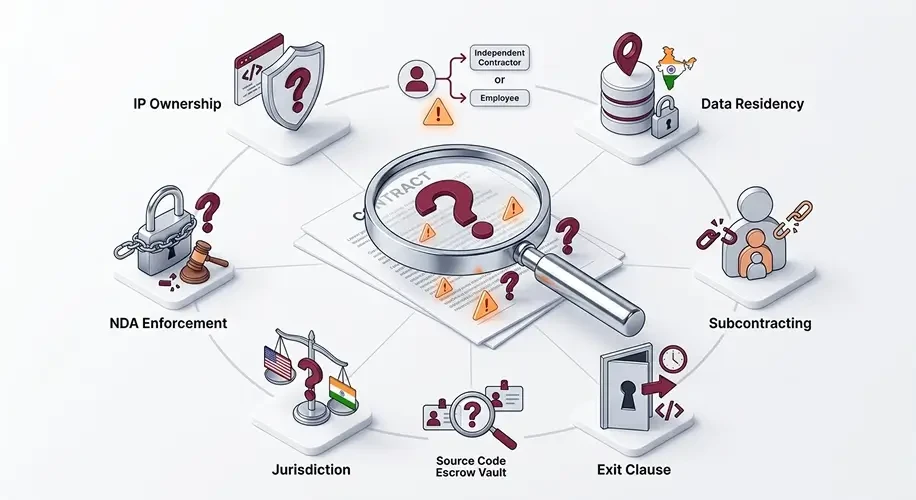
Every week, US startup founders engage Indian development teams on the basis of a handshake, a scoped proposal, or a marketplace contract without addressing the legal, tax, and operational questions that determine whether the engagement is structured correctly.
Most of the time, nothing goes wrong. The product ships, the team delivers, and the legal gaps never surface. But when something does go wrong, and it can go wrong through no fault of either party, those gaps become expensive. IP ownership defaults to the jurisdiction of the developer. Tax obligations are unclear on both sides. NDA clauses drafted for US law are unenforceable without an arbitration clause. Dispute resolution has no defined forum.
Acquaint Softtech has been operating US-India software development engagements for 13 years. We have a US office and a client base across the United States, United Kingdom, and Canada. This guide covers the 6 legal and operational questions every US startup should address before engaging an Indian development team. It is not legal advice. It is the framework for the conversation you should have with your attorney before signing. For the cost comparison context, see our staff augmentation vs Upwork guide.
Important Disclaimer This article is for informational purposes only and does not constitute legal or tax advice. Specific legal and tax obligations vary by US state, Indian state, engagement structure, and individual circumstances. Engage a qualified US attorney with cross-border technology contract experience before entering any offshore development engagement. The information below reflects general practices as of 2026 and is subject to change. |

- US startup founders evaluating Indian staff augmentation for the first time
- CTOs managing a first cross-border development engagement and needing a legal checklist
- COOs responsible for vendor contracts who need to understand India-specific considerations
- Any US business engaging an Indian development company wanting to understand the contractual framework
The 6 Legal and Operational Questions to Answer Before Day 1
Question 1: Who owns the code your Indian developers write?
Short answer: It depends entirely on your contract. Without a written work-for-hire agreement, it may not be you.
Detail: Under US copyright law, software created by an employee is owned by the employer. Software created by an independent contractor is owned by the contractor unless a written work-for-hire or IP assignment agreement states otherwise. Indian developers working for an Indian company are employed by that company. Without an explicit IP assignment clause in your engagement agreement, the Indian development company may retain rights to code they produce for you. Every engagement agreement must include: an explicit work-for-hire clause or IP assignment clause, a statement that all code produced is owned exclusively by your US entity, confirmation the Indian company has the right to assign this IP (their own developer employment agreements must support this), and a waiver of moral rights claims under Indian copyright law.
What goes wrong without this: Without written IP assignment, ownership of the codebase may be ambiguous. In a dispute or acquisition, an ambiguous IP chain is a material risk. Acquirers, investors, and enterprise clients will request IP chain documentation during due diligence. A gap here can delay or derail a transaction.
Question 2: Is your NDA enforceable in India?
Short answer: An NDA signed by an Indian company is enforceable in India, but practical enforcement requires an arbitration clause.
Detail: India recognises and enforces non-disclosure agreements under the Indian Contract Act, 1872. However, enforcing an NDA without an arbitration clause requires filing a civil suit in an Indian court and engaging Indian legal counsel through a process that can take years. Your NDA should specify: governing law (your US state or English law for international contracts), dispute resolution via international arbitration (ICC, SIAC, or LCIA rules are standard), a definition of confidential information covering source code, architecture documents, business logic, client data, and product roadmaps, and a non-solicitation clause covering both parties' employees.
What goes wrong without this: Without an arbitration clause, enforcing confidentiality requires court litigation in India. For a startup, the deterrent value of the NDA depends on whether enforcement is credible. An arbitration clause makes it credible and fast.
Question 3: Does your US entity have tax obligations for payments to an Indian dev company?
Short answer: Generally no on withholding, but confirm the treaty position and payment structure with your US accountant.
Detail: The US-India tax treaty reduces or eliminates withholding tax on most business service payments from the US to India, including software development services. Payments for services performed entirely in India by an Indian company with no US permanent establishment are generally not subject to US withholding tax. However: payments to individual Indian freelancers may require Form 1099 reporting in some circumstances. Your US accountant should confirm the specific tax position for your payment structure before the first payment, particularly if you are paying individuals rather than a registered Indian company.
What goes wrong without this: Misclassifying Indian developers as US contractors and issuing 1099s incorrectly creates IRS reporting issues. Consult a US accountant with international tax experience before the first payment.
Question 4: What are your data privacy obligations when Indian developers access US customer data?
Short answer: You remain responsible for your customer data regardless of where developers are located. GDPR, CCPA, and HIPAA follow the data, not the developer's geography.
Detail: If your application handles US consumer personal data, offshore developers accessing that data creates cross-border data transfer obligations. Key requirements: your engagement agreement must include a Data Processing Agreement (DPA) if subject to GDPR or handling EU personal data. If you are HIPAA-covered, include a Business Associate Agreement (BAA) and verify the Indian company demonstrates HIPAA-compatible security controls. For CCPA, any offshore party with access to California consumer data is a service provider and must comply with the same handling restrictions as a US provider. Your engagement agreement should specify: permitted data access scope, breach notification obligations (72 hours for GDPR), and audit rights for security practices.
What goes wrong without this: A data breach involving customer personal data is a regulatory event regardless of whether it occurs in the US or India. Without a written DPA or BAA, you have no contractual data handling obligations in place with your offshore team.
This Is the Legal Conversation We Have Already Had.
Every Acquaint Softtech engagement comes with pre-drafted NDA, IP assignment, DPA, and work-for-hire clauses reviewed for US-India cross-border compliance. We have run 1,300+ engagements. The legal framework is built. You do not need to construct it from scratch. Send us your current engagement structure and we will tell you what is missing before you sign anything.
Question 5: What contract structure correctly governs a US-India staff augmentation engagement?
Short answer: A Master Service Agreement (MSA) with Statements of Work (SOWs) is the standard and most protective structure.
Detail: The recommended contract structure consists of three documents. First, a Master Service Agreement covering: governing law and jurisdiction, IP ownership and assignment, confidentiality and NDA terms, data protection obligations, indemnification and liability limitation, termination rights and notice periods, and dispute resolution via international arbitration. Second, individual Statements of Work per engagement covering: specific deliverables or roles, sprint cadence and velocity expectations, performance metrics, rate and payment terms, and duration. Third, a Data Processing Agreement where data privacy obligations apply. The MSA governs the relationship. The SOW governs each specific engagement. This structure allows the relationship to evolve without renegotiating core legal terms with every new project.
What goes wrong without this: A single proposal document with no MSA means every engagement is governed by proposal terms which are typically inadequate on IP assignment, liability limitation, and dispute resolution.
Question 6: If something goes wrong, how do you resolve it?
Short answer: International commercial arbitration under ICC, SIAC, or LCIA rules. Not US courts. Not Indian courts.
Detail: A dispute between a US company and an Indian company that goes to court will be resolved in either US federal court or Indian court, neither of which is efficient. US courts have limited reach over Indian entities with no US assets. Indian courts can be slow. The standard approach is binding international arbitration specified in the MSA. Singapore International Arbitration Centre (SIAC) is the most common choice for US-India technology disputes. The arbitration clause should specify: the arbitration institution, number of arbitrators (one for disputes under $500K, three for larger), seat of arbitration (Singapore or London), language (English), and governing law (New York or English law).
What goes wrong without this: Without an arbitration clause, a dispute goes to court in whichever jurisdiction has reach. A US judgment against an Indian company with no US assets requires enforcement proceedings in India. A SIAC or ICC arbitration award is enforceable in India under the New York Convention.
The Operational Framework for US-India Engagements
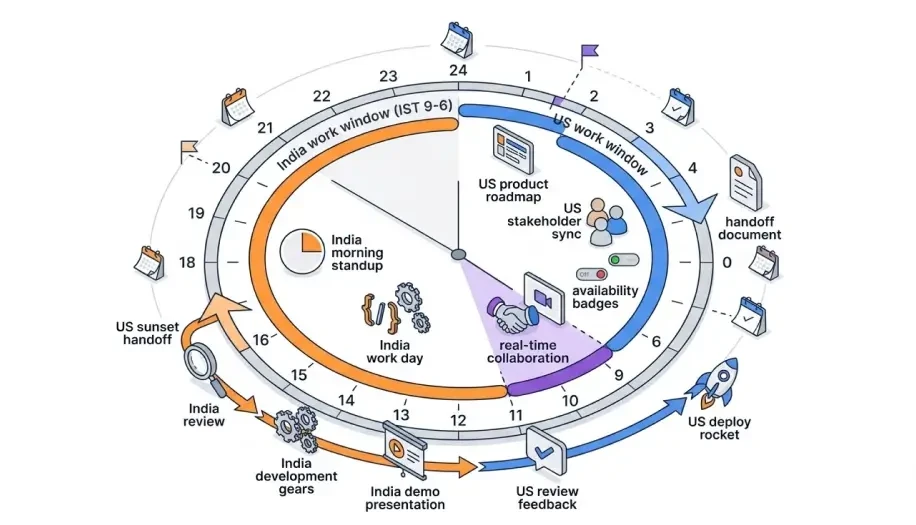
Timezone Management
India Standard Time (IST) is UTC+5:30. For US Pacific clients (PST), there is no business-hours overlap. The practical async model works well when sprint process, definition of done, and blocker escalation paths are documented clearly. Client submits reviews and questions at end of their day. Indian team processes overnight. Deliverables are ready at the start of the US client's morning. Acquaint Softtech has operated US-India engagements across all US time zones for 13 years with structured async communication. See our remote developer onboarding checklist for the specific process.
Payment and Currency
Payment to an Indian company is typically made in US dollars via international wire transfer (SWIFT), Wise Business, or Payoneer. Payment terms for Indian staff augmentation are typically monthly in advance or net-15. Indian companies cannot accept net-30 or net-60 as standard practice due to FEMA regulations on foreign currency receipt timelines.
Source Code Control
All code should be committed to a client-controlled repository (GitHub, GitLab) at the end of every sprint. Never allow an Indian development company to hold the primary copy of your codebase in their own repository without client access. With client-controlled repository access, you hold the code regardless of the vendor's operational status or any commercial dispute.
How Acquaint Softtech Structures Every US Engagement
Acquaint Softtech is a registered Indian private limited company with a US office and 13 years of US-India engagement history. Every staff augmentation engagement includes the following documentation as standard. These are the baseline for every US client engagement we run.
Master Service Agreement | Covers governing law, IP assignment, NDA, data protection, liability limitation, termination rights, and dispute resolution via SIAC international arbitration. Drafted for US-India cross-border enforceability. |
IP Assignment Agreement | Explicit work-for-hire and IP assignment clause. All code, documentation, and work product produced during the engagement is assigned to the client US entity. Our developer employment agreements contain corresponding IP assignment clauses ensuring a clean title chain. |
NDA with Arbitration Clause | Confidentiality obligations with defined scope covering code, architecture, business logic, and client data. Dispute resolution via international arbitration (SIAC, Singapore seat, English law). Enforceable in both jurisdictions. |
Data Processing Agreement (DPA) | Available for GDPR, CCPA, or HIPAA-covered clients. Covers data access controls, handling requirements, 72-hour breach notification, and audit rights. Signed before any developer accesses production data. |
Statement of Work (SOW) | Per-engagement document covering specific role or deliverable scope, sprint cadence, performance metrics, rate, payment terms, and duration. Referenced to the MSA for all legal terms. |
Every Gap in This Guide Costs More to Fix After Signing Than Before.
We have seen what happens when a US startup signs an Indian dev engagement without IP assignment, without an arbitration clause, and without a DPA. The engagement delivers well and then something changes: an acquisition, a client audit, a data incident. And the missing clauses become material problems. The conversation you need to have with a vetted Indian dev partner takes 30 minutes before you sign. It takes significantly longer and costs significantly more after a gap surfaces.
Structure the Engagement Before It Starts
Indian development teams provide US startups with access to senior engineering talent at 40 to 60 percent below equivalent US hiring costs. The legal and operational questions in this guide are not reasons to avoid this model. They are the framework for using it correctly.
A properly structured US-India staff augmentation engagement with clear IP assignment, enforceable NDA with arbitration, appropriate data protection obligations, and a well-drafted MSA is a lower-risk procurement than an unstructured one. The structure takes 2 to 3 weeks to put in place correctly. The protection it provides lasts for the life of the engagement and beyond. Acquaint Softtech has run this framework for 13 years. Every document is ready.
Staff Augmentation Model | Hire Laravel Developers | Laravel Development Services
FAQ's
-
Does a US startup need a US attorney to engage an Indian development company?
For any engagement involving significant IP development, personal data, or material commercial value: yes. A US attorney with cross-border technology contract experience should review the IP assignment clause, the arbitration provision, and any data protection obligations before signing. The cost of this review is typically $500 to $2,000. The cost of a dispute without a properly drafted contract is orders of magnitude higher.
-
Can an Indian development company own code it writes for a US startup?
Yes, without a written IP assignment agreement. Under both US and Indian copyright law, the default ownership of work created by an independent contractor rests with the creator unless a written agreement specifies otherwise. An Indian development company that writes code for a US startup without an IP assignment clause may have a defensible claim to that code. Ownership is determined by the written agreement, not by who paid for the work.
-
How do I pay an Indian development company from the US?
International wire transfer (SWIFT), Wise Business, or Payoneer are the most common methods. Payment is in US dollars. The Indian company converts to INR under FEMA regulations. Payment terms are typically monthly in advance or net-15. Under the US-India tax treaty, payments for software development services performed in India by an Indian company are generally not subject to US withholding tax. Confirm with your US accountant for your specific situation.
-
What happens to my code if the Indian development company closes?
If your IP assignment is properly executed, the code is yours regardless of what happens to the company. Your MSA should also require that all code is committed to a client-controlled repository at the end of every sprint. With client-controlled repository access, you hold the code regardless of the vendor's operational status.
-
Are there US visa or immigration concerns for remote US-India engagements?
For remote staff augmentation where developers work in India and never visit the US, there are no US visa or immigration implications. The developers are employees of an Indian company working in India. If a developer needs to visit the US for onboarding, a B-1 business visitor visa is typically appropriate for short visits. Extended on-site work in the US requires appropriate work visa classification and should be discussed with a US immigration attorney.
We’re Acquaint Softtech, your technology growth partner. Whether you're building a SaaS product, modernizing enterprise software, or hiring vetted remote developers, we’re built for flexibility and speed. Our official partnerships with Laravel, Statamic, and Bagisto reflect our commitment to excellence, not limitation. We work across stacks, time zones, and industries to bring your tech vision to life.
Table of Contents
Get Started with Acquaint Softtech
- 13+ Years Delivering Software Excellence
- 1300+ Projects Delivered With Precision
- Official Laravel & Laravel News Partner
- Official Statamic Partner
Related Reading
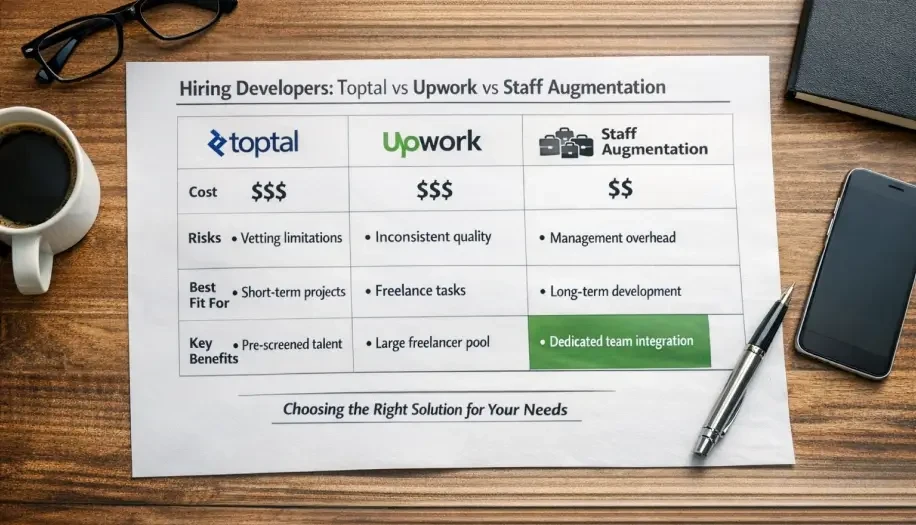
Toptal vs Upwork vs Staff Augmentation: An Honest CTO's Guide for 2026
Toptal, Upwork, and staff augmentation each solve a different problem. This honest vendor-side guide covers what each model actually costs, where each one breaks down, and which fits your situation.
Acquaint Softtech
March 16, 2026
Staff Augmentation vs Upwork vs Agency: Real Cost Breakdown for CTOs in 2026
Staff augmentation, Upwork, or a dev agency? The real cost difference in 2026 is bigger than most CTOs expect. Here are the actual numbers with zero fluff.
Acquaint Softtech
March 8, 2026
What the Best CTOs in 2026 Are Doing Differently With Their Dev Teams
After 1,300+ projects the gap between high-performing and average CTOs is not technical knowledge. It is 9 specific operational behaviours most CTOs have never been told about. This article names them.