

Staff Augmentation Red Flags: 12 Signs a Vendor Will Underdeliver
These 12 red flags appear before you sign, not after. Each one predicts a specific delivery failure. Spotting three or more in a single vendor is enough to walk away.

Ahmed Ginani
As Business Development Lead at acquaint softteech, a software development partner with 1,300+ projects across 13 years, I have sat in on hundreds of vendor evaluation conversations. The companies that end up in failed engagements almost always saw at least one of these red flags before they signed. They rationalised it. This article gives you the 12 signals that are worth taking seriously, what each one predicts, and what to do when you see it.

- CTOs and founders currently evaluating staff augmentation vendors and not sure what to look for
- Engineering leads who have been burned by a vendor before and want a structured screening framework
- Procurement leads building a vendor evaluation process for recurring development hiring
- Companies comparing multiple vendor proposals and not sure how to distinguish substance from sales polish
The difficulty with vendor red flags is that none of them are obvious in isolation. A vendor who cannot provide reference clients might be genuinely new and high quality. A vendor who avoids the IP conversation might just have a bad sales process. The signal becomes meaningful when you see multiple red flags from the same vendor. Three or more red flags in a single proposal or sales call is a pattern, not a coincidence.
The offshore due diligence checklist covers the 10 verification steps to take before signing any offshore engagement. This article focuses specifically on the signals that appear during the sales and proposal stage, before any verification is required.
Severity Guide
How to use this list CRITICAL: Walk away unless the vendor provides a specific, satisfying resolution in the same conversation. HIGH: Ask a follow-up question. If the answer is vague or deflecting, treat it as CRITICAL. MEDIUM: Note it. One MEDIUM flag alone is not disqualifying. Three MEDIUM flags together is a pattern.
|
Red Flags 1 to 6: The Proposal and Sales Stage
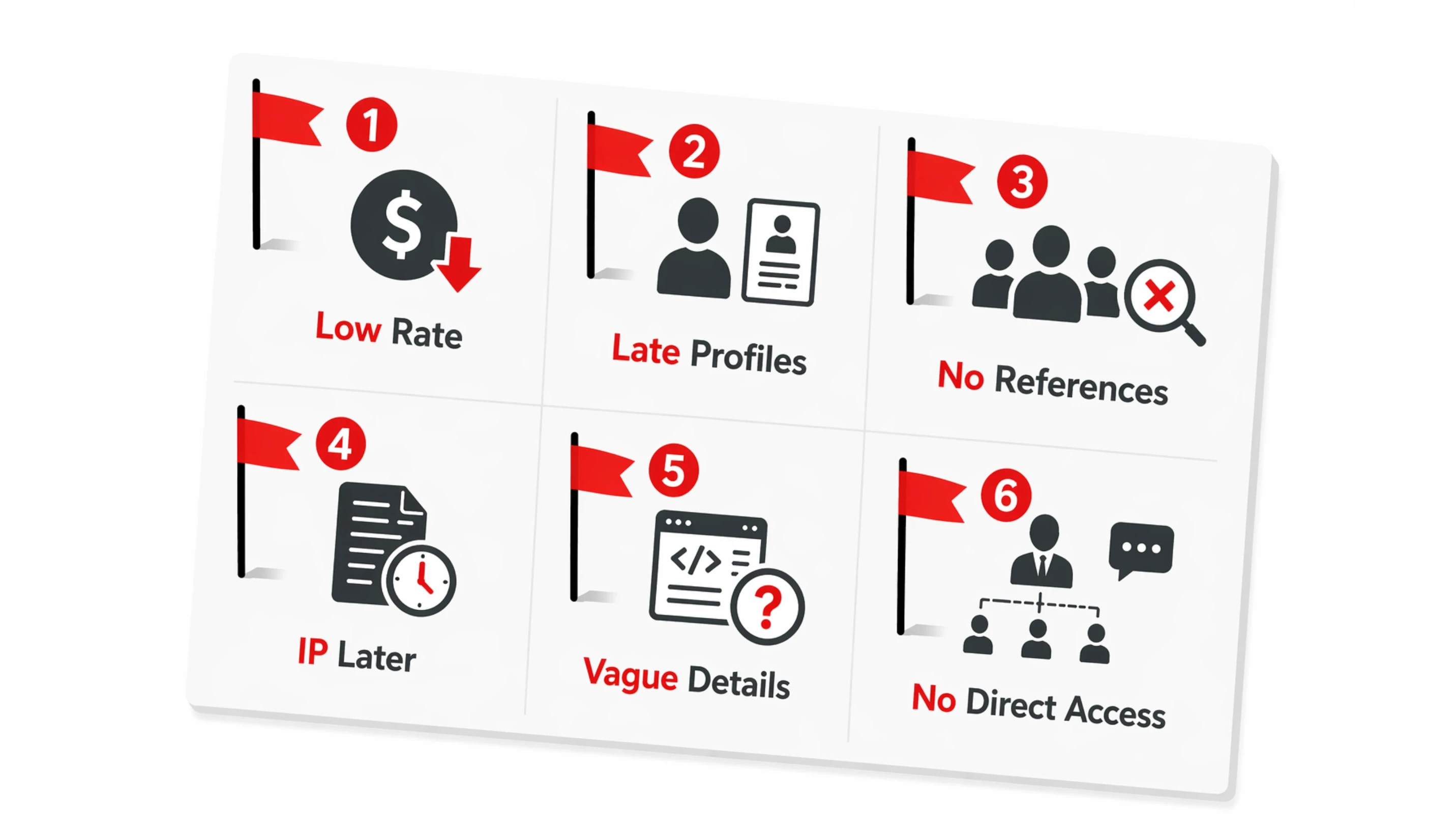
Red Flag 1 | CRITICALThe rate is significantly below the market average |
The signal: Quote arrives at $12 to $15/hr for a senior developer when market rate is $25 to $40/hr. |
What it means: Vendor is either misrepresenting seniority level, using developers shared across multiple clients, or building a low quote to win the contract then reducing quality after signing. Below-market rates on senior developers are not a bargain. They are a mismatch between what is promised and what is delivered. |
What to do: Ask them to explain specifically what makes their rate lower than comparable vendors. A legitimate answer exists. A deflecting answer does not. |
Red Flag 2 | CRITICALDeveloper profiles arrive after contract signing |
The signal: Vendor insists on signing first, then they will 'match the right developer to your project'. |
What it means: A vendor confident in their talent presents profiles for client approval before commitment. Delaying developer profiles until after signing removes your ability to evaluate the actual person who will work on your product. This is a non-negotiable point. |
What to do: Require developer profiles and client interview rights before any contract is signed. Any vendor who refuses this condition is not one worth engaging. |
Red Flag 3 | CRITICALNo verifiable client references provided |
The signal: Vendor lists logos on their website but cannot connect you with a named contact at a reference client. |
What it means: Unverifiable references are a strong indicator that the case studies on the website are either embellished or fabricated. Every legitimate vendor with real clients can provide one or two contacts for a 15-minute reference call. |
What to do: Ask specifically: can you connect me with a client who has completed a 6-month engagement in the last 12 months? If the answer involves redirecting to written testimonials only, treat this as a critical flag. |
Red Flag 4 | CRITICALIP assignment is described as something handled at project completion |
The signal: Sales rep says IP 'transfers at the end of the project' or 'is handled in the final invoice process'. |
What it means: IP should be assigned from first commit. Anything else means the vendor retains technical ownership during the engagement. If the engagement ends early, the IP position is ambiguous at best and in the vendor's favour at worst. |
What to do: Require IP assignment from first commit as a standard contract term before signing. If the vendor treats this as unusual or difficult, that itself is informative. |
Red Flag 5 | HIGHThe proposal avoids specific architecture or technology details |
The signal: Proposal is heavy on process descriptions and client outcomes but light on how the technical work will actually be done. |
What it means: A vendor with genuine technical capability can describe their approach to your specific stack and use case. Vague proposals indicate either that the developers assigned to write the proposal are junior, or that the vendor does not yet have a specific plan for your work. |
What to do: Ask them to walk you through how they would approach one specific technical challenge in your brief. The quality of the answer tells you whether the technical capability matches the sales language. |
Red Flag 6 | HIGHAll communication comes through a dedicated account manager with no direct developer access |
The signal: After multiple calls, you have still not spoken directly with any developer who would work on your project. |
What it means: In a genuine IT staff augmentation engagement, you will work directly with the developer daily. A vendor who keeps developers hidden from the client during the sales process is often screening for gaps in developer English proficiency, technical depth, or simply operating a bait-and-switch where the developer on the proposal is not the one who does the work. |
What to do: Insist on a technical pre-engagement call with the specific developer proposed for your team before signing. |
For Laravel-specific vendor evaluations, the Laravel vendor vetting checklist covers the 15-point technical assessment that separates genuine Laravel expertise from developers who list the framework on their profile without demonstrating framework-level competency.
Evaluating a Staff Augmentation Vendor Right Now?
Send me your vendor shortlist and the proposal you received. I will check it against all 12 red flags and tell you which ones are present and how significant each one is. This takes 48 hours and prevents signing with a vendor who will cost you much more than the engagement fee to disengage from.
Red Flags 7 to 12: The Contract and Terms Stage
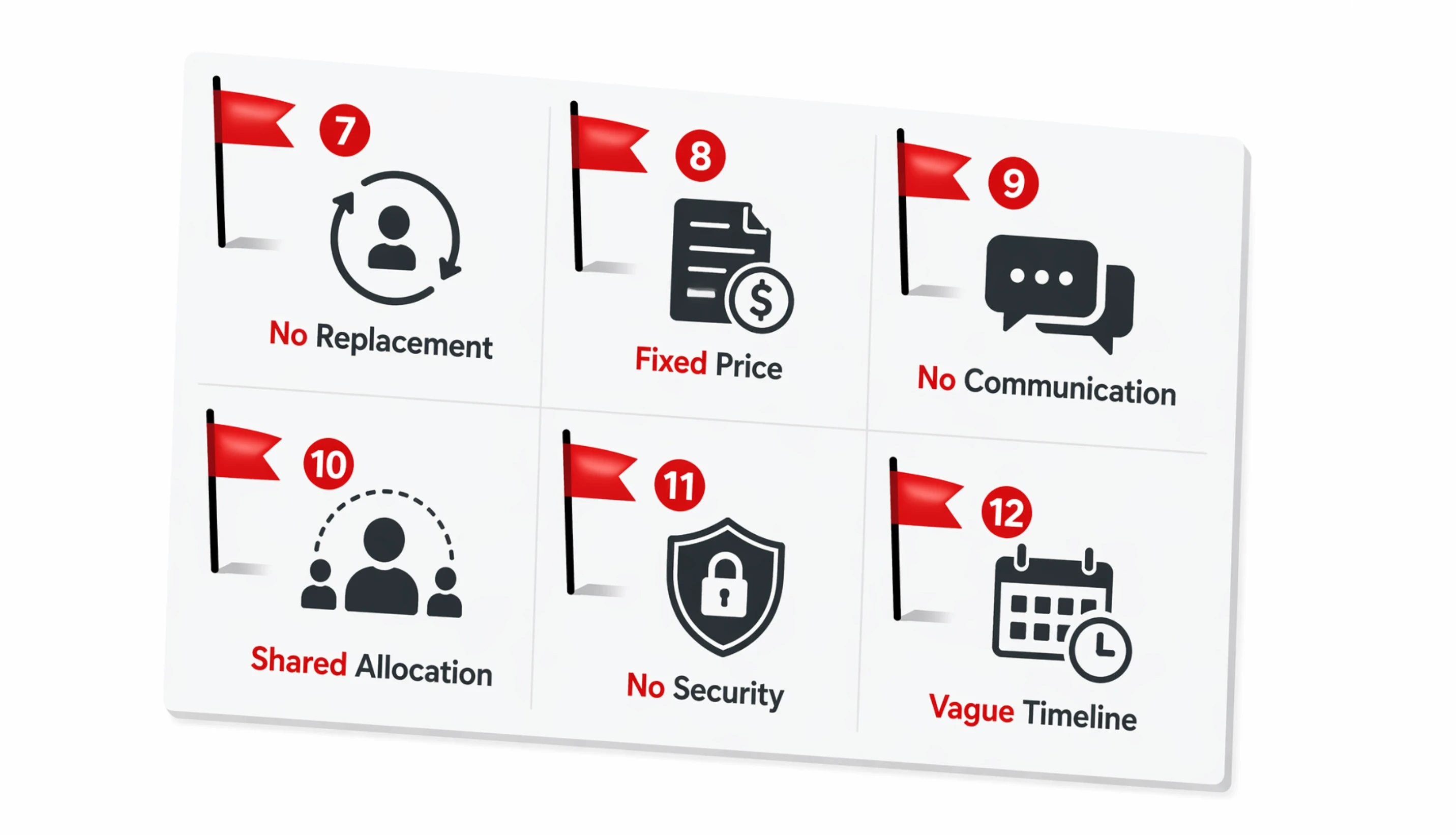
These red flags appear when you move from sales conversation to contract review. This stage is where the real structure of the engagement become visible. Many companies skip careful contract review under time pressure to start the engagement. That is exactly when these flags matters most.
Red Flag 7 | CRITICALNo specific replacement guarantee in the contract |
The signal: Contract says the vendor will 'use best efforts' to replace underperforming developers but specifies no timeline or process. |
What it means: Best efforts is a legal placeholder, not a commitment. A replacement guarantee must specify: the definition of underperformance that triggers it, the timeline for a replacement start (typically 48 to 72 hours), the client's right to approve the incoming developer, and the knowledge transfer obligations. Anything less is not a guarantee. |
What to do: Require a specific replacement clause with defined timeline, client approval rights, and structured knowledge transfer before signing. |
Red Flag 8 | HIGHFixed-price contract for an evolving scope |
The signal: Vendor quotes a fixed price for a project where requirements are not fully defined. |
What it means: Fixed-price contracts require a fully-defined scope to be meaningful. A vendor who quotes a fixed price on an evolving scope is building a large contingency into the number and planning to charge change requests for anything outside the narrowest interpretation of the original brief. For ongoing product development, a monthly retainer is the appropriate structure. The pricing model explanation covers when each model is right. |
What to do: Ask the vendor to explain how they handle scope changes in a fixed-price contract. A deflecting answer confirms the intention. |
Red Flag 9 | HIGHThe contract has no defined communication obligations |
The signal: Nothing in the contract specifies standup frequency, mid-sprint check-ins, or reporting cadence. |
What it means: Communication obligations in the contract are what prevent the 'went silent' failure mode. A vendor confident in their communication practice puts it in writing. A vendor who resists formalising communication rhythm is protecting their ability to go quiet when delivery is under pressure. |
What to do: Require specific communication terms: daily async standup summary, mid-sprint check-in, weekly metrics report. In the contract, not the relationship. |
Red Flag 10 | HIGHDeveloper is described as 'dedicated' but the contract allows shared allocation |
The signal: Contract language includes phrases like 'primarily dedicated' or 'up to 40 hours per week' without guaranteeing exclusivity. |
What it means: Primarily dedicated means partially shared. A developer working across two client accounts will deprioritise your work when the other client creates urgency. Full-time dedication means 100% allocation to your project for the duration of the engagement. |
What to do: Require explicit exclusivity language: the developer is allocated 100% to your project and cannot be assigned to other client work during the engagement. |
Red Flag 11 | MEDIUMNo data security or NDA terms in the standard contract |
The signal: Vendor says NDA 'can be added' or is available 'on request' rather than being a default term. |
What it means: Any legitimate software development vendor handles code that touches client databases, user data, and business logic. NDA and data security terms should be standard, not optional extras. A vendor for whom these are additions rather than defaults is a vendor who has not thought carefully about client data protection. |
What to do: Require NDA and data security terms as default contract terms. Review specifically for: what data the developer can access, how it is stored on their systems, and the obligations on termination. |
Red Flag 12 | MEDIUMOnboarding timeline is vague or described as 'flexible' |
The signal: Vendor cannot give a specific number of days from contract signing to developer starting work. |
What it means: A vendor with a genuine onboarding process knows how long it takes. Acquaint Softtech delivers developer profiles within 24 hours and has developers starting within 48 hours of client approval. Vague onboarding timelines indicate either that the vendor does not have a pre-vetted bench and needs to begin recruiting after signing, or that their internal process is not structured enough to predict. |
What to do: Ask specifically: if I approve a developer today, on what day can they attend their first standup? A number above 5 business days for an augmentation engagement is worth questioning. |
Understanding which pricing model a vendor prefers and why reveals their incentive structure. The staff augmentation pricing models guide covers when monthly retainers, time-and-materials, and fixed-price contracts each work in the client's favour and when they work against it.
Seen 3 or More of These in Your Current Vendor Shortlist?
Send me the proposal and I will map it against all 12 flags with specific severity ratings for each one found. If the vendor is recoverable through negotiation, I will tell you which terms to push back on. If they are not, I will tell you that too.
What a Clean Vendor Proposal Looks Like
For contrast, here is what a proposal from a vendor with none of the 12 red flags looks like. This is the Acquaint Softtech standard for every proposal.
✓ Developer profiles with verifiable credentials provided before contract
Named developers with LinkedIn profiles, GitHub activity, and technical assessment results. Client interview before any commitment. Named developer in the contract with replacement obligations.
✓ Rates at or above market with transparent cost breakdown
Senior developers at $22 to $45/hr with a full breakdown of what is included: all employer costs, equipment, management overhead. No hidden fees after signing.
✓ IP assignment from first commit as a default term
Code belongs to the client from the moment it is committed. Client repository is the primary code location. No negotiation at engagement end.
✓ Replacement guarantee with specific timeline and process
48-hour replacement start, client approval of incoming developer, structured knowledge transfer. In the contract, not the relationship.
✓ Communication obligations written into the contract
Daily async standup, mid-sprint check-in, weekly delivery metrics report. Specified in the engagement terms.
✓ NDA and data security as default contract terms
Not on request. Standard for every engagement regardless of client size or project type.
For longer engagements where the team governance structure matters as much as the contract terms, the COO guide to managing external dev teams covers the 7 KPIs and 8 red flags that tell you when an engagement that started cleanly is beginning to deteriorate. And if a dedicated team structure better fits your scale, our dedicated development teams page covers how that engagement model is structured with all 12 green lights as defaults.
Want to See the Acquaint Softtech Proposal So You Have a Clean Benchmark?
Request a proposal from Acquaint Softtech alongside your current shortlist. You will see exactly what a proposal with none of the 12 red flags looks like, including the specific contract terms, developer profiles, and pricing structure. No commitment required to receive it.
Frequently Asked Questions
-
What are the most common red flags when hiring a staff augmentation vendor?
The most reliable predictors of a bad engagement are: developer profiles not provided before signing, IP assignment delayed until project completion, no specific replacement guarantee in the contract, and rates significantly below market average. Any single one of these warrants a direct follow-up question. Three or more in the same proposal is a pattern worth walking away from.
-
Why do staff augmentation vendors underdeliver?
Most underdelivery is structural rather than talent-related. The common causes are misrepresented seniority levels, shared developer allocations sold as dedicated, no communication obligations in the contract, and no replacement mechanism when performance is below standard. The vendor selected the lowest-friction path through the sales process. The red flags in this article reveal which vendors have optimised for closing deals rather than delivering them.
-
How do I vet a staff augmentation vendor before signing?
Run through the 12 red flags in this article during the sales call and proposal review. Then apply the 10-point due diligence checklist from our offshore verification guide to independently verify credentials, Clutch reviews, and reference clients. The combination covers both what the vendor says and what you can verify independently.
-
What should I do if a staff augmentation vendor refuses to provide developer profiles before signing?
Walk away. There is no legitimate reason for a vendor with a genuine talent bench to withhold developer profiles until after commitment. Vendors who do this are either protecting a bait-and-switch process or do not have a vetted developer available and need time to recruit. Neither is a condition you want to be in after signing.
-
How long should a staff augmentation vendor take to start a developer?
A vendor with a pre-vetted bench should provide developer profiles within 24 hours of receiving requirements and have a developer attending their first standup within 48 hours of client approval. Acquaint Softtech operates on this timeline for every engagement. Any timeline longer than 5 business days indicates the vendor is recruiting after signing rather than drawing from an existing vetted pool.
-
What contract terms protect me in a staff augmentation engagement?
The minimum terms that protect client interests are: IP assignment from first commit, named developer with client approval rights, 100% allocation exclusivity, specific replacement guarantee with defined timeline, communication obligations in writing, and NDA as a default term. Any vendor who treats these as unusual requests rather than standard terms is showing you how they operate before the engagement starts.
-
Is a staff augmentation vendor better than a freelancer for long-term work?
For engagements over 3 months, staff augmentation through a structured vendor consistently outperforms individual freelancers on continuity, accountability, and total cost. The vendor carries HR, replacement, and quality risk. The freelancer does not. The difference in accountability structure becomes most visible when something goes wrong, which is exactly when it matters most.
I help agencies and founders scale their tech teams with the right developers at the right time. At Acquaint Softtech, I focus on building long term partnerships and making remote hiring simple, predictable, and results driven. My goal is straightforward to help businesses grow faster with reliable dedicated developers.
Table of Contents
Get Started with Acquaint Softtech
- 13+ Years Delivering Software Excellence
- 1300+ Projects Delivered With Precision
- Official Laravel & Laravel News Partner
- Official Statamic Partner
Related Reading
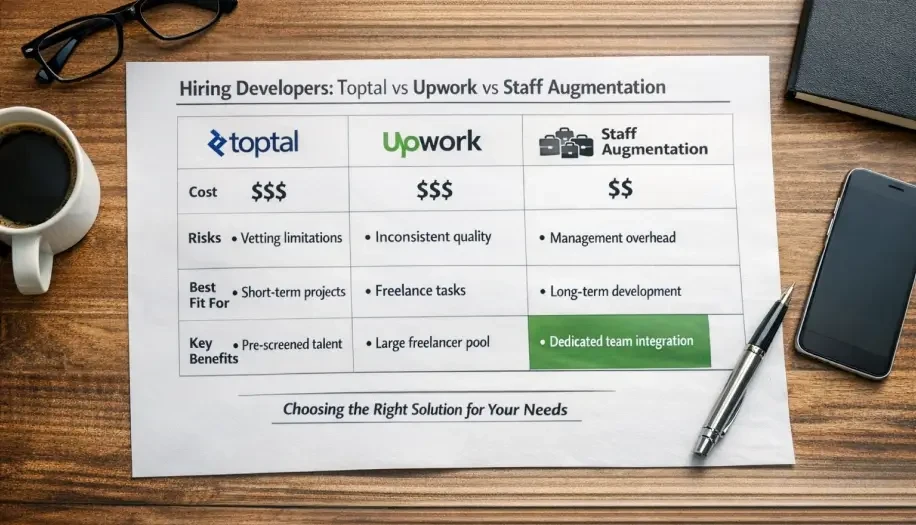
Toptal vs Upwork vs Staff Augmentation: An Honest CTO's Guide for 2026
Toptal, Upwork, and staff augmentation each solve a different problem. This honest vendor-side guide covers what each model actually costs, where each one breaks down, and which fits your situation.

Acquaint Softtech
March 16, 2026
IT Staff Augmentation vs In-House Recruitment in 2025
Confused between IT staff augmentation and in-house hiring? Discover the pros, cons, and best use cases to scale your tech teams smarter in 2025.
Acquaint Softtech
June 17, 2025
Why Offshore Development Fails: 7 Most Common Reasons and How to Avoid Each One
Offshore development fails for the same 7 reasons, repeatedly. None of them are about developer quality. All of them are about structure. Here is each one and the specific fix.
Ahmed Ginani
April 22, 2026India (Head Office)
203/204, Shapath-II, Near Silver Leaf Hotel, Opp. Rajpath Club, SG Highway, Ahmedabad-380054, Gujarat
USA
7838 Camino Cielo St, Highland, CA 92346
UK
The Powerhouse, 21 Woodthorpe Road, Ashford, England, TW15 2RP
New Zealand
42 Exler Place, Avondale, Auckland 0600, New Zealand
Canada
141 Skyview Bay NE , Calgary, Alberta, T3N 2K6