

An Introduction to TypeScript in 2026: What It Is and How to Start
TypeScript is JavaScript with a type system layered on top. You write types, a checker verifies them before your code runs, and the types are removed before execution. Two things changed recently: Node.js now runs .ts files directly without a build step, and TypeScript 7 rewrote the compiler in Go for roughly ten times faster type checking. The important caveat is that Node strips types without checking them, so you still run the type checker separately in CI.

Mukesh Ram
As the Founder and CEO at Acquaint Softtech, I find this article interesting mainly as a record of a question that no longer exists. It was written to persuade you that TypeScript might be worth trying, and it closed by saying its future looked bright. That future arrived and then some.
TypeScript is now the default for Angular, the expected choice for React and Node work, and the language Vue itself is written in. Nobody in our software product development work argues about whether to use it anymore; the arguments are about how strictly to configure it.

- You write JavaScript and keep being told you should switch.
- You have a large JavaScript codebase and no idea where migration would start.
- You have heard Node can run TypeScript directly and want to know the catch.
- Your type checking is slow, and you want to know what TypeScript 7 changes.
- You are deciding whether TypeScript is worth it for a small project.
So this article drops the persuasion and answers what people actually search for now: what TypeScript is precisely rather than loosely, how to add it to a codebase that already exists, what the two large toolchain changes of the past year mean for you, and when it is genuinely not worth the effort. There is also a small correction to make, since the 2018 text said the compiler transpires your code. It transpiles it.
What TypeScript Is, Precisely
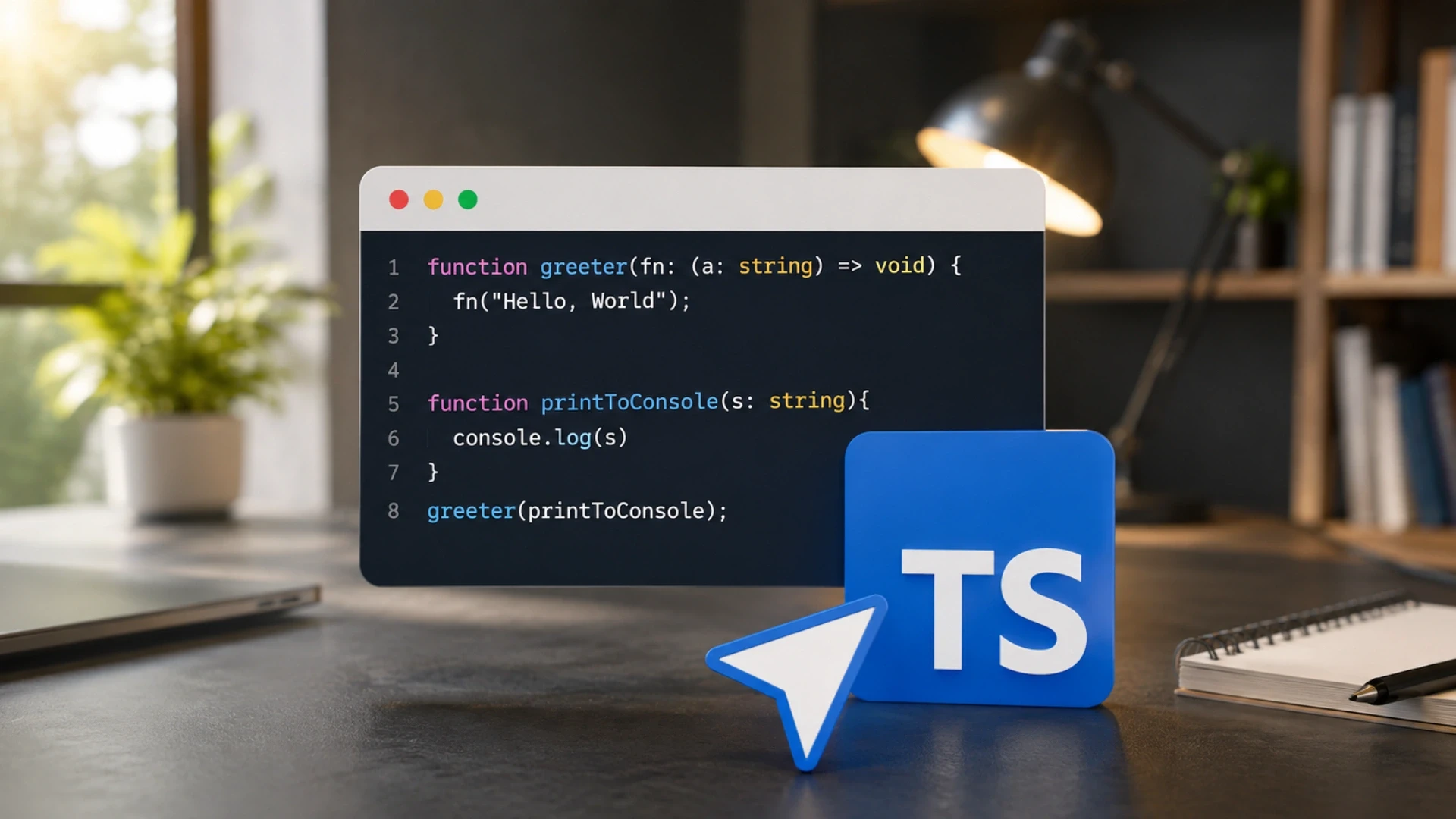
TypeScript is a type system layered over JavaScript, plus a checker that verifies your code before it runs. The types exist only during development. They are erased before execution, so nothing about them survives into the running program.
That last point is the one people miss, and it explains most of the confusion around the language. TypeScript gives you no runtime guarantees whatsoever. If an API returns a string where your type says number, TypeScript will not notice, because by then the types are gone. Types describe what you believe about your code; validating what actually arrives from outside remains a separate job.
A note on the word superset
The 2018 description called TypeScript a typed superset of JavaScript, which is nearly right and worth sharpening. Valid JavaScript is valid TypeScript, so the superset framing holds for the common case.
But a few TypeScript features, notably enums, namespaces, and parameter properties, generate real code rather than being erased, which matters enormously for the runtime changes described below. The rest of the language is purely erasable, and the official TypeScript handbook is the reference worth working through properly.
Should You Use It? Match Your Project

TypeScript pays off in proportion to how long the code will live and how many people will touch it. Find the row that describes your situation.
Your project | Is it worth it? | Reason |
Team of three or more | Yes, clearly | Types replace tribal knowledge |
Code you will maintain for years | Yes, clearly | Refactoring stops being guesswork |
Any backend API | Yes | Contracts between layers become explicit |
React or Angular application | Yes, expected | Ecosystem assumes it |
Library others will consume | Yes, essential | Your types are your documentation |
Prototype you will discard | Probably not | Setup cost exceeds the payback |
Small script, one author | Not needed | Nothing to protect against |
Legacy code nobody changes | Leave it alone | Migration buys you nothing |
The final two rows matter as much as the first six. Migrating code that nobody edits produces no benefit and consumes real budget, and we say so when clients ask us to modernise something that is quietly working. The value of types is realised at the moment somebody changes the code, so code that never changes never collects it.
Two Changes That Reset the Toolchain
More changed for TypeScript users in the past year than in the previous five. Both changes are about speed and friction rather than the language itself.
Node.js runs TypeScript directly
Modern Node.js executes .ts files without any build step, using type stripping to remove annotations and run the JavaScript underneath. As the Node.js documentation sets out, this removes types rather than checking them, and only erasable syntax is handled by default. Enums, namespaces, and parameter properties need an additional transform because they emit real code.
The catch deserves emphasis, because teams get this wrong in a way that is worse than not adopting TypeScript at all. Node strips your types and runs the result, performing zero type checking. A genuine type error will not stop the process; the program simply runs until a bad value causes an ordinary JavaScript failure, if it causes one at all. You keep running the type checker; it just moves out of the run path and into your editor and your continuous integration pipeline.
# Node runs its node app.ts # tsc still verifies it, separately npx tsc --noEmit
TypeScript 7 rewrote the compiler in Go
Microsoft ported the compiler and language service from TypeScript to Go, a project codenamed Corsa, and published the TypeScript 7.0 release candidate in June 2026 with general availability expected shortly after. The reported gain is roughly ten times faster type checking, with the VS Code codebase dropping from around seventy-eight seconds to about seven and a half.
Two things are worth knowing before you upgrade. The type system itself was transplanted rather than redesigned, so your types mean what they meant before. But version 7 carries breaking configuration changes, including stricter defaults and the removal of some older module and target options, so audit your tsconfig before moving. Given the release timeline, check the current status before planning a production cutover rather than relying on this article's date.
Is your build or type check the slowest thing in your pipeline?
Send me your repository and CI timings, and I will tell you where the time is going and what the current toolchain would save you.
How to Start on an Existing JavaScript Codebase
You do not convert a codebase in one pass, and attempting to is the most common reason migrations get abandoned. TypeScript is designed for gradual adoption, so use that.
Add TypeScript and a tsconfig with allowJs enabled, so JavaScript and TypeScript files coexist.
Turn on checkJs to get type feedback on existing JavaScript without renaming anything.
Convert leaf files first, meaning files with few dependencies, then work inward.
Install type definitions for your libraries from the DefinitelyTyped packages.
Add the type check to CI so newly converted files cannot silently regress.
Raise strictness one flag at a time once the bulk of files have moved.
Two rules keep this from stalling. Convert files when you are already changing them for another reason, which spreads the cost across work you were doing anyway. And resist the temptation to use any type to make errors disappear, because a codebase full of any has the cost of TypeScript and none of the benefit. Sequencing this properly on a large application is exactly the sort of thing we settle in a discovery workshop before anyone writes code.
Strictness: The Setting That Decides Everything
The single configuration option that determines whether TypeScript helps you is strict mode. Without it, the checker permits null and undefined almost everywhere and misses the errors it exists to catch.
Setting | What it catches | When to enable |
strict: false | Very little; mostly typos | Only during early migration |
strictNullChecks | The largest single class of bug | As soon as you can bear it |
noImplicitAny | Silent untyped values spreading | Early, with a baseline |
strict: true | All of the above together | Target state for every project |
noUncheckedIndexedAccess | Array and lookup assumptions | Once strict is comfortable |
New projects should start with strict enabled and never turn it off. Existing projects should ratchet toward it, one flag at a time, never loosening a setting to unblock a release. The moment strictness becomes negotiable under deadline pressure, it stops being a guarantee and becomes a preference, and a preference catches nothing.
When TypeScript Is Not Worth It
There are real cases where adopting TypeScript costs more than it returns, and pretending otherwise damages the argument for the cases where it clearly wins. Three situations come up repeatedly.
Short-lived code is the clearest. A script you will run twice, a prototype built to answer one question, a proof of concept that exists to be thrown away: the setup and annotation effort will not be recovered. Write it in JavaScript and move on.
A team with no TypeScript experience under a hard deadline is the second. Learning a type system while shipping under pressure produces frustration and a codebase full of any, which is the worst of both worlds. Adopt it on the next project instead, with time to learn it properly.
And stable legacy code that nobody edits is the third. Types pay off when code changes. If a service has run untouched for three years and will run untouched for three more, migrating it converts budget into no measurable benefit. That judgement is worth making explicitly rather than assuming modernisation is always correct, and it is the kind of call an experienced team should be willing to make against its own revenue.
Why Typed Codebases Hand Over Better
The commercial case for types shows up most clearly at handover, which is where a lot of software goes wrong. An untyped codebase carries its knowledge in the heads of the people who wrote it.
Acquaint Softtech, verifiable delivery record 1,300+ delivered projects across 13+ years. 95% on-time sprint delivery. 4.9 out of 5 across verified Clutch reviews. Average engineer tenure beyond 24 months. NDA signed before work begins and 100% client ownership of everything produced. The ownership commitment is the relevant one here: code you own outright is code you may hand to somebody else, and types are what make that handover survivable. |
That connection is practical rather than rhetorical. When a new engineer opens a typed codebase, the function signatures tell them what goes in and what comes out without anyone explaining it. When they open an untyped one, they read the implementation, guess, and ask somebody who may have left.
Sprint predictability depends on that ramp-up being short, which is part of why the on-time figure holds across long engagements. Our software case studies and client testimonials cover the multi-year work where this matters most.
Need engineers who write typed, maintainable JavaScript
Book a free 30-minute call, and I will introduce the specific engineers who would work on your project and show you how they set up a codebase.
What Adopting TypeScript Costs
Migration cost scales with codebase size and with how much of it you actually intend to convert. These ranges assume gradual adoption rather than a single rewrite.
Codebase size | Realistic approach | Effort and cost (USD) |
Under 10,000 lines | Convert fully in one sprint | 1 to 2 weeks, 2,000 to 8,000 |
10,000 to 50,000 lines | Convert as you touch files | 2 to 4 months elapsed, 8,000 to 30,000 |
50,000 to 200,000 lines | Types on boundaries first | 4 to 9 months elapsed, 25,000 to 90,000 |
Over 200,000 lines | New code only, plus core paths | Ongoing, absorbed into roadmap |
Greenfield project | Start strict from day one | Nil, it is the default setup |
Note that the elapsed times are long and the costs are not, because gradual migration is spread across work you were doing anyway rather than run as a separate project. A migration billed as a dedicated programme is usually the more expensive way to buy the same outcome, and it is worth asking any supplier why they have scoped it that way.
Where the work is done | Senior engineering rate | Same migration, relative cost |
New York, USA | USD 110 to 200 / hour | Highest |
United States (national) | USD 90 to 170 / hour | Very high |
Australia | AUD 110 to 200 / hour | High |
United Kingdom | GBP 65 to 130 / hour | High |
Europe (EU) | EUR 70 to 140 / hour | High |
India (Acquaint Softtech) | USD 25 to 49 / hour | Up to 40% lower |
Migration work suits a bounded offshore engagement because progress is measurable rather than subjective: files converted, strict flags enabled, errors remaining. Teams commonly hire MERN stack developers or hire Node.js developers for a fixed period to complete the boundary work, then continue in-house.
For how this sits in a wider budget, our guide to web application development cost covers the surrounding items.
Get a costed TypeScript migration plan
Book a free 30-minute call, and I will size your codebase, recommend a sequence, and give you a fixed price and timeline in your own currency.
Frequently Asked Questions
-
What is TypeScript in simple terms?
JavaScript with a type system added. You describe what your data should look like; a checker verifies it before the code runs, and the types are removed before execution.
-
Is TypeScript better than JavaScript?
For code with multiple contributors or a long life, yes, because it catches a class of errors early and documents intent. For throwaway scripts, it adds setup cost without much return.
-
Can Node.js run TypeScript without compiling?
Yes. Modern Node runs .ts files by stripping type annotations. It does not type-check them, so you still run the type checker separately in your editor and CI.
-
What is new in TypeScript 7?
The compiler was rewritten in Go, giving roughly ten times faster type checking. The type system is unchanged, but there are breaking configuration defaults, so audit your tsconfig first.
-
Does TypeScript slow down my application?
No. Types are erased before execution, so the running code is plain JavaScript. TypeScript affects build and check time during development, not runtime performance.
-
How do I migrate JavaScript to TypeScript?
Gradually. Enable allowJs and checkJs, convert leaf files first, add library type definitions, put the type check in CI, then raise strictness one flag at a time.
-
Should I enable strict mode?
Yes. Without strictness, the checker permits null and undefined almost everywhere and misses most of what it exists to catch. New projects should start strict and stay strict.
-
Does TypeScript validate data from an API?
No. Types disappear at runtime, so an API returning unexpected data will not be caught. Validate external input separately with a runtime validation library.
-
Is TypeScript hard to learn for a JavaScript developer?
The basics take days, since valid JavaScript is already valid TypeScript. Generics and advanced type features take longer, but most day-to-day work needs only the basics.
-
How long does a TypeScript migration take?
A small codebase converts in a sprint. Larger ones take months of elapsed time but little dedicated budget, because conversion happens alongside work you were already doing.
I love to make a difference. Thus, I started Acquaint Softtech with the vision of making developers easily accessible and affordable to all. Me and my beloved team have been fulfilling this vision for over 15 years now and will continue to get even bigger and better.
Table of Contents
Get Started with Acquaint Softtech
- 13+ Years Delivering Software Excellence
- 1300+ Projects Delivered With Precision
- Official Laravel & Laravel News Partner
- Official Statamic Partner
Related Blog

Rome Was Not Built in a Day: The Journey to Developing a Unicorn SaaS
Building a unicorn SaaS company is a marathon, not a sprint. Just like Rome, great products aren’t built overnight. From refining your MVP to scaling for growth.
Mukesh Ram
September 26, 2024
Bootstrap vs Material
Develop a state-of-the-art solution by picking the best technology after reading more about Bootstrap and Material UI

Shivang P
September 4, 2023
10 Must Follow Steps of Mobile App Development Process
The mobile app development process is a structured set of 10 steps that moves an idea from concept to a published app: ideation, target audience and monetization, choosing the platform, UI/UX design, picking tools, choosing the right partner, fast development, testing and deployment, marketing, and post-launch maintenance. Following the steps in order, rather than rushing to publish, is what separates apps that get downloads from the ones that get ignored.
Mukesh Ram
July 29, 2019India (Head Office)
203/204, Shapath-II, Near Silver Leaf Hotel, Opp. Rajpath Club, SG Highway, Ahmedabad-380054, Gujarat
USA
7838 Camino Cielo St, Highland, CA 92346
UK
The Powerhouse, 21 Woodthorpe Road, Ashford, England, TW15 2RP
New Zealand
42 Exler Place, Avondale, Auckland 0600, New Zealand
Canada
141 Skyview Bay NE , Calgary, Alberta, T3N 2K6