

Automated Testing in CI/CD Pipelines: What a DevOps Engineer Integrates and What It Costs in 2026
A CI/CD pipeline without automated testing catches nothing before it reaches production. Here is what a DevOps engineer integrates, in which order, and what the ROI looks like in 2026.

Taukir katava
As a DevOps Engineer at Acquaint Softtech, a software development partner, the most common gap I find when I audit an existing CI/CD pipeline is not the deployment configuration. It is the absence of meaningful automated testing. The pipeline runs, the code deploys, and nobody discovers the regression until a user reports it. Automated testing in the pipeline is what converts CI/CD from a deployment tool into a quality gate. This article covers which testing layers a DevOps engineer integrates, in what order, and what the setup costs in 2026.

- Engineering leads whose CI/CD pipeline deploys code but does not run meaningful automated tests
- CTOs who want to add automated testing to an existing pipeline and need a roadmap
- SaaS founders who have experienced production regressions that automated testing would have caught
- Teams preparing to hire a DevOps engineer and wanting to include testing integration in the brief
A CI/CD pipeline without automated testing is a fast conveyor belt to production with no quality filter. It ships code faster than a manual process and catches nothing that the developer did not catch themselves. The value of CI/CD is not speed alone. It is the combination of speed and confidence: code ships fast and problems are caught before they reach users. Automated testing is what provide that confidence.
If your pipeline is slow before you have even added testing, the deployment pipeline fix guide covers what a DevOps engineer diagnoses first. Pipeline speed and test coverage are both addressed in the same engagement.
The 4 Testing Layers a DevOps Engineer Integrates
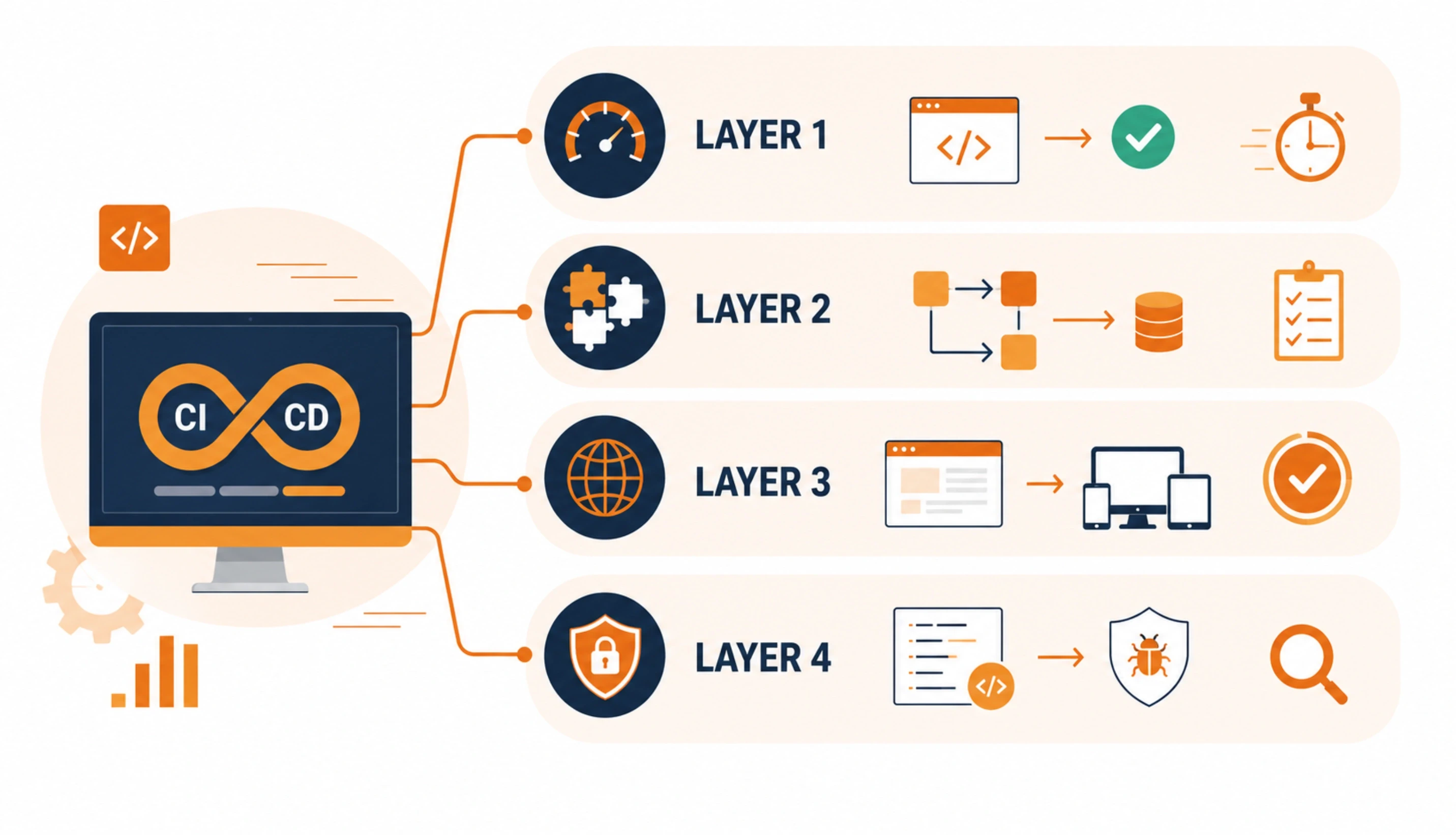
Testing in a CI/CD pipeline is not a single step. It is a layered set of checks that each catch different types of problems at different points in the pipeline. A DevOps engineer integrates them in order of speed and cost.
Layer 1: Unit Tests (fastest, cheapest)
Unit tests run against individual functions or modules in isolation. They are the fastest tests to run (typically 30 seconds to 3 minutes for a full suite) and catch the most common code-level bugs before anything else runs. A DevOps engineer configures the unit test runner in the first pipeline stage so every commit is validated immediately. If unit tests fail, the pipeline stops before any deployment occurs.
Layer 2: Integration Tests
Integration tests verify that multiple components work together correctly: that the API endpoint returns the expected response, that the database query produces the correct result, that the authentication flow works end to end. These tests take longer than unit tests (typically 3 to 15 minutes) and require a test environment with a running database and service. A DevOps engineer provisions a lightweight test environment that spins up and tears down for each pipeline run.
Layer 3: End-to-End (E2E) Tests
E2E tests simulate real user behaviour in a browser or API client. They are the slowest and most expensive tests to run (15 to 45 minutes for a meaningful suite) and catch the problems that integration tests miss: UI flows that break when components interact, third-party integration failures, and environment-specific configuration issues. A DevOps engineer integrates E2E tests against the staging environment rather than running them on every commit.
Layer 4: Static Analysis and Security Scanning
Static analysis tools (ESLint, SonarQube, Semgrep) review code for style violations, complexity issues, and common vulnerability patterns without executing the code. Security scanning tools (Trivy, Snyk, AWS Inspector) check container images and dependencies for known vulnerabilities. These checks run fast (1 to 3 minutes) and catch a different category of problem than functional tests.
The CI/CD tool that runs these testing layers affects how they are configured. The CI/CD tool comparison guide covers GitHub Actions, Jenkins, and GitLab CI and which testing integrations each supports natively.
CI/CD Pipeline With No Meaningful Tests? A DevOps Engineer Fixes That in the First Sprint.
Tell Acquaint Softtech which CI/CD tool you use and what testing frameworks your application uses. A vetted DevOps engineer will design the testing layer integration for your specific stack and send a matched profile within 24 hours.
Which Testing Tools a DevOps Engineer Uses in 2026
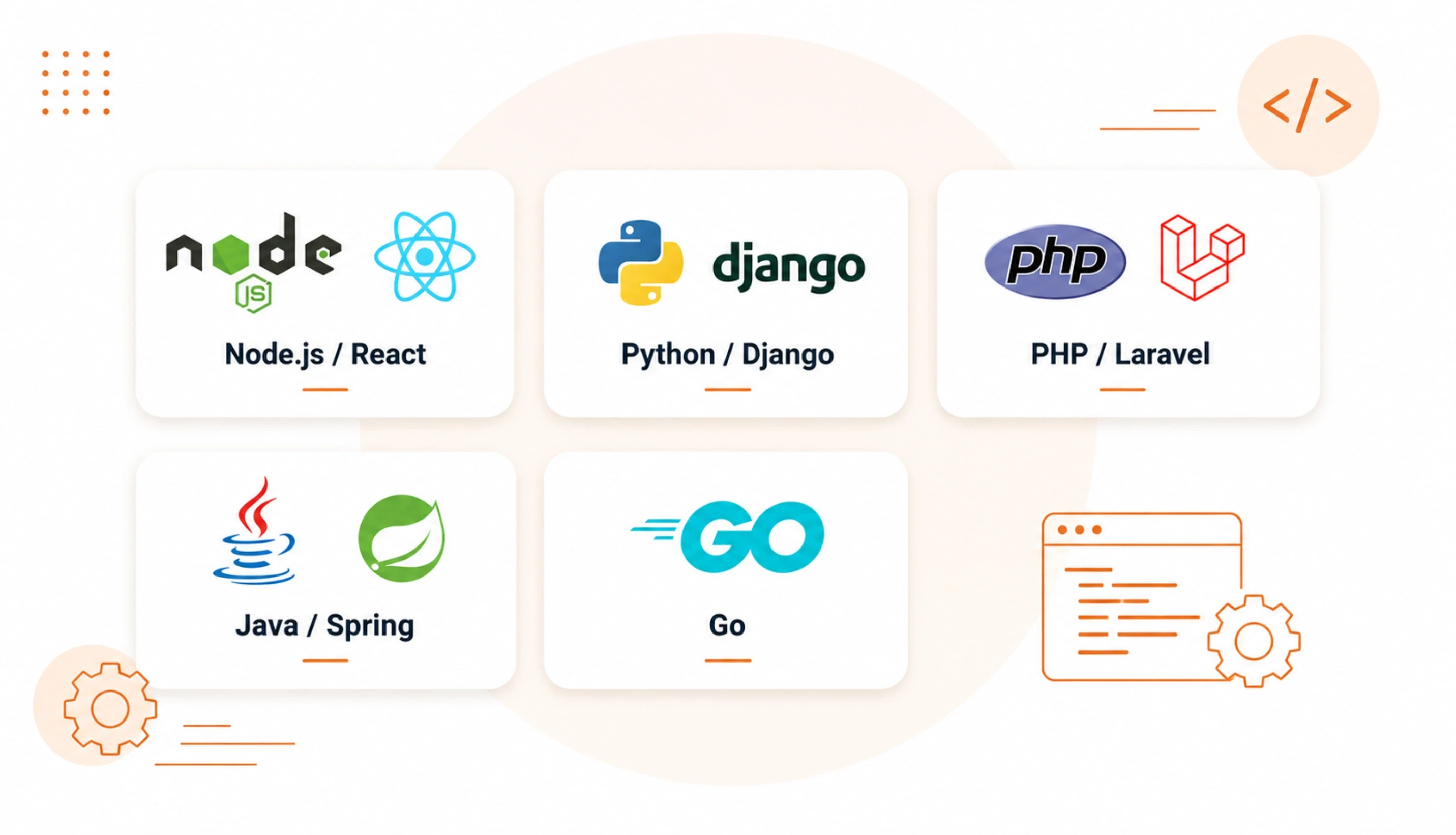
The tool selection depends on the application's language and framework. Here are the most common integrations by stack.
Stack | Unit Testing | Integration Testing | E2E Testing |
Node.js / React | Jest | Supertest + Jest | Playwright or Cypress |
Python / Django | Pytest | Pytest + Django test client | Playwright |
PHP / Laravel | PHPUnit | PHPUnit feature tests | Dusk or Cypress |
Java / Spring | JUnit + Mockito | Spring Boot Test | Selenium or Playwright |
Go | Go testing package | Go testing + test DB | Playwright |
Security (all stacks) | ESLint / SonarQube | Snyk dependency scan | Trivy container scan |
For teams running Kubernetes on EKS who need to integrate testing into their container build pipeline, the CI/CD for Kubernetes guide covers how testing layers fit into the EKS deployment pipeline specifically.
What It Costs: 2026 Numbers for Testing Integration

The cost of adding automated testing to a CI/CD pipeline depend on how many testing layers are integrated and whether the test suite already exists. Here are the honest 2026 numbers at Acquaint Softtech rates of $22/hour.
Testing Layer | Setup Time | Cost at $22/hr | What is Included |
Unit tests in pipeline | 0.5 to 1 day | $88 to $176 | Test runner config, failure reporting, pipeline gate |
Integration tests + test DB | 1 to 2 days | $176 to $352 | Test environment, DB setup/teardown, pipeline stage |
E2E tests (Playwright/Cypress) | 2 to 4 days | $352 to $704 | Browser runner, staging integration, screenshot on fail |
Static analysis + security scan | 0.5 to 1 day | $88 to $176 | ESLint, Snyk or Trivy, pipeline gate on critical findings |
Full testing pipeline (all 4 layers) | 4 to 8 days | $704 to $1,408 | All layers, reporting dashboard, flaky test handling |
The ROI of automated testing in CI/CD
A SaaS product with 10,000 active users catches a production regression after 2 hours.
Support ticket volume: 150 tickets. Resolution time: 4 hours of senior developer time.
Cost of one undetected regression: $240 in developer time + customer trust damage.
A Playwright E2E test suite that catches this regression in staging:
Setup: 2 to 4 days = $352 to $704.
One caught regression: pays for the full E2E setup.
Every subsequent caught regression: pure ROI.
For a team deploying 5 times per week, automated testing pays for itself
within the first month of production use.
Acquaint Softtech's hire DevOps engineers service provides vetted engineers who integrate testing pipelines as part of every CI/CD engagement. Matched profile in 24 hours. Engineer in your standup in 48 hours.
For the full DevOps engineer rate comparison by region, the DevOps engineer cost guide covers what each seniority level delivers in a testing integration engagement. Acquaint Softtech's starting rate is $22/hour on a monthly retainer.
Want Automated Testing That Catches Regressions Before They Reach Production?
Tell Acquaint Softtech your CI/CD tool, your application stack, and which testing layers you need. A DevOps engineer will design the integration and send a cost estimate within 48 hours.
Common Mistakes When Adding Testing to a CI/CD Pipeline
Testing integration has specific failure patterns that reduce its value even when the tests are technically running. A DevOps engineer who have integrated testing pipelines before knows which mistakes to avoid from the start.
Flaky tests that pass and fail randomly |
A test that fails intermittently without a genuine failure in the code is called a flaky test. Flaky tests erode trust in the pipeline: developers start ignoring failures because they expect them to pass on retry. A DevOps engineer configures retry logic for known flaky tests and creates a tracking process for flakiness so tests are fixed rather than silently retried. |
Running all tests on every commit |
Running a 45-minute E2E suite on every push to a feature branch wastes developer time and slows the pipeline. A DevOps engineer configures test parallelisation and scope rules: unit tests run on every commit, integration tests run on PR merges, E2E tests run before staging deployment. Each test layer runs at the right point in the pipeline. |
No test failure reporting |
A pipeline that fails and says only 'tests failed' without showing which tests failed and why is not useful. A DevOps engineer configures test result reporting: JUnit XML output, GitHub Actions test annotations, or Allure reports. The developer sees exactly which test failed, what the expected and actual values were, and a screenshot if it was an E2E test. |
Treating security scanning as optional |
Static analysis and container vulnerability scanning are skipped when teams are under delivery pressure. A DevOps engineer configures these scans as non-blocking on the first integration (warning only) and escalates them to blocking gates once the team has established a baseline. Starting as blocking gates causes developers to disable them entirely. |
For individual DevOps capacity on a monthly retainer, Acquaint Softtech's staff augmentation model provides a dedicated engineer starting at $22/hour. Available in 48 hours.
For a managed DevOps function covering testing, CI/CD, and broader infrastructure, our dedicated development teams service covers the full engagement structure.
Ready to Add Automated Testing to Your CI/CD Pipeline? Start in 48 Hours.
Pre-vetted DevOps engineers who integrate unit, integration, E2E, and security testing layers into existing CI/CD pipelines. Starting at $22/hour on a monthly retainer. Matched profile in 24 hours. Engineer in your standup in 48 hours.
Frequently Asked Questions
-
How do you add automated testing to a CI/CD pipeline?
A DevOps engineer adds the test runner as a pipeline stage that runs after the build. Unit tests run first. If they pass, integration tests run. If those pass, the pipeline proceeds to deployment. E2E tests run against the staging deployment. Each stage gates the next - a failure stops the pipeline before deployment.
-
What testing tools do DevOps engineers use for CI/CD?
Common tools by layer: unit tests - Jest (Node.js), Pytest (Python), PHPUnit (PHP), JUnit (Java). Integration - Supertest, Django test client, Spring Boot Test. E2E - Playwright or Cypress. Security - Trivy (containers), Snyk (dependencies), SonarQube (code quality). The right tool depends on the application stack.
-
What is the ROI of automated testing in CI/CD?
One caught production regression pays for the typical testing integration cost of $704 to $1,408. For a team deploying 5 times per week, automated testing catches 2 to 3 regressions per month that would otherwise reach production. The ROI is clear from the first month of use.
-
How much does it cost to add automated testing to an existing pipeline?
At Acquaint Softtech rates of $22/hour: unit tests in pipeline = $88 to $176. Full 4-layer testing setup (unit, integration, E2E, security) = $704 to $1,408. This is typically absorbed into the first sprint of a monthly retainer engagement.
-
What is a flaky test and how does a DevOps engineer handle it?
A flaky test fails intermittently without a genuine failure in the code. DevOps engineers configure retry logic for known flaky tests and track flakiness rates so developers fix the root cause rather than ignoring pipeline failures. Unaddressed flaky tests make the pipeline unreliable and reduce developer trust in test results.
-
Do I need a DevOps engineer to add testing to my CI/CD pipeline?
Not always. A senior developer with CI/CD experience can integrate unit tests into a pipeline. A DevOps engineer is the right hire when: you need all 4 testing layers integrated correctly, you want proper test result reporting, your pipeline has performance constraints that require test parallelisation, or you need security scanning as part of the compliance requirement.
-
Can automated testing slow down my CI/CD pipeline?
Yes, if not configured correctly. A DevOps engineer prevents this by running unit tests first (fastest), parallelising test suites across multiple runners, running E2E tests only on the staging deployment stage rather than every commit, and identifying and fixing slow tests during the integration. A well-configured testing pipeline adds 5 to 15 minutes to total pipeline time for meaningful coverage.
Taukir Katava is a DevOps Engineer at Acquaint Softtech with 4+ years of experience across AWS, Azure, and GCP. He specialises in Kubernetes cluster administration, CI/CD pipeline automation, and cloud infrastructure design for high-traffic platforms. Taukir writes about the practical side of production DevOps: what infrastructure decisions cost and what they actually deliver.
Table of Contents
Get Started with Acquaint Softtech
- 13+ Years Delivering Software Excellence
- 1300+ Projects Delivered With Precision
- Official Laravel & Laravel News Partner
- Official Statamic Partner
Related Reading
The Complete Guide to Hiring a DevOps Engineer in 2026: CI/CD, Cloud, Kubernetes, and What It All Costs
Everything you need before hiring a DevOps engineer in 2026. What the role covers, CI/CD to Kubernetes, what it costs in India vs the US, and how to start with a vetted engineer in 48 hours.

Acquaint Softtech
May 1, 2026
App Crashes Every Traffic Spike: The Infrastructure a DevOps Engineer Builds to Stop It
If your app crashes every time traffic spikes, the problem is infrastructure gaps, not code. Here is what a DevOps engineer diagnoses, builds, and delivers in the first 30 days.
Taukir katava
May 7, 2026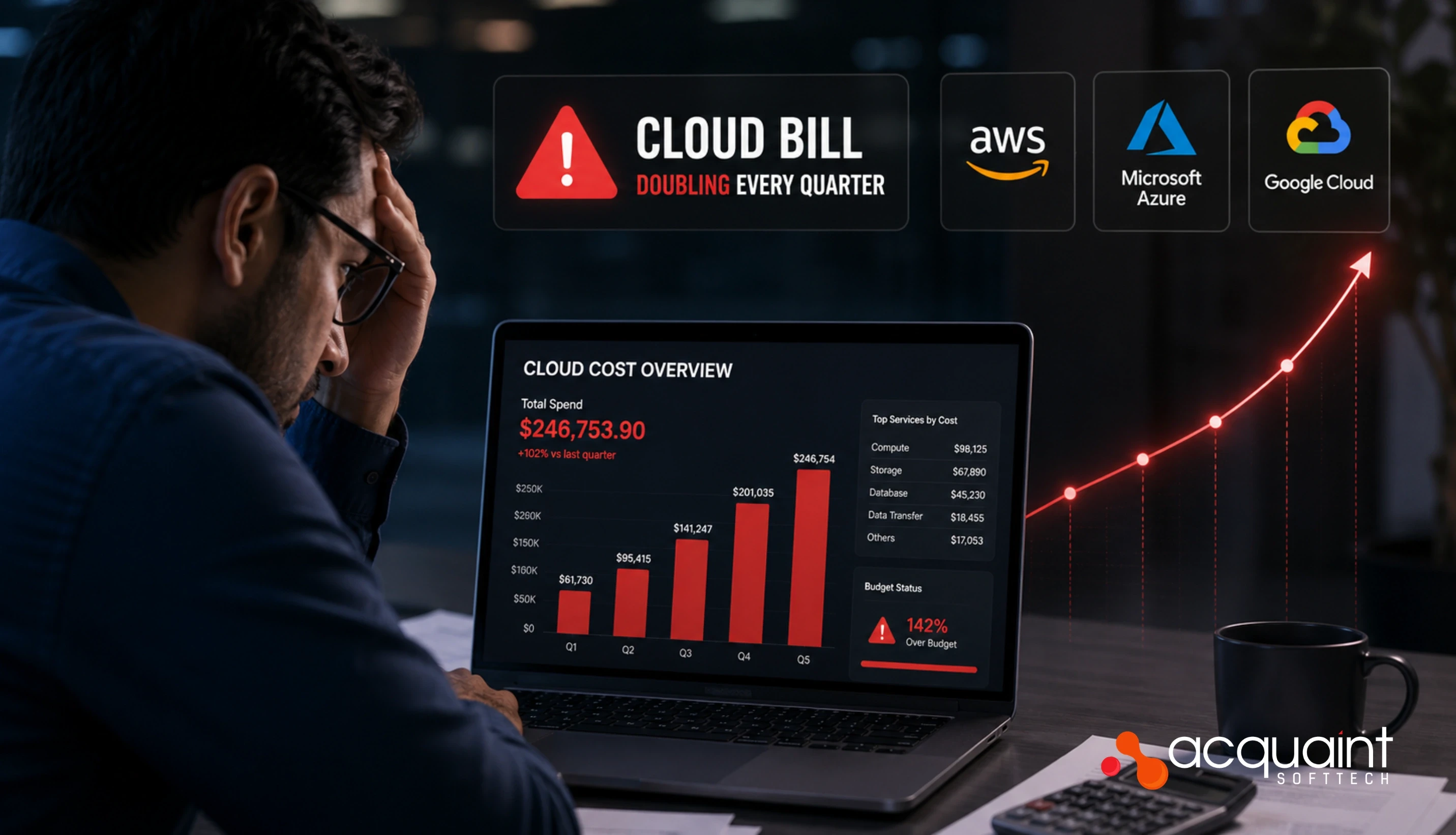
Cloud Bill Doubling Every Quarter: What a DevOps Engineer Finds and Fixes in 30 Days
AWS bill doubling every quarter without a clear reason? A DevOps engineer typically finds 20 to 40% of cloud spend as waste. Here are the 7 categories they fix first.
Taukir katava
May 8, 2026India (Head Office)
203/204, Shapath-II, Near Silver Leaf Hotel, Opp. Rajpath Club, SG Highway, Ahmedabad-380054, Gujarat
USA
7838 Camino Cielo St, Highland, CA 92346
UK
The Powerhouse, 21 Woodthorpe Road, Ashford, England, TW15 2RP
New Zealand
42 Exler Place, Avondale, Auckland 0600, New Zealand
Canada
141 Skyview Bay NE , Calgary, Alberta, T3N 2K6