

AWS vs Azure vs GCP for SaaS Startups: Which Cloud and What DevOps Engineer Skills You Need in 2026
AWS, Azure, and GCP are not interchangeable for SaaS startups. The right choice depends on your stack, team, and what DevOps skills you need. Here is the honest 2026 comparison.

Taukir katava
As a DevOps Engineer at Acquaint Softtech, a software development partner, I have deployed production infrastructure on all three major cloud platforms for SaaS products, gaming platforms, and media infrastructure. The AWS vs Azure vs GCP question comes up in almost every new engagement where a startup has not yet committed to a platform. The honest answer is that all three are capable platforms for SaaS, but they have meaningfully different strengths, pricing models, and DevOps tooling ecosystems. The right choice depends on your specific situation, not on which platform has the best marketing at the time. This guide gives you the comparison a DevOps engineer actually uses.

- SaaS startup CTOs who have not yet committed to a cloud provider and need a decision framework before hiring a DevOps engineer
- Engineering leads on AWS who are questioning whether Azure or GCP would serve them better and want an honest comparison
- Founders about to hire a DevOps engineer and wanting to know what cloud-specific skills to ask for
- Teams evaluating their first cloud migration and needing to choose a platform before the DevOps engineer begins
The AWS vs Azure vs GCP debate is often framed as a technology question. Which platform has the best Kubernetes service? Which has the lowest storage pricing? These are secondary questions. The primary question is: which platform fits your team's existing tools, your hiring market, and the specific services your application needs? A DevOps engineer who have worked on all three can tell you that the platform matters less than getting the architecture right on whichever platform you choose.
For SaaS startups already on AWS and evaluating CI/CD options, the AWS CodePipeline vs GitHub Actions guide covers the CI/CD decision within the AWS ecosystem. This article covers the higher-level cloud platform selection decision.
Platform Overview: What Each Cloud Is in Plain English
Amazon Web Services (AWS)
The market leader. AWS has been the default choice for SaaS startups since 2010. The broadest service catalogue, the largest DevOps hiring pool, the most community resources, and the most third-party integrations. AWS documentation is the most comprehensive of the three platforms and the most questions on Stack Overflow have AWS answers.
The tradeoff: AWS is the most complex platform. The number of services and configuration options can be overwhelming. Pricing is detailed and can be difficult to predict without CloudWatch cost monitoring configured from day one.
Microsoft Azure
Azure's strength is in the Microsoft ecosystem. If your product runs on .NET, your team uses Microsoft 365, your enterprise clients are on Azure Active Directory, or you have a Microsoft Partner Agreement, Azure is the natural fit. Azure's Kubernetes service (AKS) and DevOps tooling (Azure DevOps) are mature and well-integrated.
The tradeoff: Azure has historically had more service gaps than AWS. The documentation can be inconsistent. The DevOps hiring pool for Azure specialists is smaller than AWS. Azure is the right choice for Microsoft-ecosystem companies, not the default choice for stack-agnostic startups.
Google Cloud Platform (GCP)
GCP's strengths are in data, machine learning, and Kubernetes. GCP invented Kubernetes (Kubernetes was originally Google's internal system, Borg). Google Kubernetes Engine (GKE) is widely regarded as the most mature managed Kubernetes service. BigQuery for analytics is significantly cheaper and faster than AWS alternatives for large-scale data workloads.
The tradeoff: GCP has the smallest market share and the smallest DevOps hiring pool of the three. Fewer third-party integrations, less community content, and Google's history of deprecating services (Google Cloud IoT Core, Google Stadia) creates enterprise adoption hesitancy that has kept GCP as a secondary choice for most startups.
Side-by-Side Comparison: 10 Dimensions That Matter for SaaS
Dimension | AWS | Azure | GCP |
Market share (2026) | ~33% (largest) | ~22% (second) | ~11% (third) |
Best for | Most SaaS startups. Default choice. | Microsoft ecosystem, .NET, enterprise | Data-heavy, ML/AI, Kubernetes-first |
Kubernetes service | EKS (solid, newer) | AKS (mature, well-integrated) | GKE (most mature, Kubernetes origin) |
CI/CD native tooling | CodePipeline + CodeBuild | Azure DevOps (mature) | Cloud Build (capable, less popular) |
Database services | RDS, DynamoDB, Aurora | SQL Database, Cosmos DB | CloudSQL, Firestore, Bigtable |
DevOps hiring pool | Largest | Medium | Smallest |
Free tier | Generous (12 months) | Generous (12 months) | Generous (always free tier) |
Pricing predictability | Complex - CloudWatch required | Medium complexity | Simpler pricing model |
Support documentation | Most comprehensive | Good, inconsistent | Good for GCP services |
Third-party integrations | Most extensive | Strong (Microsoft ecosystem) | Growing but smaller |
For teams who have chosen AWS and are planning their first cloud migration, the startup cloud migration guide covers the 8-component setup sequence and what to budget for a first AWS migration in 2026.
Not Sure Which Cloud Platform Fits Your SaaS Stack?
Tell Acquaint Softtech your application stack, your team's existing tools, and your target market. A vetted DevOps engineer will recommend the right cloud platform for your situation and send a matched profile within 24 hours.
The Decision Framework: 5 Questions That Choose the Platform
Most SaaS startups land clearly on one platform after the first two questions. Run your situation through these five before briefing your DevOps engineer, as briefing them correctly on the platform decision save the first sprint.
Q1: What is your application stack? |
Node.js, Python, PHP, Ruby on any framework: AWS is the default. .NET, C#, or any Microsoft technology: Azure is the natural fit. Python with heavy ML/AI workloads (TensorFlow, PyTorch, BigQuery analytics): GCP is worth evaluating seriously. |
Q2: Do you have existing Microsoft licensing or enterprise clients on Azure? |
Yes: Azure makes business sense beyond the technical decision. Your enterprise clients may already have Azure AD, Azure DevOps, or Microsoft 365 integrations that make Azure the smoother path. No: AWS or GCP based on technical merits. |
Q3: Is Kubernetes your primary deployment target? |
Yes, and it is central to your architecture: GKE on GCP is the most mature managed Kubernetes service. For most startups, EKS on AWS or AKS on Azure are both excellent and the hiring pool is larger. No: All three platforms handle standard EC2/VM or container deployments equally well. |
Q4: What cloud platform does your DevOps engineer know best? |
The platform your DevOps engineer knows deeply is better than the platform that looks best on paper. A DevOps engineer with 3 years of AWS production experience will produce a better AWS setup than an equally skilled engineer learning GCP for the first time. The platform decision and the hiring decision are connected. |
Q5: What is the size and depth of your local DevOps hiring market? |
If you plan to hire multiple DevOps engineers over the next 2 years, AWS has the largest talent pool in every market. GCP specialists are the hardest to find. This matters more at scale than at a single engineer stage. |
For teams who have selected AWS and want to control infrastructure costs from day one, the cloud infrastructure cost optimisation guide covers the 8 waste categories to configure correctly at setup so the bill does not double in year one.
DevOps Engineer Skills by Platform: What to Ask For
The DevOps skills your engineer need depends directly on the platform you choose. These are the specific certifications and tool expertise to ask for when hiring by cloud platform.
Skill area | AWS DevOps engineer | Azure DevOps engineer | GCP DevOps engineer |
Core certification | AWS Certified DevOps Engineer - Professional | Microsoft Certified: DevOps Engineer Expert | Google Professional DevOps Engineer |
Kubernetes | AWS EKS (Elastic Kubernetes Service) | Azure AKS (Azure Kubernetes Service) | Google GKE (Google Kubernetes Engine) |
CI/CD native | AWS CodePipeline, CodeBuild, CodeDeploy | Azure DevOps Pipelines, Azure Repos | Cloud Build, Cloud Deploy |
Infrastructure as Code | Terraform (cloud-agnostic) or CloudFormation | Terraform or Azure Bicep / ARM templates | Terraform or Deployment Manager |
Monitoring | CloudWatch, AWS X-Ray, Prometheus + Grafana | Azure Monitor, Application Insights | Cloud Monitoring, Cloud Trace |
Secrets management | AWS Secrets Manager, SSM Parameter Store | Azure Key Vault | Secret Manager |
Serverless | AWS Lambda, API Gateway | Azure Functions, API Management | Cloud Functions, Cloud Run |
Hiring pool depth (2026) | Largest - most DevOps engineers know AWS | Medium - Microsoft ecosystem specialists | Smallest - GCP specialists harder to find |
Acquaint Softtech's hire DevOps engineers service provides pre-vetted engineers with verified production experience on AWS, Azure, and GCP. Every engineer profile includes the specific platform certifications and production deployment history. Matched profile in 24 hours.
For the DevOps engineer rate comparison by region and seniority, the DevOps engineer cost guide covers what each price tier delivers. Acquaint Softtech's starting rate is $22/hour or $3,200/month.
Know Which Cloud Platform You Need? Get a DevOps Engineer With Verified Experience on It.
Tell Acquaint Softtech your cloud platform (AWS, Azure, or GCP) and the specific services you use. We match you to a DevOps engineer with verified production experience on your platform and send a profile within 24 hours.
Multi-Cloud and Cloud-Agnostic Approaches: When They Make Sense
Some SaaS teams run workloads across multiple cloud providers. Here is when this makes sense and when it adds complexity without benefit.
When multi-cloud makes sense
Specific service advantages: You use AWS for compute (largest EC2 selection) and GCP BigQuery for analytics (significantly cheaper for large-scale SQL queries). Each workload on its best platform.
Enterprise client requirements: A B2B SaaS with enterprise clients who require data in specific cloud environments (some require AWS GovCloud, others Azure for GDPR).
Disaster recovery: Primary workload on AWS, disaster recovery on Azure. Different cloud availability zone failures do not share the same failure domain.
When multi-cloud adds unnecessary complexity
Early-stage startups: Managing two cloud platforms with one DevOps engineer requires 2x the platform knowledge. Single-cloud is the right choice at the 1 to 3 engineer stage.
Cost optimisation without performance benefit: Running workloads across clouds to get marginally lower pricing on specific services rarely justifies the operational overhead of maintaining two billing accounts, two IAM systems, and two monitoring stacks.
For individual DevOps capacity on a monthly retainer, Acquaint Softtech's staff augmentation model provides a dedicated engineer at $22/hour or $3,200/month. Available in 48 hours.
For teams building their first product on cloud and needing both DevOps and product development together, Acquaint Softtech's software product development service covers the full product team structure.
For a vendor-managed DevOps team covering cloud setup and broader infrastructure, our dedicated development teams service provides the full team structure.
Ready to Get Started on Your Chosen Cloud Platform? Acquaint Softtech Has Engineers Available Now.
Pre-vetted DevOps engineers with verified AWS, Azure, and GCP production experience. Starting at $22/hour or $3,200/month. Matched to your platform in 24 hours. Engineer in your standup in 48 hours.
Frequently Asked Questions
-
Which cloud is best for SaaS startups in 2026?
AWS is the default recommendation for most SaaS startups: largest service catalogue, largest DevOps hiring pool, most community resources. Azure is the right choice for Microsoft-ecosystem companies or those with enterprise clients on Azure AD. GCP is the right choice for data-heavy or ML-first applications, or for teams fully committed to Kubernetes as the primary deployment model.
-
What is the difference between AWS and Azure for DevOps?
AWS uses CodePipeline, CodeBuild, and CodeDeploy for native CI/CD with IAM for access management. Azure uses Azure DevOps Pipelines with Azure Active Directory. AWS has a larger DevOps hiring pool and more third-party CI/CD integrations. Azure is more natural for teams already in the Microsoft ecosystem.
-
Is GCP better than AWS for Kubernetes?
Google Kubernetes Engine (GKE) is widely regarded as the most mature managed Kubernetes service, since Kubernetes originated from Google's internal system. For teams whose primary deployment model is Kubernetes, GKE is a strong choice. For most SaaS startups, AWS EKS is sufficient and the larger hiring pool and ecosystem are more valuable.
-
What DevOps skills should I ask for when hiring for AWS?
Ask for: AWS EKS or ECS experience for container workloads, Terraform or CloudFormation for infrastructure as code, AWS CodePipeline or GitHub Actions with AWS deployment for CI/CD, CloudWatch for monitoring, and AWS Certified DevOps Engineer - Professional certification as a baseline signal.
-
How much does a DevOps engineer cost for AWS vs Azure vs GCP?
The platform does not significantly affect the rate. Acquaint Softtech DevOps engineers with AWS, Azure, or GCP experience all start at $22/hour or $3,200/month on a monthly retainer. GCP specialists may be slightly harder to source due to the smaller hiring pool, which can affect availability but not the rate.
-
Can a DevOps engineer work across multiple cloud platforms?
Yes. Most senior DevOps engineers have worked on at least two of the three major platforms. Terraform as infrastructure as code is platform-agnostic. A DevOps engineer with AWS and Azure experience can typically get productive on GCP within 2 to 4 weeks. Full platform expertise takes 6 to 12 months.
-
Should a startup choose a cloud provider based on cost?
Pricing is similar enough across the three platforms that cost should not be the deciding factor at startup scale. At $300 to $900/month in cloud spend, the difference between AWS, Azure, and GCP pricing is typically under $50/month. The deciding factors should be team expertise, hiring pool, and service fit for your application.
Taukir Katava is a DevOps Engineer at Acquaint Softtech with 4+ years of experience across AWS, Azure, and GCP. He specialises in Kubernetes cluster administration, CI/CD pipeline automation, and cloud infrastructure design for high-traffic platforms. Taukir writes about the practical side of production DevOps: what infrastructure decisions cost and what they actually deliver.
Table of Contents
Get Started with Acquaint Softtech
- 13+ Years Delivering Software Excellence
- 1300+ Projects Delivered With Precision
- Official Laravel & Laravel News Partner
- Official Statamic Partner
Related Reading
The Complete Guide to Hiring a DevOps Engineer in 2026: CI/CD, Cloud, Kubernetes, and What It All Costs
Everything you need before hiring a DevOps engineer in 2026. What the role covers, CI/CD to Kubernetes, what it costs in India vs the US, and how to start with a vetted engineer in 48 hours.

Acquaint Softtech
May 1, 2026
In-House DevOps Engineer vs Outsourcing: The Real Total Cost of Ownership for 2026
In-house DevOps engineers cost 3x to 5x more than outsourced when you count the full total cost of ownership. Here is the honest 3-year comparison and when each model actually makes sense.

Mukesh Ram
May 25, 2026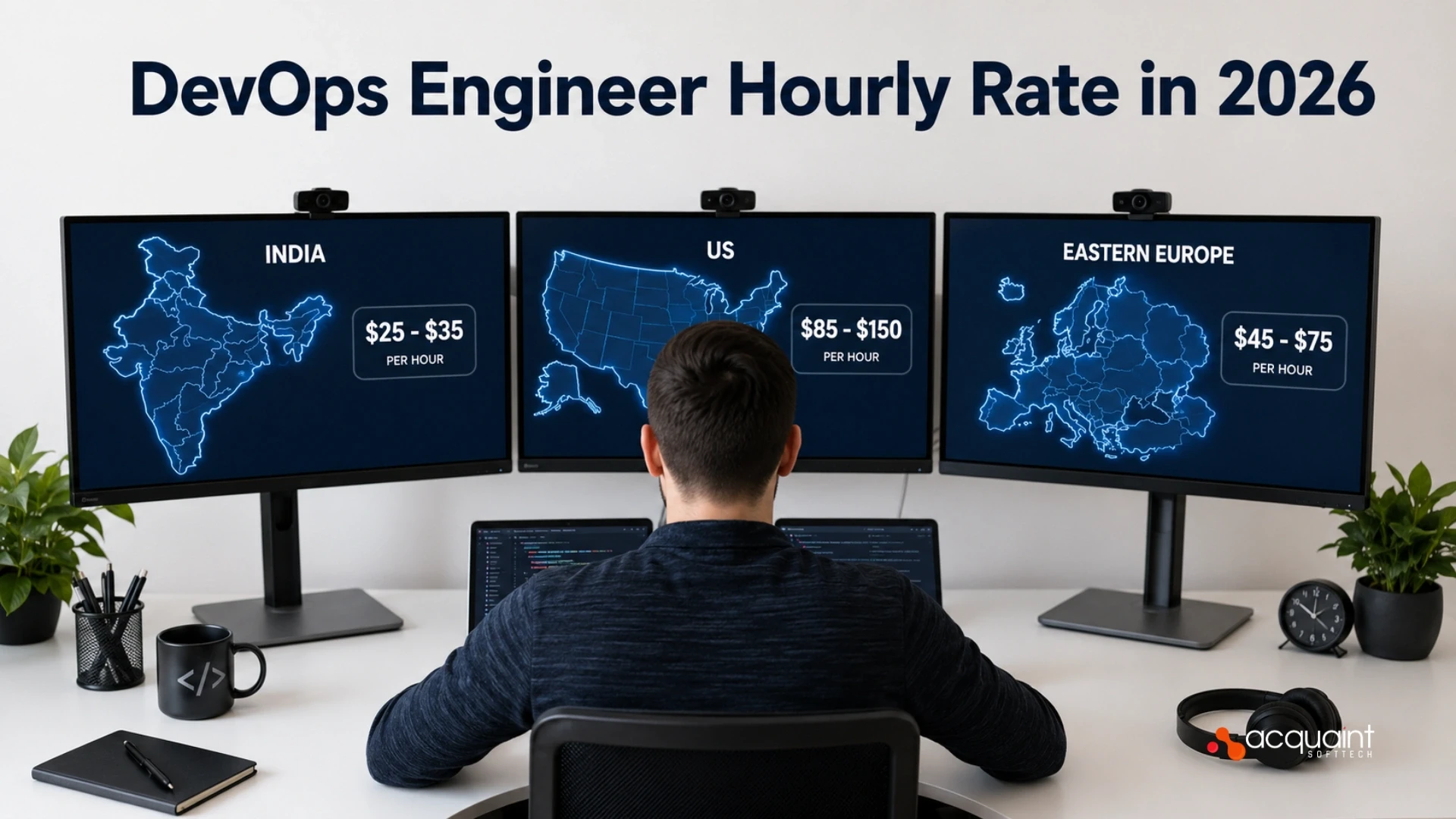
DevOps Engineer Hourly Rate in 2026: India vs US vs Eastern Europe - The Honest Rate Comparison
DevOps engineer rates in 2026 range from $22/hour in India to $100+ in the US for the same seniority level. Here is the honest regional rate comparison and what each price tier actually delivers.

Ahmed Ginani
May 21, 2026India (Head Office)
203/204, Shapath-II, Near Silver Leaf Hotel, Opp. Rajpath Club, SG Highway, Ahmedabad-380054, Gujarat
USA
7838 Camino Cielo St, Highland, CA 92346
UK
The Powerhouse, 21 Woodthorpe Road, Ashford, England, TW15 2RP
New Zealand
42 Exler Place, Avondale, Auckland 0600, New Zealand
Canada
141 Skyview Bay NE , Calgary, Alberta, T3N 2K6