

Moving Your Startup to the Cloud for the First Time: What a DevOps Engineer Sets Up and What to Budget in 2026
Moving a startup to the cloud for the first time is not a simple lift-and-shift. Here is what a DevOps engineer sets up, in what order, and what to budget in 2026.

Taukir katava
As a DevOps Engineer at Acquaint Softtech, a software development partner, I have set up cloud infrastructure for startups moving from shared hosting, a single VPS, or a local server to a production-grade cloud environment for the first time. The first cloud migration is different from a like-for-like infrastructure move. It is an opportunity to build the foundation correctly so the platform can scale without a complete rebuild six months later. This guide covers what gets built, in what order, and what to budget for a first-time cloud migration in 2026.

- Startup CTOs whose product currently runs on a single VPS or shared hosting and is growing beyond what that infrastructure can handle
- Founders who have been told 'you need to move to AWS' but do not know what that actually means in terms of what gets built and what it costs
- Engineering leads preparing to migrate their first production application to a cloud environment and wanting a realistic scope and budget
- Teams whose current infrastructure cannot handle traffic spikes and who are evaluating cloud migration as the solution
A first-time cloud migration is not simply copying your current setup onto cloud servers. A startup that migrates a single-server architecture to a single EC2 instance has paid for cloud without gaining any of the benefits: auto-scaling, high availability, managed database failover, or CDN delivery. A DevOps engineer doing a first-time cloud migration build the target architecture correctly from the start so you do not pay to rebuild it in 12 months.
For startups who have already migrated but are now facing traffic spike crashes, the traffic spike infrastructure guide covers the auto-scaling and load balancing layer that prevents crashes at scale. This article focuses on what the initial cloud setup looks like for a startup migrating for the first time.
What a DevOps Engineer Actually Builds: The 8 Core Components

A production-grade first cloud setup for a startup involves eight components. Most teams migrating for the first time have only a subset of these. A DevOps engineer builds the complete set so the foundation is right from day one.
1. VPC and Network Architecture
A Virtual Private Cloud (VPC) is the private network boundary inside AWS, Azure, or GCP. Inside the VPC, a DevOps engineer creates: public subnets (for load balancers and bastion hosts), private subnets (for application servers and databases), security groups (firewall rules for each tier), and internet gateway plus NAT gateway configuration. Getting the VPC design right at the start prevents a complete network rebuild later. Setup time: 1 to 2 days.
2. Application Server Setup (EC2, ECS, or App Service)
The application runs on EC2 instances, ECS containers, or Azure App Service depending on whether the application is containerised. A DevOps engineer provisions the compute layer, configures the operating system and runtime dependencies, sets up SSH key management, and deploys the application for the first time. For containerised applications, this includes a Docker registry (ECR or Azure Container Registry) and container orchestration setup. Setup time: 1 to 3 days.
3. Managed Database (RDS or CloudSQL)
A DevOps engineer migrates the database to a managed service: AWS RDS, Google CloudSQL, or Azure Database. Managed databases provide automated backups, point-in-time recovery, and Multi-AZ failover for an additional cost. This eliminates the need for manual database administration and provides the reliability SLA that a self-managed database server cannot match. Database migration includes schema validation and a data migration cutover plan. Setup time: 1 to 2 days.
4. Load Balancer and Auto-Scaling
An Application Load Balancer distributes traffic across multiple application instances. An Auto Scaling group adds instances when traffic increases and removes them when traffic drops. For a first-time migration, a DevOps engineer configures both with sensible defaults for the startup's current traffic level and sets scale-up thresholds appropriate to the application's traffic patterns. Setup time: 1 to 2 days.
5. CDN and Static Asset Delivery
CloudFront (AWS), Azure Front Door, or GCP Cloud CDN serves static assets from edge nodes close to users. This reduces origin server load and dramatically improves page load times for international users. A DevOps engineer configures the CDN with S3 or Blob storage as the origin for static assets and the ALB as the origin for dynamic requests. Setup time: 0.5 to 1 day.
6. CI/CD Pipeline
Without a deployment pipeline, every update to the application requires manual SSH access to the server. A DevOps engineer sets up a CI/CD pipeline on the cloud platform (AWS CodePipeline, GitHub Actions with AWS deployment, or Azure DevOps) so that code pushed to the main branch triggers an automated build, test, and deployment sequence. Setup time: 2 to 4 days.
7. Monitoring and Alerting
A DevOps engineer configures CloudWatch (AWS), Azure Monitor, or Cloud Monitoring (GCP) with dashboards for CPU, memory, request rate, error rate, and database connection count. Alerts are configured to notify the engineering team when metrics cross defined thresholds. Without monitoring, the team discovers problems from user reports rather than from infrastructure signals. Setup time: 1 to 2 days.
8. Backup and Disaster Recovery
Automated database snapshots, S3 versioning for critical files, and a documented restore procedure. A DevOps engineer tests the restore procedure at least once during the setup to confirm it works before the platform is live. Setup time: 0.5 to 1 day.
For startups planning to move to Kubernetes as part of the migration or shortly after, the CI/CD for Kubernetes guide covers what the EKS-specific CI/CD setup adds on top of the standard cloud migration foundation described above.
Moving to the Cloud for the First Time? Get a Migration Plan Before You Start.
Tell Acquaint Softtech your current infrastructure (VPS, shared hosting, or self-hosted), your application stack, and your target cloud provider. A vetted DevOps engineer will send a migration plan for your specific setup within 48 hours.
The Migration Sequence: What Happens First
Not all eight components are built simultaneously. A DevOps engineer follow a specific sequence that minimises the cutover risk and ensures the platform is tested before traffic is migrated.
Phase 1: Foundation (Days 1 to 3) | VPC and network architecture. Security groups. IAM roles and access management. All subsequent components depend on this foundation being correct. This phase is infrastructure as code from the start (Terraform or CloudFormation) so the environment is reproducible and documented. |
Phase 2: Application and Database (Days 4 to 7) | Managed database provisioned. Data migrated with zero-loss validation. Application server setup and first successful deployment to the cloud environment. The application is running in the cloud but not yet serving live traffic. |
Phase 3: Traffic Layer (Days 8 to 10) | Load balancer and auto-scaling configured. CDN set up for static assets. CI/CD pipeline connected to the cloud deployment target. The full traffic path is tested end to end with synthetic traffic before any live users are migrated. |
Phase 4: Cutover and Handoff (Days 11 to 14) | DNS cutover from old hosting to new cloud environment. Monitoring and alerting active. The old environment kept running for 48 to 72 hours as rollback option. Documentation and runbook delivered. |
For startups concerned about ongoing cloud infrastructure cost after migration, the cloud infrastructure cost optimisation guide covers the 8 waste categories to configure correctly from day one to avoid a doubling cloud bill in the first year.
What It Costs in 2026: Budget Guide
The cost of a first cloud migration have two components: the DevOps engineer time to set it up, and the ongoing monthly cloud infrastructure cost. Here are the 2026 numbers at Acquaint Softtech rates.
Migration scenario | DevOps cost at $22/hour | Ongoing cloud cost (monthly) |
Simple: single app, no containers, AWS | 8 to 12 days: $1,408 to $2,112 | $150 to $500/month (EC2+RDS+ALB) |
Standard: containerised app, CI/CD, monitoring | 12 to 18 days: $2,112 to $3,168 | $300 to $900/month |
Complex: multi-service, EKS, full observability | 18 to 25 days: $3,168 to $4,400 | $600 to $2,000/month |
Monthly retainer (migration + ongoing ownership) | $3,200/month | Cloud costs billed separately |
What 'ongoing cloud cost' includes for a standard startup setup
EC2 instances (2x t3.medium in Auto Scaling group): approx $60 to $120/month
RDS (db.t3.medium, Multi-AZ): approx $100 to $160/month
Application Load Balancer: approx $18/month + data transfer
CloudFront CDN: approx $10 to $50/month depending on traffic
S3 storage and data transfer: approx $5 to $30/month
CloudWatch monitoring: approx $10 to $30/month
NAT Gateway: approx $30 to $80/month
Total for a standard startup cloud setup: approx $233 to $488/month This is the starting point. The bill grows with traffic and new features. A DevOps engineer configures the setup to minimise waste from day one.
Acquaint Softtech's hire DevOps engineers service provides vetted engineers with first-time cloud migration experience across AWS, Azure, and GCP. Starting at $22/hour or $3,200/month on a monthly retainer.
For the full DevOps engineer rate comparison by region and seniority, the DevOps engineer cost guide covers what each price tier delivers in a cloud migration engagement.
Want a Realistic Budget for Your Specific Cloud Migration?
Tell Acquaint Softtech your current infrastructure, application stack, and target cloud provider. A DevOps engineer will send a specific cost estimate for your migration and a matched profile within 24 hours.
Common First-Time Migration Mistakes a DevOps Engineer Prevents

First-time cloud migrations fail for predictable reasons. A DevOps engineer who has done this before prevents the most expensive ones from the start.
Migrating the same broken architecture to the cloud
Single-server setups migrated to a single EC2 instance gain cloud billing without any cloud benefits. Auto-scaling, high availability, and managed services are the reason to move to cloud. A DevOps engineer builds the target architecture, not a copy of the old one.
Not testing the restore procedure before going live
Most teams configure automated backups but never test whether they can actually restore from them. A DevOps engineer tests the database restore procedure before DNS cutover so the team knows recovery works before it is needed.
Skipping Infrastructure as Code
Manual click-through setup in the AWS Console cannot be reproduced, audited, or rolled back. A DevOps engineer configures the entire setup as Terraform or CloudFormation code from day one. The infrastructure is version-controlled and reproducible.
Going live without monitoring
Migrating to cloud and not configuring CloudWatch alerts means the team discovers problems from user reports rather than from infrastructure signals. Monitoring is set up before DNS cutover, not after the first production incident.
For individual DevOps engineer capacity on a monthly retainer, Acquaint Softtech's staff augmentation model provides a dedicated engineer at $3,200/month. Available in 48 hours.
For a full product development team including DevOps for teams building their first product on the cloud, Acquaint Softtech's software product development service covers the full product team structure.
For a vendor-managed DevOps team beyond a single engineer, our dedicated development teams service covers the full engagement including PM, DevOps, and QA.
Ready to Move Your Startup to the Cloud? Acquaint Softtech Has DevOps Engineers Available This Week.
Pre-vetted DevOps engineers with first-time cloud migration experience on AWS, Azure, and GCP. Starting at $22/hour or $3,200/month. Migration plan delivered in 48 hours. Engineer in your standup in 48 hours.
Frequently Asked Questions
-
What does cloud migration involve for a startup?
A first-time cloud migration involves: VPC and network setup, managed database provisioning and data migration, application server deployment, load balancer and auto-scaling configuration, CDN setup, CI/CD pipeline, monitoring and alerting, and backup configuration. A DevOps engineer builds all 8 components in a structured 14-day sequence.
-
How much does it cost to move a startup to the cloud?
At Acquaint Softtech's rate of $22/hour, a standard first-time cloud migration takes 12 to 18 days and costs $2,112 to $3,168 for the DevOps engineer time. Ongoing cloud infrastructure costs for a standard startup setup run $300 to $900/month depending on traffic and services used.
-
How long does a first cloud migration take?
A DevOps engineer completes a standard first-time cloud migration in 14 to 18 working days. Simple single-application migrations take 8 to 12 days. Complex multi-service or containerised migrations take 18 to 25 days. The application is tested in the cloud before DNS cutover, with the old environment kept live for 48 to 72 hours as a rollback option.
-
Which cloud provider should a startup use for a first migration?
AWS is the most common choice for startups in 2026: largest free tier, widest DevOps hiring pool, most extensive documentation, and the most services available for standard SaaS infrastructure. GCP is a strong alternative for data-heavy or machine learning applications. Azure is the right choice for startups already in the Microsoft ecosystem or with enterprise clients on Azure.
-
Can a DevOps engineer migrate without downtime?
Yes. A DevOps engineer builds the complete cloud environment and tests it with the production data before any DNS change. The cutover is a DNS update that takes 1 to 5 minutes. The old environment stays live for 48 to 72 hours as a rollback option. Zero planned downtime is achievable for most first-time migrations.
-
What is Infrastructure as Code and why does it matter for a first migration?
Infrastructure as Code (IaC) means the entire cloud setup is defined in code files (Terraform or CloudFormation) rather than configured manually in the cloud console. IaC means the environment can be reproduced, version-controlled, audited, and rolled back. A DevOps engineer who configures the first migration in IaC saves the team significant time on every future infrastructure change.
-
What does Acquaint Softtech charge for a startup cloud migration?
A standard first-time cloud migration takes 12 to 18 days at $22/hour. Total cost: $2,112 to $3,168. This is typically absorbed into the first month of a $3,200/month monthly retainer. Matched profile in 24 hours. Engineer in your standup in 48 hours.
Taukir Katava is a DevOps Engineer at Acquaint Softtech with 4+ years of experience across AWS, Azure, and GCP. He specialises in Kubernetes cluster administration, CI/CD pipeline automation, and cloud infrastructure design for high-traffic platforms. Taukir writes about the practical side of production DevOps: what infrastructure decisions cost and what they actually deliver.
Table of Contents
Get Started with Acquaint Softtech
- 13+ Years Delivering Software Excellence
- 1300+ Projects Delivered With Precision
- Official Laravel & Laravel News Partner
- Official Statamic Partner
Related Reading
Deployment Pipeline Taking Hours: What Hiring a DevOps Engineer Cuts It Down To
A deployment pipeline that takes hours is costing your business more than just developer time. Here is what a DevOps engineer diagnoses, fixes first, and delivers in the first 30 days.
Taukir katava
May 4, 2026
DevOps Engineer Hourly Rate in 2026: India vs US vs Eastern Europe - The Honest Rate Comparison
DevOps engineer rates in 2026 range from $22/hour in India to $100+ in the US for the same seniority level. Here is the honest regional rate comparison and what each price tier actually delivers.

Ahmed Ginani
May 21, 2026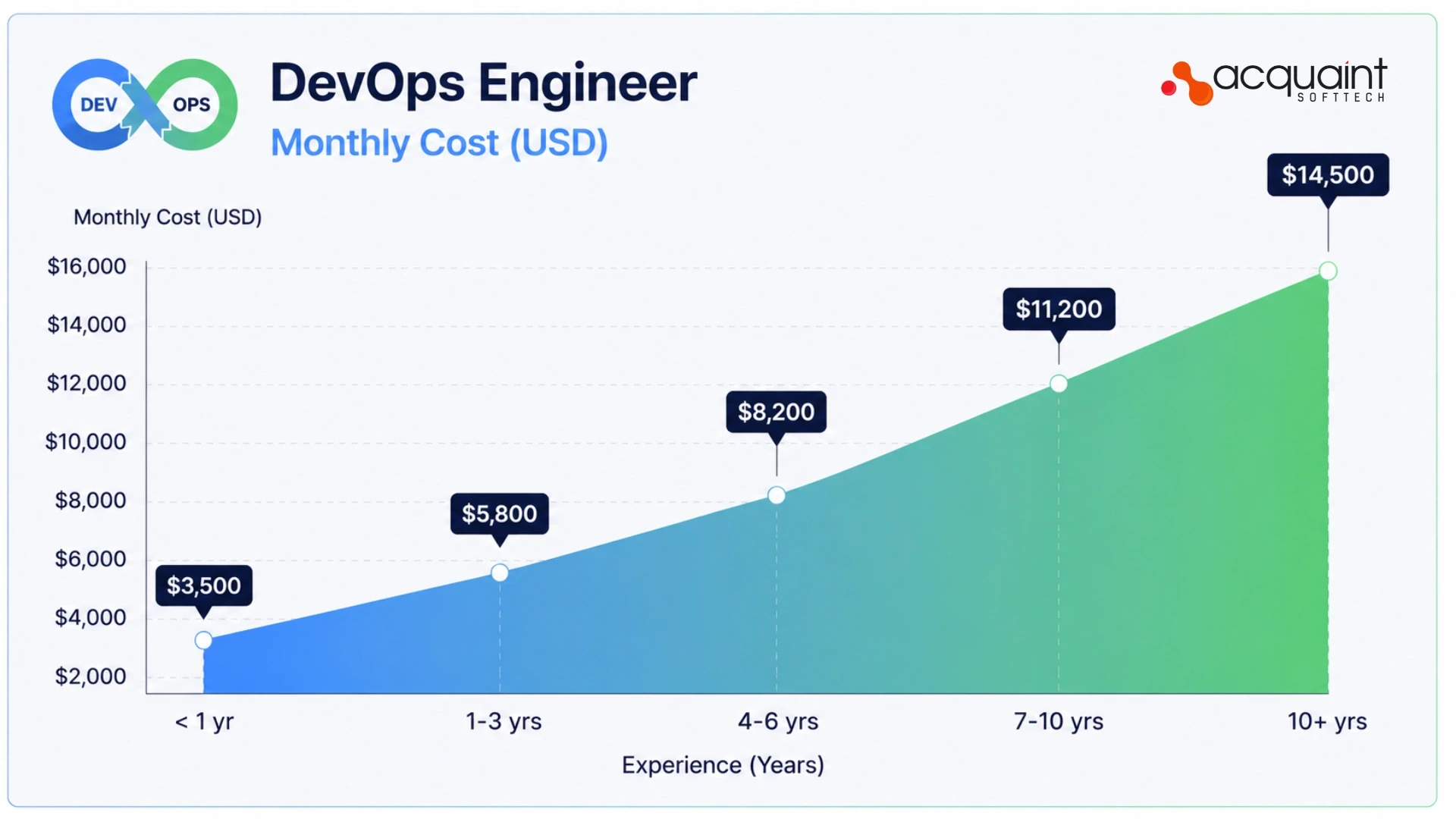
DevOps Engineer Monthly Cost: What Acquaint Softtech Clients Actually Pay in 2026
Acquaint Softtech DevOps engineers start at $22/hour or $3,200/month. Here is exactly what clients pay across different engagement types, what is included, and what each scenario delivers.

Mukesh Ram
May 22, 2026India (Head Office)
203/204, Shapath-II, Near Silver Leaf Hotel, Opp. Rajpath Club, SG Highway, Ahmedabad-380054, Gujarat
USA
7838 Camino Cielo St, Highland, CA 92346
UK
The Powerhouse, 21 Woodthorpe Road, Ashford, England, TW15 2RP
New Zealand
42 Exler Place, Avondale, Auckland 0600, New Zealand
Canada
141 Skyview Bay NE , Calgary, Alberta, T3N 2K6