

AI-Powered Guest Experience: Personalisation, Chatbots, and Predictive Service in Hospitality
AI-powered guest experience in hospitality is the use of machine learning, natural language processing, and predictive analytics to personalise every guest interaction from booking to checkout.

Manish Patel

- You are a hotel owner CTO, or product manager evaluating AI for guest experience
- You want to build or upgrade a hospitality chatbot personalization engine or concierge system
- You need to understand AI cost and implementation timeline in hospitality
- You are comparing off-the-shelf AI tools versus custom-built solutions
- You want predictive forecasting, sentiment analysis, or AI upsell features in your platform
- You are a travel startup building AI powered guest engagement features from scratch
What separates a hotel that consistently earns 4.8-star reviews from one stuck at 3.9, despite similar room quality and pricing? In 2026, the answer is almost always software. Specifically, whether the property has deployed AI systems that personalise every guest interaction before, during, and after the stay.
According to the EU Tourism Transition Pathway, the European Commission has placed access to data and AI at the core of its 2026 Sustainable Tourism Strategy, recognising that AI adoption directly determines the competitiveness of hotels, OTAs, and travel platforms across Europe and globally.
This is not a trend limited to large chains. Hotels with 10 rooms and OTAs with 50 employees are deploying AI-powered guest engagement tools that were enterprise-only two years ago. The cost of building these systems with a specialist AI development services partner has dropped significantly, and the ROI is now measurable within the first quarter of deployment.
This article covers every layer of AI-powered guest experience, from personalisation engines and hotel chatbots to predictive demand forecasting, contactless journeys, and guest sentiment analysis. It provides real cost benchmarks, case studies, and a build vs buy framework. It is part of the complete guide to travel and Hospitality Software Development, the master pillar covering the full travel technology stack.
Acquaint Softtech has delivered 1,300+ software projects across 20+ industries over 13+ years, with 70+ in-house engineers serving clients in the USA, UK, Europe, Australia, and New Zealand. Dedicated AI engineering teams deploy within 48 hours of a brief, with a 95% sprint delivery rate and a 4.9/5 rating from 50+ verified Clutch reviews. The insights in this guide are drawn directly from that delivery experience across hospitality AI projects, not from general research.
What Is AI-Powered Guest Experience in Hospitality?
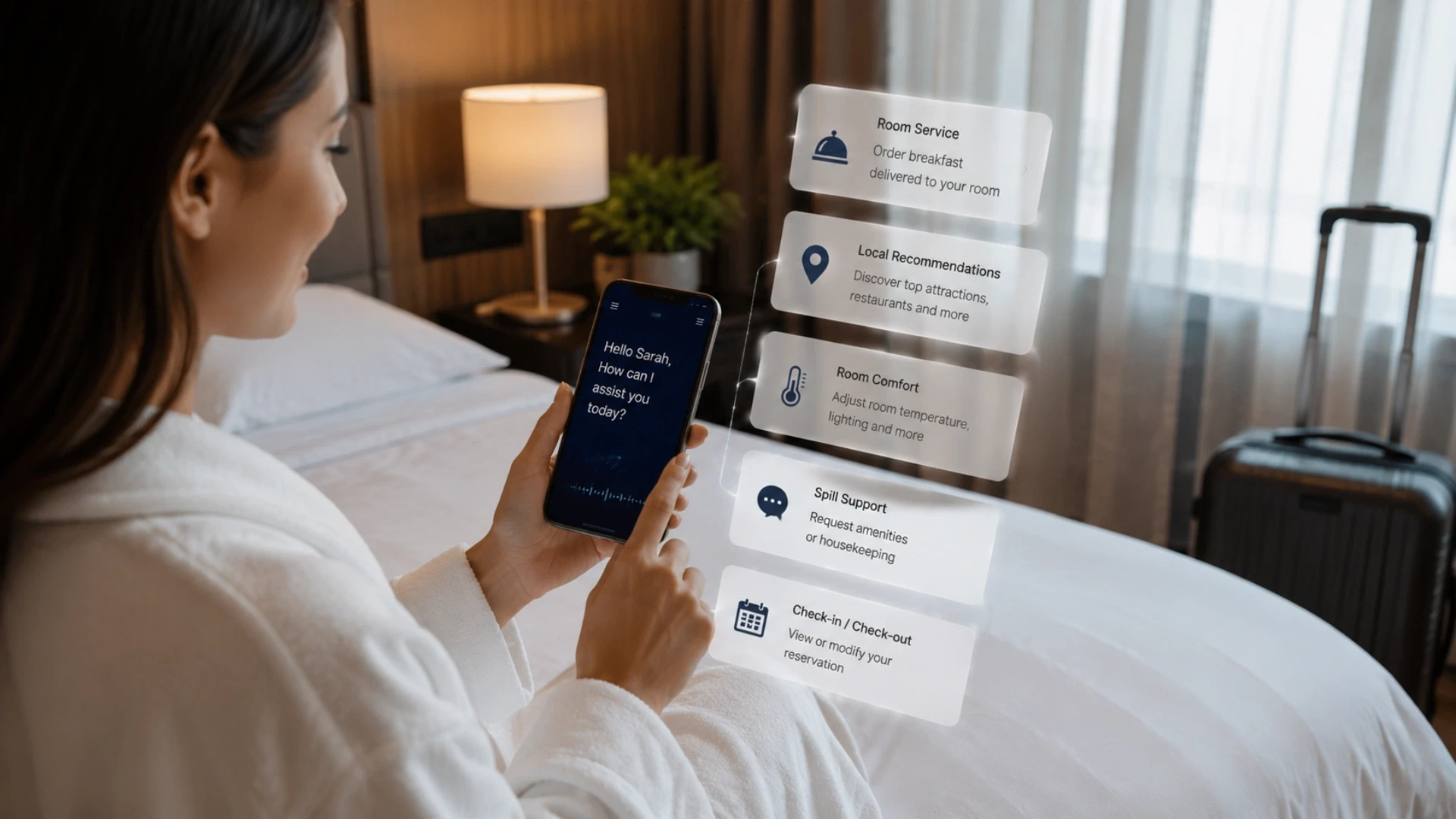
AI-powered guest experience is the application of machine learning, natural language processing, and behavioural analytics to personalise every stage of a hotel or travel booking journey. It moves hospitality operations from reactive service, responding after a guest asks, to predictive service, where the system anticipates what a guest needs before they articulate it.
The guest experience in a modern hotel or travel platform touches at least eight separate software systems: the booking engine, PMS, channel manager, CRM, POS, mobile app, loyalty platform, and communication layer. AI binds these systems together into a single intelligent layer that reads patterns across all of them and acts on those patterns in real time. In most implementations, backend systems are built using scalable frameworks such as Laravel, often supported by specialised development teams like hire Laravel developers to ensure stable integration across all modules.
Core AI Capabilities in Modern Hospitality Platforms
AI Capability | Where It Applies | Business Result |
Personalization Engine | Booking UI, email, in-app offers | Higher conversion and increased revenue |
Hotel Chatbot / Concierge | Pre-stay, in-stay, post-stay support | 24/7 service with reduced staff workload |
Demand Forecasting ML | Pricing and revenue management | Improved revenue performance |
Sentiment Analysis | Reviews, surveys, chat data | Faster issue detection and resolution |
Smart Room / IoT AI | HVAC, lighting, room controls | Reduced energy costs and improved efficiency |
For hotel chains and travel startups assessing AI for the first time, a structured Discovery Workshop maps which AI capabilities deliver the fastest ROI against existing data infrastructure, preventing the common mistake of training a personalisation model on guest data that is too fragmented to produce useful signals.
Why AI in Hospitality Is No Longer Optional in 2026
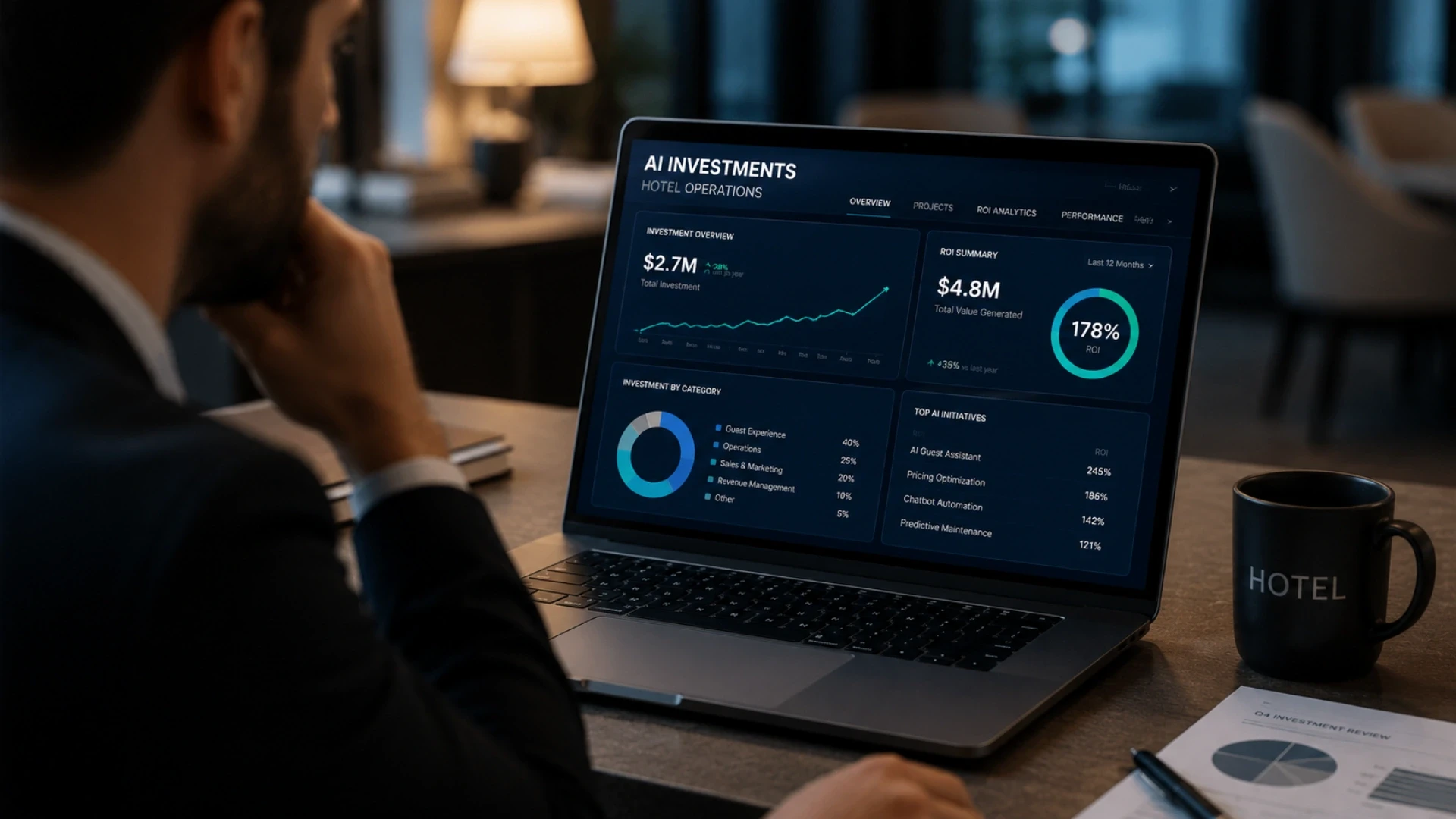
The hospitality AI adoption curve crossed a major milestone in 2025, with platforms like Booking.com, Expedia, and Marriott using AI personalisation as a core retention strategy. Businesses without it are seeing lower conversion rates compared to AI-enabled competitors.
Research shows strong ROI: 77% of users prefer automated messaging, ML-based forecasting improves RevPAR by 8 to 14 per cent, and AI chatbots increase satisfaction by up to 30 per cent. Expedia has also integrated conversational AI for trip planning directly into its booking app. Companies often work with experienced engineering partners like Hire Developers to build and scale these AI-powered hospitality systems.
What Is Driving AI Urgency in Hospitality in 2026?
Staff shortages across Europe, the USA, Australia, and New Zealand are making AI automation of routine guest interactions a financial requirement, not just a preference.
EU Regulation (EU) 2024/1028, effective May 2026, mandates standardised data-sharing by travel platforms including Airbnb, Booking.com, and Vrbo. Compliance tracking and data auditing for this regulation is increasingly handled by AI systems.
Review platform algorithms now incorporate sentiment scoring into ranking, meaning hotels without real-time sentiment monitoring lose search visibility even when service quality is high.
Post-stay hyper-personalisation drives re-booking. Hotels sending AI-triggered, behaviour-based messages within 72 hours of checkout achieve measurably higher direct booking return rates than broadcast email campaigns.
For hospitality teams that need AI engineering capability without building an internal ML team, IT staff augmentation services allow hotels and travel platforms to embed pre-vetted AI engineers into existing workflows within 48 hours, without the 3 to 6 month delay of direct hiring.
Building AI Personalisation Engines for Hotels
A hotel personalisation engine is a recommendation system that reads guest data signals including booking history, browse behaviour, loyalty tier, nationality, and past preferences, and uses those signals to serve contextually relevant content, offers, and pricing to each guest. The engine operates across booking UI, email, in-app messages, and front desk prompts.
How a Hotel Personalisation Engine Works
The data layer combines guest information from PMS, CRM a centralized UX research repository helps teams organize and connect qualitative findings with these quantitative signals. The model layer uses recommendation algorithms to understand preferences and intent. The delivery layer sends personalised offers across booking pages, emails, and check-in systems.
Hyper-personalisation enables individual-level targeting instead of broad segments, improving ancillary revenue by 12 to 22 per cent per stay. Hotels like Marriott and Hilton already use this approach, and most travellers prefer personalised AI-driven experiences over price alone.
The technical foundation combines Python-based ML models (collaborative filtering, matrix factorisation), a guest data platform (CDP) as the single source of truth, and a real-time feature store for low-latency recommendation serving. Hiring Python developers with prior experience in recommendation systems shortens the model training and A/B testing phase from months to weeks.
Build a Hotel Personalisation Engine That Actually Performs
Most hotel AI projects fail at the data layer, not the model layer. Acquaint Softtech starts every hospitality AI project with a data consolidation audit before any model is trained.
1,300+ projects delivered. 70+ in-house engineers. 95% sprint delivery rate. Dedicated team deployed within 48 hours. Up to 40% cost savings vs. Western agencies.
Hotel Chatbots and Virtual Concierge Systems
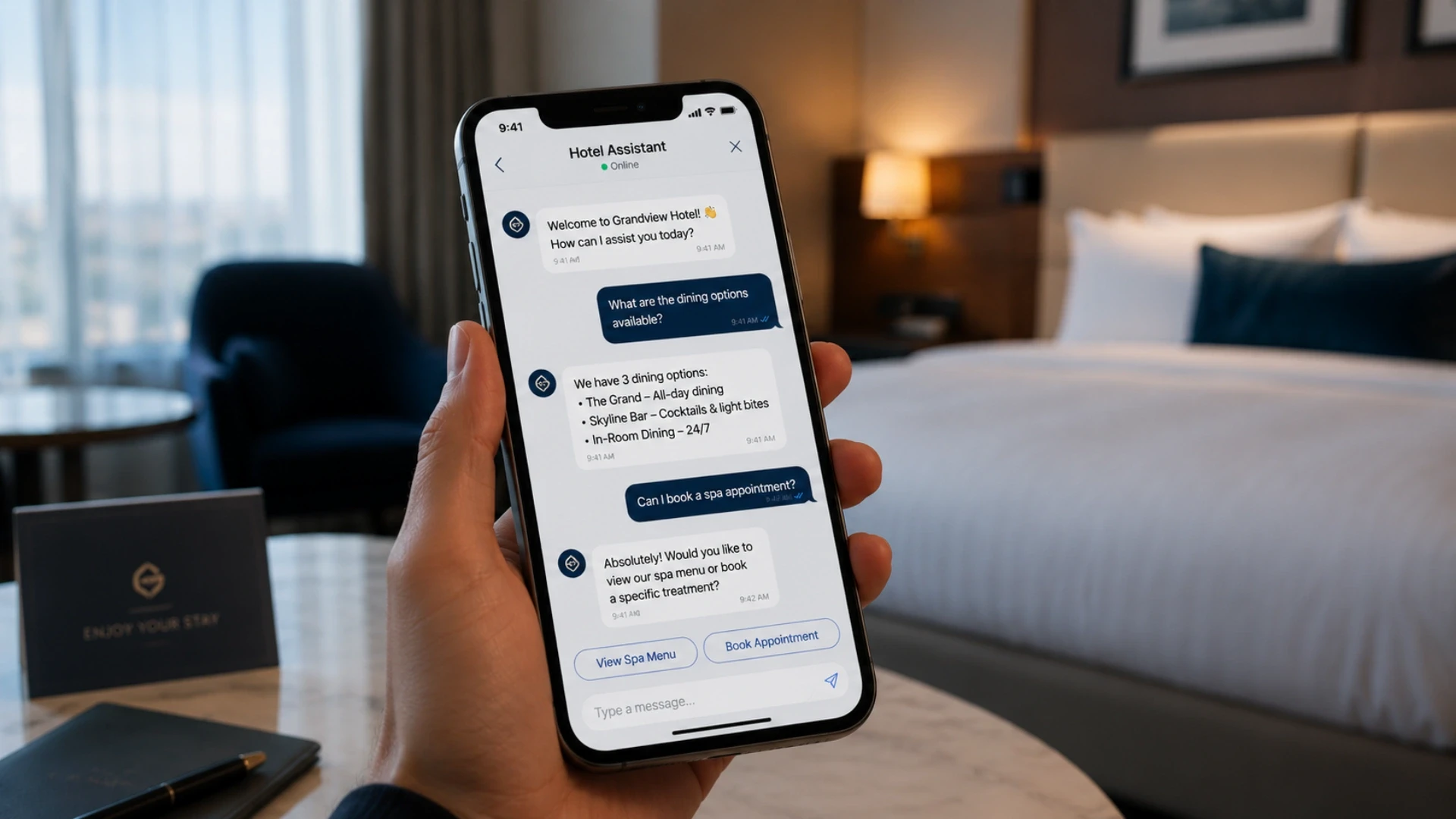
A hotel chatbot is an AI-powered conversational agent that handles guest queries, service requests, and booking interactions across WhatsApp, SMS, in-app chat, and web. A virtual concierge extends this to proactive engagement: rather than waiting for a guest to ask, it surfaces relevant information and offers based on context, such as a dining recommendation three hours before dinner or a spa availability message on a rainy afternoon.
Connecting the chatbot to an AI-driven CRM makes these proactive triggers sharper, since every recommendation draws on the guest's full interaction history. Development of such intelligent systems is often supported by backend expertise, such as hiring Django developers to ensure scalable, real-time conversational workflows.
What a Production Hotel Chatbot Handles in 2026
The hotel chatbot handles common guest needs such as check-in/check-out assistance, service requests, facility information, room upgrades, feedback collection, and loyalty queries, while escalating complex or frustrated cases to human agents. In production, it can automate 40% to 65% of guest interactions, reducing front desk workload by 20% to 35% within a few weeks of deployment.
The technical stack for a production hotel chatbot combines an NLP engine (Dialogflow, Rasa, or a fine-tuned LLM), a webhook integration layer connecting to the PMS and booking engine APIs, a conversation state manager, and a human handoff protocol. Building this with MERN stack developers for the frontend interface and Python for the NLP backend is the most efficient architecture for hospitality chatbot projects.
Pre-Stay, In-Stay, and Post-Stay: The Three Concierge Phases
Phase | Key Interactions | AI Function |
Pre-Stay | Confirmation, preferences, transport, upgrades | Preference collection, upsell timing |
In-Stay | Service requests, local recommendations, issue escalation | Sentiment monitoring, proactive triggers |
Post-Stay | Feedback, loyalty points, re-booking offers | NPS scoring, churn prediction, re-engagement |
Hotels building mobile-first guest communication should engage React Native developers for the app layer and Python AI engineers for the NLP backend within the same sprint cycle. Separating these teams across vendors is the most common cause of interface/intelligence synchronisation delays that push chatbot launches past deadlines.
Predictive Service: Demand Forecasting and Occupancy AI
Predictive service means the software acts on data before the guest or hotel manager asks it to. Demand forecasting models predict future occupancy by date segment, allowing dynamic pricing to adjust automatically. Predictive maintenance models flag equipment failures before they disrupt a guest stay.
Staffing algorithms model check-in volume by hour, preventing front desk queues on peak arrival days. In such data-driven systems, having the right infrastructure expertise is critical, which is where services like Hire DevOps Developers help ensure scalable and reliable deployment of predictive models.
How Hotel Demand Forecasting Works
A demand forecasting model for hotels uses historical occupancy data, forward-looking booking pace, local events calendars, competitor pricing signals from rate scraping, and macroeconomic seasonal factors as input features. The model, typically ARIMA, Facebook Prophet, or an LSTM neural network depending on the property's data volume, outputs predicted occupancy rates by date segment with confidence intervals. Revenue managers use these forecasts to set or approve dynamic pricing rules. Building a reliable model requires a minimum of 24 months of clean, labelled booking data.
The EU's Regulation (EU) 2024/1028, effective May 2026, mandates standardised data-sharing by travel platforms such as Airbnb and Booking.com. European hotel groups and OTAs are increasingly using AI-driven demand intelligence and compliance tracking as a direct response to these obligations, accelerating AI adoption across the continent.
Predictive Maintenance and Staffing Optimisation
Predictive maintenance uses IoT sensor data from HVAC, elevators, and plumbing to flag anomalies before they cause guest-facing failures. Properties using predictive maintenance report a 25% to 40% reduction in emergency maintenance costs and a measurable drop in maintenance-related negative reviews. Staffing optimisation models use historical check-in patterns, group booking data, and event calendars to recommend shift schedules, reducing both overstaffing costs and under-service complaints.
For travel platforms that need both data engineering and ML capability without building an internal team, software development outsourcing with a dedicated AI squad model provides the full stack from data pipeline to trained model to monitoring dashboard within a single engagement.
For further reading on how distributed ML engineering teams are structured for complex product builds, see: How to Build a Successful Remote Development Team.
Deploy a Dedicated AI Engineering Team in 48 Hours
Acquaint Softtech provides dedicated AI and ML engineers for hospitality demand forecasting, sentiment analysis, and recommendation engine projects.
Up to 40% cost savings vs. Western agencies. 95% sprint delivery rate. 24+ month average team tenure. 4.9/5 from 50+ verified Clutch reviews.
Contactless Guest Journey and Smart Room Technology
The contactless guest journey, digital check-in, mobile key provisioning, in-app room controls, and contactless checkout, moved from a pandemic response feature to a permanent guest expectation between 2022 and 2024. By 2026, guests across the USA, UK, Europe, Australia, and New Zealand expect contactless arrival as standard, and reviews mentioning front desk queues or key card failures register measurable negative sentiment impact on ranking algorithms.
What Is a Digital Check-In and Mobile Key System?
A digital check-in system lets guests complete arrival on their phone by verifying identity, choosing preferences, paying, and receiving a digital key via BLE or NFC. It integrates the hotel app with the PMS and smart lock systems using SDKs from providers like ASSA ABLOY, Dormakaba, or SALTO.
Building such solutions usually takes 6 to 10 weeks with an experienced team, and hiring specialised developers like Hire MEAN Stack Developers can significantly speed up development for apps that combine digital keys, AI concierge, and IoT-based room controls.
Smart Room AI: Voice, IoT, and Energy Management
Smart room technology uses AI and IoT to control HVAC, lighting, blinds, entertainment, and locks, automatically adjusting room settings based on guest preferences.
It helps improve comfort while reducing energy costs by up to 30% in some hotels and supports sustainability goals under regulations like the EU CSRD. Building such systems with voice control (Alexa or Google Nest) requires integrated AI, IoT, and mobile development in a single product team for effective implementation.
Guest Data Platforms and Sentiment Analysis
A guest data platform (CDP) is the foundational infrastructure that makes all other AI hospitality applications possible. It consolidates guest records from PMS, booking engine, loyalty system, POS, mobile app, and OTA channels into a single, deduplicated profile with stay history, spending patterns, communication preferences, and behaviorally inferred attributes.
Why Most Hotel AI Projects Underperform
Most hotel AI projects fail due to poor data quality rather than model performance. In most cases, guest data is fragmented across multiple systems without a single unique identifier, which reduces the accuracy of personalisation and predictive AI outputs.
Building a CDP requires a data engineering layer that aggregates inputs, applies identity resolution to deduplicate records, standardises schemas, and maintains a real-time feature store for model serving. This is typically an 8- to 16-week project before the first model is trained. Hotels with technical debt in legacy PMS or CRM systems should consider version upgrade services alongside CDP development to ensure source systems output clean, structured data.
Sentiment Analysis: From Reviews to Operational Intelligence
Sentiment analysis models read unstructured text from OTA reviews, in-stay surveys, chatbot transcripts, and social media mentions and classify sentiment by topic: room cleanliness, staff friendliness, breakfast quality, check-in speed. This allows hotel operations teams to see which service areas are generating negative sentiment before those themes dominate public review scores. Properties using real-time sentiment monitoring reduce review-triggered operational issues by 30% to 45% within three months of deployment.
For hospitality businesses building real-time guest intelligence platforms, hiring AI/ML engineers with NLP and text classification experience is a more efficient path than hiring general-purpose data scientists who need six months to develop hospitality domain knowledge.
For teams assessing the right engagement model to build data and AI capability quickly, see the Acquaint Softtech comparison guide: Staff Augmentation vs Dedicated Team vs Outsourcing.
Building vs Buying AI for Hospitality: A Decision Framework
The build vs buy question for hotel AI is more nuanced than for standard SaaS tools. To: Off-the-shelf AI tools like Revinate (sentiment), IDeaS (revenue management), Zendesk (AI agents for guest support), or Apaleo (PMS with AIs modules) are proven and fast to deploy. Custom-built AI delivers differentiated capability and trains on proprietary guest data, but requires more upfront investment.
Factor | Buy Off-the-Shelf | Build Custom |
Time to Deploy | 2 to 8 weeks | 3 to 9 months |
Data Ownership | Vendor holds data model | Full ownership retained |
Personalization Depth | Segment-level, generic | Individual-level, proprietary |
Annual Cost | $12,000 to $80,000/year licensing | $40k to $150k build, lower ongoing |
Best For | Single property, limited dev capacity | Hotel chains, OTAs, platforms at scale |
For hotel groups with 5 or more properties or OTAs processing over 1,000 bookings per month, a custom-built AI layer typically breaks even within 18 to 24 months compared to ongoing SaaS licensing. For teams that want guidance before committing to a budget, a CTO service provides strategic technology leadership without a full-time hire, helping hospitality businesses make architecture decisions with confidence.
Post-launch AI platforms require ongoing model retraining and monitoring. Software support and maintenance services ensure that personalisation engines, chatbots, and demand forecasting models continue to perform accurately as guest data patterns evolve across seasons and markets.
Real Case Studies: AI and Hospitality Delivered by Acquaint Softtech
Acquaint Softtech has delivered 1,300+ software projects across 20+ industries including travel and hospitality. Verified Clutch engagement records and additional project details are available on the Acquaint Softtech case studies page.
Case Study 1: Homestay Booking Platform with Full Guest Communication Layer
Client | Hiran Holidays | Pakistan | Hospitality and Leisure |
Scope | Online booking engine, payment integration, review management, central reservation system, SEO |
Outcome | 40% to 50% growth in website traffic. 5.0/5.0 Quality and Schedule scores on Clutch. |
Clutch Rating | 5.0/5.0 Overall, Quality, Schedule, and Cost |
Acquaint Softtech delivered a custom booking engine with real-time room availability, secure payment integration, a review management module, and SEO-optimised property listings. The client noted: "Our experience with them was great, so we were pretty happy with their services."
Verified Clutch review: clutch.co/profile/acquaint-softtech-private.
Case Study 2: AI Document Intelligence Demonstrating Applied ML Architecture
Client | Hybopay Finance Ltd. | Dublin, Ireland | Financial Services |
Scope | Custom AI data-extraction model, internal web console, API infrastructure, document intelligence system |
Outcome | Fast document validation, elimination of data entry errors, every milestone delivered on schedule. |
Clutch Rating | 5.0/5.0 Overall, Quality, Schedule, and Cost | May 2026 |
The AI data extraction architecture used here custom ML model plus API infrastructure plus real-time validation- maps directly to hotel guest data platforms and sentiment analysis systems. The same model-building approach applies to hospitality: the engineering methodology is identical; only the domain data differs. The client noted: "Acquaint Softtech understood our constraints from the start and designed around them."
Across 50+ verified Clutch reviews, Acquaint Softtech holds a 4.9/5 overall rating with Premier Verified status. Engineering clients across FinTech, HealthTech, Logistics, and Hospitality consistently cite delivery speed, domain expertise, and the team's ability to adapt mid-sprint as differentiating qualities.
AI Hospitality Development Cost: A Transparent Framework
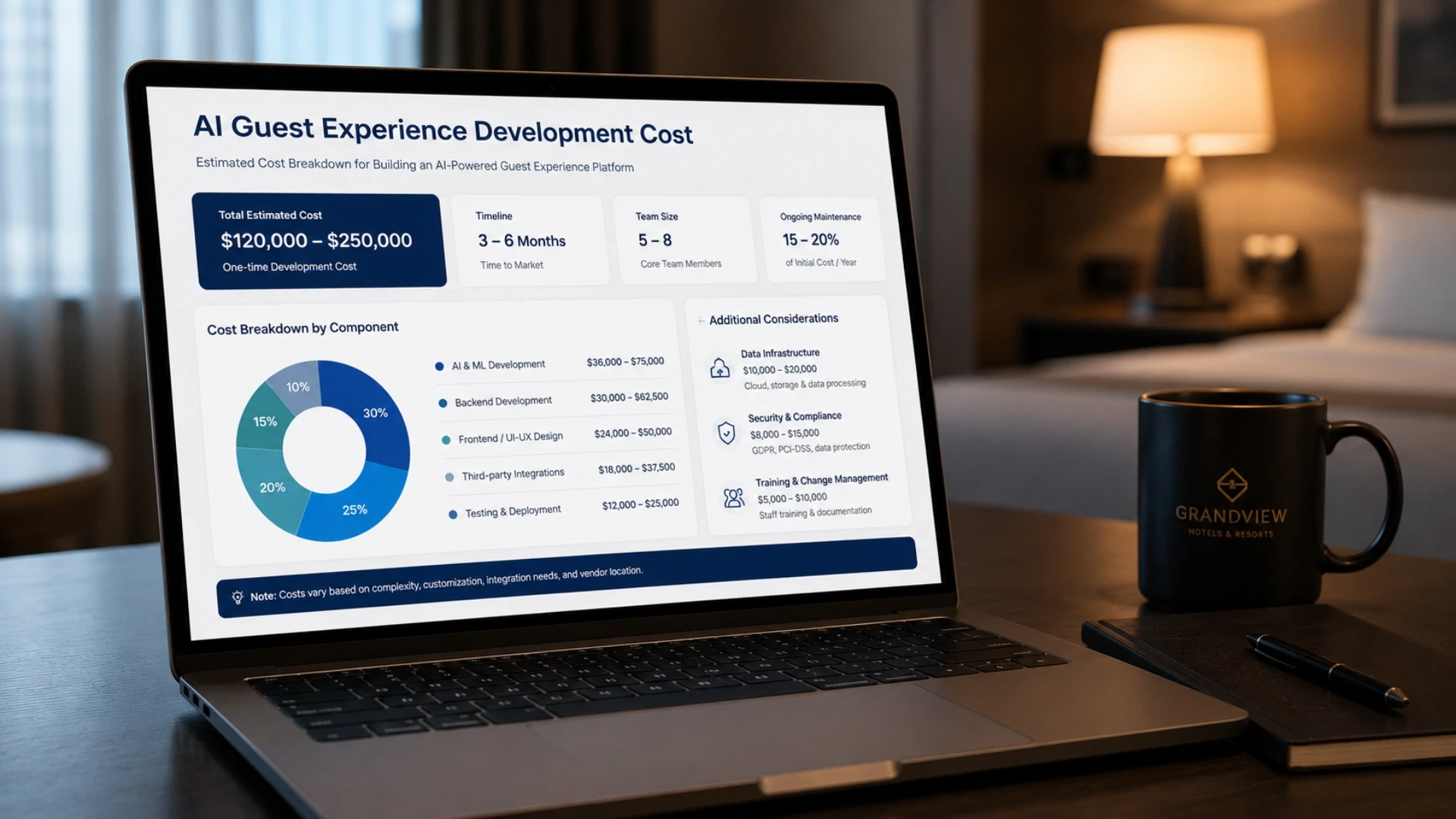
The cost of AI guest experience development depends on four variables: data readiness (how clean and consolidated guest data is before build starts), model complexity (rule-based vs. ML-driven), integration scope (how many hotel systems need live API connections), and team location.
AI Component | India-Based Team | Western Agency |
Hotel Personalisation Engine (MVP) | Starting from $5,000 | $25,000 to $65,000 |
Hotel Chatbot (NLP + PMS integration) | $18,000 to $45,000 | $55,000 to $130,000 |
Demand Forecasting Model | $20,000 to $55,000 | $60,000 to $160,000 |
Guest Data Platform (CDP) | $35,000 to $90,000 | $100,000 to $250,000 |
Sentiment Analysis System | $15,000 to $40,000 | $45,000 to $110,000 |
Full AI Guest Experience Stack | $90,000 to $220,000 | $270,000 to $650,000 |
Acquaint Softtech's dedicated AI engineers deliver up to 40% cost savings compared to UK, US, European, or Australian agencies, with a 95% sprint completion rate and 24+ month average team tenure. The data engineering phase adds 4 to 8 weeks and $12,000 to $25,000 to most projects and is not optional. Skipping it is the single most common reason hotel AI projects fail to deliver ROI.
For teams deciding between engagement models for AI delivery, the Acquaint Softtech guide Software Development Outsourcing Companies provides verified cost and capability data across vendors globally.
Teams in early-stage product definition for AI hospitality features can also benefit from MVP development services to build and validate a focused AI module (chatbot or personalisation engine) before committing to full-stack development budget.
Build the AI Guest Experience Stack Your Competitors Are Racing Toward
This guide has covered personalisation engines, chatbots, predictive forecasting, smart room tech, and sentiment analysis. The question is not whether to build; it is how fast you can start.
Acquaint Softtech's dedicated AI engineering team deploys within 48 hours. 1,300+ projects delivered. 95% sprint delivery rate. 4.9/5 from 50+ verified Clutch reviews.
Join 200+ technology companies who have scaled AI product development with Acquaint Softtech across the USA, UK, Europe, Australia, and New Zealand.
Frequently Asked Questions
-
How does AI improve guest experience in hotels?
AI improves hotel guest experience through personalisation engines that serve relevant offers, chatbots that handle service requests 24/7, demand forecasting that optimises pricing in real time, and sentiment analysis that flags service issues before they reach public reviews. Hotels report RevPAR improvements of 8% to 14% and front desk time savings of 20% to 35%.
-
What is a hotel personalisation engine?
A hotel personalization engine is an AI system that reads guest data from PMS, booking history, and CRM to serve individually relevant offers, room upgrades, and content at each stage of the guest journey. It uses collaborative filtering and content-based recommendation algorithms to move from segment-level to individual-level personalisation.
-
What can a hotel chatbot handle?
A production hotel chatbot handles booking queries, check-in and checkout assistance, room service requests, facility information, upgrade offers, pre-arrival preference collection, and post-stay feedback. Well-built chatbots resolve 40% to 65% of guest queries without human intervention within 6 to 12 weeks of deployment.
-
How much does it cost to build AI for a hotel?
A hotel chatbot with PMS integration costs $18,000 to $45,000 with an India-based dedicated team. A full AI guest experience stack including personalisation engine, demand forecasting, sentiment analysis, and CDP costs $90,000 to $220,000. Western agencies charge 40% to 60% more for equivalent scope.
-
What data does a hotel need for AI personalisation?
A hotel needs 24 months of labelled booking data, guest stay history, in-stay spend data from POS, communication preference records, and review or feedback data, all consolidated into a single guest profile. Data fragmentation across legacy systems is the most common project blocker.
-
Is AI in hospitality only for large hotel chains?
No. Purpose-built chatbots and demand forecasting modules are affordable for independent hotels and boutique properties. Custom AI makes economic sense for hotel groups with 5+ properties or OTAs processing over 1,000 bookings per month. Smaller properties can achieve similar outcomes with configurable off-the-shelf tools.
-
How long does it take to build a hotel AI system?
A hotel chatbot takes 8 to 16 weeks, including PMS integration. A personalisation engine takes 12 to 20 weeks including data engineering. A complete AI guest experience stack with CDP, recommendation engine, and forecasting model takes 6 to 12 months with a team of 4 to 6 engineers.
-
What is predictive service in hospitality?
Predictive service means the hotel system acts before a guest asks: surfacing upgrade offers before check-in, alerting maintenance before equipment fails, and adjusting staffing before peak arrival periods. It relies on demand forecasting models, IoT sensor data, and behavioural analytics running across the hotel's connected systems.
I lead technology and client success at Acquaint Softtech with one goal in mind. Deliver work that feels personal, reliable, and worthy of long term trust. I stay close to both our clients and our developers to make sure every project moves with clarity, quality, and accountability.
Table of Contents
Get Started with Acquaint Softtech
- 13+ Years Delivering Software Excellence
- 1300+ Projects Delivered With Precision
- Official Laravel & Laravel News Partner
- Official Statamic Partner
Related Blog
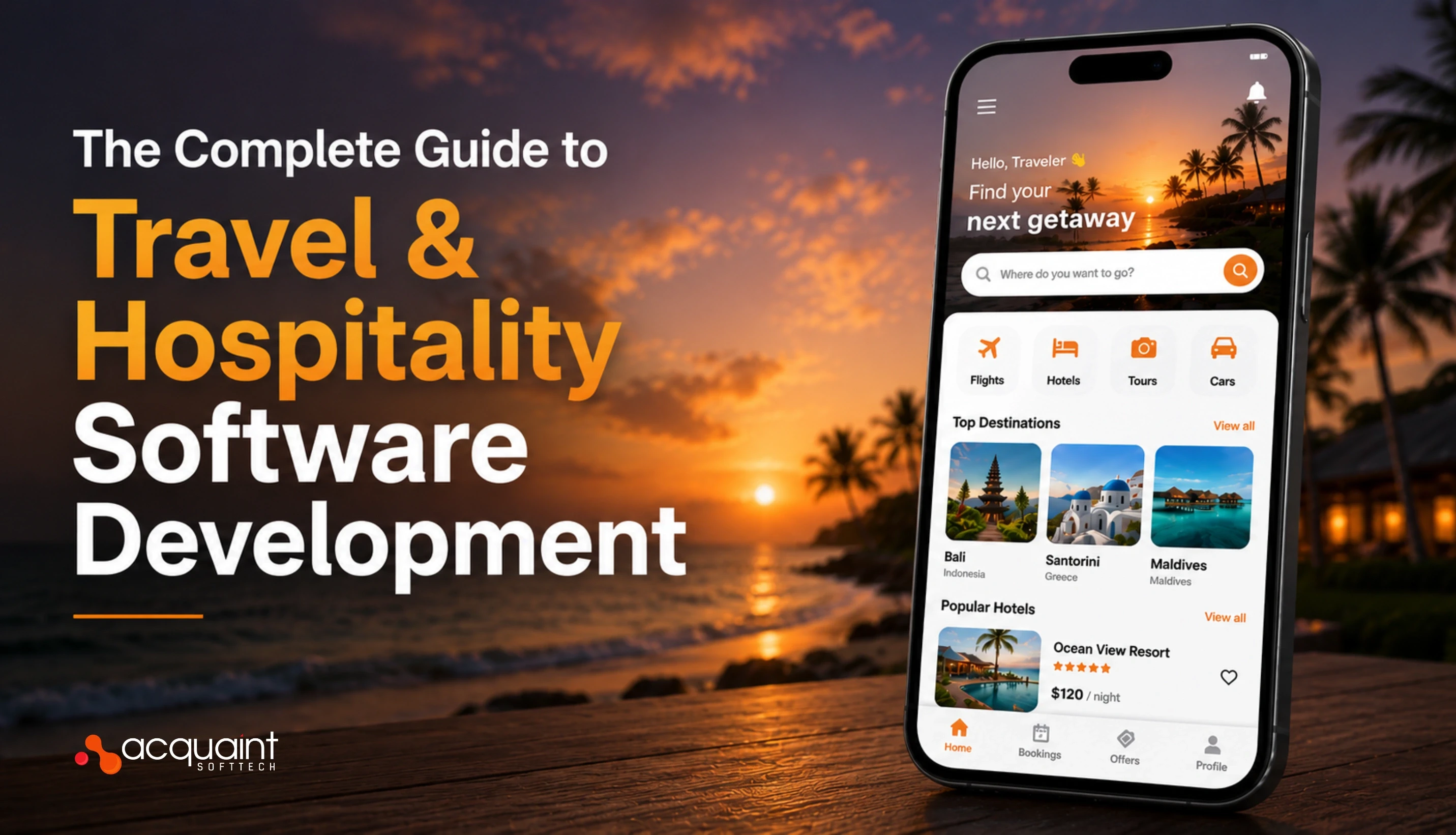
The Complete Guide to Travel & Hospitality Software Development in 2026
Most travel and hospitality platforms fail not because the idea was wrong, but because the technology architecture was underplanned. This guide explains every platform type, cost tier, and technology decision your team needs to make before writing the first line of code.

Acquaint Softtech
May 6, 2026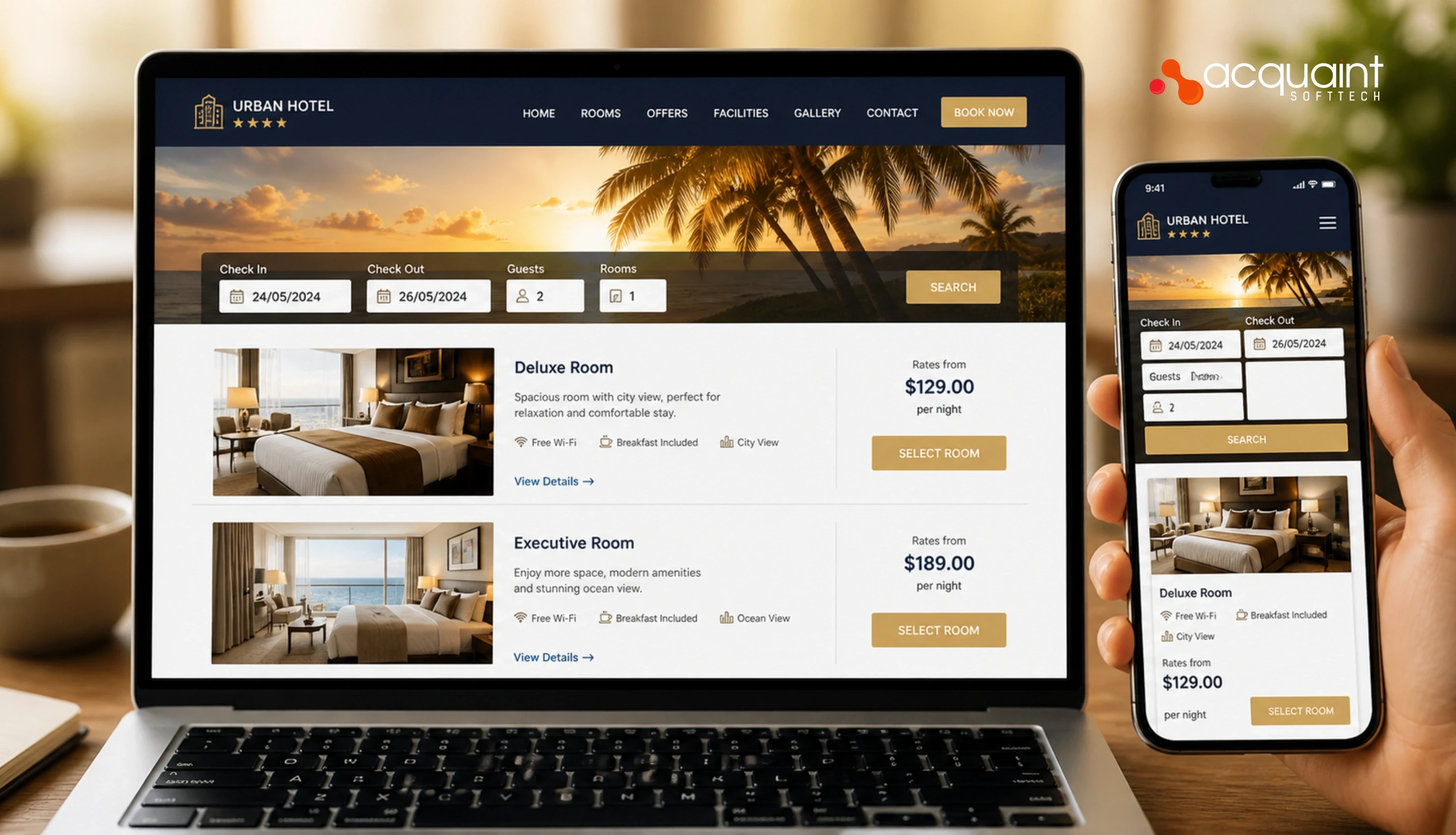
How Hotel Booking Engines Work: Search, Availability, Pricing, and Reservation Architecture
A hotel booking engine is not a search bar. It is an availability engine, a pricing decision system, a payment pre-authorisation layer, and a channel inventory synchroniser, all running simultaneously. This guide explains every architectural layer and how each one connects in a production system.
Manish Patel
May 12, 2026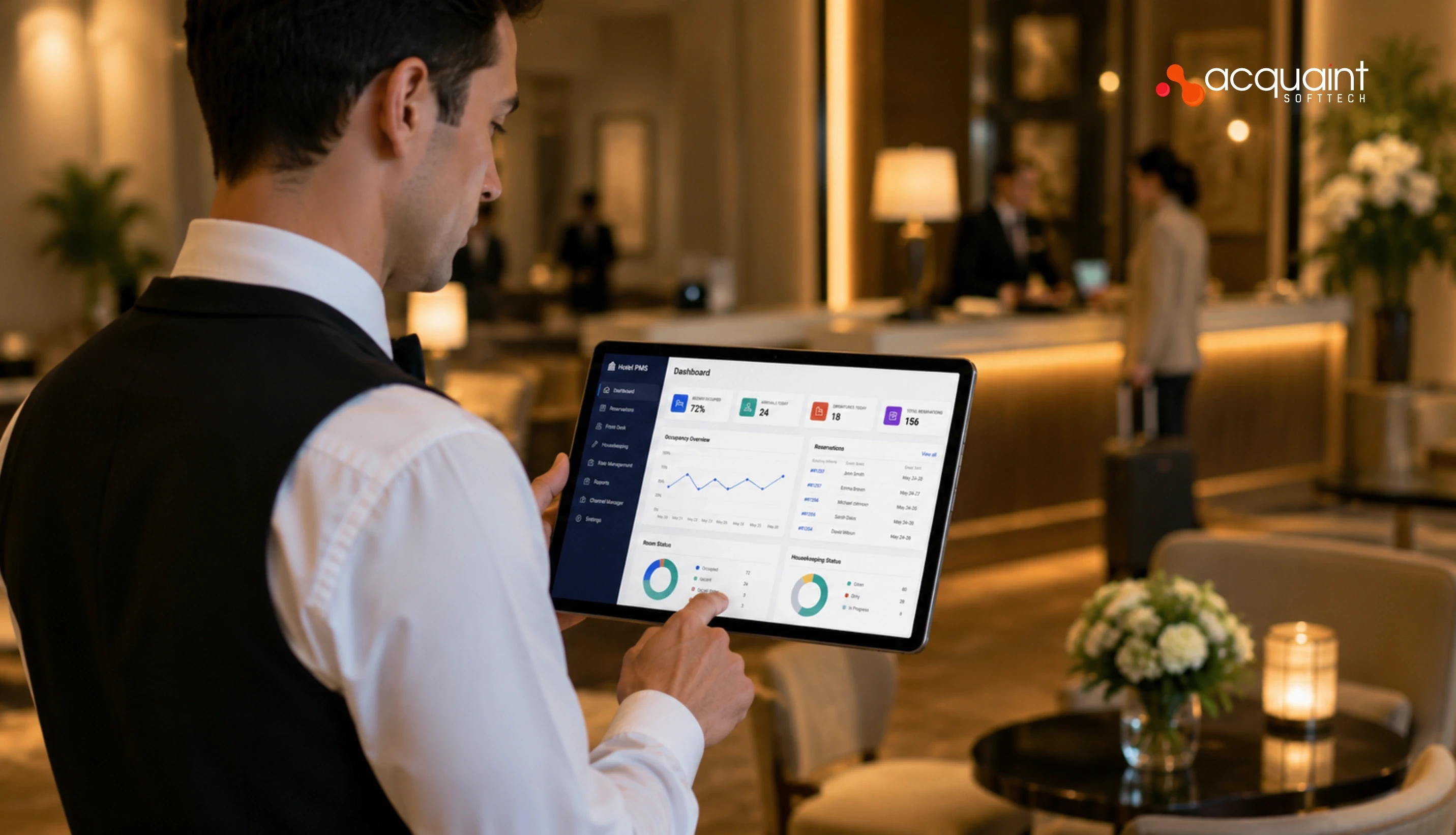
Hotel PMS Development: Front Desk, Housekeeping, and Guest Management in One System
A hotel PMS is not a booking system. It is the operational backbone connecting every department in real time. Here is what it includes, how each module is built, and what it costs in 2026.
Manish Patel
May 20, 2026India (Head Office)
203/204, Shapath-II, Near Silver Leaf Hotel, Opp. Rajpath Club, SG Highway, Ahmedabad-380054, Gujarat
USA
7838 Camino Cielo St, Highland, CA 92346
UK
The Powerhouse, 21 Woodthorpe Road, Ashford, England, TW15 2RP
New Zealand
42 Exler Place, Avondale, Auckland 0600, New Zealand
Canada
141 Skyview Bay NE , Calgary, Alberta, T3N 2K6