

Hotel PMS Development: Front Desk, Housekeeping, and Guest Management in One System
A hotel PMS is not a booking system. It is the operational backbone connecting every department in real time. Here is what it includes, how each module is built, and what it costs in 2026.

Manish Patel
As Head of Tech and Client Success at Acquaint Softtech, a software product development company with 1,300+ projects delivered across 13+ years, I architect and review hotel property management system builds every month. Most hotel operators I speak with confuse a PMS with a booking engine, and that confusion costs them in duplicated work, manual coordination between departments, and guest experience gaps that show up in reviews.

- Hotel businesses are looking for skilled developers for custom PMS software development.
- CTOs and product teams evaluating PMS architecture, integrations, and module design.
- Hospitality companies replacing rigid PMS tools with scalable custom platforms.
- Developers and engineering leads building hotel management and guest operations systems.
This guide explains hotel PMS (Property Management System) development, what a PMS actually is, how each core module is built, hotel PMS property management system development, what it costs in 2026, and how Acquaint Softtech approaches development, so you have enough clarity to make a decision.
PROBLEM: Your front desk, housekeeping, and guest communication teams are running on separate tools. Check-in data does not automatically update the room status. Housekeeping learns about checkouts through a WhatsApp group. Guest preferences from the last visit live in someone's notebook.
AGITATE: At a $180 average daily rate, a 10-minute delay in room-ready notification across 50 rooms per day costs roughly 8 to 10 room-nights of revenue per month in late check-ins and rushed turnovers. Guest satisfaction scores drop, OTA reviews slip, and your teams spend their shifts firefighting instead of serving.
SOLUTION: A purpose-built hotel PMS connects every department in a single data flow. This guide gives you the exact module architecture, the real build cost, and a decision framework to choose between custom and off-the-shelf. Acquaint Softtech sends a team structure and developer profiles within 48 hours.
A hotel PMS is often called a booking management tool, but it is actually the central data system of hotel operations, coordinating guests, departments, and connected systems like channel managers and POS. Most issues arise not from missing features but from poor integration between separately built modules, which leads to operational delays and manual reconciliation. Acquaint Softtech has built such hotel technology platforms through its custom software product development services for hospitality clients across the US, UK, Australia, and UAE.
This content is part of The Complete Guide to Travel & Hospitality Software Development in 2026 based on real delivery experience from these projects.
What a Hotel PMS Actually Is (and What It Is Not)
.webp "What a Hotel PMS Actually Is")
A hotel Property Management System (PMS) is the operational software that manages room inventory, guest records, departmental task assignments, and billing from a single database. It is not a booking engine, a channel manager, or a customer relationship management tool, though it communicates with all three.
The confusion exists because most off-the-shelf PMS vendors bundle a reservation module into their product and call the whole thing a booking system. The reservation module handles existing reservations. A booking engine generates new ones. They are architecturally separate even when they share a vendor.
The Defining Characteristic
A PMS owns the guest lifecycle from the moment a reservation is confirmed until the final invoice is closed. Every physical action in the hotel, from the key card assignment to the minibar charge, traces back to a PMS record. A channel manager distributes availability outward. A booking engine captures inbound demand. The PMS is the record of what actually happened.
Three Layers of a Modern PMS
The first layer is the operational layer: front desk, housekeeping, and maintenance. The second layer is the guest layer: profiles, preferences, communication, and loyalty. The third layer is the financial layer: billing, folio management, reporting, and revenue attribution. A PMS strong in the first layer but weak in the third produces operators who reconcile revenue in spreadsheets every morning.
What a PMS Is Not
A PMS is not your rate management engine. It stores the rates already set by your revenue management system. It is not your OTA connector. It receives confirmed reservations from the channel manager. It is not your CRM in the strict sense, though guest profiles within a PMS function as an operational CRM. Understanding these boundaries prevents scope creep during development and operational confusion after go-live.
Why the Distinction Matters for Development
When a hotel group asks Acquaint Softtech to build a PMS, the first question is always: what integrations must be live on day one? A PMS built in isolation from its integration map is a data silo from the first week of operation. Acquaint Softtech's AI development services extend PMS platforms with demand prediction and anomaly detection for hotels ready to add an intelligence layer above the operational core.
The Six Core Modules: Architecture and What Each One Does
Most PMS platforms describe their modules in marketing terms. The actual architecture that determines whether a system works in real hotel operations is more specific. Each module below is described by what it stores, what it processes, and what it communicates.
Module 1: Front Desk and Reservation Management
The front desk module is the primary interface for check-in, check-out, room assignment, and reservation modification. It stores guest arrival and departure times, room type and rate plan, folio history, and notes attached to the reservation. The check-in workflow in a well-built PMS takes 90 seconds: retrieve reservation, confirm identity, assign room, encode key card, print or email the welcome folio. Each step writes to a single record. The room assignment algorithm considers housekeeping status, guest preferences from prior stays, and current occupancy distribution. A hotel assigning rooms manually from a physical board is not running a PMS. It is running a reservations log.
Module 2: Housekeeping Task Management
The housekeeping module converts reservation updates into automatic cleaning tasks. When checkout is confirmed, the room status changes to Dirty, and a cleaning task instantly appears in the housekeeping queue. Supervisors assign it, attendants update progress via mobile, and after inspection, the room becomes Clean and Available in real time for the front desk.
This enables faster early check-ins and reduces delays that typically waste 20–45 minutes per room in non-integrated systems. In some advanced implementations, AI-driven workflow optimisation and staffing coordination can further improve turnaround efficiency, similar to approaches supported via hiring AI ML engineers, helping hotels reduce operational lag and improve room utilisation across high occupancy cycles.
Module 3: Guest Profile and CRM Layer
The guest profile module stores everything that makes repeat stays feel personal: room preferences, dietary restrictions, loyalty tier, communication preferences, prior complaints, and special occasions. The technical implementation is a normalised guest record that persists across stays and survives reservation cancellations. This data feeds the loyalty program, the pre-arrival email, and the upsell engine. Acquaint Softtech builds the guest profile module to connect directly to email and WhatsApp notification workflows as part of its hospitality software product development services for hotel clients.
Module 4: Folio, Billing, and Revenue Reporting
The billing module manages the guest folio: the running record of charges attached to a reservation. Room charges post automatically at midnight. Restaurant charges post when the point of sale syncs. Minibar charges post when housekeeping scans the room. At checkout, the folio is reviewed, discounts or corrections are applied, and the invoice is closed.
The reporting layer aggregates this data into occupancy rate, ADR (Average Daily Rate), and RevPAR (Revenue per Available Room). A PMS without a clean billing module forces accounting to reconcile manually across multiple systems, typically consuming 2 to 4 hours per day in hotels running disconnected tools.
Module 5: Maintenance and Work Order Management
The maintenance module accepts work orders from any department and routes them to the engineering team. A guest reports a broken tap via the in-room tablet. The request creates a work order, assigns it to an available engineer, tracks completion, and notifies the front desk when resolved. Rooms with open maintenance work orders are automatically blocked from assignment until cleared. This module is often omitted from entry-level PMS platforms, which forces hotels to run maintenance on a separate ticketing system. The integration cost of bridging those two systems later is consistently higher than building it into the PMS from the start.
Module 6: Management Dashboard and Analytics
The management layer consolidates data from all five operational modules into role-based dashboards. The general manager sees occupancy, ADR, and RevPAR for today, this week, and month-to-date, compared against the same period last year.
The housekeeping supervisor sees the room status by floor. The financial controller sees daily revenue by department and folio exceptions. Acquaint Softtech implements these dashboards using real-time data pipelines rather than overnight batch jobs. For teams that need dedicated Python developers for hospitality data pipelines, Acquaint Softtech deploys matched profiles within 48 hours.
Want to See What a Hotel PMS Module Architecture Looks Like for Your Property?
Acquaint Softtech reviews your current operational gaps and sends a tailored PMS module structure and developer profiles within 48 hours. The review is specific to your property type, integration requirements, and team size. You interview before you commit. No engagement starts without your approval.
How a Hotel PMS Works in One Operational Day
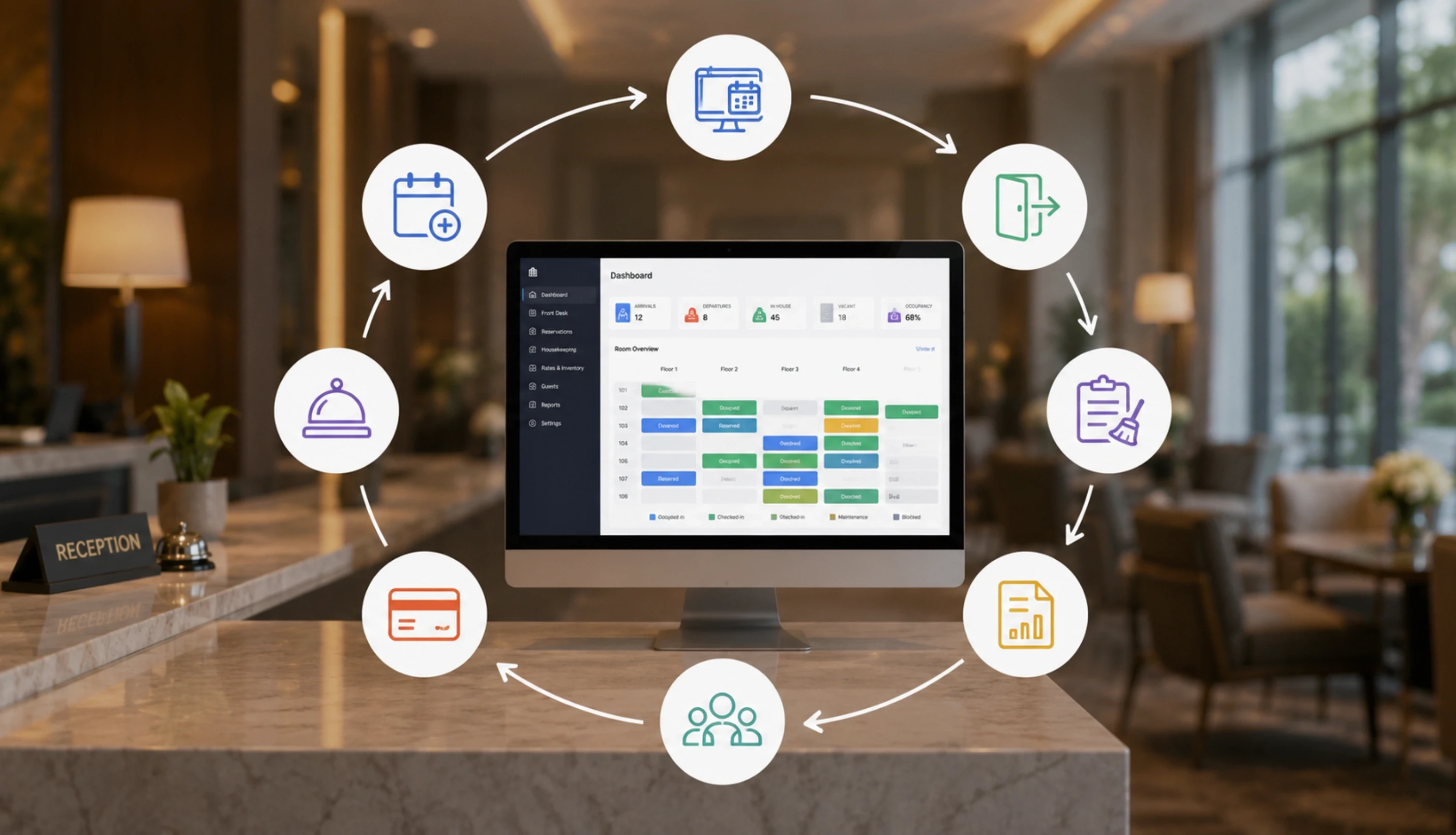
The architecture is best understood through what a real operating day looks like when every module is integrated. Each time block below names the event, identifies which module handles it, and describes what the system does versus what the staff member does.
6:00 AM: Night Audit Completes Automatically
The PMS runs the night audit without manual intervention. Room charges post for all occupied rooms. Revenue is attributed to room type and rate plan. The system generates the daily revenue report, the arrivals list, the departure list, and the housekeeping assignment queue pre-populated with all checkout rooms. The front desk manager opens the shift to a dashboard that is already current. No one builds the morning report from scratch.
8:00 AM: Housekeeping Queue Opens
The housekeeping supervisor reviews the automatically generated task list. Checkout rooms are marked Dirty, stayover rooms are marked for standard service, and priority rooms (VIPs, early check-ins, complaints) are flagged. Tasks are assigned by zone, and attendants receive them on mobile devices. As rooms are cleaned, updates reflect in real time on the front desk dashboard, removing the need for calls, radios, or whiteboards. Systems like this are typically built when businesses hire developers for booking system workflows to automate hotel operations end-to-end.
10:00 AM: Checkouts and Room Reassignments
Guests checking out are processed in 2 to 4 minutes. The folio, accumulating charges since check-in, is reviewed on screen. Any discrepancy is corrected on the spot. The invoice is closed. The system marks the room Dirty and adds it to the housekeeping queue. A guest who booked late checkout holds the room until 2 PM with a single click. The room is blocked from the housekeeping queue until 2 PM with no manual communication required between the front desk and housekeeping.
2:00 PM: Early Check-Ins Begin
As rooms clear housekeeping inspection, they appear in the front desk's available inventory. Guests waiting for early check-in are notified automatically by SMS or WhatsApp when their specific room is ready. The front desk team does not need to monitor a whiteboard or take calls from impatient guests in the lobby. The system handles the notification. The staff member handles the welcome experience.
4:00 PM: Maintenance Request From a Current Guest
A guest reports a faulty air conditioning unit through the in-room tablet. The work order is created automatically, assigned to the next available engineer, and tracked through to completion. If the engineer cannot resolve the issue within 30 minutes, the system flags the front desk to offer a room change. The entire chain of events is documented in the guest folio and the guest profile for future reference.
11:00 PM: Pre-Arrival Workflow for Tomorrow
The PMS sends automated pre-arrival emails to every guest arriving tomorrow. The emails include check-in time, parking instructions, and an upsell offer for a room upgrade or spa booking. Responses and upgrade purchases are recorded directly in the reservation record. The front desk team starts tomorrow's shift knowing which guests upgraded, which requested late check-in, and which have a note from a prior stay. Acquaint Softtech's dedicated Laravel developers build multi-channel guest communication modules across hospitality clients, connecting email, SMS, and WhatsApp through a single notification service.
What Does Hotel PMS Development Cost in 2026?
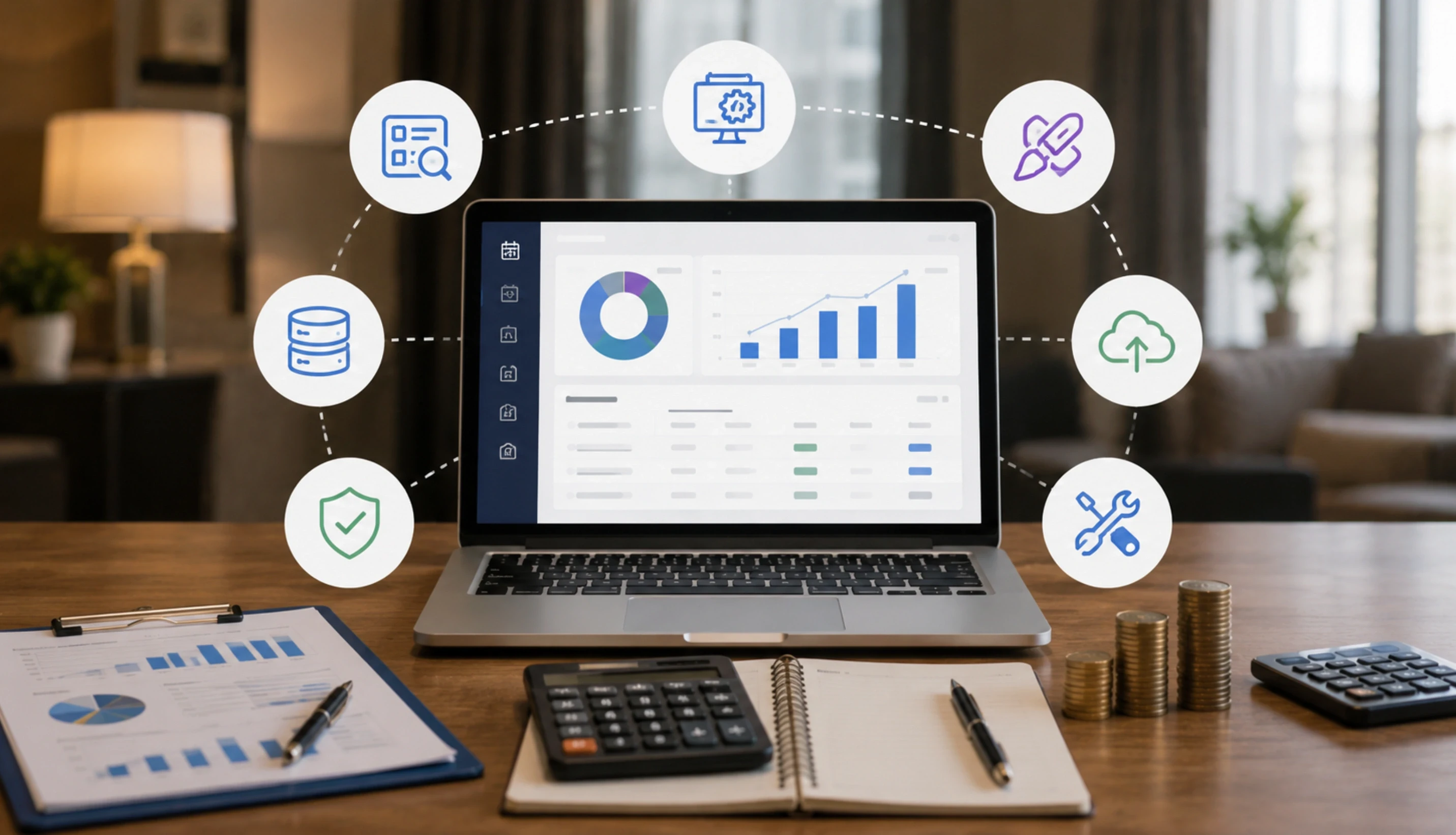
The cost of custom hotel PMS development depends on three variables: the number of modules, the number of integrations, and whether you are building for a single property or a multi-property group. The table below reflects Acquaint Softtech's delivery data across hospitality software builds, with cost ranges in USD.
Engagement Tier | Build Cost (USD) | Timeline | Modules Included | Monthly Maintenance |
Small Property (under 60 rooms, single hotel) | $35,000 to $65,000 | 14 to 20 weeks | Front desk, housekeeping, billing, and guest profiles | $2,000 to $3,500/mo |
Mid-Market Hotel (60 to 200 rooms, 1 to 3 properties) | $70,000 to $130,000 | 22 to 32 weeks | All six modules + channel manager and POS integrations | $3,500 to $6,500/mo |
Hotel Group (5+ properties, centralised operations) | $140,000 to $280,000 | 36 to 52 weeks | All modules + multi-property config + revenue analytics | $6,500 to $14,000/mo |
The monthly rate includes bug fixes, security updates, performance monitoring, and minor feature additions, and also supports hiring for property management needs as part of ongoing operational support. It does not include new module development. Based on Acquaint Softtech delivery data across 1,300+ projects, custom builds for mid-market hotels save 35% to 45% in annual platform fees compared to enterprise PMS vendor contracts at equivalent feature coverage, within 18 to 24 months of go-live.
What the Monthly Rate Includes at Acquaint Softtech
Dedicated developers from your original build team, not a generic support rotation
48-hour response SLA (Service Level Agreement) on all critical bug reports
Monthly performance review with your technical point of contact
Integration monitoring for all connected systems: channel manager, POS, key card systems
Quarterly security audit and patch cycle
Onboarding support for new front desk or housekeeping staff, up to 5 per quarter
The rate the client pays is the rate. No additional employer overhead, benefits costs, or hardware procurement sits on top of the monthly figure.
Ready to See a Cost Breakdown for Your Specific Property Type?
Acquaint Softtech builds the cost estimate around your module requirements, not a vendor's pre-packaged tier. Send your property type, room count, and integration list. We return a detailed cost breakdown and a team structure within 48 hours. You interview the developers before any engagement starts.
The 5 Questions That Tell You Whether to Build Custom or Buy
This decision framework is the same one Acquaint Softtech uses in the first discovery call with every hospitality client. Five questions. Each has a Yes or No answer that points in a clear direction.
Question 1: Do you run more than one property type under a single brand?
Yes: Standard PMS platforms are designed for homogeneous property portfolios. If your portfolio includes city hotels, resorts, and serviced apartments, a custom build handles configuration differences without forcing every property into the same room type and billing logic.
No: A single-property hotel at fewer than 60 rooms with standard room types will find Cloudbeds or Little Hotelier cheaper and faster to deploy than a custom build.
Question 2: Do your current PMS vendor fees exceed $40,000 per year?
Yes: A custom build in the $70,000 to $130,000 range typically reaches cost parity with a $40,000 annual vendor fee in under 3 years, while adding functionality the vendor platform does not support. The 40% cost saving against traditional vendor fees is a figure Acquaint Softtech consistently observes across mid-market hospitality builds. For those ready to move, Acquaint Softtech's staff augmentation model gives you direct access to hospitality developers without the overhead of a fixed vendor contract.
No: If your current platform costs under $20,000 per year and covers your operational needs, the build cost cannot be justified on financials alone.
Question 3: Do you require integrations not supported by major PMS vendors?
Yes: Regional payment gateways, specific point-of-sale systems, local government reporting requirements, or proprietary loyalty programs that do not conform to standard APIs are common reasons for custom builds in Southeast Asia, the Middle East, and parts of Eastern Europe. Acquaint Softtech's hospitality clients in the UAE and Australia have built custom PMS integration layers for exactly these requirements.
No: If your integrations map to the standard list supported by Opera Cloud, Cloudbeds, or Apaleo, a vendor platform with API extension is likely the faster path. A product discovery workshop with Acquaint Softtech takes 5 days and maps your integration requirements against available vendor APIs before recommending a build path.
Question 4: Is your guest data currently fragmented across three or more systems?
Yes: A custom PMS with a unified guest data layer is worth building for the data consolidation value alone. Guest profiles spread across a PMS, a CRM, a loyalty platform, and a marketing tool cost hotels in repeat booking conversion. The consolidation architecture is one of the highest-ROI elements of a custom build.
No: If your guest data lives cleanly in one or two systems that already sync reliably, custom development for data consolidation alone is over-engineering the solution.
Question 5: Does your growth plan include 5 or more properties in the next 36 months?
Yes: A custom multi-property PMS with centralised operations and property-level customization is the most scalable architecture available. Adding a new property to a well-built custom PMS takes 2 to 4 weeks of configuration, not a new vendor contract.
No: A single property with no near-term expansion plan does not need a multi-property architecture. Build for the next 18 months, not a hypothetical group portfolio. For groups already at scale, Acquaint Softtech's dedicated software development team model handles the ongoing development workload after go-live.
Scoring: 3 or more Yes answers: a custom build is justified by both operational fit and financial return. 1 to 2 Yes answers: evaluate a vendor platform with API extension first. 0 Yes answers: implement an off-the-shelf platform immediately. The build cost is not the right use of your capital at this stage.
Integration Map: The Systems Your PMS Must Connect
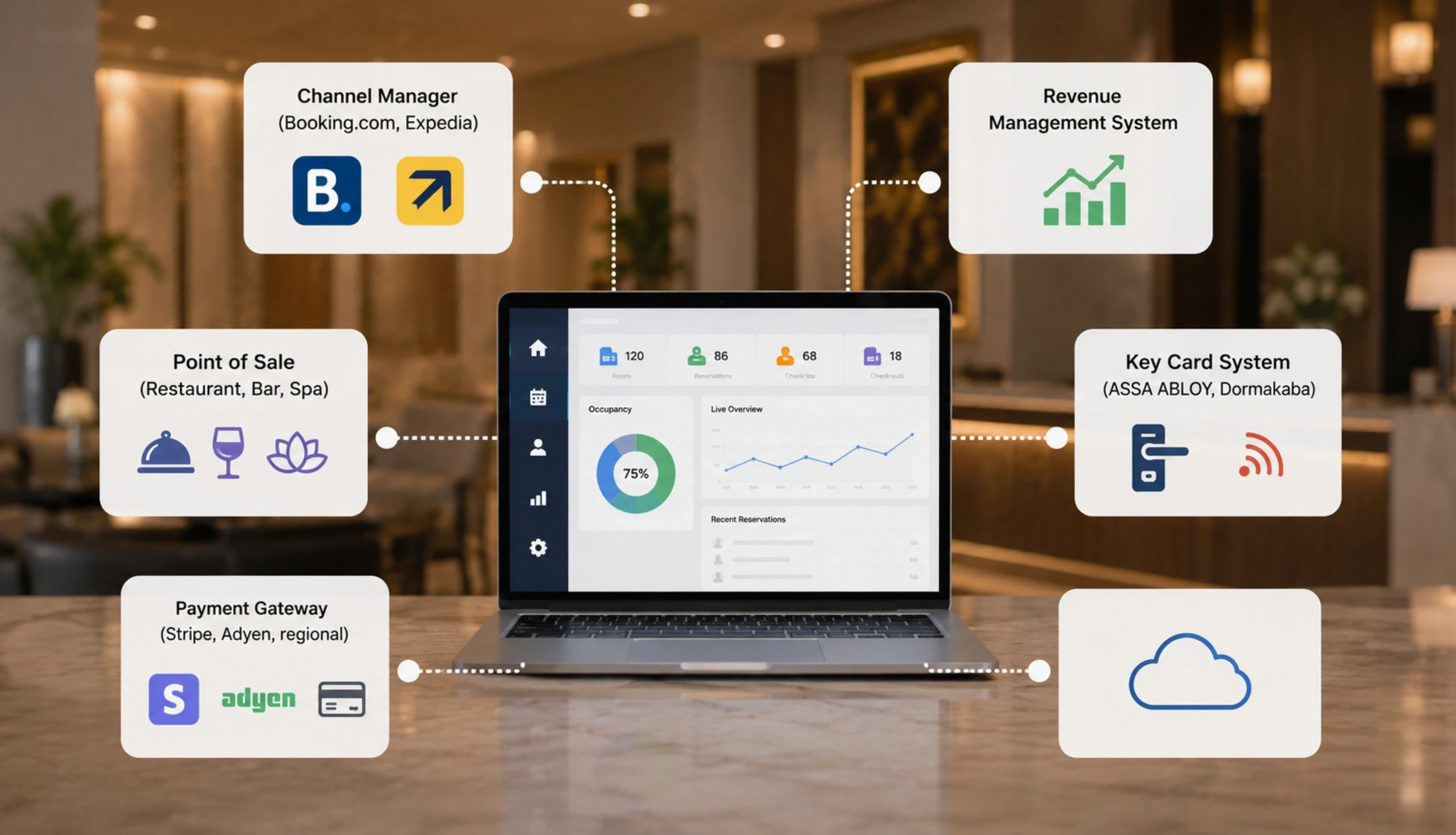
A PMS built in isolation from its integration map is incomplete from the first day of operation. The table below shows the standard integration layer for a mid-market hotel PMS, the data flow direction, and the consequence of building each integration incorrectly.
Connected System | Data Flow | What PMS Receives | Consequence of Poor Integration |
Channel Manager (Booking.com, Expedia) | Inbound | Confirmed reservations, modifications, cancellations | Overbookings, manual re-entry of reservations, and rate discrepancies |
Revenue Management System | Inbound | Rate plans and restrictions per room type and date | PMS shows incorrect rates at check-in; billing disputes at checkout |
Point of Sale (Restaurant, Bar, Spa) | Inbound | Charges posted to the guest folio in real time | Manual charge entry, missed postings, and folio errors at checkout |
Key Card System (ASSA ABLOY, Dormakaba) | Outbound | Room assignment, access level, checkout expiry | Key encoding requires a separate login; check-in takes 5 to 8 minutes instead of 90 seconds |
Payment Gateway (Stripe, Adyen, regional) | Bidirectional | Pre-authorization confirmation, settlement, and refund status | Manual payment reconciliation; PCI (Payment Card Industry) compliance gaps |
Accounting/ERP (Xero, SAP, QuickBooks) | Outbound | Daily revenue journal, folio summaries, tax attribution | Accounting team reconciles manually; 2 to 4 hours per day |
Guest Communication (Email, SMS, WhatsApp) | Outbound | Pre-arrival, check-in confirmation, and post-stay feedback triggers | Communication is handled manually; timing is inconsistent; guest experience suffers |
The integration layer is not a secondary concern. Based on Acquaint Softtech delivery data across 1,300+ projects, integration failures account for more than 60% of the operational problems hotels report after PMS go-live. Every integration in the table above is built and tested before the PMS is considered production-ready.
For teams that need MERN stack developers for the guest-facing frontend layer, Acquaint Softtech deploys matched profiles within 48 hours. For teams considering DevOps engineers for cloud deployment and monitoring, the same 48-hour deployment timeline applies.
Answered Yes to 3 or More Questions in Section 5? Let Us Build Your PMS.
Acquaint Softtech has built property management and hospitality platforms for clients across the US, UK, Australia, and UAE. We send a full module architecture and integration map specific to your property type within 48 hours. You interview the team before the engagement starts. No generic proposal. No commitment before you approve the team.
Frequently Asked Questions
-
What is a hotel PMS, and how does it differ from a booking engine?
A hotel PMS manages hotel operations like room inventory, guest records, billing, and workflows during a guest’s stay. A booking engine only handles online reservations and sends confirmed bookings to the PMS. Both systems are separate but must work together through real-time integration. Without proper integration, hotels often face manual updates and reservation sync issues.
-
What are the core modules for a hotel PMS?
A hotel PMS mainly includes front desk management, housekeeping, guest CRM, billing, maintenance management, and analytics dashboards. Smaller systems may skip maintenance or analytics, but that creates manual work later. Hotels with more than 60 rooms usually need all six modules for smooth operations. These modules help centralise hotel workflows in one system.
-
How does front desk management work in a hotel PMS?
The front desk module manages check-in, room assignment, key card integration, and guest billing. It automatically considers room availability, housekeeping status, and guest preferences during room allocation. At checkout, staff can review and close the guest folio digitally without paperwork. A well-built PMS completes the entire check-in process in around 90 seconds.
-
What does hotel PMS development cost in 2026?
Hotel PMS Type
Estimated Cost
Timeline
Small Hotel PMS
$35,000–$65,000
14–20 weeks
Mid Sized Hotel PMS
$70,000–$130,000
22–32 weeks
Multi Property Hotel PMS
$140,000–$280,000
36–52 weeks
-
How long does it take to build a custom hotel PMS?
A small PMS with basic modules and integrations usually takes 14–20 weeks to launch. Mid-market systems with advanced integrations like POS, channel managers, and payment gateways take 22–32 weeks. Integration partner delays are the most common timeline risk. Acquaint Softtech includes extra integration testing time in project planning to avoid deployment issues.
-
Should I build a custom PMS or use Opera, Cloudbeds, or Apaleo?
Vendor PMS platforms work well for small hotels with standard requirements and lower annual costs. A custom PMS becomes more cost-effective when vendor fees exceed $40,000 annually or when complex integrations are needed. Custom systems also provide full ownership and flexibility for future growth. The decision mainly depends on long-term ROI and operational complexity.
-
How does housekeeping automation work in a hotel PMS?
Housekeeping automation updates room status in real time after guest checkout. Rooms move automatically from Occupied to Dirty, then to In Progress, Inspected, and finally Clean and Available. Staff update statuses directly from mobile devices, and the front desk sees changes instantly. This reduces coordination delays and speeds up room readiness significantly.
-
What tech stack does Acquaint Softtech use for hotel PMS development?
Acquaint Softtech uses Laravel for the backend API layer and React or Vue for the dashboard frontend. Real-time updates are powered through WebSockets for faster department coordination. The housekeeping mobile interface is built as a Progressive Web App for Android device support. PostgreSQL is used for secure and reliable guest and billing data management.
I lead technology and client success at Acquaint Softtech with one goal in mind. Deliver work that feels personal, reliable, and worthy of long term trust. I stay close to both our clients and our developers to make sure every project moves with clarity, quality, and accountability.
Table of Contents
Get Started with Acquaint Softtech
- 13+ Years Delivering Software Excellence
- 1300+ Projects Delivered With Precision
- Official Laravel & Laravel News Partner
- Official Statamic Partner
Related Blog
The Complete Guide to PropTech Software Development in 2026
PropTech is not a real estate website with a login. It is a system of record that manages listings, leases, ledgers, and work orders on a single accountable platform. Here is what it costs, how it is built, and how to pick a partner in 2026.

Acquaint Softtech
May 4, 2026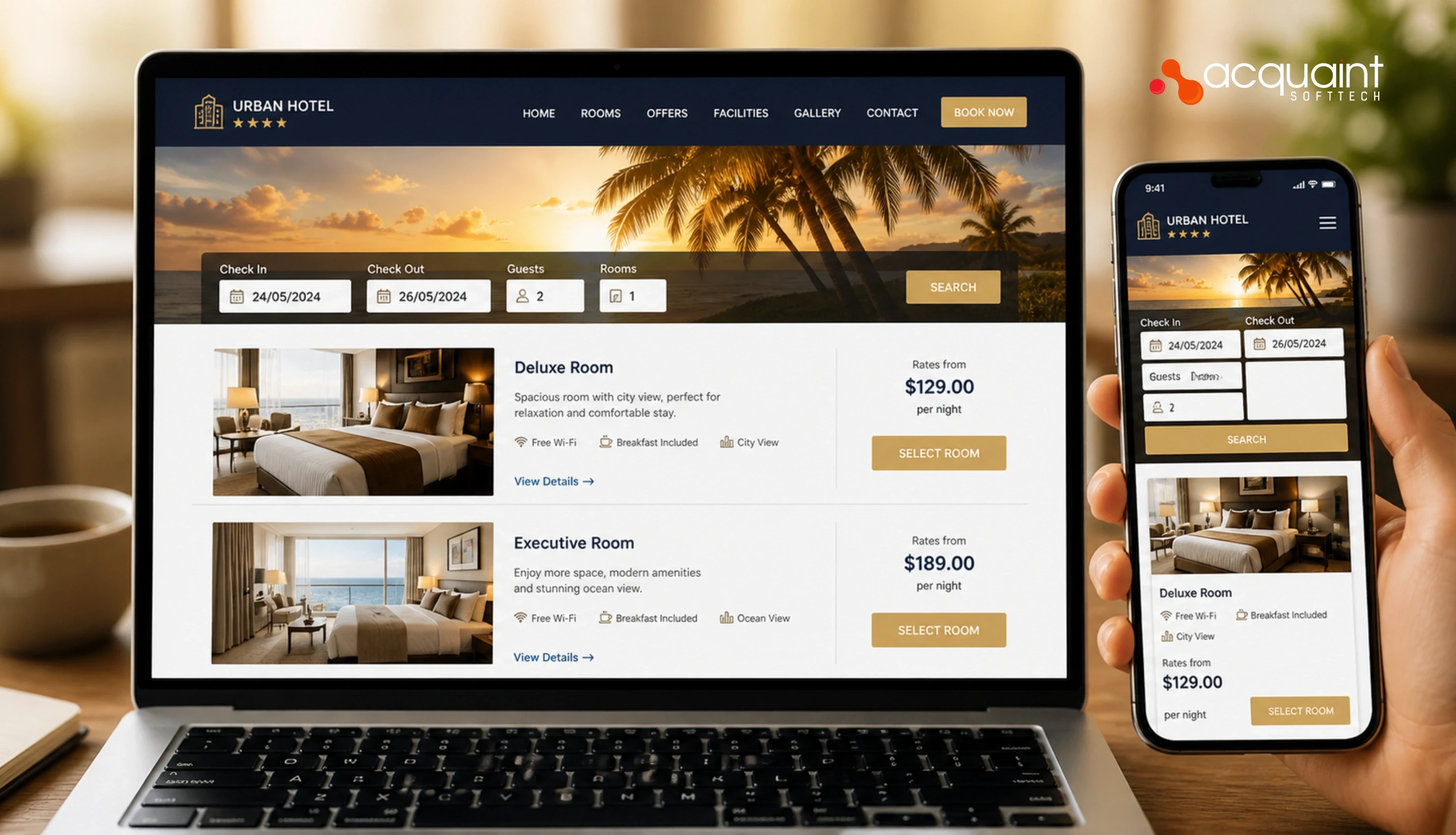
How Hotel Booking Engines Work: Search, Availability, Pricing, and Reservation Architecture
A hotel booking engine is not a search bar. It is an availability engine, a pricing decision system, a payment pre-authorisation layer, and a channel inventory synchroniser, all running simultaneously. This guide explains every architectural layer and how each one connects in a production system.
Manish Patel
May 12, 2026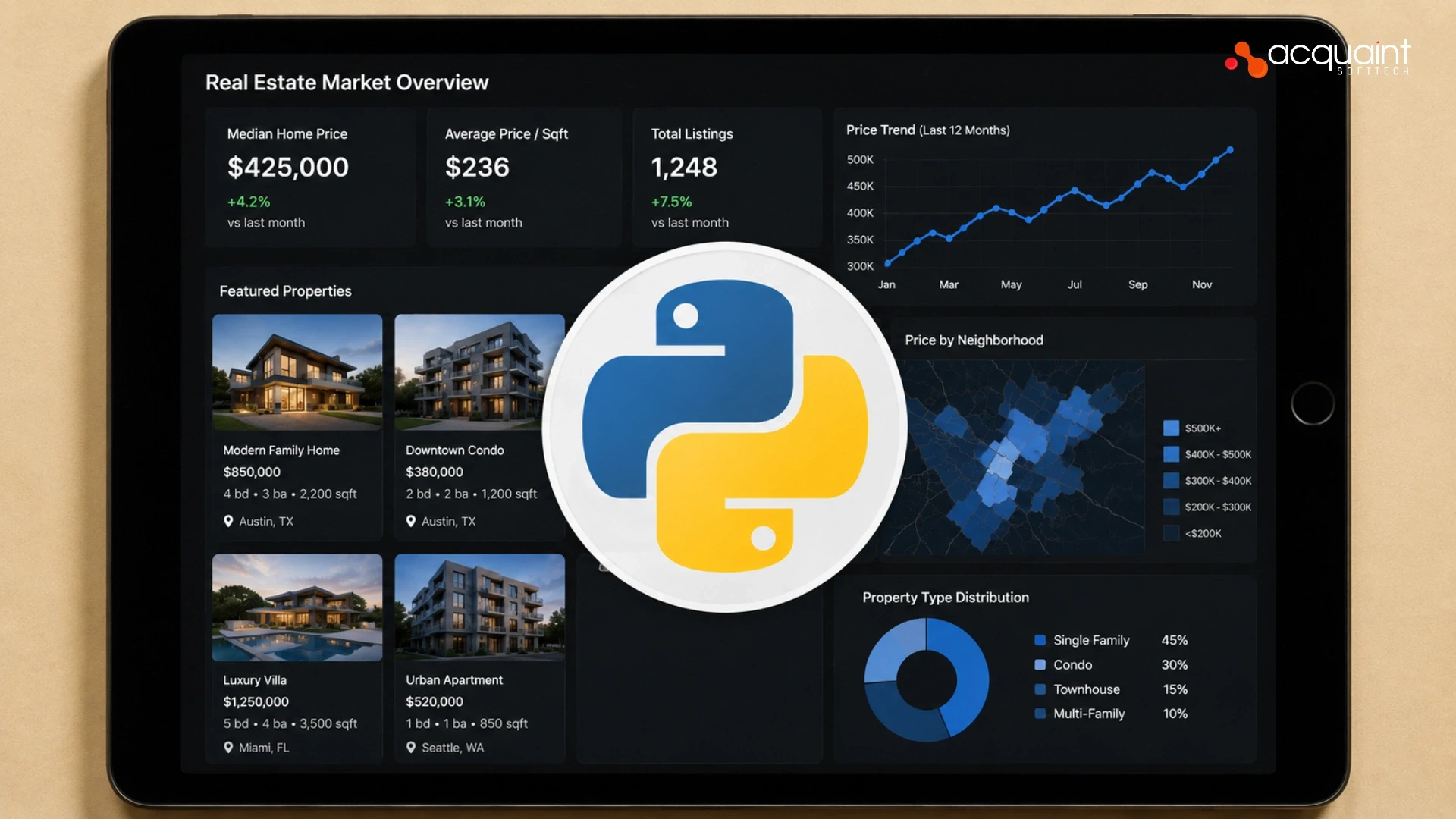
Python for Real Estate PropTech Platforms, MLS Integrations, and Analytics Dashboards
Python for real estate in 2026. How to build PropTech platforms, integrate MLS and RESO Web API, and ship analytics dashboards real estate teams actually use.
Acquaint Softtech
May 20, 2026India (Head Office)
203/204, Shapath-II, Near Silver Leaf Hotel, Opp. Rajpath Club, SG Highway, Ahmedabad-380054, Gujarat
USA
7838 Camino Cielo St, Highland, CA 92346
UK
The Powerhouse, 21 Woodthorpe Road, Ashford, England, TW15 2RP
New Zealand
42 Exler Place, Avondale, Auckland 0600, New Zealand
Canada
141 Skyview Bay NE , Calgary, Alberta, T3N 2K6