

CI/CD Pipeline for Kubernetes on AWS EKS: What a DevOps Engineer Configures and What It Costs in 2026
A Kubernetes cluster without a proper CI/CD pipeline requires manual helm commands for every deployment. Here is what a DevOps engineer configures for automated EKS deployments and what it costs.

Taukir katava
As a DevOps Engineer at Acquaint Softtech, a software development partner. An EKS cluster without a proper CI/CD pipeline means every deployment is a manual helm upgrade command run by a developer with cluster access. On a team deploying 10 times a day across 8 services, that is 80 manual operations per day, no rollback automation, no environment promotion gates, and no audit trail of what was deployed when. A properly configured CI/CD pipeline for Kubernetes eliminates all of this. This guide covers exactly what a DevOps engineer builds for automated EKS deployments using GitHub Actions, Helm, and ArgoCD, and what the implementation costs for UK, European, and US teams in 2026.

- Engineering teams running Kubernetes on EKS who deploy manually with helm upgrade commands and want the full pipeline automated
- SaaS CTOs who have an EKS cluster set up but no automated promotion flow from staging to production
- Teams using GitHub Actions for CI but still running Kubernetes deployments manually after the build step
- Founders hiring a DevOps engineer for EKS and wanting CI/CD pipeline configuration included in the engagement brief
A Kubernetes CI/CD pipeline have two distinct phases: the Continuous Integration phase (build, test, scan, push image) and the Continuous Deployment phase (update cluster state with the new image). Most teams have the CI phase configured. The gap is almost always in the CD phase: how the new image gets from the container registry into the running cluster without manual intervention and without bypassing the staging environment.
For the EKS cluster foundation that the CI/CD pipeline deploys to, the AWS EKS setup and management guide covers the full cluster setup including node groups, IRSA, and the Load Balancer Controller. This article covers the deployment automation layer that sits on top of that cluster.
The 5 Stages of a Kubernetes CI/CD Pipeline
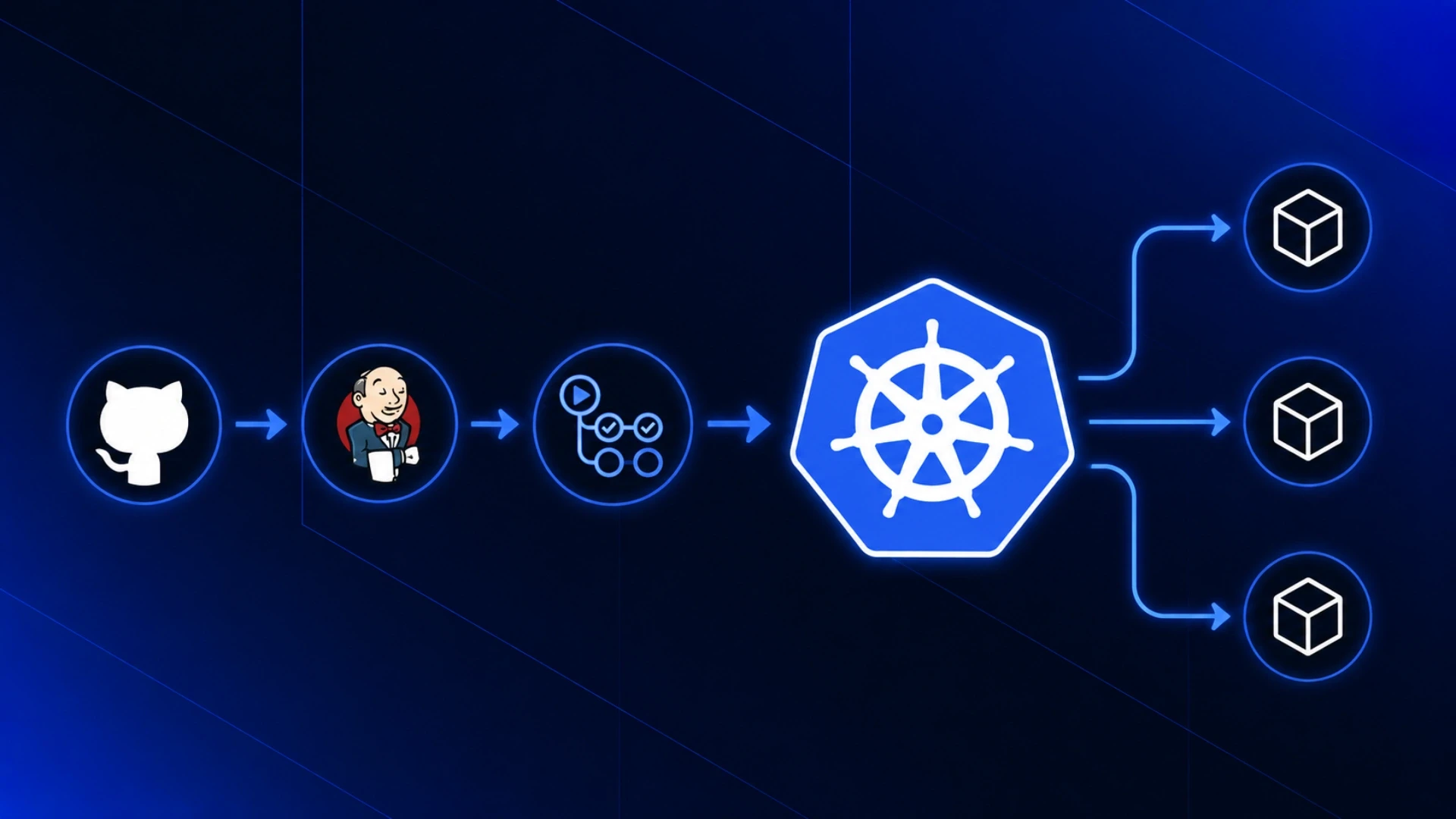
A production-grade Kubernetes CI/CD pipeline has 5 stages. Each stage runs automatically on code push. A DevOps engineer configures all 5 and connects them into a single workflow that runs without human intervention for staging, and requires a review gate for production.
Stage 1: Build and Test |
Triggered by: push to any branch or pull request merge. GitHub Actions (or GitLab CI or Azure DevOps) checks out the code, runs unit tests, runs linting and static analysis, and builds the Docker image. The build step tags the image with the Git commit SHA so every image is traceable to the exact commit that produced it. |
Key configuration: Docker layer caching reduces build time by 60 to 80% on repeat builds. Multi-stage Dockerfiles reduce image size. Build failures fail the pipeline immediately before any image is pushed. |
Stage 2: Image Scanning |
Before the image is pushed to the registry, Trivy scans it for known CVEs. A DevOps engineer configures severity thresholds: critical CVEs fail the pipeline (no image pushed, no deployment triggered). High CVEs generate a warning and are logged but do not block the pipeline by default (configurable to block based on the team's security policy). |
Key configuration: Trivy is integrated as a GitHub Actions step using the official Trivy action. Scan results are uploaded as GitHub Security alerts for visibility. Base image pinning (specific SHA digests rather than floating tags like 'latest') prevents supply chain substitution between builds. |
Stage 3: Push to Registry |
After a clean scan, the image is pushed to Amazon ECR (or Azure ACR or GCP Artifact Registry). The image is tagged with both the Git commit SHA (immutable, for traceability) and a semantic version tag if the build is from a tagged release. |
Key configuration: OIDC federation between GitHub Actions and AWS IAM eliminates the need for AWS access keys in GitHub Secrets. The GitHub Actions workflow assumes an IAM role via OIDC, gets a temporary credential, and pushes to ECR. No long-lived credentials stored anywhere. |
Stage 4: Deploy to Staging (Automatic) |
After a successful push to ECR, the pipeline automatically deploys to the staging Kubernetes namespace or cluster. The deployment step runs: helm upgrade service-name ./charts/service --set image.tag=<commit-sha> -f values/staging.yaml. A Kubernetes rollout status check waits for the deployment to complete and marks the pipeline step as failed if the rollout does not succeed within the configured timeout. |
Key configuration: staging deployment is automatic with no manual approval. Rollback is automatic if the rollout status check fails: helm rollback service-name <previous-revision>. Smoke test job runs as a post-deployment step and reports pass or fail. |
Stage 5: Deploy to Production (Manual Approval Gate) |
Production deployment is NOT automatic. A DevOps engineer configures a manual approval gate: after staging passes smoke tests, the pipeline pauses and sends a Slack notification requesting approval. A designated approver (CTO, engineering lead, or senior engineer) reviews the staging smoke test results and approves the production deployment in GitHub Actions. |
Key configuration: production approval requires a specific GitHub team membership. The approval step shows the diff between the current production image tag and the new one. Production deployment uses the same helm upgrade command with values/production.yaml. ArgoCD can replace this step with a GitOps-based promotion (PR to update the production values file). |
For teams who are comparing Helm-based deployment to a full GitOps approach with ArgoCD, the Helm charts and Kubernetes automation guide covers both the imperative Helm approach and the GitOps ArgoCD model in detail.
EKS Cluster Set Up But Still Deploying Manually? Get the CI/CD Pipeline Configured This Sprint.
UK, European, and US SaaS teams: tell Acquaint Softtech your current deployment process (how many services, current CI tool, whether you use Helm) and your cloud provider. A vetted DevOps engineer will design the pipeline and send a matched profile within 24 hours.
GitOps With ArgoCD: The Alternative to Pipeline-Driven Deployments
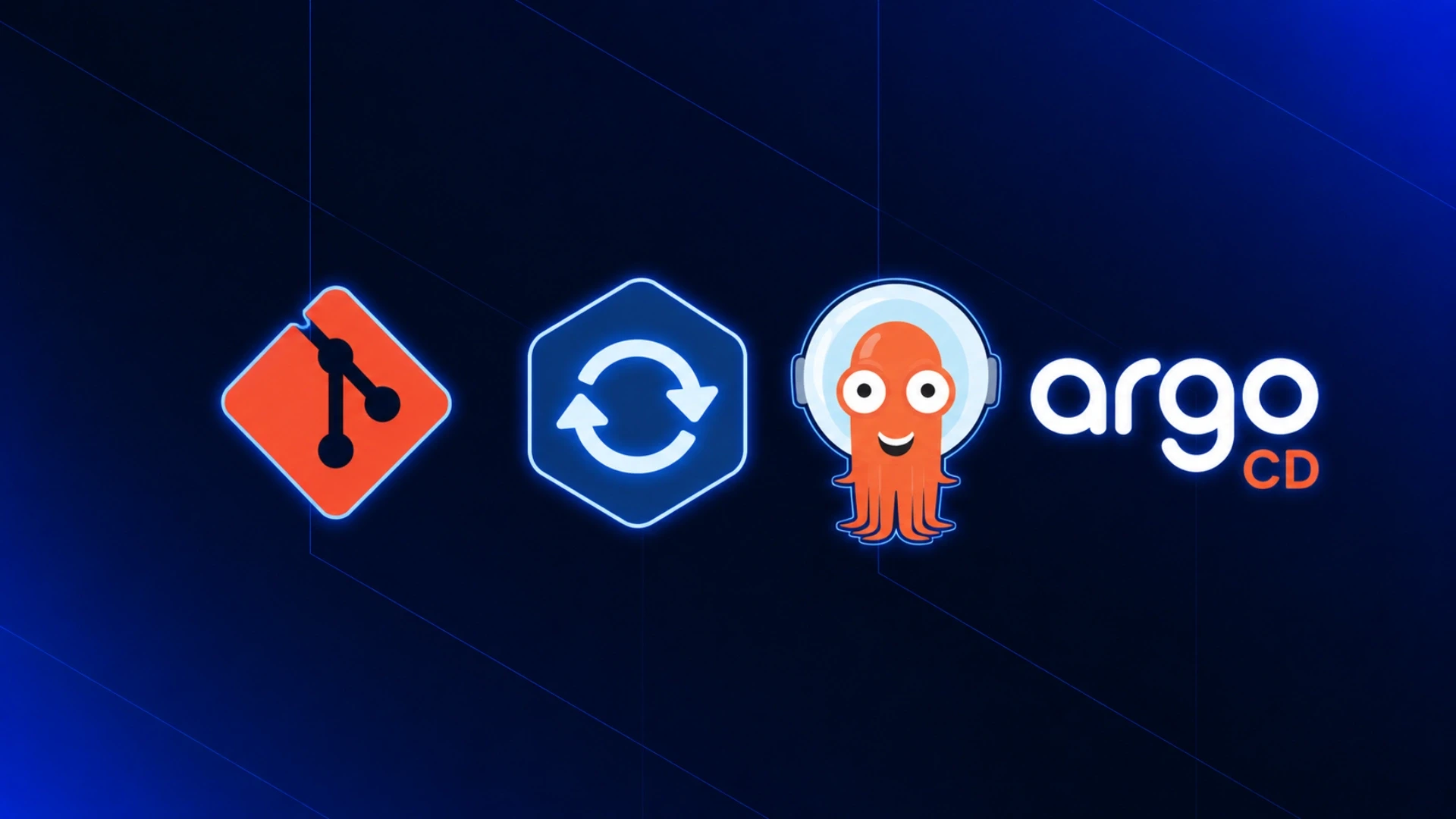
GitHub Actions calling helm upgrade is a valid, widely-used Kubernetes deployment approach. ArgoCD is a GitOps alternative where the cluster continuously reconcile itself to the state defined in Git. Both approaches are configurable by a DevOps engineer. Here is the honest comparison.
GitHub Actions + Helm (imperative approach)
How it works: Pipeline runs helm upgrade when triggered by a commit or approval.
Staging: Automatic on merge to staging branch.
Production: Manual approval gate in GitHub Actions UI.
Rollback: helm rollback <release> <revision> (one command).
Audit trail: GitHub Actions workflow run history.
Best for: Teams who want simple, familiar workflow. CI/CD engineers comfortable with pipeline configuration. Small to mid-size teams.
ArgoCD (GitOps approach)
How it works: ArgoCD watches a Git repository. When the desired state in Git changes (e.g. image tag updated in values file), ArgoCD applies the change to the cluster automatically.
Staging: ArgoCD auto-syncs on commit to staging branch.
Production: Production promotion = PR to update production values file. PR review = production approval gate. Merge = deployment.
Rollback: Revert the Git commit. ArgoCD re-syncs to previous state.
Audit trail: Git history. Every production change has a reviewed PR.
Self-healing: ArgoCD reverts manual kubectl changes automatically. Cluster state always matches Git state.
Best for: Teams who want full GitOps discipline. Compliance frameworks that require documented change approval (SOC 2 CC8.1). Teams with multiple engineers making infrastructure changes.
For teams on ECS who are evaluating whether to move to EKS before building a Kubernetes-native CI/CD pipeline, the Kubernetes vs ECS comparison guide covers the full decision framework and cost comparison.
Want GitOps With ArgoCD or GitHub Actions for Your EKS Deployments?
Acquaint Softtech DevOps engineers have configured GitHub Actions + Helm pipelines and full ArgoCD GitOps setups for SaaS companies in the UK, Germany, Netherlands, and US. Tell us your current setup and preference. Matched profile in 24 hours.
What It Costs: UK, Europe, and US Teams in 2026

The CI/CD pipeline for Kubernetes is typically configured as part of the broader EKS setup engagement or as a standalone sprint. Here are the honest 2026 cost at Acquaint Softtech rates compared to in-house engineers across all markets.
Region / model | In-house senior DevOps | Eastern Europe agency | Acquaint Softtech ($22/hr) |
UK | GBP 80,000-110,000/yr | GBP 60-80/hour | $22/hour | $3,200/month |
Germany / DACH | EUR 90,000-120,000/yr | EUR 70-90/hour | $22/hour | $3,200/month |
Netherlands | EUR 85,000-115,000/yr | EUR 65-85/hour | $22/hour | $3,200/month |
US | $130,000-180,000/yr | $80-110/hour | $22/hour | $3,200/month |
CI/CD engagement scope | Cost at $22/hour | What is delivered |
GitHub Actions CI pipeline (build, scan, push) | 2 to 3 days: $352 to $528 | Automated build, Trivy scanning, OIDC to ECR, image tagging with commit SHA |
Helm deployment to staging (CD stage 4) | 1 to 2 days: $176 to $352 | Automated staging deployment, rollout health check, auto-rollback on failure |
Production approval gate (CD stage 5) | 1 to 2 days: $176 to $352 | Manual approval workflow, Slack notification, production helm upgrade |
ArgoCD setup + Application CRDs | 3 to 5 days: $528 to $880 | ArgoCD deployed, Application manifests per service, auto-sync staging, manual sync production |
Full 5-stage pipeline (GitHub Actions + Helm + ArgoCD) | 6 to 10 days: $1,056 to $1,760 | Complete CI/CD: build, scan, push, staging auto-deploy, production GitOps promotion |
Monthly retainer (pipeline + cluster management) | $3,200/month | Pipeline maintenance, new service onboarding, security updates, incident response |
Acquaint Softtech's hire DevOps developers service provides pre-vetted engineers with GitHub Actions, Helm, and ArgoCD production experience on EKS. Starting at $22/hour or $3,200/month.
For the full DevOps engineer rate comparison across the UK, Europe, and US, the DevOps engineer cost guide covers what each price tier delivers.
For teams who are starting from manual deployments and need CI/CD before Kubernetes, the manual to automated deployment guide covers the full automation sequence as the prerequisite step.
Individual DevOps engineer on a monthly retainer through our staff augmentation model. Starting at $22/hour or $3,200/month. Available in 48 hours.
For teams building their first product and wanting Kubernetes CI/CD from day one, Acquaint Softtech's software product development service covers the full product team including DevOps.
Ready to Automate Your Kubernetes Deployments? Acquaint Softtech Has EKS CI/CD Engineers Available.
Pre-vetted DevOps engineers with GitHub Actions, Helm, and ArgoCD production experience. UK, European, and US clients. Starting at $22/hour or $3,200/month. Pipeline running in the first sprint. Matched profile in 24 hours.
Frequently Asked Questions
-
What is a Kubernetes CI/CD pipeline?
A Kubernetes CI/CD pipeline automates the process from code push to cluster deployment. The 5 stages are: build and unit test, image vulnerability scanning (Trivy), push to container registry (ECR), automatic deploy to staging with health check, and manual-approval deploy to production. The pipeline eliminates manual helm commands and ensures every deployment is tested, scanned, and auditable.
-
How do you set up CI/CD for Kubernetes on EKS?
A DevOps engineer configures: GitHub Actions workflows for build, test, and push stages; OIDC federation between GitHub Actions and AWS IAM for credential-free ECR access; Helm upgrade commands in the deploy step with image tag set from the Git commit SHA; Kubernetes rollout status check for health verification; and either a GitHub Actions manual approval gate or an ArgoCD Application for GitOps-based promotion.
-
What is the difference between GitHub Actions and ArgoCD for Kubernetes deployments?
GitHub Actions is a CI/CD platform that runs pipelines triggered by Git events. It calls helm upgrade as a pipeline step. ArgoCD is a GitOps tool that continuously watches a Git repository and reconciles the cluster state to match it. GitHub Actions is simpler and more familiar. ArgoCD provides self-healing, full Git audit trail for every change, and drift correction. Both can be used together: GitHub Actions for CI, ArgoCD for CD.
-
How long does CI/CD pipeline setup for Kubernetes take?
A full 5-stage pipeline (GitHub Actions CI, image scanning, ECR push, staging auto-deploy, production approval gate) takes 6 to 10 days at Acquaint Softtech's $22/hour rate, costing $1,056 to $1,760. Adding ArgoCD GitOps adds 3 to 5 days and $528 to $880.
-
What is OIDC federation for GitHub Actions and AWS?
OIDC (OpenID Connect) federation allows GitHub Actions to assume an AWS IAM role without storing AWS access keys in GitHub Secrets. GitHub Actions presents a short-lived OIDC token to AWS, which validates it against the GitHub OIDC provider and returns a temporary IAM credential. This eliminates long-lived credentials from GitHub and is the AWS-recommended approach for CI/CD authentication.
-
How much does a Kubernetes CI/CD DevOps engineer cost in the UK and Europe?
A UK-based DevOps engineer with EKS CI/CD experience costs GBP 80,000 to 110,000 per year fully loaded. In Germany or the Netherlands, EUR 85,000 to 120,000 per year. Acquaint Softtech provides the same level of EKS CI/CD experience at $22/hour or $3,200/month, delivering UK, European, and US SaaS clients an equivalent capability at a significant cost saving.
-
What is a rollout health check in a Kubernetes CI/CD pipeline?
After helm upgrade is called, a rollout health check runs kubectl rollout status deployment/<name> --timeout=5m. If the new pods do not reach Ready state within the timeout (typically because the application fails its readiness probe), the pipeline step fails and helm rollback is called automatically to restore the previous version. This prevents broken deployments from reaching staging or production without human intervention.
Taukir Katava is a DevOps Engineer at Acquaint Softtech with 4+ years of experience across AWS, Azure, and GCP. He specialises in Kubernetes cluster administration, CI/CD pipeline automation, and cloud infrastructure design for high-traffic platforms. Taukir writes about the practical side of production DevOps: what infrastructure decisions cost and what they actually deliver.
Table of Contents
Get Started with Acquaint Softtech
- 13+ Years Delivering Software Excellence
- 1300+ Projects Delivered With Precision
- Official Laravel & Laravel News Partner
- Official Statamic Partner
Related Reading
Kubernetes for Growing Startups: What a DevOps Engineer Manages and What It Costs to Hire in 2026
Most startups move to Kubernetes too early or too late. Here is when the move makes sense, what a DevOps engineer manages in a cluster, and what it costs to hire one in 2026.
Taukir katava
June 5, 2026
Docker to Kubernetes Migration: What a DevOps Engineer Handles and What It Costs in 2026
Running Docker without orchestration is manageable at 3 services. At 8 or more, it becomes a reliability and deployment risk. Here is what a DevOps engineer does to migrate you to Kubernetes.
Taukir katava
June 9, 2026
GitHub Actions vs Jenkins vs GitLab CI: Which CI/CD Tool Should You Hire a DevOps Engineer to Implement?
GitHub Actions, Jenkins, and GitLab CI each win in a different context. Here is the honest comparison from a DevOps engineer who has implemented all three in production, with the 5-question decision framework.
Taukir katava
May 5, 2026India (Head Office)
203/204, Shapath-II, Near Silver Leaf Hotel, Opp. Rajpath Club, SG Highway, Ahmedabad-380054, Gujarat
USA
7838 Camino Cielo St, Highland, CA 92346
UK
The Powerhouse, 21 Woodthorpe Road, Ashford, England, TW15 2RP
New Zealand
42 Exler Place, Avondale, Auckland 0600, New Zealand
Canada
141 Skyview Bay NE , Calgary, Alberta, T3N 2K6