

D2C Platform Development Guide 2026: Tech Stack, CX, and Growth Engine
A D2C brand platform is a custom-built digital infrastructure that lets a brand sell directly to consumers without retail intermediaries, combining a branded storefront, subscription engine, loyalty module, customer data layer, and fulfillment system in one owned technology stack.

Manish Patel

- You are a founder or CTO planning your first owned D2C channel in 2026.
- You sell on Amazon or marketplaces and want to reduce dependency and reclaim margins.
- You are outgrowing Shopify and need a platform built around your specific workflows.
- You want to understand what tech stack, modules, and costs a real D2C build involves.
- You lead a brand in the USA, UK, Europe, Australia, or India, looking to scale DTC.
- You need to hire a dedicated D2C development team without a 90-day recruiting process.
Introduction: Why 2026 Is the Pivotal Year for D2C Brand Platforms
Every brand selling through Amazon, Flipkart, or retail chains in 2026 faces the same challenge: someone else owns the customer relationship. The marketplace controls purchase data, buying behavior, and repeat purchase insights, while the brand only receives payouts and shipment updates. This data gap limits customer lifetime value and long-term growth, which is why many brands now invest in custom software product development to build direct customer ownership and personalized digital experiences. The D2C model changes that equation entirely. A brand that owns its platform owns the first-party data: purchase history, browsing behavior, subscription preferences, support interactions, and loyalty status.
According to the UK Government's Digital Markets, Competition and Consumers Act guidance, consumer data ownership and consent management are now foundational legal requirements for brands operating in digital channels across the UK and EU, making a controlled, owned platform not just a competitive advantage but a compliance imperative.
As a CIO at Acquaint Softtech, drawing on the firm's 13+ years of building custom software platforms and its record of delivering more than 1,300+ projects across 20+ industries. If you are planning a D2C platform build in 2026 and want to understand the technology, the architecture decisions, the real costs, and how to put a team together, this is the guide that replaces five separate Google searches.
The global D2C e-commerce market was valued at $134 billion in 2023 and is projected to exceed $186 billion by 2025, according to industry forecasts. Brands that invest in owned D2C infrastructure now will be the ones compounding on that growth. Brands that stay on the rented marketplace infrastructure will keep paying the data toll.
What Is a D2C Brand Platform and Why Does It Differ from a Standard Online Store?

A D2C (Direct-to-Consumer) brand platform is a purpose-built digital infrastructure that enables a brand to sell products directly to its end customers without a retail intermediary or marketplace layer. It differs from a standard e-commerce store in scope and strategic intent. A standard store handles transactions. A D2C platform handles the entire customer relationship lifecycle: discovery, conversion, post-purchase experience, retention, loyalty, community, and referral.
The technology distinction matters because it shapes every architectural decision. A D2C platform needs a subscription engine, a loyalty module, a customer data platform (CDP) for behavioral analytics, an email and SMS automation layer, and a mobile-first storefront. These are not optional add-ons. They are the mechanisms through which a D2C brand creates the LTV advantage that makes the economics of customer acquisition sustainable.
D2C Platform vs Standard E-Commerce Store: The Core Differences
Dimension | D2C Platform | Standard Store |
Customer Data | Full brand-owned data | Limited shared data |
Subscription Support | Built-in recurring billing | Third-party apps needed |
Loyalty Engine | Native loyalty features | Plugin-based |
Personalization | AI-driven recommendations | Basic or limited |
Brand Experience | Fully customized UX | Template-based |
Fulfillment Control | Direct logistics control | Platform-controlled |
Understanding the full scope of a D2C platform helps explain why the software product development process for building a D2C brand online starts with a customer journey map before any code is written. The architecture must support not just today's catalog but the loyalty programs, subscription tiers, and analytics depth the brand will need twelve months after launch.
D2C Website vs Marketplace Selling: When to Build Your Own Platform

Selling through marketplaces like Amazon, Flipkart, or Etsy provides instant distribution and built-in trust. However, it also limits customer ownership, brand control, and post-purchase remarketing while imposing commissions of 8% to 45% depending on the category. Since Amazon does not expose full buyer or competitor data through its official APIs, brands often turn to tools like an Amazon scraper to monitor their own listings, pricing, and competitive position while they build toward D2C independence. For scaling brands, this becomes a long-term margin and data challenge, which is why many businesses invest in AI-driven personalization and customer intelligence by choosing services like Hire AI/ML Engineers to build their own high-converting D2C platforms.
The D2C Economic Argument
The D2C economic advantage compounds over time. When a brand owns its customer data, it can run email and SMS flows that cost fractions of paid acquisition. According to Klaviyo's 2025 D2C Benchmarks report, email marketing returns an average of $42 for every $1 spent for D2C brands with owned lists. That return is not accessible to brands selling exclusively through marketplaces where buyer contact details are withheld by the platform.
The decision to build an owned D2C platform is most clearly justified when: the brand has validated product-market fit and is generating consistent monthly revenue above $50,000; the marketplace commission plus ads spend is consuming more than 30% of revenue; the brand has a subscription or loyalty concept that requires direct customer relationships; or the brand operates in a regulated category where customer data must be handled under a specific compliance framework. In such cases, ongoing platform maintenance and modernization, including services like version upgrade services, also become important to ensure long-term scalability and security.
When to Build Your Own D2C Store
Signal | Marketplace Position | D2C Platform Action |
Monthly Revenue | $50K+ | Begin D2C parallel channel immediately |
Commission Rate | Over 20% | Custom platform ROI is positive within 12 months |
Repeat Purchase Rate | Under 15% | D2C retention tools can double this in 6 months |
Customer Data Access | None | Our platform gives full behavioral data from day one |
Subscription Concept | Blocked by the marketplace | Core D2C platform module, built to own it |
Brand Differentiation | Template-constrained | Custom storefront removes all UX restrictions |
Acquaint Softtech has helped brands across the UK, USA, Europe, and India build the D2C channel alongside an existing marketplace presence, using a dedicated development team model that deploys the first engineer within 48 hours of brief and has the storefront MVP ready in 6 to 10 weeks. The D2C website vs marketplace selling guide on the Acquaint Softtech blog covers the platform selection decision in more technical detail.
D2C Tech Stack for 2026: What to Build With and Why
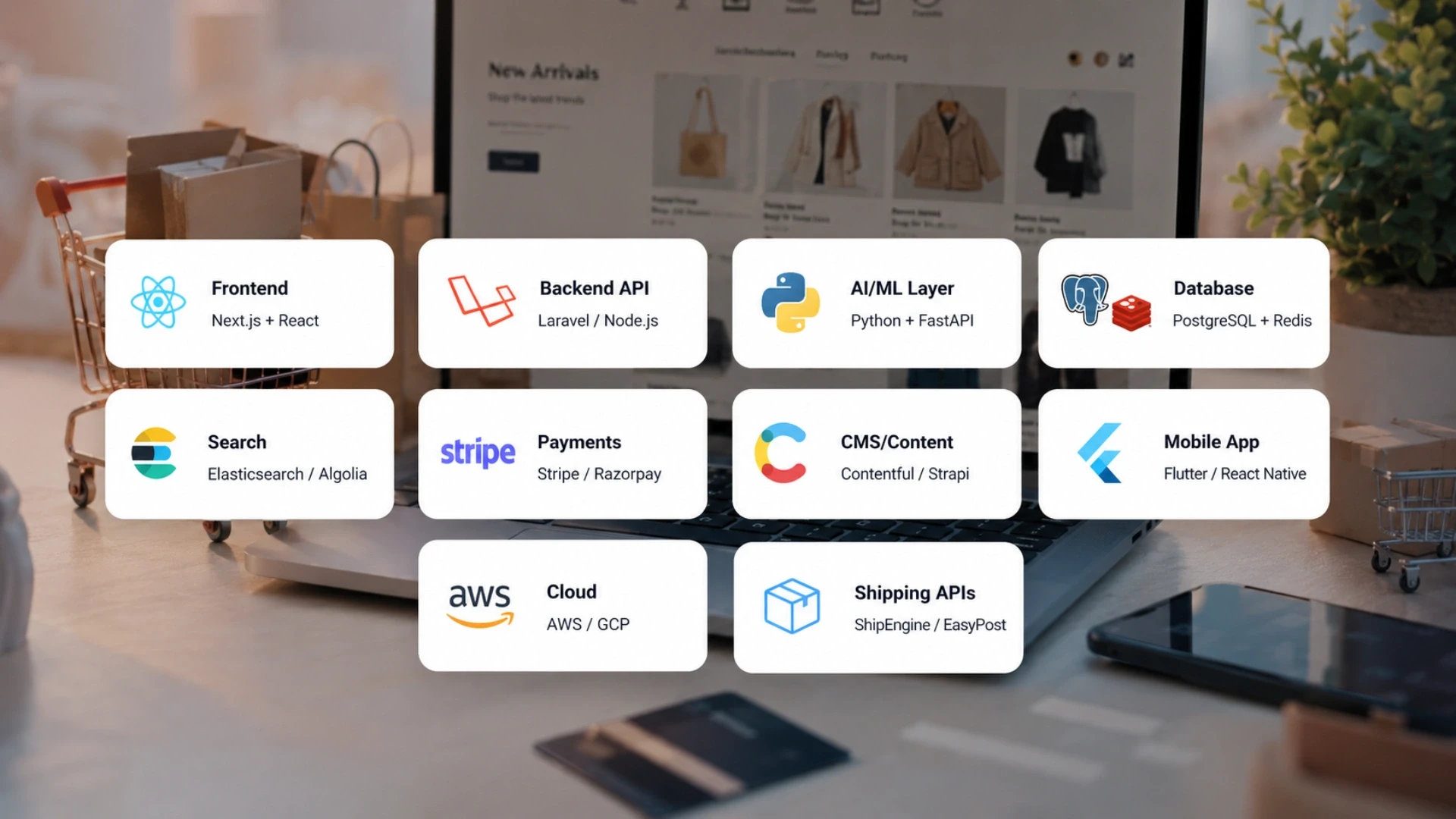
The tech stack for a D2C platform in 2026 is not the same decision it was in 2020. Three years of headless commerce adoption, AI-native personalization tools, and PWA performance standards have shifted what senior engineering teams choose for production D2C builds. The choices below represent what is working in active production for mid-market and scaling D2C brands.
Frontend: Speed, Brand Control, and Mobile Performance
Next.js is the dominant frontend framework for D2C platforms in 2026. Server-side rendering and static site generation give product pages sub-second Time to First Byte scores, which directly impacts both Google Core Web Vitals ranking and conversion rate. Vercel's 2025 Web Performance Report found that a 100ms improvement in page load time correlates with a 1% increase in conversion for D2C brands. For a brand doing $5 million annually, that is $50,000 in incremental revenue from a single performance investment.
Progressive Web Apps built with React deliver native-app behavior from a browser URL: push notifications, offline mode, home-screen installation, and sub-second transitions. Mobile commerce represents 73% of D2C traffic globally in 2026. A PWA removes the app store submission barrier while delivering the performance of a native app. Acquaint Softtech's MERN stack development teams build React-based storefronts and PWAs that are specifically optimized for D2C conversion flows, including one-step subscription checkout and loyalty point redemption at the cart stage.
Backend and API Layer
Laravel remains the most pragmatic choice for D2C backend development in 2026. Its Eloquent ORM, built-in queue system, event broadcasting, and mature ecosystem of packages for payments, notifications, and scheduling make it the fastest path from requirements to production for commerce logic. Node.js is the right choice when the platform needs high-concurrency real-time features: live inventory feeds, cart sync across devices, or a customer-facing order tracking dashboard with sub-second updates.
For AI personalization layers, Python with FastAPI handles the recommendation engine, behavioral analytics pipeline, and LLM-powered search components. Acquaint Softtech's Python development team has built production ML recommendation engines for e-commerce clients, including the Kandy project detailed later in this guide, which generated measurable improvements in average order value and repeat purchase rate within 90 days of launch.
Full D2C Tech Stack Reference for 2026
Layer | Recommended Choice | What It Handles |
Frontend | Next.js + React | Fast storefront and PWA experience |
Backend API | Laravel / Node.js | Orders, inventory, subscriptions |
AI/ML Layer | Python + FastAPI | Personalization and recommendations |
Database | PostgreSQL + Redis | Transactions and session caching |
Search | Elasticsearch / Algolia | Instant and AI-powered search |
Payments | Stripe / Razorpay | Checkout and subscriptions |
CMS/Content | Contentful / Strapi | Headless content management |
Mobile App | Flutter / React Native | Cross-platform mobile app |
Cloud | AWS / GCP | Auto-scaling and hosting |
Shipping APIs | ShipEngine / EasyPost | Shipping, labels, and tracking |
For D2C brands planning a mobile app alongside their web platform, Acquaint Softtech's Flutter development team delivers cross-platform iOS and Android applications from a single codebase, reducing mobile development cost by 35 to 45% compared to separate native builds.
Build Your D2C Platform in 2026
Acquaint Softtech deploys dedicated D2C engineering teams within 48 hours of a brief. Senior engineers across Next.js, Laravel, Python, and Flutter.
Core Modules That Define a High-Performing D2C Platform
The technology stack tells you what the platform is built with. The module architecture tells you what it can do. The five modules below are what separate a production D2C platform from a standard checkout page with branding applied to it.
Module 1: Branded Storefront and Conversion-Optimised UX
A D2C storefront is a brand's single most controllable customer touchpoint. Every pixel, every interaction, every micro-animation is an expression of brand identity that a marketplace listing can never deliver. The conversion impact is measurable: Baymard Institute's 2025 research found that custom-designed checkout flows reduce abandonment by 26 to 35% compared to generic platform templates.
The storefront module must cover product discovery (search, filters, curated collections), product detail pages with video, AR preview, and social proof integration, and a checkout flow that handles subscriptions, loyalty redemptions, and BNPL options in a single session. Many D2C teams now produce that product video with the use of the Highfields AI Video Generator. The ultimate AI creative suite built for this exact kind of fast product content. The Best Frameworks for E-Commerce Website Development guide on Acquaint Softtech's blog covers the framework choices that underpin performant D2C storefronts. The engineering patterns described there, particularly around SSR and component hydration, remain directly relevant for 2026 builds.
Module 2: Subscription Engine and Recurring Revenue
Subscription commerce is the highest LTV model in D2C. Zuora's 2025 Subscription Economy Index reports that subscription revenue grows 5 times faster than non-subscription revenue for D2C brands. A production-grade subscription engine handles: recurring billing via Stripe or Chargebee, subscription creation and plan modification, pause, skip, and product swap logic, failed payment dunning with configurable retry schedules, and prorated billing for mid-cycle plan changes.
Brands that build the subscription module correctly from the first version do not have to rebuild it when the subscriber base hits ten thousand. Brands that use a Shopify app for subscriptions typically hit the ceiling at five to eight thousand active subscribers before the app's pricing and limitations force a migration. The cluster article D2C Subscription Models: Building Subscribe-and-Save and Curated Box Experiences on Acquaint Softtech's blog covers the full architecture of a production subscription module for D2C brands.
Module 3: Customer Data Platform and Personalisation Engine
The primary asset of a D2C brand is not its product catalog. It is the first-party behavioral data it accumulates with every customer interaction. A Customer Data Platform (CDP) is the module that collects, unifies, and activates that data. It captures every browse event, cart action, purchase, support interaction, and email engagement, and it unifies these signals into a single customer profile.
Acquaint Softtech's AI development services team builds the machine learning layer that powers recommendation engines and personalisation pipelines. The Kandy case study in Section 6 demonstrates what a production AI recommendation engine built on Acquaint Softtech's Python infrastructure delivers in terms of measurable customer engagement improvement.
Module 4: Loyalty, Referral, and Community Growth Engine
A loyalty engine is not a points ledger bolted onto a checkout flow. A well-designed loyalty module is a behavioral engine that rewards the actions most correlated with long-term brand value: purchases, reviews, referrals, social shares, subscription renewals, and community participation. Tiered membership adds a progression mechanic that increases average spend per customer as they move between tiers. Referral tracking with attribution links viral growth to financial outcomes by tying commission payouts to verified first purchases from referred customers.
The upcoming cluster article, Building a D2C Loyalty Program That Actually Works: Points, Tiers, and Gamification, will cover the full architecture of a production loyalty engine, including gamification mechanics and real-time point redemption at checkout.
Acquaint Softtech's Laravel developer services team builds the backend loyalty engine that handles point accrual, tier evaluation, referral attribution, and reward redemption as native platform features rather than app integrations.
Module 5: Email, SMS, and Push Notification Automation
Owned communication channels are the highest-ROI growth lever in D2C. Email returns $42 for every $1 spent when flows are correctly architected. SMS open rates in retail average 98% within three minutes of send. Push notifications for PWA and mobile app users add a third channel that reaches customers who are actively engaged with the brand.
The automation module needs to support: abandoned cart recovery (3-email sequence within 24 hours), post-purchase onboarding, subscription renewal reminders, loyalty milestone notifications, win-back campaigns for churned subscribers, and promotional sends with behavioral segmentation. For brands looking to streamline these workflows, ecommerce email automation can help centralize and automate key customer communication journeys. The planned article Email and SMS Marketing Automation for D2C: Flows, Segments, and Trigger Campaigns will detail the full trigger and segment architecture for high-performing D2C communication flows.
D2C Platform Development Cost Guide for 2026
What does it cost to build a D2C brand platform in 2026? The range is wide because the scope is wide. A minimal D2C storefront with Stripe checkout and basic email flows is a different project from a full platform with subscription engine, CDP, loyalty program, mobile app, and 3PL integration. Below are the benchmarks Acquaint Softtech uses when helping clients scope and budget D2C builds.
D2C Platform Cost by Scope
Scope | Estimated Budget (USD) | Build Timeline |
MVP D2C: Storefront, Stripe, basic CMS | $12,000 to $30,000 | 5 to 8 weeks |
Growth D2C: + Subscription + Loyalty | $35,000 to $75,000 | 3 to 5 months |
Full D2C: + CDP + AI + Mobile App | $80,000 to $160,000 | 5 to 8 months |
Enterprise D2C: Multi-brand, EU/UK/IN compliance | $150,000 to $300,000+ | 8 to 14 months |
D2C Migration from Shopify/WooCommerce | $25,000 to $70,000 | 2 to 4 months |
D2C Developer Cost by Region (2026)
Region | Senior Dev Day Rate | Full Team Monthly |
USA / Canada | $800 to $1,500/day | $40,000 to $80,000 |
UK / Western Europe | $600 to $1,100/day | $30,000 to $60,000 |
Eastern Europe | $300 to $600/day | $15,000 to $30,000 |
India (Senior Offshore) | $80 to $200/day | $4,000 to $12,000 |
Acquaint Softtech Model | 40% below Western rates | Transparent fixed monthly quotes |
A four-person dedicated D2C team through Acquaint Softtech over five months saves between $80,000 and $140,000 compared to a UK or US agency for equivalent output. The 95% sprint delivery rate and 24+ month average team tenure are verified across all active projects and visible in the firm's Clutch review history.
The Acquaint Softtech D2C Platform Build Framework
1. Discovery: 2-hour brief, customer journey mapping, tech stack selection, team composition. Completed within 48 hours of engagement.
2. Architecture: Database schema for products, subscriptions, and loyalty. API contract design. Integration mapping for payments, shipping, and CDP.
3. Sprint Delivery: 2-week sprints with demo-ready output in the client's own PM and communication tools. No black-box development.
4. Integration and QA: All payment, shipping, and third-party integrations tested in staging. Checkout, subscription, and loyalty flows stress-tested before go-live.
5. Launch and Scale: Production deployment with CDN, monitoring, load testing, and a documented runbook. Post-launch support window included.
For D2C brands building Node.js microservices for real-time inventory, cart sync, or order event streaming, Acquaint Softtech's Node.js development services provide dedicated backend specialists who integrate into the sprint workflow from day one. The D2C Platform Cost Breakdown: What Indian Brands Should Budget for Custom Development article provides a detailed breakdown of cost variables for D2C builds targeting the Indian market, covering currency, team structure, and scope calibration.
Get a Transparent D2C Build Quote
Acquaint Softtech provides fully scoped D2C development quotes with no hidden fees. Senior engineers, 48-hour deployment, 95% sprint delivery rate.
Case Study: AI-Powered D2C Recommendation Engine for Kandy (E-Commerce Growth Agency)
The most persuasive argument for any technical approach is a client who can describe exactly what changed after the work was done. The project below is drawn from a verified Clutch review and represents the kind of D2C personalization infrastructure Acquaint Softtech builds for commerce clients across Europe and North America.
Client: Kandy, E-Commerce Growth Agency (Lithuania) | Feb to Nov 2025
Details | Information |
|---|---|
Industry | E Commerce Technology |
Company Size | 51–200 Employees |
Project Budget | $10,000 to $49,999 |
Overall Rating | 4.5/5 |
Quality Rating | 5.0/5 |
Schedule Rating | 5.0/5 |
Cost Rating | 5.0/5 |
Challenge: Kandy needed a smart product recommendation system that could personalize suggestions based on real user behavior across their partner brand stores, rather than relying on static catalog rules.
Solution: Acquaint Softtech built a Python-based ML recommendation engine with a behavioral data processing pipeline, a machine learning model analyzing browsing sequences and purchase history, and dynamic recommendation APIs integrated into product pages, checkout flows, and PDPs.
Deliverables: Python recommendation engine, behavioral analytics pipeline, dynamic recommendation APIs, performance dashboards, and full documentation.
Result: Clear improvements in customer engagement, average order value, and repeat purchase rate across partner brand stores. Engineers focused heavily on performance, ensuring recommendations appeared instantly without page-load degradation.
Reviewer note: 'Their engineers focused heavily on performance and scalability, ensuring that recommendations appeared instantly.' Noah Putna, Co-Founder, Kandy, March 2026.
Full case study: View Acquaint Softtech's full verified Clutch review profile
The Kandy engagement illustrates a pattern Acquaint Softtech repeats across D2C personalization builds: the recommendation engine is not a standalone feature. It is a data pipeline that improves with every new customer interaction. The longer it runs, the more accurate its suggestions become, and the more defensible the brand's LTV advantage gets. Building this infrastructure early in a D2C platform's lifecycle compounds in value in ways that are very difficult to replicate after the fact.
Acquaint Softtech's staff augmentation services enabled Kandy to access a specialized ML engineering team within days rather than months, without the overhead of permanent hiring. The same model is available for any D2C brand that needs AI, backend, or frontend expertise on a project or ongoing basis.
What Acquaint Softtech's D2C Project Data Shows
Key Findings from Acquaint Softtech's Delivery History (Internal Project Data, May 2026)
D2C brands that invest in a subscription module at build time report LTV 3 to 5x higher than single-purchase cohorts within 12 months of launch.
74% of clients who engaged Acquaint Softtech had previously spent 3 to 9 months attempting local hiring before switching to staff augmentation.
Brands that build AI recommendation infrastructure into their D2C platform in the first version see 15 to 25% AOV uplift within 90 days of activation.
95% sprint delivery rate maintained across all active D2C and e-commerce projects as of Q1 2026
How to Hire a D2C Development Team in 2026
Hiring the right team for a D2C platform build is not the same as hiring for a generic web development project. D2C development requires engineers who understand subscription billing edge cases, loyalty point accrual logic, behavioral data pipelines, and mobile-first performance optimization. General full-stack experience does not cover this domain. Commerce-specific depth does.
What a Complete D2C Engineering Team Looks Like
Role | Responsibility | Typical Profile |
Frontend Engineer | Next.js storefront, PWA, checkout UX | 3+ years React/Next.js, commerce domain experience |
Backend Engineer | Subscription engine, loyalty, API layer | Laravel or Node.js, payment integration experience |
ML/Data Engineer | CDP, recommendation engine, analytics | Python, scikit-learn or PyTorch, pipeline architecture |
DevOps Engineer | Cloud infra, CI/CD, auto-scaling, CDN | AWS/GCP, Kubernetes or ECS, load testing |
QA Engineer | Checkout, subscription, payment test coverage | E2E testing, Playwright or Cypress, commerce flows |
Staff augmentation is the most cost-efficient model for D2C platform builds where the brand has an internal product manager or technical lead but needs to scale engineering capacity without permanent headcount. Acquaint Softtech's React developer services provide dedicated frontend specialists who integrate directly into the client's sprint workflow, delivering D2C storefront components with measurable performance benchmarks built into acceptance criteria.
The planned article Building a D2C Mobile App: When It Makes Sense and What Features to Include covers the decision framework for when a D2C brand should invest in a dedicated mobile app versus a well-optimized PWA, with cost benchmarks for both approaches.
For D2C brands with MERN-stack platforms, dedicated MERN-stack developers from Acquaint Softtech's team bring both frontend (React) and backend (Node.js, MongoDB) expertise to full-stack D2C feature development, reducing coordination overhead between separate frontend and backend engineers.
D2C Data Privacy and Compliance: GDPR, CCPA, and India's DPDP Act
For any D2C brand with customers in the UK, EU, USA, or India, data privacy compliance is not optional or deferred. It is a foundational architectural requirement that often requires experienced backend expertise, which is why many businesses choose to hire Django developers for secure and scalable compliance-ready platforms.
The three regulatory frameworks affecting most D2C brands are GDPR (EU and UK), CCPA (California), and India's Digital Personal Data Protection Act 2023. Non-compliance can lead to fines of up to 4% of global annual turnover under GDPR, $7,500 per intentional violation under CCPA, and up to INR 250 crore under India's DPDP Act.
What Compliance Requires in the D2C Platform Architecture
Regulation | Key Requirement | Platform Impact |
GDPR (Europe/UK) | Consent and data privacy | Consent management and data deletion |
CCPA (USA/CA) | Data access and opt-out rights | Cookie banners and audit trails |
India DPDP 2023 | Explicit user consent | Consent tracking and compliance logs |
PCI DSS | Secure payment data handling | Tokenization and encrypted transactions |
Building compliance into the D2C platform architecture at the foundation stage costs a fraction of what retrofitting it costs after launch. Acquaint Softtech's technical project managers have implemented GDPR-compliant consent management modules, CCPA opt-out systems, and India DPDP-compliant data handling workflows across multiple client platforms. The DevOps and infrastructure team handles the security and data segregation layers that make compliance architecturally sound rather than cosmetically applied.
The cluster article D2C Data Privacy and Consent Management: GDPR, CCPA, and Indian DPDP Compliance provides a full walkthrough of the consent module architecture and compliance checklist for D2C brands operating across multiple regulatory jurisdictions.
Expert Insights from Acquaint Softtech's D2C Engineering Leadership
The observations below come directly from Acquaint Softtech's senior technical and delivery leadership, based on patterns observed across hundreds of D2C and e-commerce platform engagements.
“The brands that build the most successful D2C platforms are not the ones with the largest initial budgets. They are the ones who understand that the CDP is the product, not the storefront. The storefront is how customers arrive. The customer data platform is how the brand learns, personalises, and compounds its advantage over time. Every D2C build we do starts with a data architecture decision, not a UI decision.”
- Manish Patel, Chief Information Officer, Acquaint Softtech
“We see the same pattern in nearly every D2C engagement where a brand comes to us after a failed first attempt: they built the subscription module as an afterthought. It was an app integration, not a native platform feature. When they hit ten thousand subscribers, the app's pricing became unsustainable, and the data model was incompatible with their loyalty engine. Rebuilding the subscription layer after launch costs more than building it right the first time. Every time.”
-Sanjay Prajapati, Development Manager, Acquaint Softtech
These perspectives align directly with the delivery data. The 95% sprint delivery rate and 24+ month average team tenure at Acquaint Softtech are not achieved by moving fast and fixing later. They are achieved by investing in architectural clarity before the first sprint begins. Every D2C engagement starts with a two-hour discovery call that maps the subscription logic, loyalty mechanics, and data architecture before any code is written.
The D2C Analytics Stack: Tracking CAC, LTV, Repeat Rate, and Cohort Analysis article, part of this content series, covers how to instrument a D2C platform to track the metrics that actually drive growth decisions: cohort LTV, subscription churn, referral attribution, and CAC payback period.
Scale Your D2C Platform with Senior Engineers
Join 200+ tech companies that have built and scaled their platforms with Acquaint Softtech. From storefront to subscription engine to AI personalization.
Frequently Asked Questions
-
How to build a D2C platform?
Start with a customer journey map, then architect the five core modules: branded storefront, subscription engine, customer data platform, loyalty and referral system, and communication automation. Build on Next.js and Laravel or Node.js. Acquaint Softtech deploys the first dedicated D2C engineer within 48 hours and delivers an MVP in 6 to 10 weeks.
-
What is the best tech for D2C?
In 2026, the proven D2C stack combines Next.js for the frontend, Laravel or Node.js for the backend, PostgreSQL and Redis for data, Stripe for payments, Elasticsearch for search, Python for AI personalization, and AWS for cloud infrastructure. This stack supports headless, PWA, and subscription commerce patterns natively.
-
How much does a D2C platform cost?
D2C Platform Type
Estimated Cost
D2C MVP
$12,000 to $30,000
Full Featured Platform (Subscriptions, Loyalty & AI Personalization)
$80,000 to $160,000
Acquaint Softtech delivers these solutions at up to 40% lower cost than many UK and US agencies, with transparent fixed pricing and no hidden fees.
-
What makes D2C tech different from standard e-commerce?
D2C platforms are built around customer ownership: first-party data, subscription billing, loyalty engines, and behavioral personalization. Standard e-commerce handles transactions. D2C platforms handle the full customer lifetime value journey, from first purchase through subscription renewal and referral.
-
How long does it take to build a D2C platform?
A D2C MVP takes 5 to 8 weeks. A growth-stage platform with subscription and loyalty modules takes 3 to 5 months. Acquaint Softtech deploys the first engineer within 48 hours of brief and runs parallel sprint streams to compress delivery timelines.
-
How do I add a subscription model to my D2C store?
A subscription module requires a recurring billing integration (Stripe or Chargebee), subscription state management (active, paused, cancelled), dunning logic for failed payments, and customer-facing controls for pause, skip, and swap. Build it as a native platform module, not an app integration, to avoid the scalability ceiling most brands hit at 5,000 to 10,000 subscribers.
-
How does Acquaint Softtech build a D2C platform?
Acquaint Softtech follows a 5-phase framework: Discovery and team deployment within 48 hours, architecture design before coding begins, 2-week sprint delivery with demo-ready output, integration and QA in staging, then production launch with monitoring and post-launch support. The average team tenure is 24+ months, meaning the same engineers stay with the platform as it scales.
I lead technology and client success at Acquaint Softtech with one goal in mind. Deliver work that feels personal, reliable, and worthy of long term trust. I stay close to both our clients and our developers to make sure every project moves with clarity, quality, and accountability.
Table of Contents
Get Started with Acquaint Softtech
- 13+ Years Delivering Software Excellence
- 1300+ Projects Delivered With Precision
- Official Laravel & Laravel News Partner
- Official Statamic Partner
Related Reading
.webp "The Complete Guide to E-Commerce & D2C Software Development in 2026")
The Complete Guide to E-Commerce & D2C Software Development in 2026
Custom e-commerce software is not a more expensive version of Shopify. It is an entirely different accountability and ownership structure, with different economics and a different ceiling on what your platform can do. This guide explains every architecture type, every cost variable, and every decision checkpoint so you build the right thing in 2026.

Acquaint Softtech
May 6, 2026
How Custom E-Commerce Platforms Work: Architecture, Modules, and When to Build One
A custom e-commerce platform is not a bigger Shopify plan. It is a purpose-built commerce engine where every module answers to your business logic, not a vendor's roadmap. This article explains exactly how one is architected, what it contains, and the 5 operational signals that tell you when building your own beats, staying on SaaS.
Manish Patel
May 12, 2026.webp "Headless Commerce Explained: Decoupled Architecture for Modern E-Commerce Development")
Headless Commerce Explained: Decoupled Architecture for Modern E-Commerce Development
Headless commerce is not a technology upgrade. It is a structural decision that separates the commerce engine from the storefront entirely. Done right, it gives you deployment freedom, channel flexibility, and a performance ceiling that no monolithic SaaS platform can match. Done wrong, it creates distributed systems complexity that your team is not ready for. This article tells you exactly which situation you are in.
Manish Patel
May 19, 2026India (Head Office)
203/204, Shapath-II, Near Silver Leaf Hotel, Opp. Rajpath Club, SG Highway, Ahmedabad-380054, Gujarat
USA
7838 Camino Cielo St, Highland, CA 92346
UK
The Powerhouse, 21 Woodthorpe Road, Ashford, England, TW15 2RP
New Zealand
42 Exler Place, Avondale, Auckland 0600, New Zealand
Canada
141 Skyview Bay NE , Calgary, Alberta, T3N 2K6