

Headless Commerce Explained: Decoupled Architecture for Modern E-Commerce Development
Headless commerce is not a technology upgrade. It is a structural decision that separates the commerce engine from the storefront entirely. Done right, it gives you deployment freedom, channel flexibility, and a performance ceiling that no monolithic SaaS platform can match. Done wrong, it creates distributed systems complexity that your team is not ready for. This article tells you exactly which situation you are in.

Manish Patel
As Head of Tech and Client Success at Acquaint Softtech, a software product development company with 1,300+ projects delivered across 13+ years, I evaluate headless commerce architecture decisions for clients at every stage of growth: from D2C founders launching their second storefront to enterprise brands running $50M in annual GMV across 4 markets. The phrase "headless commerce" is used loosely in the industry: it covers everything from a Next.js storefront connected to Shopify via API to a fully decoupled microservices platform with an independent content layer.
This article gives you the precise definition and headless commerce architecture explained, along with the exact architecture, the honest trade-offs, and the 5-question framework that tells you whether going headless is the right decision for your specific platform.

- CTOs and engineering leads evaluating headless commerce architecture.
- D2C founders on Shopify/WooCommerce are facing performance and scaling limits.
- Product managers justifying headless adoption with cost and conversion impact.
- Agencies deciding when headless commerce adds real value vs complexity.
Problem: You are running an e-commerce operation where the frontend is becoming a bottleneck. Your SaaS platform's theme system limits what your design team can build. Your mobile app cannot share the same commerce logic as your web store. Your page load speed is throttled by the platform's rendering layer. Every ambitious frontend change requires a developer, a deployment, and a risk assessment.
Agitate: The cost of this bottleneck is not just speed. It is team efficiency, time to market for campaigns, and the inability to build the personalised, channel-specific experiences that drive conversion in 2026. A Baymard Institute study shows average cart abandonment is 70.19% across all industries, and page load speed is one of the top 3 controllable contributors to that number.
Solution: This guide explains exactly what headless commerce is, how its architecture works in practice, what it costs to build in 2026, and the precise conditions under which it is the right decision. Acquaint Softtech has delivered headless commerce builds for clients across the US, UK, Australia, and UAE. The frameworks here come from that delivery data.
Headless commerce is a decoupled architecture where the frontend presentation layer and the backend commerce engine operate as separate systems connected by an API. The "head" in headless refers to the frontend: the storefront, the product pages, the cart and checkout interface. In a traditional monolithic commerce platform, the head is tightly coupled to the commerce logic. Removing the head means the backend no longer dictates how the frontend is built, deployed, or rendered. The complete guide to e-commerce and D2C software development in 2026 covers the full landscape of commerce architecture types. This article goes deep on the headless layer specifically: what it is, how it is built, what it costs, and when it is the right decision.
The confusion in discussions about headless commerce exists because vendors use the term to describe both a lightweight API integration with a SaaS platform (Shopify Storefront API + Next.js) and a fully custom decoupled backend with an independent commerce engine.
These are architecturally different at a level that affects team size, build timeline, and total cost of ownership by a factor of 3 to 5. This article treats them as distinct. Both are covered. The distinction determines which one is right for your situation. The architecture of custom e-commerce platforms and their core modules is covered in the companion sub-pillar. This article focuses specifically on the headless layer.
What Headless Commerce Actually Is
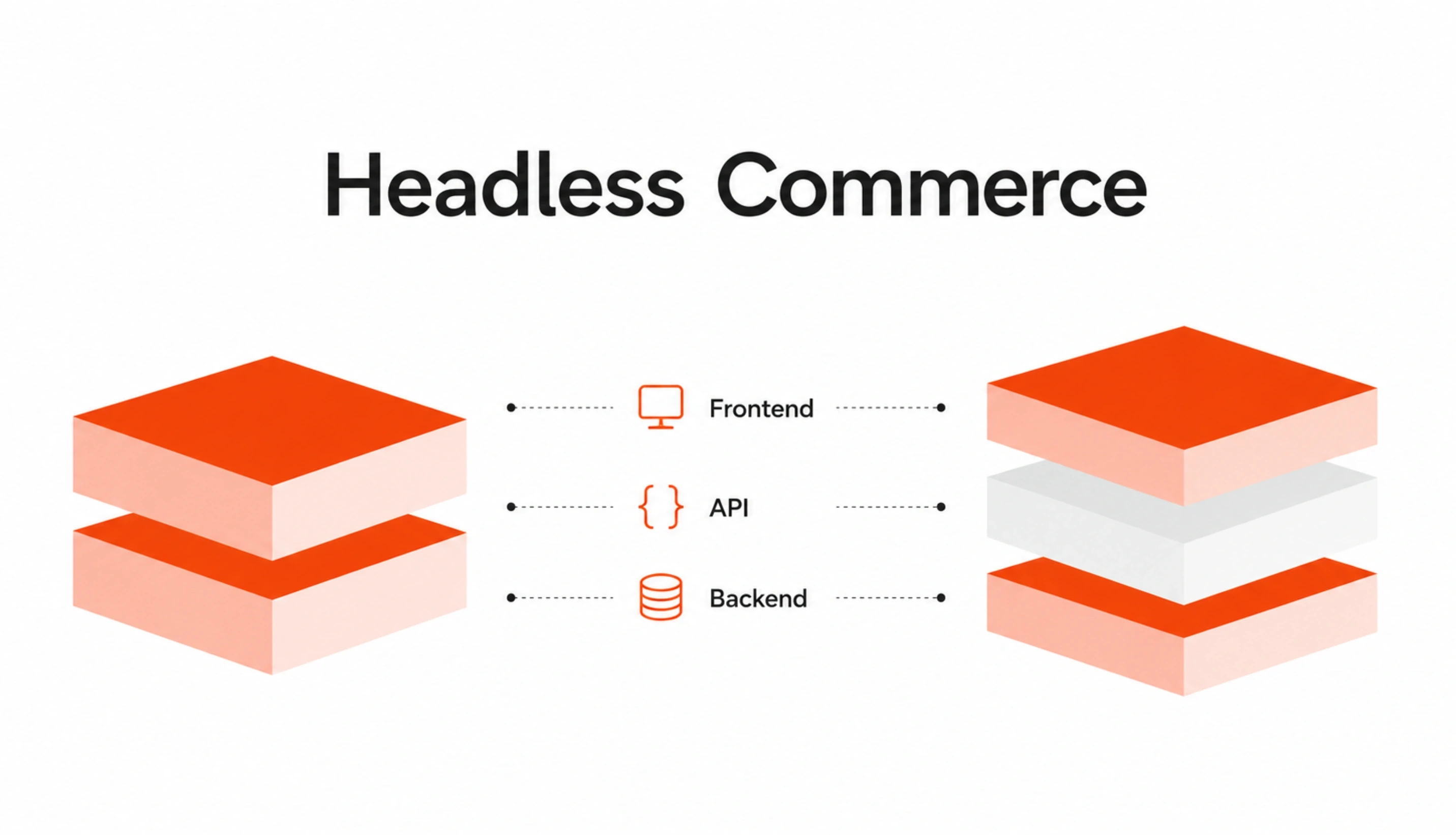
Headless commerce is a commerce architecture where the frontend and the backend are deployed, maintained, and scaled independently, connected by one or more APIs. The backend handles catalogue, inventory, pricing, promotions, cart, checkout, order management, and payment processing. The frontend handles rendering, navigation, search interface, and the user experience layer. Neither layer knows how the other is built. Each layer communicates only through the API contract.
The traditional commerce architecture is replaced
In a traditional monolithic commerce platform, Shopify, WooCommerce, and Magento on-premises, the frontend theme is rendered by the platform's own template engine. The Liquid template in Shopify, the PHP theme in WooCommerce, and the PHTML files in Magento. The frontend developer is constrained by the platform's rendering model, its JavaScript injection points, and its checkout flow. Changing the checkout requires the platform's APIs. Adding a new page type requires the platform's routing system. The frontend cannot be independently deployed.
What decoupling actually changes
Decoupling removes this constraint entirely. The frontend is an independent application: a React Single Page Application (SPA), a Next.js server-side rendered site, a Vue Nuxt application, or a mobile app. It communicates with the commerce backend via a REST or GraphQL API. The frontend team deploys independently of the backend team. A campaign page can go live in minutes without a commerce deployment.
A mobile app uses the same API as the web store. A second storefront for a new market is a new frontend consuming the same backend. Acquaint Softtech builds headless frontends for clients using React and Next.js, staffed by dedicated MERN stack developers who specialise in API-first commerce builds.
Headless-on-SaaS vs headless-on-custom
There are two structurally different headless implementations. The first is headless-on-SaaS: the Shopify or Contentful backend is retained, and a custom frontend is built on top of the platform's Storefront API. The second is headless-on-custom: the commerce backend is a purpose-built engine (Laravel, Django, or a microservices architecture) and the frontend consumes an API that the client's team owns and controls. Headless-on-SaaS is faster to implement and retains the SaaS platform's operational simplicity but preserves its limitations: you still cannot change the checkout logic, you still pay transaction fees, and you still cannot exceed the platform's API rate limits.
Headless-on-custom removes all of those constraints and is the architecture Acquaint Softtech builds for clients who need full ownership. The build vs buy analysis for custom Laravel applications covers the decision between these two models at the backend level.
How the Decoupled Architecture Works: Layer by Layer
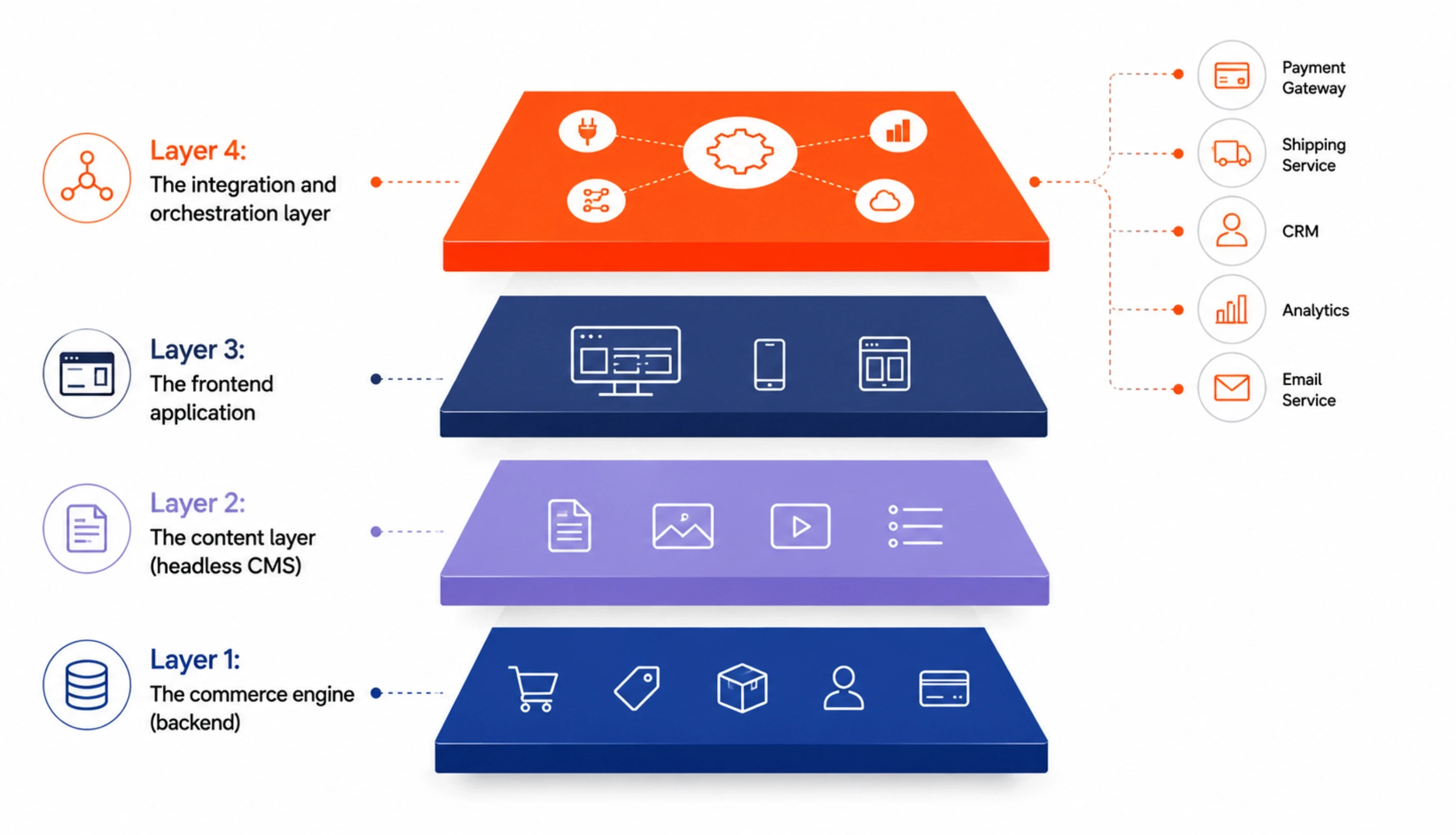
A production-grade headless commerce architecture has 4 distinct layers, each with a specific responsibility. Understanding the layers and the API contracts between them is the prerequisite for any headless build. Based on Acquaint Softtech delivery data across 1,300+ projects, here is how each layer is structured. The software product engineering team at Acquaint Softtech designs the API contract between each layer before writing the first line of code, because a poorly defined API contract between the frontend and the commerce engine is the most common cause of rework in headless builds.
Layer 1: The commerce engine (backend)
The commerce engine is the source of truth for catalogue, pricing, inventory, promotions, cart, checkout, order management, and payment processing. In a headless-on-custom build, this is a purpose-built application on Laravel or Django with a RESTful or GraphQL API exposed to the frontend. In a headless-on-SaaS build, this is the Shopify Storefront API or a similar SaaS backend API. The commerce engine never knows how the frontend renders its data. It only knows what data has been requested and what operations have been performed. Acquaint Softtech's Laravel development services include the design and implementation of commerce API layers for headless builds.
Layer 2: The content layer (headless CMS)
In most production headless commerce builds, a separate content management system handles the non-transactional content: marketing pages, campaign content, editorial pages, blog posts, and banner management. This is what makes the architecture truly headless: the marketing team manages content in a dedicated CMS (Contentful, Prismic, Sanity, or Statamic) without touching the commerce backend.
Content and commerce data are fetched independently by the frontend and composed at render time. Acquaint Softtech is a Statamic Partner and builds headless content layers on Statamic for Laravel-based commerce builds, combining a Laravel commerce engine with a Statamic CMS content layer for clients who want both layers on the Laravel ecosystem.
Layer 3: The frontend application
The frontend is an independent application that consumes both the commerce engine API and the content layer API. It handles routing, rendering, caching, and the user experience layer. In a Next.js build, pages are server-side rendered (SSR) at request time or statically generated (SSG) at build time, with incremental static regeneration (ISR) for pages that change frequently. The frontend team deploys independently using a CDN (Content Delivery Network) like Vercel, Netlify, or Cloudflare Pages.
This independence is the primary performance benefit of headless: the frontend is served from edge nodes geographically close to the user, with time-to-first-byte (TTFB) of 50 to 150 milliseconds compared to 400 to 1,200 milliseconds for a server-rendered SaaS platform. As Acquaint Softtech's analysis of AR/VR and eCommerce in web development shows, the independent frontend layer also makes it straightforward to integrate immersive commerce experiences, 3D product views, virtual try-on, and AR room placement without rebuilding the commerce engine.
Layer 4: The integration and orchestration layer
In a production headless build, the frontend does not always call the commerce engine directly. An API gateway or Backend for Frontend (BFF) layer sits between the frontend and the downstream services: it aggregates data from the commerce engine and the CMS, handles authentication and session management, applies rate limiting, and provides a single endpoint for the frontend to consume. The BFF is particularly important in microservices headless builds, where the frontend would otherwise need to call 6 to 10 individual services per page load. Acquaint Softtech's DevOps and CI/CD strategy guide for Laravel covers the deployment pipeline patterns that keep a multi-layer headless build operationally maintainable.
Want to See a Headless Architecture Proposal for Your Platform?
Acquaint Softtech reviews your current commerce setup, your frontend requirements, and your channel strategy and produces a headless architecture brief with tech stack recommendation within 48 hours. You review before any engagement begins.
Headless vs Traditional vs Composable: The Structural Difference
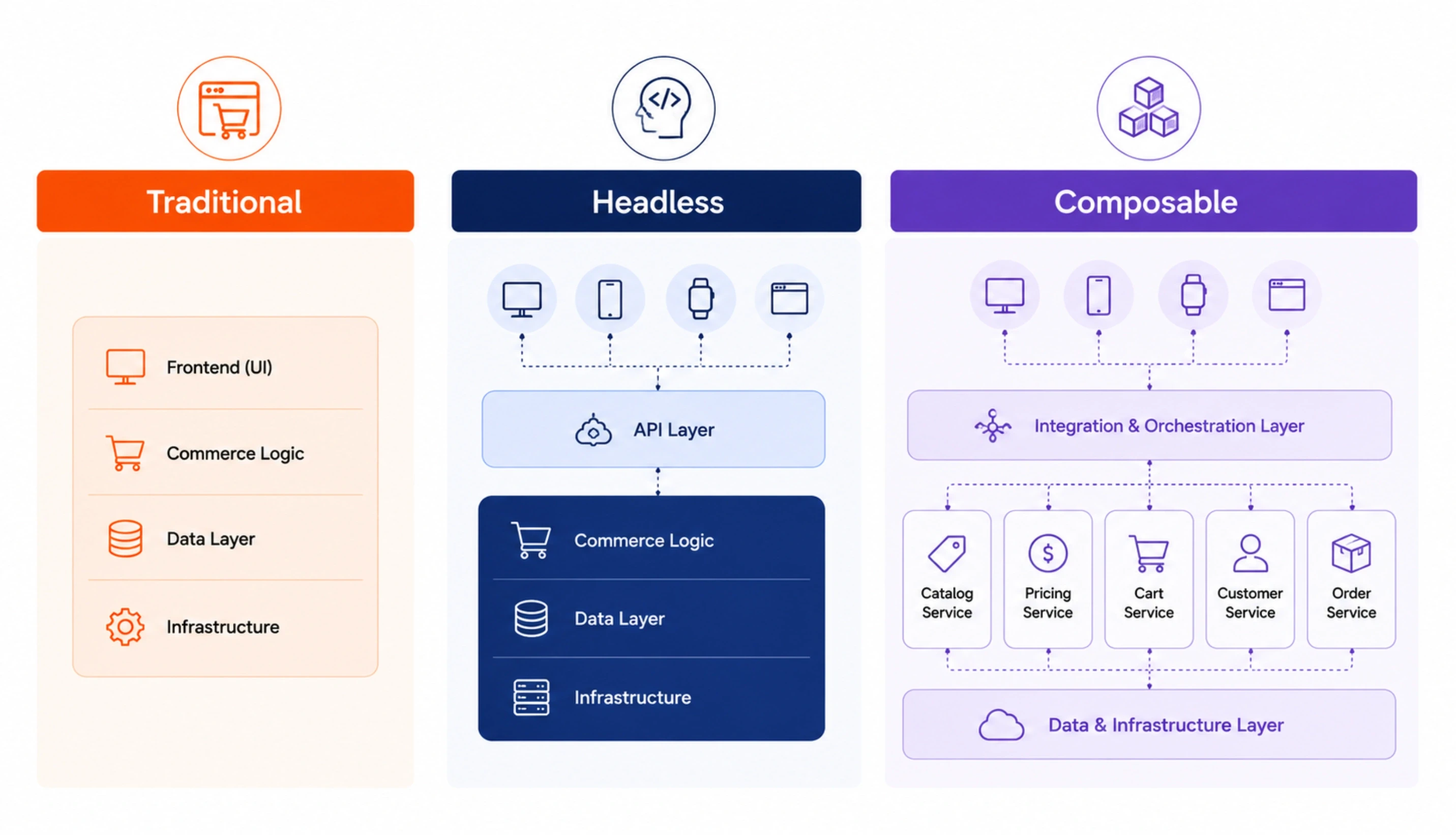
The market uses three terms that describe three different points on the decoupling spectrum: traditional (monolithic), headless (frontend decoupled), and composable (all layers independently swappable). Understanding where each sits on that spectrum is essential before choosing an architecture. The wrong choice at this stage adds 6 to 18 months to the path of correcting it.
Dimension | Traditional (Monolith) | Headless | Composable |
Frontend deployment | Deployed with the commerce backend. Frontend changes require a commerce deployment. | Deployed independently. Frontend team ships without touching the commerce backend. | Each frontend and each service deploys independently with no cross-dependency. |
Backend ownership | The platform vendor owns the backend logic and data model. | Commerce engine is either SaaS (Shopify API) or custom-built. | Each capability — search, cart, payments, CMS — is a best-of-breed independent service. |
Content management | Content is managed inside the commerce platform's admin. | The content layer is a separate headless CMS fetched by the frontend independently. | Content is managed in a dedicated CMS fully independent of commerce and other services. |
Performance ceiling | Constrained by the platform's server-side rendering speed and CDN configuration. | Frontend served from edge CDN. TTFB of 50 to 150ms for static pages. | Same as headless for frontend, with additional scaling flexibility per service. |
Team structure | One team manages both frontend and backend in the same codebase. | The frontend team and the backend team operate independently with the API contract as a boundary. | Independent pod per capability. Requires significant engineering investment to operate. |
Build complexity | Low. One codebase, one deployment pipeline, one team. | Medium. Two codebases, two deployment pipelines, and an API contract to maintain. | High. N codebases, N pipelines, service discovery, distributed tracing, and on-call per service. |
Best fit | Businesses under $2M GMV with standard catalogue and checkout requirements. | Multi-channel requirements, mobile apps, or frontend performance constraints at $2M to $20M GMV. | Enterprise platforms above $20M GMV with 15+ engineers and distributed systems maturity. |
The decision principle: most D2C brands and mid-market commerce operators are in the headless range. Composable commerce is appropriate only when you have the engineering organisation to operate a distributed system, and only when the operational overhead of running independent services produces a return in deployment velocity and scalability that a headless build cannot deliver.
For clients in the $2M to $20M GMV range, Acquaint Softtech consistently recommends a software development outsourcing engagement structured as headless-on-custom with a modular backend, not a composable microservices architecture.
The API-First Commerce Stack: Frontend, Backend, and Content
A production headless commerce build requires decisions across 4 technology layers. Based on Acquaint Softtech delivery data across 1,300+ projects, here are the stack choices that produce the best outcomes at each tier. The PHP vs Python vs Node.js comparison covers the backend language decision in more depth. This section maps the full stack.
Backend commerce engine options
Laravel (PHP) is Acquaint Softtech's primary recommendation for custom headless commerce backends. It provides a mature ORM, robust job queue (Laravel Horizon), native API resource transformers, and a rich ecosystem of commerce-adjacent packages. Acquaint Softtech is an Official Laravel Partner with dedicated Laravel developers who have built production commerce APIs handling 50,000+ daily active users.
Django (Python) is the right choice when the client's existing engineering team is Python-first or when the platform requires heavy data processing, recommendation engine work, or AI-adjacent features. Acquaint Softtech's Django development services cover Django REST Framework (DRF) API development for headless commerce builds.
Frontend framework options
Next.js (React) is the dominant choice for headless commerce frontends in 2026, offering server-side rendering, static generation, incremental static regeneration, and edge runtime support in a single framework. It integrates natively with Vercel's edge network for sub-100ms TTFB on static pages. Nuxt.js (Vue) is a viable alternative for teams with Vue expertise, offering equivalent rendering modes.
Astro is a strong choice for content-heavy commerce storefronts where JavaScript hydration overhead affects performance on low-end mobile devices. Acquaint Softtech's hire remote developers page details how Acquaint Softtech staffs React and Next.js engineers for headless commerce frontend builds.
Headless CMS options
Contentful is the most widely adopted headless CMS for enterprise headless commerce builds, offering mature SDKs, a rich content modelling interface, and global CDN delivery. Sanity is the preferred choice for teams that need flexible, schema-first content modelling and real-time collaboration. Prismic offers a simpler setup suitable for mid-market D2C brands that do not require Contentful's enterprise feature set.
Statamic, built on Laravel, is Acquaint Softtech's recommendation for clients running a Laravel commerce backend: it provides a unified Laravel ecosystem for both the commerce API and the content layer, reducing operational complexity and keeping the full stack in a single language and deployment environment.
Search and personalisation layer
Product search in a headless build is handled by a dedicated search service, not the commerce backend. Algolia is the dominant managed search solution for mid-market headless commerce: it provides instant search, faceted filtering, and personalisation out of the box. Elasticsearch (via OpenSearch) is the right choice for builds with 1M+ product records, complex faceting requirements, or the need to run search infrastructure on the client's own cloud account.
Acquaint Softtech's AI development services include building AI-powered personalisation and recommendation layers as part of headless commerce builds for clients who want to move beyond keyword search into intent-aware discovery.
What Does a Headless Commerce Build Cost in 2026?
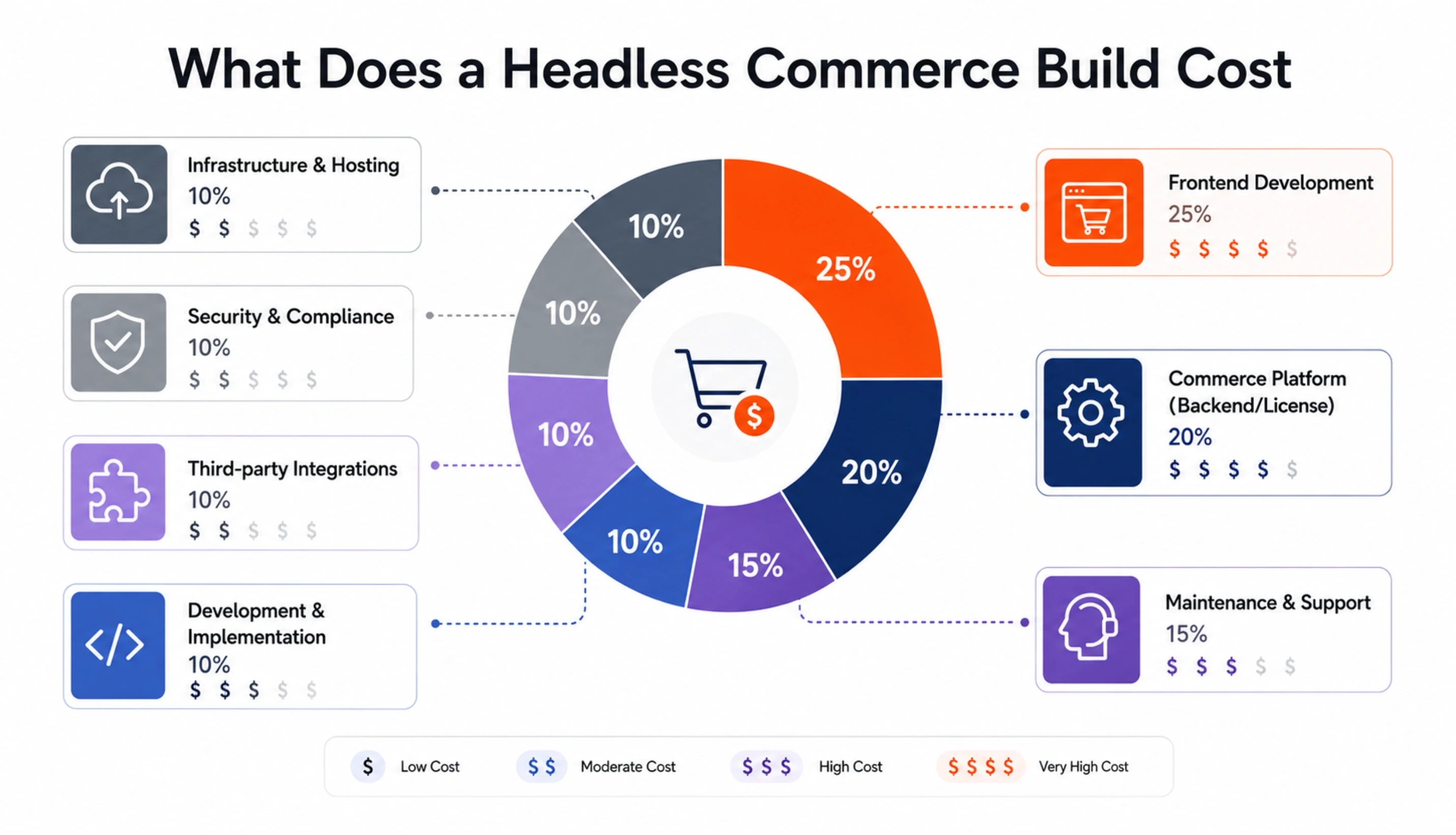
Headless commerce build cost depends on the backend type (headless-on-SaaS vs headless-on-custom), the frontend complexity, the number of storefronts, the CMS choice, and the search and personalisation requirements. The figures below are based on Acquaint Softtech delivery data for headless builds from India. Acquaint Softtech is a custom eCommerce development company with 70+ multi-stack engineers and a 13-year delivery track record. The 40% cost saving against equivalent in-house team costs is consistent across engagements.
Build Type | Frontend Build Cost | Backend Cost (if custom) | Total Build Range | Timeline |
Headless-on-SaaS (Shopify + Next.js) | $18,000 to $40,000 | N/A (SaaS backend) | $18,000 to $40,000 | 10–18 weeks |
Mid-Market Custom Headless | $30,000 to $55,000 | $50,000 to $90,000 | $80,000 to $145,000 | 20–32 weeks |
Enterprise Headless + Composable | $60,000 to $120,000 | $120,000 to $250,000+ | $180,000 to $370,000+ | 32–52 weeks |
Headless-on-SaaS is the lower-cost entry point but retains SaaS platform transaction fees and API rate limits. The cost savings compared to a full custom build must be weighed against the ongoing SaaS overhead at scale. A business at $5M GMV on Shopify Plus paying 0.15% transaction fees plus $4,000/month in apps spends $67,500 per year on platform overhead, overhead that disappears with a custom headless backend.
What the monthly rate includes at Acquaint Softtech for headless builds
Frontend development: React/Next.js storefront with SSR, SSG, and ISR configuration
Backend API development: commerce engine design, GraphQL or REST API, authentication layer
Headless CMS integration: content modelling, API integration, editorial workflow setup
Search integration: Algolia or Elasticsearch configuration and indexing pipeline
DevOps: CDN configuration, CI/CD pipeline, edge deployment, monitoring and alerting
Performance engineering: Core Web Vitals optimisation, TTFB benchmarking, caching strategy
QA (Quality Assurance): end-to-end testing, API contract testing, cross-browser and device validation
The rate the client pays is the rate. No additional employer overhead, contractor fees, or tool licensing costs on top. Acquaint Softtech's MVP development services allow clients to build a custom headless storefront against an existing SaaS backend to validate the architecture decision before committing to a full custom backend build.
Want a Cost Breakdown for Your Headless Commerce Build?
Acquaint Softtech reviews your current platform, your frontend requirements, and your channel strategy and sends a scoped cost estimate with team composition within 48 hours. You review the team profiles before any contract is signed.
The 5 Questions That Tell You Whether to Go Headless
Answer each question honestly against your current situation. If you answer Yes to 3 or more, a headless architecture is justified. The product discovery workshop at Acquaint Softtech uses this framework as a structured assessment tool at the start of every commerce architecture engagement.
Question 1: Do you have a mobile app or plan to launch one within 12 months?
A mobile app requires an API to consume commerce data. If the mobile app and the web store share the same API, they also share the same commerce engine, the same pricing rules, the same cart logic, and the same order management. This is the single most compelling operational argument for headless.
Yes: headless architecture is directly justified by this requirement.
No: this criterion alone does not justify the architectural investment, but proceed to the remaining questions.
Question 2: Is your frontend performance directly affecting conversion rate?
Measure your Core Web Vitals (Largest Contentful Paint, First Input Delay, Cumulative Layout Shift) and your TTFB against Google's 2026 thresholds. If your LCP exceeds 2.5 seconds on mobile and you have evidence that page load speed is correlated with bounce rate or cart abandonment on your platform, the performance argument for a headless frontend is commercially justified.
Yes: headless frontend addresses this directly.
No: Investigate CDN configuration and asset optimisation before committing to a headless build.
Question 3: Do your marketing and development teams deploy independently?
In a monolithic platform, a marketing campaign page often requires a developer to implement it in the platform's template system. If your marketing team is blocked by the development queue for content changes, campaign launches, or A/B test implementations, headless architecture eliminates that dependency: the marketing team manages content in the CMS, the developer manages the frontend component library, and neither needs to coordinate on every launch.
Yes: headless produces immediate operational efficiency.
No: if the teams already share a deployment workflow without friction, headless may not produce an operational benefit.
Question 4: Will you operate more than one storefront from the same commerce backend?
If you are planning to launch a second brand, a second regional storefront, a B2B portal, or a wholesale channel that shares your product catalogue, pricing engine, and order management with your primary D2C store, headless architecture is the only clean way to achieve this. Each storefront is a separate frontend consuming the same backend API. Acquaint Softtech's guide on developing your own online marketplace covers the multi-storefront and multi-seller architecture patterns in detail.
Yes: multi-storefront is a primary use case for headless.
No: if you are running a single storefront with no multi-channel plans, the operational overhead of headless may not be justified.
Question 5: Can your team operate two independently deployed systems?
Headless requires two deployment pipelines, two monitoring setups, two sets of on-call procedures, and a stable API contract that both teams respect. If your engineering team is under 4 people or if you do not currently have a structured release and deployment process, the operational overhead of headless may cost more in engineering time than the architecture gains in deployment flexibility.
Yes: your team has the operational maturity to run this architecture.
No: invest in a well-structured modular monolith first, and migrate to headless when the team and the business both justify it.
Answered Yes to 3 or More? Let Acquaint Softtech Design Your Headless Stack.
Tell us your platform, your channel requirements, and your team structure. We produce a full headless architecture brief with tech stack, team composition, and timeline within 48 hours. You interview the proposed team before any engagement begins.
Common Misconceptions About Headless Commerce
Headless commerce carries more misconceptions per technology topic than almost any other area of e-commerce architecture. Most are products of vendor marketing, developer enthusiasm outpacing operational reality, or confusion between headless-on-SaaS and headless-on-custom. Here is what the delivery data shows. Acquaint Softtech has evaluated these claims across software product development engagements for clients on four continents.
Misconception 1: Headless always delivers better performance than a monolithic platform
What people believe Going headless automatically gives you faster page loads, better Core Web Vitals, and higher conversion rates. | What the data shows A poorly implemented headless build is slower than a well-optimised monolith. Headless performance depends on CDN configuration, SSR vs SSG strategy, API response times, and JavaScript bundle optimisation. A Next.js storefront with unoptimized API waterfalls and a 400 KB JavaScript bundle will score worse on Core Web Vitals than a well-tuned Shopify theme. Performance is an outcome of implementation quality, not of architecture choice. |
Misconception 2: Any developer can build a headless commerce frontend
Myth: Headless just means React on the frontend. Any frontend developer can build it.
Three reasons this is wrong:
Headless commerce frontend development requires expertise in server-side rendering, edge deployment, API design and consumption, caching strategy, and commerce-specific patterns like cart state management across SSR and client hydration. These are distinct skills from standard React development.
API contract design between the frontend and the commerce backend is the single most common failure point in headless builds. A developer who has not built commerce APIs before will design a contract that creates N+1 query problems, exposes sensitive pricing data, or requires full page reloads for cart updates.
Acquaint Softtech's headless commerce builds are staffed with frontend engineers who have production experience with commerce API integration, not generalist React developers reassigned to a commerce project.
Misconception 3: Headless-on-Shopify gives you full ownership
Common belief: Building a custom Next.js frontend on top of Shopify's Storefront API means you own the platform.
You own the frontend codebase. You do not own the commerce engine, the checkout flow, the pricing logic, or the order management system. Shopify's Storefront API exposes read-only catalogue data and limited cart/checkout functionality.
The checkout itself, the page where money changes hands, is still Shopify's. You cannot change its structure, its fields, or its flow beyond what Shopify's Checkout Extensibility API allows. Transaction fees still apply. API rate limits still apply. If Shopify changes its pricing or deprecates an API version, your headless frontend is affected. True ownership requires a custom commerce backend.
Misconception 4: Composable commerce is just a more advanced version of headless
MYTH:
Composable commerce is headless commerce taken to its logical conclusion. Every company building a headless system should eventually go composable.
FACT:
Composable commerce is not a more advanced version of headless. It is a different operational model entirely, appropriate for a different organisational size. Composable architecture requires independent engineering pods per capability, service discovery infrastructure, distributed tracing, cross-service API versioning contracts, and the on-call and incident response structures to support N independent services.
Most commerce operators who adopt a composable architecture before their organisation justifies it spend 18 to 24 months managing operational complexity before returning to a simpler architecture.
Acquaint Softtech recommends composable architecture only for clients above $20M GMV with 15+ engineers and an established DevOps function. The hire dedicated DevOps engineers page covers the infrastructure expertise required to operate a composable commerce stack.
Frequently Asked Questions
-
What is headless commerce?
Headless commerce is a decoupled architecture where the frontend presentation layer and the backend commerce engine operate as separate systems connected by an API (Application Programming Interface). The backend handles catalogue, pricing, cart, checkout, and order management. The frontend handles rendering and the user experience layer. Neither layer dictates how the other is built or deployed.
-
What is the difference between headless commerce and traditional e-commerce?
In traditional monolithic commerce, the frontend theme is rendered by the platform's own template engine: Shopify's Liquid, WooCommerce's PHP theme, and Magento's PHTML files.
The frontend cannot be deployed independently of the commerce backend. In headless commerce, the frontend is an independent application, typically React or Next.js, that consumes the commerce backend via an API. Frontend and backend teams deploy independently, and the same API can power a web store, a mobile app, and a kiosk from a single backend.
-
When should I go headless?
Go headless when you have a mobile app or plan to launch one, when your frontend performance is demonstrably affecting conversion rate, when your marketing and development teams need to deploy independently, or when you plan to run more than one storefront from the same commerce backend. If none of these conditions applies, a well-optimised traditional or modular monolith will serve you better with significantly lower operational overhead.
-
How much does a headless commerce build cost?
Headless Commerce Type
Estimated Cost
Timeline
Headless on SaaS Platform
$18,000 to $40,000
10 to 18 weeks
Mid Market Custom Headless Build
$80,000 to $145,000
20 to 32 weeks
Enterprise Composable Architecture
$180,000 to $370,000+
Depends on scope
These estimates are based on Acquaint Softtech’s offshore delivery model from India.
-
What tech stack does Acquaint Softtech use for headless commerce?
Backend: Laravel (primary) or Django, with a RESTful or GraphQL API layer. Frontend: Next.js (React) or Nuxt.js (Vue), deployed on Vercel or Cloudflare Pages. Headless CMS: Statamic (for Laravel backend clients), Contentful, or Sanity. Search: Algolia for mid-market, Elasticsearch/OpenSearch for large catalogues. Each stack is selected to match the client's existing technical environment, team capability, and performance requirements.
-
Can I go headless without replacing my Shopify backend?
Yes. Headless-on-SaaS keeps the Shopify backend and replaces only the frontend theme with a custom Next.js storefront consuming Shopify's Storefront API. This approach is faster and cheaper to implement than a full custom backend but retains Shopify's limitations: you cannot change the checkout structure, you still pay transaction fees, and you cannot exceed Shopify's API rate limits. It is the right starting point for brands that need frontend flexibility but are not yet ready for a full custom backend investment.
-
Is headless commerce appropriate for a D2C startup?
For most pre-revenue D2C startups, no. The operational overhead of managing two independently deployed systems outweighs the architectural benefits at the early stage. A well-configured Shopify theme or WooCommerce setup allows faster launch and cheaper iteration. The exception is a startup whose business model requires a mobile-first multi-channel experience from day one.
In those cases, Acquaint Softtech recommends a headless-on-SaaS build with a Shopify backend as the path of least resistance to a production-grade headless architecture without the full custom backend investment.
I lead technology and client success at Acquaint Softtech with one goal in mind. Deliver work that feels personal, reliable, and worthy of long term trust. I stay close to both our clients and our developers to make sure every project moves with clarity, quality, and accountability.
Table of Contents
Get Started with Acquaint Softtech
- 13+ Years Delivering Software Excellence
- 1300+ Projects Delivered With Precision
- Official Laravel & Laravel News Partner
- Official Statamic Partner
Related Blog
.webp "The Complete Guide to E-Commerce & D2C Software Development in 2026")
The Complete Guide to E-Commerce & D2C Software Development in 2026
Custom e-commerce software is not a more expensive version of Shopify. It is an entirely different accountability and ownership structure, with different economics and a different ceiling on what your platform can do. This guide explains every architecture type, every cost variable, and every decision checkpoint so you build the right thing in 2026.

Acquaint Softtech
May 6, 2026
How Custom E-Commerce Platforms Work: Architecture, Modules, and When to Build One
A custom e-commerce platform is not a bigger Shopify plan. It is a purpose-built commerce engine where every module answers to your business logic, not a vendor's roadmap. This article explains exactly how one is architected, what it contains, and the 5 operational signals that tell you when building your own beats, staying on SaaS.
Manish Patel
May 12, 2026
Python for eCommerce Building Custom Marketplaces and Automation Pipelines
Python for eCommerce in 2026. How to build custom marketplaces, automate operations, and architect platforms that compete with Shopify on your own terms.
Acquaint Softtech
May 19, 2026India (Head Office)
203/204, Shapath-II, Near Silver Leaf Hotel, Opp. Rajpath Club, SG Highway, Ahmedabad-380054, Gujarat
USA
7838 Camino Cielo St, Highland, CA 92346
UK
The Powerhouse, 21 Woodthorpe Road, Ashford, England, TW15 2RP
New Zealand
42 Exler Place, Avondale, Auckland 0600, New Zealand
Canada
141 Skyview Bay NE , Calgary, Alberta, T3N 2K6