

How Custom E-Commerce Platforms Work: Architecture, Modules, and When to Build One
A custom e-commerce platform is not a bigger Shopify plan. It is a purpose-built commerce engine where every module answers to your business logic, not a vendor's roadmap. This article explains exactly how one is architected, what it contains, and the 5 operational signals that tell you when building your own beats, staying on SaaS.

Manish Patel
As Head of Tech and Client Success at Acquaint Softtech, a software product development company with 1,300+ projects delivered across 13+ years, I review custom e-commerce architecture decisions every week alongside founders and CTOs who have outgrown their current platform. The build-vs-buy decision is both the most consequential and least well-framed question in commerce technology, where most teams compare the wrong things at the wrong stage. This article explains how a custom e-commerce platform works, including its core architecture, key modules, and how choosing between monolith and microservices impacts timeline and cost. It also highlights the 5 operational signals that indicate when building your own platform delivers better outcomes than relying on SaaS.

- D2C founders scaling beyond Shopify or WooCommerce limitations.
- Engineering teams evaluating monolithic vs microservices eCommerce architecture.
- Product companies planning a custom commerce platform build.
- Operations leaders comparing custom development costs with SaaS platform expenses.
Problem: You are running a growing D2C or e-commerce business on Shopify, WooCommerce, or a hosted platform. Transaction fees, monthly app subscriptions, and rigid checkout flows are compounding. A business at $2M Gross Merchandise Value (GMV) paying 1.5% in transaction fees plus $2,500 per month in third-party apps spends $42,000 per year on platform overhead alone.
Agitate: Every quarter you delay a custom build, that overhead compounds. Your checkout is a template your competitor uses. Inventory rules are hacked together across four separate apps. The platform you depend on can change its pricing or its API (Application Programming Interface) limits without your input. According to Shopify's published pricing, merchants on Basic and Shopify plans pay 0.5% to 2% in transaction fees on top of payment processor fees, a cost that scales directly with GMV growth.
Solution: This guide gives you the exact architecture blueprint, the core module breakdown, an honest cost comparison, and a 5-question decision framework that tells you whether a custom build is the right answer. Acquaint Softtech has built custom commerce platforms for clients across the US, UK, and Australia. The frameworks here come from that delivery data.
The confusion in the build-vs-buy debate exists because most teams define "custom" incorrectly. Custom does not mean expensive, fragile, or reserved for enterprise brands with $50M in annual revenue. An outsourced custom e-commerce platform is a commerce engine built to your business rules, not a template extended beyond its intended use. The operational difference from SaaS is an ownership structure: you own the codebase, the data schema, the checkout logic, and the infrastructure. Platform lock-in disappears when you own the platform. Acquaint Softtech's eCommerce development services are built on this principle. This article defends a specific position: a custom build is the right answer when your business has pricing logic, product relationships, or operational workflows that no hosted platform was designed to support.
Before examining the architecture layers, it helps to understand what separates a commerce engine from a commerce template. The complete guide to e-commerce and D2C software development in 2026 covers the full strategic landscape, from architecture types to platform cost comparisons. This article goes deep on custom architecture, specifically, and when the build decision is justified.
What a Custom E-Commerce Platform Actually Is

A custom e-commerce platform is a commerce system built from first principles to a specific business model, data schema, and operational workflow. It is not Shopify with custom code on top. It is not WooCommerce with 40 plugins. The defining characteristic is ownership: the client owns every layer, from the database schema to the deployment infrastructure.
The codebase is yours
No vendor holds a licence over your platform, and there is no subscription fee to keep the store running, which directly impacts custom e-commerce in India considerations for long-term ownership. The code lives in your repository, deployed to infrastructure you control. Acquaint Softtech builds these platforms on Laravel (PHP), Django (Python), or the MERN stack based on the client’s existing tech environment and team capability, and every line of code is transferable to any team at any time.
The business logic is primary
Custom platforms exist because business logic cannot always be expressed through configuration options. Subscription-box D2C brands need a subscription engine, not a Shopify app that costs $99 per month and breaks on edge cases. Luxury resale platforms need condition-grading workflows built into the product creation flow. Acquaint Softtech's fashion resale marketplace case study demonstrates exactly this: Enrico Trombini, Founder of Lampoo, needed a platform where luxury item authentication, condition grading, and seller payout calculation were core modules, not afterthoughts bolted onto a generic platform. The result was faster site speed and a measurable reduction in cart drops.
The data schema is designed for your model
SaaS platforms use a universal data schema that must accommodate every type of business on the platform. A custom build designs the schema around your product relationships. A platform selling configurable industrial parts has different variant and attribute structures than a fashion brand. A correctly designed schema means search is faster, reporting is accurate, and the data is not distorted by the platform's assumptions.
The infrastructure scales to your load profile
Custom platforms are deployed to cloud infrastructure sized and configured for the client's actual traffic patterns. A B2B platform with predictable business-hours traffic has different infrastructure needs than a D2C brand running flash sales. Acquaint Softtech's DevOps engineers configure auto-scaling, CDN (Content Delivery Network) distribution, and database read replicas based on the client's load profile, not a hosting plan's preset limits.
The Core Architecture: Monolith vs Microservices for E-Commerce
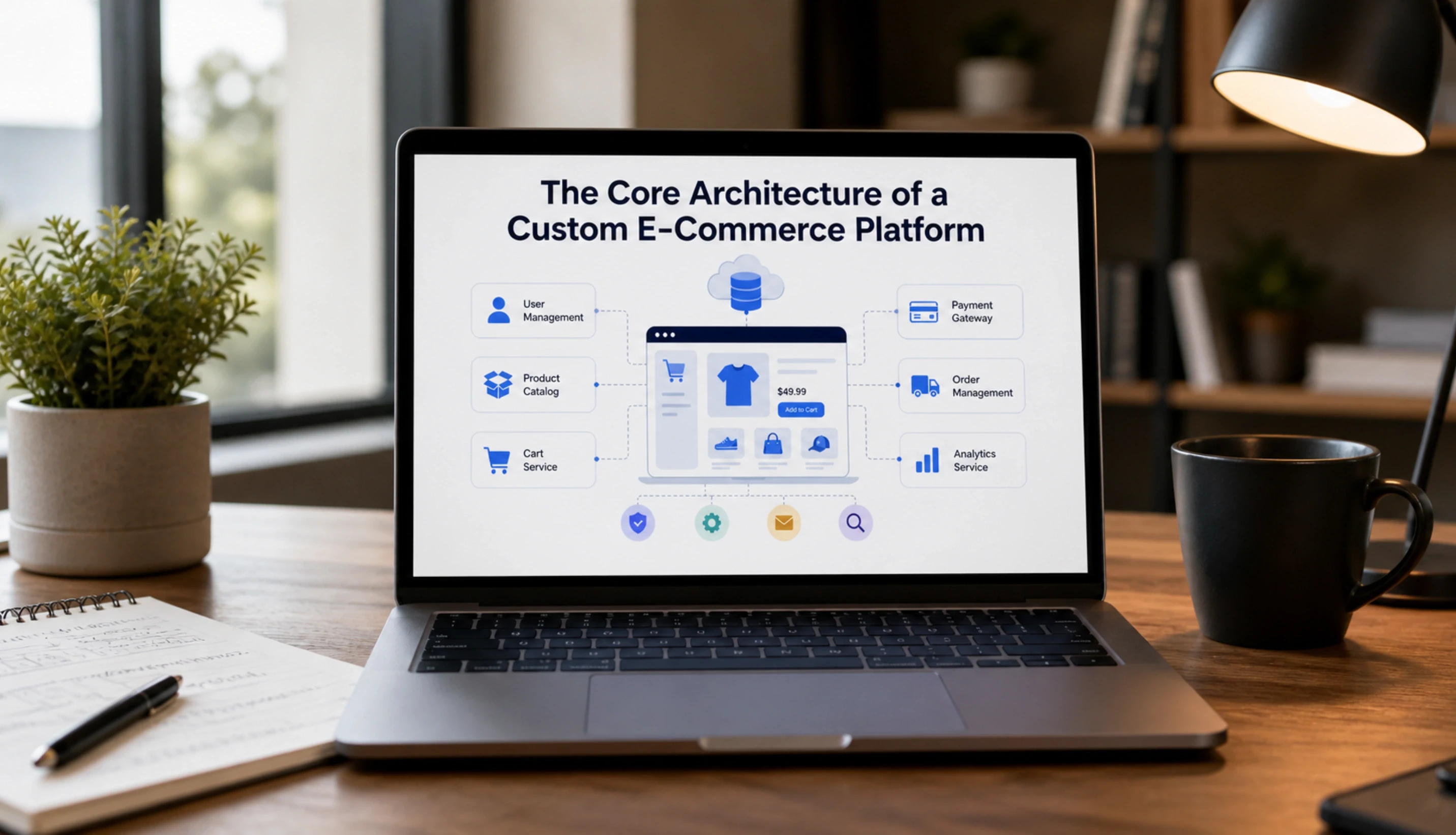
The architecture choice is the most consequential technical decision in a custom build. It determines deployment complexity, team structure, timeline, and cost. Most early-stage and mid-market custom platforms should start as a well-structured monolith. Microservices are not inherently superior. They are appropriate at a specific scale and team size.
Monolithic commerce architecture
A monolithic architecture packages the entire application into a single deployable unit: storefront, catalog, cart, checkout, order management, and inventory. The database is shared. Application modules communicate in-process, not over a network. For teams of 3 to 8 developers building a platform for a business under $10M GMV, a monolith is almost always the correct starting point.
Deployment is straightforward. Debugging is faster. Development velocity is higher because there is no distributed systems overhead. A well-structured Laravel or Django monolith handles 50,000 daily active users without vertical scaling limits becoming a material concern. The PHP vs Python vs Node.js comparison for SaaS stacks published by Acquaint Softtech explains why Laravel and Django remain the dominant monolith choices for commerce platforms that need to scale without rewriting.
Microservices commerce architecture
A microservices architecture separates the platform into independently deployable services: a catalog service, a cart service, a checkout service, a payment service, an inventory service. Each service has its own database. Services communicate over an API or message queue. The operational benefit is independent scaling: if your search service is under load, you scale it without touching checkout.
The cost is architectural complexity. You need a team with distributed systems experience, a service mesh, centralised logging, and a rigorous deployment pipeline. Acquaint Softtech recommends microservices when the platform exceeds 200,000 daily active users, the team will exceed 15 engineers, or specific modules require independent release cycles. The dedicated MERN stack development team at Acquaint Softtech handles microservices builds for mid-market and enterprise clients.
The modular monolith: the right middle ground
There is a third option that most custom commerce builds should use: a modular monolith. The application is deployed as a single unit, but the internal code is organised into strict module boundaries: a catalog module, an orders module, a payments module, each with its own service layer and minimal cross-module dependencies. When the business grows to the point where microservices are justified, the modular monolith migrates cleanly.
Acquaint Softtech's standard for new custom commerce builds is the modular monolith on Laravel or Django, because it delivers the development speed of a monolith with the architectural discipline that prevents the codebase from becoming unmaintainable at scale.
Want to Know Which Architecture Fits Your Platform?
Acquaint Softtech reviews your business model, traffic profile, and team capacity and recommends the architecture pattern that delivers the fastest path to production without creating technical debt. We send a technical brief within 48 hours. You review before committing to any engagement.
The 7 Core Modules Every Custom Commerce Platform Contains
.webp "The 7 Core Modules Every Custom Commerce Platform Contains")
A production-grade custom e-commerce platform is not a single application. It is a collection of modules, each with a defined responsibility, a clear data boundary, and a specific interface with adjacent modules. Based on Acquaint Softtech delivery data across 1,300+ projects, these are the 7 modules every custom build must contain. The software product engineering team at Acquaint Softtech designs each module against the client's operational requirements before writing the first line of code.
Module 1: Product catalog and information management
The catalog module handles product creation, attribute management, variant generation, media storage, and categorisation. In a custom build, this module is designed for the client's specific product model. A fashion platform needs colour, size, and condition as variant axes.
A B2B platform needs configurable technical specifications per SKU (Stock Keeping Unit). Getting the catalog schema right before writing any code is critical: a poorly designed catalog schema produces performance problems that are expensive to fix later. Acquaint Softtech runs a product discovery workshop to define the catalog data model before architecture begins.
Module 2: Inventory and stock management
The inventory module tracks stock levels, reserves units at add-to-cart, confirms reservations at order placement, and releases reservations on abandonment or cancellation. For multi-warehouse operations, the module allocates stock by proximity, available quantity, and fulfilment cost rules. Real-time inventory is the difference between overselling and accurate availability. A custom inventory module reflects the client's actual warehouse structure and fulfilment logic, not a generalised model.
Module 3: Cart and session management
The cart module manages the session state for a buyer's in-progress order. It handles guest carts and authenticated user carts, merges them on login, applies promotion rules, calculates shipping options, and persists state across sessions. Cart abandonment recovery triggers live inside this module: when a cart is abandoned after a configured duration, the module fires a recovery event that downstream systems consume. A custom cart module allows the client to define promotion stacking rules, bundle discount logic, and checkout gate conditions that no generic platform supports.
Module 4: Checkout and payment processing
The checkout module orchestrates the final purchase flow: address collection, shipping method selection, payment collection, order creation, and confirmation dispatch. In a custom build, the checkout can enforce business rules that a SaaS (Software as a Service) platform cannot: minimum order value by customer segment, payment method restrictions by geography, and split payment support for B2B invoice customers.
Payment processing integrates with Stripe, Razorpay, PayPal, or a direct payment gateway via a payment adapter layer, keeping the checkout module agnostic to the payment provider. Acquaint Softtech's Laravel development services include payment gateway integrations for clients across the US, UK, Australia, and UAE.
Module 5: Order management system
The order management system (OMS) receives confirmed orders from checkout, routes them to the appropriate fulfilment workflow, tracks status transitions from processing to picked to shipped to delivered or returned, and manages exception handling for failed payments, address errors, and carrier issues.
A custom OMS integrates directly with the client's 3PL (Third-Party Logistics) provider, ERP (Enterprise Resource Planning) system, or warehouse management software. For marketplace operators running multiple sellers, the OMS must also split orders by seller, track individual fulfilment SLAs (Service Level Agreements), and route commission splits to the payments engine. Acquaint with Softtech's published guide on developing your own online marketplace, which covers the order routing and commission logic that multi-vendor OMS modules must contain.
Module 6: Pricing and promotions engine
The pricing engine calculates the final price for every product in every context: base price, customer segment discount, volume tier pricing, promotional price, bundle price, and currency conversion. Promotion rules, percentage off, fixed discount, buy-X-get-Y, and free shipping threshold are stored as configurable rules that marketing teams manage through an admin interface without engineering involvement. A custom pricing engine handles rules that SaaS platforms do not support natively, including customer-group-specific pricing for B2B accounts and market-specific base pricing for multi-geography operations.
Module 7: Storefront and API layer
The storefront is the client-facing rendering layer. In a custom build, this is either a server-rendered application (Laravel Blade, Django templates) or a headless frontend (React, Vue, Next.js) consuming a REST or GraphQL API from the commerce backend. Headless architecture separates the frontend from the commerce logic entirely: the frontend team deploys independently, the mobile app uses the same API, and the platform powers multiple storefronts from one backend.
As Acquaint Softtech's analysis of AR/VR and e-commerce in web development covers, headless storefronts also make it significantly easier to layer immersive technologies onto an existing commerce backend without rebuilding core modules. Acquaint Softtech builds both server-rendered and headless commerce frontends. The hire remote developers page details how Acquaint Softtech staffs frontend and backend engineers for custom commerce builds.
Custom Platform vs SaaS E-Commerce: The Structural Difference
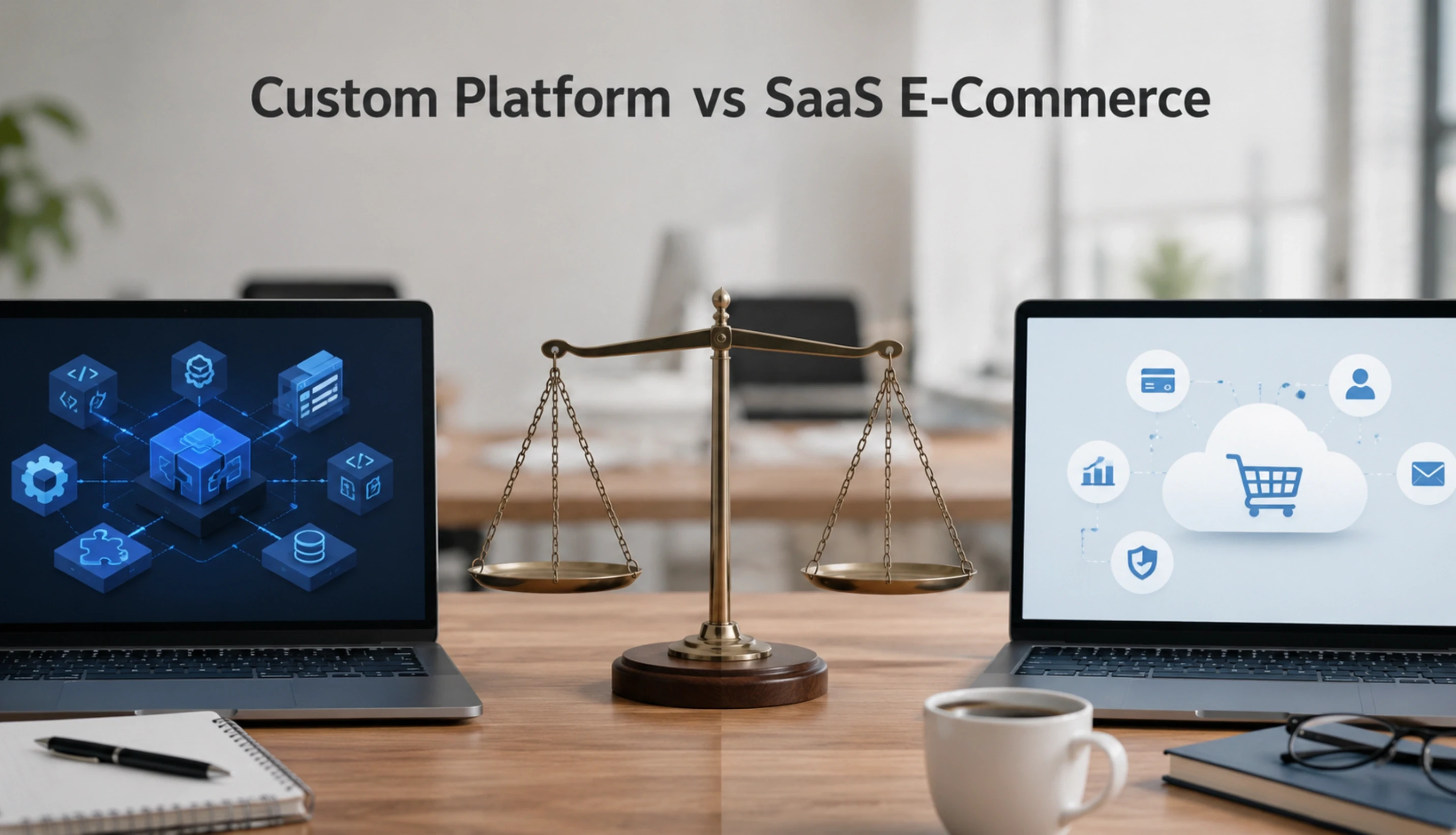
Custom platforms and SaaS platforms are not two versions of the same thing at different price points. They are structurally different. SaaS platforms serve the broadest possible market with a configurable product. Custom platforms serve one business with a purpose-built product. The confusion arises because SaaS platforms have become highly configurable, which makes them look more capable than they are at the edges.
Dimension | Custom Platform | SaaS Platform (Shopify / Magento) |
Codebase ownership | Client owns 100% of the code. No vendor dependency for continued operation. | The platform vendor owns the codebase. Licence fee required to keep the store running. |
Business logic | Every checkout rule, pricing rule, and workflow is built to the client's specification. | Business logic is limited to what the platform's configuration options allow. |
Data ownership | All data in the client-controlled database. Export at any time in any structure. | Data sits in vendor infrastructure. Exports are format-constrained and may incur fees. |
Transaction fees | Zero per-transaction platform fee. Payment processor fee only (typically 1.4% to 2.9%). | Shopify charges 0.5% to 2% per transaction on top of payment processor fees. |
App dependency | No apps required. All features are native modules. | Mid-market operations typically require 10 to 40 paid third-party apps. |
Scalability ceiling | No platform-imposed ceiling. Infrastructure scales to the load profile. | Platform imposes API rate limits, checkout session limits, and admin API throttling. |
Integration model | Direct API integration to any system. No middleware required. | Integrations through certified app partners or Shopify's webhook and API tier limits. |
Best fit | Businesses with unique workflows, high GMV, or multi-channel operations, SaaS cannot support. | Businesses under $500K GMV are launching quickly with standard catalogue-and-checkout operations. |
The decision principle is straightforward. SaaS is faster and cheaper to launch, and it is the right answer until your business model produces requirements that the platform cannot support without workarounds. The moment your team spends more engineering time on SaaS workarounds than on product features, you have passed the build threshold.
The WordPress-to-Laravel migration guide published by Acquaint Softtech covers exactly the inflection point where a WordPress-based commerce site outgrows its foundation. Acquaint Softtech's WooCommerce development services include honest assessments of when WooCommerce continues to serve a client and when a custom build is the more cost-effective long-term choice.
What Does a Custom E-Commerce Platform Build Cost in 2026?
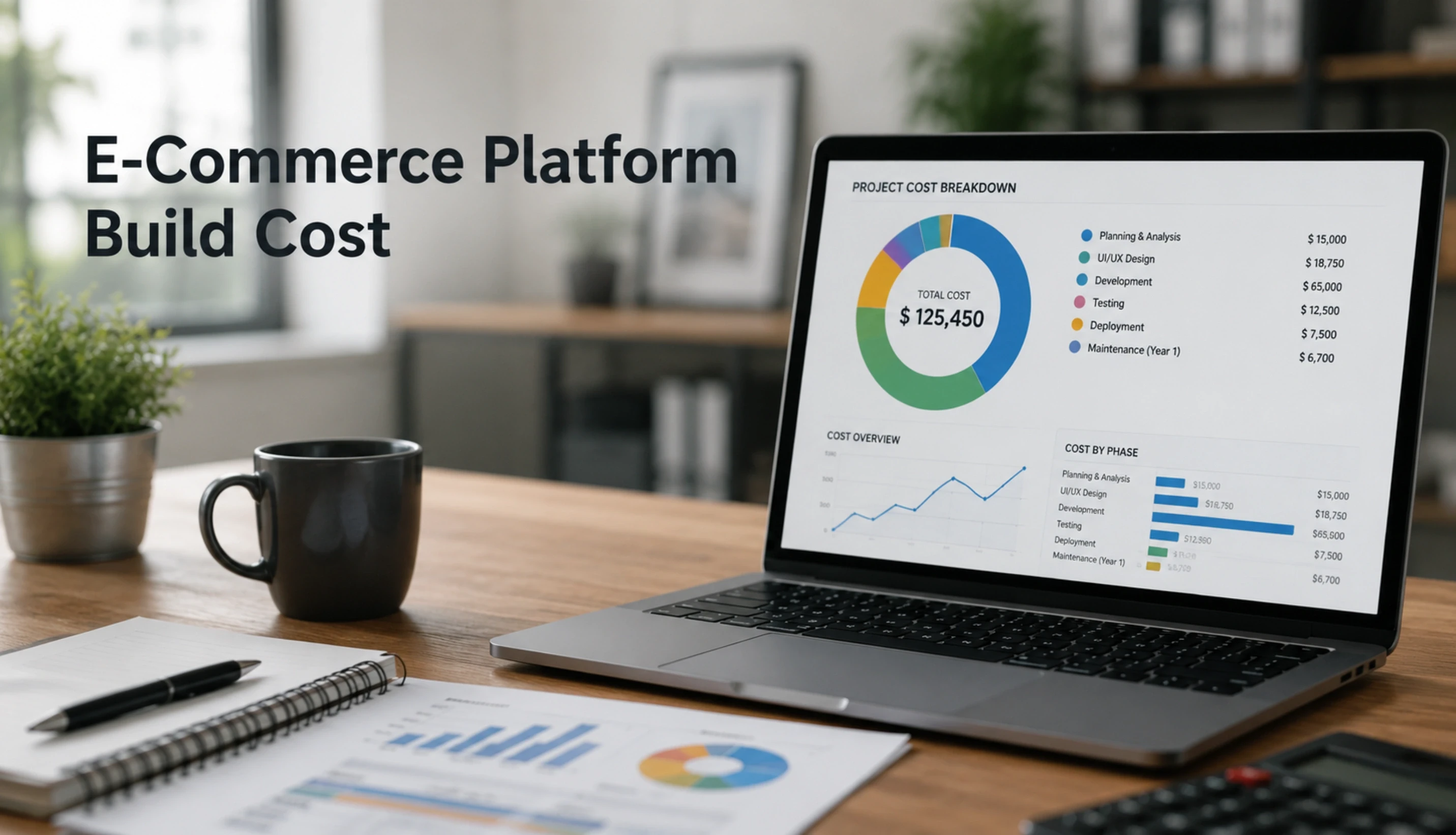
Custom build cost depends on the complexity of the data model, the number of integration points, the architecture pattern, and the team composition. The figures below are based on Acquaint Softtech delivery data for offshore development from India. Acquaint Softtech is a custom eCommerce development company and an Official Laravel Partner with 70+ multi-stack engineers serving the US, UK, and Australia markets. The 40% cost saving against equivalent in-house team costs is consistent across engagements.
Engagement Tier | Custom Build Cost | Equivalent SaaS + Apps/yr | Annual Saving | Timeline |
Small D2C (up to $500K GMV) | $25,000 to $55,000 | $18,000 to $30,000 in fees | $4,000–$12,000 from yr 3 | 14–20 weeks |
Mid-Market (up to $5M GMV) | $60,000 to $110,000 | $40,000 to $80,000 in fees | $20,000–$50,000 per year | 20–32 weeks |
Enterprise (above $5M GMV) | $120,000 to $250,000+ | $100,000 to $200,000+/yr | $60,000–$120,000 per year | 32–52 weeks |
The cost table shows the build cost only. Ongoing costs include hosting ($200 to $2,000/month, depending on scale), support and maintenance ($1,500 to $5,000/month), and feature development as the roadmap progresses. The comparison that makes the build decision honest is total SaaS cost: platform fee, transaction fees at current and projected GMV, and all app subscription costs.
What the monthly rate includes at Acquaint Softtech
• Full-stack development: frontend, backend, and API integration
• Architecture design and technical documentation
• Quality Assurance (QA) testing and regression suite
• Database design and optimisation
• DevOps setup, CI/CD pipeline, and deployment automation
• Project management and sprint planning
• Weekly client reporting and velocity tracking
The rate the client pays is the rate. No additional employer overhead, contractor fees, or tool licensing costs on top. Acquaint Softtech's MVP development services allow clients to build the commerce core and validate it in the market before committing to the full platform investment.
Want a Cost Breakdown for Your Specific Commerce Build?
Acquaint Softtech reviews your platform requirements and sends a scoped cost estimate with team composition and timeline within 48 hours. No engagement starts without client approval. You review the team profiles before any contract is signed.
The 5 Signals That Tell You When to Build Your Own Platform
This is the decision framework. Each signal reflects a real operational condition that Acquaint Softtech observes in clients ready for a custom build. Apply them to your current situation. If 3 or more are true, the build decision is justified. The software product development process at Acquaint Softtech begins with a structured assessment of exactly these conditions.
Signal 1: Your checkout cannot express your pricing logic
Your business uses customer-tier pricing, minimum order values by segment, configurable bundle discounts, or promotional stacking rules that require more than 2 conditions. Your current platform requires a developer to hard-code these rules into a theme template or app function, meaning every pricing change requires a deployment. Yes: your checkout logic has exceeded what configurable SaaS was designed to handle. No: your pricing model is standard retail, and SaaS continues to serve you.
Signal 2: SaaS overhead exceeds the build investment payback
Add your annual platform fee, transaction fees at current GMV, and all app subscription costs. If this total exceeds $30,000 per year, a custom build with a 3-year payback horizon is worth modelling. A business at $3M GMV on Shopify Plus, paying 0.15% transaction fees plus $3,000 per month in apps, spends $52,500 per year on platform overhead. An $80,000 custom build pays back in under 2 years. Yes: model the build. No: the overhead is not yet significant enough to justify the investment.
Signal 3: You need integrations that the app ecosystem cannot support
You need a direct integration with an ERP, a 3PL, a B2B procurement system, or an internal data warehouse that the platform's app marketplace does not cover. Custom platforms integrate directly with any system via REST API or message queue. Acquaint Softtech's AI development services include AI-powered inventory prediction and personalisation engines built as native modules in custom commerce platforms, not as third-party app integrations.
Signal 4: Your catalogue structure exceeds the platform's data model
You have products with more than 3 variant axes, configurable technical specifications, or product relationships; kits, bundles, subscriptions, rentals, that the platform models poorly. Shopify's variant system caps at 3 options and 100 variants per product. A platform selling configurable B2B products or subscription boxes with hundreds of option combinations hits this ceiling and then maintains the extra logic through a combination of metafields and custom apps that degrade over time.
Signal 5: Your growth plan requires a platform you can own
You plan to expand to multiple storefronts, enter new markets with different currency and tax models, launch a mobile app on the same commerce backend, or raise investment where platform dependency is a liability in due diligence. Custom builds are assets. SaaS subscriptions are operating costs. Acquaint Softtech's Bagisto development services use Laravel's open-source Bagisto e-commerce framework as the foundation for clients who want the speed of an established commerce layer with the ownership of a custom codebase.
Matched 3 or More Signals? Let Acquaint Softtech Scope Your Build.
Tell Acquaint Softtech which signals match your situation. We review your current platform, your catalogue structure, and your integration requirements and deliver a scoped architecture brief within 48 hours. You interview the proposed team before any engagement begins.
Common Misconceptions About Custom E-Commerce Platforms
Most resistance to custom builds comes from misconceptions that are either outdated or derived from bad prior experiences with the wrong development partner. Clearing them produces a more accurate risk assessment. Acquaint Softtech has built custom commerce platforms as both a primary software development outsourcing partner and as a dedicated team embedded in the client's development operation.
Misconception 1: Custom builds take years to launch
What people believe A custom e-commerce platform takes 12 to 24 months to build and will always be late. | What the data shows A well-scoped modular monolith built on Laravel or Django reaches production-ready v1 in 16 to 28 weeks for a mid-market commerce platform. Timelines extend when the scope is undefined at the start or when the development partner lacks domain experience. Acquaint Softtech runs a structured discovery workshop before every commerce build to define scope, data models, and integration contracts before the first sprint begins. |
Misconception 2: You need a large in-house team to maintain it
What people believe: Once built, a custom platform requires a 10-person engineering team just to keep it running. 1. The reality is three numbers: 1 to 3 engineers for routine maintenance and incremental feature development. 2. Acquaint Softtech's support and maintenance services cover monitoring, security patches, dependency updates, and bug resolution for clients who want to keep a lean internal team. 3. Maintenance overhead depends on the quality of the original build, not on the fact that it is custom. A well-structured codebase with automated tests is cheaper to maintain than a Shopify store with 30 interdependent apps. |
Misconception 3: Headless commerce is always the right architecture
What people believe: Every modern custom commerce platform should be headless because headless is better.
Headless architecture produces significant development complexity and increases the team size required to build and maintain the platform. It is the right choice when the client has a mobile app, multiple storefronts, or a frontend team that operates independently from the backend team. For a single D2C storefront serving one market, a server-rendered application is faster to build, cheaper to maintain, and performs equivalently for most traffic profiles.
Acquaint Softtech's DevOps and CI/CD strategy guide for Laravel illustrates how a well-structured server-rendered application can reach production with the same deployment rigour as any headless build. Acquaint Softtech recommends headless only when the client's use case specifically justifies the architectural overhead.
Misconception 4: Open-source frameworks mean you have a custom platform
Myth | Using Magento or WooCommerce means you have a custom platform because you control the code. |
Fact | Controlling the codebase of an open-source platform is not the same as owning a purpose-built platform. Magento's data model and module architecture impose the same structural constraints as any SaaS platform: your business logic must adapt to the framework's design decisions. A genuinely custom build designs the data model and module boundaries for the client's specific requirements. Acquaint Softtech is a Bagisto Partner and uses Bagisto as the foundation for clients who want framework benefits with true ownership. Hire dedicated Laravel developers to build on a framework your team fully controls. |
Frequently Asked Questions
-
When should I build a custom e-commerce platform instead of using Shopify?
Build a custom platform when your pricing logic, product structure, or checkout workflow goes beyond Shopify’s standard capabilities, or when platform and app costs exceed $30,000 per year. For businesses under $500K GMV with a standard catalogue, Shopify is usually the faster and more affordable option. The custom build approach becomes financially justified around $2M to $3M GMV when operational requirements become more complex.
-
What are the core modules a custom e-commerce platform must contain?
Seven modules: product catalog and information management, inventory and stock management, cart and session management, checkout and payment processing, order management system, pricing and promotions engine, and a storefront and API layer. The catalog and inventory modules are foundational. Errors in their data models produce cascading problems in every other module, and they are the most expensive to fix after the build is complete.
-
Should I use a monolith or microservices for my custom commerce platform?
Use a modular monolith for most builds. Microservices are appropriate for above 200,000 daily active users, above 15 engineers on the team, or when specific modules need independent release cycles. Starting with microservices before the business justifies them is the single most common architectural mistake in custom commerce builds, and it produces distributed systems complexity that significantly extends timelines and costs.
-
How much does a custom e-commerce platform cost to build in 2026?
Platform Type
Cost Range
Timeline
Small D2C Platform
$25,000 to $55,000
14 to 20 weeks
Mid Market Platform with ERP Integration
$60,000 to $110,000
20 to 32 weeks
Enterprise Platform with Microservices
$120,000 to $250,000+
Depends on scope
-
How long does it take to build a custom e-commerce platform?
A small platform reaches production-ready v1 in 14 to 20 weeks with a team of 3 to 4 developers. A mid-market platform takes 20 to 32 weeks with 5 to 7 developers. Timeline accuracy depends entirely on the scope definition at the start. Acquaint Softtech's discovery workshop produces a full module specification, data model, and integration contract before the first sprint begins, which eliminates the scope-creep delays that extend most builds.
-
Who owns the code when Acquaint Softtech builds my platform?
The client owns 100% of the code from the first line written. Acquaint Softtech retains no IP (Intellectual Property) claim or access rights after the engagement ends. Non-Disclosure Agreements (NDAs) are signed before any architecture discussion. The codebase transfers to the client's repository at project start, not at completion. If the engagement ends at any point, the client retains everything built to that date with full documentation. This is a contract term, not a negotiation point.
-
Is a custom e-commerce platform appropriate for a pre-revenue D2C startup?
For most pre-revenue startups, no. Shopify or WooCommerce allows a team to validate product-market fit quickly before investing $60,000 to $110,000 in a custom platform. The exception is a startup whose business model is structurally incompatible with SaaS: subscription-box businesses with complex bundling logic, B2B marketplaces with custom pricing per account, or luxury resale platforms with condition-grading workflows.
I lead technology and client success at Acquaint Softtech with one goal in mind. Deliver work that feels personal, reliable, and worthy of long term trust. I stay close to both our clients and our developers to make sure every project moves with clarity, quality, and accountability.
Table of Contents
Get Started with Acquaint Softtech
- 13+ Years Delivering Software Excellence
- 1300+ Projects Delivered With Precision
- Official Laravel & Laravel News Partner
- Official Statamic Partner
Related Blog
.webp "The Complete Guide to E-Commerce & D2C Software Development in 2026")
The Complete Guide to E-Commerce & D2C Software Development in 2026
Custom e-commerce software is not a more expensive version of Shopify. It is an entirely different accountability and ownership structure, with different economics and a different ceiling on what your platform can do. This guide explains every architecture type, every cost variable, and every decision checkpoint so you build the right thing in 2026.

Acquaint Softtech
May 6, 2026.webp "Why Develop Your E-commerce Website With Laravel Bagisto?")
Why Develop Your E-commerce Website With Laravel Bagisto?
Bagisto is a free, open-source e-commerce platform built on the Laravel PHP framework and Vue.js. Created by Webkul, it lets developers and merchants build highly customizable online stores, multi-vendor marketplaces, and headless commerce with minimal setup. Because it leverages Laravel, you get a robust ecosystem, rapid deployment tools, and huge flexibility for custom enterprise applications, which is why it is a top choice for an e-commerce website with Laravel Bagisto.

Mukesh Ram
April 29, 2022
How Custom E-Commerce Platforms Work: Architecture, Modules, and When to Build One
A custom e-commerce platform is not a bigger Shopify plan. It is a purpose-built commerce engine where every module answers to your business logic, not a vendor's roadmap. This article explains exactly how one is architected, what it contains, and the 5 operational signals that tell you when building your own beats, staying on SaaS.
Manish Patel
May 12, 2026India (Head Office)
203/204, Shapath-II, Near Silver Leaf Hotel, Opp. Rajpath Club, SG Highway, Ahmedabad-380054, Gujarat
USA
7838 Camino Cielo St, Highland, CA 92346
UK
The Powerhouse, 21 Woodthorpe Road, Ashford, England, TW15 2RP
New Zealand
42 Exler Place, Avondale, Auckland 0600, New Zealand
Canada
141 Skyview Bay NE , Calgary, Alberta, T3N 2K6