

FastAPI Performance Benchmarks vs Node.js and Go What the Numbers Actually Mean
FastAPI vs Node.js vs Go performance benchmarks for 2026. Real RPS numbers, hidden costs, and what the speed gap actually means for your Python backend.

Acquaint Softtech
Introduction: The Numbers Are Real, the Conclusions Are Often Wrong
Every few months a new FastAPI vs Node.js vs Go benchmark goes viral. Go wins by 4x. Node.js wins by 2x. FastAPI matches Node.js. FastAPI loses to Express by 70%. The numbers are usually real. The conclusions drawn from them are usually wrong, because raw requests-per-second tells you almost nothing about whether your team should pick Python, JavaScript, or Go for a real production backend in 2026.
The honest framing is this: speed matters when speed matters, and most backends never reach the load where it does. A backend that handles 8,000 RPS at peak runs equally well on FastAPI, Express, or Go. A backend that handles 80,000 RPS does not. The decision is not 'which is fastest'. It is 'which combination of speed, ecosystem, hiring, and cost produces the best outcome for the specific system I am building'. This guide separates the benchmark hype from the production reality.
It is written for CTOs, engineering leads, and senior backend developers who are choosing a stack for a new product, evaluating a rewrite, or pushing back on a colleague's claim that 'Python is too slow'. Every number below comes from a published 2026 benchmark or production case study, not internal lore.
If you are still building the team that will execute the architecture decision, the complete guide to hiring Python developers in 2026 sets the wider hiring context. The numbers below assume you have engineers who can ship in any of the three languages.
The Real 2026 Numbers (and Where They Came From)
.webp "The Real 2026 Numbers")
The clearest 2026 production benchmark comes from a controlled study published by johal.in using wrk2 on bare-metal AMD EPYC hardware, with 10 threads and 100 concurrent connections per test. Go 1.23 hit 142,000 RPS at peak, delivering 3.7x higher throughput than FastAPI 0.110 and 7.4x higher than Express 5 for JSON CRUD workloads. Notably, FastAPI used 40% less memory than Express 5 at 10,000 concurrent connections and had 2.1x faster cold start times. Speed is not the only number that matters.
Table 1: Published 2026 Throughput Benchmarks (JSON CRUD, Bare Metal)
Framework | Peak RPS | Memory at 10K Conns | Cold Start |
|---|---|---|---|
Go 1.23 (net/http) | 142,000 | Low (5 to 15MB binary) | Instant |
FastAPI 0.110 (Uvicorn) | ~38,000 | 40% less than Express | ~0.5 to 1s |
Express 5 (Node 22) | ~19,000 | Higher baseline | ~1 to 2s |
These numbers are real, but they describe a specific narrow workload: a single JSON endpoint hammered by a synthetic load tool on dedicated hardware. They do not describe what happens when your endpoint queries a PostgreSQL database, calls three downstream microservices, validates a Pydantic schema, encrypts a JWT, and writes a structured log to Datadog. In real production, the framework choice is rarely the bottleneck. The database, network, and external services almost always dominate.
What Synthetic Benchmarks Miss (and Why It Matters)
A 'Hello World' benchmark on bare metal has roughly the same relationship to your production backend that a Formula 1 lap time has to your daily commute. It tells you the ceiling of the engine. It tells you almost nothing about the journey.
Real endpoints do real work. Database queries, downstream API calls, and serialization typically add 50 to 500ms per request. The framework's 1ms vs 5ms overhead disappears in the noise.
Network latency is the floor. A 10ms client-to-server round-trip is the minimum on most cloud networks. No backend can render that latency invisible, regardless of language.
Validation and serialization cost is real but consistent. Pydantic validation in FastAPI adds ~1ms per request. Class-validator in NestJS adds similar. Go's struct unmarshalling is faster but rarely the deciding factor in p95 latency.
CPU-bound work is where Go genuinely wins. If your backend is doing image processing, encryption-heavy operations, or pure compute loops, Go is 2 to 10x faster. If it is doing API I/O, the gap is much smaller.
Cold starts matter for serverless. If you are deploying to Lambda, FastAPI's 0.5 to 1s cold start beats Node.js's 1 to 2s, and Go's instant start beats both. For long-running containers, cold start is a one-time cost.
When the Language Choice Actually Matters
There are clear cases where the language and framework genuinely move the needle. According to Index.dev's 2026 backend technology comparison, Go is 2 to 10x faster than Node.js or Python for CPU-bound tasks, and Stripe rebuilt their core payment processing backend in Go to handle millions of daily transactions with sub-100ms latency, achieving 99.99% uptime and processing over 10,000 RPS during peaks. The decision was not aesthetic. It was an engineering response to a measured constraint.
Choose Go when
Your peak RPS exceeds 50,000 per service.
CPU-bound work dominates the request path (encryption, compression, ML inference outside Python frameworks).
Infrastructure cost is a board-level concern at your scale.
You need a single static binary with no runtime dependencies (e.g., embedded systems, edge deployments).
Your team has Go expertise or you are willing to invest in building it.
Choose Node.js (Express, NestJS, or Fastify) when
Your team is JavaScript-fluent end to end.
You are deploying serverless and cold start matters most days.
Real-time WebSockets are the core of the product.
Your frontend, mobile, and backend all share TypeScript types.
The ecosystem fit (auth libraries, payment SDKs, ORMs) is genuinely better for your domain.
Choose FastAPI when
AI/ML integration is a core requirement (PyTorch, TensorFlow, scikit-learn).
Data engineering, ETL pipelines, or scientific computing touches your API.
Type safety with automatic OpenAPI documentation is a priority.
Your team is Python-fluent and you want fast iteration with strong validation.
Your peak RPS sits between 5,000 and 35,000 per service (which is most production backends).
The Real Cost Comparison Most Articles Skip
Raw RPS is one input into the cost equation. Engineering velocity, hiring depth, ecosystem fit, and infrastructure efficiency are the others. A team that ships in Python in 6 weeks but pays 30% more on infrastructure usually wins against a team that ships in Go in 14 weeks and saves on servers.
Table : Total Cost Comparison Beyond RPS (2026 Estimates)
Cost Dimension | FastAPI | Node.js (Express/NestJS) | Go |
|---|---|---|---|
Infrastructure per 100K RPS | Higher (4 to 6x Go) | Higher (5 to 7x Go) | Lowest baseline |
Hiring depth (mid-senior) | Very deep (Python pool) | Very deep (JS pool) | Smaller, premium rates |
Time to first production API | Fastest (1 to 2 weeks) | Fast (1 to 3 weeks) | Slower (3 to 6 weeks) |
AI/ML library ecosystem | Best in class | Limited | Limited |
Type safety out of box | Strong (Pydantic) | Optional (TS) | Strong (compiled) |
Operational maturity | Production-ready | Decade-proven | Production-ready |
In a 2026 case study by the same johal.in benchmark team, a fintech replaced 12 Node.js Express containers (4 vCPU, 8GB RAM each, $42,000/month) with a hybrid stack: Go for the core payment endpoint, FastAPI for the ML-based fraud detection endpoint, and Express 5 for the legacy admin panel. Core payment p99 dropped to 8ms, throughput hit 140,000 RPS, and infrastructure cost fell to $18,000/month, a 57% reduction. The lesson is not 'Go always wins'. The lesson is that the right language for each workload matters, and a one-language religion costs money.
For the full ownership cost picture across a Python backend's lifetime, including infrastructure, engineering, and observability spend, the analysis on ownership cost of Python projects walks through the 24-month total cost in detail.
Need Senior Python Engineers Who Have Shipped FastAPI at Scale?
Acquaint Softtech provides senior Python engineers with production experience in FastAPI, Uvicorn, async architecture, PostgreSQL scaling, and hybrid stacks that mix Python with Go or Node.js. Profiles in 24 hours. Onboarding in 48.
The Adoption Reality of Each in 2026
Adoption tells a different story than benchmarks. According to Second Talent's 2026 framework usage analysis citing W3Techs data, Node.js powers over 6.3 million web applications globally with a 4.24% market share, while FastAPI has reached 88,000 GitHub stars and become the fastest-growing Python web framework. OpenAI runs FastAPI in production. Python drives more than 50% of all AI and ML initiatives. Both ecosystems are deep, mature, and hire-able. Neither is a niche bet.
Where Each Lives in 2026 Production
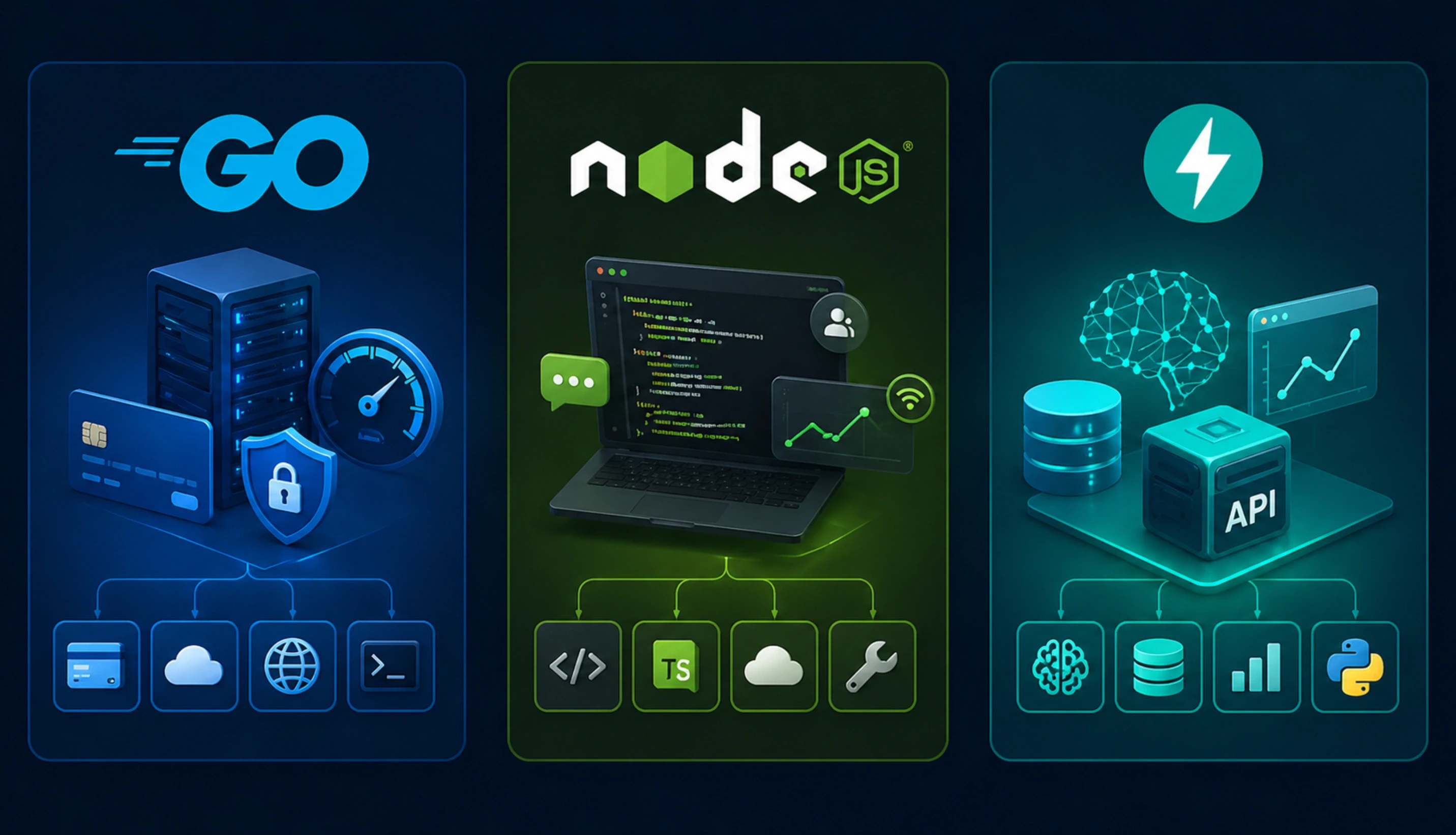
Go is the default for high-throughput payment processing, infrastructure tooling, networking, and CLIs. Used by Stripe, Cloudflare, Uber, Discord, and Twitch core systems.
Node.js dominates real-time apps, full-stack TypeScript stacks, serverless functions, and developer tooling. Used by Netflix, LinkedIn, PayPal, Walmart, and most TypeScript SaaS.
FastAPI leads ML model serving, data engineering APIs, scientific computing, and Python-first SaaS backends. Used by OpenAI, Microsoft, Uber's ML infrastructure, and most modern Python startups.
The Hybrid Pattern Most Production Stacks Run in 2026
The dirty secret of high-scale 2026 backends is that almost none run a single language. Stripe, Uber, and Netflix all mix languages aggressively, picking the right tool for each workload rather than enforcing a one-language standard. The pattern that consistently wins is FastAPI for the parts that touch Python's strengths, Go for the parts that touch raw throughput, and Node.js for the parts that touch real-time or full-stack TypeScript.
Pattern 1: FastAPI Primary with Go for Hot Paths
Most of the API in FastAPI for development velocity and Python ecosystem fit. The 2 to 5 specific endpoints handling the highest traffic moved to Go for cost efficiency. Common in fintech, SaaS, and analytics platforms where most endpoints are CRUD but specific paths (payments, search, real-time pricing) need Go's performance.
Pattern 2: FastAPI for ML, Node.js for Real-Time, Go for Internal
Each language used for what it does best. FastAPI handles ML model serving and data APIs. Node.js handles WebSocket, chat, and notification streams. Go handles internal microservices like rate limiting, auth proxies, and service mesh sidecars. Common in mid-to-large engineering organisations with multiple distinct workload types.
Pattern 3: FastAPI Monolith with Selective Go Microservices
Start with a FastAPI monolith for speed of development. Extract specific services to Go only when measurement shows a real cost or latency problem. The most common 2026 startup pattern, because it preserves velocity early and adds Go only where it earns its keep.
For the broader microservices decision framework that surrounds these hybrid patterns, the guide on Python microservices architecture and when to break the monolith walks through when extracting a service is genuinely justified.
How to Make FastAPI Punch Above Its Benchmark Weight
Most teams blame FastAPI for poor performance when the real issue is configuration. A correctly tuned FastAPI deployment closes a meaningful share of the gap with Node.js and Go in real production workloads.
Use Uvicorn workers behind Gunicorn. Worker count = (2 x CPU cores) + 1 for I/O-heavy services. Single-process Uvicorn underuses available cores.
Switch to orjson or msgspec. Replacing FastAPI's default JSON serializer with orjson typically reduces serialization time by 30 to 50%.
Use async drivers everywhere. asyncpg for PostgreSQL, aiomysql for MySQL, motor for MongoDB, httpx for outbound HTTP. Sync drivers in async endpoints destroy throughput silently.
Cache hot Pydantic schemas. Pydantic v2 is significantly faster than v1, but creating models per request still adds overhead. Reuse schema objects.
PgBouncer in front of PostgreSQL. Connection pool exhaustion is a common scaling failure. PgBouncer with transaction pooling handles thousands of client connections cleanly.
Cache aggressively in Redis. Most performance complaints in FastAPI come from the database, not the framework. Cache hot reads aggressively.
For the broader architectural patterns that shape backend performance beyond framework tuning, the guide on Python development architecture and frameworks covers the design patterns each framework supports at scale.
How Acquaint Softtech Builds High-Performance Python Backends
Acquaint Softtech is a Python development and IT staff augmentation company based in Ahmedabad, India, with 1,300+ software projects delivered globally across healthcare, FinTech, SaaS, EdTech, and enterprise platforms. Our backend engagements follow the architectural framework described in the complete guide to hiring Python developers, and our senior engineers have shipped FastAPI systems handling well into the tens of thousands of RPS in production.
Senior Python engineers with FastAPI production depth. Hands-on with Uvicorn worker tuning, orjson optimisation, async PostgreSQL with asyncpg, Redis cluster integration, and Celery worker pipelines.
Polyglot architecture experience. Hybrid stacks combining FastAPI with Go services for hot paths and Node.js for real-time layers, deployed across AWS, GCP, and Azure.
Healthcare and FinTech compliance experience. GDPR-compliant FastAPI platform delivered for BIANALISI, Italy's largest diagnostics group, processing patient records with audit-grade logging.
Transparent pricing from $20/hour. Dedicated Python engineering teams from $3,200/month per engineer. Architecture audits and performance reviews from $5,000.
To bring senior Python engineers onto your performance-critical project quickly, you can hire Python developers with profiles shared in 24 hours and a defined onboarding plan within 48.
The Bottom Line
Go is faster than FastAPI. FastAPI is faster than Express on real workloads. Express has the deepest ecosystem of the three. None of these statements decides which language belongs in your backend. The decision is made on the intersection of throughput need, team composition, ecosystem fit, hiring depth, and infrastructure cost, not on a benchmark headline.
Most production backends in 2026 run between 5,000 and 35,000 RPS, where FastAPI is comfortably sufficient when properly tuned. The teams that need Go know they need it, because measurement shows it. Everyone else who reaches for Go because of a benchmark thread on Hacker News is solving the wrong problem. Pick the stack that fits your team and your workload. Tune it well. Worry about the next 10x of throughput when you are actually approaching it, not before.
Trying to Decide Between FastAPI, Node.js, and Go?
Book a free 30-minute architecture review. We will look at your traffic patterns, team composition, and roadmap, and tell you straight which stack fits and where a hybrid would save you money. No sales pitch. Just senior engineers who have shipped all three in production.
Frequently Asked Questions
-
Is FastAPI really as fast as Node.js and Go like the marketing claims?
Not in raw synthetic benchmarks. Controlled tests on bare metal show Go at roughly 142,000 RPS, FastAPI at around 38,000 RPS, and Express 5 at around 19,000 RPS for JSON CRUD workloads. FastAPI is closer to Node.js than to Go on raw speed, and meaningfully faster than Express for I/O-bound real workloads. The 'on par with NodeJS and Go' claim is true in spirit for most production patterns and overstated in isolated benchmarks.
-
Should I rewrite my FastAPI backend in Go for performance?
Almost never as a blanket move. Rewrite a specific FastAPI service in Go only when measurement shows the framework itself is the bottleneck, which is rare. Most performance complaints trace back to database queries, missing indexes, sync ORM in async endpoints, or missing caching. Fix those first. If a specific endpoint genuinely peaks at 50,000+ RPS and Python tuning has hit its ceiling, then Go is justified for that endpoint, not the whole backend.
-
What kind of RPS can a real production FastAPI backend handle?
A correctly tuned FastAPI service typically handles 10,000 to 35,000 RPS per worker on commodity cloud hardware, scaling horizontally from there. Multi-worker deployments with Gunicorn plus Uvicorn workers have run hundreds of thousands of requests per day in production. The ceiling for FastAPI is usually the database, not the framework. OpenAI, Microsoft, and Netflix all run FastAPI in production at significant scale.
-
When should I choose Go over FastAPI for a new project?
When CPU-bound work dominates the request path, peak RPS exceeds 50,000 per service, infrastructure cost is a board-level concern, or you need a single static binary for embedded or edge deployments. Stripe rebuilt their core payment processing in Go for exactly these reasons. For most CRUD APIs, ML serving, and data engineering work, the operational and hiring overhead of Go does not pay off versus FastAPI.
-
Is Node.js still relevant in 2026 if FastAPI and Go are faster?
Yes, very much. Node.js powers over 6.3 million web applications globally and remains the default for full-stack TypeScript teams, real-time applications with WebSockets, serverless functions where cold start matters, and SaaS backends where the frontend, mobile, and backend share a single language. Speed is one dimension. Ecosystem fit and team composition are equally important.
-
What is the most underrated FastAPI optimization most teams miss?
Switching the JSON serializer from FastAPI's default to orjson or msgspec, which typically cuts serialization time by 30 to 50% with a one-line change. Combined with async-only database drivers (asyncpg, motor) and PgBouncer in front of PostgreSQL, these three changes close a meaningful share of the gap with Node.js in real workloads. Most 'FastAPI is slow' complaints disappear after these three fixes.
-
Should a hybrid stack (FastAPI + Go + Node.js) be the default for new products?
Not for early-stage products. Start with a single language that matches your team and your primary workload, ship the MVP, and find product-market fit. Hybrid stacks make sense at scale when distinct workloads (ML inference, real-time, payment processing) genuinely have different performance profiles. Adopting a polyglot architecture before that point usually multiplies operational cost without solving a real problem.
We’re Acquaint Softtech, your technology growth partner. Whether you're building a SaaS product, modernizing enterprise software, or hiring vetted remote developers, we’re built for flexibility and speed. Our official partnerships with Laravel, Statamic, and Bagisto reflect our commitment to excellence, not limitation. We work across stacks, time zones, and industries to bring your tech vision to life.
Table of Contents
Get Started with Acquaint Softtech
- 13+ Years Delivering Software Excellence
- 1300+ Projects Delivered With Precision
- Official Laravel & Laravel News Partner
- Official Statamic Partner
Related Blog

When Is Python Development Too Expensive? Pricing Red Flags That Signal a Bad Vendor
Not all expensive Python development is justified. This guide identifies the exact pricing red flags that signal a bad vendor, with real benchmarks, warning signs, and what fair Python pricing actually looks like in 2026.
Acquaint Softtech
March 26, 2026
How to Hire Python Developers Without Getting Burned: A Practical Checklist
Avoid costly hiring mistakes with this practical checklist on how to hire Python developers in 2026. Compare rates, vetting steps, engagement models, red flags, and more.
Acquaint Softtech
March 30, 2026
Total Cost of Ownership in Python Development Projects: The Full Financial Picture
The build cost is just the beginning. This guide breaks down the complete TCO of Python development projects across every lifecycle phase, with real benchmarks, a calculation framework, and 2026 data.
Acquaint Softtech
March 23, 2026India (Head Office)
203/204, Shapath-II, Near Silver Leaf Hotel, Opp. Rajpath Club, SG Highway, Ahmedabad-380054, Gujarat
USA
7838 Camino Cielo St, Highland, CA 92346
UK
The Powerhouse, 21 Woodthorpe Road, Ashford, England, TW15 2RP
New Zealand
42 Exler Place, Avondale, Auckland 0600, New Zealand
Canada
141 Skyview Bay NE , Calgary, Alberta, T3N 2K6
Your Project. Our Expertise. Let’s Connect.
Get in touch with our team to discuss your goals and start your journey with vetted developers in 48 hours.