

Top FinTech Software Development Companies in 2026
A curated list for founders, product leaders, and financial institutions hiring expert teams to build secure, compliant, and scalable fintech platforms, from neobanks and digital wallets to payment gateways, lending, and RegTech. The global fintech market is projected to grow from around US$328 billion in 2026 to nearly US$2 trillion by 2034, and users now expect banking-grade security with consumer-grade speed.
Building fintech software is harder than shipping a slick UI. Few teams can engineer the part that actually matters, encrypted transactions, audit trails, regulatory compliance, fraud checks, and payment integrations that never lose a cent. We ranked the top firms on verified Clutch data, pricing, and real financial-platform outcomes.
Marketing Head








How the top fintech software development companies were shortlisted.
In fintech, the wrong build does not just underperform, it fails an audit, leaks data, or drops a transaction. So we ignored marketing pages and judged teams on evidence: could they prove security discipline, compliance experience, and a track record of shipping financial products that regulators and users both trust?
Starting from a longlist of financial software specialists and general agencies claiming fintech expertise, we filtered on five signals, depth of verified Clutch reviews, hands-on work with payments and regulated systems, engineering maturity in security and data integrity, honest pricing, and the type of fintech client each firm serves best. Anything under 50 verified reviews was cut. What survived is below.
6 questions to ask any fintech development company before you sign.
In fintech, the gap between a demo and production is where audits fail and money leaks. Ask these six questions before you sign, each targets a place fintech builds quietly break.
How do they handle security and encryption?
Fintech lives and dies on data protection. Ask about encryption at rest and in transit, secure key management, and how they prevent breaches, not just whether the app "has login."
Do they understand your compliance landscape?
PCI-DSS, GDPR, SOC 2, KYC, AML, the rules depend on your product and region. Confirm the team has shipped under real regulatory requirements, not just read about them.
Can they build reliable payment and transaction flows?
Failed, duplicated, or unreconciled transactions destroy trust instantly. Verify experience with payment gateways, ledgers, and reconciliation that balances to the cent, every time.
How do they prevent fraud and secure access?
Ask about fraud detection, multi-factor authentication, role-based access, and audit trails. In fintech, who can do what, and the record of who did it, is not optional.
Will the architecture scale under load?
A fintech app that slows during a market spike or payday surge loses users and money. Confirm the build handles high transaction volume without dropping requests.
Who owns the code, data, and IP?
Financial platforms carry sensitive logic and data. Confirm NDA terms, 100% IP ownership, and clear data handling before a single line is written.
The 5 best fintech software development companies, compared.
Rates and reviews only tell you so much. The real question in fintech is whether a team has shipped under real regulation, and at your stage, a lean MVP and an enterprise banking rebuild are not the same job. The table below lines up review depth, cost of entry, and where each firm is strongest, so the shortlist maps to your product, not just your budget.
Review counts, project sizes, and hourly rates come from each firm's live Clutch profile and shift over time, so check the latest before deciding. We ranked on verified reviews, a real security and compliance record, and proven fintech delivery, not the lowest rate. Full disclosure: Acquaint Softtech publishes this ranking and lists itself first; every other firm was judged on the same public criteria, and where a competitor fits better, we say so in their profile.
The 5 best fintech software development companies.
What each team genuinely does best in fintech, and the budget and stage it suits, so you can match a partner to your product and its risk, not just to the lowest rate.
Acquaint Softtech
Ahmedabad, India · Founded 2013 · 70+ developers
Acquaint Softtech ranks first because it has already shipped fintech at the end that scares most agencies, regulated, audited, and handling real money. It built a neobank backend for XOALA, compliance and audit tooling for MAP FinTech, transaction-investigation systems for FLIQA Payments, and a debt-management platform for SuperFi, alongside a financial web portal and a fintech data warehouse. These are not concept demos; they are production financial platforms where a dropped transaction or a failed audit is not an option. On Laravel, MERN, and secure cloud infrastructure, the 70+ engineer team builds the account systems, payment flows, and audit trails that regulated products actually run on.
What sets it apart is the rare mix fintech buyers look for and seldom find in one partner: ISO 27001 certified security, compliance-aware architecture for PCI-DSS, KYC, and GDPR, encrypted data handling, NDA and 100% IP ownership from day one, 48-hour developer onboarding, and a 5-day developer replacement guarantee, all at offshore pricing from $22 per hour. For founders and growth-stage fintechs that need senior, security-first engineering without enterprise price tags, it is the strongest overall fit on this list.
- ✔ Shipped neobank, payments, debt-management, and compliance systems in production
- ✔ Security engineered in: encryption, key management, audit trails, ISO 27001
- ✔ Compliance-aware for PCI-DSS, KYC, AML, and GDPR from day one
- ✔ NDA and 100% IP ownership from day one, 5-day replacement guarantee
- •Best value on custom, regulated builds, not off-the-shelf core licensing
- •Ideal for startup-to-growth fintechs, not only enterprise $50K+ budgets
- •Offshore hours, aligned to your overlap window
Praxent
Austin, TX, USA · Founded 2000 · Financial-services focus
Praxent is a US-based firm that works almost exclusively in financial services, banks, credit unions, lenders, wealth managers, and insurers. With 25+ years in the space, its strength is fintech UX and modernization: taking clunky, legacy financial workflows and turning them into clean, digital-first experiences customers actually complete. The trade-off is cost, with projects typically starting around $50,000 and premium hourly rates, it fits funded institutions and scale-ups more than early-stage founders.
Innowise
Warsaw, Poland · Founded 2007 · 3,500+ engineers
Innowise is a large Poland-based engineering firm with 3,500+ specialists and deep fintech coverage across banking, payments, lending, investments, and insurance. Its strength is scale and compliance maturity: it can staff big, multi-workstream financial builds and back them with SOC 2, PCI-DSS, and GDPR-ready engineering. The trade-off is fit, with an enterprise delivery model and $50,000-plus projects, it suits funded scale-ups and institutions more than lean, early-stage teams.
KindGeek
Lviv, Ukraine · Founded 2014 · Fintech-focused
KindGeek is a Ukraine-based product company built around fintech, having helped launch neobanks, lending platforms, and digital wallets from concept to market. Its strength is compliance-first product building for earlier-stage fintechs: ISO 27001 and PCI-DSS practices paired with hands-on product strategy, not just code. The trade-off is scope, its sweet spot is focused fintech MVPs and growth builds rather than sprawling enterprise modernization programs.
Leobit
Austin, TX, USA · Founded 2014 · 170+ engineers
Leobit is a US-headquartered firm (Austin, with a Lviv development center) focused on .NET, web, and fintech builds for startups and tech companies. Its strength is financial platform engineering and legacy modernization, the unglamorous work of updating ageing lending and loan-servicing systems that many agencies avoid, backed by ISO 27001 and ISO 9001 certification. The trade-off is stack and focus: it is strongest for .NET-based financial builds and modernization, less so if your product needs a different technology base.
In fintech, the wrong build is not a bug. It is a fine.
Founder & CEO, Acquaint Softtech
In 13 years we have shipped fintech at the hard end, a neobank backend for XOALA, compliance and audit systems for MAP FinTech, and transaction tooling for FLIQA Payments, and the lesson is always the same: the model has to match the risk you carry. A white-label core or template gets a simple idea live fast, and I will tell you to use one. But the moment you touch real money, regulated data, or an audit, a generalist who has never shipped under PCI-DSS or KYC learns compliance on your budget, and in fintech a compliance miss is not a bug, it is a fine.
So the real question is not "cheap or custom." It is "how much risk does this product carry, and does my partner understand it?" Low risk, move fast and lean. Regulated or revenue-critical, hire a team that has already built under those constraints and can prove it, that is the advice I give on every call, even when it points someone elsewhere.
Fintech we have already shipped.
Rankings carry more weight when they are backed by production systems. Here are financial platforms Acquaint has engineered, regulated, audited, and handling real transactions, the same rigor your build will need.
We use innovative IT Solutions to overcome industry challenges and build customer trust through cutting edge Fintech application development and custom FinTech software development.

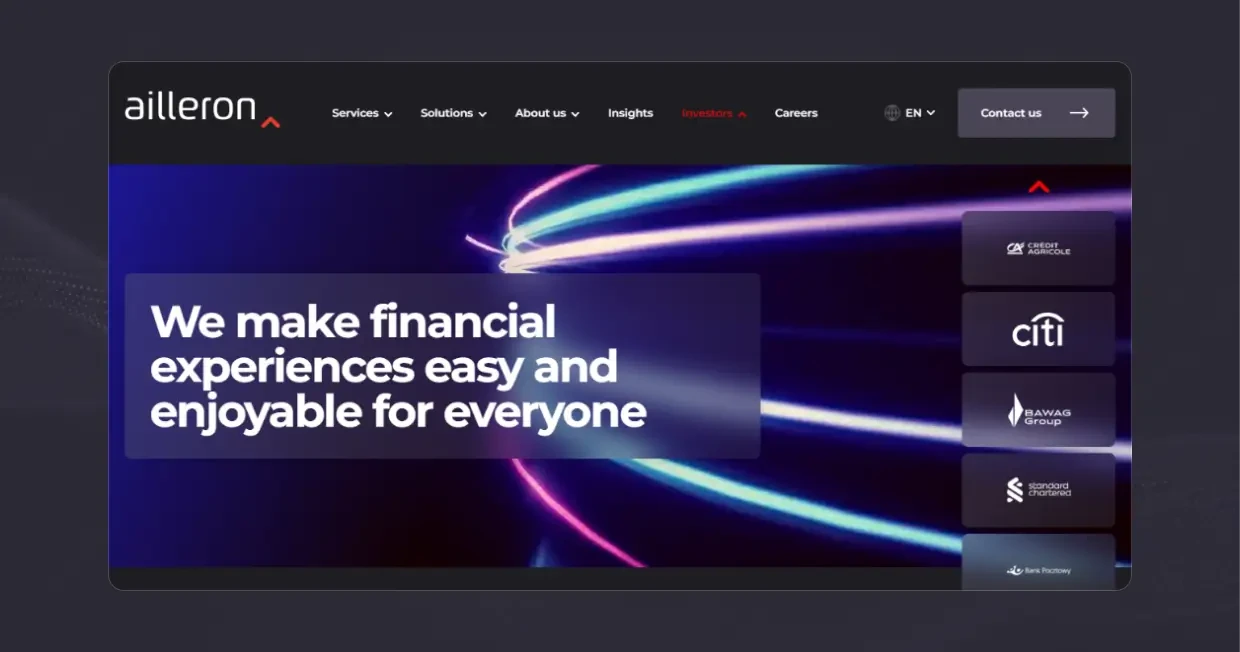
In the high-stakes world of banking tech, data isn't just information; it’s currency. As a financial software outsourcing company, we helped Ailleron transform fragmented data into a streamlined, high-velocity engine that powers smarter financial decisions and seamless scalability.
When National Inkasso GmbH needed a modern, secure, and scalable web portal to serve global clients, they chose Acquaint Softtech. We didn’t just redesign a site; we engineered a high-velocity digital engine. In financial services, speed builds confidence. Security builds trust.

What Clients Say on Clutch & Upwork
Rated 5 stars on Clutch across 66+ reviews. Trusted by 1,293+ clients on Upwork with a 98% success rate. The proof is public.


Why fintech founders choose Acquaint Softtech.
Proven fintech delivery
We have shipped the hard stuff, a neobank backend for XOALA, compliance and audit systems for MAP FinTech, and transaction-investigation tooling for FLIQA Payments. Real financial products, in production, under real regulatory pressure.
Security engineered in, not bolted on
Encryption at rest and in transit, secure key management, role-based access, and full audit trails, ISO 27001 certified practices baked into how we build, not added after a breach.
Compliance-aware from day one
PCI-DSS, GDPR, KYC, and AML are not afterthoughts. We architect for the rules your product and region demand, so audits become a checkbox, not a crisis.
Payments and transaction integrity
Payment gateway integrations, ledgers, and reconciliation that balance to the cent. In fintech, money movement is where trust is won or lost, and we build it to never drop a transaction.
Official engineering partnerships
Official Laravel Partner, Statamic Partner, and Bagisto Partner, framework-certified expertise that gives your financial platform a stable, production-grade foundation.
Your code, your IP, protected
NDA and 100% IP ownership from day one, with secure data handling throughout. Sensitive financial logic stays yours, fully.
Fintech software development, answered.
-
How much does it cost to develop a fintech app?
A fintech app typically costs between $30,000 and $80,000 for an MVP, and $150,000 or more for a full regulated platform with compliance, payments, and security built in. The exact figure depends on features, integrations, and regulatory scope. Offshore partners like Acquaint Softtech deliver the same engineering from $22 per hour, well below US and UK agency rates.
-
How long does it take to build a fintech app?
A fintech MVP usually takes 3 to 5 months, while a full compliant platform with payments, KYC, and audit systems takes 6 to 12 months. Timelines depend on regulatory requirements and third-party integrations, which is why a discovery phase to lock scope before development is worth the time.
-
What compliance and regulations does a fintech app need?
Most fintech apps must meet PCI-DSS for card payments, KYC and AML for identity and anti-fraud, and GDPR or regional data laws for privacy, with SOC 2 often required for enterprise trust. The exact set depends on your product and market. Acquaint Softtech architects for these from day one, having built compliance and audit systems for clients like MAP FinTech.
-
How do you make a fintech app secure?
Fintech security is built in layers: encryption at rest and in transit, secure key management, multi-factor authentication, role-based access, and complete audit trails. Security must be engineered from the first line of code, not added after launch. Acquaint follows ISO 27001 certified practices across every financial build.
-
How do I choose the right fintech software development company?
Verify four things: genuine reviews you can read on platforms like Clutch, proven experience shipping regulated financial products, demonstrated security and compliance discipline, and clear terms on code and data ownership. Ask for named fintech clients and case studies, not just claims. Every company on this list was vetted for a minimum of 50 verified Clutch reviews.
-
What technology stack is used for fintech development?
Fintech platforms commonly pair a secure backend such as Laravel, Node.js, or Java with a cross-platform frontend like React Native or Flutter, plus encrypted databases, payment gateway APIs, and cloud infrastructure such as AWS for scale and uptime. The right stack depends on your compliance needs, transaction volume, and speed to market.
-
Can you build a neobank, digital wallet, or payment app?
Yes. These require secure account systems, real-time transaction processing, payment integrations, and strict compliance. Acquaint Softtech has engineered a neobank backend for XOALA and transaction-investigation tooling for FLIQA Payments, building the account, payment, and audit layers that regulated financial products depend on.
-
Who owns the code, data, and IP in a fintech project?
You should own 100% of the code, data, and intellectual property, with an NDA in place before any work begins. In fintech this is non-negotiable, since your platform carries sensitive financial logic and customer data. Acquaint Softtech signs an NDA and transfers full IP ownership from day one.
Marketing Head
Related Blog
.webp "The Complete Guide to FinTech Software Development in 2026")
The Complete Guide to FinTech Software Development in 2026
Complete guide to fintech software development 2026: all five verticals, compliance architecture, real build sequences, AI capabilities, and fintech development cost, from 1,300+ delivered projects.

Acquaint Softtech
May 6, 2026Fast And Secure Fintech Mobile Payment Application
We use innovative IT Solutions to overcome industry challenges and build customer trust through cutting edge Fintech application development and custom FinTech software development.

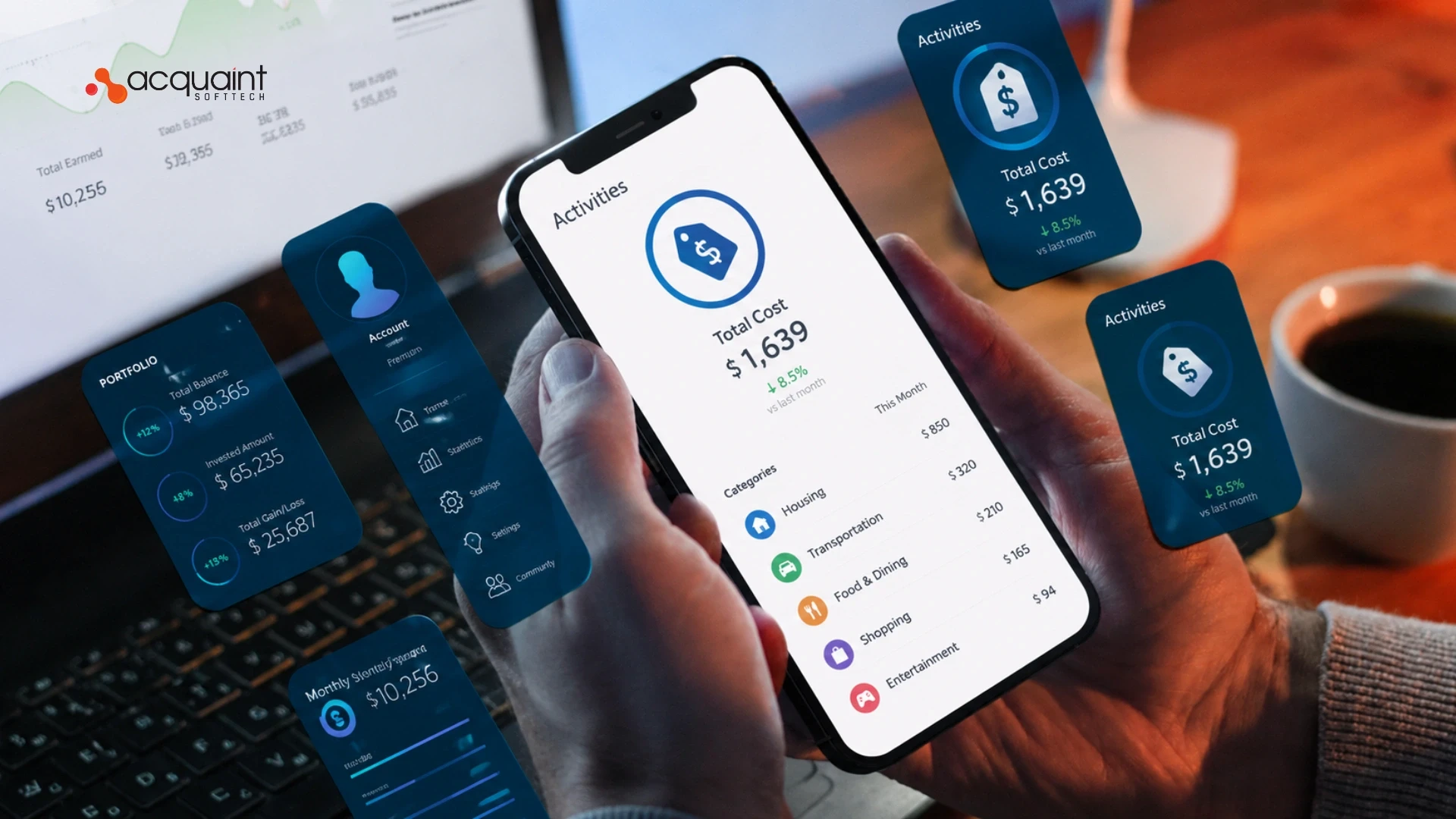
FinTech App Development Cost in 2026: Real Pricing by Feature and Complexity
A fintech app typically costs $20,000–$300,000+ to build, depending on features and compliance. The biggest cost factors are app type, security, integrations, and regulatory requirements.

Ahmed Ginani
July 16, 2026India (Head Office)
203/204, Shapath-II, Near Silver Leaf Hotel, Opp. Rajpath Club, SG Highway, Ahmedabad-380054, Gujarat
USA
7838 Camino Cielo St, Highland, CA 92346
UK
The Powerhouse, 21 Woodthorpe Road, Ashford, England, TW15 2RP
New Zealand
42 Exler Place, Avondale, Auckland 0600, New Zealand
Canada
141 Skyview Bay NE , Calgary, Alberta, T3N 2K6