

Health Insurance Platform Development: Payer Systems, Member Portals, and Telehealth Integration
Health insurance platform development is the building of the technology a health payer needs to enrol members, adjudicate claims, manage benefits, and connect care. It spans three pillars: a payer core system for eligibility, claims, and benefits; a member portal and app for self-service; and FHIR-based integration with telehealth, EHRs, and pharmacy systems. A custom payer platform typically costs $300,000 to $1.5M and must be HIPAA-compliant and CMS interoperability-ready from day one.

Manish Patel

- You run a health plan or payer and your legacy core system cannot meet CMS interoperability deadlines.
- You are launching a digital-first health insurer and need a payer platform from scratch.
- You want a member portal and app that actually lowers call-centre volume.
- You need to integrate telehealth, EHRs, and pharmacy data through FHIR APIs.
- You are scoping a health insurance build and need to know cost, timeline, and what to build first.
Introduction
A member calls their health plan to understand a medical bill, but the agent cannot see all the information in one place. After multiple calls and repeated explanations, the member finally learns their claim was denied because of a missing prior authorisation. The experience creates frustration, increases support costs, and damages trust.
The real problem is not customer service. It is disconnected systems. When claims, benefits, and member data are spread across different platforms, neither members nor agents have a clear view of what is happening. A unified platform solves this by bringing all information together in one place.
Acquaint Softtech's software product development services structure health platform builds around a unified member and claims model, and the broader engineering context lives in the complete guide to InsurTech software development. For the member-facing portals and apps built on modern JavaScript stacks, the MERN stack development team delivers the self-service experience members actually use.
This article breaks a health insurance platform into its three pillars, the payer core, the member experience, and the interoperability and clinical layer, and shows how to build each to be HIPAA compliant and CMS ready. It is written for the health plan leader who has heard that member story too many times and wants the architecture that ends it.
What a Modern Health Insurance Platform Must Do
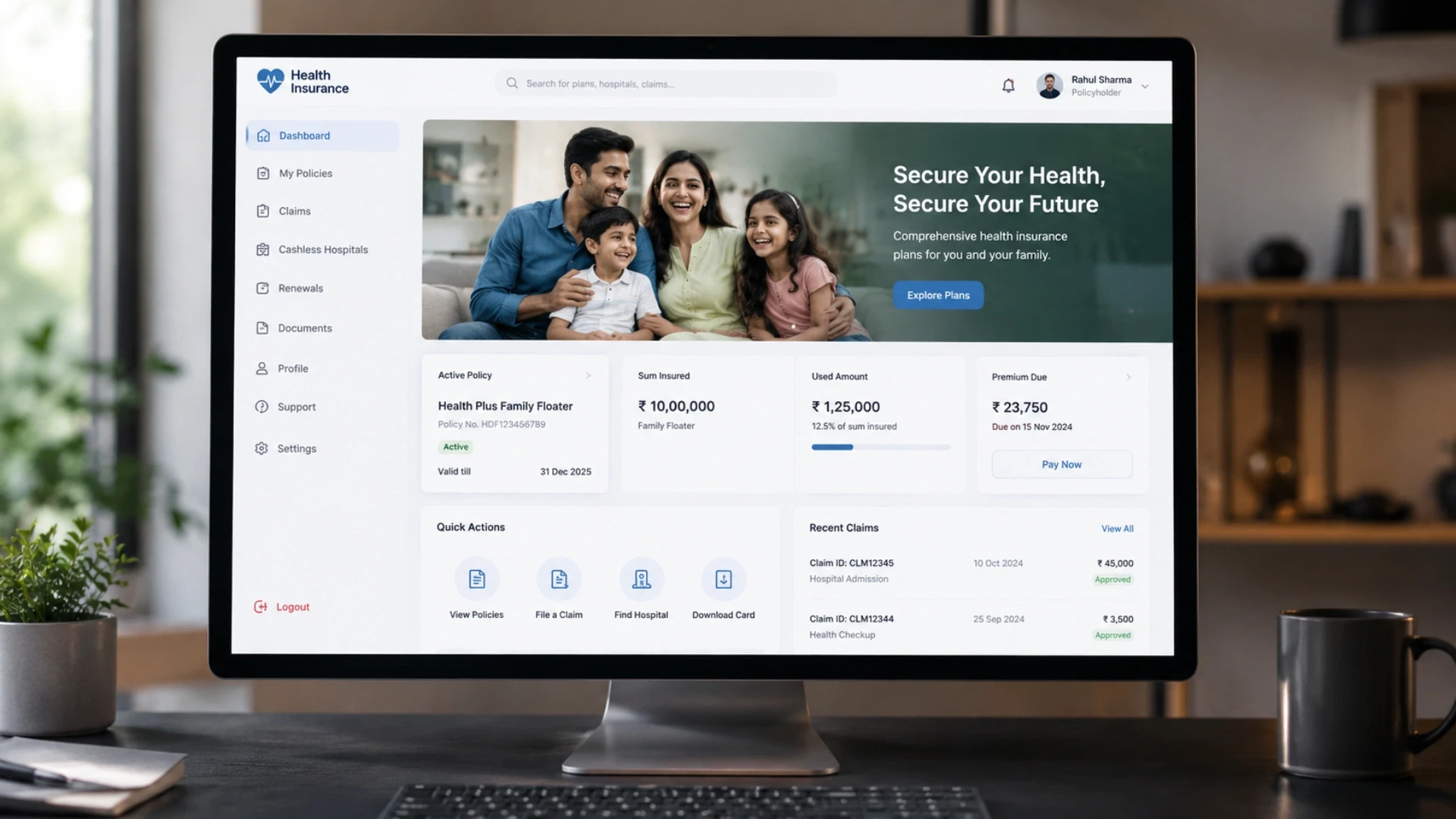
A modern health insurance platform has to satisfy four pressures at once: members expect a digital experience as smooth as their banking app, claims and administrative costs must come down, regulators now mandate open data access through FHIR APIs, and care is increasingly delivered virtually through telehealth. A platform that solves only one of these and ignores the others will fail an audit, lose members, or bleed cost. The architecture has to address all four from the start.
What is a health insurance payer?
A health insurance payer is the organisation that funds and administers healthcare coverage: it enrols members, collects premiums, defines benefits, adjudicates claims from providers, and pays them. Payers include commercial health plans, Medicare Advantage and Medicaid managed-care organisations, and digital-first insurers. The payer platform is the technology that runs all of this, distinct from a provider system that runs a clinic or hospital. Understanding the payer-versus-provider distinction is the foundation of any health insurance tech stack decision.
Acquaint Softtech builds payer platforms as unified systems where eligibility, benefits, claims, and member data share one model, so a member or agent sees one consistent truth. The engagement model is described in the dedicated software development teams service, where engineers with healthcare domain experience own the platform rather than treating it as a generic CRUD application.
The platform must expose clean APIs internally so the member portal, the claims engine, and external partners all read the same data. Acquaint Softtech's backend development services build the API and data layer that turns siloed payer functions into one coherent system, which is the precondition for both good member experience and CMS interoperability compliance.
For teams that want to map the architecture before committing budget, the discovery workshop service produces a payer data model, an interoperability plan, and a compliance map in four to six weeks. In healthcare, that upfront design is what keeps HIPAA and CMS requirements from becoming expensive retrofits later.
Pillar 1: The Payer Core System

The payer core is the engine of the health plan. It owns member enrolment and eligibility, plan and benefit configuration, premium billing, provider network and contracts, and the link to claims adjudication. Everything the member sees and every claim a provider submits depends on the accuracy of this core. Legacy payer cores, often decades old, are the root cause of the slow, opaque experiences that frustrate members and inflate administrative costs.
What does a payer core system manage?
It manages five connected functions: enrolment and eligibility, benefit configuration, premium billing, provider contracts, and claims adjudication. Because each function depends on the others, any change in benefits must instantly flow through billing and claims as well as the member portal. When these capabilities sit in separate systems, the member sees one version of reality while the claims engine operates on another, leading to errors like duplicate or incorrect denials. This is why insurers increasingly rely on unified platforms and skilled engineering teams, including options to hire MEAN stack developers, to build tightly integrated, real-time systems that keep every function in sync.
Payer Core Function | What It Owns | Why It Must Be Unified |
Enrolment and eligibility | Who is covered, effective dates | Claims must check live eligibility |
Benefit configuration | What each plan covers, cost-share | Portal and claims must show same benefit |
Premium billing | Payment collection and reconciliation | Lapses must update eligibility instantly |
Provider data and contracts | Network status, reimbursement rates | Adjudication needs live contract terms |
Claims feed | Link to adjudication engine | Decisions depend on all of the above |
Acquaint Softtech builds the payer core on a unified data model so a benefit change propagates to claims and the member portal in real time rather than overnight. Where the plan runs a Node and JavaScript stack, the MERN stack development team builds the core services and the APIs that expose eligibility and benefits to every downstream consumer.
The provider network and contract data must connect to reimbursement logic accurately, because a wrong rate is a wrong payment. Acquaint Softtech's Python development team builds the rules and rate engines that turn contract terms into correct adjudication outcomes, and keeps them version-controlled and auditable.
The deeper pattern of building a unified insurance core rather than four stitched-together systems is covered in the guide to InsurTech software development, which applies the same one-data-model principle across insurance lines including health.
Pillar 2: Claims Adjudication and Prior Authorisation
Claims adjudication is where a payer spends most of its administrative effort and where automation delivers the largest return. The adjudication engine receives a provider claim, checks eligibility and benefits, applies coding and payment rules, runs payment-integrity checks, and either pays, adjusts, or denies. Prior authorisation sits upstream, deciding before treatment whether the plan will cover a procedure. Both are ripe for automation, and both are now subject to new federal rules that mandate electronic, FHIR-based processing.
How does health claims adjudication work?
A provider submits a claim, typically as an EDI 837 transaction through a clearinghouse. The adjudication engine verifies the member was eligible on the date of service, confirms the benefit covers the procedure, applies coding edits and the contracted reimbursement rate, runs fraud and payment-integrity checks, and issues an 835 electronic remittance advice with the payment or denial. The full cycle runs five to fourteen days in most plans. Automating the rules-based portions lets clean claims auto-adjudicate in seconds, reserving human review for the genuinely complex cases.
Acquaint Softtech builds the adjudication engine with a configurable rules layer so coding edits, benefit logic, and payment-integrity checks can be tuned without an engineering release. This connects to the broader claims-automation engineering described in the insurance claims automation guide, which covers straight-through processing and AI adjudication patterns that apply directly to health claims.
Prior authorisation is being reshaped by the CMS interoperability rule, which mandates FHIR-based prior-auth APIs. Acquaint Softtech's AI development services team builds the AI-assisted clinical review and document-extraction models that let a plan automate prior-auth determinations while keeping a human-in-the-loop for clinical edge cases.
The payment-integrity and fraud layer is built by the hire AI and ML engineers team, who construct the anomaly and pattern-detection models that catch improper payments before money leaves the plan, embedding integrity at adjudication rather than as a costly post-payment audit.
Pillar 3: The Member Portal and Mobile App
The member portal is the face of the health plan and the single biggest lever on member satisfaction and call-centre cost. A member who can see their claim status, find an in-network provider, check what a procedure will cost, and refill a prescription without calling is a member who does not generate the three expensive phone calls. The portal is not a nice-to-have; it is the most direct way to lower administrative cost while raising retention.
How do you build a member portal that lowers call volume?
By giving members self-service answers to the questions they would otherwise call about: real-time claim status, clear explanation of benefits, in-network provider search with cost estimates, digital ID cards, prior-authorisation status, and prescription management. The portal must read from the same unified payer core the agents use, so the member sees exactly what the agent sees. Modern plans layer an AI assistant on top, so members can ask plain-language questions and get answers pulled from their own benefits and claims data. The portal succeeds when calling becomes the exception, not the default.
Acquaint Softtech builds member portals and apps on the MERN stack for a fast, responsive self-service experience that reads live from the payer core. The MERN stack team delivers the React front end and Node services that make claim status, benefits, and provider search instant rather than a phone call.
The mobile app, where members increasingly expect to manage coverage, is built with the React Native development team, giving members digital ID cards, push notifications on claim status, and secure messaging from a single app across iOS and Android.
The AI member assistant that answers plain-language benefit and claim questions is built by the Python development team, which connects a language model to the member's own benefits and claims data through a secure, auditable retrieval layer that never exposes protected health information beyond the authenticated member.
CASE EXAMPLE
Oscar Health: A Technology Company That Happens to Sell Insurance
Oscar Health built its business as a technology platform first, with the member experience as the product. For 2026 open enrollment, its plans are available in 573 counties across 20 states, and it has layered an AI member assistant, Oswell, built on a large language model, on top of its platform to answer routine member questions about benefits, treatment, and prescriptions on demand.
The architecture that makes this possible is a unified member data layer plus CMS-compliant interoperability. Oscar makes a member's claims and clinical data available through a FHIR API within 24 hours of receiving it, contracting a HIPAA-compliant interoperability provider to expose that data to third-party apps like Apple Health with the member's consent.
The lesson for any health plan is that the member experience and the compliance layer are the same investment. A unified data core that powers a great portal is also the core that satisfies CMS data-access mandates. Acquaint Softtech builds exactly this: one member and claims model that serves both the experience and the regulator.
See how Acquaint Softtech approaches InsurTech platform builds
Every avoidable member call costs you money and goodwill.
Acquaint Softtech builds member portals and apps at up to 40% less than Western agencies, with a 95% sprint delivery rate. Book a call and get a self-service roadmap that targets your top call drivers.
Interoperability: FHIR, CMS Mandates, and Data Exchange
Interoperability is no longer optional for US health payers. Federal rules now require plans to expose member claims and clinical data through standardised FHIR APIs, and to support FHIR-based prior authorisation. A platform that cannot meet these mandates is not just behind on features; it is out of compliance. Building on FHIR from the start is far cheaper than retrofitting a legacy core to speak it later.
What is FHIR and why does it matter for payers?
FHIR, Fast Healthcare Interoperability Resources, is the standard data format and API specification for exchanging healthcare information. It defines how a member record, a claim, a coverage, or a clinical document is structured and shared between systems. CMS rules require payers to provide patient access, provider directory, and payer-to-payer data exchange through FHIR APIs, with prior-authorisation APIs mandated under the CMS interoperability and prior authorisation rule. By July 2026, networks must facilitate FHIR-based access and a patient-initiated record locator service. A payer platform built FHIR-native meets these requirements as a feature, not a fire drill.
Acquaint Softtech builds the payer data model FHIR-native so patient-access, provider-directory, and payer-to-payer APIs are a configuration rather than a rebuild. This API engineering is delivered through the backend development services, which implement the FHIR resources and endpoints CMS requires with the security controls that protect them.
Connecting to EHRs, clearinghouses, and pharmacy systems through FHIR and EDI is an integration discipline in itself. Acquaint Softtech's software development outsourcing model provides the dedicated integration engineers who build and maintain these connections, which are too numerous and too change-prone for a small internal team to own alone.
The cost framework for building an integration-heavy, regulated platform like this is covered in the minimum budget required to start a Python development project guide, which gives a realistic basis for budgeting FHIR and EDI integration work before committing.
Telehealth and Clinical Integration
Telehealth has moved from an emergency stopgap to a core benefit, and members now expect to reach virtual care through their health plan rather than a separate app. Integrating telehealth into the payer platform means a member can book a virtual visit, have it covered and adjudicated automatically, and have the clinical record flow back into their member data. Done well, telehealth integration lowers cost of care and raises engagement; done as a bolt-on, it creates yet another data silo.
How does telehealth integrate with a health insurance platform?
Modern health plans integrate telehealth directly into the member portal, creating a seamless journey from appointment booking and coverage verification to claims processing and prescription management. By connecting clinical records, pharmacy data, and payer systems through secure APIs, members enjoy a smooth experience while AI-powered insights help identify care gaps, improve outcomes, and reduce costs.
Where a plan needs an ongoing engineering partner to maintain and extend these clinical integrations as standards evolve, Acquaint Softtech's support and maintenance services provide the continuous capacity to keep telehealth, EHR, and pharmacy connections current and compliant.
HIPAA, Security, and the Compliance Layer
In health insurance, security and compliance are not a layer you add at the end; they are the foundation everything else sits on. HIPAA governs how protected health information is stored, transmitted, and accessed, and a single breach carries financial penalties and reputational damage that can end a plan. Every architectural decision, from database design to API authentication to logging, has to be made with HIPAA technical safeguards in mind from the first sprint.
What does HIPAA require from a health insurance platform?
HIPAA's technical safeguards require encryption of protected health information in transit and at rest, role-based access controls so staff see only the data their role permits, comprehensive audit logging of every access to member data, automatic logoff, and integrity controls that prevent improper alteration. Beyond HIPAA, plans must meet the No Surprises Act, price-transparency rules, and state-level requirements. The platform must be able to prove, through its audit trail, exactly who accessed what and when, because in a regulatory review the burden is on the plan to demonstrate compliance.
Acquaint Softtech builds HIPAA technical safeguards into the architecture from sprint one: encryption everywhere, role-based access, and immutable audit logging on every access to protected health information. This is delivered through the dedicated software development teams, staffed by engineers who have navigated healthcare compliance audits rather than generalists learning HIPAA on the job.
The infrastructure-level controls, encrypted storage, network isolation, disaster recovery, and continuous monitoring are built by the DevOps engineering team, who configure HIPAA-eligible cloud services and the logging and alerting that prove compliance during an audit.
For plans that need senior technical leadership to own the compliance and security strategy across the whole platform, Acquaint Softtech's virtual CTO services provide fractional CTO engagement to set the security architecture and audit-readiness plan before development scales.
Cost, Timeline, and Build Sequencing
Health insurance platform cost scales with the number of pillars built, the lines of business and member volume, the depth of clinical integration, and the compliance surface. The figures below reflect offshore delivery with senior healthcare-domain engineers, the model Acquaint Softtech uses across its 1,300+ project portfolio. In healthcare more than anywhere, sequencing matters, because compliance must lead, not follow.
Scope | Estimated Cost (USD) | Timeline |
Member portal and mobile app | $120,000 to $300,000 | 5 to 9 months |
Payer core (eligibility, benefits, billing) | $250,000 to $600,000 | 9 to 16 months |
Claims adjudication and prior auth engine | $180,000 to $450,000 | 8 to 14 months |
FHIR interoperability and CMS APIs | $90,000 to $220,000 | 4 to 8 months |
Telehealth and clinical integration | $80,000 to $200,000 | 4 to 8 months |
Full health insurance platform | $650,000 to $1,800,000 | 16 to 30 months |
The best approach is to first build a strong compliance and data foundation, followed by the payer core, and then a member portal that delivers immediate value. Claims and clinical integrations should come next. Many organisations make the mistake of launching the member portal first, which still shows inconsistent data if backend systems are not unified.
With Acquaint Softtech, health plans can also reduce development costs by up to 40% through an offshore model that includes dedicated project management and QA. For complex programs, virtual CTO support helps guide architecture, sequencing, and compliance decisions from the start.
Plans migrating off a legacy payer core rather than building greenfield use Acquaint Softtech's software product development practice to run the transition incrementally, keeping the existing plan operational while new pillars take over one at a time.
The case for adding healthcare engineers through a flexible model rather than slow permanent hiring is set out in the guide to what staff augmentation is, which describes how Acquaint Softtech staffs long-running, compliance-heavy platform builds.
Join 200+ technology companies that have scaled with Acquaint Softtech.
HIPAA-ready health insurance platforms delivered at up to 40% less than Western agencies, with a 4.9/5 rating from 50+ verified Clutch reviews. Book a call and leave with a sequenced, compliance-first build plan, no obligation.
Frequently Asked Questions
-
What is a health insurance payer?
A health insurance payer is the organisation that funds and manages healthcare coverage by enrolling members, collecting premiums, defining benefits, and processing claims. It is different from providers, who deliver medical care.
-
What is health insurance in simple words?
Health insurance is a system where an organisation pays for a member’s medical costs in exchange for regular premiums, helping reduce out-of-pocket healthcare expenses.
-
What is the definition of a payer in insurance?
A payer is the entity responsible for financing and administering insurance coverage, including claim approval, payment to providers, and benefit management.
-
Who is the payer in insurance?
The payer is usually a health insurance company, government program, or managed-care organisation that pays for covered medical services on behalf of members.
-
How does Oscar Health work?
Oscar Health Inc is a technology-first insurer built on a unified member data platform. It uses AI support and exposes claims and clinical data through FHIR APIs within 24 hours, improving transparency and member experience.
-
What is FHIR in healthcare?
FHIR (Fast Healthcare Interoperability Resources) is the standard API framework used to exchange healthcare data between systems, enabling payers to share claims, clinical data, and provider information securely.
-
What is HIPAA in simple terms?
HIPAA is a US healthcare data protection law that requires health platforms to secure patient data through encryption, access control, audit logs, and strict privacy safeguards.
-
How do you build a member portal for health insurance?
A member portal is built on a unified payer core and shows real-time claims, benefits, providers, and prescriptions. Modern stacks like MERN and AI assistants help reduce call volume and improve user experience.
-
How does telehealth integrate with a health plan?
Telehealth integrates through FHIR and clinical APIs, allowing virtual visits to connect directly with coverage checks, clinical records, claims processing, and pharmacy benefit systems.
-
How much does a health insurance platform cost?
A full health insurance platform typically costs between $650,000 and $1.8 million, depending on scope. Offshore development partners like Acquaint Softtech can reduce costs by up to 40%.
I lead technology and client success at Acquaint Softtech with one goal in mind. Deliver work that feels personal, reliable, and worthy of long term trust. I stay close to both our clients and our developers to make sure every project moves with clarity, quality, and accountability.
Table of Contents
Get Started with Acquaint Softtech
- 13+ Years Delivering Software Excellence
- 1300+ Projects Delivered With Precision
- Official Laravel & Laravel News Partner
- Official Statamic Partner
Related Blog
.webp "The Complete Guide to InsurTech Software Development in 2026")
The Complete Guide to InsurTech Software Development in 2026
InsurTech software is not a fintech variant with policy fields. It is a policy-centric, regulator-accountable platform that runs quote, bind, issue, endorse, pay, and report as one system.

Acquaint Softtech
May 5, 2026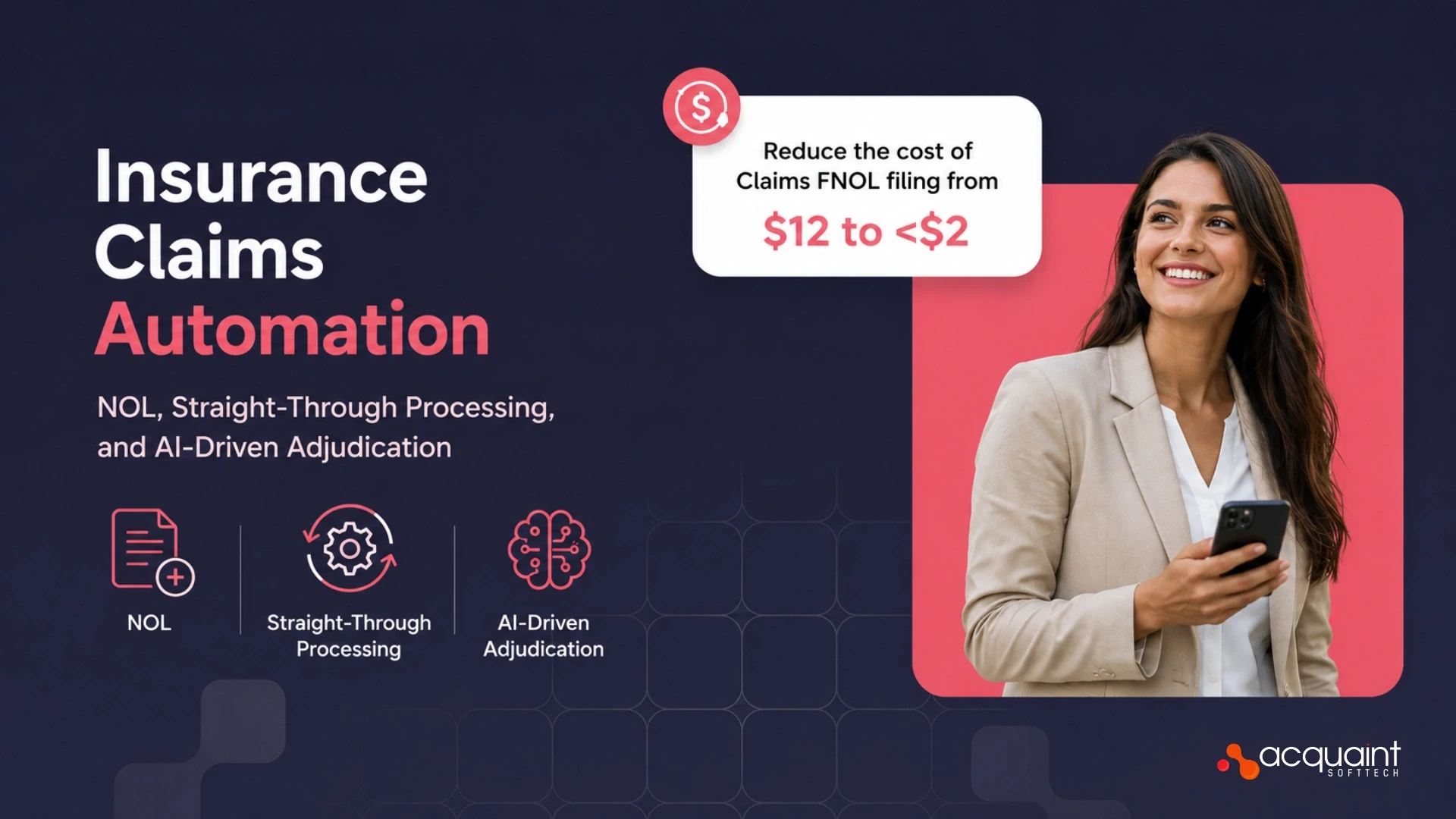
Insurance Claims Automation: FNOL, Straight-Through Processing, and AI-Driven Adjudication
AI-driven claims automation reduces claim processing costs from $15–$22 to $3–$5 and cuts turnaround time from 14 days to under 24 hours. Explore the complete 2026 claims automation architecture, from FNOL intake to AI fraud detection and adjudication.
Manish Patel
May 21, 2026
Modern Insurance Underwriting: AI-Driven Risk Assessment, Automated Decisions, and Continuous Underwriting
Modern insurance underwriting uses AI and machine learning to evaluate applicant risk, automate accept-or-decline decisions, and continuously monitor policyholder risk after policy binding. Automated systems process 500 to 1,500 data variables in seconds, reduce quote cycle time from days to under three minutes, and achieve 90-99% accuracy on low-complexity risks. Carriers deploying AI underwriting report 3-6 point loss ratio improvements within the first year.
Manish Patel
June 2, 2026India (Head Office)
203/204, Shapath-II, Near Silver Leaf Hotel, Opp. Rajpath Club, SG Highway, Ahmedabad-380054, Gujarat
USA
7838 Camino Cielo St, Highland, CA 92346
UK
The Powerhouse, 21 Woodthorpe Road, Ashford, England, TW15 2RP
New Zealand
42 Exler Place, Avondale, Auckland 0600, New Zealand
Canada
141 Skyview Bay NE , Calgary, Alberta, T3N 2K6