

What Is Staff Augmentation? Meaning, Models, Costs and Examples (2027)
Staff augmentation means adding skilled external professionals to your in-house team for a set period, while you keep control of their work. A partner handles hiring, vetting and employment. Companies use it to fill skill gaps, meet deadlines and scale quickly without permanent hires. Augmented developers typically cost from $22 an hour or $3,200 a month.

Acquaint Softtech
Business conditions change quickly. A product launch moves forward, a key developer resigns, or a client asks for an AI feature nobody on the team has built before. Firms need models that let them adapt fast, and that is where staff augmentation comes in. If you are exploring IT staff augmentation services, this guide explains exactly what the model means, how it works and when it pays off.
Staff augmentation means adding skilled professionals from an external partner to your existing team, for weeks, months or years, while they work under your direction. You decide what they build; the partner handles recruitment, vetting, employment and replacement. It keeps a business agile, able to scale up and down, and able to bring in specialist skills without slow, costly full-time hiring.

- You want a clear answer to what staff augmentation means and how it works.
- You are deciding between staff augmentation, hiring, freelancers and outsourcing.
- You want to know the models, costs, risks and real examples before you commit.
- You are looking for a reliable IT staff augmentation partner.
We have provided augmented engineers to companies across the USA, UK, Europe and Australia since 2013, across more than 1,300 projects. The pattern we see is consistent: staff augmentation works brilliantly when the client has clear priorities and someone to direct the work, and it struggles when it is used to avoid making those decisions.
This updated guide brings together our earlier articles on skill gaps, in-demand skills, controlling dependency, AI-assisted development and super apps, so everything you need to know about staff augmentation is in one place.
EXPERT INSIGHT "Staff augmentation is not a way to hand off responsibility. It is a way to add skill and speed to a team that already knows where it is going. Get the direction right, and augmented engineers multiply it." Acquaint Softtech |
Missing a skill or racing a deadline?
Tell us the role, the skills and your timeline. We will tell you honestly whether staff augmentation is the right fit and, if it is, share matched profiles within hours.
What a Loan Signing in Football Teaches About Staff Augmentation

A loan player wears your shirt
In football, when a club suddenly lacks a defender midway through a season, it does not always buy one. It often borrows one on loan from another club. For the length of the loan, that player wears your shirt, trains with your squad and plays in your manager's system. That is staff augmentation in one picture. The augmented engineer joins your team, follows your processes and works toward your goals, even though another company employs them.
The parent club handles the contract
During a loan, the parent club still holds the player's contract and much of the administration. The borrowing club simply gets a skilled player on the pitch. In staff augmentation, the partner employs the engineer, pays salary and benefits, provides equipment and handles HR. You get the skill without the paperwork, the recruitment cost or the long-term commitment.
Your manager still picks the team
A loan player does not decide tactics. The borrowing club's manager does. Staff augmentation works the same way: your product owner and tech lead decide what gets built and how. That is the biggest difference between augmentation and outsourcing, and the reason augmentation keeps control in your hands.
The best loans are for a clear reason
Clubs that use loans well know exactly which gap they are filling and for how long. Clubs that borrow players without a plan end up with a crowded squad and little improvement. The same is true of staff augmentation. It works best when you know which skill you need, why, and for how long.
What Is Staff Augmentation?
Staff augmentation is an outsourcing strategy in which you hire external experts, temporarily or for a specific project, to support your in-house team. The augmented professionals act as an extension of your team rather than a separate vendor, which lets you avoid slow and costly full-time hiring while keeping control of the work.
What does staff augmentation mean in simple terms?
In simple terms, staff augmentation means "renting" skilled people for your team. You add the people you need, when you need them, they work as your teammates, and when the need ends, they leave without the cost and complexity of layoffs.
Key characteristics of staff augmentation
• High flexibility to scale the team up or down.
• Greater control over workflows than outsourcing.
• Quicker onboarding than traditional hiring.
• Well suited to dynamic projects where priorities change.
• Access to specialist skills you do not have in-house.
• No long-term employment commitment.
• No traditional hiring overheads such as recruitment fees and benefits.
How Staff Augmentation Works

Staff augmentation follows a simple process. With an experienced partner, it can move from first conversation to a working engineer in about two days.
Step | What happens | Typical timing |
Define the need | Skills, duration, budget | Before you call |
Select a provider | Choose an IT staff augmentation partner | Days |
Define roles | Responsibilities and reporting lines | Day 1 |
Screen candidates | Review profiles and interview | Hours to Day 1 |
Onboard | NDA, access, tools, first ticket | Days 1 to 2 |
Scale | Add, swap or release engineers | Ongoing |
Defining your skill needs
Start with what the project needs: the technologies, seniority, time zone overlap, project duration and budget. The clearer this brief, the better the match and the faster the start.
Choosing the provider and screening candidates
Select a provider that offers the skills you need, such as Laravel, Python, DevOps or QA. Review pre-vetted profiles and interview the engineers before they join. For example, teams building PHP products often hire Laravel developers who can work in an existing codebase from the first week.
Integrating and scaling
Once selected, augmented engineers join your standups, sprints and code reviews. As the project changes, you can add more people, swap in different skills or release engineers with agreed notice.
Why Consider Staff Augmentation for Technical Teams?
Technical teams choose staff augmentation because it solves capacity and skill problems faster than any other model, without giving up control.
Quick access to skilled developers: start in days instead of months.
Access to specialised talent: AI/ML, cloud, DevOps, cybersecurity and more.
Faster time to market: pre-vetted professionals contribute quickly.
Scalability and flexibility: grow or shrink the team as the roadmap changes.
Cost efficiency: avoid recruitment fees, benefits, training and office costs.
Reduced hiring risk: the provider vets candidates and replaces anyone who is not a fit.
Focus on core work: your permanent team stays on the most important problems.
Knowledge transfer: specialists can upskill your internal team as they work.
Operational flexibility: no extra HR or infrastructure burden.
Knowledge retention: augmented staff work under your management, so knowledge stays in your systems.
Full control: you set workflows, priorities and communication.
Types of Staff Augmentation Models

There is no single staff augmentation model. The right one depends on how long you need help, how specific the skill is and how closely the people need to work with your team.
Model | Typical duration | Best for |
Short-term | Weeks to two months | Peaks, leave, deadlines |
Long-term | Six months or more | Ongoing roadmaps |
Project-based | One project | A defined build |
On-demand | Days or hours | Sudden small gaps |
Skill-based | As long as needed | AI, DevOps, security gaps |
Remote team | Ongoing | Distributed teams |
Dedicated team | Long term | Full product teams |
Hybrid | Ongoing | Mixed in-house and external |
Short-term staff augmentation
Covers workload peaks, staff leave or urgent deadlines, typically for a few weeks to a couple of months. Example: a fintech startup adds two developers for six weeks to finish a release.
Long-term staff augmentation
Usually lasts more than six months, with augmented engineers working as part of the internal team. Example: an eCommerce company adds a backend Laravel developer for a year-long roadmap.
Project-based staff augmentation
Talent is added for one specific project, from planning to delivery. Example: a healthcare startup adds engineers to build a patient booking app over four months.
On-demand talent
People are added within days, or even hours, to fill a sudden gap. Example: a SaaS company adds a UI/UX designer for a week to refine wireframes before a client presentation.
Skill-based staff augmentation
Fills missing expertise such as AI, DevOps or AR/VR. Example: a logistics firm adds a machine learning engineer for a three-month route optimisation pilot.
Remote team augmentation
Remote professionals join your daily workflows from another location. Example: a US company adds a QA team from India with overlapping working hours.
Dedicated team augmentation
A partner provides a full-time team that focuses on your work for the long term. Example: a startup builds and maintains its platform with a dedicated team from its partner.
Hybrid team augmentation
Mixes internal staff with external specialists. Example: a product team in New York works with remote DevOps engineers and an in-house UX team.
How Much Does Staff Augmentation Cost?

Staff augmentation is usually priced per person, either hourly for part-time work or as a monthly rate for full-time engineers. Rates depend on role, seniority, technology and the partner's location.
Role at Acquaint Softtech | Part-time | Full-time (176 hours) |
Developers (Laravel, Python, MERN) | From $22/hr | $3,200/month |
AI/ML engineers | From $30/hr | $4,400/month |
Fixed-budget project | Not applicable | From $5,000 |
What the rate includes
A good staff augmentation rate is all-inclusive: salary, benefits, equipment, office, administration and replacement if an engineer leaves. You should not see separate charges for onboarding or account management.
How it compares with hiring
A senior in-house engineer in the US can cost roughly $10,000 to $15,000 a month once salary and employment costs are included, before recruitment fees and the months it takes to hire. Staff augmentation removes those costs and lets you stop paying when the work ends, which is why it is often the most cost-effective option for startups and scaling teams.
Skills and Roles Most Often Augmented in 2027
Almost any technology role can be augmented. These are the skills companies most often bring in through staff augmentation.
Skill area | Examples | Why teams augment it |
Programming languages | Python, JavaScript, PHP, Java | Core build capacity |
Web development | Frontend and backend | Feature backlogs |
Mobile development | iOS, Android, cross-platform | App launches |
Cloud and DevOps | CI/CD, cloud platforms | Faster, safer releases |
AI and machine learning | LLMs, RAG, MLOps | New AI features |
Data engineering | Pipelines, analytics | Reporting and AI data |
Cybersecurity and QA | Testing, security reviews | Quality and compliance |
Programming and web development
Python, JavaScript and PHP remain the most requested languages for web products. Python is especially popular because it covers web backends, automation, data and AI in one language. When you hire Python developers through augmentation, look for real production experience with frameworks such as Django or FastAPI.
AI and machine learning
The fastest-growing augmented role in 2027 is the AI/ML engineer. Few companies can justify a permanent AI team before they know which AI features will pay off, so augmentation lets them add the skill for a project and prove the value first. You can hire AI/ML engineers for LLM integration, RAG pipelines, predictive analytics and MLOps.
How to find your skill gaps first
A skill gap is the difference between the skills a project needs and the skills your team has. To find yours, define the scope (individual roles or the whole team), list the skills your roadmap will need over the next few years, rate each one from 1 to 10 for importance and for current ability, and look for the biggest gaps. Close long-term gaps through training or hiring, and use staff augmentation for gaps that are urgent, specialised or temporary.
Use Cases of Staff Augmentation
Accelerating a product launch
A startup about to launch adds React Native developers so it can hit its launch date without permanent hires.
Filling skill gaps in niche technologies
A logistics firm adds a data scientist for three months to build forecasting models its team could not create alone.
Handling short-term projects
An agency adds a full-stack developer and a UI designer for six weeks to deliver a client project.
Supporting digital transformation
A retailer moving to a cloud ERP adds cloud migration and DevOps experts for the transition.
Managing a sudden increase in workload
A SaaS company adds Laravel and QA engineers for three months to clear a growing backlog.
Enhancing support and maintenance
An eCommerce platform adds remote support engineers in other time zones for round-the-clock coverage.
Prototyping or MVP development
A founder adds UI/UX, backend and QA specialists to build an investor-ready prototype.
Building super apps and multi-service platforms
Super apps combine messaging, payments, shopping, bookings and other services in one platform. They need many specialist skills at once, including payments, security, data privacy compliance and mobile performance, and each service may be subject to different regulations. Staff augmentation lets a company add specialists for each service as the platform grows, rather than hiring a permanent team for every capability up front.
Examples of Staff Augmentation
What are examples of staff augmentation? Here are three real engagements from our work.
Example one: a Nordic marketplace group clears its backlog
A family of Nordic digital marketplaces had more roadmap features than its in-house developers could handle. Backlogs were growing, small bugs on listing pages could affect thousands of users, and legacy code slowed new work. A team of 2 to 5 augmented engineers joined for eight months. Read the full marketplace staff augmentation case study.
The engineers joined daily standups, sprint planning and code reviews. They cleared long-pending tickets, fixed bugs that slowed listing pages, refactored outdated services with the client's lead engineers, resolved a long-standing image processing issue, built internal admin tools for the support team and delivered same-day fixes when urgent issues appeared. The engagement cleared high-priority backlogs and stabilised core listing platforms, so the in-house team could move from reactive bug fixing to planned feature work. The client's CEO said what stood out was how well the engineers blended with their own developers.
Example two: a taxi services company scales from one developer to fourteen
A taxi services business in the Philippines wanted a modern mobile app but lacked in-house infrastructure, domain knowledge and skills. It started with one developer from Acquaint Softtech, then grew to a long-term dedicated team of 14, with access to our QA team. By augmenting rather than building an in-house team, the company saved close to $300,000.
Example three: an EdTech platform launches and grows
Staff augmentation also helped an e-learning platform build and launch with remote developers instead of a full in-house team. Read how staff augmentation helped an EdTech platform grow its revenue.
Need a whole team, not just one engineer?
Like the taxi services example, many clients start with one developer and grow into a dedicated team that works only on their roadmap, with hiring and HR handled for them.
Staff Augmentation and AI-Assisted Development

Software development has changed. Most engineers now work with AI coding assistants, automated testing and CI/CD pipelines, an approach sometimes called augmented development. Traditional, non-augmented development relies more on manual coding, testing and deployment.
Area | AI-assisted development | Traditional development |
Speed | Faster boilerplate and testing | Slower manual tasks |
Accuracy | Automated checks catch errors | More human error |
Collaboration | Shared tools and knowledge | More knowledge silos |
Oversight | Needs clear review rules | High human control |
What this means for staff augmentation
When you augment your team, ask how engineers use AI tools, not just which languages they know. The best augmented engineers use AI to move faster while still reviewing every line they ship. Set clear rules on day one: which AI tools are approved, whether your code may be shared with them, and how AI-generated code is reviewed and tested.
Alternatives to Staff Augmentation
Staff augmentation sits between in-house hiring and full outsourcing. Here is how the main options compare.
Option | Strengths | Best for |
Staff augmentation | Fast, flexible, high control | Skill gaps and scaling |
In-house hiring | Highest control and culture fit | Long-term core team |
Project outsourcing | Vendor owns delivery | One-off defined projects |
Freelancers | Quick and low cost | Small, low-risk tasks |
Managed services | Provider owns outcomes via SLA | Stable operations |
In-house hiring
Gives the most control and cultural alignment, but hiring is slow, onboarding is expensive and scaling down is hard.
Freelancers
Quick and inexpensive for small tasks, but limited vetting, accountability and continuity make them risky for complex or long-term work.
Traditional outsourcing
A vendor takes full responsibility for a project, which reduces your management effort but also your flexibility and control. If that is what you need, our software development outsourcing model gives you one accountable partner.
Dedicated teams
When you need a whole team for the long term rather than individual engineers, dedicated software development teams give you staff augmentation-level control with less day-to-day management.
Is IT Staff Augmentation For You?
IT staff augmentation is likely to suit you if several of these are true:
You need to scale quickly without long-term commitments.
You are missing deadlines because of skill gaps or resource shortages.
Your team is overstretched and productivity is falling.
You need fresh perspectives or new technical ideas.
You lack niche skills such as AI, cybersecurity or cloud for a project.
You want to reduce hiring and overhead costs.
You have a clear scope and someone to coordinate the work.
You want to test a new market or product without permanent hires.
If you have no one to direct the work, or you want a vendor to own the outcome, a dedicated team or project outsourcing is usually a better fit.
How to Choose the Right IT Staff Augmentation Partner
The partner you choose decides most of the outcome. A reliable IT staff augmentation company should match the model to your project, budget, collaboration needs and time zone.
What to evaluate in a provider
Track record and client testimonials you can verify.
How engineers are vetted, and whether they are in-house employees or freelancers.
Communication practices and time zone overlap.
Ability to scale up, scale down and replace engineers quickly.
Security certifications, NDAs and IP ownership terms.
What to evaluate in candidates
Assess technical skill with a realistic task, problem-solving through a walkthrough of something they built, communication in a live conversation, and cultural fit with your team's way of working.
Before you sign, use our offshore development due diligence checklist to verify the ten things that matter most in any outsourcing contract.
Challenges and How to Overcome Them
Onboarding and integration delays
Choose a provider with strong onboarding support, and have access, documentation and a first task ready before the engineer joins.
Cultural or communication gaps
Align on working culture early, set documentation practices, agree on overlap hours and use shared collaboration and project management tools so nobody works in isolation.
Security and IP risks
Confirm NDAs, security protocols and IP ownership before work starts, and limit access to what each engineer needs.
Over-dependency on your provider
Staff augmentation can create dependency if one partner holds too much knowledge or control. The common risks are loss of control, information compromise, project management challenges, inconsistent quality and reliance on a single vendor.
Control | How it reduces dependency |
Clear contracts | Scope, metrics, security, revision rights, termination |
Communication | Regular updates and planned overlap hours |
Internal oversight | An internal liaison, audits and dashboards |
Shared systems | Your repositories, documents and access controls |
Partnership | Regular alignment on goals and roadmap |
At Acquaint Softtech, we standardise onboarding documents, follow ISO 27001 security processes and provide time-zone-compatible engineers, so these risks are managed from the first day.
Current Trends in Staff Augmentation
Demand for AI and data skills: AI/ML, data engineering, cloud and cybersecurity are the most requested augmented roles.
AI-assisted engineering: clients now ask how augmented engineers use AI tools and how their output is reviewed.
Global, remote-first teams: companies treat remote augmented engineers as normal members of the team.
AI in matching and screening: providers use AI tools to match candidates to requirements faster.
Soft skills and culture fit: communication matters more as teams become distributed.
Security first: certifications, access controls and IP terms are now standard requirements.
Measuring Success in Staff Augmentation
Measure augmented engineers the same way you measure your own team. These seven metrics show whether staff augmentation is working:
Metric | What to look for |
Delivery timelines | Sprint goals and releases on time |
Budget adherence | Spend in line with plan |
Productivity | Throughput per engineer over time |
Quality | Defects reaching production, review feedback |
Skill gap closure | Gaps filled and knowledge transferred |
Stakeholder satisfaction | Feedback from product owners and leads |
Business impact | Features shipped that move key metrics |
Grow Smarter, Not Harder
Staff augmentation helps companies stay agile, control costs and access talent with lower risk. But success depends on strategy: choosing the right model and partner, integrating engineers properly, communicating clearly and measuring results.
What you get with us | Detail | Why it matters |
In-house engineers | 70+ full-time employees | Continuity, not freelancers |
Speed | Profiles in hours, start in 48 hours | Protect your deadlines |
Pricing | From $22/hr or $3,200/month | Predictable, all-inclusive |
Security | ISO 27001 certified, NDA first | Code and data protected |
Flexibility | No exit penalties | Scale as needs change |
With more than 13 years of experience, 1,300+ projects delivered and official Laravel, Statamic and Bagisto partnerships, we provide augmented engineers who work in your tools, your sprints and your time zone.
Ready to scale with the right talent?
Tell us the skills you need and how fast you need them. We will share matched profiles within hours, and your chosen engineers can start within 48 hours. Free 30-minute consultation.
Frequently Asked Questions
-
What does staff augmentation mean?
Staff augmentation means adding skilled external professionals to your in-house team for a set period, while you direct their work and a partner handles employment.
-
How does staff augmentation work?
You define the skills you need, review and interview vetted profiles from a partner, onboard the chosen engineers into your team and scale up or down as needed.
-
What are examples of staff augmentation?
Adding developers to clear a backlog, bringing in an AI engineer for a pilot, or adding QA engineers before a launch are common examples.
-
What is staff augmentation in business?
It is temporarily hiring external professionals to fill skill gaps or boost capacity without permanent hires.
-
Is staff augmentation cost-effective for startups?
Yes. It removes recruitment, training and benefits costs, and you stop paying when the work ends.
-
What is the difference between staff augmentation and outsourcing?
Staff augmentation adds people to your team under your control. Outsourcing hands an entire project and its outcome to a vendor.
-
How fast can augmented staff start?
With Acquaint Softtech, matched profiles arrive within hours and engineers can start within 48 hours of a confirmed hire.
We’re Acquaint Softtech, your technology growth partner. Whether you're building a SaaS product, modernizing enterprise software, or hiring vetted remote developers, we’re built for flexibility and speed. Our official partnerships with Laravel, Statamic, and Bagisto reflect our commitment to excellence, not limitation. We work across stacks, time zones, and industries to bring your tech vision to life.
Table of Contents
Get Started with Acquaint Softtech
- 13+ Years Delivering Software Excellence
- 1300+ Projects Delivered With Precision
- Official Laravel & Laravel News Partner
- Official Statamic Partner
Related Blog
Staff Augmentation vs Dedicated Team vs Outsourcing: Which Python Model Is Right for You?
Compare Python staff augmentation, dedicated team, and project outsourcing models. Real 2026 data on cost, control, speed, and IP risk. Find which model fits your project stage.
Acquaint Softtech
April 6, 2026
Offshore Development Due Diligence: 10 Things to Verify Before Signing Any Contract
A client signed with a vendor who had 3 actual developers, stolen case studies, and 4 self-written Clutch reviews. 10 checks that take 2 hours prevent this every time.

Ahmed Ginani
April 13, 2026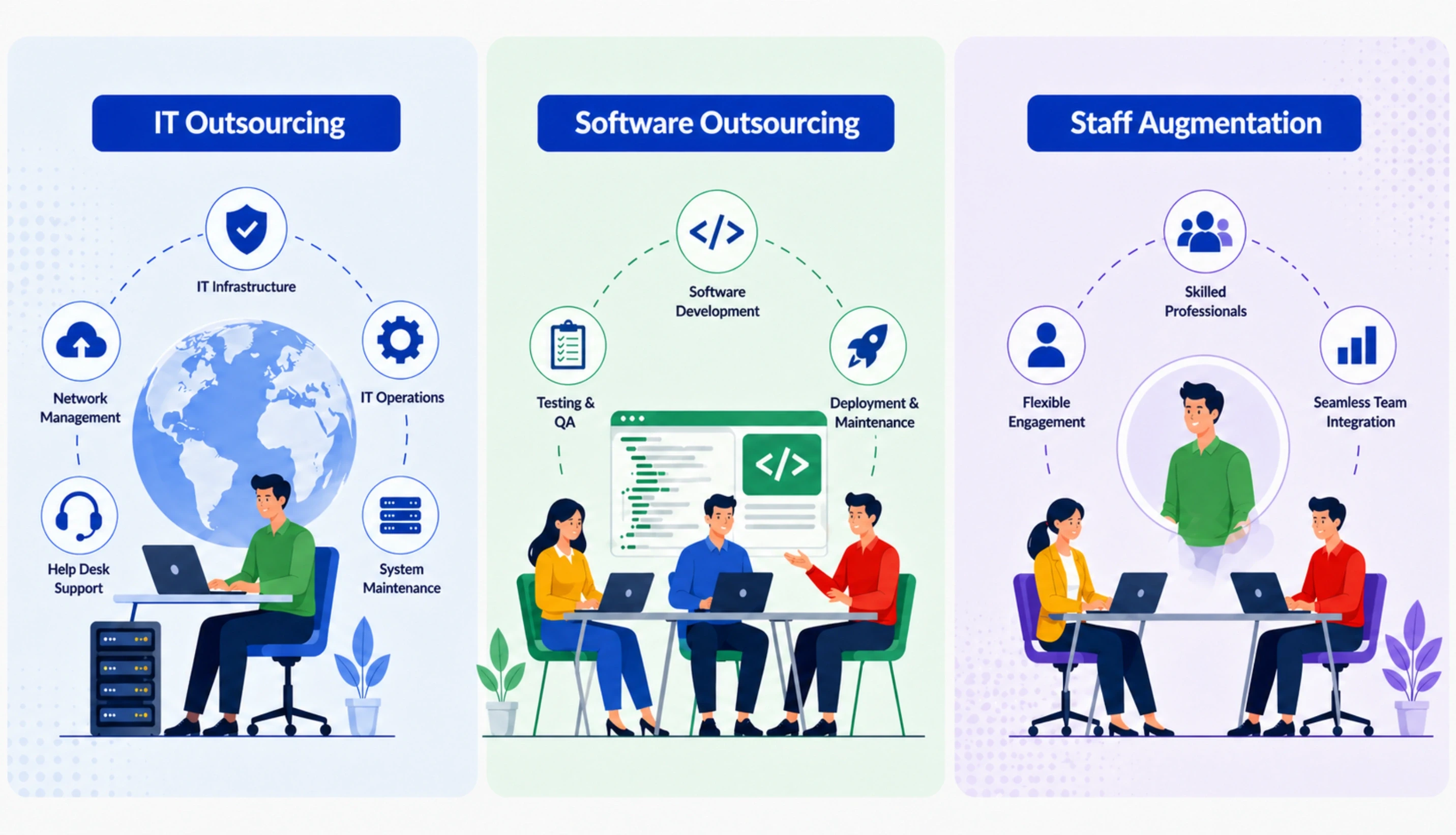
IT Outsourcing vs Software Outsourcing vs Staff Augmentation
IT outsourcing, software outsourcing, and staff augmentation are used interchangeably. They are not the same thing. This plain-English guide explains the difference in under 10 minutes.
Ahmed Ginani
April 29, 2026India (Head Office)
203/204, Shapath-II, Near Silver Leaf Hotel, Opp. Rajpath Club, SG Highway, Ahmedabad-380054, Gujarat
USA
7838 Camino Cielo St, Highland, CA 92346
UK
The Powerhouse, 21 Woodthorpe Road, Ashford, England, TW15 2RP
New Zealand
42 Exler Place, Avondale, Auckland 0600, New Zealand
Canada
141 Skyview Bay NE , Calgary, Alberta, T3N 2K6