

End-to-End HealthTech Product Development: From Idea to App Store Launch
End-to-end HealthTech product development covers everything from idea validation to launch and ongoing support. A HIPAA-compliant MVP typically takes 3–9 months and costs $40,000–$400,000.

Acquaint Softtech
Most HealthTech products fail not because of bad ideas, but because early architecture decisions ignore regulation. Unlike normal software, compliance (HIPAA/GDPR), FDA classification, and EHR integrations must be built in from day one, not added later. If not, teams often face $30K–$80K retrofits, 3–6-month delays, or even unexpected FDA requirements. In 2026, successful HealthTech means designing compliance, clinical workflows, and regulations into the system from sprint one.
Acquaint Softtech's end-to-end HealthTech product development services cover the complete journey from idea validation through App Store launch and post-launch support, with HIPAA compliance, clinical UX, and regulatory awareness embedded from the first engagement day.

- You are a HealthTech founder or CTO planning your first product build.
- You want to understand exactly what happens at each stage from idea to launch.
- You need to know what HIPAA compliance actually requires at the engineering level.
- You are comparing development partners and want to evaluate Acquaint Softtech's process.
- You have a validated idea and need a trusted team to execute the full build.
The digital health market is under accelerating regulatory scrutiny in 2026. The proposed 2026 HIPAA Security Rule update strengthens requirements for encrypted data in transit and at rest. Apple and Google now require accurate health data declarations at the app listing level, and inaccurate disclosures have led to app removals that destroy go-to-market timelines. The FTC Health Breach Notification Rule applies to consumer health apps regardless of HIPAA status. The FDA's Digital Health Center of Excellence publishes its Software as a Medical Device (SaMD) classification guidance, and any HealthTech product that influences clinical decisions must be assessed against this guidance before a line of code is written. Getting the regulatory surface mapped early prevents the most expensive of all HealthTech failures: building the wrong product for the wrong regulatory category.
This article covers all eight stages of end-to-end HealthTech product development, Acquaint Softtech's delivery process and verified track record, and cost data for each product type. For the full healthcare software development context across all eight categories, start with the complete guide to Healthcare software development.
Why Healthcare Product Development Is Different From Every Other Software Build

How an end-to-end healthtech product works is fundamentally different from how a standard SaaS or consumer app is built, in three ways that change everything about the project timeline, team composition, and architecture decisions. Understanding these differences is the prerequisite for building a HealthTech product that reaches users rather than dying in a compliance retrofit.
Dimension | Standard Software Build | HealthTech Product Build |
Compliance | Added pre-launch if needed | HIPAA, GDPR, FTC built into architecture from day one |
Timeline | Weeks, fast iteration | 3–9 months with compliance, clinical validation, and review cycles |
User vs Buyer | Often same person | Usually different (patients use, hospitals/insurers pay) |
Feature Failure Impact | Churn and bad reviews | Legal penalties, HIPAA fines, patient safety risks |
Regulatory Classification | Not required | Must be defined (HIPAA tool, wellness app, CDS, or SaMD/FDA) |
Benefits of end-to-end healthtech product development with a specialist partner rather than a generalist agency: the compliance architecture is embedded rather than bolted on, EHR integration requirements are scoped before the data model is designed rather than after, and clinical UX is tested with real clinical users before launch rather than discovered through negative App Store reviews. End-to-end healthtech product use cases 2026 include telemedicine platforms, mental health apps, remote patient monitoring systems, hospital management tools, clinical analytics platforms, and pharmacy management software — all requiring the same compliance-first approach.
Acquaint Softtech's virtual CTO services provide the technical leadership and regulatory awareness for HealthTech founders who do not yet have an internal CTO. For the full HealthTech product type landscape, Acquaint Softtech's discovery workshop services classify the product type and regulatory pathway in the first week before any architecture decision is made.
Stage 1: Discovery and Idea Validation: Week 1 to 2

The first stage of end-to-end HealthTech product development is not design and it is not architecture. It is validation: confirming that the problem is real, urgent, and addressable before any technical decision is made. The most expensive HealthTech projects are the ones that began building in week two before the validation questions were answered in week one.
What the discovery stage produces
Validated problem statement with named clinical users, their current workaround, and the measurable cost of that workaround in time or errors.
Regulatory pathway classification: wellness (FTC), HIPAA-covered entity tool, non-locked CDS, or FDA SaMD, with the cost and timeline implications of each pathway documented before development is scoped.
Buyer map: the entity that pays for the product (hospital, insurer, employer, or patient), their procurement cycle, and the decision criteria they apply before purchasing a clinical tool.
Phase 1 MVP scope: the minimum set of features without which the core clinical workflow cannot function, derived from user interviews and regulatory requirements, not from a feature wishlist.
Technical feasibility assessment: any integration requirement (EHR, wearable device, insurance payer API) that will affect the architecture is identified and scoped in Stage 1, before the data model is designed in Stage 3.
Acquaint Softtech's discovery workshop services deliver all five outputs above in a structured 2-week engagement. The discovery workshop is the first deliverable in every Acquaint Softtech HealthTech end-to-end engagement. How to Validate Your HealthTech covers the five-gate validation framework in full detail, including the regulatory scoping methodology at Gate 2.
Stage 2: Regulatory and Compliance Scoping: Weeks 2 to 4

Regulatory scoping is the single most consequential decision in the HealthTech product development process. A compliance issue caught in week two costs a sprint. The same issue caught at App Store submission costs months. One company spent eight months and $85,000 building a wellness product only to discover it crossed the FDA SaMD threshold during a health system partnership conversation, not during their own compliance review (Sociilabs, May 2026).
Product Classification | Regulatory Framework | Timeline & Cost Impact |
Wellness App (no clinical claims) | FTC Health Breach Notification Rule | Fastest launch, no FDA/HIPAA unless PHI is involved |
HIPAA-Covered Tool | HIPAA Security Rule + BAAs | +20–35% development cost, no FDA approval required |
Non-Locked CDS | HIPAA applies; no FDA if clinician can override | Moderate compliance effort, depends on workflow design |
SaMD Class II | FDA 510(k) or De Novo clearance | +$50K–$300K, adds 6–18 months |
Digital Therapeutic (DTx) | FDA clearance + clinical trial evidence | +$500K+, 18–36 months, payer validation required |
HIPAA compliance in 2026 is not a checkbox. Treating compliance as a continuous gate in the CI/CD pipeline, automated audit trail generation, and security scanning running on every deployment, is the 2026 standard (Kellton, May 2026). Acquaint Softtech's DevOps engineers configure HIPAA-eligible AWS infrastructure and CI/CD compliance gates as a first-sprint deliverable on all HealthTech engagements, before any application feature code is written.
Stage 3: Architecture Design and Tech Stack Selection: Weeks 3 to 6
Architecture design follows compliance scoping because the regulatory classification directly determines the architecture. A HIPAA-covered entity tool has different data model requirements than a wellness app. An FDA SaMD product has different audit trail and software lifecycle documentation requirements than a non-regulated clinical tool. Tech stack selection that happens before compliance scoping produces architectures that require expensive rework when the regulatory reality is discovered.
Architecture decisions shaped by HealthTech compliance
Data model PHI classification: which data fields in the system contain Protected Health Information, which are de-identified, and which are fully anonymised. This classification shapes the database schema, encryption strategy, and access control rules.
EHR integration pathway: any connection to Epic, Cerner, AthenaHealth, or another EHR requires FHIR R4 API integration, which must be designed into the API architecture. HL7 FHIR R4 is the US standard mandated by CMS under the Interoperability and Patient Access Final Rule. Each EHR connection adds $20,000 to $40,000 to project scope (2026).
Offline-first versus online-only mobile architecture: clinical apps used in rural or low-connectivity environments must be designed offline-first from the architecture stage. Offline sync is substantially harder to add as a retrofit than to build in from the start (April 2026).
AI feature classification: any AI feature that influences clinical decisions must be assessed against the FDA's non-locked CDS criteria. This assessment shapes how the AI output is presented (as information for a clinician to act on, not as an autonomous decision), which affects the UI and API design.
Acquaint Softtech holds Official Laravel Partner status and delivers HealthTech architectures across Laravel, React Native, Python, MERN, MEAN, and Django, matching the stack to the product requirements rather than to the agency's preferred framework. The software product development service includes architecture design as a standard discovery workshop deliverable. For teams that have already validated their idea and need specific engineers, hire React Native developers for cross-platform mobile, or hire Laravel developers for the backend, all with HealthTech delivery experience.
Stage 4: MVP Feature Prioritisation: What to Build First
HealthTech MVP feature prioritisation is the output of the discovery and validation process, not a creative exercise. The MVP must contain the minimum features without which the core clinical workflow cannot be completed, plus all required compliance infrastructure. Everything else is Phase 2.
The Acquaint Softtech HealthTech MVP Feature Decision Framework
BUILD in Phase 1: any feature without which the core clinical workflow cannot be completed.
BUILD in Phase 1: all HIPAA technical safeguards; these are non-negotiable and cannot be deferred.
BUILD in Phase 1: the single user role the product is designed for (clinician, patient, or administrator, not all three simultaneously).
DEFER to Phase 2: analytics, reporting, and admin dashboards; build these after real usage data exists.
DEFER to Phase 2: AI features; validate the core workflow before adding AI personalisation on top of it.
DEFER to Phase 2: second and third user roles, launch for one user type, then expand.
DEFER to Phase 2: EHR integrations beyond the minimum required for the core workflow; manual data entry in Phase 1 is acceptable if it validates the clinical value proposition.
HealthTech Product Type | Phase 1 MVP (Build) | Phase 2 (Defer) |
Telemedicine Platform | Video consult, booking, basic notes, billing | EHR integration, AI scribing, remote monitoring |
Mental Health App | Mood tracking, journaling, crisis support, HIPAA | AI personalization, therapist matching, CBT modules |
Hospital Management System | Registration, scheduling, basic EMR, billing | Pharmacy, lab, analytics, multi-facility ops |
Remote Patient Monitoring | Single device, alerts, clinician dashboard | Multi-device, AI risk scoring, EHR write-back |
Home Healthcare Platform | Scheduling, EVV, basic documentation | GPS routing, multi-state EVV, PDGM billing |
The MoSCoW framework (Must have, Should have, Could have, Won't have) applied to HealthTech MVP scoping works well when compliance requirements are placed in the Must Have column from the start rather than discovered during QA (March 2026). A dedicated HealthTech team, compliance-aware architect, one to two mobile developers, a backend engineer, and a QA specialist can deliver a scoped HIPAA-compliant MVP in 8 to 12 weeks from defined scope. Acquaint Softtech's dedicated software development teams operate exactly this team structure for all HealthTech MVP engagements.
Stage 5: HIPAA-Compliant Build: Sprints 1 Through Launch

The build phase of a HealthTech product differs from a standard software sprint cycle in one critical way: compliance architecture is sprint zero and sprint one work, not a pre-launch audit. Teams that treat compliance as sequential to the build phase consistently spend $30,000 to $80,000 on retrofit work when the data model, API structure, and cloud configuration are not designed for HIPAA from the start (Premium App Developer, 2026).
What HIPAA-compliant build means at the sprint level
Sprint 0 and Sprint 1 deliverables: HIPAA-eligible AWS infrastructure deployed as Terraform code, AES-256 column encryption configured on all PHI-holding database tables, CloudTrail audit logging active, TLS 1.3 enforced on all API endpoints, RBAC schema defined and implemented, BAA executed with the cloud provider. These are not features; they are the infrastructure all other features run on.
Every sprint: automated security scanning runs in the CI/CD pipeline on every deployment. Not as a pre-launch audit. Not as a quarterly review. On every deployment. This is the 2026 standard for healthcare software development (Kellton, May 2026).
FHIR integration sprints: if EHR integration is in scope, FHIR R4 API integration is developed and tested against the EHR vendor's sandbox environment during dedicated integration sprints, not assembled in the last sprint before launch.
Documentation as code: HIPAA requires documented risk assessments, access control policies, and incident response plans. These compliance documents are produced alongside the code, not assembled post-build for a pre-launch audit.
Key Insight
A compliance issue caught in week two costs a sprint. The same issue caught at App Store submission costs months. And the same issue caught in a CMS or HHS audit post-launch costs up to $1.9 million per violation category annually. The cost curve of fixing compliance problems is exponential by stage. Acquaint Softtech's delivery process treats compliance as a continuous gate, not a final checkpoint.
Acquaint Softtech’s software product development team delivers HIPAA-compliant healthcare infrastructure using the AWS Healthcare Compliance Reference Architecture as the baseline, with Terraform infrastructure-as-code for reproducible and auditable deployments, and offers scalable engineering support through its team of hired MERN stack developers for building secure healthcare applications.
Stage 6: Clinical User Testing and QA
Clinical user testing in HealthTech is not the same as standard user acceptance testing. The test population matters: clinicians testing clinical apps must be real clinical practitioners using the app in their actual workflow context, not QA engineers performing scripted test cases. A clinical workflow flaw discovered in testing adds one sprint. The same flaw discovered by clinical users after launch costs user trust, clinical adoption, and in the case of a compliance error, regulatory exposure.
What clinical testing covers that standard QA does not
Clinical workflow completion testing: can a real clinician complete the primary clinical task, prescribing, documenting, ordering, or reviewing, without coaching from the product team? Failed workflow completion tests reveal UX problems that cannot be found in scripted test cases.
HIPAA penetration testing: a professional penetration test from a certified healthcare security firm is not optional for HealthTech enterprise products; it is a procurement requirement for most US health systems. Schedule this 4 to 6 weeks before the planned launch date to allow remediation time.
Clinical content review: for mental health apps, AI recommendation systems, or clinical decision support tools, a licensed clinical practitioner must review all AI outputs, clinical content, and therapeutic claims before App Store submission. This review confirms the product does not cross into the FDA SaMD territory without intended registration.
Accessibility testing for clinical populations: WCAG 2.2 compliance for patient-facing apps, particularly relevant for senior and chronic illness patient populations who have visual or motor accessibility needs.
Acquaint Softtech's AI and ML development services produce clinical boundary documentation for every AI feature before testing, confirming the intended use, output type, and that the feature does not constitute autonomous clinical decision-making. This documentation forms part of the compliance evidence package that health system procurement committees request.
Stage 7: App Store Submission and Healthcare-Specific Review

App Store submission for HealthTech products has strict compliance requirements, especially around health data privacy and disclosures. In 2026, both Apple and Google have tightened enforcement, and inaccurate declarations can result in app rejection or removal, significantly delaying launch timelines.
Companies offering white label software development can help ensure applications are built and packaged with compliance-ready architecture, reducing App Store approval risks and speeding up go-to-market.
Apple App Store healthcare submission requirements
Health data privacy declaration: accurate declaration of all health data types the app collects, uses, or shares. Data types must match the actual app behaviour — not a best-guess at submission. Health and Fitness data category requires explicit justification.
HIPAA compliance acknowledgement: apps that handle PHI must include a HIPAA privacy notice and terms of use visible before users create an account. The App Store reviewers check for this before approval.
Mental health category review: mental health apps face a 2 to 4 week longer review cycle than standard apps. Build this into the launch timeline.
Privacy nutrition label accuracy: every data type listed in the App Privacy section must accurately reflect the app's actual data collection and sharing behaviour. Inaccurate privacy labels are an App Store rejection trigger.
Google Play healthcare submission requirements
Sensitive app category compliance: health apps must comply with Google Play's Sensitive Events and Healthcare policies, including restrictions on targeting specific medical conditions in ad copy.
Health Connect permission declaration: apps using Android Health Connect to read or write health data must apply for and receive Health Connect permission approval before the app is listed publicly.
Data safety section accuracy: equivalent to Apple's privacy nutrition label — inaccurate data safety declarations are a suspension trigger, not just a review rejection.
Acquaint Softtech’s native developers prepare App Store submission packages including privacy nutrition labels, data safety declarations, and HIPAA documentation as part of standard delivery. You can also hire MEAN stack developers for scalable healthcare application development. The 48-hour deployment refers to onboarding developers, not App Store approval, which typically takes 7 to 21 days depending on Apple and Google review processes for healthcare apps.
Stage 8: Post-Launch Support, Maintenance, and Iteration
Launch is not the end of HealthTech product development. It is the beginning of the most important phase: learning from real clinical users, maintaining HIPAA compliance through OS updates and dependency changes, and iterating the product toward product-market fit in the clinical market.
Post-Launch Activity | Frequency | Cost Benchmark |
OS Compatibility Updates (iOS/Android) | Annual major + ongoing patches | ~15–20% of initial build cost/year |
HIPAA Compliance Re-audit | Annual | $10K–$40K/year (audit + security testing) |
Cloud Infrastructure (AWS/Azure) | Monthly | $500–$3,000/month (mid-tier product) |
EHR API Updates (FHIR changes) | Quarterly (as released) | $5K–$20K per major integration update |
Product Iteration Sprints | Quarterly | Varies (typically 2–4 sprints/quarter based on scope) |
Acquaint Softtech's support and maintenance services include HIPAA compliance maintenance, OS compatibility updates, cloud infrastructure management, and sprint-based product iteration for all HealthTech products delivered by the team.
The staff augmentation model allows flexible team scaling for post-launch iteration phases, adding React Native or Laravel engineers for specific sprint-based feature delivery without long-term headcount commitment.
How Acquaint Softtech Delivers End-to-End HealthTech Products
End-to-end healthtech product development company: Acquaint Softtech has delivered 1,300 or more software projects across 20 or more industries in 13 or more years, with 70 or more in-house engineers across Laravel, React Native, Python, DevOps, and AI/ML disciplines. The HealthTech delivery practice covers the full stack of clinical software categories.
HealthTech Category | Delivery Experience |
Telemedicine | HIPAA video, FHIR integration |
Mental Health | Mood tracking, therapy tools |
Hospital Systems | HMS modules, HL7 FHIR |
Remote Monitoring | Wearables, RPM, FHIR sync |
Data Warehouse | ETL pipelines, analytics |
Diagnostics (LIS) | HL7/ASTM integration |
Insurance Claims | EDI billing, fraud detection |
Home Healthcare | EVV, GPS tracking, mobile apps |
Every category above is served by a cross-functional team combining the right stack specialists for the product: hire Laravel developers for backend APIs and adjudication engines; hire React Native developers for cross-platform mobile; hire Python developers for AI/ML, ETL, and data engineering; hire DevOps engineers for HIPAA-compliant cloud infrastructure and CI/CD; hire AI/ML engineers for clinical AI features and fraud detection.
Verified Case Studies: What Acquaint Softtech Has Built
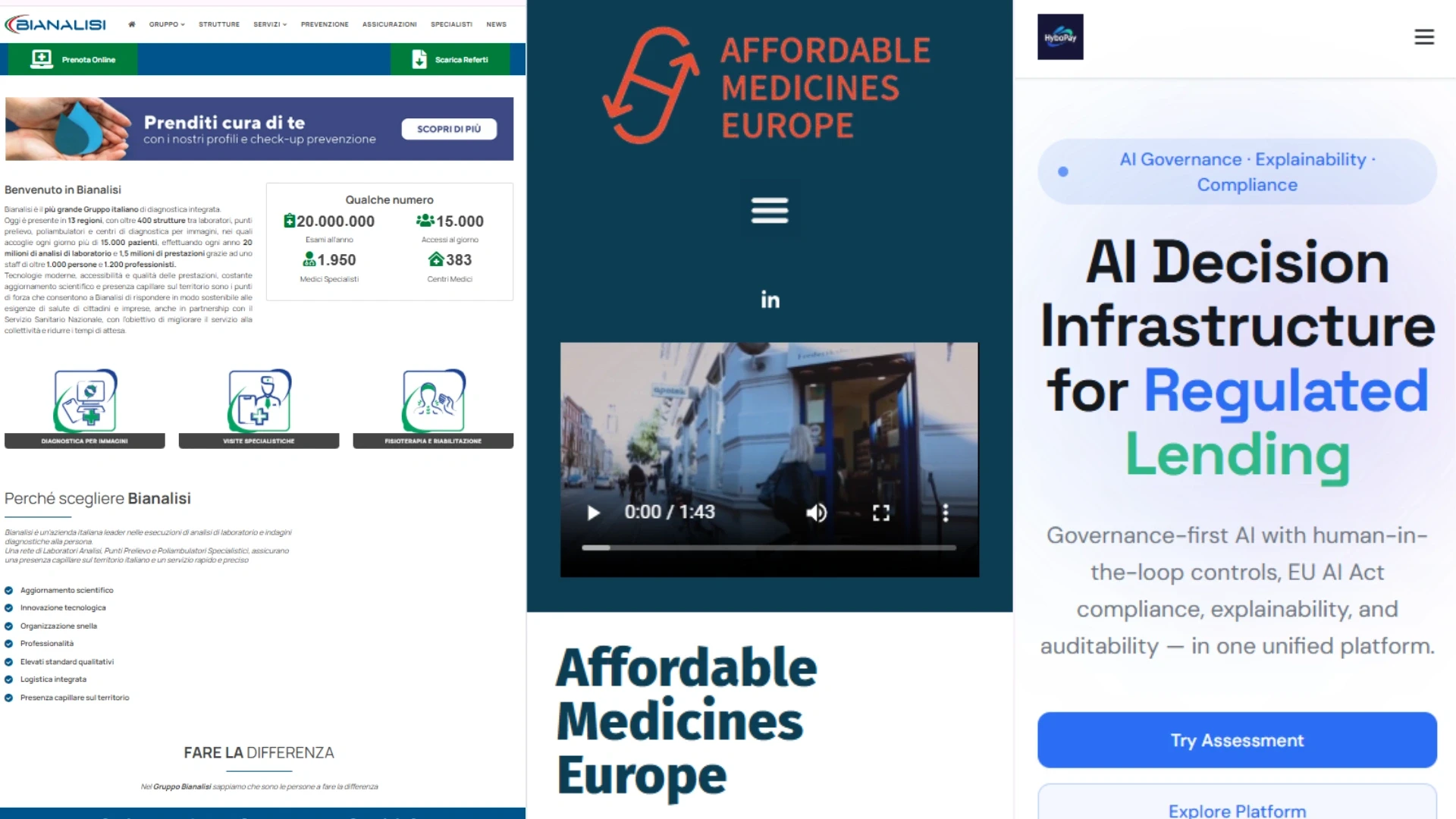
BIANALISI SPA, Italy: Clinical Analytics Platform
Client: BIANALISI SPA, Italy's largest integrated diagnostics group, 1,001 to 5,000 employees
Project: Cross-facility clinical data analysis and predictive health intelligence platform connecting lab, imaging, and outpatient data across regional facilities
Technology: Python (pandas, scikit-learn, FastAPI), PostgreSQL, React.js, European-compliant cloud infrastructure
Duration: April to November 2025: 7 months. All milestones on schedule despite mid-project regulatory scope changes.
Clutch Rating: 5.0 out of 5.0 across Overall, Quality, Schedule, and Cost | Verified: February 22, 2026
Affordable Medicines Europe: Pharmaceutical Regulatory Compliance Platform
Client: Affordable Medicines Europe — pharmaceutical parallel importer association representing 120 or more companies in 23 EU/EEA countries
Project: Secure regulatory compliance and member data platform with fine-grained RBAC, secure APIs, and complete audit trail for pharmaceutical regulatory compliance
Technology: Laravel backend with Spatie Permission for multi-role RBAC, secure RESTful APIs, React.js frontend, audit trail for all sensitive operations
Clutch Verified: Yes, publicly verifiable at clutch.co/profile/acquaint-softtech-private
Custom end-to-end HealthTech product development services: discovery to App Store.
Acquaint Softtech delivers the complete journey: discovery workshop, compliance scoping, HIPAA architecture, MVP build, clinical testing, App Store submission, and post-launch support. $25 to $49/hour, Clutch-verified. 50 or more reviews. 95 percent on-time sprint delivery.
End-to-End HealthTech Development Cost in 2026
End-to-end healthtech product development cost in 2026 is determined by product type, compliance requirements, and platform target. The following ranges are drawn from Acquaint Softtech's project portfolio.
HealthTech Product Type | Cost (USD / EUR) | Timeline |
Simple wellness/engagement app | $40K–$80K (€37K–€74K) | 3–5 months |
Mid-tier (telemedicine, mental health, RPM MVP) | $80K–$200K (€74K–€185K) | 5–9 months |
Complex platforms (HMS, LIS, claims, teletherapy) | $200K–$500K (€185K–€460K) | 9–18 months |
Enterprise / AI HealthTech | $400K–$1M+ (€370K–€920K+) | 14–24 months |
FDA SaMD / Digital Therapeutics | $500K–$1.5M+ (€460K–€1.4M+) | 18–36 months |
Why Acquaint Softtech delivers at 40 percent lower cost than US agencies
Hourly rate: $25 to $49 per hour (Clutch-verified), versus $120 to $200 per hour for US agencies and $40 to $80 per hour for Eastern European agencies.
70 or more in-house engineers across all required specialisms, no outsourcing or subcontracting. One contract, one team, one accountability chain.
HIPAA compliance knowledge included in every healthcare engagement, no additional compliance consultant required. HIPAA-eligible AWS infrastructure deployed as standard in sprint one.
13 or more years of healthcare domain experience, no onboarding time lost to healthcare-specific learning. Clinical UX patterns, FHIR integration, and compliance documentation are institutional knowledge, not research tasks.
Official Laravel Partner status for backend development. Dedicated React Native team for cross-platform mobile. Python AI/ML team for data engineering and clinical AI. Full-stack coverage from a single partner.
For US-based clients, outsourcing HealthTech development to Acquaint Softtech at $25 to $49 per hour reduces a typical 6-month MVP engagement cost from $250,000 to $400,000 (US agency rates) to $130,000 to $220,000, without reducing compliance rigour, clinical domain expertise, or delivery accountability. Explore flexible engagement models including software development outsourcing and dedicated team engagements.
End-to-end HealthTech product development services India: HIPAA-compliant, from idea to App Store.
Acquaint Softtech takes HealthTech products from discovery through App Store launch: compliance scoping, HIPAA architecture, MVP build, clinical testing, and post-launch support. 4.9/5, 50 or more Clutch reviews. Premier Verified. 1,300 or more projects in 13 or more years.
Frequently Asked Questions
-
How accurate is HealthTech development in cost and timeline?
It is 95% accurate when compliance and scope are defined during discovery. Most overruns happen due to late EHR integration or compliance changes. Early planning ensures predictable delivery. This is why discovery phase alignment is critical before development starts.
-
How much does HealthTech product development cost?
Costs range from $40,000 to $1,500,000+ depending on complexity. MVPs start at $40K–$80K, mid-tier platforms $80K–$200K, and enterprise AI or FDA SaMD solutions go above $400K. Final cost depends heavily on integrations and compliance needs. India-based teams can significantly reduce total budget.
-
What data is needed before building a HealthTech product?
You need validated user problems, regulatory classification, buyer mapping, MVP feature list from clinical interviews, and integration feasibility (EHR/wearables/payers). Without this, scope errors are likely. This data ensures product-market fit before coding begins. It also reduces rework during later development stages.
-
Can HealthTech products replace doctors or clinicians?
No. They only support and assist clinical decision-making. Any AI system providing diagnosis or treatment suggestions requires FDA SaMD approval and human oversight. These tools are designed to augment, not replace, clinical expertise. Regulatory frameworks strictly enforce this boundary.
-
How long does it take to build a HealthTech product?
It takes 3 to 18 months depending on complexity. MVP apps take 3–5 months, telehealth 5–9 months, and enterprise systems with integrations take 9–18 months. Compliance testing and approvals extend timelines further. App Store and security reviews also add extra time.
-
What is a HealthTech discovery workshop?
It is a 2-week structured planning phase that defines scope, regulatory path, MVP features, and technical feasibility before development starts. It prevents costly rework later. It also aligns clinical and technical stakeholders early. This step improves overall project success rate.
-
What is the best development model for HealthTech products?
An outsourced HIPAA-experienced agency is best for MVPs. It costs $130K–$250K vs $422K–$632K for in-house teams. Freelancers are not recommended for compliance-heavy systems. Agencies also provide faster scaling and delivery consistency.
-
Why is outsourcing HealthTech development cost-effective?
Outsourcing to India-based HIPAA teams at $25–$49/hour reduces cost by up to 40% while maintaining compliance and delivery quality. It also reduces hiring and infrastructure overhead. This makes it ideal for startups and early-stage founders.
-
What increases HealthTech development cost the most?
The biggest cost drivers are HIPAA compliance, EHR integrations, AI features, FDA requirements, and data security infrastructure. Late-stage requirement changes also significantly increase costs. Proper planning reduces budget overruns.
-
Why choose Acquaint Softtech for HealthTech development?
It offers end-to-end development with HIPAA built-in, 13+ years of experience, 70+ engineers, Laravel partnership, and 95% on-time delivery at $25–$49/hour. It supports full-cycle development from discovery to App Store launch. This reduces coordination risk and improves delivery speed.
We’re Acquaint Softtech, your technology growth partner. Whether you're building a SaaS product, modernizing enterprise software, or hiring vetted remote developers, we’re built for flexibility and speed. Our official partnerships with Laravel, Statamic, and Bagisto reflect our commitment to excellence, not limitation. We work across stacks, time zones, and industries to bring your tech vision to life.
Table of Contents
Get Started with Acquaint Softtech
- 13+ Years Delivering Software Excellence
- 1300+ Projects Delivered With Precision
- Official Laravel & Laravel News Partner
- Official Statamic Partner
Related Blog
The Complete Guide to Healthcare Software Development in 2026
Healthcare software development in 2026 is not a single discipline. It is six distinct product categories, each with its own compliance perimeter, integration burden, and cost curve.
Acquaint Softtech
May 1, 2026.webp "Embedded Insurance Platform Development: APIs, Partner Integrations, and Contextual Offers")
Embedded Insurance Platform Development: APIs, Partner Integrations, and Contextual Offers
Embedded insurance platform development is the process of building software that enables non-insurance brands to offer coverage at checkout or in their apps via APIs. It has three layers: a contextual offer engine that decides what to show and when, a partner-facing integration layer of quote and bind APIs, and a carrier layer that handles underwriting, policy, and claims.

Manish Patel
June 16, 2026
How to Validate Your HealthTech Idea Before Writing a Single Line of Code
Validating a HealthTech startup idea before development helps reduce risk, confirm market demand, and ensure regulatory readiness. A structured validation process allows you to refine your MVP and avoid costly mistakes later.

Chirag Daxini
July 1, 2026India (Head Office)
203/204, Shapath-II, Near Silver Leaf Hotel, Opp. Rajpath Club, SG Highway, Ahmedabad-380054, Gujarat
USA
7838 Camino Cielo St, Highland, CA 92346
UK
The Powerhouse, 21 Woodthorpe Road, Ashford, England, TW15 2RP
New Zealand
42 Exler Place, Avondale, Auckland 0600, New Zealand
Canada
141 Skyview Bay NE , Calgary, Alberta, T3N 2K6