

The Definitive 2026 Guide To Hiring Remote Developers In The AI Era
What is the best way to hire remote developers in 2026? This article explains how using a structured AI-driven vetting process can make all the difference.

Manish Patel
Introduction
In 2026, hiring developers feels less like recruitment and more like assembling an Avengers team, except your superheroes work from four different time zones.
All businesses know the talent war is over, artificial intelligence won. Now, a new imperative defines C-suite success: companies must hire the strategists who command the machines, not the entry-level staff who simply operate the tools.
Picture this: It's 2026 in the USA. Your CEO coffee chat turns into a brainstorming blitz. You sketch an app on a napkin. By lunch, an AI sketches the code. By dinner, a remote developer in India polishes it to perfection. Zero jet lag and no office politics, just pure, pixel-perfect progress. Sounds like a dream?
It's the new normal, and if you're not hiring remote developers in the AI era, you're basically running your tech stack on a flip phone.
Let me open this guide with an observation I’ve repeated in boardrooms more times than I can count: “Talent is global. Opportunity is not.” And the companies that bridge this gap will win the next decade. This is the ultimate guide to hiring remote developers in 2026.
How AI is Transforming Remote Developer Hiring in 2026
AI isn't just assisting; it's transforming. In 2026, platforms like LinkedIn's AI recruiters match candidates in seconds, predicting fit with 85% accuracy. For CEOs, this means faster, fairer hiring. But don't outsource your judgment. AI flags biases, but you decide.
AI is like that brilliant intern who codes faster than you can say 'coffee break,' but remember, the CEO still calls the shots. The AI era hit warp speed in 2025 and will be testing the limits in 2026.
AI doesn't just code; it predicts bugs, suggests architectures, and even writes tests. GitHub reports devs using AI tools ship 55% faster. But here's the kicker: It creates jobs, not kills them.
Morgan Stanley forecasts AI will grow software developers' roles by 20% through 2027, as humans handle the "why" behind the "what." Remote work rides this wave.
The revenue for the AI development tool software market is expected to rise to USD 9.76 billion in 2025. Besides which, the global AI in the software development market is expected to rise to USD 15,704.8 million by 2033.
Businesses prefer to outsource and hire remote developers where cost efficiency is not the only reason. The need to integrate AI and other advanced technologies plays a big part in this decision besides other reasons.
Hence, the obvious question most businesses might be asking is, how to hire remote developers in the AI era? The following sections help address this concern.
Outsourcing to an Agency

When the stakes are high, trusting your entire product roadmap to individual remote freelancers is like building a skyscraper with random bricks; you might get a structure, but you definitely won’t sleep well under it. Your product can scale only when your talent strategy does.
That’s why software outsourcing continues to outpace both in-house hiring and solo contractors. The global IT outsourcing market is expected to hit USD 588.38 billion by 2025, and the trend isn’t slowing.
CEOs see the writing on the wall: hiring individual developers feels cheap upfront but becomes a long-term liability the moment something breaks. A freelancer solves a task, but an agency takes responsibility.
Hiring individuals means your team handles screening, technical tests, onboarding, training, monitoring, replacements, and most importantly, accountability. If even one link in this chain fails, your deadlines slip, your budget stretches, user experience suffers, and customer trust takes the hit.
It’s like hiring a single lifeguard for an entire coastline. Sure, it’s cheaper. But is it smart?
Outsourcing to a reputable agency, on the other hand, isn’t a cost, it’s a strategic transfer of risk. You hand over the engineering responsibility to experts who’ve already built the processes, the teams, and the structure you would otherwise spend years building internally.
That’s why the smartest companies in 2026 aren’t just “hiring remote developers.” They’re partnering with remote development agencies like Acquaint Softtech. With us, you don’t get one developer; you get an entire engineering machine ready to scale, adapt, and deliver. There are several other benefits as explained in the following sections.
Agencies Offer a More Reliable and Scalable Model:
Outsourcing to a software development company removes the biggest weakness of freelance hiring: individual dependency.
An agency gives you a fully staffed ecosystem, developers, project managers, QA teams, DevOps engineers, tech leads, and escalation layers. If someone becomes unavailable, the agency replaces them instantly.
There are no delays, no drama, and no “sorry for the inconvenience” emails. That’s continuity and reliability freelancers simply can’t guarantee. One of our clients once joked:
“Working with an agency is like having a spare engine mid-flight. Working with freelancers is hoping the one engine you have doesn’t burst into flames.”
They weren’t wrong. At Acquaint Softtech, we use a multi-layered delivery model:
Developers follow structured Git workflows
Every ticket goes through code reviews
AI-assisted quality checks catch hidden issues
Automated testing pipelines guard against regression
Project leads and managers ensure smooth communication
Escalation layers keep delivery unblocked
This means you get consistent performance, no matter who writes the code. That’s the power of a professional engineering partner, not just a hired individual. Agencies like ours offer predictability, scalability, and round-the-clock reliability.
This is something that individual hiring can’t match, no matter how talented the freelancer is. In 2026, outsourcing isn’t Plan B. It’s the smartest path for companies that want speed, stability, and a team that always has their back.
Mitigation of Legal and Compliance Risk:
The global shift toward flexible work has elevated legal and tax risks for the contracting organization, particularly regarding worker misclassification.
Navigating Global Law: A dedicated software development company simplifies compliance. They act as the legally compliant service provider, managing all local HR requirements, taxes, and potential liabilities, often facilitated through mechanisms similar to a Contractor of Record (CoR) or Employer of Record (EOR) service.
Protecting IP and Data Security: AI projects involve sensitive training data and core IP. A mature outsourcing partner ensures data privacy through encryption, strict access controls, and regular security audits. They establish robust IP protection protocols, mitigating software outsourcing risks with rigorous oversight.
For high-risk AI data projects, the agency model functions as a necessary risk transfer mechanism.
Proven Scalability and Financial Prudence:
Strategic outsourcing provides the fastest, most reliable path to scaling high-performance technical teams.
Here are a few case studies of large firms that chose to outsource over hiring in-house developers and made the wise decision to hire remote developers from Acquiant Softtech:
Tryko Technologies Case Study: Tryko scaled from one developer to 14 dedicated professionals for a major app development project, saving over $300,000 compared to in-house development.
SuperFi Finance Case Study: Secured a full, managed team structure (4 developers, QA, DevOps, and PM) to build a comprehensive fintech solution, saving over $60,000 on annual hiring costs.
Strategic outsourcing allows the CEO to focus internal teams entirely on defining the strategy (the how), studying the market opportunity, and creating the product vision. The outsourcing partner specializes in security and scalability, delivering (the how) the execution, engineering, and compliance management.
Statistics and Facts:
Here are a few statistics that are hard to overlook:
92% of G2000 firms prefer to outsource their software requirements.
68% of US companies outsource to low-cost countries.
India ranks top when it comes to IT and software development outsourcing.
40% of US multinational companies outsource software development to firms in countries like India, China, and the Philippines. (According to Deloitte’s study)
59% of businesses outsource to cut costs, and 26% of small businesses outsource to get help from an expert.
65% of organizations outsource to enable focus on their core business, while 33% do it for greater global scalability and critical business needs. (Deloitte)
28% to enhance service quality and 16% to help meet regulatory needs. (Deloitte)
In the AI era, this shines brighter. Our team at Acquaint Softtech wields tools like Copilot, boosting output 55%. No training wheels needed; we bring battle-tested AI pros.
Outsourcing developers is like Uber for code reliable rides, no parking wars. Outsourcing is the ultimate talent shortcut: You skip the 18-month hiring cycle and jump straight to the MLOps architect. The table below explains why businesses should outsource to a software development company:
Benefit | Stat/Fact | Why It Matters for CEOs |
Cost Savings | Up to 70% labor reduction | Frees budget for growth, not HR drama. |
Speed to Market | 30% faster delivery | Beat competitors to AI-first launches |
Talent Access | Global pool—24/7 op. | No more “talent desert” woes |
Risk Migration | Built-in QA compliance | Sleep easy; we handle the headaches. |
Scalability | Ramp up/down on demand | Flex with market shifts, no layoffs. |
Stop struggling to find niche expertise and manage high turnover.
A dedicated software company provides an entire, stable team of vetted specialists. Gain instant access to cutting-edge skills and guaranteed project continuity. Future-proof your development—partner with Acquaint Softtech for guaranteed expertise and delivery.
The New Developer DNA - Core Skills
The definition of a “great developer” has changed dramatically in the last few years. In the pre-AI era, companies evaluated developers almost entirely based on their programming proficiency, problem-solving abilities, and familiarity with a tech stack.
Those criteria still matter, but in 2026, they no longer differentiate top talent from average talent. Artificial intelligence has reshaped the software development landscape so thoroughly that developers must now combine traditional engineering competence with advanced AI-assisted capabilities, automation thinking, cross-discipline awareness, and an exceptional level of self-management.
As someone who works closely with remote development teams across continents, I can confidently say that the developers who thrive in distributed environments share a very specific set of skills.
This “New Developer DNA” is not theoretical; it is built on practical traits that consistently lead to higher-quality output, faster delivery, and frictionless collaboration in global projects.
CEOs who understand these traits are far better equipped to hire remote developers who will remain relevant and productive through 2026 and beyond.
The Technical Core - MLOps and Data Literacy:
The developer of 2026 acts as an engineer focused on long-term architecture and scalability. Developers must achieve fluency in MLOps (Machine Learning Operations).
MLOps is the vital engineering discipline that merges machine learning practices with DevOps methodologies, allowing for crucial functions like model versioning, continuous integration, and continuous monitoring for data drift.
Developers capable of operationalizing AI and implementing MLOps to bridge theory and business impact will become the most valuable technical assets. Mastery of Python, data science principles, and machine learning models serves as the necessary technical backbone.
AI-Assisted Engineering and Automation Fluency:
The most successful developers in 2026 don’t see AI as a separate tool; they treat it as a foundational layer in their workflow. They use AI copilots to accelerate development, automate repetitive tasks, reduce debugging time, and explore architecture options.
These developers understand how to prompt AI effectively, validate AI-generated code, and integrate AI-assisted decisions into human-driven logic. According to GitHub’s 2025 Copilot Impact Study, developers using AI assistance complete tasks up to 55% faster and report a 40% decrease in cognitive load, allowing them to focus more on creative, high-level engineering.
For CEOs, this matters immensely. A developer who knows how to use AI correctly can achieve what previously required two or three team members. When you hire talent through Acquaint Softtech, this AI competency is non-negotiable.
We train our developers rigorously to ensure they understand not only how to use AI tools but also how to maintain code quality, security, and architectural integrity while doing so.
Deep Understanding of Modern Frameworks and Architectures:
While AI becomes a powerful accelerator, strong technical foundations remain essential. In 2026, companies increasingly rely on advanced frameworks like Laravel 12, Node.js, Next.js, NestJS, Flutter, React Native, and AI-ready cloud platforms.
Remote developers must be capable of building scalable, modular, cloud-native systems that can evolve quickly. Familiarity with microservices, serverless architecture, containerization, CI/CD pipelines, and API-driven ecosystems is no longer optional.
The best remote developers combine framework mastery with architectural thinking. They know how to design systems that can handle real-world loads, not just pass coding interviews. CEOs benefit greatly from this, because it reduces long-term technical debt.
Thus, businesses can benefit from hiring remote developers from Acquaint Softtech. We have over 15 years of experience in working on over 40 technologies. Besides which, we have a dedicated team of developers for Laravel, React, and Node.js more.
Additionally, we are also a Laravel partner, having delivered over 100 top-notch Laravel solutions globally.
Mandatory Fluency - AI Ethics and Governance:
Knowledge of AI ethics, security, and responsible implementation is mandatory. Executives must ensure their partners treat AI fluency as a company-wide operational standard.
This includes understanding and mitigating:
Algorithmic bias and fairness in outputs.
Data governance and privacy concerns.
The ethical risks of deepfakes and automated phishing attacks.
Security-First Thinking and Responsible Coding Practice:
Security in 2026 isn’t a “nice to have.” It’s the oxygen your product breathes. Any developer you hire must write secure code from day one, no warm-up laps.
Whether they’re building authentication flows, API endpoints, database queries, or complex data pipelines, they must understand vulnerabilities, encryption, access control, validation rules, and compliance expectations.
Cyberattacks aren’t slowing down either. Check Point’s Security Insights reported a 38% rise in global ransomware attacks in 2025. This is a reminder that threats don’t knock; they kick the door down.
In software, shortcuts become long-term regrets. Secure code is the only code worth shipping.
Remote developers also operate in environments spread across devices, locations, and networks. That means one careless decision, like a weak SSH password or an unpatched dependency, can expose your entire system. Teams serious about isolating that risk go a step further - routing remote developer traffic through private proxies that keep production access, staging endpoints, and internal API calls off the open internet, so a single compromised laptop doesn't turn into a full-system breach.
Cultural Alignment and Professional Integrity:
Technical skills get work done. Cultural alignment makes teams unstoppable. A remote developer must match your work ethic, communication rhythm, confidentiality expectations, and overall professionalism.
You don’t want brilliance dripping with ego or talent that disappears when deadlines approach. A team succeeds only when everyone agrees on the same rules of engagement. Values matter.
Consistency matters. Showing up every day with ownership and discipline matters. With an increase in the use of AI, it is also important to follow the ethical AI practices.
And here’s where agencies beat freelancers nine times out of ten. Agencies pre-screen developers not only for skills but also for behavior, reliability, communication style, and cultural fit.
You don’t have to worry about developers ghosting mid-sprint or vanishing during production crunch week. Skill builds the software. The character keeps it running. That’s why long-term clients stay with us; we don’t just hire coders; we hire people who uphold the culture we promise.
The Strategic Vetting Framework for AI-Era Partners:
CEOs must insist their partners vet remote talent far beyond basic technical syntax testing. The focus must shift to assessing ethical application and complex problem-solving abilities. A strategic outsourcing partner who maintains a continuously up-to-date, AI-fluent talent pool absorbs the client’s expensive and critical AI upskilling risk.
This allows the client to leapfrog competitors by accessing certified MLOps and ethical talent immediately.
Skill Domain | Relevance in AI Era (2026) | Acquaint Softtech Vetting Focus |
AI Fluency/MLOps | Deploying and maintaining secure AI models in production; bridging theory to business impact. | Experience with MLOps pipelines, custom ML/GPT integration, and cloud deployment. |
Critical Thinking | Oversight of AI-generated code, ensuring reliability, security, and long-term architecture. | Scenario-based problem-solving questions. Code review of simulated AI output. |
Ethics & Compliance | Understanding algorithmic bias, data privacy, and regulatory frameworks (e.g., EU AI Act). | Training in ethical AI design, data governance experience, and knowledge of concepts like transparency and accountability. |
Communication/Collaboration | Functioning as the "translator" between technical teams, AI agents, and business stakeholders. | Assessing writing clarity, cross-cultural empathy, and documentation skills. |
Metrics That Matter – Track, Tweak, Triumph
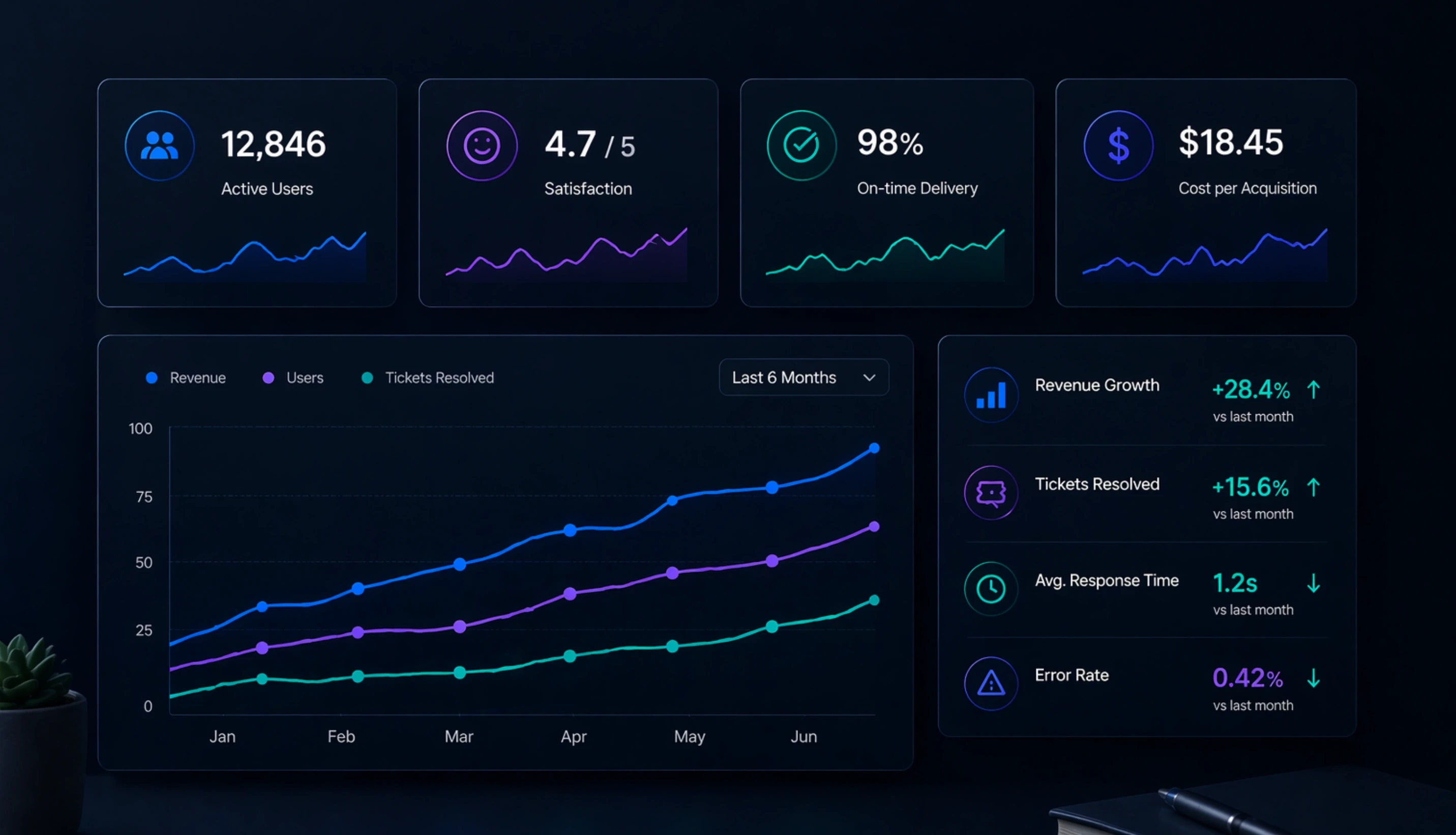
One of the biggest mistakes CEOs make when managing remote developers is relying on the wrong metrics. They measure hours instead of outcomes, activity instead of impact, and task completion instead of long-term value.
In 2026, when AI-assisted tools and distributed teams have become the norm, traditional metrics simply do not reflect the true performance of a remote engineering team. To build a high-performing tech engine, you must evaluate developers based on measurable indicators that correlate with business growth, product stability, and delivery predictability.
Success isn't vibes; it's velocity. Measure remote developers right, or fly blind. As CTO, I spend a significant portion of my time analyzing performance data across teams, projects, and product lines. The insights we extract help us optimize velocity, maintain quality, and ensure that every hour spent by a developer contributes to forward momentum.
Below are the metrics that truly matter in the AI-driven remote work era, metrics that reveal not just what developers do but how effectively they contribute to business outcomes.
Core KPIs:
Flow Metrics: Velocity (tasks/week), efficiency (wait vs. work time). Aim: 80% efficiency.
Quality: Bug rates post-deploy. Target <5%.
Collab: Response times, NPS from peers. Remote? Track async contribs.
Business Impact: ROI, features shipped vs. revenue lift.
Common tools for this include Jira for flows and GitHub for commits. Ensure quarterly reviews.
Why CEOs Must Track These Metrics:
When CEOs evaluate remote development teams using these performance indicators, they gain a deeper, more accurate understanding of progress, risks, and opportunities. These metrics create transparency, reduce guesswork, and ensure accountability across distributed environments.
They also allow leadership to intervene quickly when issues arise, instead of discovering problems weeks later when deadlines have already slipped. A software outsourcing company like Acquaint Softtech builds these metrics directly into their operational fabric.
This is one of the biggest advantages of working with an agency rather than hiring independent developers. You don’t need to set up systems, train teams, or create frameworks; you simply get measurable, consistent engineering performance from day one.
Businesses can benefit a great deal by hiring remote developers from firms that implement metrics to track their software development project.
Mastering the Total Cost of Ownership (TCO)
Businesses must calculate the true total cost of ownership (TCO) for technical talent, moving beyond the simple comparison of geographic wages.
One of the most misunderstood aspects of hiring remote developers, whether individually or through an outsourcing partner, is the total cost of ownership. Most CEOs initially evaluate developers through a narrow lens: the hourly rate or monthly salary.
While this number is easy to compare, it rarely represents the real financial impact of bringing someone onto your team. In 2026, when products evolve rapidly, when user expectations shift overnight, and when AI accelerates both development and competition, understanding TCO becomes a strategic necessity rather than a finance exercise.
Total cost of ownership is the full picture that allows CEOs to make confident, long-term decisions. Here is the breakdown of the components of TCO in more detail:
Cost to Hire Remote Developers:
The most obvious cost is the developer’s salary or hourly rate or the cost to outsource the project to a software development company. Businesses that hire remote developers from a well-established firm like Acquaint Softtech do not need to worry about additional overheads.
Developers come trained, onboarded into a delivery pipeline, equipped with necessary tools, and aligned with best practices. Remote developers aren’t the future; AI has made them the competitive advantage of today.
Quality Issues Multiply Costs Through Rework and Technical Debt:
Remote developers who lack oversight or architectural guidance often create this hidden debt. Their lack of experience and ability to manage the project often results in scope creep and eventually budget overruns. This can increase the overall cost of the project.
Following bad coding practices increases technical debt, which is very expensive to fix later. However, when you hire from a software development company with a good track record of delivering projects in a timely manner, like Acquaint Softtech, you receive code that is built for scale, tested thoroughly, and reviewed rigorously
This ensures that long-term costs remain predictable rather than escalate unexpectedly. Besides, firms like these always account for unexpected issues and incorporate an alternative strategy to keep the project and budget on track.
Infrastructure, Tools, and Technology Stack Maintenance:
Outsourcing to freelancers often involves investing in special tools and software development, quality checks, and more. However, outsourcing to a professional firm like Acquiant Softtech eliminates the cost for infrastructure, tools, and other technologies.
Recruitment and Replacement Costs Are Often Ignored:
Hiring a freelancer will save costs upfront; however, in the case of a dispute, you will not hear from them again. This equates to project downtime and additional cost to replace the developer.
On the other hand, trusting a software agency like Acquaint Softtech eliminates any such additional cost.
Security, Compliance, and NDA Enforcement Carry Their Own Costs:
Agencies with established processes already operate within security-first frameworks. For example, at Acquaint Softtech, every developer adheres to strict NDA protocols, works within secure cloud environments, follows clear access controls, and abides by organizational compliance standards.
This reduces legal exposure and strengthens data protection without requiring you to invest in additional security layers. On the contrary, dealing with freelancers can increase the cost of legal compliance and security. Besides which, it can also result in loss of sensitive data.
Productivity Loss and Delays:
Outsourcing agencies minimize these losses through structured project planning, clear communication protocols, sprint-based tracking, and continuous oversight. A predictable workflow translates into predictable financial outcomes, and this stability is exactly what CEOs need when navigating competitive markets.
Maintenance & Updates:
With the rapid changes in technology that are not stagnant, one needs to account for the need to upgrade and maintain the project. Hence, the cost for crucial security updates, modifying features, and adding a new one also adds to the total cost of ownership.
Businesses that outsource to a software development outsourcing firm like Acquaint Softtech will be at an advantage when it comes to maintenance. We ensure seamless updates and simplify the process of incorporating new features. This is possible since all our projects are documented, and the development team will have knowledge of the project.
On the other hand, for the firm that chooses to hire a freelancer, maintenance can be quite expensive since it is often hard to get hold of them after completion of a project.
Why Outsourcing Delivers a Lower TCO in 2026:
When CEOs consider the full spectrum of expenses, not just salaries, outsourcing emerges as the most cost-efficient approach. The combination of trained developers, established systems, integrated tools, guaranteed replacements, and quality-driven delivery significantly reduces long-term costs.
Acquaint Softtech has spent years refining this model to ensure clients receive high performance at a fraction of the operational cost of building internal teams. By partnering with an agency, you avoid costly surprises, eliminate inefficiencies, and gain a stable engineering engine that supports growth without straining budgets.
In a business environment where speed, quality, and adaptability determine success, mastering the Total Cost of Ownership gives CEOs a powerful strategic advantage.
Smart companies in 2026 rely on global talent!
Outsourcing is the strategic choice that guarantees high-quality, pre-vetted teams on demand, boosting velocity and efficiency. Make the intelligent shift: Talk to our team at Acquaqint Softtech about cost-effective, high-performance outsourcing.
Facing the Challenges
Hiring remote teams isn't a walk in the park. CEOs face isolation, communication gaps, and security risks. AI helps (think encrypted tools), but human elements persist.
Outsourcing to a professional software outsourcing company helps mitigate this. As someone who has managed several projects outsourced by many types of businesses globally, I know that challenges are not obstacles; they are indicators of what needs structure, clarity, and stronger systems.
The good news is that every challenge has a solution, and most of those solutions become significantly easier when you work with a structured outsourcing partner like Acquaint Softtech.
This section helps businesses see the full picture. It showcases the benefits and also the realities to prepare and operate effectively in 2026 and beyond:
Communication gaps can derail progress when expectations are not crystal clear:
Solution: Formalize communication rhythms from day one and document thoroughly. Always establish centralized communication channels, and avoid relying on assumptions.
Time Zone differences can become a strength or a weakness depending on the workflow:
Solution: Ensure every developer follows a predictable overlap schedule with the client’s timezone. This guarantees real-time collaboration when needed and uninterrupted productivity during independent tasks. When CEOs plan workflows deliberately, time zones stop being a hurdle and evolve into a competitive advantage.
And yes, it also snacks on poorly matched remote teams.
Cultural Misalignment - When cultures clash, collaboration suffers and decisions slow down
Solution: Top outsourcing firms screen for cultural fit as seriously as they test for technical skills. The right partner removes friction and helps teams click from Day 1.
Security Risks in Remote Setups: A remote laptop without guardrails is a security breach waiting to happen
Solution: Enforce VPN-only access, encrypted channels, role-based permissions, and NDAs. Partner with an agency that already runs secure repositories, tiered access, and compliance-grade processes. In short: treat security like oxygen, not an optional extra. (IBM reports the average cost of a data breach crossed $4.45M in 2023.)
Productivity Without Micromanagement - A task list doesn’t guarantee progress-just activity
Solution: A professional software outsourcing company will use AI-powered code analytics, sprint tracking, and PM oversight. This keeps work visible and predictable without CEOs turning into babysitters. Measure output, not mouse movement.
Talent Replacement & Continuity - If a freelancer disappears, your timeline collapses with them
Solution: When you hire through a reliable software company, replacements plug in instantly; they already know the stack, structure, and sprint plan. Continuity becomes the rule, not the exception.
Scaling Without Chaos - Scaling with freelancers is like building a skyscraper with a single hammer.
Solution: Agencies maintain bench strength across developers, QA, DevOps, and UI/UX. You scale when you want—not when the market feels generous.
Staying Aligned With Business Goals
Solution: Outsource to a structured firm. PMs and tech leads maintain context, share updates, and align every sprint with business priorities. No more miscommunication or roadmaps drifting off-course. This beats working with a distracted freelancer juggling 5 clients.
Long-Term Stability - Freelancers may exit anytime. Businesses cannot
Solution: Choose a company with experience, credibility, and proven retention. You get dedicated developers committed for the long haul.
Outdated Skills & Tooling Gaps - Tech evolves weekly. Not every independent developer keeps up
Solution: Established software companies run continuous training on AI copilots, new frameworks, cloud-native practices, and emerging trends. Your project benefits from always-current engineering.
Technical Proficiency Gaps - Writing code isn’t enough. Modern apps require architecture, scalability, and security thinking
Solution: Evaluate holistic capability: architecture, optimization, security, infrastructure, and DevOps. A software outsourcing company will always filter for this.
Don’t be intimidated by these challenges; every model has weaknesses. What matters is how you build around them. Companies winning in 2026 invest in structure, accountability, and partnership—not guesswork.
With a mature partner like Acquaint Softtech, these risks don’t just shrink—they become opportunities to improve engineering discipline, team resilience, and product quality.
Remote work isn’t risky. Unmanaged remote work is. Acquaint Softtech ensures secure environments, consistent communication, and developers trained on the latest AI-driven tools. When you outsource to us, you’re not just hiring talent-you’re hiring a system.
Future Trends: What’s Next in 2026 and Beyond
Remote hiring is evolving at warp speed. AI, automation, ML, and cloud-native development have reshaped what “remote developer” even means. Today’s best teams excel in:
adaptive communication
security-first thinking
AI-assisted coding
async collaboration
cross-cultural fluency
Hire remote developers from seasoned outsourcing partners like Acquaint Softtech. They manage training, evaluation, and QA, so CEOs stay focused on strategy, not putting out fires. Remote developers no longer support players; they’re the backbone of future innovation.
Ready to Build a Future-Proof Engineering Team in 2026?
Gain access to the newest breakthroughs in AI, automation, cloud, and modern tech stacks at Acquaint Softtech. Build faster, innovate smarter, and stay ahead of your competitors
Frequently Asked Questions
-
What’s the biggest advantage of hiring remote developers in 2026?
Access to world-class talent without borders. India, Eastern Europe, LATAM, and Southeast Asia host top engineers skilled in AI, automation, and cloud-native workflows. Remote teams help companies scale faster and cheaper. Acquaint Softtech ensures you get vetted, AI-ready developers out of the box.
-
How has AI changed the hiring process?
AI now screens portfolios, analyzes code, predicts performance, identifies gaps, evaluates consistency, and even checks collaboration habits. It speeds up hiring and reduces risk with data-backed decisions.
-
Freelancer or remote development agency—what’s the better option?
Freelancers are flexible but risky: no backup, inconsistent quality, and limited accountability.
Agencies offer structure, PM oversight, QA layers, DevOps pipelines, and guaranteed continuity. The difference is night and day. -
How do I evaluate remote developers effectively?
Use multi-step evaluation:
practical coding tests
architecture reviews
communication assessment
AI-tool proficiency
asynchronous collaboration ability
Outsourcing partners simplify this through rigorous screening and multi-round evaluations.
-
What is the true Total Cost of Ownership (TCO)?
TCO includes:
onboarding
attrition
training
rework
tools
management time
infrastructure
security
Many CEOs underestimate total cost by 40–70%. Outsourcing greatly reduces TCO because agencies provide trained developers, secure infrastructure, and consistent oversight.
I lead technology and client success at Acquaint Softtech with one goal in mind. Deliver work that feels personal, reliable, and worthy of long term trust. I stay close to both our clients and our developers to make sure every project moves with clarity, quality, and accountability.
Table of Contents
Get Started with Acquaint Softtech
- 13+ Years Delivering Software Excellence
- 1300+ Projects Delivered With Precision
- Official Laravel & Laravel News Partner
- Official Statamic Partner
Related Blog
Hire Remote Developers: The Right Choice for Startup Success
Discover why hiring remote developers or a dedicated remote team is the smartest decision for startups. Learn how to scale quickly, save costs, and access top talent globally.

Acquaint Softtech
September 16, 2025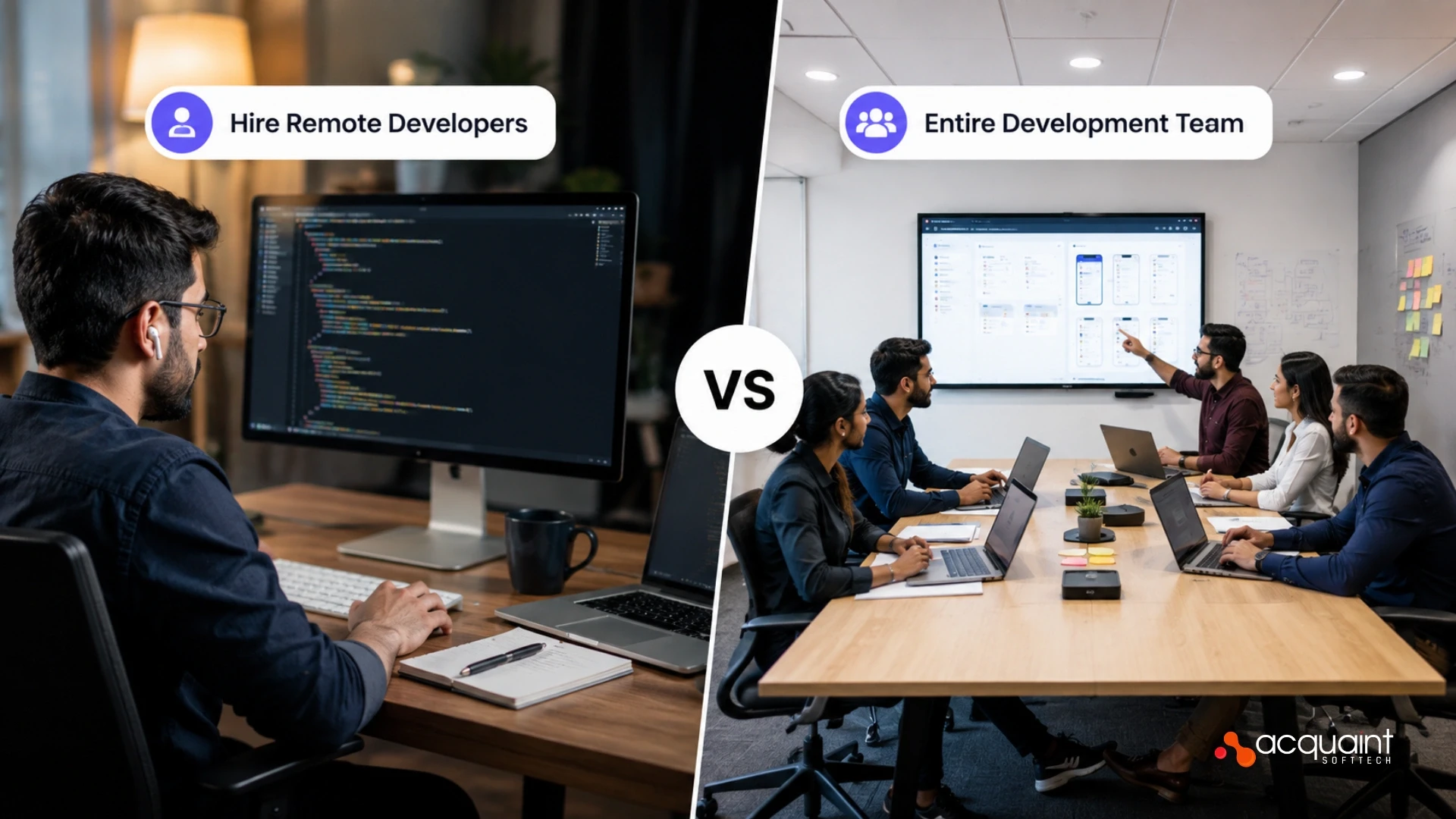
Hire Remote Developers or an Entire Development Team: The Complete Guide
Hiring remote developers means engaging a developer or a dedicated development team from a software company, usually in another country, to build your website or app without setting up an in-house team. It is beneficial because it gives instant access to skilled experts, cuts costs (often up to 60%), speeds time to market, and scales up or down easily.

Mukesh Ram
February 22, 2023
Best Practices for Hiring Dedicated Remote Developers in 2026
Hiring remote developers in 2026? Get our ultimate guide on best practices for finding, vetting & integrating dedicated Remote Development teams.
Acquaint Softtech
November 6, 2025India (Head Office)
203/204, Shapath-II, Near Silver Leaf Hotel, Opp. Rajpath Club, SG Highway, Ahmedabad-380054, Gujarat
USA
7838 Camino Cielo St, Highland, CA 92346
UK
The Powerhouse, 21 Woodthorpe Road, Ashford, England, TW15 2RP
New Zealand
42 Exler Place, Avondale, Auckland 0600, New Zealand
Canada
141 Skyview Bay NE , Calgary, Alberta, T3N 2K6
Your Project. Our Expertise. Let’s Connect.
Get in touch with our team to discuss your goals and start your journey with vetted developers in 48 hours.