

How Last Mile Delivery Software Works: Dispatch, Routing, Tracking, and Customer Notifications
Last-mile delivery software is a platform that manages the final leg of the delivery journey from a dispatch hub to the customer's door. It covers four interconnected systems: automated dispatch that assigns orders to the right driver, route optimization that sequences stops for minimum fuel and time, real-time GPS tracking that surfaces live delivery status to dispatchers and customers, and automated notifications that send ETAs, delays, and delivery confirmations across SMS, email, and push.

Manish Patel

- You are a CTO, founder, product owner, or ops director building a delivery management platform.
- You run a 3PL, courier, or e-commerce delivery business.
- Looking for a cost-effective alternative to high Western agency rates.
- Comparing custom-built vs ready-made last-mile delivery software.
- Planning an MVP for a logistics tech startup.
The final mile is where revenue is won or lost;
Last mile delivery is the most expensive leg of the supply chain. The Capgemini Research Institute found that last-mile costs account for up to 53 percent of total shipping costs, and that route optimization reduces per-delivery fuel spend by 20 to 30 percent. A separate 2025 Ryder Last Mile Study found that 96 percent of consumers who had a positive delivery experience said they are more likely to shop with that same retailer again. The technology gap between operators with last-mile delivery software and those without is widening every quarter.
This article draws directly on work delivered by Acquaint Softtech's logistics software development team. With 1,300+ projects across 20+ industries in 13+ years, 70+ in-house engineers, and a 4.9/5 Clutch rating from 50+ verified client reviews, every cost figure, architecture decision, and framework in this article comes from shipped production work, not theory.
The UK government's London Logistics Plan 2026 notes that average London drivers lost 156 hours to excess traffic congestion in 2022. Software-driven route optimization and dynamic re-routing directly address this operational loss. For a complete view of how the last mile fits into the broader logistics technology landscape, the guide to logistics and supply chain software development on the Acquaint Softtech blog covers WMS, TMS, OMS, fleet, and supply chain planning alongside the last mile.
What is last-mile delivery software?
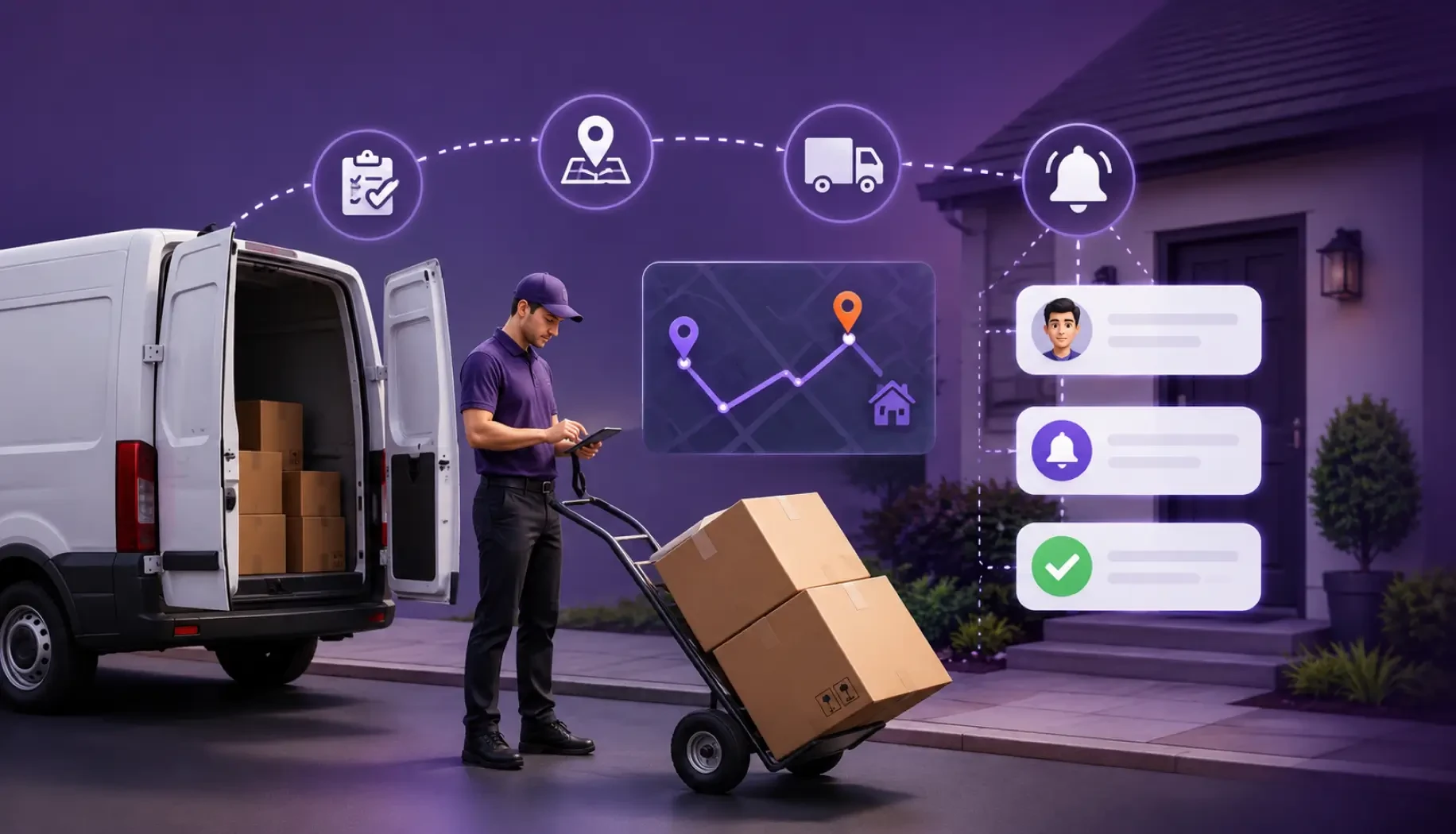
Last-mile delivery software manages the final stage of delivery from a warehouse to the customer by connecting dispatch, route optimization, real-time tracking, and customer notifications. It is the most complex and costly part of the supply chain, where delays or failures directly impact delivery efficiency and customer experience.
Acquaint Softtech's React Native developers build the offline-capable driver apps that power the dispatch and tracking layers. For clients in Europe and the UK, offline-first architecture is non-negotiable: rural routes, loading docks, and underground car parks all create dead zones where a connected-only app fails at the critical moment of delivery.
The four core systems in every last-mile platform
System | What it does | Why it is critical |
Dispatch Management | Receives orders, assigns drivers, manages workload, and shift constraints | Errors here cascade through every downstream step; average 22 min assignment time without automation |
Route Optimization | Sequences multi-stop routes respecting time windows, capacity, and traffic | Reduces fuel cost 20 to 30 percent; increases stops per driver per day by 15 to 25 percent |
Real-Time Tracking | Streams GPS data from the driver app to the dispatcher dashboard and customer tracking page | Expected by 90 percent of consumers as baseline in 2026; no longer optional |
Customer Notifications | Sends ETAs, delay alerts, and delivery confirmations via SMS, push, and email | Reduces inbound customer service calls by up to 60 percent; reduces failed deliveries by 22 percent |
The five bold cluster topics this article connects to directly are: delivery driver auto-assignment algorithm, customer delivery tracking page development, COD management system delivery, delivery slot booking system, and failed delivery management retry logic.
Each is a distinct engineering problem within the last-mile platform, and each is covered in depth in the broader Acquaint Softtech logistics content series and its white-label software development services offerings. The AI layer that sits across all four systems is addressed in Section 08. AI in last-mile delivery is not a standalone product. It is an optimization layer built on top of reliable dispatch data and clean GPS feeds. Without those foundations, no AI model produces useful results.
How dispatch management works
Dispatch management automates delivery order assignment by matching jobs with available drivers based on location and capacity, reducing assignment time from 18 to 22 minutes to under 3 minutes. It also standardizes orders from multiple systems like WMS, TMS, and e-commerce platforms to prevent dispatch errors.
Acquaint Softtech's Laravel developers have built dispatch engines for courier platforms and 3PL operators across the UK, USA, and Australia. Laravel's event-driven queue system suits dispatch workflows where each order state transition, from received through assigned, picked up, in transit, and delivered, triggers downstream actions including driver notifications, customer alerts, and ETA recalculations.
Dispatch logic: how auto-assignment works
Assignment factor | What it checks | Technical implementation |
Driver proximity | Real-time GPS position vs. pickup location | Haversine distance calculation on live GPS feed; nearest available driver selected first |
Vehicle capacity | Current load vs. order weight, volume, and count | Constraint check against order dimensions and driver capacity record before assignment |
Shift availability | Driver's Hours of Service remaining | HOS record updated per completed stop; FMCSA and EU tachograph rules enforced by engine |
Skill and certification | Hazmat, age-restricted, or specialist delivery flags | Order-level tag matched against driver certification record stored in driver profile |
Workload balance | Current active orders per driver | Queue depth comparison across all available drivers; prevents single driver overload |
For platforms serving US carriers, Hours of Service compliance is governed by the FMCSA. For European operations, EC Regulation 561/2006 on tachograph and driving time rules applies. The US Department of Transportation FMCSA publishes current ELD and HOS mandate requirements. Building dispatch logic without mapping against these constraints creates compliance risk from the first day of production.
For operators who need to add an automated dispatch engine to an existing platform, Acquaint Softtech's staff augmentation services place a vetted logistics engineer inside the existing team within 48 hours of a brief. This is the fastest path to shipping a dispatch automation module without a full rebuild cycle.
Route optimization: the engineering core of the last mile
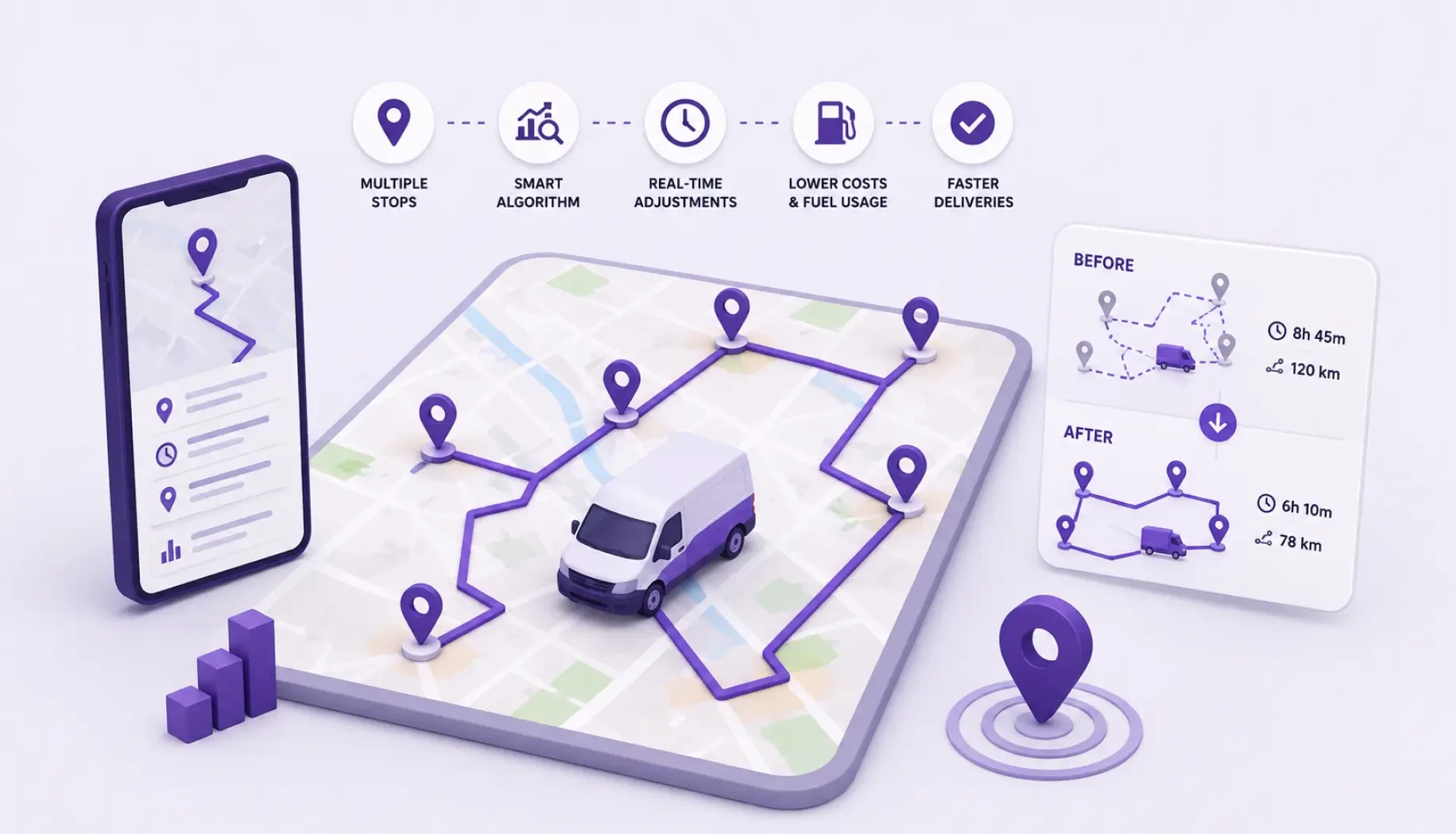
Route optimization arranges delivery stops in the most efficient order based on factors like traffic, delivery windows, vehicle capacity, and driver schedules. It is a core part of last-mile delivery software, helping reduce fuel costs and improve delivery efficiency through advanced algorithms and VRPTW-based optimization models.
Acquaint Softtech's Python developers have built route optimization engines using OR-Tools and custom VRP solvers for delivery platforms serving the UK, Europe, and Australia. For platforms processing above 10,000 daily routes, the team implements ML-based parameter tuning on top of the OR-Tools core to improve solution quality without increasing compute time.
Route optimization inputs and constraints
Input type | Examples | Impact if missing |
Stop coordinates | Customer lat/lng, geocoded from address | Incorrect routing and stops out of sequence from the first run |
Time windows | Deliver between 9 am and 12 pm; business hours only | Failed deliveries, customer complaints, and SLA breaches |
Vehicle capacity | Max weight, volume, and stop count per run | Overloaded routes and compliance violations |
Traffic data | Live congestion from Google Maps, HERE, or Mapbox | Routes built on stale data underperform from the first stop |
Driver shift constraints | Start and end depot, max hours, break requirements | HOS violations, driver burnout, and compliance exposure |
Priority flags | Same-day, time-critical, fragile, hazmat | High-value orders miss windows; safety risks on specialist loads |
For platforms where delivery slot booking is a customer-facing feature, the route engine must incorporate slot constraints as a first-class input, not as a post-processing filter. Teams that add delivery slot booking system logic after the route engine is built consistently discover that the slot constraints require rewriting the constraint model from scratch.
The broader AI and machine learning in logistics article on the Acquaint Softtech blog covers how ML-based route optimizers are trained and deployed in production, including the data volume and quality requirements that must be met before a model outperforms a well-tuned OR-Tools implementation.
Real-time GPS tracking: the data pipeline
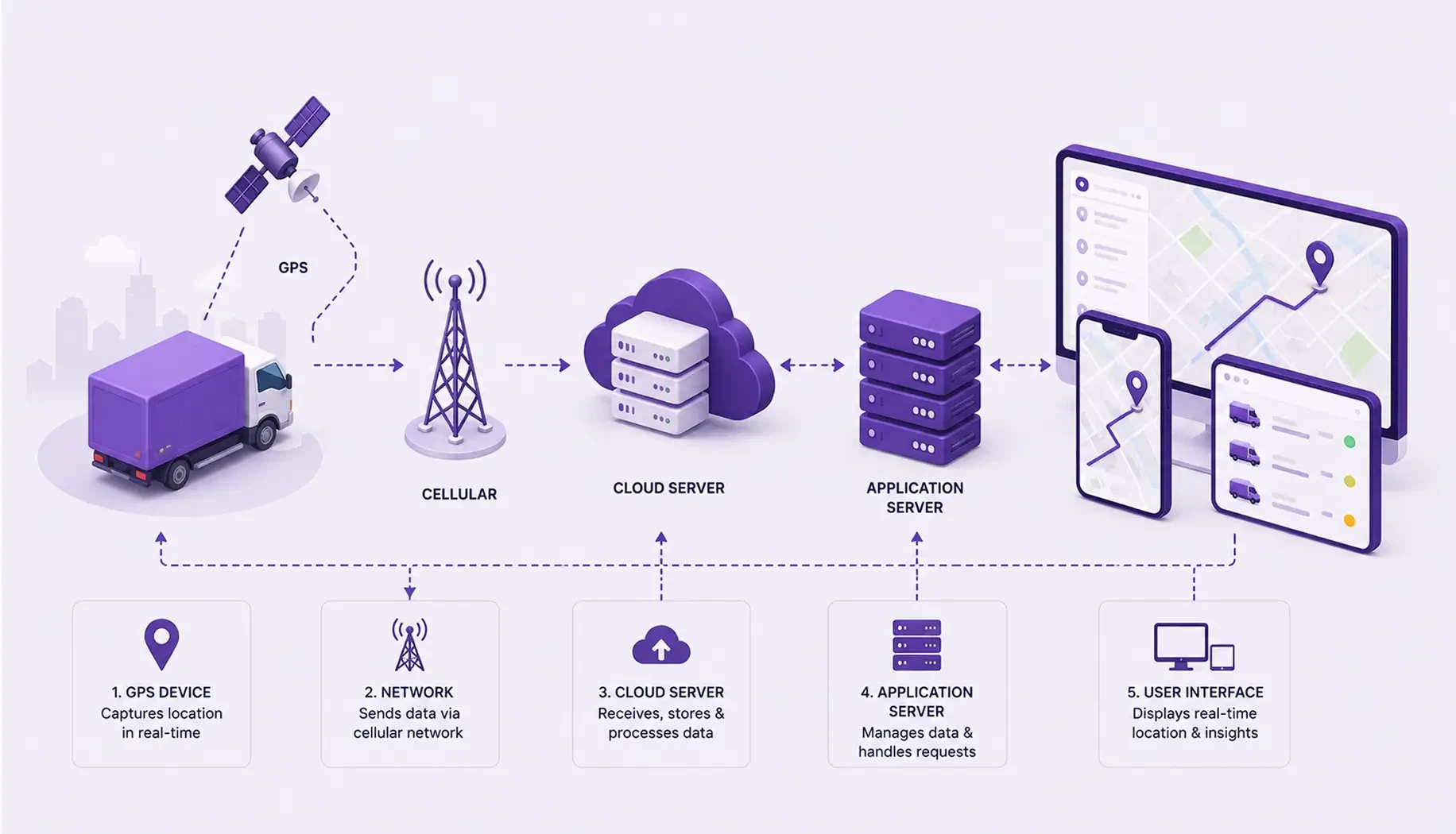
Real-time GPS tracking in a last-mile platform requires a scalable data pipeline that processes live driver locations, updates dispatcher dashboards, and refreshes customer ETAs in real time. With GPS updates every 5 to 15 seconds, even a fleet of 100 drivers can generate 400 to 1,200 events per minute, requiring the system to handle peak seasonal traffic without performance issues.
Acquaint Softtech's DevOps engineers with the real-time data pipelines for delivery platforms. The standard stack is MQTT for device-to-server GPS event transmission, Redis for real-time position caching and session management, WebSockets for server-to-dashboard live push updates, and PostgreSQL for historical GPS event storage. AWS IoT Core handles device management for platforms with 1,000 or more concurrent driver devices.
GPS tracking pipeline: layer by layer
Layer | Technology | Purpose |
Device-to-server | MQTT over TLS | Secure and lightweight GPS data transfer |
Real-time cache | Redis | Stores live driver locations for fast access |
Live dashboard updates | WebSockets | Pushes real-time fleet updates |
Customer tracking | WebSockets / SSE | Updates live ETAs on tracking pages |
Persistent storage | PostgreSQL + TimescaleDB | Stores GPS history for analytics and audits |
Peak load scaling | AWS Auto Scaling + Load Balancer | Handles seasonal traffic spikes |
Building a last-mile delivery platform? Start with a scoping call.
Acquaint Softtech has delivered 40+ logistics platforms, including dispatch systems, route optimization engines, real-time GPS tracking, and customer notification pipelines. Your first dedicated delivery engineer deploys within 48 hours of the brief.
Customer notification systems: the UX that protects revenue
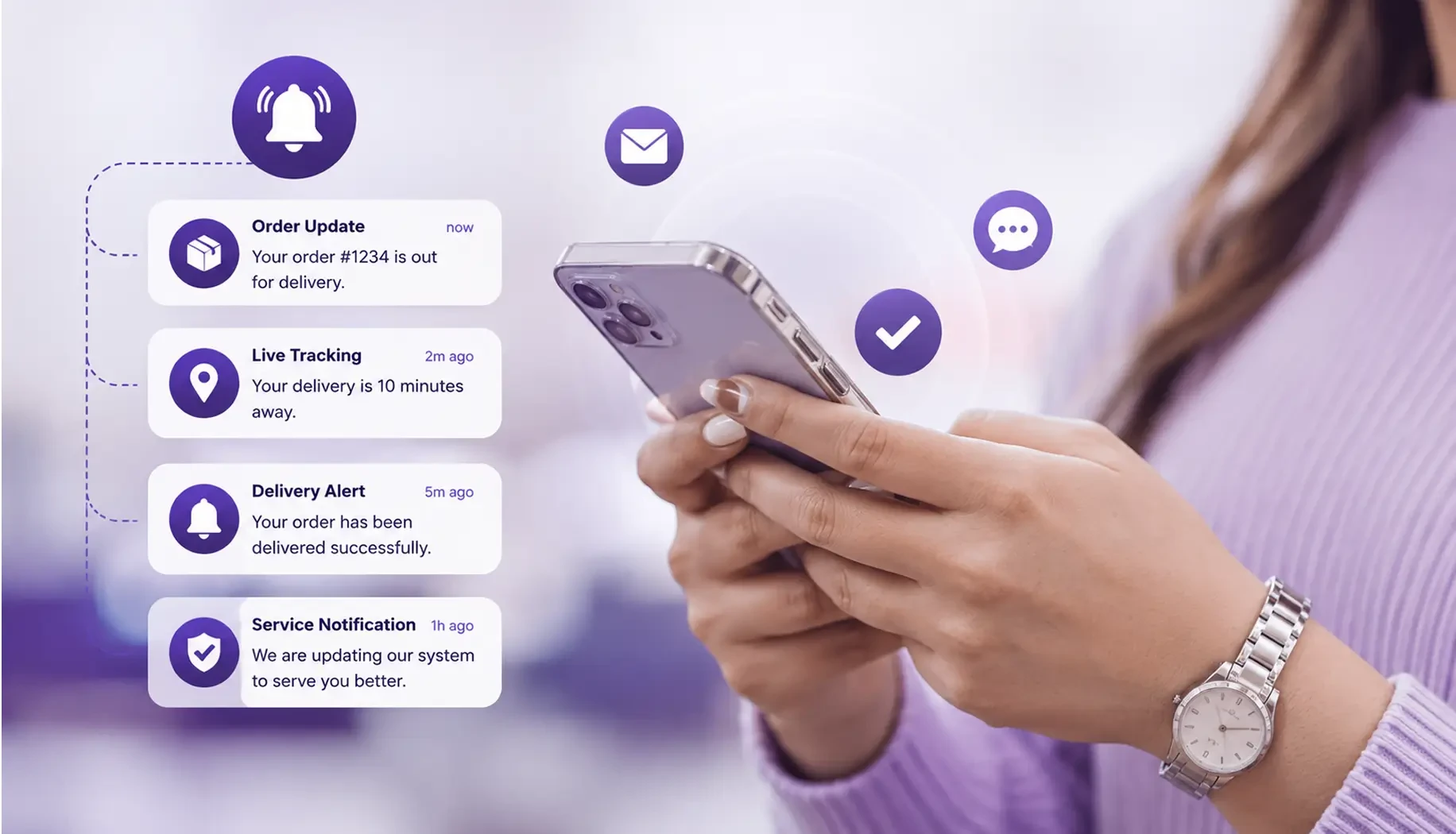
Customer notification systems in last-mile software provide real-time ETAs, delivery updates, delay alerts, and delivery confirmations. These proactive updates improve customer satisfaction, reduce frustration, and help businesses retain repeat customers.
The notification delivery layer uses Twilio for SMS and WhatsApp, Firebase Cloud Messaging for push, and SendGrid or AWS SES for email. The trigger logic must be configurable per customer segment. B2C consumers want push and SMS. B2B recipients typically prefer email and EDI. Acquaint Softtech's MERN stack developers have built notification engines for platforms serving UK retail and European 3PL clients, with multi-channel delivery, fallback channel logic, and configurable threshold rules per client type.
Notification triggers and channel selection
Trigger event | Recommended channel | Operational impact |
Order dispatched | Push and SMS | Include driver name, photo, ETA, and tracking link at the moment of dispatch |
Driver 30 minutes away | Push and SMS | 'Driver is nearby' alert reduces failed deliveries by up to 22 percent |
ETA updated (delay) | Push, SMS, and Email | Proactive delay alert with reschedule option prevents inbound customer service calls |
Delivery confirmed | Push and Email | ePOD reference, photo, and timestamp; rating request link included |
Failed delivery | SMS and Email | Reason code, reattempt schedule, and self-service rebook link |
COD collection confirmed | SMS | Digital receipt with amount and driver reference for immediate reconciliation |
Branded tracking pages are increasingly a competitive differentiator. Operators in the USA, UK, Europe, and Australia that offer a white-labeled tracking page under their own domain, rather than sending customers to a generic carrier URL, report materially higher net promoter scores and lower 'where is my order' call volumes.
Building a branded tracking page requires a React.js or Vue.js frontend with a WebSocket connection to the GPS pipeline, and a short-URL service to generate customer-specific tracking links at dispatch time. The Acquaint Softtech software product engineering team has built branded tracking pages for platforms serving multi-client 3PL operations in the UK and Germany, where each logistics client displays its own branding on the same underlying platform infrastructure.
Proof of delivery: the compliance and dispute layer
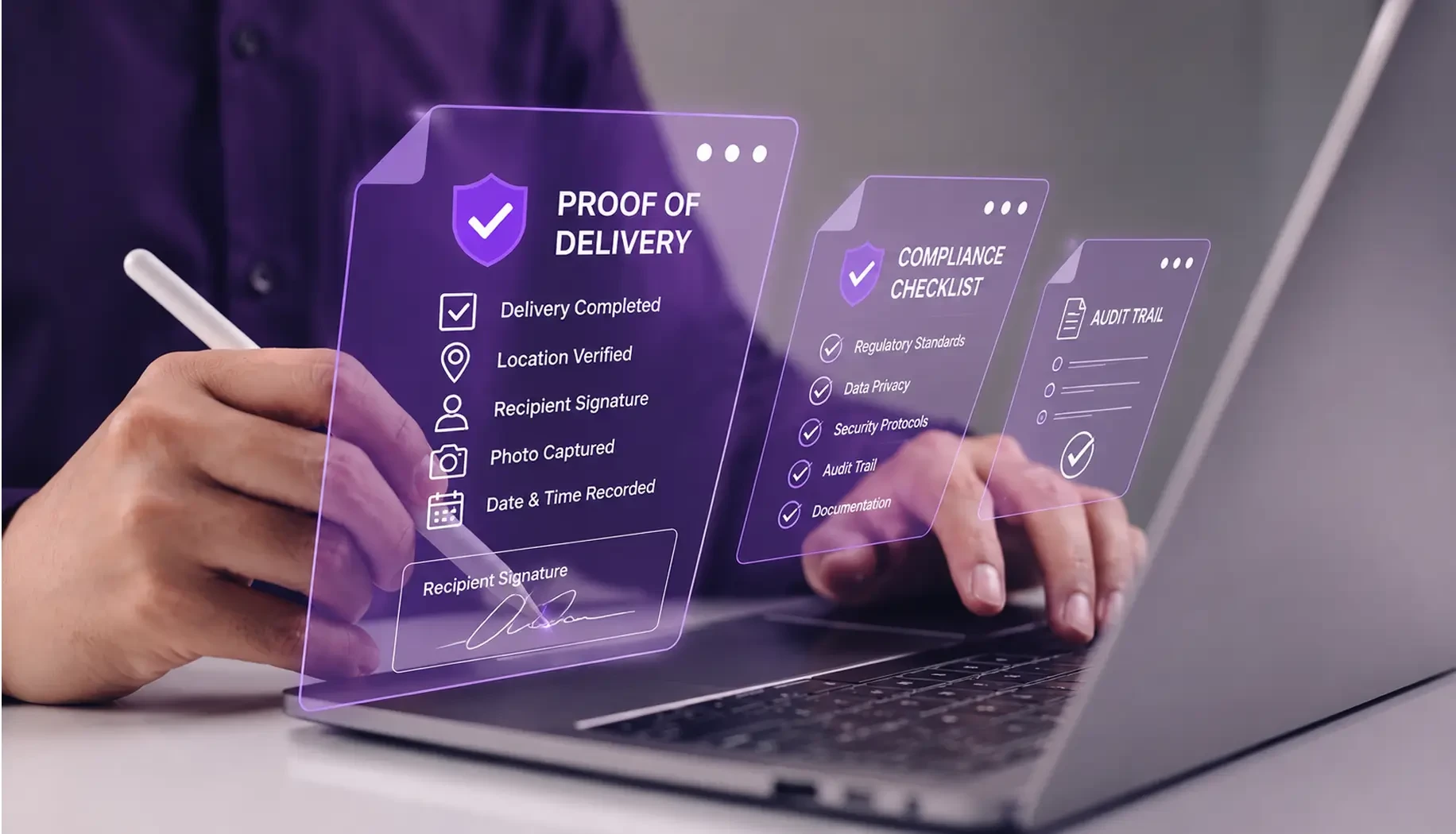
EPOD (electronic Proof of Delivery) systems capture delivery proof through e-signatures, photos, GPS location, and timestamps. They help resolve delivery disputes quickly and must work offline, storing data securely on the device until connectivity is restored.
Acquaint Softtech's mobile app development builds offline-capable driver apps with encrypted local storage, background sync, and ePOD capture modules for delivery platforms across the UK, Europe, and Australia. For COD operations, still the dominant payment model in many South Asian and Southeast Asian markets, the ePOD module also handles cash amount recording, denomination breakdown, and automated reconciliation against the dispatched order value.
Teams building a COD management system delivery module must treat the ePOD capture and the cash reconciliation as a single atomic workflow, not two separate features.
ePOD capture requirements by delivery type
Delivery type | Required evidence | Compliance layer |
Standard parcel | Photo of the package and GPS coordinates | Timestamp and customer notification of confirmed delivery |
Signature-required | E-signature, photo, and GPS | Recipient name printed on signature record; refusal reason code if declined |
Age-restricted | ID scan or age confirmation with signature | Date of birth recorded; staff member ID logged against the delivery |
Cash on Delivery (COD) | Photo, e-signature, and cash amount recorded | Denomination breakdown stored; reconciliation auto-generated against order |
Hazmat | Photo, signature, and compliance checklist | IATA/ADR reference code; handler certification verified before sign-off |
White-glove or installation | Photo checklist and customer sign-off | Job completion checklist; serial number and installation confirmation recorded |
Cut your last-mile development cost by up to 40% without sacrificing quality.
Acquaint Softtech's delivery engineers cost $25 to $49 per hour (verified on Clutch). 95 percent on-time sprint delivery. 24+ months average team tenure on logistics engagements across the USA, UK, Europe, and Australia.
Last mile delivery software development costs in 2026
Last-mile delivery software development costs are determined by feature scope, integration count, real-time data requirements, platform modernization needs, and the regional rate of the development team. Services such as version upgrade services are also often required to keep logistics platforms secure, scalable, and compatible with modern infrastructure.
The ranges below are drawn from Acquaint Softtech's own project portfolio and cover everything from a focused MVP to a production platform handling thousands of daily deliveries.
Cost by scope and complexity
Platform scope | MVP cost (USD) | Production build cost |
Basic delivery tracking and notifications | $20,000 to $45,000 | $80,000 to $150,000 |
Dispatch, routing, and driver app | $40,000 to $80,000 | $120,000 to $280,000 |
Full platform: all 4 modules plus ePOD | $80,000 to $180,000 | $250,000 to $500,000 |
White-label or multi-client platform | $120,000 to $250,000 | $350,000 to $700,000 |
Crowd-sourced or gig delivery platform | $150,000 to $300,000 | $400,000 to $800,000 |
Cost by development region
Region | Senior developer rate | Notes |
USA and Canada | $800 to $1,500/day | Strong domain knowledge; the highest cost |
Western Europe (UK, Germany, Netherlands) | $600 to $1,100/day | Strong last-mile expertise; GDPR native |
Eastern Europe (Poland, Romania) | $350 to $600/day | Strong engineering; logistics domain varies by firm |
India, Tier 1 (Clutch-verified) | $180 to $350/day | Best value for equivalent quality; verify credentials on Clutch |
Southeast Asia | $150 to $280/day | Quality varies significantly; strict vetting required |
Acquaint Softtech's logistics delivery team operates at $25 to $49 per hour, publicly listed on Clutch. This represents up to 40 percent savings versus Western agency rates. The team's average tenure on last-mile engagements exceeds 24 months. Engineers who stay with a platform learn the carrier relationships, edge cases, and SLA commitments that short-tenure developers cannot replicate.
For a full cost breakdown by module across WMS, TMS, OMS, and last mile, the Complete Guide to Logistics and Supply Chain Software Development includes region-by-region cost tables and a named 5-Phase Build Framework drawn from 40+ delivered projects.
Operators who need to start lean can begin with a software product MVP development engagement. Acquaint Softtech's MVP approach builds the dispatch and driver app modules first, ships to production, collects real delivery data, and then adds route optimization and customer notifications in sprint two. This approach reduces day-one investment while generating the operational data that makes route optimization models meaningful.
Technology stack for last-mile delivery platforms
Stack selection must follow architecture requirements, not developer preference. A last-mile platform operates in three technical environments simultaneously: a server-side operations platform covering the dispatcher dashboard, route engine, and notification engine; an offline-capable mobile environment for the driver app; and a customer-facing web environment for the tracking page. Each environment has different constraints and different technology choices.
Platform Layer | Technology Choices | Purpose |
Backend | Laravel, Node.js | Dispatch workflows and GPS event handling |
AI & Analytics | Python, FastAPI, Django | Route optimization and ETA prediction |
Dispatcher Dashboard | React.js, Leaflet, Mapbox | Real-time fleet tracking |
Driver App | React Native | Offline GPS tracking and ePOD |
Customer Tracking | React.js, Vue.js | Live ETA and branded tracking page |
Mapping & Routing | Google Maps, HERE, Mapbox | Navigation and route management |
GPS Pipeline | MQTT, WebSockets, Redis | Real-time GPS data processing |
Notifications | Twilio, FCM, SendGrid | SMS, push, and email alerts |
Cloud Infrastructure | AWS IoT Core, RDS, Auto Scaling | Scalable hosting and device management |
Acquaint Softtech holds Official Laravel Partner status and deploys across Laravel, MERN, Python, Django, and React Native stacks. For AI-assisted delivery features, including dynamic ETA prediction and smart auto-dispatch, the team's AI and ML development services cover the full pipeline from model development through production deployment and monitoring.
For platforms that need a delivery analytics dashboard on-time rate cost per drop module, the backend analytics layer should be built as a separate read-only database fed by event streams from the dispatch engine, not as queries against the same transactional database. This separation prevents analytics queries from degrading live dispatch performance during peak hours.
The discovery workshop services offered by Acquaint Softtech produce a complete stack decision document and integration architecture map as the first deliverable. Teams that complete this workshop before writing any application code consistently deliver faster and with fewer mid-sprint architecture reversals.
Build vs buy: decision framework for last-mile software
The decision between building a custom last-mile platform and buying an off-the-shelf solution depends on five factors: workflow uniqueness, integration depth, competitive use of the platform, unit economics of the chosen route, and internal technical capability. Neither choice is universally correct.
Dimension | Off-the-Shelf Software | Custom Build |
Setup Time | 2 to 6 weeks | 3 to 9 months |
Cost | Monthly SaaS fees | Team-based development cost |
Customization | Limited | Fully customizable |
Integrations | Standard connectors | Custom API integrations |
Competitive Edge | Shared features | Proprietary platform |
Data Ownership | Vendor-controlled | Full ownership |
Best For | Standard operations | Complex and scalable logistics workflows |
From Acquaint Softtech's portfolio data: 68 percent of clients who came to the team for last-mile software had previously used an off-the-shelf platform and hit a ceiling, typically around multi-client isolation, custom integration requirements, or the need to white-label the platform for their own customers.
For operators who need to extend an existing last-mile platform rather than build from scratch, Acquaint Softtech's dedicated development teams model places vetted logistics engineers inside the existing team within 48 hours. The software development outsourcing model is the right fit when a complete platform build is required without an in-house engineering function.
Operators who need a virtual technical lead to oversee architecture decisions without hiring a full-time CTO can engage Acquaint Softtech's virtual CTO services. This is particularly valuable for logistics startups and mid-market operators in the UK and Europe who are commissioning their first custom last-mile platform and need an experienced engineering voice in vendor evaluation, architecture review, and sprint oversight.
Join 200+ technology companies and logistics operators who have scaled with Acquaint Softtech.
1,300+ projects. 70+ engineers. 4.9/5 Clutch rating from 50+ verified clients. Clutch Premier Verified. Official Laravel Partner. Your first logistics engineer deploys within 48 hours of the brief.
Frequently asked questions
-
What is last-mile delivery software?
Last-mile delivery software is a platform that manages the final leg of the delivery journey from a hub or warehouse to the customer. It combines automated dispatch, route optimization, real-time GPS tracking, and customer notifications into a single workflow connecting dispatcher dashboards, driver mobile apps, and customer-facing tracking pages.
-
What are the key features of last-mile delivery software?
The essential modules are: automated dispatch for order-to-driver assignment, route optimization for multi-stop sequencing with time windows and capacity constraints, real-time GPS tracking for live fleet visibility, customer notifications via SMS, push, and email, and proof of delivery with e-signature, photo capture, and GPS confirmation.
-
How does route optimization work in delivery software?
Route optimization uses algorithms derived from the Vehicle Routing Problem with Time Windows (VRPTW). The system sequences delivery stops into the most efficient order, respecting driver shift constraints, vehicle capacity, and customer time windows. Google OR-Tools is the standard implementation for up to 10,000 routes per day. ML-based optimizers are applied above that volume threshold.
-
What is the biggest challenge in last-mile delivery?
Failed deliveries. When a customer is not home, a driver cannot access an address, or a time window is missed, the cost is 4 to 6 times the cost of a successful delivery. Last-mile software addresses this through proactive customer notifications, which reduce missed-delivery rates by up to 22 percent, accurate ETAs, and automated rescheduling triggered by the exception event.
-
How much does last-mile delivery software cost to develop?
Logistics Platform Type
Estimated Cost
MVP with Dispatch, Routing & Driver App
$40,000 to $80,000
Full Production Logistics Platform
$250,000 to $500,000
A Clutch verified India based development team can typically deliver the same technical capabilities as a Western agency at up to 40% lower cost.
-
How does GPS tracking work in delivery apps?
Driver apps transmit GPS coordinates to the server via MQTT at intervals of 5 to 15 seconds during active delivery. The server caches current driver positions in Redis for sub-millisecond reads, then pushes live updates to dispatcher dashboards and customer tracking pages via WebSockets. ETAs on the tracking page recalculate in real time as the driver progresses through each stop.
-
What is proof of delivery in logistics software?
Proof of delivery is the verified record that a delivery was completed. It consists of an e-signature from the recipient, a photo of the package at the delivery address, GPS coordinates of the driver's device, and a device-side timestamp. ePOD records are stored against the order for dispute resolution, client billing verification, and compliance auditing.
-
How does Acquaint Softtech build last-mile delivery platforms?
Acquaint Softtech uses a 5-phase build framework: integration scoping, architecture design, integration contract and sandbox testing, sprint development with domain checkpoints, and load testing with cutover planning. Engineers deploy within 48 hours of a brief and stay with the platform for an average of 24+ months. Verified at 4.9/5 from 50+ client reviews on Clutch.
I lead technology and client success at Acquaint Softtech with one goal in mind. Deliver work that feels personal, reliable, and worthy of long term trust. I stay close to both our clients and our developers to make sure every project moves with clarity, quality, and accountability.
Table of Contents
Get Started with Acquaint Softtech
- 13+ Years Delivering Software Excellence
- 1300+ Projects Delivered With Precision
- Official Laravel & Laravel News Partner
- Official Statamic Partner
Related reading
The Complete Guide to Logistics & Supply Chain Software Development in 2026
Logistics and supply chain software development in 2026 is not a single discipline. It is six distinct product categories, each with its own integration burden, operational perimeter, and cost curve.

Acquaint Softtech
May 1, 2026
How Warehouse Management Systems Work: Architecture, Modules, and Data Flow Explained
A Warehouse Management System is not a spreadsheet with barcode readers attached. It is a structured operational platform that owns inventory location, pick sequence, worker task allocation, and carrier handoff in one controlled environment.
Manish Patel
May 8, 2026
Transportation Management Systems: Carrier Selection, Rate Shopping & Load Optimization
A Transportation Management System is not a tracking map with extra buttons. It is a structured freight operations platform that owns carrier selection, rate negotiation, load planning, dispatch, and proof-of-delivery capture in one governed workflow.
Manish Patel
May 18, 2026India (Head Office)
203/204, Shapath-II, Near Silver Leaf Hotel, Opp. Rajpath Club, SG Highway, Ahmedabad-380054, Gujarat
USA
7838 Camino Cielo St, Highland, CA 92346
UK
The Powerhouse, 21 Woodthorpe Road, Ashford, England, TW15 2RP
New Zealand
42 Exler Place, Avondale, Auckland 0600, New Zealand
Canada
141 Skyview Bay NE , Calgary, Alberta, T3N 2K6