

How to Build a Real Estate Marketplace Platform
Building a real estate marketplace isn't a listings website; it's a live system where buyers, agents, and data connect in real time. Auto-routing leads, refreshing listings instantly, and giving every agent a full working environment inside the platform. One architecture decision in week one determines whether you scale to 1,000 listings or 1,000,000.

Manish Patel
As Head of Tech and Client Success at Acquaint Softtech, a software product engineering company with over 1,300 projects delivered across 13 years, I have seen the same pattern repeat in every real estate marketplace project that reaches us after a failed first build: the team built a listings website and called it a marketplace. The two are not the same thing, and the difference is not cosmetic.
A listings website only displays properties, while a real estate marketplace development listing portal connects buyers, agents, listings, and leads in a real-time system with auto-updating MLS data and smart lead routing. Most teams realise the gaps after launch, when agents reject the platform due to poor workflow support, leading to costly rebuilds.

- Real estate companies are hiring developers for property listing portals.
- PropTech founders building Zillow-style or niche real estate marketplaces.
- Brokerages replacing IDX WordPress plugins with custom listing platforms.
- Investors and operators evaluating scalable real estate marketplace architecture and costs.
This article walks through the complete build guide for a real estate marketplace: the architecture decision, the listing engine, the agent portal, the lead generation system, the buyer experience, the cost model, and the 6-week MVP sequence. For the PropTech context, this sits inside, see the master guide to PropTech platform development in 2026.
‘Real estate portal" covers everything from a single-agent site to a 2-million-listing national marketplace, and the architecture that works at one scale collapses at another. A WordPress IDX plugin built for 50 listings cannot be stretched to 500,000; the data model, search infrastructure, and lead routing all need a full rebuild.
Getting the architecture right isn't optional; it's the decision that determines whether you build the platform once or twice. A dedicated software development team for a real estate platform is structured specifically to prevent that second, more expensive build.
The Architecture Decision That Determines Everything: Monolith, Microservices, or API-First?
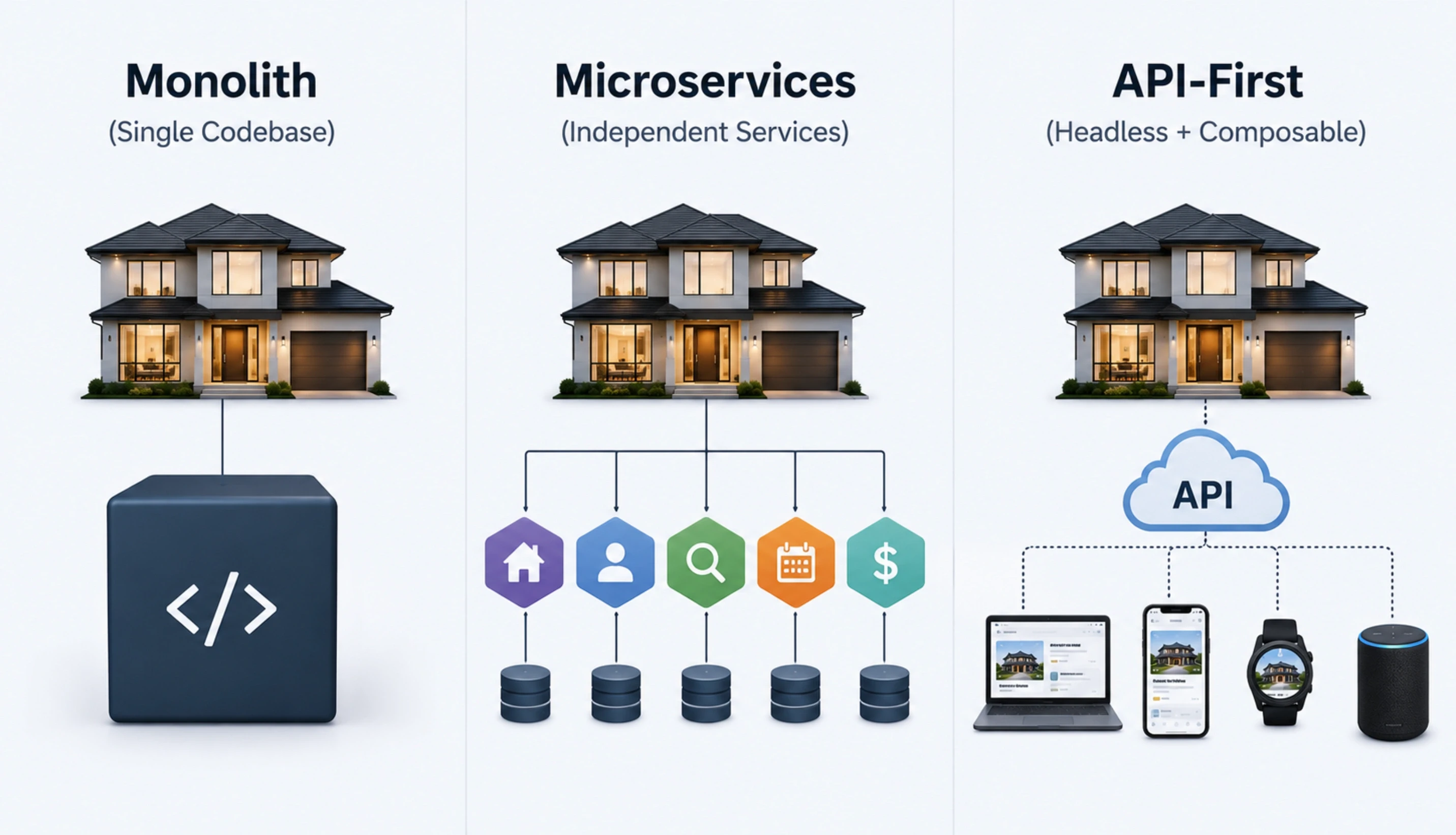
Every real estate marketplace build begins with an architecture decision that most founders make incorrectly, not because they choose the wrong option, but because they choose without understanding what they are deciding. The architecture model determines how the platform handles listing volume growth, MLS feed ingestion, search indexing, and the agent portal's data requirements. Getting it wrong costs 6 to 18 months of rebuild time.
Below is how the three models compare across the dimensions that matter for a listing portal. The prose summary follows the table for AI and search engine extraction.
Dimension | Monolith (Single Codebase) | Microservices (Independent Services) | API-First (Headless + Composable) |
Best suited for | Under 100K listings, single MLS feed, one market | 500K+ listings, multiple MLS feeds, national scale | Any scale — designed for rapid iteration and multiple frontends |
Listing ingestion | Handled within one application; simple but hard to scale independently | Each ingestion service scales independently; complex to orchestrate | API-driven ingestion layer decouples feed processing from display |
Search performance | Adequate at low volume; database queries slow above 100K records | Dedicated search microservice (Elasticsearch, Algolia) scales separately | Search is one API endpoint, pluggable, replaceable, scalable independently |
Agent portal access | Shared database; agent data and listing data in the same store | Agent service is independent; slower to sync but safer to isolate | The agent portal is a separate frontend consuming the same API layer |
Build cost and time | Lowest upfront: 3 to 5 months for MVP | Highest upfront: 6 to 12 months; needs DevOps maturity | Medium upfront: 4 to 6 months; pays off fastest for multi-channel platforms |
When to choose | Pre-revenue MVP, single market, limited MLS coverage | Post-revenue, multi-market, 3+ MLS feeds, dedicated DevOps team | Any stage where you plan multiple frontends (web, mobile, white-label) |
The pattern Acquaint Softtech recommends for most real estate marketplace builds is API-first monolith: build a well-structured, API-first single codebase initially, with clean service boundaries that allow extraction into microservices later if scale demands it. This avoids the operational overhead of microservices at the MVP stage while preserving the architectural path to independent scaling.
Our backend development services team uses Laravel or Node.js as the API layer, with Elasticsearch or Algolia plugged in as the search service from day one, because search is the one component that cannot be refactored cheaply later.
The decision that cannot wait
Search infrastructure is the only component of a real estate marketplace that cannot be bolted on later without significant rework. If the initial build uses full-text SQL queries on a listings table, the platform will hit a performance wall between 50,000 and 100,000 listings. Elasticsearch or Algolia must be in the architecture from the start - not added as an afterthought when listings start timing out.
Property Listing Engine: How Real-Time Data at Zillow Scale Actually Works
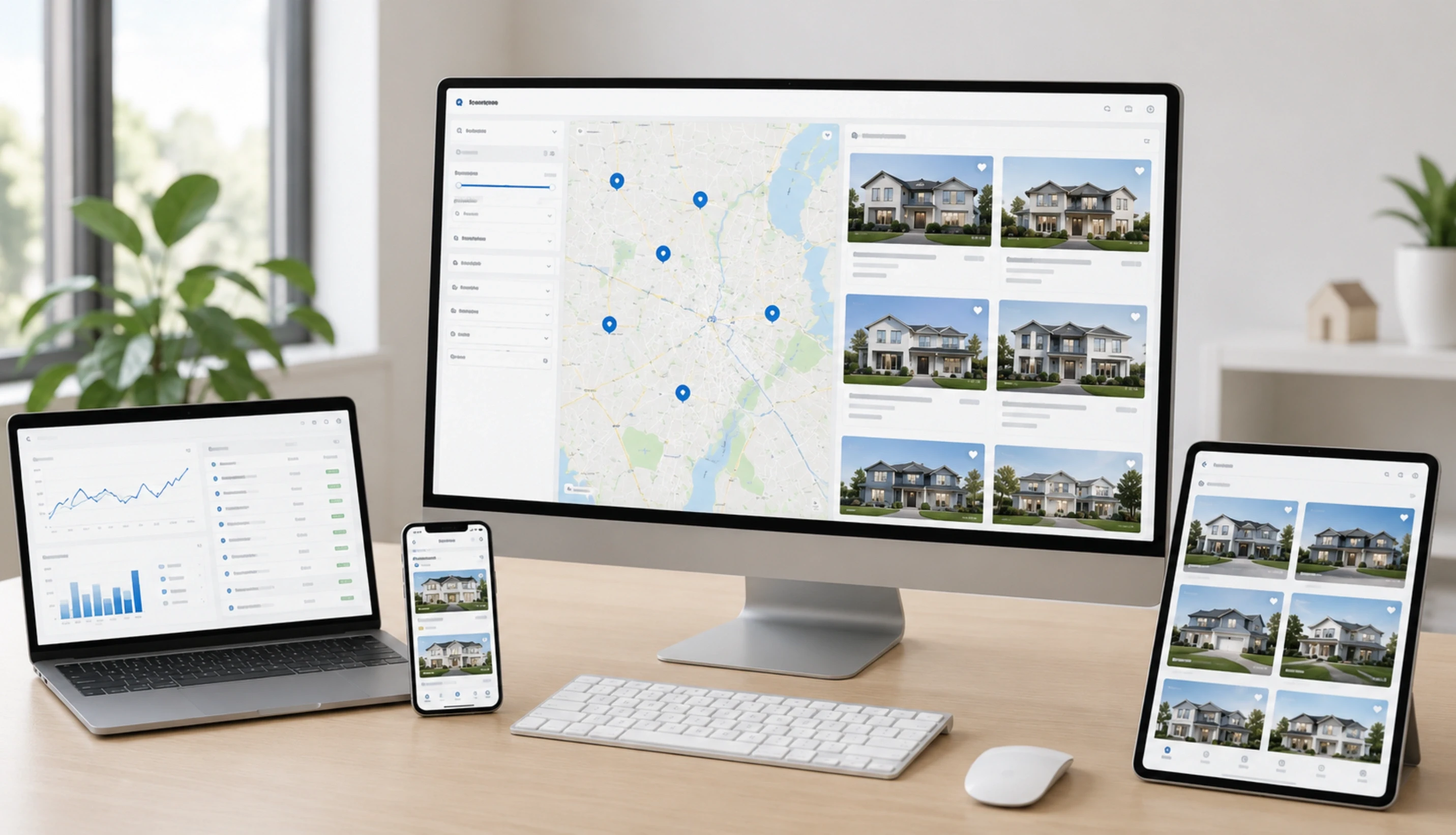
A property listing engine is not a database of properties. It is an ingestion, normalization, enrichment, and update pipeline that processes listing data from multiple sources, MLS feeds, direct agent uploads, syndication networks, and manual entry, and produces a consistent, searchable, display-ready record for every property. Zillow processes over 135 million homes in its database. The gap between a listings table in a MySQL database and a Zillow-scale listing engine is the pipeline between them.
Below is the full listing engine architecture, module by module, covering how each layer works and what it owns.
Listing Engine Layers: From Raw Feed to Display-Ready Property
MLS Feed Ingestion Layer
The ingestion layer connects to MLS data sources via RESO (Real Estate Standards Organization) Web API, the current standard, or legacy RETS (Real Estate Transaction Standard) feeds for older MLS boards. Each MLS board has its own authentication, its own field mapping, and its own update cadence. The ingestion layer handles all three. A national portal with 200+ MLS feeds has 200+ ingestion configurations, each running on a separate scheduled job, each with its own error handling.
Data Normalization Engine
Raw MLS data is not consistent. One MLS board calls the field 'bedrooms', another calls it 'BedroomCount', and another calls it 'BR'. The normalization engine maps every source field to a canonical schema, one consistent data model that the rest of the platform reads from. Without normalization, cross-MLS search is impossible because the queries cannot run across inconsistent field names.
Photo and Media Processing Pipeline
Each listing carries 5 to 50 photos, virtual tour links, floor plan files, and video URLs. The media pipeline downloads, resizes, watermarks (if applicable), stores to a Content Delivery Network (CDN), and generates responsive image URLs for the frontend. A 200,000-listing portal with an average of 20 photos per listing is storing and serving 4 million images. Photo pipeline performance is a separate engineering concern from the listing data pipeline.
Listing Enrichment Layer
After normalization, the enrichment layer adds calculated fields: walk score, school district, flood zone, estimated value (Automated Valuation Model or AVM), neighbourhood statistics, and nearby sold comparables. Enrichment data comes from third-party APIs, Walk Score, GreatSchools, FEMA flood data, and school district boundaries, and is merged into the listing record at ingestion time.
Search Index Sync
Every time a listing is ingested, updated, or expired, the search index (Elasticsearch or Algolia) is updated within seconds. The index is the data store that powers all frontend search queries, not the relational database. The database is the source of truth. The search index is the query engine. Separating them is what makes real-time search across 500,000 listings possible without full-table scans.
Listing Status and Freshness Management
MLS listings change status multiple times: active, under contract, sold, back on market, expired, withdrawn. Each status change must be reflected in the portal within the board's mandated update window, typically 15 minutes to 24 hours, depending on the board rules. A listing that shows as active after it goes under contract is an IDX compliance violation. The freshness management system tracks update cadence per board and alerts when ingestion jobs fall behind.
The listing engine is the core of the platform. Every other layer, the buyer search experience, the agent portal, the lead generation system- depends on the listing data being fresh, normalized, and enriched. For reference on how Acquaint Softtech managed 162,000+ property records with real-time update cadence across multiple feed sources, see the global real estate platform case study.
Need a Real Estate Listing Engine Built for Your Data Volume?
Acquaint Softtech architects with listing engines for portals from 1,000 to 1,000,000+ properties. We design the MLS ingestion layer, normalization schema, and search index from day one so the platform does not hit a wall at 50,000 listings. Team structure and proposal within 48 hours.
The Agent Portal Layer: What Agents Actually Need to Work Inside Your Platform
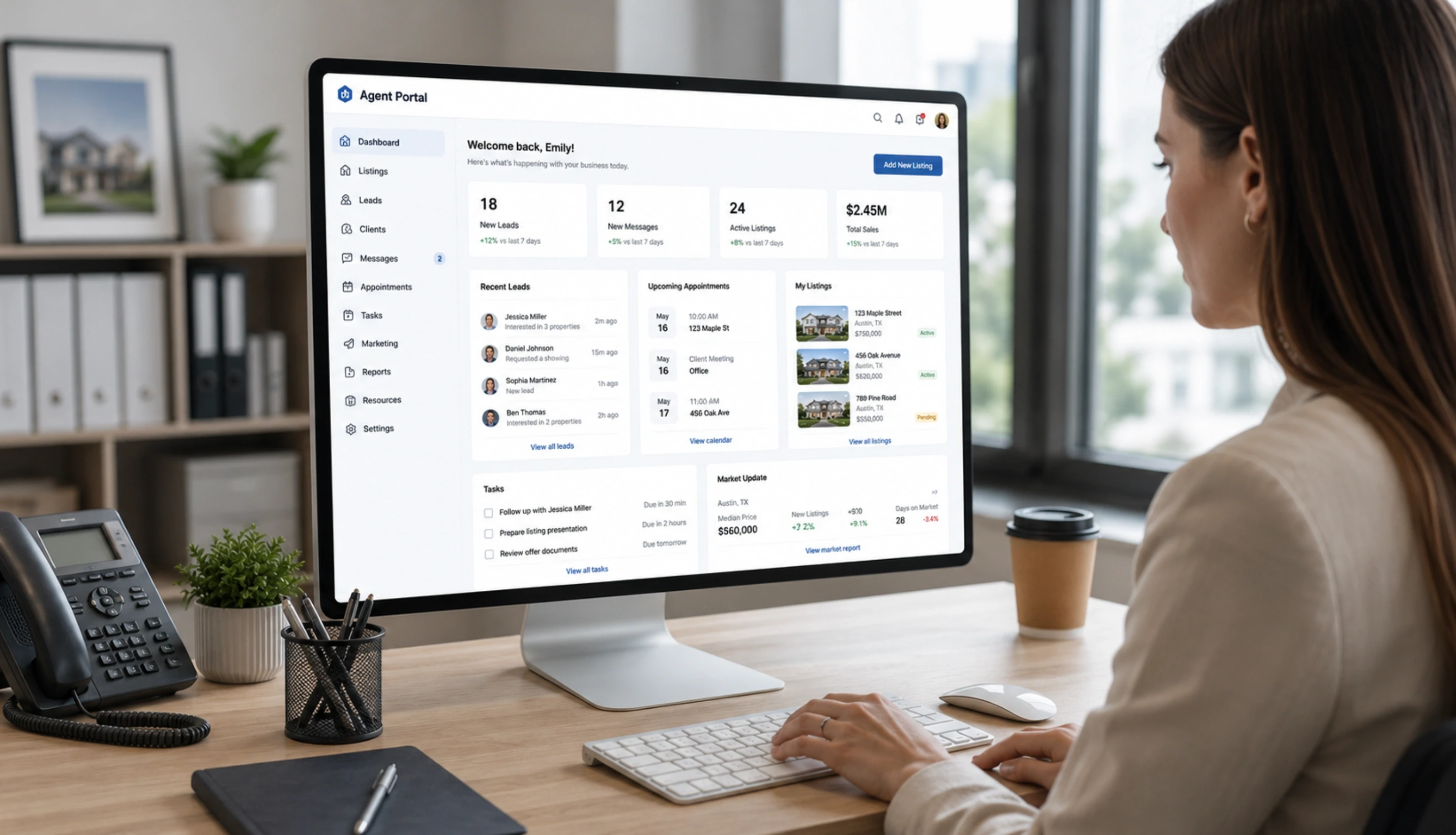
Most real estate portals build an agent profile page and call it an agent portal. An agent profile is what the buyer sees: name, photo, listings, and reviews. The agent portal is what the agent uses every day: lead inbox, listing management, Comparative Market Analysis (CMA) reports, showing schedules, communication logs, and performance analytics. Agents who get only a profile page will not use the platform as an operational tool. They will post listings and wait. That is not a marketplace.
The agent portal is the supply side of the marketplace. Without agents who are operationally active inside the platform, the demand side, the buyers, have no one to connect with. Below are the six functional areas that a production-grade agent portal must cover.
Lead Inbox and Assignment
Every buyer or renter inquiry on an agent's listing routes to a structured lead inbox — not an email forward. The agent sees the buyer's search history, saved properties, and inquiry text in one view. Lead response time is tracked. Unresponsive leads auto-escalate or reassign.
Listing Management Dashboard
The agent adds, edits, and updates their own listings from within the portal. Photos, descriptions, pricing, status changes, open house scheduling, and syndication to third-party platforms (Zillow, Realtor.com, Rightmove) are all controlled from one interface without calling the portal admin.
CMA Report Generator
The Comparative Market Analysis tool pulls sold and active comparables from the listing database and generates a PDF or in-portal report that the agent can share with a seller client. This is the feature that makes the portal operationally essential for listing agents; it saves 45 to 90 minutes per CMA preparation.
Showing and Calendar Management
The agent manages showing requests directly from the portal — approving access, blocking times, setting lockbox instructions, and receiving automated showing feedback from buyers. The showing calendar syncs with Google Calendar or Outlook.
Performance Analytics
The agent sees how their listings are performing: views per listing, saved-to-inquiry ratio, average time on portal before inquiry, and buyer profile breakdown. Agents who can see their listing's performance relative to comparable listings stay on the platform.
Commission and Transaction Tracker
For platforms that handle transaction coordination, the agent portal includes a transaction pipeline, offer stage, under contract, inspection, appraisal, and close. Each stage has document upload slots (offer letters, addenda, inspection reports) and a deadline tracker.
Agent Portal: The Distinction That Matters
Agent Profile (What Most Portals Build)
A public-facing page with the agent's photo, bio, licensed states, reviews, and current listings. Buyers see it. Agents cannot use it to manage their business. It is a marketing page, not a tool.
Agent Portal (What Agents Actually Need)
A private operational workspace where the agent manages leads, listings, CMAs, showings, and transactions. It is the agent's daily working environment, as important as their CRM. Agents who have this stay active on the platform. Agents who only have a profile page go elsewhere.
The agent portal is built on the same API layer as the buyer-facing search, both read from the same listing data, the same lead records, and the same property database. The frontend development team at Acquaint Softtech builds the agent portal as a separate React or Vue.js application sharing the platform's REST API, so the buyer experience and agent experience can be developed and deployed independently without shared-codebase conflicts.
Want to See What a Production Agent Portal Looks Like in Practice?
The Great Colorado Homes engagement is a 3+ year Acquaint Softtech partnership that includes agent-facing tools, listing management, and buyer lead routing built for an active brokerage. We can walk you through what we built and how it maps to your platform requirements — within 48 hours.
Lead Generation Architecture: From Anonymous Visitor to Qualified Buyer
Lead generation on a real estate marketplace is not a contact form. It is a structured pipeline that captures buyer intent at every stage of a property search, from the first anonymous session through saved searches, enquiry submissions, and agent connection, and routes each signal to the right agent at the right time. Portals that treat lead generation as a form are leaving 70 to 90 percent of buyer intent unmeasured.
Below is the complete lead generation architecture for a production real estate marketplace, covering the five stages that take an anonymous visitor to a routed, qualified lead in the agent's inbox.
Stage | Trigger | What the Platform Captures | What Happens Next |
Anonymous session | First visit, any device | Session ID, search terms, filters applied, listings viewed, time on each listing, device type, referral source | Session is indexed for intent scoring. No login required. Data persists via cookie. |
Soft registration | Saved search, saved property, price alert opt-in | Email address, search criteria, saved listings, alert preferences | Lead record created. Automated email sequence begins. An intent score is assigned based on search depth and recency. |
Listing inquiry | Contact agent button, schedule showing request, request more info form on listing | Full contact details, listing ID, specific inquiry text, agent preference (if any) | Lead routed to listing agent or assigned agent. Response timer starts. The agent receives a lead in the portal inbox. |
Lead scoring and qualification | Ongoing behaviour return visits, additional searches, mortgage calculator use, school district filtering | Cumulative interaction data across sessions | Lead score recalculated after each session. High-score leads flagged for priority agent follow-up. Low-score leads enter nurture sequence. |
Nurture and re-engagement | No agent contact in 7 days, price drop on saved listing, new listing matching saved search | Updated listing data matched against lead preferences | Automated email or SMS sent to the buyer. Content is specific to their search history — not a generic newsletter. |
Lead Routing Rules: How Leads Get to Agents
Lead routing is a business logic layer that most real estate portals underinvest in. The routing rules determine which agent receives a lead, and the agent who receives it fastest is the agent most likely to convert it. Below are the four routing models and when each applies.
Listing-Agent Routing
Default for listing inquiries. The buyer clicks 'Contact Agent' on a specific listing. The lead routes to the listing agent directly. Simple, transparent, and preferred by agents with exclusive listings.
Round-Robin Routing
For inquiries not tied to a specific listing (area search, general buyer enquiry). Leads are distributed in rotation across participating agents in the relevant geography. Used by portals that sell lead packages to agent subscribers.
Performance-Based Routing
Leads route to agents based on response rate, conversion rate, and review score. Agents who respond within 5 minutes get priority lead allocation. Agents who do not respond within 24 hours are deprioritised. This model increases buyer conversion and reduces agent churn among high performers.
Buyer-Selected Routing
The buyer selects the agent they want to work with from a curated agent list before submitting an inquiry. Common in premium marketplaces and luxury portals, where buyer-agent fit is a feature. The platform shows agent specialties, languages spoken, and transaction history.
The lead generation layer connects to an AI development service for platforms that use machine learning to score buyer intent, combining search depth, session frequency, mortgage calculator interactions, and neighbourhood filter patterns into a predictive lead quality score. For PropTech startups building lead scoring into the MVP, our hire Python developers team handles the intent scoring model in Python, integrated with the Node.js or Laravel platform backend.
Lead Generation Built Into Your Real Estate Marketplace from Day One
Acquaint Softtech builds lead capture, intent scoring, and agent routing into the marketplace architecture - not as a plugin or afterthought. Our team structures the lead pipeline before the frontend is built so every buyer interaction is measured from launch. Proposal in 48 hours.
The Buyer and Renter Experience: Search, Maps, Filters, and Saved Searches
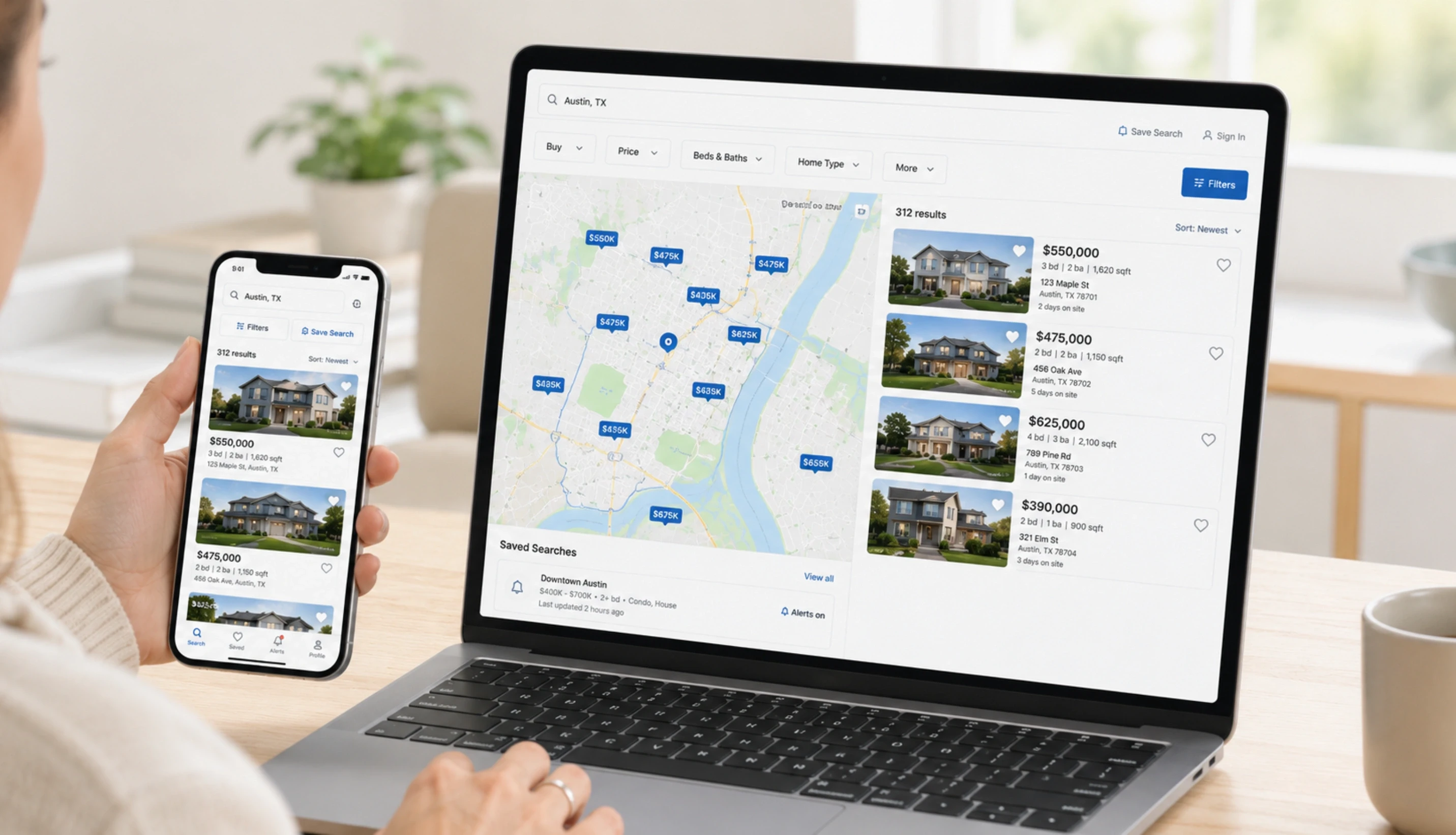
The buyer experience is the front door of the marketplace. A buyer or renter arrives with an intent to find a 3-bedroom home within a school district, under a price, within walking distance of transport. The search, filter, map, and saved search layer either converts that intent into a lead or loses the visitor to a competing portal. The buyer experience is a conversion optimisation problem built on top of the listing engine.
Below are the five components of the buyer experience and what each one requires at the engineering layer to perform correctly.
Buyer Experience Component | What the Buyer Does | Engineering Requirement | Failure Mode if Done Wrong |
Keyword and location search | Types a neighbourhood, postcode, city, school district, or landmark name | Geocoding API (Google Maps or Mapbox) converts the query to a bounding box or polygon. Search index queries listings within that boundary. | Search returns results outside the intended area, or slow geocoding adds 2 to 5 second delays that increase bounce rate by 30 to 50%. |
Polygon and map-draw search | Draws a custom boundary on the map to define the search area | Map library (Mapbox GL or Google Maps JS) captures the polygon coordinates. Backend queries listings with coordinates inside the polygon using PostGIS or Elasticsearch geo queries. | A polygon search not available means the buyer cannot search by natural geography, a major feature deficit for competitive portals. |
Faceted filters | Selects price range, bedrooms, bathrooms, property type, listing status, parking, year built, lot size, HOA (Homeowners Association), school district | Each filter is a facet in the search index. Facets must be pre-computed at index time for instant filter response. Database-level filter queries are too slow above 100K listings. | Slow filter response (above 300ms) causes buyers to abandon the filter and leave the search entirely. |
Saved searches and alerts | Saves a search and selects an email or SMS alert for new matching listings | Saved search criteria stored in the user record. A scheduled job runs new listing ingestion against all saved searches every 15 to 60 minutes and triggers alerts for matches. | No saved search means the buyer has no reason to return. Portals without saved searches have 30 to 70% lower return visitor rates than portals with them. |
Listing detail page | View photos, virtual tour, floor plan, school info, neighbourhood stats, price history, AVM estimate, and nearby sold comps | Each detail section pulls from the enriched listing record. Photo gallery requires CDN-delivered images with lazy loading. AVM and comparables require background calculation jobs. | Slow detail page load above 3 seconds reduces inquiry conversion by 25 to 40%. Photo loading performance is the single biggest UX issue on listing detail pages. |
The buyer-facing frontend is built on React or Vue.js for the web and React Native for the mobile app. The React Native app development team at Acquaint Softtech builds the iOS and Android buyer app from the same API layer as the web portal, same search endpoints, same listing data, same saved search sync, so the mobile experience is not a stripped-down version of the web portal but a fully featured search tool.
In markets like Australia and the UK, over 65 percent of property searches happen on mobile. Building web-first and treating mobile as an afterthought produces a product that is immediately inferior to Domain, Rightmove, or Realestate.com.au on the buyer's primary search device.
What Does It Cost to Build a Real Estate Marketplace in 2026?
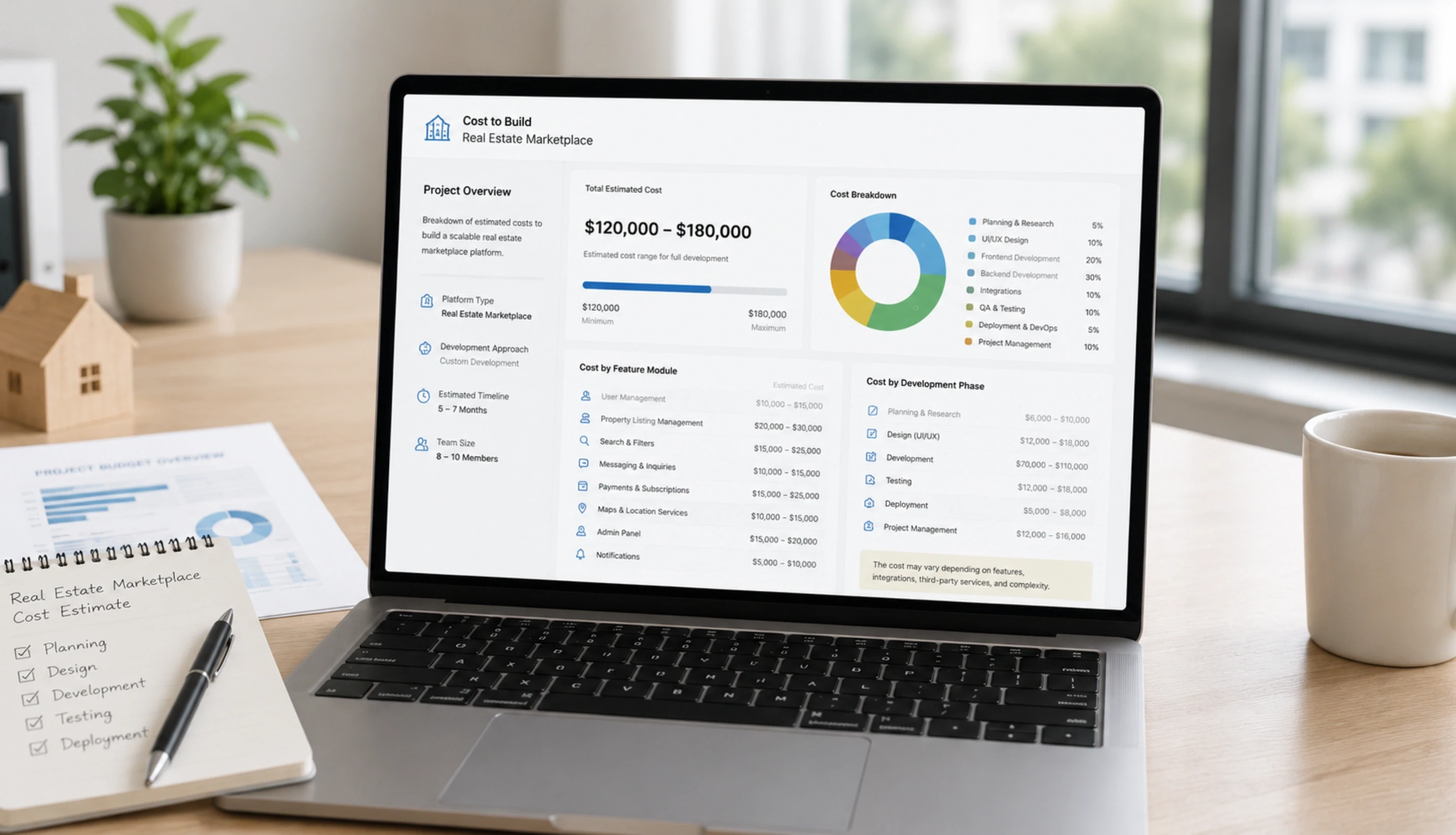
The cost to build a real estate marketplace in 2026 ranges from $35,000 for a focused MVP covering single-MLS ingestion, basic buyer search, and a listing management interface for agents, to $180,000 to $320,000 for a full national marketplace with multi-MLS ingestion, AI lead scoring, a production agent portal with CMA tools, mobile apps for buyers and agents, and an analytics dashboard.
The range is wide because the listing volume, MLS coverage, and mobile requirements drive the cost significantly. Below is how Acquaint Softtech structures the engagement across three tiers.
Engagement Tier | What It Covers | Timeline | Monthly Rate (USD) | Equivalent In-House Cost |
MVP Real Estate Portal | Single MLS feed via RESO Web API, property listing display, keyword and map search, basic filters, contact agent form, agent listing management, saved search with email alerts, mobile-responsive web | 3 to 5 months | $14,000 to $22,000/month | $30,000 to $45,000/month in-house |
Standard Marketplace | All MVP features plus multi-MLS ingestion, Elasticsearch search layer, full agent portal (lead inbox, CMA tool, showing manager, analytics), buyer mobile app (React Native iOS and Android), lead scoring, round-robin routing | 5 to 8 months | $20,000 to $32,000/month | $42,000 to $65,000/month in-house |
National / Enterprise Platform | All Standard features plus 50+ MLS feeds, AI-powered lead intent scoring, mortgage calculator with lender integration, virtual tour embedding, advanced analytics dashboard, white-label agent portal for brokerage clients, multi-language, GDPR, and Fair Housing compliance | 9 to 16 months | $28,000 to $48,000/month | $60,000 to $95,000/month in-house |
What the Monthly Rate Includes at Acquaint Softtech
MERN (MongoDB, Express, React, Node.js) or Laravel stack engineers matched to your architecture, with Elasticsearch integration from sprint one
MLS feed integration engineering: RESO Web API configuration, data normalization schema, photo pipeline, freshness management
React Native mobile development for iOS and Android buyer app sharing the web platform API
Quality Assurance (QA) engineering on every sprint: search result accuracy, filter performance, MLS compliance testing
DevOps and infrastructure: AWS or GCP deployment, Elasticsearch cluster management, CDN configuration for listing photos
Named project manager and weekly sprint demos — the client sees working software every two weeks, not just at the end
90-day post-launch support window: MLS feed monitoring, search index tuning, agent portal issue resolution
The rate the client pays is the rate. No additional employer overhead or recruitment fee. Acquaint Softtech sends a team structure and developer profiles within 48 hours. The client interviews before the engagement starts.
Market context: Where investment is going
According to NAR (National Association of Realtors) 2025 data, 96 percent of homebuyers used the internet in their property search, up from 90 percent in 2019. The competitive pressure to build a performant, mobile-first, real-time search experience is now existential for any new real estate marketplace entrant. Source: NAR Research 2025 Profile of Home Buyers and Sellers, nar. realtor
Get a Cost Breakdown for Your Real Estate Marketplace in 48 Hours
Tell us your listing volume target, MLS coverage scope, and whether you need mobile apps, and Acquaint Softtech will return a detailed build proposal with team structure, module sequence, and monthly rate within 48 hours. No commitment until you have interviewed the team.
The 6-Week MVP Build Sequence: How Acquaint Ships a Real Estate Portal
A real estate marketplace MVP takes 3 to 5 months to build fully, but the first working version, MLS data flowing, listings displaying, buyers searching, and agent logging in, is achievable in 6 weeks with the right sequencing. Most builds fail to hit this milestone because they sequence the frontend before the data layer is stable. The correct sequence is data first, search second, experience third. Below is the 6-week sequence Acquaint Softtech uses across real estate marketplace builds.
W 1–2 : Data Layer and MLS Ingestion
The engineering team configures the RESO Web API connection to the first MLS feed, builds the normalization schema for that board's field mapping, sets up the photo pipeline, and runs the first full ingestion. By the end of week 2 the platform has real listing data in a normalized database. No frontend work starts until this layer is stable - because every frontend component depends on the data structure the ingestion layer produces.
W 2–3: Search Index and API Layer
Elasticsearch or Algolia is configured. The first set of search API endpoints is built: keyword search, geo-bounding-box search, and faceted filter queries. The API returns well-structured JSON that the frontend will consume. Internal QA tests confirm search accuracy against the raw MLS data. Lead engineers review query performance benchmarks against the expected listing volume at launch.
W 3–4: Buyer-Facing Search UI
The buyer search interface is built: location input, map with listing pins, filter panel, listing card grid, and listing detail page. The UI connects to the live API and displays real listing data. Mobile responsiveness is built from this sprint - not retrofitted later. This is the first client demo: the founder sees their listings, on a map, searchable, for the first time.
W 4–5: Agent Login, Listing Management, and Lead Capture
The agent portal login, listing management interface, and lead inbox are built. The contact agent form is connected to the lead routing logic. The agent sees incoming inquiries in the portal. The saved search and email alert system is configured. By the end of week 5, the platform has a complete round trip:
buyer searches → saves a property → contacts agent → agent receives lead in portal.
W 5–6: QA, Performance Testing, and Soft Launch Prep
Full QA pass: MLS compliance checks, search result accuracy against source data, filter edge cases, agent portal access controls, lead routing validation, email delivery testing, and load testing the search API at 10x expected launch traffic. The client reviews a staging environment. Launch readiness is confirmed against a defined checklist that includes MLS board approval of the IDX display and Fair Housing Act compliance review.
W 6+: Iteration: Mobile App, Additional MLS Feeds, CMA Tool
Post-launch sprints add the React Native mobile app, additional MLS feed configurations, CMA report generator, showing management, and performance analytics. Each feature is added on top of a stable data and search foundation - not retrofitted into an architecture that was not designed for it.
The 6-week sequence is enabled by Acquaint Softtech's 48-hour team deployment model: a full-stack team with MLS integration experience is available within 48 hours of the engagement starting. The hire MERN stack developers page covers the specific engineer profiles used in real estate marketplace builds. For portals using Laravel as the backend, the hire Laravel developers page covers the equivalent team composition.
Common Build Mistakes That Kill Real Estate Marketplaces at Scale
The mistakes below are not hypothetical. They surface consistently in the real estate marketplace projects that reach Acquaint Softtech after a failed first build, and in the projects that stall at 50,000 listings after a successful launch. Each has a specific fix that is much cheaper to implement at the start than after the platform is in production.
Mistake: Starting with the frontend before the data layer is stable.
The Fix: The frontend should not be touched until the MLS ingestion layer is running, producing normalized data, and the search index is returning correct results from real listing records. Frontends built before the data layer is stable are built against mock data that does not match production reality — and the rebuild cost to fix broken UI assumptions about field names, image URLs, and filter values is high. Data first, always.
Mistake: Using SQL full-text search as the search layer because it works at 10,000 listings.
The Fix: SQL full-text search on a listings table will handle 10,000 records adequately. It will begin to degrade at 50,000 and fail performance requirements at 100,000. Every real estate marketplace that expects to grow beyond 50,000 listings must use Elasticsearch or Algolia from day one. Retrofitting a search layer onto an existing platform is a 4 to 8-week rebuild that blocks all other feature development. The cost of adding it at the start is 2 to 3 weeks of engineering time.
Mistake: Building the agent portal as an afterthought once the buyer experience is complete.
The Fix: The agent portal and the buyer experience share the same API layer and the same listing data. Building the buyer side first, without designing the agent data model, produces an API structure that the agent portal cannot consume cleanly, and a partial rebuild of the API layer is required. The agent portal should be scoped and designed before the first line of frontend code is written, even if it is delivered in a later sprint. Architecture is designed together; delivery is sequenced.
Mistake: Treating mobile as a phase two deliverable in a market where buyers search primarily on mobile.
The Fix: In the US, UK, Europe, and Australia, the majority of property searches happen on a smartphone. Launching a web-only portal and calling mobile 'phase two' means launching an immediately inferior product in the buyer's primary search context. The correct approach is to design the API layer for mobile from day one and build the React Native app in parallel with the web frontend, sharing the same endpoints, the same authentication, and the same search queries. Mobile is not a separate product; it is a separate surface on the same product.
Mistake: Skipping MLS compliance review before the IDX display goes live.
The Fix: Every MLS board that grants IDX data access has display rules: how long sold listings must remain hidden, what attribution text must appear, which fields can be displayed publicly, and what search result limitations apply. Launching an IDX feed without a compliance review risks losing data access from the MLS board, which means losing the listing data that powers the entire platform. MLS compliance review is a two-to-four-week process that must be factored into the launch timeline, not treated as a post-launch task.
The regulatory pressure around listing fee transparency is also tightening at the federal level. In March 2026, the FTC issued an Advance Notice of Proposed Rulemaking on rental housing fee practices, specifically targeting platforms where mandatory fees are not clearly disclosed at the listing level. Marketplaces being built today should design fee transparency directly into the listing display layer, not as a future compliance fix.
For the hire DevOps engineers who manage MLS feed monitoring, Elasticsearch cluster scaling, and CDN configuration for listing photo delivery, these are the infrastructure roles that prevent the operational failures above from reaching production. A DevOps engineer should be on the team from sprint one, not added when the first production incident happens.
Avoid the 5 Most Expensive Real Estate Marketplace Build Mistakes
Acquaint Softtech reviews your marketplace architecture against the failure patterns above as part of every initial scoping session. We flag the gaps before the build starts - not after six months of work. Response within 48 hours. You interview the team before any commitment.
Frequently Asked Questions
-
How do you build a real estate marketplace?
Building a real estate marketplace requires four core layers: MLS listing ingestion, a fast search engine, a buyer-facing property search experience, and an agent portal for lead and listing management. Both the buyer and agent sides use the same API layer for data access. Lead generation is built directly into the platform architecture from the beginning, not added later as a plugin. A typical MVP takes around 3–5 months to build and launch.
-
What features does a property listing platform need?
A production property listing platform needs six core features: MLS/manual listing ingestion, a normalized property database, fast search with Elasticsearch or Algolia, a buyer-facing search experience, an agent portal, and real-time lead routing. It should also support CDN-based photo delivery, a React Native mobile app, and IDX compliance for MLS data usage.
-
How much does it cost to build a real estate portal in 2026?
Real Estate Platform Type
Estimated Cost
Timeline
Real Estate Portal MVP
$35,000 to $80,000
3 to 5 months
Standard Marketplace Platform
$120,000 to $200,000
5 to 8 months
Enterprise Real Estate Platform
$200,000 to $400,000+
9 to 16 months
All estimates include QA, DevOps, project management, and a 90 day post launch support window.
-
How does agent-buyer matching work in a real estate platform?
Agent-buyer matching in a real estate marketplace is handled by a lead routing layer that fires when a buyer submits an inquiry. The routing system evaluates the inquiry type (specific listing contact, general area search, or open buyer enquiry) and applies routing rules to assign the lead. Listing-specific inquiries route to the listing agent.
Non-listing inquiries route via round-robin, performance-based scoring, or buyer selection, depending on the marketplace model. Performance-based routing, where agents with faster response times and higher conversion rates receive priority allocation, produces the best buyer conversion outcomes and the lowest agent churn among high performers.
-
What is the difference between IDX and a custom real estate portal?
IDX is a system that allows brokerages and agents to display MLS property listings on their websites under MLS rules. IDX plugins for WordPress offer basic listing display and search features but have limited filtering, lead management, and scalability. A custom real estate portal uses the same MLS data through RESO Web API but gives full control over search, UI, agent tools, and lead routing. Custom platforms can scale to millions of listings, while IDX plugins usually struggle beyond 10,000–50,000 records.
-
What tech stack is best for a real estate marketplace?
The most effective real estate marketplace stack uses Node.js or Laravel for the backend, React or Vue.js for the web frontend, and React Native for mobile apps. Elasticsearch or Algolia powers property search, while PostgreSQL or MongoDB stores listing data with PostGIS for geospatial queries. Redis handles caching and queues, and AWS or GCP manages infrastructure. The biggest technical decision is Elasticsearch vs Algolia. Elasticsearch offers more control and scalability, while Algolia is faster to launch and easier to tune.
I lead technology and client success at Acquaint Softtech with one goal in mind. Deliver work that feels personal, reliable, and worthy of long term trust. I stay close to both our clients and our developers to make sure every project moves with clarity, quality, and accountability.
Table of Contents
Get Started with Acquaint Softtech
- 13+ Years Delivering Software Excellence
- 1300+ Projects Delivered With Precision
- Official Laravel & Laravel News Partner
- Official Statamic Partner
Related Blog

The Complete Guide to PropTech Software Development in 2026
PropTech is not a real estate website with a login. It is a system of record that manages listings, leases, ledgers, and work orders on a single accountable platform. Here is what it costs, how it is built, and how to pick a partner in 2026.

Acquaint Softtech
May 4, 2026.webp "How Property Management Software Works:")
How Property Management Software Works: Tenant Portals, Lease Tracking, and Maintenance Automation
Property management software unifies tenant onboarding, lease tracking, rent collection, and maintenance, all automated, with no manual handoffs. Most landlords notice the gap only after a dispute, missed payment, or backlog. The real questions: how it works, the build cost, and whether it custom-fits your portfolio.
Manish Patel
May 11, 2026
How to Write a Software Development Brief That Gets Accurate Proposals, Not Optimistic Ones
The brief that says 'we need a web application' gets 30 proposals ranging from $15K to $400K. The brief that defines scope precisely gets 5 comparable ones. The difference is 7 specific sections most briefs are missing.

Chirag Daxini
April 13, 2026India (Head Office)
203/204, Shapath-II, Near Silver Leaf Hotel, Opp. Rajpath Club, SG Highway, Ahmedabad-380054, Gujarat
USA
7838 Camino Cielo St, Highland, CA 92346
UK
The Powerhouse, 21 Woodthorpe Road, Ashford, England, TW15 2RP
New Zealand
42 Exler Place, Avondale, Auckland 0600, New Zealand
Canada
141 Skyview Bay NE , Calgary, Alberta, T3N 2K6