

Building a Freelance Marketplace Like Upwork or Fiverr: Two-Sided Platform Architecture
A freelance marketplace like Upwork or Fiverr is a two-sided platform that connects clients who need work done with freelancers who provide services. It works by letting clients post jobs or browse gigs, matching them with freelancers, holding payment in escrow against milestones, and releasing funds when work is approved, taking a commission on each transaction.

Manish Patel

- You want to know how Upwork and Fiverr work before you build.
- You are scoping a freelance, gig, or services marketplace.
- You are unsure how to solve the chicken-and-egg liquidity problem.
- You need to understand escrow and payments before you start.
- You are choosing a development partner for a marketplace build.
You open Upwork or Fiverr, and it looks simple: profiles, search, and a payment button. But a freelance marketplace is not just a directory; it’s a live trust-driven economy that only works when both sides, clients and freelancers, exist in balance. Most marketplace projects fail because teams launch without solving the real problems: liquidity, escrow, and reputation.
Without clients, freelancers don’t join, and without freelancers, clients don’t stay. And without escrow, trust breaks the moment money is involved. What looks like a clean platform is actually a complex system of trust, transactions, and balance, where the real product is not the UI, but the engine that keeps the marketplace alive.
This article opens up that machinery. It explains how Upwork and Fiverr work, lays out the two-sided platform architecture, and walks through liquidity, escrow, trust, and matching, the systems that separate a marketplace that compounds from one that stalls. The global gig economy has grown into a vast market with hundreds of millions of freelancers worldwide, tracked by sources such as Statista, which is why the design decisions below carry real commercial weight.
The detail here is grounded in first-hand experience. As CIO of Acquaint Softtech, I have led the architecture of two-sided platforms and talent marketplaces, the matching, escrow, and reputation systems described in this guide, across a company that has delivered 1,300+ projects over 13+ years, built with MERN stack developers for clients across the USA, UK, Europe, Australia, and New Zealand. The patterns below come from systems my teams ran in production, matching real supply with real demand and moving real money between them.
If you want the wider category context first, this complete guide to on-Demand app development, which frames marketplaces alongside ride-hailing, food delivery, and logistics apps. Read on to see exactly how a two-sided platform holds together.
What a Two-Sided Marketplace Really Is
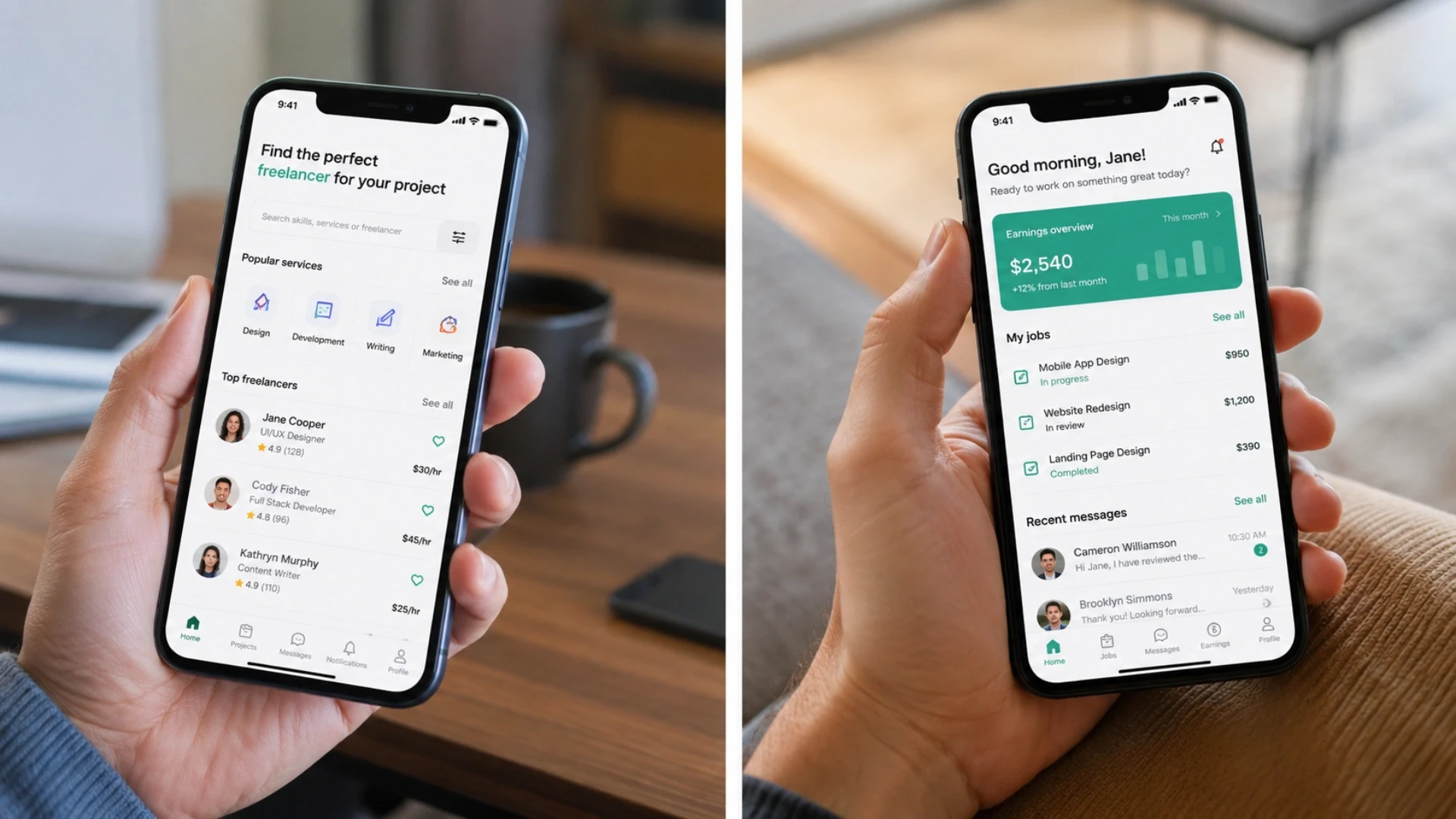
The question of what is a two-sided platform has a simple answer with deep consequences: it is a business whose product is the connection between two groups, not a thing it makes itself. A freelance marketplace owns no work and employs no freelancers; its asset is the smooth, trusted transaction between client and freelancer. That changes how it must be engineered, and it is why Acquaint Softtech models both sides as first-class systems from the start with a dedicated software development team.
Two-sided platforms live and die on network effects: each new freelancer makes the platform more useful to clients, and each new client makes it more attractive to freelancers. That flywheel is powerful once it spins, but it is brutally hard to start, which is the central challenge of the whole category. Designing for that dynamic, rather than just building screens, is why marketplace builds benefit from staff augmentation services that add marketplace-experienced engineers to the team.
It helps to study an adjacent multi-sided model to see the pattern. A food delivery platform connects diners, restaurants, and couriers, and faces the same need to balance supply and demand in real time. The guide on how to create an on-demand food delivery app like Uber Eats shows how a related multi-sided marketplace is structured, and many of those lessons transfer directly to a freelance platform.
How Upwork and Fiverr Actually Work
Understanding how Upwork works technically starts with seeing that Upwork and Fiverr use two different marketplace models, and choosing between them shapes your entire build. Upwork uses a bid model: clients post jobs, and freelancers submit proposals. Fiverr uses a catalogue model: freelancers list fixed-price gigs, and clients buy them like products.
Many modern platforms blend both, and a configurable foundation makes that possible, which is why some founders begin with white label software development to launch a branded marketplace quickly while keeping room to customise.
Dimension | Upwork (Bid Model) | Fiverr (Catalogue Model) |
Discovery | Client posts a job | Client browses gigs |
Initiation | Freelancer sends proposal | Client orders a fixed package |
Pricing | Negotiated, hourly or fixed | Set by freelancer per gig |
Best For | Complex, custom projects | Standardised, productised work |
The bid model suits complex, negotiated work where scope varies, so it needs proposals, messaging, and contract terms. The catalogue model suits standardised, productised services where the buyer knows exactly what they want, so it needs rich gig listings, packages, and fast checkout. Some founders test demand on a simple no-code or CMS-based site before committing to a custom platform, and teams that have outgrown a basic site often engage WordPress developers to bridge the gap before a full custom rebuild.
Once the model is proven and volume demands a real architecture, the move to a custom build becomes urgent, because a prototype cannot carry escrow, matching, and reputation at scale. For a complete view of taking a platform from idea to launch, the complete process of on-demand delivery app development lays out the phases in order, and the same disciplined sequencing applies to a marketplace.
The Liquidity Problem: Solving Chicken-and-Egg
Liquidity is the single most important word in marketplaces, and most founders ignore it until launch day, when the freelance marketplace business model meets cold reality: an empty platform helps no one. The way out is rarely to build more features; it is to manufacture early activity deliberately. Acquaint Softtech treats liquidity as a design problem, not just a marketing one, and engineers the platform to support a phased rollout, often delivered through software development outsourcing that lets founders move fast on a tight budget.
The proven tactics are well documented. Seed the harder side first, usually supply, by recruiting freelancers directly. Narrow the focus to a single niche or city, so the small early pool still feels full. Reduce friction so the first transactions actually complete. These moves are about concentrating activity until the flywheel catches, and getting the platform scoped to support them is exactly the work Acquaint Softtech runs in discovery workshops before development.
Founders who want the deeper playbook should study how successful marketplaces overcame the cold start. The venture firm NfX maintains a widely cited guide to marketplace chicken-and-egg tactics, and the patterns it describes- single-player utility, niche focus, and supply seeding- should shape the product roadmap as much as the architecture does.
Want a Marketplace Built to Reach Liquidity Faster?
Acquaint Softtech designs the two-sided architecture, escrow, and matching in the planning phase, before production code is written. 1,300+ projects delivered. Teams deployable within 48 hours of brief. Build the parts that actually make a marketplace work.
Core Workflow: From Job Post to Paid Deliverable
Following one engagement through the system shows where the project workflow for freelance apps gets its complexity. A client posts a job or buys a gig, a freelancer is engaged, and the two agree on scope, price, and milestones. From that point, the platform must hold a structured contract that both sides and the system can rely on. Acquaint Softtech builds the client and freelancer apps for this flow with React Native developers so both sides share one consistent, real-time view of the engagement.
Engage: A client posts a job and accepts a proposal, or buys a fixed-price gig directly.
Agree terms: Scope, price, and milestones are set, creating a contract record.
Fund escrow: The client deposits payment, which the platform holds in trust.
Deliver: The freelancer does the work and submits deliverables against each milestone.
Review: The client approves the work or requests revisions.
Release: On approval, escrow releases funds to the freelancer minus commission.
Close: Both parties rate each other, feeding the reputation system.
Running alongside every step is messaging and a shared contract, because most disputes start as miscommunication. A reliable, searchable message thread tied to the contract protects both sides and gives support the context to resolve issues. This real-time, stateful workflow rewards a backend tuned for live updates, which is why MEAN stack developers are a strong fit for the engagement pipeline.
The booking-to-fulfilment pattern here echoes other on-demand service platforms, where a request becomes a scheduled job that must be tracked to completion. The on-demand home services app development guide details a comparable job-to-completion workflow that maps cleanly onto freelance engagements.
The Escrow Engine: Milestones, Payments, and Disputes
.webp "The Escrow Engine")
Escrow is the beating heart of a freelance marketplace, and the part founders most often underestimate. Without it, a client risks paying for work that never arrives, and a freelancer risks delivering work that is never paid for. A proper escrow payment system design holds the client's money the moment a contract is funded, then releases it only when the agreed milestone is approved. Acquaint Softtech builds this financial core with Laravel developers, whose framework suits secure, rule-driven transaction logic.
Milestones are what make escrow practical for larger projects. Instead of one all-or-nothing payment, the work is split into stages, each funded and released in turn, which reduces risk for both sides and keeps projects moving. The engine must also handle the hard cases: partial releases, refunds, and a structured dispute process where both parties submit evidence and the platform or an arbiter decides. Keeping this engine correct and available under load is helped by DevOps engineering that hardens the payment and ledger services.
Building escrow from scratch is rarely wise, because moving and holding other people's money invites heavy regulation. Most marketplaces build on a payments platform designed for this, such as Stripe Connect, which provides marketplace payments and escrow-style flows with compliance handled. Choosing and integrating the right payment infrastructure early is one of the highest-leverage decisions in the entire build.
Get an Escrow and Payments Blueprint for Your Platform
Acquaint Softtech clients save up to 40% versus Western agency rates, with a 95% on-time sprint delivery record and a 4.9/5 Clutch rating from 50+ verified reviews. Book a scoping call and receive a detailed architecture and cost blueprint within 48 hours.
Trust and Reputation Systems
If escrow protects the money, reputation protects everything else. On a marketplace full of strangers, a client decides whom to hire and a freelancer decides which jobs to take based almost entirely on signals of trust. Reviews, ratings, verification badges, and completion history are not decoration; they are the infrastructure that lets transactions happen at all. Acquaint Softtech engineers these signals, including smart matching of reputation to relevance, with AI and ML engineers.
The trust signals a marketplace needs
Two-way reviews and ratings: Both client and freelancer rate each other after every engagement, building a track record.
Identity and skill verification: Verified identity, and where relevant verified skills or certifications, raise the floor of trust.
Completion and earnings history: Jobs completed, on-time rate, and total earned signal reliability at a glance.
Badges and tiers: Status levels reward consistent quality and give clients a quick quality filter.
Dispute and refund record: A transparent history of how issues were resolved keeps both sides accountable.
Reputation systems must also resist manipulation, because fake reviews and rating inflation can quietly destroy trust. Detecting suspicious patterns and keeping the signals honest is ongoing work, which is why Acquaint Softtech pairs the build with support and maintenance services that keep anti-fraud and review integrity current after launch.
Search, Matching, and Discovery
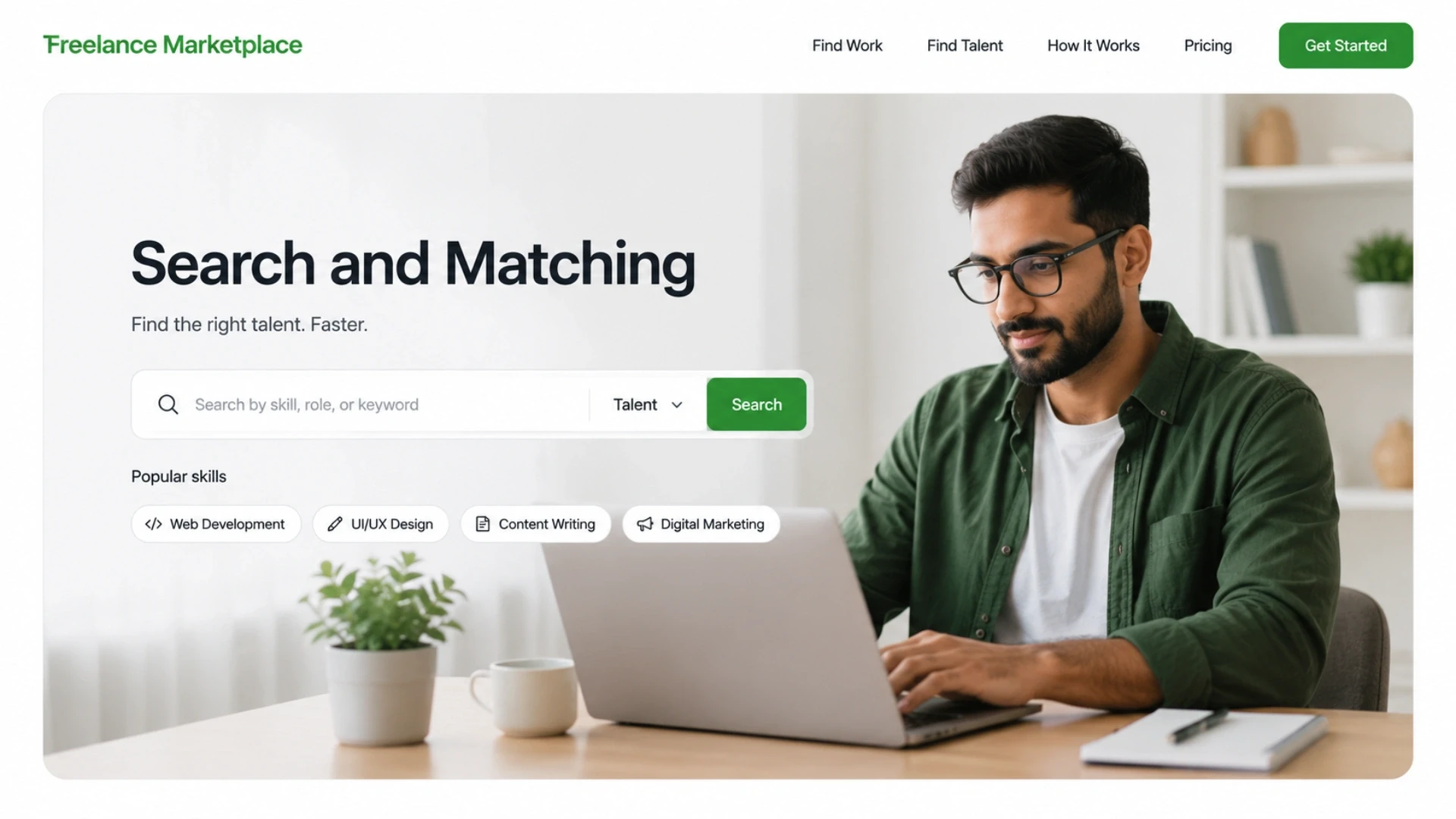
Discovery is where liquidity becomes usable. A platform can have thousands of freelancers, but if a client cannot quickly find the right one, the marketplace feels empty. Search must filter by skill, budget, rating, and availability, and ranking must surface genuinely relevant results rather than just the loudest profiles. Acquaint Softtech builds this search-and-ranking layer with Python developers who are comfortable with relevance scoring and recommendation logic.
The best platforms go beyond search to proactive matching: recommending freelancers to a posted job, or surfacing gigs to a browsing client, based on skills, history, and past success. This is a data problem that rewards a structured, queryable backend, which is why Django developers often build the matching and catalogue services where relational data and search intersect.
Good matching is ultimately about reducing time-to-transaction, the same goal that drives matching engines in other on-demand platforms where supply must meet demand quickly. The breakdown of the cost to develop an on-demand taxi booking application explains a comparable matching layer, and the principles of fast, relevant pairing carry directly into a freelance marketplace.
Tech Stack for a Marketplace in 2026
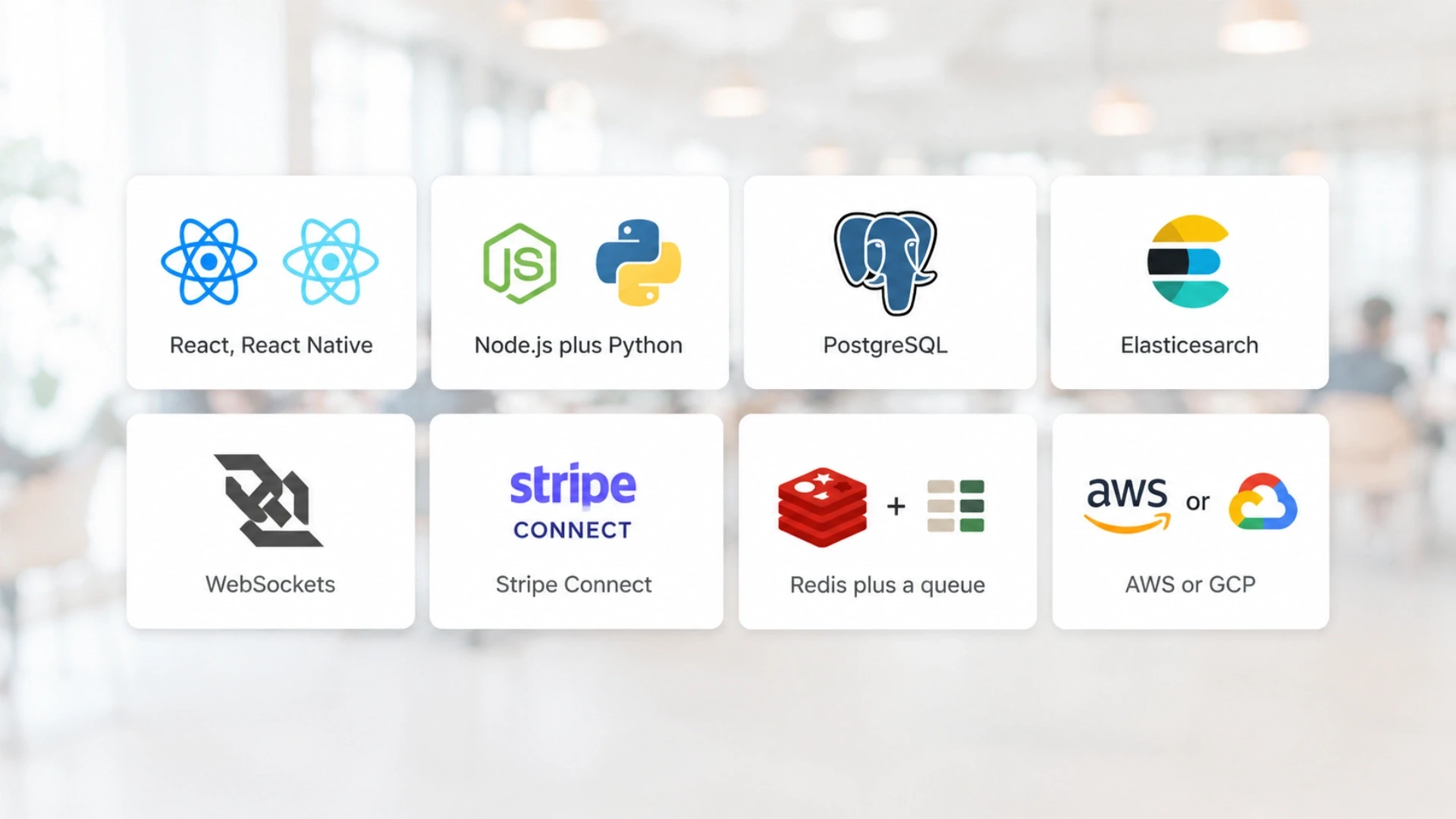
Technology choices for a freelance marketplace balance real-time interaction, search performance, and secure payments. The combinations below suit platforms aiming to scale across categories and regions. Quality and reliability matter enormously here because trust is fragile, so Acquaint Softtech bakes automated testing into the build with automation engineers who keep the critical escrow and contract flows regression-proof.
Layer | Recommended Technology | Why It Fits a Marketplace |
Web and Mobile | React, React Native | Shared code for client and freelancer apps |
Backend | Node.js plus Python | Real-time messaging plus matching logic |
Database | PostgreSQL | Relational data for contracts and profiles |
Search | Elasticsearch | Fast filtering across freelancers and gigs |
Real-time | WebSockets | Live messaging, notifications, and status |
Payments | Stripe Connect | Escrow-style flows and split payouts |
Cache and Queue | Redis plus a queue | Sessions, feeds, and background jobs |
Cloud | AWS or GCP | Scales with marketplace growth |
A marketplace backend is a set of cooperating services: identity, listings and search, contracts and escrow, messaging, reviews, and notifications, each scaled to its own load. As the platform grows across categories and geographies, parts of it will need upgrading and re-architecting, and Acquaint Softtech supports that evolution through version upgrade services that modernise the stack without disrupting live transactions.
Search deserves special attention because discovery quality directly drives liquidity, so a dedicated search engine like Elasticsearch usually earns its place early. The same real-time and scaling concerns appear in delivery platforms, and the breakdown of the cost to develop an on-demand courier services app details a comparable real-time, high-read architecture that a marketplace can learn from.
Cost to Build a Freelance Marketplace in 2026

Freelance marketplace development cost in India and other offshore hubs varies widely because a niche MVP and a multi-category global platform are different products. The ranges below reflect Acquaint Softtech project economics for dedicated teams, and the wise starting point is a focused MVP delivered through flexible engagement, often beginning with remote developers who prove the model in one niche before scaling.
Scope | Estimated Cost (India Team) | Timeline |
MVP: one model, escrow, reviews | $30,000 to $55,000 | 14 to 20 weeks |
Standard: bid plus catalogue, matching | $60,000 to $110,000 | 22 to 32 weeks |
Advanced: AI matching, disputes, analytics | $110,000 to $190,000 | 32 to 44 weeks |
Enterprise multi-category platform | $190,000 to $320,000+ | 44 to 60+ weeks |
Western agency rates for the same scope run 40 to 60% higher, driven by overhead rather than engineering quality. A team comparing where to hire developers for an Upwork clone should weigh delivered outcomes over hourly rate, because a cheap team that builds escrow or trust poorly creates risk and rework far larger than any saving. Setting the right technical direction early, sometimes with a virtual CTO service, protects the budget over the long run.
The factors that push marketplace cost up are specific: escrow and split payments are sensitive financial work, trust and anti-fraud systems take real engineering, search and matching are their own discipline, and supporting two distinct user types doubles the surface area.
Case Study: A Two-Sided Talent Platform
Theory matters less than a working system. The engagement below is a real, published Acquaint Softtech project that solves the same core problems a freelance marketplace faces: connecting two sides, matching talent to demand, role-based dashboards, real-time alerts, and automated workflows that build trust. You can read the full story at Scalable and Custom Construction Company Recruitment Engine.
Case Study: Salter Grange, Two-Sided Talent Platform
Client: Salter Grange, a fast-growing construction recruitment agency (Managing Director Marty McCoy).
Challenge: Salter Grange needed to turn fragmented, manual hiring into a single, scalable platform that connects two sides, skilled-trades candidates and employers, with automation, trust, and real-time visibility, without losing recruiter control or performance.
Approach: Acquaint Softtech built a centralised, secure platform unifying candidate sourcing, job tracking, and client communication. It added intelligent automation for shortlisting, status updates, and document validation, real-time alerts on new submissions, and role-based dashboards for recruiters, managers, and clients, all engineered to scale across volumes and regions.
Results: Fragmented hiring became faster closures with full visibility. The platform delivered real-time dashboards without performance trade-offs, enterprise-grade security for sensitive candidate data, and a modular architecture built to scale across more candidates, clients, and geographies.
Why It Matters for a Freelance Marketplace: The parallels are direct. Connecting candidates and employers maps to connecting freelancers and clients, automated shortlisting maps to matching, real-time alerts map to proposal and order notifications, and role-based dashboards map to the freelancer, client, and admin views every marketplace needs.
The two-sided matching, automation, and real-time visibility at the heart of this project are exactly what a freelance marketplace needs. Acquaint Softtech builds that capability through dedicated AI development services, pairing matching intelligence with the infrastructure that keeps a two-sided platform responsive at scale.
Founders should judge a partner by delivered outcomes rather than promises. A full library of verified engagements across marketplace, mobility, and healthcare work is available, and independent client ratings can be checked on the Acquaint Softtech Clutch profile, where the company holds a 4.9/5 score with Premier Verified status.
Why Acquaint Softtech for Marketplace Development
The architecture choices made in the first sprints of a marketplace build, the two-sided data model, the escrow engine, and the reputation system- set the platform's ceiling for growth and its trustworthiness. The partner who builds the MVP effectively owns both, so choosing a team with real two-sided platform experience is a long-term decision. Acquaint Softtech delivers that depth through full-cycle software product development tuned for marketplaces.
Three things matter most here. The first is direct delivery experience: over 13+ years and 1,300+ projects across 20+ industries, the team has built two-sided talent platforms, marketplaces, and on-demand systems for clients in the USA, UK, Europe, Australia, and New Zealand, including the matching, automation, and trust patterns described throughout this guide. The second is team stability, with an average engagement tenure of 24+ months, so the engineers who design your escrow engine are the ones who refine it as you scale, supported by experienced project managers who keep complex marketplace builds on track.
The third is speed without compromise: a dedicated team deploys within 48 hours of a signed brief, and the first sprint review happens in two weeks, materially faster than the four-to eight-week onboarding common at Western agencies.
Ready to Build a Marketplace That Reaches Liquidity?
Join 200+ technology companies that scaled with Acquaint Softtech. 1,300+ projects delivered. 4.9/5 Clutch rating. 50+ verified reviews. Teams deployable in 48 hours. The fastest path from idea to a production-ready two-sided marketplace.
Frequently Asked Questions
-
What is Upwork and how does it work?
Upwork is a global freelance marketplace that connects clients with skilled professionals. Clients post jobs and freelancers submit proposals to win work. Payments are securely handled through escrow or hourly tracking before funds are released. It works as a trust-based digital hiring system for remote work.
-
How does Upwork work technically?
Upwork runs on a two-sided marketplace system with real-time matching. Clients hire freelancers through bids or direct offers, and contracts are managed on-platform. Payments, messaging, and reviews are handled through a secure backend system. The platform continuously connects supply and demand using algorithmic matching.
-
How do freelancers get paid on Upwork?
Freelancers are paid through hourly or fixed-price contracts. Money is first held in escrow or tracked via work logs. After client approval, Upwork releases payment minus service fees. This ensures safe and transparent global transactions.
-
How to build a freelance marketplace like Upwork?
You need a client app, freelancer app, and admin panel on one backend. Core features include job posts, escrow payments, chat, search, and reviews. Launching in one niche helps solve early marketplace demand issues. This focus is key to achieving liquidity and user growth.
-
How much does an Upwork clone cost?
A basic MVP costs around $30,000 to $55,000. A mid-level platform ranges from $60,000 to $110,000 with advanced features. Enterprise platforms with AI matching cost $110,000+. Pricing depends on complexity and region of development.
-
What is escrow in Upwork?
Escrow is a secure payment system that holds client money before work begins. Funds are released only after milestone approval or project completion. It protects both freelancers and clients from fraud. This builds trust between unknown parties in online work.
-
Is Upwork safe for freelancers and clients?
Yes, Upwork is safe because it uses verified profiles, escrow payments, and dispute resolution. All transactions are tracked within the platform. This reduces risk between strangers working online. Safety systems are built into every contract flow.
-
How does Upwork match jobs with freelancers?
Upwork uses search filters, skills matching, and AI-based recommendations. Freelancers apply using “Connects” to bid on jobs. Clients select based on proposals, ratings, and portfolios. This improves hiring accuracy and speed on the platform.
-
Can I earn ₹1 lakh per month on Upwork?
Yes, it is possible with high-paying skills and consistent clients. Most freelancers reach it through 3–6 monthly retainers or high-value projects. Strong portfolios and niche expertise are key. Income grows with credibility and repeat clients.
-
What tech stack does Upwork use?
Upwork uses React and React Native for frontend apps. Backend runs on Node.js or Python with PostgreSQL and Elasticsearch. Stripe Connect, Redis, and AWS/GCP power payments, search, and scaling. This stack supports global-scale real-time marketplace operations.
I lead technology and client success at Acquaint Softtech with one goal in mind. Deliver work that feels personal, reliable, and worthy of long term trust. I stay close to both our clients and our developers to make sure every project moves with clarity, quality, and accountability.
Table of Contents
Get Started with Acquaint Softtech
- 13+ Years Delivering Software Excellence
- 1300+ Projects Delivered With Precision
- Official Laravel & Laravel News Partner
- Official Statamic Partner
Related Blog
The Complete Guide to On-Demand App Development in 2026
Not every on-demand app is Uber. Not every marketplace is Amazon. This 2026 guide maps every platform type, its architecture, real cost, and the cold-start sequence that separates launches that work from those that fail.

Acquaint Softtech
May 7, 2026
How Ride-Hailing Apps Work: Driver Matching, Tracking, and App Architecture
Ride-hailing apps are not simple taxi dispatchers. They are real-time logistics engines built on matching algorithms, GPS infrastructure, and dynamic pricing. Here is exactly how they work.
Manish Patel
May 14, 2026
Food Delivery App Like Zomato & DoorDash: Architecture, Features, and Scale
Zomato and DoorDash are not apps. They are data platforms. Every feature you see in the consumer interface is the output of a precisely designed data model, a set of platform entities with defined relationships, and a state machine with explicit transition rules. This guide walks through the data architecture, the platform design decisions, and the six scaling triggers that tell you when the platform needs to grow.
Manish Patel
May 21, 2026India (Head Office)
203/204, Shapath-II, Near Silver Leaf Hotel, Opp. Rajpath Club, SG Highway, Ahmedabad-380054, Gujarat
USA
7838 Camino Cielo St, Highland, CA 92346
UK
The Powerhouse, 21 Woodthorpe Road, Ashford, England, TW15 2RP
New Zealand
42 Exler Place, Avondale, Auckland 0600, New Zealand
Canada
141 Skyview Bay NE , Calgary, Alberta, T3N 2K6