

How Ride-Hailing Apps Work: Driver Matching, Tracking, and App Architecture
Ride-hailing apps are not simple taxi dispatchers. They are real-time logistics engines built on matching algorithms, GPS infrastructure, and dynamic pricing. Here is exactly how they work.

Manish Patel
As Head of Tech and Client Success at Acquaint Softtech, a software product development company with 1,300+ projects delivered across 13+ years, I evaluate the system architecture of on-demand platforms every week. The majority of founders who approach us to build a ride-hailing app underestimate what is actually running underneath Uber, Ola, or Lyft; they see a map and a button, and they believe that is what needs to be built.
What they do not see is how ride-hailing apps work: architecture, driver matching tracking, including the matching engine deciding in under 3 seconds, the GPS pipeline processing 5-second location pings from thousands of drivers simultaneously, and the dynamic pricing engine adjusting fares in real time based on demand and supply ratios. This article breaks down the full architecture of a production-grade ride-hailing platform, explains how driver matching and real-time GPS tracking work at a system level, and gives you the cost and team data you need to evaluate building one.
PROBLEM: You want to build a ride-hailing app, but every developer you speak to gives you a different estimate, a different tech stack, and a different definition of what the platform actually needs. The architecture questions remain unanswered: How does driver matching work? What infrastructure does real-time GPS need? Why do so many ride-hailing startups fail at scale.
AGITATE: Building on a misunderstood architecture costs 40% to 60% more to fix than to build the first time correctly. A matching algorithm that cannot scale past 500 concurrent drivers will fail publicly during your peak launch. A GPS pipeline built on polling instead of WebSockets will drain user batteries and collapse under load. These are not theoretical risks; they are the exact failure modes Acquaint Softtech inherits when clients come to us after a failed first build.
SOLUTION: This guide gives you the exact architecture layers, the driver matching logic, the GPS infrastructure design, and the cost data you need to build or evaluate a ride-hailing platform with confidence. Every section is written from delivery experience, not from documentation.

- Founders and product managers planning a ride-hailing platform from scratch.
- CTOs and engineering leads scaling apps beyond 10,000 concurrent rides.
- Businesses evaluating taxi app development vendors and technical capabilities.
- Teams learning from Uber, Ola, and Lyft to build unique solutions.
A ride-hailing app is more than a map-based booking app. It is a real-time logistics platform connecting riders, drivers, and a dispatch system that must respond within seconds at scale. While the user only sees the app interface, the real complexity lies in the matching engine, GPS tracking, surge pricing, and payment systems. Building a basic MVP is relatively simple, but creating a platform that can reliably handle 10,000+ concurrent rides without failures is a far more advanced engineering challenge. Understanding that problem is why you are reading this. To understand the full context of on-demand platform development, see the complete guide to on-demand app development in 2026.
The architecture breakdown begins with the five layers that every production-grade ride-hailing system requires. If your current vendor proposal does not address all five, the proposal is incomplete. You can also evaluate your options to hire React Native developers with on-demand platform experience to verify the architecture before committing.
The Five-Layer Architecture of a Ride-Hailing Platform
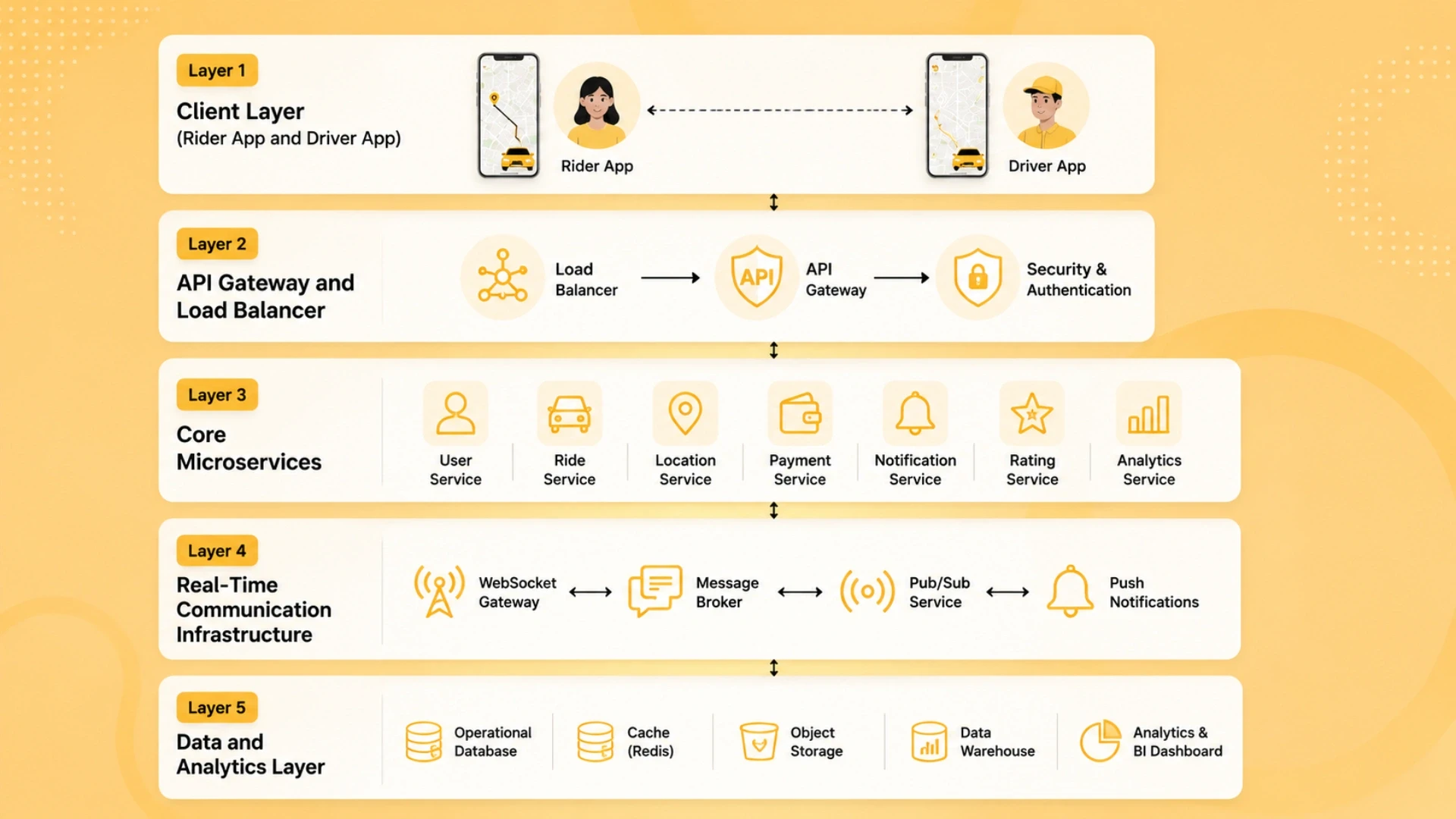
A ride-hailing platform is not a single application. It is five interconnected service layers, each with its own infrastructure requirements, data contracts, and failure modes. Understanding what each layer does is the prerequisite for evaluating any vendor proposal or architecture diagram.
Layer 1: Client Layer (Rider App and Driver App)
The rider app handles booking, live tracking, fare display, and payments, while the driver app manages trip acceptance, navigation, earnings, and availability. Both apps communicate with the backend only through APIs, with all trip state managed server-side. Acquaint Softtech builds both apps on React Native for faster cross-platform delivery, reducing development time by 30% to 40% compared to separate native apps. Businesses looking to scale backend and frontend operations can also hire MERN stack developers for full-stack on-demand platform development.
Layer 2: API Gateway and Load Balancer
The API gateway is the single entry point for all client requests. It handles authentication (JSON Web Token validation), rate limiting, request routing, and SSL termination. The load balancer distributes incoming traffic across backend service instances. During peak demand, a production-grade ride-hailing platform can receive 50,000 to 200,000 API calls per minute. Without a properly configured API gateway and auto-scaling load balancer, the platform collapses at exactly the moment it is needed most.
Layer 3: Core Microservices
This is where the platform logic lives. The core services include the matching service (pairs riders to drivers), location service (stores GPS updates), pricing service (calculates fares and surge pricing), trip service (manages ride lifecycle), payment service (handles charges and refunds), and notification service (sends real-time updates). These services run independently and communicate through Kafka or RabbitMQ, preventing one service failure from affecting the entire system. Many companies also hire Python developers to build scalable backend microservices for ride-hailing platforms.
Layer 4: Real-Time Communication Infrastructure
The rider needs to see the driver moving on the map. The driver needs to receive trip requests in under 3 seconds. Both require persistent real-time connections, not HTTP polling. WebSocket connections (or Server-Sent Events for one-way streams) are the correct infrastructure here. A platform using HTTP polling for location updates will consume 3x to 5x more server resources than one using WebSockets, and will introduce a 2-second to 10-second location lag that makes the rider-facing map useless.
Layer 5: Data and Analytics Layer
The data layer handles three distinct workloads: transactional data (PostgreSQL for trip records, user accounts, and payments), real-time spatial data (Redis for in-memory driver locations and geospatial indexing), and analytical data (a separate data warehouse for demand pattern analysis, driver behaviour scoring, and surge pricing calibration). Many early-stage ride-hailing builds collapse this into a single database. That decision works for the first 5,000 trips and fails for the first 500,000. Acquaint Softtech's product engineering services and expertise to hire Laravel developers help businesses design scalable data architectures from the start instead of treating separation as a post-launch fix.
The table below summarises each layer, the technology decision point, and the failure risk when the layer is underbuilt.
Layer | Function | Key Tech | Failure Risk |
Client Layer | Rider and driver interfaces; API communication | React Native, Swift, Kotlin | Poor UX; location drift on the driver map |
API Gateway | Auth, routing, rate limiting, load balancing | Kong, AWS API Gateway, NGINX | Platform collapse at peak traffic |
Core Microservices | Matching, location, pricing, trip, payment | Node.js, Python, Go; Kafka event bus | Cascade failures; unhandled edge cases |
Real-Time Infra | WebSocket connections for live location and trip events | Socket.IO, AWS WebSocket API, Redis Pub/Sub | Location lag, battery drain, and UX failure |
Data Layer | Transactional, spatial, and analytical workloads | PostgreSQL, Redis, BigQuery or Redshift | Scaling wall at ~500K trips |
Want to See What a Production-Grade Ride-Hailing Architecture Looks Like for Your Use Case?
Acquaint Softtech delivers a detailed architecture review and team structure within 48 hours. The review covers all five layers, identifies the gaps in any existing proposal, and gives you a concrete cost range. You interview the tech lead before committing to any engagement.
How Driver Matching Works: The Algorithm Behind the 3-Second Decision
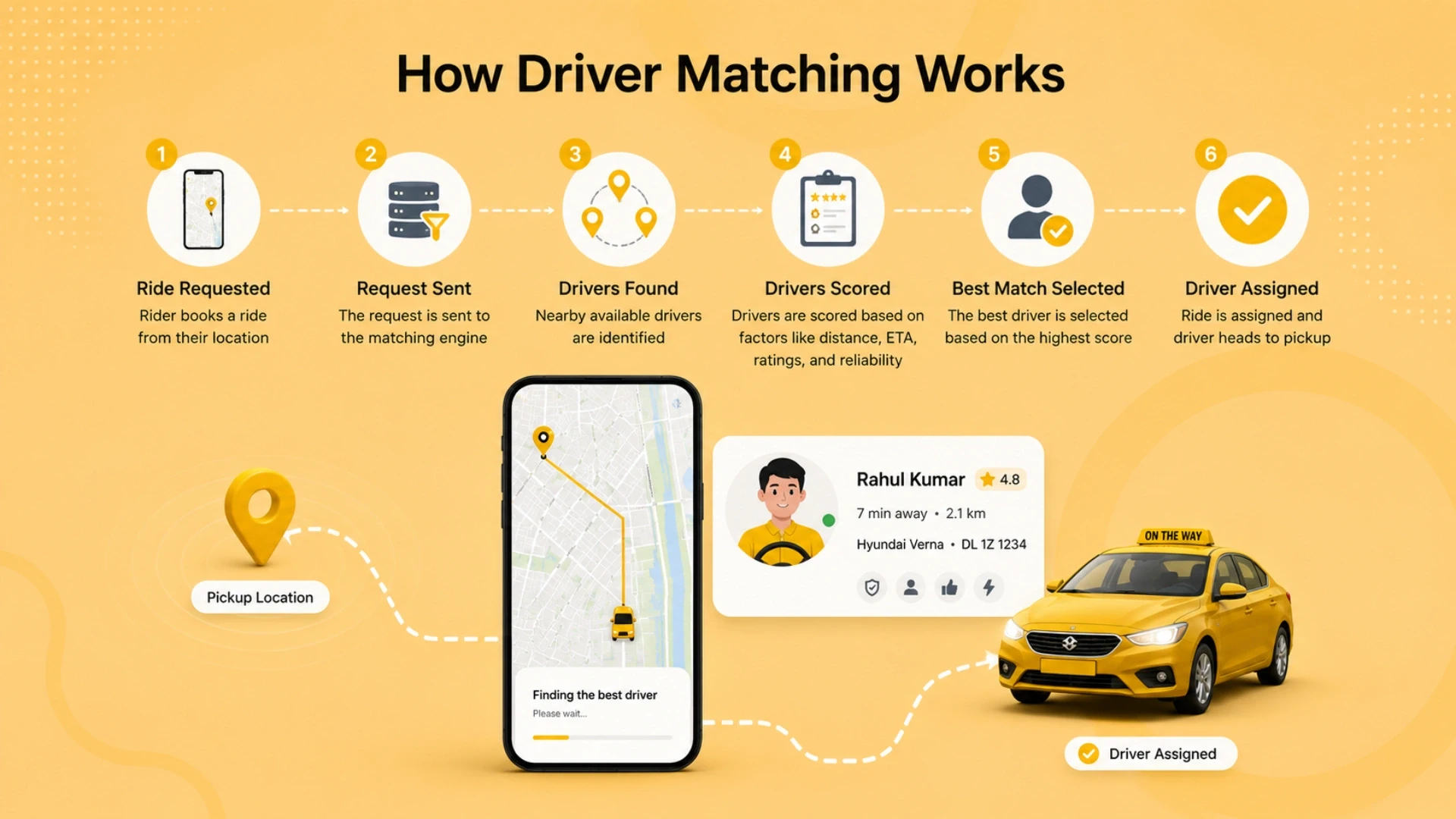
The matching service is the intellectual core of any ride-hailing platform. It answers one question under time pressure: which available driver, in which location, with which vehicle type, should be assigned to which rider request, to minimize wait time, maximize driver utilization, and maximize the probability of trip acceptance. This is not a simple nearest-driver query. It is a constrained optimization problem run in real time.
Step 1: Geospatial Indexing of Available Drivers
When a driver toggles online, their location is written to a Redis Sorted Set using a geohash or the Redis GEOADD command. This allows the matching service to run a geospatial query, 'give me all drivers within 2 km of this rider', in under 10 milliseconds at any scale. The matching service does not read from the primary PostgreSQL database for this query. It reads from Redis. This separation is the reason Uber can match a rider in Lagos at the same speed as a rider in London, regardless of database size.
Step 2: Candidate Pool Construction
The matching service builds a candidate pool of 10 to 30 available drivers within the search radius. Each driver is scored based on straight-line distance to the rider (around 40%), estimated travel time using live traffic data (around 35%), driver acceptance rate history, and driver rating, where drivers below 4.5 stars are deprioritized. The scoring weights are configurable and adjusted based on city demand patterns. Teams building these advanced dispatch and matching systems often use staff augmentation services to quickly scale engineering capacity for real-time platform development.
Step 3: Sequential Dispatch
The matching service does not broadcast the trip request to all candidates simultaneously. It dispatches to the highest-scoring driver first and waits 10 to 15 seconds for acceptance. If the driver does not accept, the request moves to the second candidate. This sequential dispatch model prevents the 'thundering herd' problem, where 20 drivers all accept the same trip, causing 19 cancellations and a poor user experience. Sequential dispatch is the correct architecture. Broadcast dispatch is the common mistake in under-resourced builds.
Step 4: Fallback and Timeout Logic
If the matching service exhausts the candidate pool without a match (all drivers declined or no drivers in range), the rider receives a 'no drivers available' notification, and the system re-enters a 30-second retry loop with an expanded search radius. This fallback logic is essential. A matching service without explicit fallback handling produces silent failures, where the rider waits indefinitely with no feedback. Based on Acquaint Softtech delivery data across 1,300+ projects, timeout and fallback handling are the most commonly missing components in first-version ride-hailing builds.
The table below compares the correct matching architecture against the common shortcuts taken in MVP builds.
Dimension | Production Architecture | Common MVP Shortcut |
Driver index | Redis Geospatial (GEOADD/GEORADIUS). Millisecond queries at any scale. | PostgreSQL proximity query. Slow at 5,000+ drivers. |
Dispatch mode | Sequential: highest-score driver first. 10-15 second acceptance window. | Broadcast: all candidates notified at once. Causes cascade cancellations. |
Scoring factors | Distance, ETA, acceptance rate, rating. Configurable weights. | Distance only. Simple nearest-driver logic. |
Fallback | Explicit timeout logic with expanded radius retry and rider notification. | Silent failure. Rider sees spinner indefinitely. |
Scaling | Stateless matching service. Horizontally scalable behind a load balancer. | Single-process matching. Fails above 500 concurrent requests. |
The matching architecture directly determines the rider experience. A well-built matching service produces average wait times of 2 to 4 minutes in a city with 500+ active drivers. A poorly built one produces 8 to 15 minutes, even with the same number of drivers. If you are evaluating the building of an Uber clone in 2026 decision, the matching service quality is the first technical differentiator to evaluate.
Real-Time Location Tracking: GPS Infrastructure, WebSockets, and Data Flow
Real-time location tracking is the feature riders notice most. A driver moving smoothly on the map creates trust. A driver teleporting across the screen in 10-second jumps creates anxiety and cancellations. The difference is not the GPS hardware — it is the architecture of the location update pipeline between the driver app and the rider's screen.
The Location Update Pipeline
The driver app sends a GPS coordinate update every 3 to 5 seconds. At 1,000 active drivers, that is 200 to 333 location updates per second arriving at the location service. The location service writes each update to two destinations simultaneously: Redis (for live driver position queries used by the matching service) and a time-series data store (for trip replay, dispute resolution, and analytics).
This type of scalable infrastructure is commonly used in white-label software development projects where high-volume real-time tracking is required. The location service does not write to PostgreSQL for live updates because PostgreSQL cannot sustain 300+ writes per second per driver at production scale without significant performance degradation.
WebSocket vs HTTP Polling: The Right Choice
The rider app tracks the driver in near real time using WebSockets, which maintain a constant connection and push live location updates instantly. Compared to HTTP polling, WebSockets reduce server load, save battery, and provide faster updates. Production platforms typically use WebSockets for live map tracking and Server-Sent Events (SSE) for trip status notifications like ride accepted or driver arriving.
Map Rendering: Google Maps vs Mapbox vs Custom Tile Server
The rider and driver apps both require a map renderer. Google Maps API is the most common choice for new builds because of its accuracy, global coverage, and familiar UX. The cost is $7 per 1,000 map loads. At 50,000 daily active users, that is $350 per day in map costs, before directions API calls. Mapbox costs $0.50 per 1,000 map loads and offers more visual customization. For platforms in a single country or city, a self-hosted OpenStreetMap tile server costs approximately $200 to $400 per month in infrastructure and eliminates per-load charges. Choosing the wrong mapping provider at the MVP stage is a common source of cost overrun at scale. Acquaint Softtech's hire dedicated React Native developers teams to evaluate mapping cost-per-scale as a design-phase decision for every ride-hailing build.
ETA Calculation and Route Optimization
The ETA (Estimated Time of Arrival) shown to the rider is not the raw GPS distance divided by average speed. It is a route-aware calculation using current traffic data. Production platforms call the Directions API (Google or Mapbox) at the moment of matching to get the actual ETA, then recalculate every 60 to 90 seconds during the trip. The ETA shown to the rider is always the directions-API ETA, never a straight-line estimate. A platform showing straight-line ETAs loses rider trust within the first week of operation.
Surge Pricing Logic: How Supply, Demand, and External Events Set the Fare
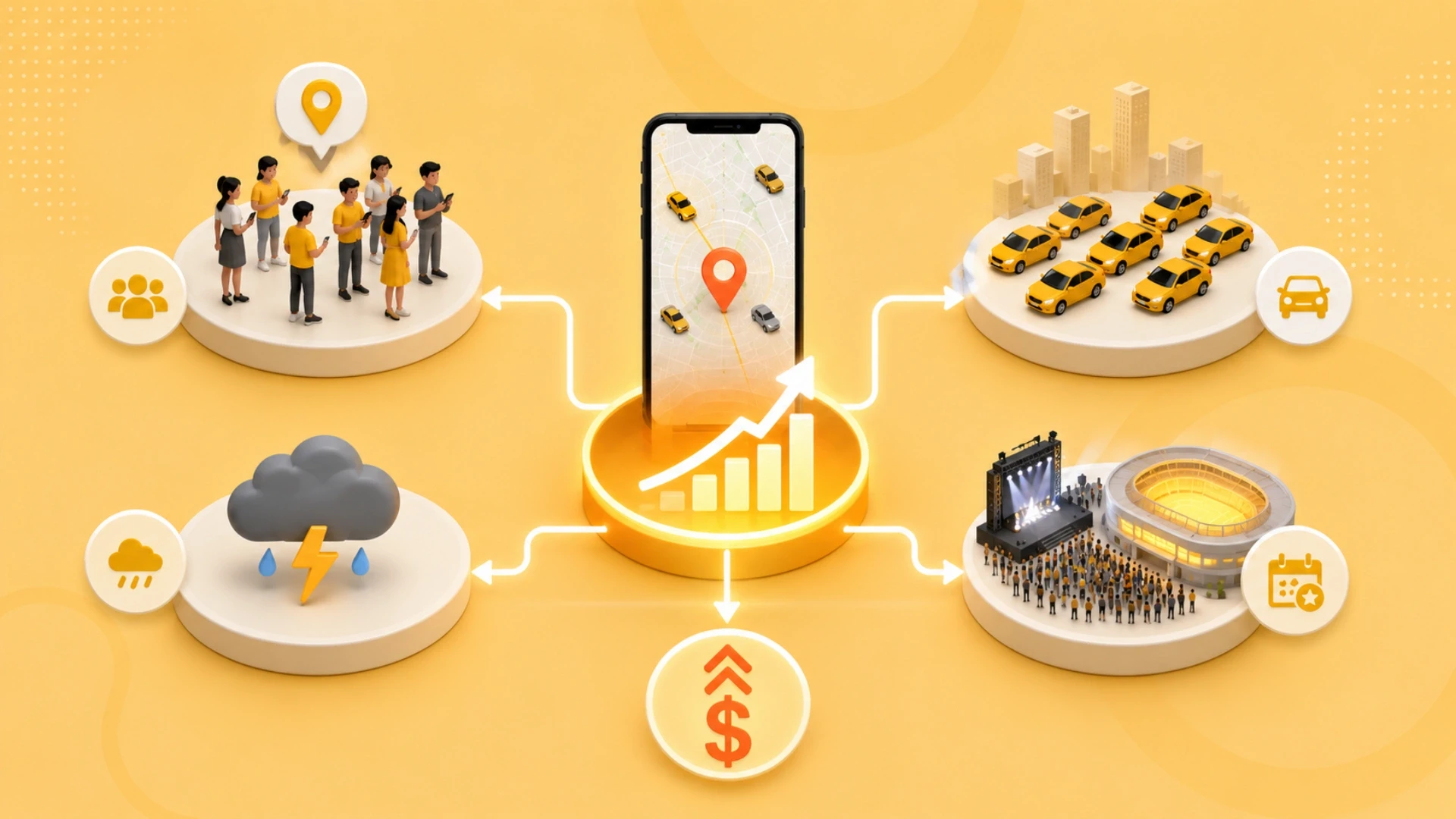
Surge pricing is the mechanism that balances driver supply against rider demand in real time. It is not a manual override or a marketing feature. It is an automated control system that increases fares when demand exceeds supply to attract more drivers into the area, reduce demand to a level the available supply can serve, and protect the platform's fulfillment rate during peak periods.
The Surge Multiplier Calculation
The pricing service divides the operational area into a geohash grid. Each grid cell has a supply-demand ratio calculated every 60 seconds: (active ride requests in cell) divided by (available drivers in cell). A ratio below 0.7 produces a 1.0x multiplier (base fare). A ratio between 0.7 and 1.2 produces a 1.2x to 1.5x multiplier. A ratio above 1.2 produces a 1.5x to 2.5x multiplier. These thresholds are configurable per city and per time-of-day profile.
The key rule: surge pricing requires at least 15 minutes of demand pattern data before activating, to prevent spurious spikes from triggering unnecessary surges. Many companies also hire AI/ML engineers to improve demand forecasting and optimize dynamic pricing accuracy at scale.
External Event Integration
A mature surge pricing engine also ingests external event signals: stadium events (from a calendar API or manual entry), public transport disruptions (from a transit API), and severe weather alerts (from a weather API). When these signals are present, the pricing service can pre-warm surge zones before demand peaks, rather than reacting after drivers are already overwhelmed. This is the architectural difference between Uber's surge pricing and that of most Uber clones. Most clones react to demand. Production platforms anticipate it. For the full technical breakdown of surge pricing architecture, the building a surge pricing engine topic in this cluster covers the implementation details.
Rider App, Driver App, and Admin Panel: What Each Component Does
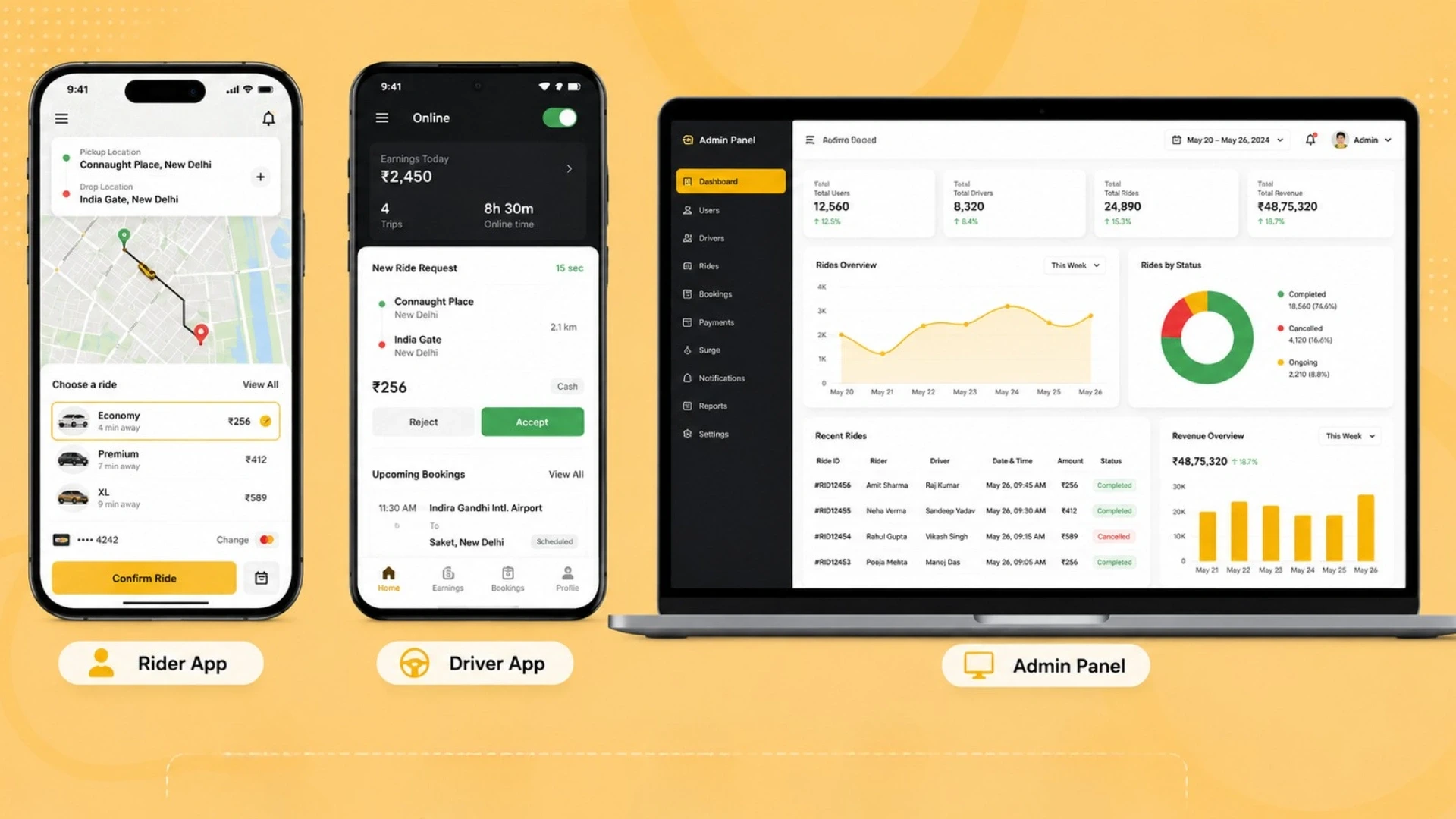
A ride-hailing platform has three distinct interfaces. Each has a different user, a different set of data requirements, and a different architecture pattern. Building all three correctly requires understanding what each component actually does, not just what features it shows.
The Rider App
The rider app covers six primary flows: booking (set pickup and destination, see fare estimate, confirm request), live tracking (see driver moving on the map in real time), in-trip status (ETA updates, route changes, arrival notification), payment (card on file, wallet, or cash confirmation), rating and feedback, and trip history. The rider app communicates with the backend through REST API calls for booking actions and WebSocket subscriptions for live tracking data. Acquaint Softtech's mobile app development services for on-demand platforms always include offline-graceful degradation: the rider app displays the last known driver position when the WebSocket connection drops, rather than showing an error.
The Driver App
The driver app covers: availability toggle (online/offline), trip request display (pickup point, fare preview, acceptance window), turn-by-turn navigation (integrated Mapbox or Google Maps navigation SDK), earnings dashboard (daily and weekly earnings, trip count, rating), and offline mode (the app queues acceptance and status events if the driver loses connectivity and replays them when reconnected). The offline mode is not optional for markets in Southeast Asia, Africa, or India, where network quality is variable. A driver app without offline resilience produces trip failures in low-connectivity areas and driver complaints that damage the platform's NPS (Net Promoter Score).
The Admin Panel
The admin panel serves three groups of internal users: operations (live fleet map, active trip monitoring, manual trip override), support (dispute resolution, fare adjustments, account suspension), and finance (revenue reconciliation, driver payout processing, refund management). The admin panel is the most underbuilt component in the majority of first-version ride-hailing platforms.
It is typically built as an afterthought, resulting in support teams doing manual database queries to resolve disputes. A well-built admin panel reduces support ticket resolution time from 2 to 3 hours to 10 to 15 minutes. For a related example of how Acquaint Softtech approaches platform operations tooling, see the aviation safety software case study, which required a similarly complex operations and audit panel.
What Does It Cost to Build a Ride-Hailing App in 2026?
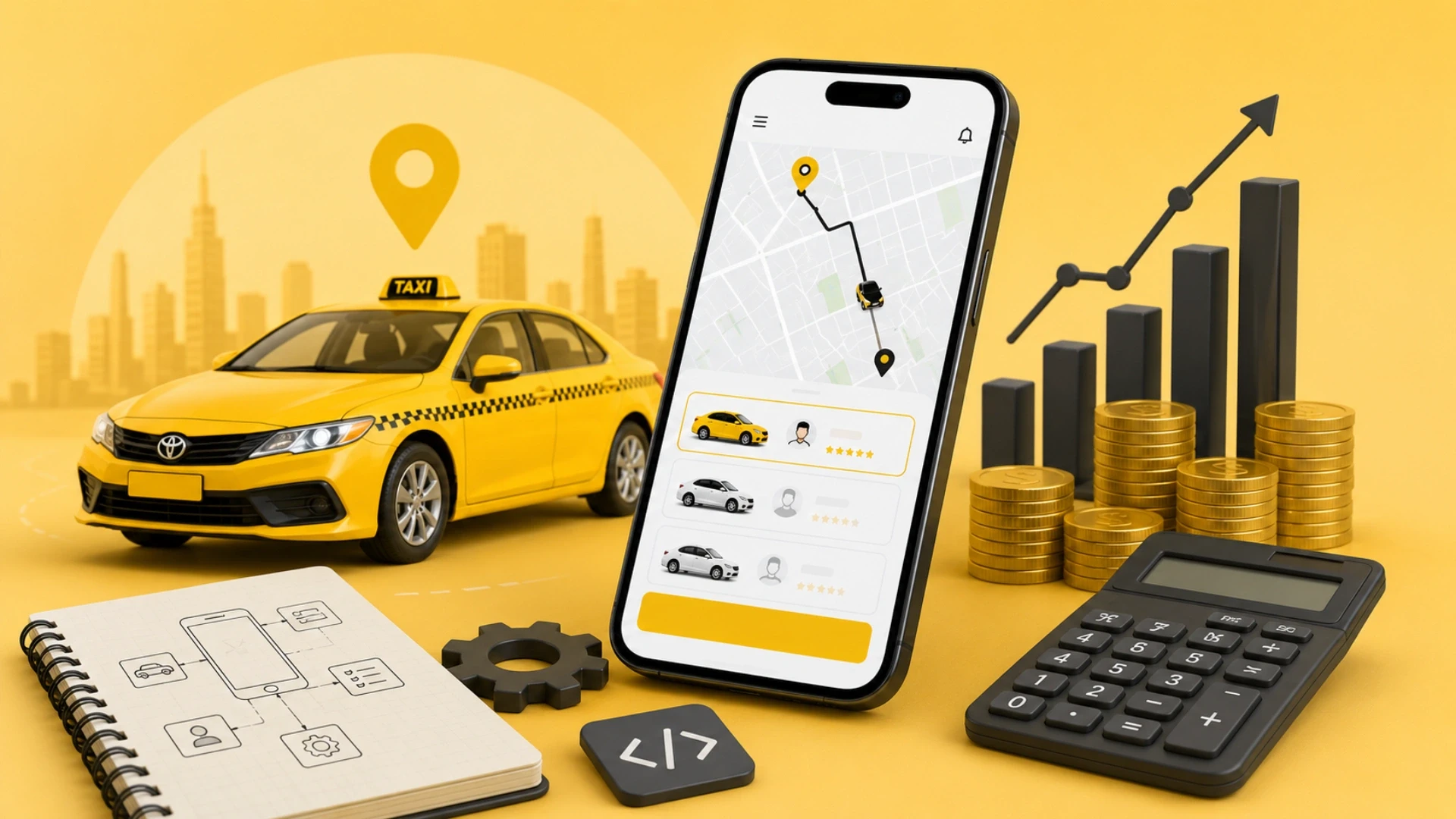
NThe cost to build a ride-hailing platform depends on four variables: the number of cities at launch (single-city vs multi-city requires different geospatial architecture), the matching algorithm complexity (basic nearest-driver vs full scoring model), the mapping provider choice (Google Maps vs Mapbox vs self-hosted), and the team location (India-based teams cost 40% to 60% less than US or UK-based teams for equivalent delivery quality). Based on Acquaint Softtech delivery data across 1,300+ projects, the ranges below reflect what clients actually spend, not what a vendor's intake form estimates.
Tier | Build Cost | In-House Equiv. | Timeline | Team Size |
MVP (1 city, basic matching) | $25,000 to $45,000 | $90,000 to $140,000 | 14 to 20 weeks | 4 to 5 devs |
Mid-market (multi-city, scoring model, surge pricing) | $55,000 to $95,000 | $180,000 to $260,000 | 24 to 34 weeks | 7 to 9 devs |
Enterprise (10+ cities, ML matching, full analytics) | $110,000 to $200,000 | $400,000 to $600,000 | 40 to 60 weeks | 12 to 18 devs |
The in-house equivalent cost assumes US or UK market salaries. Acquaint Softtech clients building in India typically achieve the same output at 40% to 60% of the in-house cost. The rate the client pays is the all-inclusive monthly rate, with no employer overhead, equipment, or office costs added on top. Businesses can also hire DevOps developers through Acquaint Softtech to streamline infrastructure, deployment, and scalability for Uber-like app development. The engagement begins within 48 hours of team approval.
What the Monthly Rate Includes at Acquaint Softtech
React Native mobile developers for rider and driver apps
Node.js or Python backend engineers for core microservices
DevOps engineer for infrastructure, CI/CD, and WebSocket scaling
QA (Quality Assurance) engineer for location tracking accuracy and matching regression tests
A tech lead who owns architecture decisions and communicates directly with the client
Weekly sprint reviews, deployment every 2 weeks, full source code ownership from day one
Answered Yes to 3 or More of the Cost Questions? Let Us Build You a Ride-Hailing Team.
Acquaint Softtech sends a team structure, developer profiles, and a cost breakdown for your specific platform within 48 hours. The client interviews the tech lead and developers before the engagement starts. No engagement begins without explicit client approval.
The 5 Questions That Tell You Whether You Are Ready to Build
Before scoping a ride-hailing platform build, these five questions determine whether your current plan is ready to execute or needs further architecture validation. Each question has a direct Yes/No answer below it.
Does your vendor proposal address all five architecture layers explicitly?
Yes: proceed. The proposal is complete enough to evaluate on the team and cost.
No, the proposal is incomplete. A proposal that does not name the real-time communication layer, the data layer separation, or the matching service architecture is missing 60% of the technical problem.
Does your matching algorithm design include fallback and timeout logic?
Yes: the matching service is production-aware. Proceed to cost and timeline evaluation.
No: request an explicit fallback specification before agreeing to a scope. A matching service without fallback produces silent user-facing failures at launch.
Is your location update pipeline WebSocket-based, not HTTP polling?
Yes: the real-time infrastructure is correctly designed. Battery drain and server load will be manageable at scale.
No: require the vendor to redesign this before the build starts. HTTP polling for live location is technically incorrect and will need to be rebuilt at the first scale threshold.
Have you calculated your per-ride mapping API cost at your target scale?
Yes: proceed. You have a realistic infrastructure cost model.
No: model it now. A platform doing 5,000 rides per day on Google Maps API will spend $1,400 to $2,100 per month on mapping alone, before directions API calls. This is a common unbudgeted cost that appears 6 months into operation.
5. Does your budget include a dedicated admin panel with fleet management and dispute resolution?
Yes, your operations team will be able to manage the platform without engineering involvement.
No: add it to the scope. A ride-hailing platform without an operations panel requires engineering intervention for every dispute, every manual fare adjustment, and every driver suspension.
If you answered No to 2 or more of these questions, your current build plan has material risks. Acquaint Softtech provides a discovery workshop service specifically designed to close these gaps before development begins, typically in 5 to 10 business days.
Ready to Build a Ride-Hailing Platform That Handles Real Scale from Day One?
Acquaint Softtech delivers a team structure, architecture brief, and developer profiles within 48 hours. The client reviews and interviews the team before the first sprint begins. There is no commitment until the client approves. The engagement starts 48 hours after approval.
Frequently Asked Questions
-
How does Uber match drivers to riders?
Uber’s matching engine uses a geospatial index to find nearby available drivers and ranks them based on distance, traffic-adjusted ETA, acceptance rate, and driver rating. The top driver gets the request first, and if they do not accept within 10 to 15 seconds, the request moves to the next driver. This sequential dispatch system avoids duplicate trip acceptance. The entire matching process completes in under 3 seconds, while horizontal scaling helps maintain speed during peak demand and high concurrent ride volume.
-
What algorithms power ride-hailing apps?
A production ride-hailing platform runs four separate algorithmic services: driver matching using geospatial ranking, surge pricing that updates fares every 60 seconds based on supply-demand ratios, ETA calculation using real-time routing data recalculated every 60 to 90 seconds, and route optimization for the fastest or most cost-effective path. These services share state through Redis but operate independently without directly calling each other.
-
How do apps track driver location in real time?
Ride-hailing apps track driver locations by sending GPS updates every 3 to 5 seconds through the device’s location API. These updates are transmitted via WebSocket connections for faster real-time communication, then stored in Redis for live tracking and in time-series databases for analytics and trip history.
-
How much does it cost to build a taxi app like Uber?
A taxi app like Uber costs around $25,000 to $45,000 for a single-city MVP with basic matching and GPS, built in 14 to 20 weeks by an India-based dedicated team. A multi-city platform with advanced matching, surge pricing, and analytics costs $55,000 to $95,000 over 24 to 34 weeks. Enterprise-grade platforms for 10+ cities with ML-based matching and data warehousing cost $110,000 to $200,000 over 40 to 60 weeks.
-
What tech stack is best for a ride-hailing app in 2026?
Acquaint Softtech recommends React Native for rider and driver apps, Node.js or Python for backend microservices, Kafka or RabbitMQ for service communication, Redis for real-time driver tracking, PostgreSQL for transactions, and Socket.IO or AWS WebSocket API for live connections. For maps, Google Maps is easiest to start, Mapbox is more cost-effective at medium scale, and self-hosted OpenStreetMap is cheapest at large scale. This is one of the most proven tech stacks for building scalable ride-hailing platforms.
-
How long does it take to build a ride-hailing app from scratch?
A single-city ride-hailing MVP with rider and driver apps, matching, GPS tracking, payments, admin panel, and QA takes around 14 to 20 weeks with 4 to 5 engineers. A scalable multi-city platform with advanced matching, surge pricing, and analytics takes 24 to 34 weeks with 7 to 9 engineers. Timeline mainly depends on matching complexity, payment integrations, and admin panel customization. Acquaint Softtech can deploy the first developer within 48 hours of approval.
-
What is the difference between a ride-hailing app and a taxi dispatch system?
A ride-hailing app is a marketplace where drivers accept or reject ride requests, requiring real-time matching, driver acceptance flow, and dynamic pricing. A taxi dispatch system is fleet-managed, where operators assign rides directly to drivers without acceptance. Ride-hailing focuses on automated matching, while taxi dispatch focuses on booking and fleet management.
-
Can I start with an MVP and scale the architecture later?
Yes, but core scaling decisions must be planned during MVP development. Real-time systems like Redis, WebSockets, and stateless matching services should be included from the start to avoid costly rebuilds later. Acquaint Softtech builds MVPs on production-ready architecture with simplified business logic, making future scaling easier and reducing technical debt.
I lead technology and client success at Acquaint Softtech with one goal in mind. Deliver work that feels personal, reliable, and worthy of long term trust. I stay close to both our clients and our developers to make sure every project moves with clarity, quality, and accountability.
Table of Contents
Get Started with Acquaint Softtech
- 13+ Years Delivering Software Excellence
- 1300+ Projects Delivered With Precision
- Official Laravel & Laravel News Partner
- Official Statamic Partner
Related Blog
.webp "How To Create an On-Demand Food Delivery App Like Uber Eats (2026 USA Guide)")
How To Create an On-Demand Food Delivery App Like Uber Eats (2026 USA Guide)
Building an app like Uber Eats means creating a multi-sided ecosystem of four interfaces: a customer app, a delivery driver app, a restaurant dashboard, and a central admin panel. A custom-coded MVP typically costs $75,000 to $120,000 (much less with no-code tools), and success depends on smart market positioning, core feature implementation, and US legal compliance. The proven path is to pick a niche, handle legal requirements, choose your build approach, ship a focused MVP, then test rigorously.

Mukesh Ram
October 16, 2019
The Complete Guide to On-Demand App Development in 2026
Not every on-demand app is Uber. Not every marketplace is Amazon. This 2026 guide maps every platform type, its architecture, real cost, and the cold-start sequence that separates launches that work from those that fail.

Acquaint Softtech
May 7, 2026.webp "How To Hire a Top On-Demand App Development Company (2026 Guide)")
How To Hire a Top On-Demand App Development Company (2026 Guide)
An on-demand app development company builds custom software that connects users with instant services, goods, or transport through real-time digital platforms. These agencies handle the multi-sided architecture behind customer apps, service-provider dashboards, and admin panels. To hire the right one, research the market, set your priorities, make inquiries, check credentials, and choose the apt partner. Core features include real-time GPS tracking, secure payments, push notifications, and admin dashboards.
Mukesh Ram
October 24, 2019India (Head Office)
203/204, Shapath-II, Near Silver Leaf Hotel, Opp. Rajpath Club, SG Highway, Ahmedabad-380054, Gujarat
USA
7838 Camino Cielo St, Highland, CA 92346
UK
The Powerhouse, 21 Woodthorpe Road, Ashford, England, TW15 2RP
New Zealand
42 Exler Place, Avondale, Auckland 0600, New Zealand
Canada
141 Skyview Bay NE , Calgary, Alberta, T3N 2K6