

How to Build an OTA: Online Travel Agency Architecture for Flight, Hotel & Package Booking
Most OTA builds fail not on the booking logic but on the integration layer. Here is the complete architecture map, GDS, hotel aggregation, package bundling, payments, and what each module actually costs to build in 2026.

Manish Patel
As Head of Tech and Client Success at Acquaint Softtech, a custom software product development company with 1,300+ projects delivered across 13+ years, I review OTA (Online Travel Agency) architecture decisions and travel marketplace builds every quarter. Founders building OTA platforms often underestimate the integration layer. While learning how to build OTA online travel agency architecture, they usually plan the UI and booking flow well, but later face complex GDS APIs, hotel aggregator integrations, and real-time pricing sync challenges that expand the project scope. This guide covers the core OTA architecture, costs, timelines, and key technical decisions needed to build a scalable travel platform.

- Travel companies are hiring skilled developers for OTA and booking marketplace platforms.
- CTOs scaling GDS, hotel feed, and travel API integration systems.
- Agencies replacing white-label booking tools with custom OTA platforms.
- Engineering teams building travel booking architecture and supplier connectivity modules.
THE REAL PROBLEM WITH OTA BUILDS
You are watching the travel technology landscape shift, and you are not sure which of it is noise and which is real.
Your competitors are talking about AI-powered trip personalisation, voice search for flights, and real-time bundle optimisation. Your investors are asking whether your tech stack can support the same itinerary flexibility that Booking.com and Expedia have built over a decade. And underneath all of it, you have a launch timeline, a development budget, and a supplier negotiation list that keeps getting longer.
The trap most OTA founders fall into is building the booking UI first and the integration architecture last.
They launch a clean search interface that demonstrates beautifully in a demo. They sign up their first users. Then they try to connect a GDS for live flight inventory, integrate a hotel aggregation API, and build a package bundler that prices flight plus hotel as a single transaction, and the architecture they designed for the UI collapses under the weight of real-time supplier data, rate caching requirements, and booking confirmation workflows that differ by supplier.
Six months later, the platform that looked production-ready in the demo is still not live. The integration work is consuming the engineering team. The initial architecture needs to be rebuilt.
This article is the map. Not of what sounds technically exciting, but of what actually has to be built for an OTA to work in production.
Based on delivery data from Acquaint Softtech's work with travel technology clients across the US, UK, Australia, and UAE, this guide covers the complete OTA architecture layer by layer: what each module is, how it works, what it connects to, and what it costs. Every figure is grounded in real build data, not in vendor estimates or theoretical ranges.
An OTA is defined by its supplier integrations, not its UI. Two platforms may look the same but perform very differently based on their integration architecture. Strong integrations improve inventory, pricing, and booking reliability, while weak ones lead to failed results and delays.
As highlighted in guide to travel & hospitality software Development, the integration layer is the biggest factor behind OTA success, with integrations taking 40% to 60% of total development effort.
What an OTA Actually Is: Architecture First, Features Second
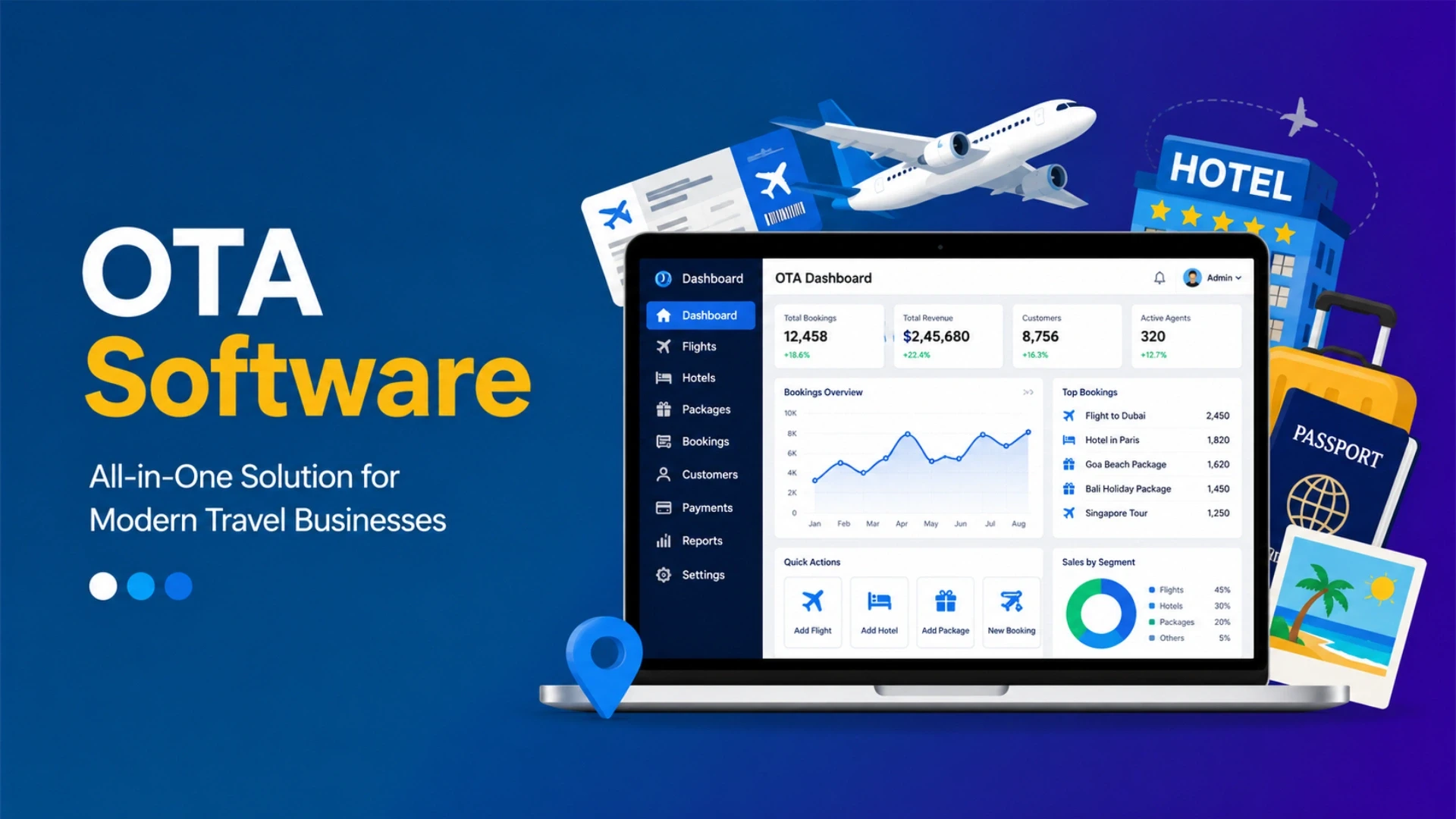
An OTA (Online Travel Agency) is a platform that aggregates travel inventory from multiple suppliers, presents it to travellers in a searchable interface, processes bookings in real time, and handles the financial transaction between traveller and supplier. The user experience layer is what travellers see. The architecture is what makes the inventory current, the pricing accurate, and the booking confirmed.
The Three-Layer Model
Every functioning OTA has three layers. The first is the supplier connectivity layer: the integrations that pull live inventory and rates from GDS providers, hotel aggregators, hotel aggregation modules, airline direct APIs, and activity suppliers. The second is the business logic layer: the search, filtering, sorting, caching, pricing, and bundle assembly logic that transforms raw supplier data into a usable product. The third is the presentation and transaction layer: the search interface, booking flow, payment processing, confirmation, and post-booking communication. Most teams design the third layer first, but the first layer determines whether the product works.
What Separates an OTA from a Booking Widget
A booking widget embeds a single supplier's availability into a website. An OTA aggregates multiple suppliers, normalises their data formats into a unified schema, and presents a comparison. The normalisation step is where the real engineering work lives. Amadeus returns flight data in one XML format. Sabre returns it in another. A hotel aggregator like Hotelbeds returns property data in a different format again. The OTA's integration layer translates all of these into a single internal data model. Without that translation layer, search comparison is impossible.
The Four Supplier Types Every OTA Must Handle
Flight inventory comes from GDS providers (Amadeus, Sabre, Travelport) or airline direct APIs (NDC). Hotel inventory comes from aggregators (Expedia Partner Solutions, Hotelbeds, Booking.com connectivity) or direct hotel API connections. Activity and experience inventory comes from specialist aggregators like Viator or Bokun. Ground transport inventory comes from car rental aggregators (Rentalcars API) or transfer-specific platforms. An OTA that handles all four types is a full-service travel marketplace. Most OTA builds start with two: flights and hotels.
The Five Core Modules of a Production OTA
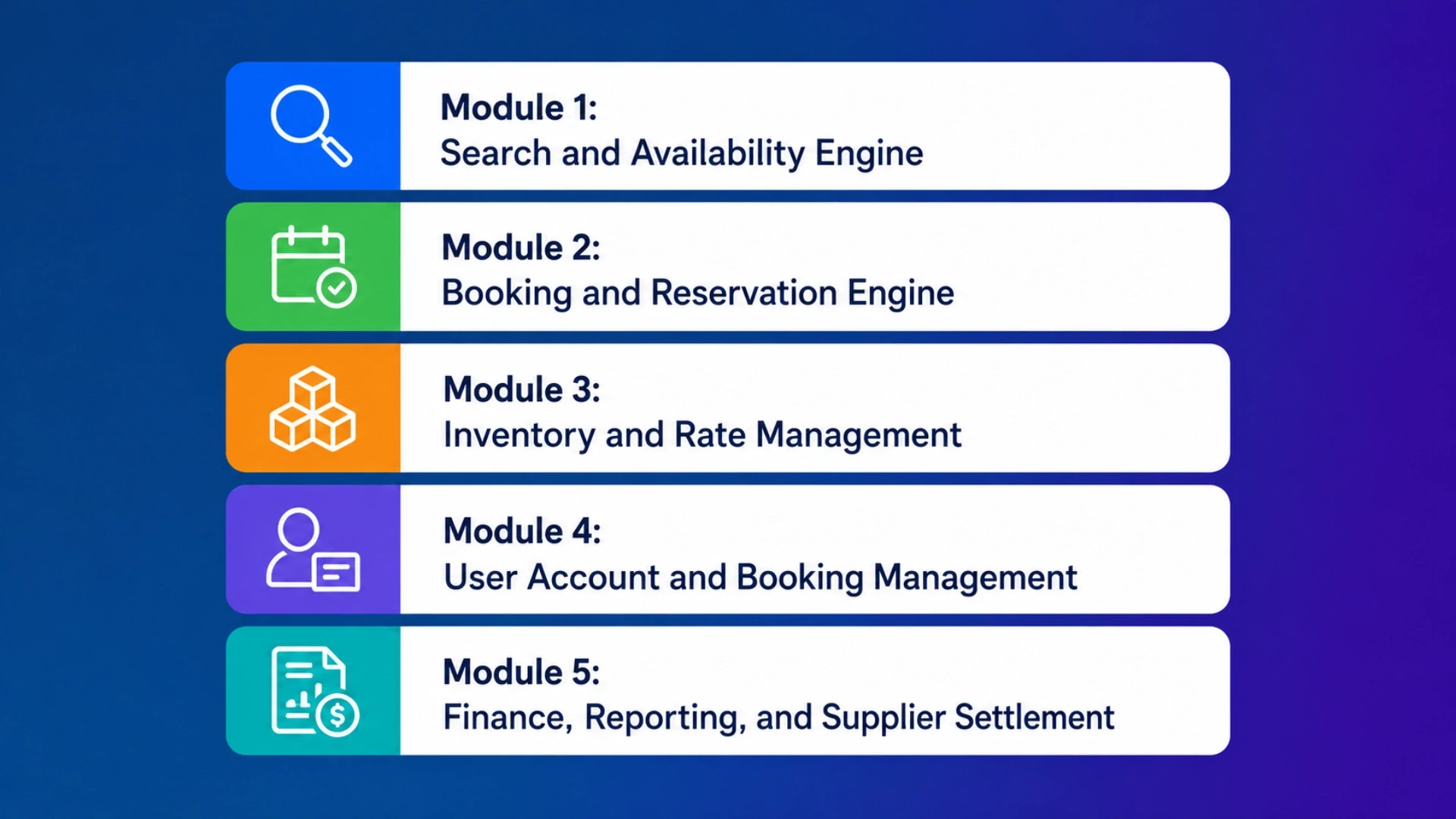
The five modules below are the minimum required for an OTA to function in production. Each is described by its responsibility, its internal logic, and its integration dependencies. A platform missing any one of these five is not a production OTA. It is a prototype.
Module 1: Search and Availability Engine
The search module receives a traveller query (origin, destination, dates, passenger count), sends it simultaneously to all connected supplier APIs, receives availability and pricing responses, normalises them into a unified format, applies caching rules, and returns results in under 3 seconds. The 3-second target is a hard commercial requirement: every additional second of search latency reduces booking conversion by 7% to 12%, based on industry data from major OTAs. The caching layer is critical.
Direct GDS API calls for every search request would exceed rate limits within hours of launch. Acquaint Softtech implements a tiered cache: static data (routes, schedules) cached for 24 hours; dynamic data (prices, availability) cached for 5 to 15 minutes with a background refresh cycle. MERN stack developers are the most common profile Acquaint Softtech assigns to the search and results layer, given the real-time data handling requirements.
Module 2: Booking and Reservation Engine
The booking module handles the transaction between the traveller selecting an itinerary and the supplier confirming the booking. This is a multi-step workflow: fare hold or seat lock, passenger detail collection, ancillary selection (luggage, seats, meals), payment authorisation, supplier booking confirmation, and PNR (Passenger Name Record) or voucher generation. The booking module must handle failures at each step.
A payment succeeds, but the supplier returns an error. A fare hold expires between selection and payment. A seat assigned in the search layer is no longer available for booking. Each failure scenario requires a defined fallback: either an alternative offer or a graceful cancellation with full refund. The failure handling logic is the most underestimated part of the OTA booking architecture.
Module 3: Inventory and Rate Management
The inventory module controls what the OTA displays, pricing, and profit margins. It receives rate updates from connected supplier APIs, applies markup rules, promotions, and currency conversion, then calculates revenue through commission, markup, or hybrid models. Acquaint Softtech’s software product engineering services, supported by teams, you can hire AI/ML engineers for advanced pricing and automation, including rate management module development alongside search and booking systems.
Module 4: User Account and Booking Management
The account module manages traveller profiles, booking history, saved searches, loyalty points, and document storage (passport details, travel insurance policies). The traveller-facing booking management interface allows itinerary changes, cancellation requests, ancillary additions, and rebooking for disrupted travel. In a modern flight hotel booking architecture, most post-booking changes require supplier API calls: a name change on a flight booking goes back to the GDS, while a hotel cancellation goes back to the aggregator. The account module must queue, track, and confirm each post-booking action against its supplier, not just update a local database record.
Module 5: Finance, Reporting, and Supplier Settlement
The finance module handles the full transaction lifecycle: payment collection from the traveller, supplier cost reconciliation, commission and markup calculation, and supplier payout. For an OTA operating across multiple currencies, the settlement layer must handle currency conversion at both the charge point (what the traveller pays) and the payout point (what the supplier receives), with the difference captured as FX (foreign exchange) revenue or cost.
The reporting layer provides the OTA operator with booking volume, revenue, margin, and refund data by supplier, date, destination, and channel. Acquaint Softtech assigns dedicated Python developers to the finance and settlement module for most OTA builds, given the data pipeline complexity involved in multi-supplier, multi-currency reconciliation.
Want to See What an OTA Module Architecture Looks Like for Your Platform?
Acquaint Softtech maps your supplier list, your target markets, and your commercial model to a module architecture and developer team structure within 48 hours. You see the exact scope before any engagement starts. You interview the team before you commit.
GDS Integration: How Live Flight Inventory Actually Works
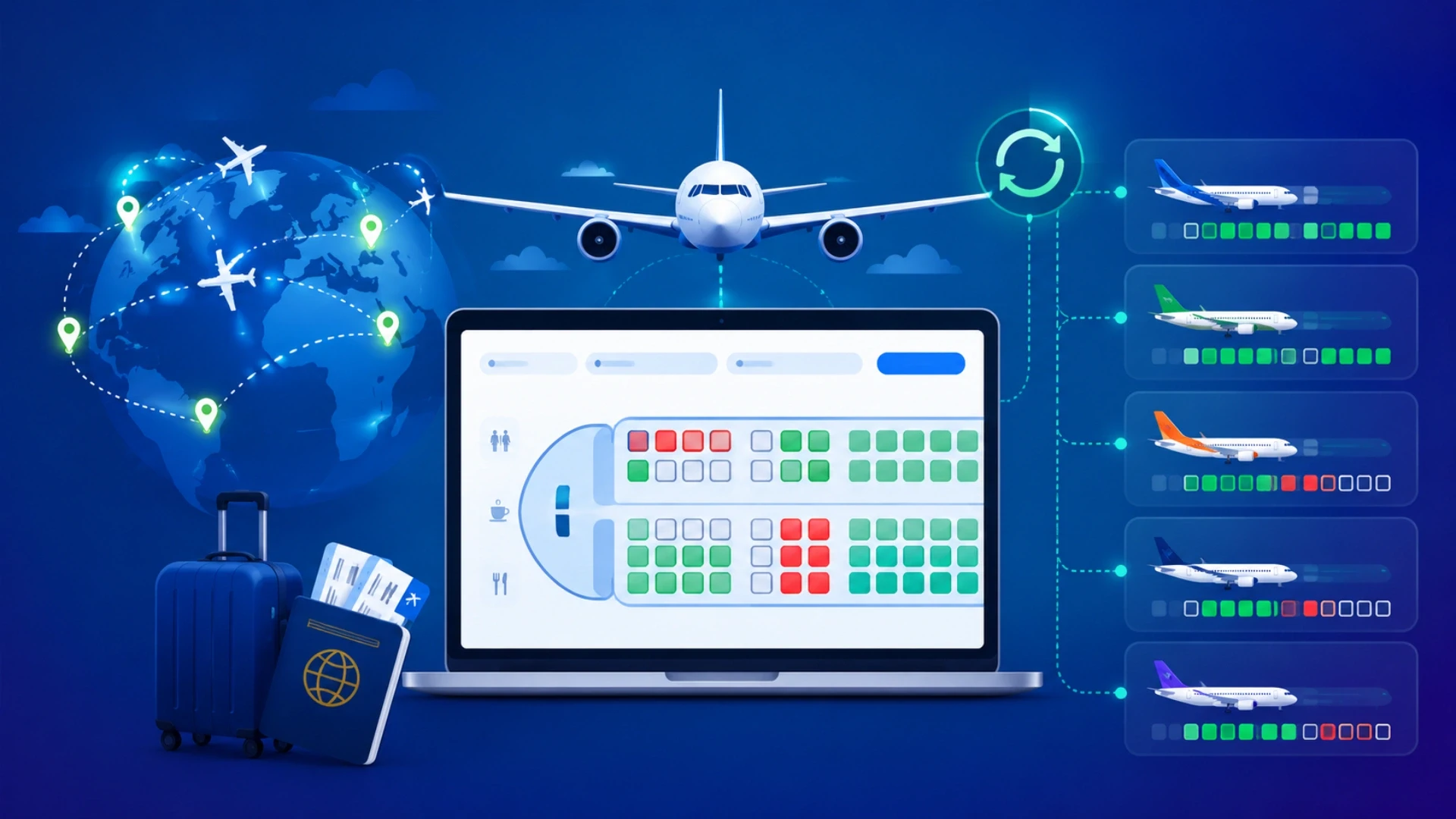
GDS integration is the module that stops more OTA projects than any other. The technology itself is mature and well-documented. The friction is in the commercial process, the data format complexity, and the performance requirements of real-time flight search.
The Three Major GDS Providers
Amadeus, Sabre, and Travelport collectively distribute the majority of global airline inventory available to third-party platforms. Each provides access through a combination of REST and SOAP APIs, with different authentication models, rate limit structures, and data schemas. Amadeus uses its Self-Service and Enterprise API tiers, with the Self-Service tier accessible without a commercial agreement for development and testing. Sabre uses its Sabre Red 360 and developer portal ecosystem. Travelport uses its Smartpoint SDK and JSON API layer. An OTA that wants multi-GDS coverage builds connectors for all three, with a routing layer that sends each search query to the most appropriate GDS based on route coverage and pricing.
NDC: The Alternative to GDS for Airline Direct
NDC (New Distribution Capability) is the IATA (International Air Transport Association) standard for direct airline API connectivity. It allows OTAs to connect to airlines without going through a GDS, receiving richer content (branded fares, seat maps, ancillary pricing) directly from the airline. NDC connectivity is available from major carriers, including British Airways, Lufthansa, American Airlines, and Air France-KLM. The trade-off is that NDC requires a separate integration and commercial agreement with each airline, while a GDS provides aggregated multi-airline access through a single contract. Most production OTAs use GDS for breadth and NDC for the highest-volume routes where direct airline content is commercially superior.
The Technical Reality of GDS Integration
A production OTA GDS integration includes four core components: search connectivity, fare rules management, booking processing, and post-booking operations like cancellations and refunds. Building a complete integration for one GDS usually takes 8 to 14 weeks, while adding another GDS takes 4 to 6 extra weeks because the normalisation layer is already built.
Rate Limiting and Caching Strategy
GDS providers impose strict API rate limits. Amadeus Self-Service limits search calls to 50 per minute on the free tier, scaling up commercially. Production OTAs handle hundreds of simultaneous searches. A caching strategy that stores recent search results and serves them for subsequent identical or similar queries is not optional. It is the difference between a platform that stays within rate limits and one that gets blocked.
Acquaint Softtech implements Redis-based caching for GDS responses with TTL (Time To Live) values tuned to the volatility of each data type: static fare rules cache for hours; live seat availability caches for minutes. For teams evaluating dedicated Laravel developers for the backend API layer, the GDS connector and caching architecture are one of the primary scoping areas in Acquaint Softtech's initial engagement review.
GDS integration is the module that stops more OTA projects than any other. The technology itself is mature and well-documented. The friction is in the commercial process, the data format complexity, and the performance requirements of real-time flight search.
The Three Major GDS Providers
Amadeus, Sabre, and Travelport collectively distribute the majority of global airline inventory available to third-party platforms. Each provides access through a combination of REST and SOAP APIs, with different authentication models, rate limit structures, and data schemas. Amadeus uses its Self-Service and Enterprise API tiers, with the Self-Service tier accessible without a commercial agreement for development and testing. Sabre uses its Sabre Red 360 and developer portal ecosystem. Travelport uses its Smartpoint SDK and JSON API layer. An OTA that wants multi-GDS coverage builds connectors for all three, with a routing layer that sends each search query to the most appropriate GDS based on route coverage and pricing.
NDC: The Alternative to GDS for Airline Direct
NDC (New Distribution Capability) is the IATA (International Air Transport Association) standard for direct airline API connectivity. It allows OTAs to connect to airlines without going through a GDS, receiving richer content (branded fares, seat maps, ancillary pricing) directly from the airline. NDC connectivity is available from major carriers, including British Airways, Lufthansa, American Airlines, and Air France-KLM. The trade-off is that NDC requires a separate integration and commercial agreement with each airline, while a GDS provides aggregated multi-airline access through a single contract. Most production OTAs use GDS for breadth and NDC for the highest-volume routes where direct airline content is commercially superior.
The Technical Reality of GDS Integration
A production OTA GDS integration includes four core components: search connectivity, fare rules management, booking processing, and post-booking operations like cancellations and refunds. Building a complete integration for one GDS usually takes 8 to 14 weeks, while adding another GDS takes 4 to 6 extra weeks because the normalisation layer is already built.
Rate Limiting and Caching Strategy
GDS providers impose strict API rate limits. Amadeus Self-Service limits search calls to 50 per minute on the free tier, scaling up commercially. Production OTAs handle hundreds of simultaneous searches. A caching strategy that stores recent search results and serves them for subsequent identical or similar queries is not optional. It is the difference between a platform that stays within rate limits and one that gets blocked.
Acquaint Softtech implements Redis-based caching for GDS responses with TTL (Time To Live) values tuned to the volatility of each data type: static fare rules cache for hours; live seat availability caches for minutes. For teams evaluating dedicated Laravel developers for the backend API layer, the GDS connector and caching architecture are one of the primary scoping areas in Acquaint Softtech's initial engagement review.
Hotel Aggregation: Building the Supplier API Hub
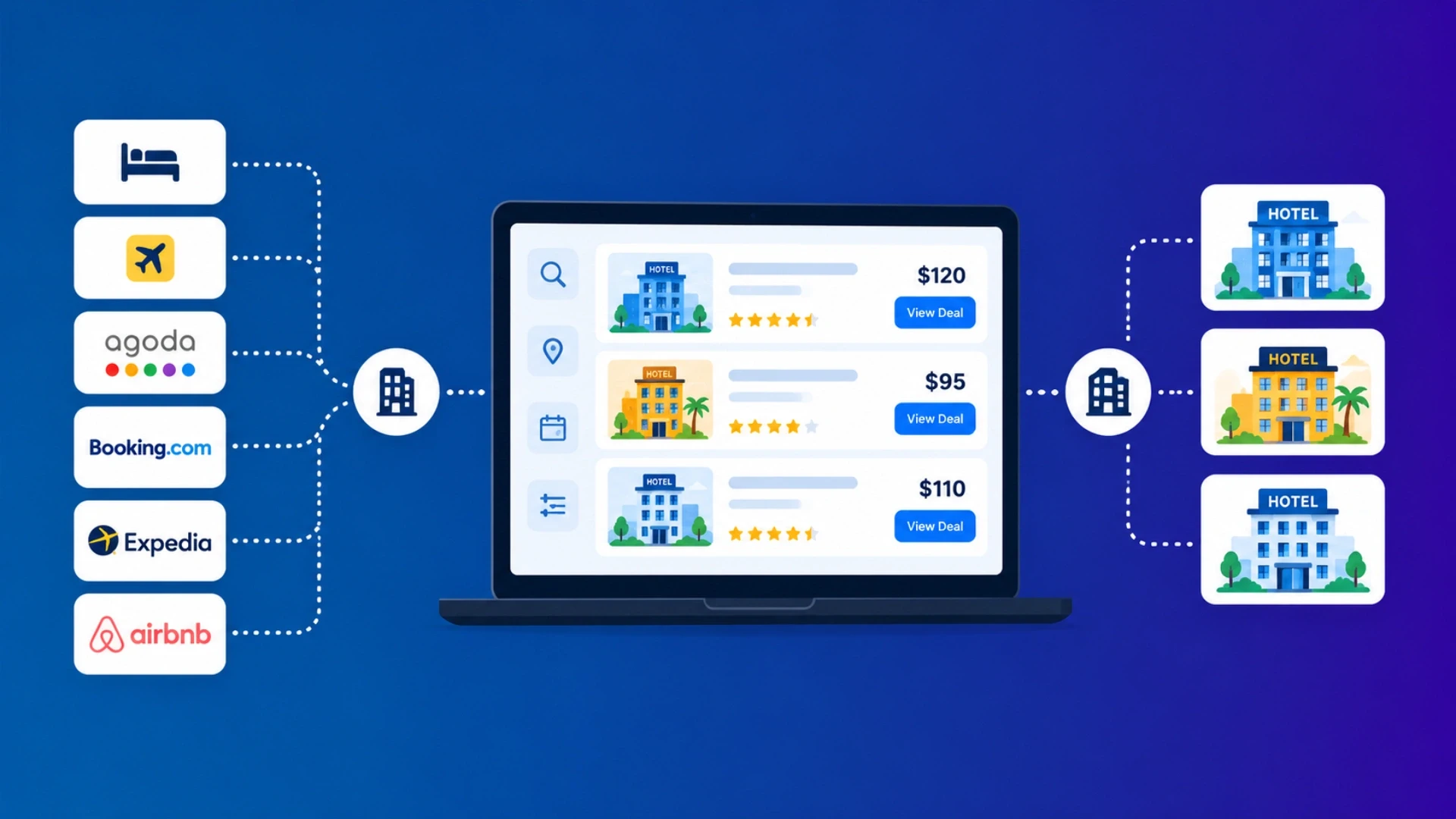
Hotel inventory on an OTA comes from one of three sources: direct hotel API connections (rare for independent OTAs, standard for large platforms), hotel aggregator APIs (the practical route for most OTA builds), or a combination of both. The aggregator route is where most OTA projects begin, and the architecture decisions made at this stage determine how much the platform can differentiate on inventory quality as it scales.
The Main Hotel Aggregator APIs
Expedia Partner Solutions (EPS) provides access to Expedia Group's hotel inventory through its API, covering approximately 700,000 properties globally. Hotelbeds is the largest B2B (Business-to-Business) hotel bed bank, providing access to properties not always available on consumer OTAs. Booking.com offers its connectivity API to registered platforms through its demand program.
Agoda provides API access through its partner program, particularly strong in Asia-Pacific markets. Each aggregator provides net rates, which the OTA marks up to create its selling price. The net rate plus the OTA's markup equals the traveller's price. Margin control is entirely the OTA's responsibility.
The Data Normalisation Problem
Each aggregator returns hotel data in a different format. Property identifiers are different. Room type naming conventions are different. Cancellation policy formats are different. Tax and fee structures are presented differently. An OTA that connects to three aggregators without a normalisation layer shows travellers three different versions of the same property with inconsistent pricing, conflicting cancellation terms, and duplicated listings.
The hotel content normalisation layer, which maps each aggregator's data format to a unified internal schema, is a significant engineering task. Acquaint Softtech estimates 4 to 8 weeks of dedicated development per aggregator integration, with additional time for deduplication logic across aggregators that cover overlapping properties.
Property Content and Media Management
Beyond pricing and availability, hotel inventory includes property descriptions, photos, amenity lists, location data, and review scores. This content comes from the aggregators but is inconsistently structured and frequently out of date. A production OTA builds a content management layer that pulls property content from aggregators, enriches it with direct hotel data where available, and stores it in a searchable internal database.
The search and filter interface operates against this internal database, not against live aggregator API calls for every search. Acquaint Softtech's custom software product development services for OTA clients include the hotel content pipeline as a standard scope item, given that property content quality directly affects booking conversion rates.
Live Availability vs Cached Rates
Hotel pricing has a different real-time requirement than flight pricing. Flight fares change by the second. Hotel rates change less frequently, typically by day or rate period. This allows a more aggressive caching strategy for hotels: rates can be cached for 15 to 30 minutes without material accuracy degradation. Availability, however, must be checked in real time at booking. A hotel that shows as available in the search cache may have sold out in the 20 minutes between the traveller's search and their booking attempt. The booking module always calls the aggregator API to confirm live availability before processing payment.
Package Bundling: Pricing Flight Plus Hotel as One Transaction
Package bundling is the highest-margin product on any OTA. A traveller who books a flight and a hotel as a package typically pays less than booking each separately, while the OTA earns more from the combined margin than from two separate transactions. The architecture that makes this possible is more complex than the sum of its parts.
Why Package Pricing Is Not Just an Addition
A flight costs $320. A hotel night costs $150. The package price is not $470. It is $415, because the OTA earns net rates from the hotel aggregator and can absorb some margin to offer a bundle price that appears cheaper than booking separately. The pricing engine calculates the package price dynamically based on the net cost of each component, the OTA's margin rules for packages, and the perceived value relative to the unbundled prices shown in adjacent search results. Getting this calculation wrong in either direction either kills package attractiveness or destroys margin.
The Technical Components of a Bundle Engine
The package bundle engine has five components. The first is the component resolver: it takes a traveller's destination and dates and calls both the flight search and the hotel search simultaneously, not sequentially. The second is the combination generator: it creates all valid flight and hotel combinations for the query, filtered by traveller preferences. The third is the pricing engine: it calculates the package price for each combination based on net costs and margin rules. The fourth is the availability validator: it confirms that both the flight and the hotel selected for a package are simultaneously bookable. The fifth is the split booking processor: executes two separate supplier bookings as a single atomic transaction, with rollback logic if either booking fails after the other succeeds.
The Rollback Problem
Flight booking succeeds. Hotel booking fails. The traveller now has a confirmed flight with no hotel, and the OTA has a confirmed supplier booking it must either honour or cancel. The rollback logic must cancel the flight booking, issue a full refund, and notify the traveller, all within seconds, all automatically. This failure scenario is not rare. Supplier API timeouts, inventory conflicts, and payment failures combine to produce booking failures on 2% to 5% of package attempts in production. An OTA without rollback logic produces support tickets for every one of these failures. Acquaint Softtech builds the rollback layer before the happy path in package module development, because fixing rollback logic after launch is significantly more expensive than building it first. For teams needing DevOps engineers for platform reliability and uptime monitoring, Acquaint Softtech deploys matched profiles within 48 hours.
Ancillary Bundling: Activities, Transfers, and Insurance
After flights and hotels, the next bundle components are airport transfers, travel activities, and travel insurance. Each adds a supplier integration, a pricing layer, and a booking confirmation workflow. A transfer booking requires a pickup location, a pickup time derived from the flight arrival, and a vehicle type. An activity booking requires a date, a time slot, and a headcount. Travel insurance requires a quote calculated against the total trip value, the traveller's age, and the destination. These are not small integrations. Each one adds 2 to 5 weeks to build time and a supplier contract to manage. Acquaint Softtech's MVP development services for OTA clients typically scope the first release with flights and hotels only, adding ancillary bundles in the second release after the core booking loop is validated.
What Does OTA Development Cost in 2026?
The cost of building an OTA ranges from $80,000 for a focused MVP with two supplier integrations to $400,000 or more for a full-service travel marketplace. The table below reflects Acquaint Softtech's delivery data across travel platform builds, with cost ranges in USD.
Build Scope | Build Cost (USD) | Timeline | Included | Monthly Maintenance |
OTA MVP (flights + hotels, 1 GDS + 1 aggregator) | $80,000 to $130,000 | 18 to 26 weeks | Search, booking, 2 supplier integrations, payments, and user accounts | $3,500 to $6,000/mo |
Mid-Scale OTA (flights + hotels + packages, multi-GDS) | $140,000 to $220,000 | 28 to 40 weeks | All 5 core modules, multi-GDS, 2 hotel aggregators, bundle engine | $6,000 to $10,000/mo |
Full Travel Marketplace (all verticals, B2B portal, white-label) | $250,000 to $420,000 | 44 to 64 weeks | All modules + activities + transfers + insurance + B2B agent portal | $10,000 to $18,000/mo |
Based on Acquaint Softtech delivery data across 1,300+ projects, OTA builds that include a dedicated integration testing phase before each supplier go-live are 35% less likely to experience post-launch operational failures than those that test integrations in parallel with UI development. The testing investment is always cheaper than the post-launch remediation.
What the Monthly Rate Includes at Acquaint Softtech
Dedicated developers from the original build team, not a generic support pool
Supplier API monitoring: alerts for GDS downtime, aggregator rate failures, and payment gateway errors
48-hour SLA (Service Level Agreement) on critical booking flow failures
Monthly integration health review: response times, error rates, cache hit ratios by supplier
Quarterly security audit covering PCI (Payment Card Industry) compliance for payment processing
Onboarding support for new supplier integrations: scoping, documentation review, and connector build estimation
The rate the client pays is the rate. No additional employer overhead, benefits cost, or cloud infrastructure provisioning sits on top of the monthly figure.
Ready to See a Cost Breakdown for Your Specific OTA Build Scope?
Acquaint Softtech builds the estimate around your supplier list, your target markets, and your commercial model. Send your GDS preference, hotel aggregator list, and product scope. We return a detailed cost breakdown, a timeline, and a team structure within 48 hours. You interview the developers before any engagement starts.
The 5 Signals That Tell You When to Build vs When to Buy
This is the same signal framework Acquaint Softtech uses in every initial OTA discovery session. Five observable conditions. Each point clearly points toward a custom build or toward a white-label or SaaS travel platform.
Signal 1: You have a supplier contract that a white-label platform cannot accommodate
Yes: If you have negotiated net rates with a GDS or hotel aggregator that are below the standard commercial tiers, a white-label platform will apply its own markup logic on top of your rates, destroying your pricing advantage. A custom build puts your margin rules in your own system.
No: If your supplier access is entirely through standard commercial APIs at published rates, a white-label platform like Travel Compositor or a booking engine SDK gives you faster go-to-market at lower upfront cost. Acquaint Softtech's software development outsourcing services can help you evaluate this boundary before committing to either path.
Signal 2: Your target market has a supplier mix that standard platforms do not cover
Yes: Southeast Asian rail operators, Middle Eastern regional carriers, African bus networks, and specialty accommodation types are frequently absent from major white-label OTA platforms. If your market requires these suppliers, you build the integration yourself. No: If your market is served by Amadeus, Sabre, and the major hotel aggregators, and your target product is flights plus hotels for a global traveller audience, a white-label solution has your supplier coverage already built.
Signal 3: Your commercial model is not per-booking commission
Yes: Subscription travel clubs, corporate travel platforms with negotiated flat fees, and B2B (Business-to-Business) agent portals with sub-agent markup controls require financial architectures that SaaS OTA platforms rarely support. If your revenue model is anything other than standard per-booking commission, a custom build is likely required. Acquaint Softtech has built a B2B travel portal architecture for clients whose commercial model required sub-agent management, markup controls, and custom settlement logic that no available white-label platform could support.
No: Standard commission-based OTAs selling to retail travellers fit most white-label and API-first platforms.
Signal 4: You need AI-powered personalisation or smart search
Yes: Destination recommendation engines, traveller preference learning, smart bundle optimisation, and predictive pricing require a custom data layer that owns your traveller data and your booking history. A white-label platform owns that data. You do not. If traveller data is a core asset in your business model, you cannot afford to have it locked in a third-party system. Acquaint Softtech's AI development services for travel platforms cover recommendation engine development, traveller preference modelling, and dynamic bundle optimisation as standalone modules that can be built on top of an existing OTA or as part of a new build.
No: If your product is a straightforward search-and-book experience with no personalisation requirements, AI investment in the first release is over-engineering.
Signal 5: Your growth plan includes a B2B agent distribution layer
Yes: A B2B travel portal with sub-agent management, markup controls, and credit limit management for travel agents requires a custom architecture. Most white-label platforms either do not support B2B distribution or support it in a limited form that cannot accommodate agent-specific pricing rules. Acquaint Softtech's dedicated software development team model is the delivery structure most suited to OTA builds with a B2B distribution layer, given the ongoing development workload that agent portal features generate after initial go-live.
No: A retail-only OTA with no agent channel does not need B2B architecture in the first release.
Scoring: 3 or more Yes answers: the functional requirements justify a custom build. The question becomes one of timeline and capital allocation, not technology choice. 1 to 2 Yes answers: evaluate a white-label platform with custom integration extensions before committing to a full build. A product discovery workshop scopes both options in 5 days. 0 Yes answers: implement a white-label solution. The build cost is not justified at this stage.
Answered Yes to 3 or More? Acquaint Softtech Builds Production OTAs.
Acquaint Softtech has built travel marketplaces, OTA integration layers, and booking platforms for clients across the US, UK, Australia, and UAE. Send your supplier list, target market, and commercial model. We return a full architecture map and team structure within 48 hours. You interview every developer before the engagement starts. No generic proposal.
Frequently Asked Questions
-
How to build an OTA?
Building an OTA involves five stages: supplier API agreements, architecture planning, core development, integration testing, and go-live. API access for airlines and hotels can take 4 to 12 weeks, so it should start early. The platform must define integrations, data flow, and caching before UI development. Core modules include search, booking, payments, and user accounts. Teams that skip architecture planning often face major integration issues later in development.
-
What is OTA platform architecture?
OTA platform architecture is the technical structure that powers flight, hotel, and package bookings across five layers: supplier integrations, data normalisation, business logic, transaction processing, and user interface. The supplier connectivity and data normalisation layers are the most critical because they control inventory quality, pricing accuracy, platform speed, and booking reliability. Most OTA projects fail when teams underplan these backend layers and focus too early on frontend development.
-
What is GDS integration for flights?
GDS (Global Distribution System) integration connects an OTA to airline inventory through providers like Amadeus, Sabre, and Travelport. It gives access to flight schedules, fares, seat availability, and booking confirmation through one API connection.
The integration includes search, fare rules, booking/PNR creation, and post-booking management for cancellations and refunds. A production-ready GDS integration usually takes 8 to 14 weeks, while multi-GDS setups with routing layers can take up to 24 weeks.
-
What does OTA development cost in 2026?
Based on Acquaint Softtech delivery data, an OTA MVP with one GDS integration, one hotel aggregator, and core booking modules costs $80,000 to $130,000 and takes 18 to 26 weeks. A mid-scale OTA with multi-GDS coverage, two hotel aggregators, and a package bundling engine costs $140,000 to $220,000 over 28 to 40 weeks.
A full travel marketplace with all verticals, a B2B agent portal, and white-label distribution costs $250,000 to $420,000 over 44 to 64 weeks. Monthly maintenance starts at $3,500 per month for an MVP-stage platform and scales to $18,000 per month for a full marketplace. These figures include development, integration testing, QA (Quality Assurance), and go-live support. Cloud infrastructure costs are separate.
-
How long does it take to build a travel booking platform?
An OTA MVP with two supplier integrations takes 18 to 26 weeks from architecture sign-off to production go-live. The timeline has three main risk factors: supplier API access approval, which runs 4 to 12 weeks independently of development and must be started before the build begins; integration testing, which expands when supplier documentation is incomplete or when API responses differ from documented specifications; and payment gateway certification, which requires PCI compliance documentation and adds 2 to 4 weeks for platforms processing card payments.
Acquaint Softtech builds supplier API access timelines into every OTA project plan and starts the access application process in the first week of engagement, not after development begins.
-
What is the best tech stack for an OTA?
Acquaint Softtech builds OTA platforms using Laravel for backend APIs, React for real-time booking interfaces, Redis for caching, and PostgreSQL for bookings and payments. Elasticsearch supports large-scale hotel search, while WebSockets handle live seat and booking updates. With experience across 1,300+ projects, the team also helps businesses hire MERN stack developers for OTA frontend development.
-
What is the difference between a GDS and a hotel aggregator?
A GDS (Global Distribution System) provides airline inventory like flight schedules, fares, and seat availability through one API connection, while a hotel aggregator provides hotel room inventory, rates, and booking data.
Both require search, booking, and post-booking integrations, but their data structures and workflows are completely different. OTAs selling flights need GDS access, hotel OTAs need aggregators, and full travel OTAs need both, with a strong data normalisation layer to manage different formats.
I lead technology and client success at Acquaint Softtech with one goal in mind. Deliver work that feels personal, reliable, and worthy of long term trust. I stay close to both our clients and our developers to make sure every project moves with clarity, quality, and accountability.
Table of Contents
Get Started with Acquaint Softtech
- 13+ Years Delivering Software Excellence
- 1300+ Projects Delivered With Precision
- Official Laravel & Laravel News Partner
- Official Statamic Partner
Related Blog
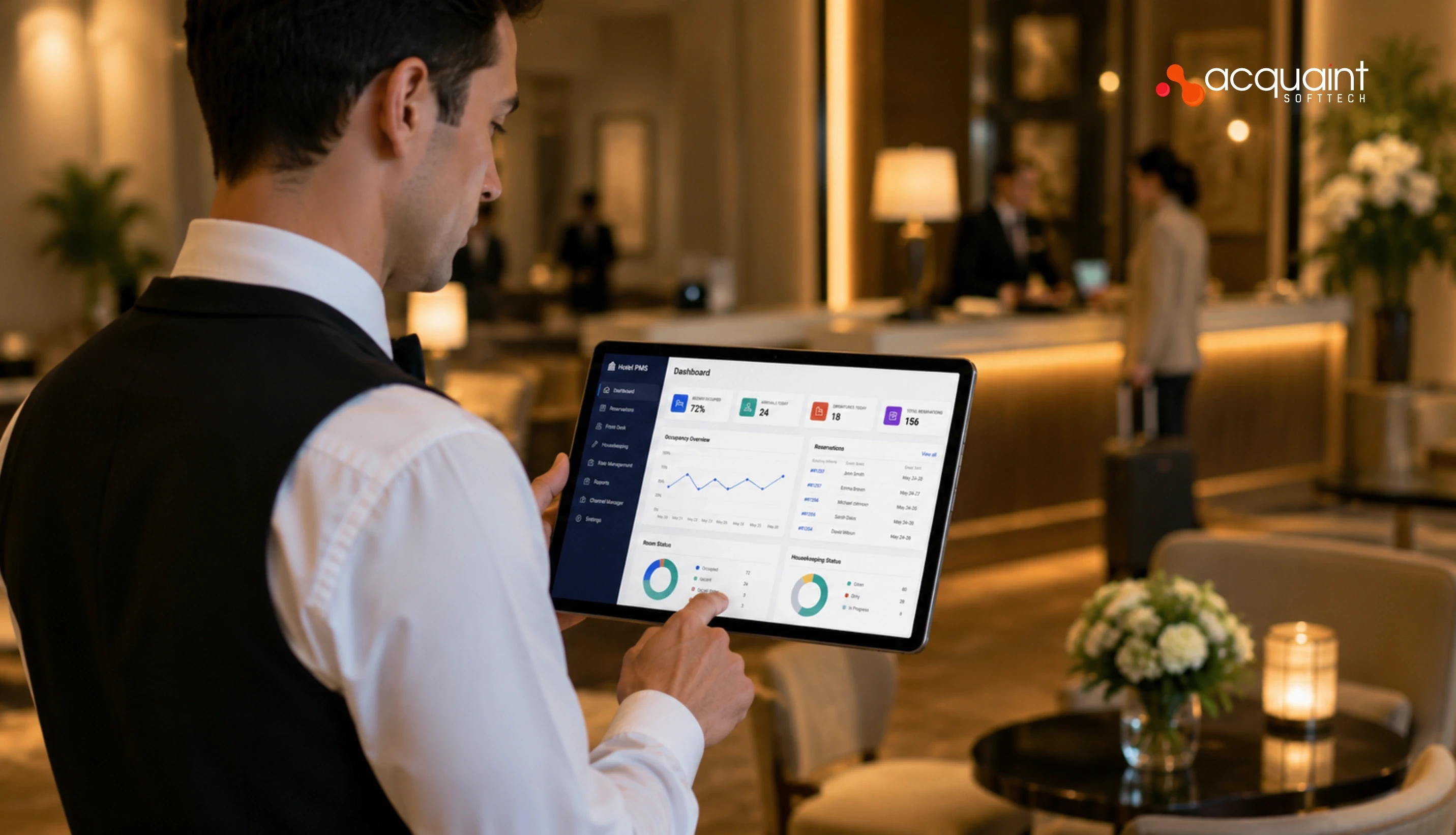
Hotel PMS Development: Front Desk, Housekeeping, and Guest Management in One System
A hotel PMS is not a booking system. It is the operational backbone connecting every department in real time. Here is what it includes, how each module is built, and what it costs in 2026.
Manish Patel
May 20, 2026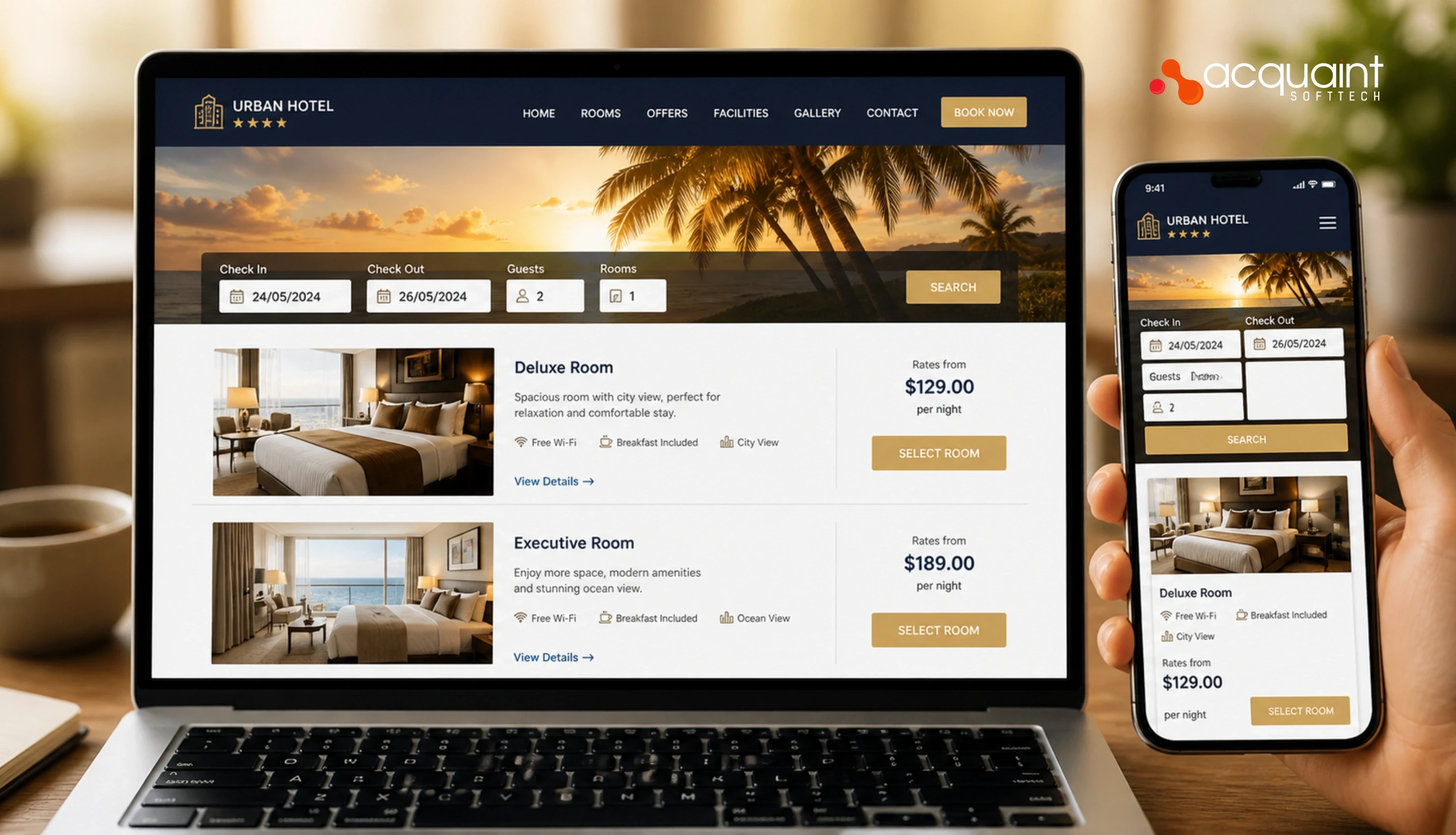
How Hotel Booking Engines Work: Search, Availability, Pricing, and Reservation Architecture
A hotel booking engine is not a search bar. It is an availability engine, a pricing decision system, a payment pre-authorisation layer, and a channel inventory synchroniser, all running simultaneously. This guide explains every architectural layer and how each one connects in a production system.
Manish Patel
May 12, 2026
The Complete Guide to Travel & Hospitality Software Development in 2026
Most travel and hospitality platforms fail not because the idea was wrong, but because the technology architecture was underplanned. This guide explains every platform type, cost tier, and technology decision your team needs to make before writing the first line of code.

Acquaint Softtech
May 6, 2026India (Head Office)
203/204, Shapath-II, Near Silver Leaf Hotel, Opp. Rajpath Club, SG Highway, Ahmedabad-380054, Gujarat
USA
7838 Camino Cielo St, Highland, CA 92346
UK
The Powerhouse, 21 Woodthorpe Road, Ashford, England, TW15 2RP
New Zealand
42 Exler Place, Avondale, Auckland 0600, New Zealand
Canada
141 Skyview Bay NE , Calgary, Alberta, T3N 2K6