

How to Protect Your IP When You Hire Python Developers Offshore
Protect your IP when hiring Python developers offshore in 2026. Contract clauses, NDA framework, jurisdiction rules, and legal safeguards that hold up.

Mukesh Ram
Introduction: Why Offshore IP Protection Is a Contract Problem, Not a Geography Problem
Most founders and CTOs worry about the wrong thing when hiring Python developers offshore. They worry about the country. They should worry about the contract. IP loss in offshore engagements rarely happens because someone in India, Poland, or the Philippines stole code. It happens because the contract never actually transferred IP to the client in the first place, or transferred it too late, or transferred it under a jurisdiction where the client cannot enforce it. As W. Edwards Deming observed, "In God we trust; all others must bring data." Applied to offshore IP protection, trust in your Python development partner is fine, but the enforceable data (signed contracts, executed IP assignments, jurisdiction-aware NDAs) is what actually protects your intellectual property. The framework below is the same framework detailed across the complete guide to hiring Python developers in 2026, extracted here for teams focused specifically on IP protection.
The legal stakes have escalated meaningfully in 2026. According to the 2026 offshore development IP protection framework by FullScale, the single most common gap in offshore contracts is IP that transfers "upon final payment," which the FullScale legal team correctly calls "code held hostage with extra steps." IBM Security 2026 data further shows 36% of businesses suffered a breach due to outsourced vendor errors, and India's DPDP Act rules (notified November 2025, full enforcement May 2027) impose penalties up to ₹250 crore per breach on offshore engagements handling end-client personal data. This guide walks through the 8 critical contract clauses, the 5-layer IP protection stack, jurisdiction selection rules, the freelancer versus vetted-agency IP risk gap, technical access controls, and the specific safeguards required by 2026's tightened legal landscape.
The 8 Critical Contract Clauses for Offshore Python IP Protection
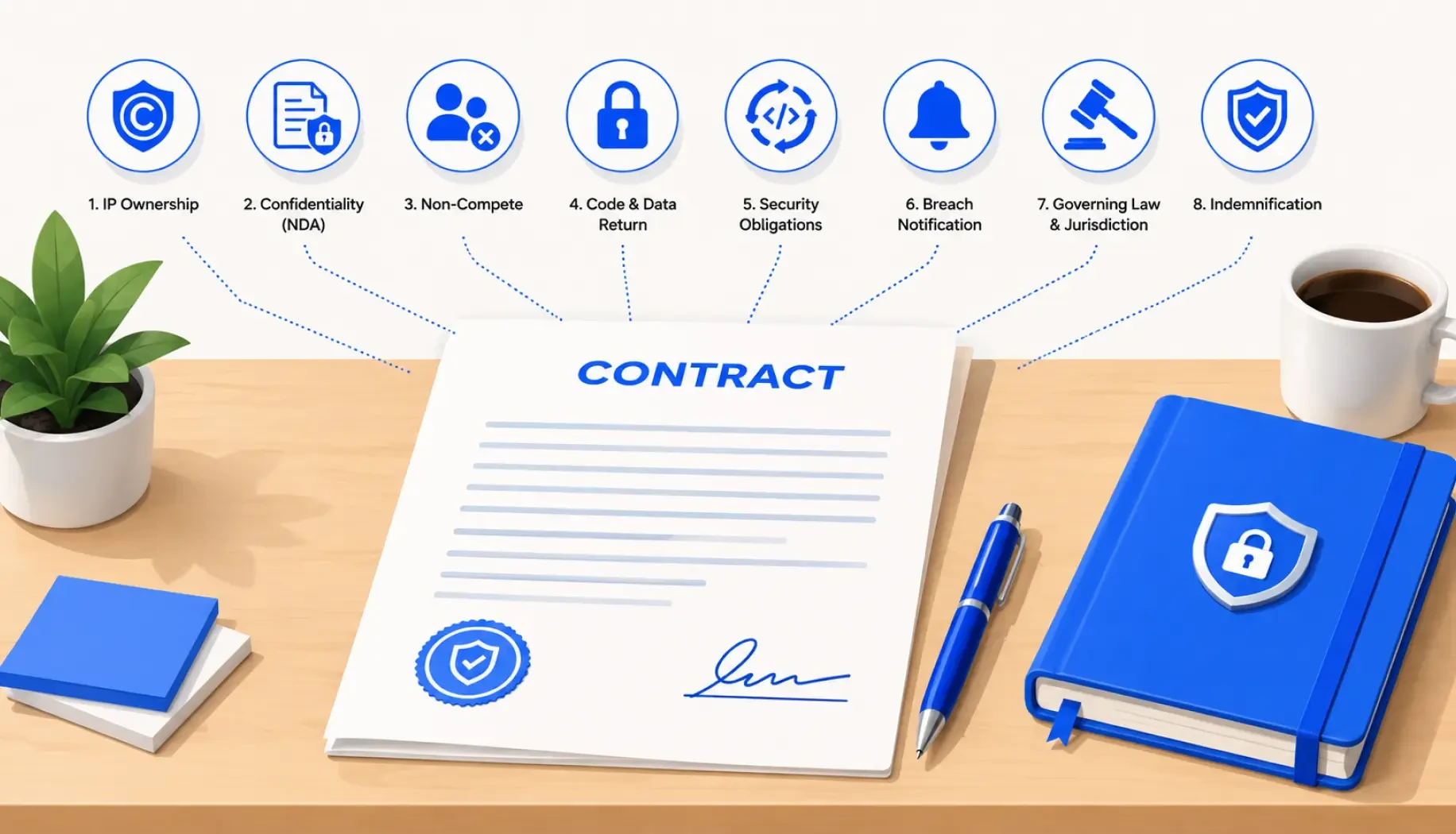
Offshore Python IP protection is 80% contract structure and 20% technical enforcement. Getting the contract clauses right upfront prevents 90% of downstream IP disputes. The 8 clauses below are non-negotiable for any offshore Python engagement over $20,000 or longer than 8 weeks.
The 8 Critical Contract Clauses for Offshore Python IP Protection
# | Clause | Why It Matters |
|---|---|---|
1 | Day 1 IP Assignment | Not upon payment. Code belongs to you from the moment it's written. |
2 | Comprehensive NDA Coverage | Source code, architecture, business logic, roadmap, customer data |
3 | AI-Assisted Work Language | Covers AI-generated code, per US Copyright Office 2026 guidance |
4 | Moral Rights Waiver | Developer waives any residual moral rights to derivative works |
5 | Pre-Existing IP Assignment | Any prior IP used in project transfers on incorporation |
6 | Governing Law and Venue | Delaware or California (US), with arbitration in favorable jurisdiction |
7 | Dual Jurisdiction NDA | Enforceable in both client country and offshore developer country |
8 | Exit and Code Handover | 30-day exit, full documentation, no licensing restrictions post-exit |
The Clauses That Save You Money vs the Ones That Signal You Care
Day 1 IP Assignment is the single most important clause. IP that transfers 'upon final payment' or 'upon delivery' creates a window where the developer legally owns your code. If a dispute arises before payment, if the engagement ends mid-project, or if the developer takes another engagement while your code sits partially delivered, you have no legal claim. Day 1 assignment eliminates this window structurally.
AI-Assisted Work language is the 2026 blind spot. US Copyright Office 2026 guidance clarifies that AI-generated output without human authorship is not copyright-protected. If your Python developer uses GitHub Copilot, Claude Code, or Cursor to generate code, the assignment clause must explicitly cover AI-assisted work product, not just human-typed code. Most standard offshore contracts written before 2025 do not.
Dual Jurisdiction NDA is what makes enforcement real. Per Wisemonk's 2026 analysis, single-jurisdiction NDAs (US only) are unenforceable in Indian court without an Indian arbitration clause. If your developer is in India, your NDA must reference both the Indian Contract Act 1872 and your foreign client jurisdiction. Same principle applies to Philippines, Ukraine, and other offshore destinations.
Moral Rights Waiver is often missed. Some jurisdictions (particularly civil-law countries) recognize inalienable moral rights that persist even after IP assignment. Explicit waiver language addresses this and prevents disputes over derivative work rights.
The specific red flags in Python outsourcing contracts that surface IP ambiguity, including the joint-ownership provisions and work-for-hire language patterns that create post-engagement disputes, are covered in red flags when outsourcing Python development, which walks through the specific contract patterns that predict expensive IP resolution.
The 5-Layer IP Protection Stack for 2026

Consistent scoring across evaluators requires anchor definitions for each score level. The 0 to 5 rubric below gives every evaluator a shared reference for what "5 - excellent" means versus what "3 - adequate" means, which prevents the interpretation drift that undermines multi-evaluator scoring.
0 to 5 Scoring Rubric with Anchor Definitions
Score | Level | Anchor Definition |
|---|---|---|
5 | Excellent | Evidence exceeds requirement, multiple production references, verified independently |
4 | Strong | Evidence meets requirement clearly, at least one strong production reference |
3 | Adequate | Evidence exists but general or claim-only, capability plausible but not verified |
2 | Weak | Evidence thin, claims not supported by portfolio or references, capability uncertain |
1 | Poor | No evidence, capability improbable, vendor cannot substantiate |
0 | Missing | Not applicable or vendor explicitly cannot deliver this dimension |
As Peter Drucker observed: "What gets measured gets managed." Applied to Python vendor scorecards, the criteria you actually measure are the criteria that get proper attention during evaluation. Scorecards that skip technical depth in favor of "cultural fit" produce delivery failures. Scorecards that skip security and compliance in favor of aggressive pricing produce audit failures. The 10-criteria framework above is opinionated because Python delivery outcomes are not neutral: certain dimensions predict success far better than others, and the weights reflect what evidence from 1,300+ projects consistently shows.
Applying the Rubric Correctly
Multiple evaluators score independently. Each stakeholder scores independently and completes the scorecard within 24 hours of the discovery call. Share scores before discussing opinions. Independent scoring prevents groupthink and surfaces disagreements that reveal weak signals in the vendor evaluation.
Score against evidence, not sales promises. A vendor claiming SOC 2 compliance scores 3 (adequate). A vendor showing SOC 2 Type II report from a Big 4 auditor scores 5 (excellent). The difference is evidence versus assertion. Anchor definitions require evidence to score above 3.
Blind evaluate proposal content where possible. Score the proposal content, not the brand recognition. Nvelop's 2026 RFP best-practices research confirms that blinded scoring where evaluators score proposal content without seeing vendor names produces meaningfully more accurate assessments than open scoring.
Document rationale for scores above 4 or below 2. High and low scores require documented rationale for audit trails and organizational learning. Middle-range scores (2 to 4) can be recorded without extensive commentary, but outliers need reasoning that survives review.
Ready to See Acquaint Softtech's Full IP Protection Framework?
Every Acquaint Softtech Python engagement executes the complete 5-layer IP protection stack before any code is discussed: signed MSA with Day 1 IP assignment, jurisdiction-specific NDA (US, UK, EU, or India as applicable), stamped Deed of IP Assignment per developer per placement (Indian Stamp Act compliant), Data Processing Agreement covering GDPR and DPDP requirements, and SOW with embedded IP language per engagement.
Jurisdiction Selection: Where Your Contract Lives Legally

Jurisdiction determines whether your contract is enforceable when things go wrong. According to WIPO, one of the most common mistakes in outsourcing software development is assuming that NDAs and confidentiality agreements hold up uniformly across jurisdictions. Many countries lack enforcement mechanisms or legal precedent to support IP breach claims. Selecting the right jurisdiction upfront is the difference between a contract that protects you and a contract that documents your protection.
Jurisdiction Comparison for Offshore Python Engagements 2026
Jurisdiction Approach | Enforceability | Complexity | Cost |
|---|---|---|---|
US-only (Delaware/California) | Strong in US, weak offshore | Low | Low |
Offshore-only (India, Philippines) | Strong offshore, weak in US | Medium | Low |
Dual jurisdiction (recommended) | Strong in both | High | Medium |
International arbitration (ICC/SIAC) | Strong globally | High | High |
How to Select the Right Jurisdiction for Your Python Engagement
US-only jurisdiction is common but incomplete. Delaware or California governing law with US courts as venue works for US-based clients hiring offshore vendors, but only if the offshore vendor has assets or operations in the US. If they do not, enforcing a US judgment offshore requires expensive follow-on litigation in the developer's country. For most offshore engagements, US-only is inadequate protection.
Dual jurisdiction is the pragmatic 2026 standard. Contract references both the client's jurisdiction (Delaware/California/UK) and the developer's jurisdiction (Indian Contract Act 1872, Philippine civil code, Ukrainian civil code). Disputes can be brought in either venue based on which offers stronger relief for the specific claim. Reputable offshore Python agencies provide dual jurisdiction agreements as standard practice.
International arbitration is enterprise-grade protection. For engagements over $500,000 or involving highly sensitive IP, arbitration under ICC (International Chamber of Commerce) or SIAC (Singapore International Arbitration Centre) rules provides globally enforceable awards under the New York Convention. Higher administrative cost but strongest enforceability across jurisdictions.
Country-specific requirements must be layered on. Indian engagements require Indian Stamp Act compliance on Deed of IP Assignment. EU engagements require GDPR-compliant DPA. UK engagements post-Brexit require UK GDPR compliance. Each layer adds specific requirements that generic templates do not cover.
The complete comparison of offshore Python developer rates across India, Eastern Europe, and Latin America, including which regions have mature IP protection frameworks and which have weaker enforcement mechanisms, is covered in the offshore Python developer rates analysis, which walks through region-specific IP protection maturity as part of the rate comparison.
Freelancer vs Vetted Agency: The IP Risk Gap
The structural difference between hiring an offshore freelancer and hiring through a vetted offshore agency is largest in IP protection. According to the 2026 India IP protection framework analysis by Wisemonk, the DPDP Act (rules notified November 2025, with full enforcement May 2027) imposes penalties up to ₹250 crore per breach on offshore engagements handling personal data. Freelancer engagements typically operate without the four-party deed of assignment, dual jurisdiction NDA, DPDP-compliant DPA, SOC 2 Type II attestation, and exit recovery clause that vetted agencies execute as standard practice. The IP risk gap is not marginal. It is structural.
Freelancer vs Vetted Agency IP Protection Comparison
IP Protection Element | Offshore Freelancer | Vetted Offshore Agency |
|---|---|---|
Signed MSA | Rarely, platform terms substitute | Standard, tailored per client |
Comprehensive NDA | Generic template if any | Jurisdiction-specific, tailored |
Day 1 IP assignment | Rarely, usually payment-based | Standard practice |
Deed of IP Assignment (India) | Almost never | Stamped, per developer, per project |
DPA for GDPR/DPDP | Almost never | Standard for personal data |
AI-assisted work language | Rarely | Included in 2026 templates |
Post-engagement code retention | Common risk | Prohibited by contract |
Enforcement viability | Weak, jurisdictional gaps | Strong, dual jurisdiction |
What the IP Risk Gap Actually Costs
Freelancer IP disputes cost 3 to 10x the original engagement value. When an offshore freelancer retains code copy post-engagement, disputes IP ownership, or launches a competing product based on your codebase, the litigation cost frequently exceeds $100,000 for engagements originally worth $10,000 to $30,000. The 2025 PatentPC analysis of freelance developer contracts found significant risk around code ownership.
Agency engagements produce audit-defensible IP trails. Every Acquaint Softtech engagement includes signed MSA, jurisdiction-specific NDA, stamped Deed of IP Assignment per developer, DPA where applicable, and SOW with embedded IP language. This audit trail survives investor due diligence, acquisition diligence, and regulatory inspections. Freelancer engagements typically cannot produce equivalent documentation.
The rate savings from freelancer engagements are illusory when IP costs surface. A $30/hour freelancer that costs $60,000 across a 6-month engagement and produces a $200,000 IP dispute cost more than a $50/hour vetted agency engagement at $100,000 with zero IP risk. The apparent savings become negative when the IP risk actualizes.
Enterprise procurement policies increasingly prohibit freelancer engagements. Fortune 500 procurement policies now often specify vendor requirements (revenue thresholds, SOC 2 certifications, dual jurisdiction NDAs) that eliminate freelancer engagements from consideration. This is not procurement bureaucracy; it is a documented response to the IP risk gap.
The complete hidden costs analysis comparing freelancer engagements to vetted agencies for Python development, including the specific IP risk categories that surface post-engagement, is covered in hidden costs of hiring a Python freelancer vs a dedicated agency, which walks through the 6 hidden cost categories that make freelancer economics deceptive.
Technical Access Controls That Reinforce Legal Protection
Legal protection needs technical enforcement. Signed contracts prevent disputes but do not prevent code leaks. Technical access controls limit what an offshore Python developer can do with your codebase during the engagement and enforce data hygiene that supports the legal framework.
The 7 Technical Controls That Reinforce Contract Protection
Role-based Git access. Offshore Python developers access only the repositories they need for their specific engagement. No blanket organization-wide access. GitHub Enterprise, GitLab, or Bitbucket configurations should enforce this by default. Access reviewed quarterly.
2FA and SSO enforcement. Two-factor authentication and single sign-on for every offshore developer accessing client systems. Prevents credential theft from compromising client IP. Zero-trust security architecture where every access is verified regardless of network location.
VPN with source IP allowlisting. Offshore developers connect through client VPN with fixed source IP allowlisting. Prevents access from unauthorized locations and provides audit trail for compliance investigations.
Encrypted development environments. Development machines encrypted at rest, mobile device management (MDM) enrollment for personal devices used for work, and remote wipe capability if devices are lost or stolen.
Code repository monitoring. Daily monitoring of Git activity, unusual pull patterns, and cross-repo access anomalies. Detection of code exfiltration attempts through repository cloning or bulk downloads.
Data classification and access. Sensitive data (customer PII, business logic, algorithms) classified and access-controlled based on developer role. Not every developer needs access to every data type, and role-based access enforces this.
Audit logging with immutable retention. All access to client systems logged with immutable retention (WORM storage or equivalent). Logs survive developer access revocation and support forensic analysis if IP disputes surface post-engagement.
Technical controls do not replace legal protection; they reinforce it. A vetted offshore Python agency operates all seven technical controls as standard practice, which is why Acquaint Softtech's engagements consistently pass enterprise procurement diligence covering SOC 2, ISO 27001, HIPAA, GDPR, and DPDP compliance requirements without exceptions.
Case Study
Real Case Study: BIANALISI's IP Protection Framework
BIANALISI: Italy's Largest Diagnostic Group
Enterprise Client: Multi-lab diagnostic operations across Italy
IP Protection Requirement: GDPR-compliant predictive analytics platform handling protected health information across multiple lab operations
5-Layer Stack Applied: MSA with dual jurisdiction (Italian civil code + Indian Contract Act), comprehensive NDA covering source code + business logic + patient data schemas, stamped Deed of IP Assignment per Python engineer (Indian Stamp Act compliant), GDPR-compliant DPA with tri-party structure (client + processor + sub-processor), engagement-specific SOWs with embedded IP language
Compliance Outcome: Passed multiple GDPR compliance inspections over 18+ months in production without findings. Zero IP disputes. Full audit trail available for regulatory review. Codebase remains fully owned by BIANALISI with complete documentation trail.
Ongoing Engagement: 18+ months in production, same team continuity, same IP framework governing every SOW added over the engagement duration
As Warren Buffett has observed: "Risk comes from not knowing what you're doing." Applied to offshore Python IP protection, the risk comes from signing offshore contracts without understanding the jurisdiction gaps, the AI-assisted work coverage gaps, the DPDP Act compliance gaps, or the enforcement mechanism gaps that turn signed contracts into unenforceable documents. The 8 critical clauses, 5-layer stack, dual jurisdiction framework, and technical access controls above are what serious teams use to know exactly what they are doing when they hire Python developers offshore.
The Bottom Line
Offshore Python IP protection is a contract problem, not a geography problem. The IP disputes that surface 6 to 12 months into offshore Python engagements almost never happen because someone in India or the Philippines or Ukraine stole code. They happen because the contract never actually transferred IP to the client in the first place, or transferred it too late, or transferred it under a jurisdiction where the client cannot enforce it. The 8 critical contract clauses (Day 1 IP assignment, comprehensive NDA, AI-assisted work language, moral rights waiver, pre-existing IP assignment, governing law and venue, dual jurisdiction NDA, exit and code handover) prevent 90% of IP disputes when applied correctly.
The pragmatic 2026 approach for any offshore Python engagement is to insist on Day 1 IP assignment (not payment-triggered), require dual jurisdiction NDA (not US-only), execute jurisdiction-specific Deed of IP Assignment (Indian Stamp Act compliant for India), include AI-assisted work language explicitly (per US Copyright Office 2026 guidance), sign DPA if personal data is involved (DPDP Act, GDPR, or HIPAA as applicable), and apply role-based technical access controls with monitoring. Vetted offshore Python agencies like Acquaint Softtech operate the complete 5-layer stack as standard practice; freelancer engagements typically do not.
Ready to Apply This IP Protection Framework to Your Offshore Python Engagement?
Book a free 30-minute IP consultation with Acquaint Softtech. Share your project scope, jurisdiction requirements, compliance obligations (GDPR, HIPAA, DPDP, PCI-DSS as applicable), and offshore engagement questions, and we will walk through our complete 5-layer IP protection framework, review your current contract template for gaps, and identify the specific clauses your engagement needs. No sales pitch, just legal-defensible IP protection grounded in 1,300+ Python projects delivered across US, UK, EU, and Gulf clients.
Frequently Asked Questions
-
How do I protect my IP when hiring Python developers offshore?
Apply the 5-layer IP protection stack. Master Service Agreement with Day 1 IP assignment, dual jurisdiction terms, and 30-day exit clause. Comprehensive NDA covering source code, business logic, architecture, and roadmap. Deed of IP Assignment executed per developer per placement (Indian Stamp Act compliant for Indian engagements). Data Processing Agreement covering GDPR, DPDP Act, HIPAA, or other applicable privacy law.
-
What is the biggest IP mistake in offshore Python engagements?
IP that transfers 'upon final payment' rather than Day 1. This is the single most common gap in offshore contracts, correctly called 'code held hostage with extra steps' by FullScale's 2026 IP protection framework. When IP transfers upon payment, the developer legally owns your code during the engagement. If a dispute arises before payment, if the engagement ends mid-project, or if the developer takes another engagement while your code sits partially delivered, you have no legal claim to your own code.
-
Do I need dual jurisdiction NDAs for offshore Python developers?
Yes, for enforcement viability. Per Wisemonk's 2026 India IP protection framework, single-jurisdiction NDAs (US only) are unenforceable in Indian court without an Indian arbitration clause. If your Python developer is in India, your NDA must reference both the Indian Contract Act 1872 and your foreign client jurisdiction. Same principle applies to Philippines, Ukraine, and other offshore destinations.
-
How does India's DPDP Act affect offshore Python engagements in 2026?
Significantly. India's DPDP Act (rules notified November 2025, full enforcement May 2027) imposes penalties up to ₹250 crore per breach on engagements handling end-client personal data. Requires tri-party Data Processing Agreements between client, Indian processor, and any sub-processors. Applies to any Python engagement where the Indian developer processes personal data (users, customers, employees, patients) belonging to the client.
-
What about AI-assisted code and Python IP protection?
The 2026 blind spot in most offshore contracts. US Copyright Office 2026 guidance clarifies that AI-generated output without human authorship is not copyright-protected. If your Python developer uses GitHub Copilot, Claude Code, Cursor, or other AI coding assistants, the assignment clause must explicitly cover AI-assisted work product, not just human-typed code. Most standard offshore contracts written before 2025 do not address this. Update your contract template to include AI-assisted work language explicitly.
-
Is source code escrow necessary for offshore Python engagements?
Usually not, when you have clean Day 1 IP assignment. Source code escrow is a third-party service that holds code in case the vendor vanishes. When you have Day 1 IP assignment with regular code commits to your repositories, you already hold the code directly, not a promise to get it later. Escrow becomes valuable in specific scenarios: fixed-price project engagements where code sits on vendor infrastructure until milestone delivery, engagements with vendors that lack financial stability or credibility, and engagements where clients cannot maintain infrastructure to host code directly.
I love to make a difference. Thus, I started Acquaint Softtech with the vision of making developers easily accessible and affordable to all. Me and my beloved team have been fulfilling this vision for over 15 years now and will continue to get even bigger and better.
Table of Contents
Get Started with Acquaint Softtech
- 13+ Years Delivering Software Excellence
- 1300+ Projects Delivered With Precision
- Official Laravel & Laravel News Partner
- Official Statamic Partner
Related Blog

How to Hire Python Developers Without Getting Burned: A Practical Checklist
Avoid costly hiring mistakes with this practical checklist on how to hire Python developers in 2026. Compare rates, vetting steps, engagement models, red flags, and more.

Acquaint Softtech
March 30, 2026
Total Cost of Ownership in Python Development Projects: The Full Financial Picture
The build cost is just the beginning. This guide breaks down the complete TCO of Python development projects across every lifecycle phase, with real benchmarks, a calculation framework, and 2026 data.
Acquaint Softtech
March 23, 2026
Python Developer Hourly Rate: What You're Actually Paying For
Python developer rates range $20-$150+/hr in 2026. See what experience, specialisation & hidden costs actually determine the price. Save 40% with vetted offshore talent.
Acquaint Softtech
March 9, 2026India (Head Office)
203/204, Shapath-II, Near Silver Leaf Hotel, Opp. Rajpath Club, SG Highway, Ahmedabad-380054, Gujarat
USA
7838 Camino Cielo St, Highland, CA 92346
UK
The Powerhouse, 21 Woodthorpe Road, Ashford, England, TW15 2RP
New Zealand
42 Exler Place, Avondale, Auckland 0600, New Zealand
Canada
141 Skyview Bay NE , Calgary, Alberta, T3N 2K6
Your Project. Our Expertise. Let’s Connect.
Get in touch with our team to discuss your goals and start your journey with vetted developers in 48 hours.