

Laravel Performance Optimization: How to Scale a Laravel App for Real Business Traffic
Laravel performance optimization is the work of finding and removing the bottlenecks that make an app slow under traffic, then architecting it to scale. The biggest single win is almost always eliminating N+1 queries and adding indexes, which cuts response times by 80 to 95%. Measure first, fix the biggest bottleneck first, and never rewrite when a targeted fix will do.

Kalpesh Rajora
As a Project Manager at Acquaint Softtech, I have watched Software Product Development teams face the same question again and again: why does a Laravel app get slower at the exact moment the business takes off? The answer is rarely bad code. The app was built for last year's traffic and never tuned for today's. Speed quietly decays as data grows and features pile up, until a busy Tuesday becomes an outage.
The fix in 2026 is to measure deliberately, fix the biggest bottleneck first, and scale on purpose, usually without a rewrite. This article walks the why, the levers, the cost by region, and a real case study.

- Founders and CTOs running a business platform on Laravel that slows down as traffic and data grow
- Teams whose traffic spikes (launches, campaigns, seasonal peaks) cause timeouts or outages
- Companies whose cloud bill keeps climbing, who suspect the app is inefficient, not just busy
- Product leads who want to scale without a risky rewrite or a bigger in-house team
- Buyers who want a realistic cost, by region, before they commit
Here is why this is so unforgiving. A page that runs one extra database query per row feels instant with 50 records and crawls with 50,000. Heavy work done inside the web request, sending email, building reports, calling APIs, blocks the user and times out under load. And a single server can only do so much before every request slows at once.
Speed is not a vanity metric either: Google's research on web performance ties faster pages directly to higher conversions and lower bounce, so for a business platform every slow second is lost revenue. If you want it built to stay fast from the first sprint, our Discovery Workshop maps the bottlenecks and the fix order before a single line of code changes.
Why Laravel Is Built to Scale, and How That Helps You
.webp "Why Laravel Is Built to Scale, and How That Helps You")
A fair question before optimizing: is Laravel even the right tool for high traffic? Yes, and that is the point that saves you a migration. Laravel ships first-party tools for exactly the work that scaling demands, which is why teams hire Laravel developers to push performance rather than abandon a framework that already has the levers built in. You scale on the stack you already run, with your existing team's knowledge, instead of paying for a rewrite in a faster language you would then have to maintain.
Laravel tool | What it does | Benefit to you |
Eloquent eager loading | Loads related data in one query | Kills N+1 slowdowns |
Cache + Redis | Stores expensive results | Less database load |
Queues + Horizon | Runs heavy work in background | Instant responses |
Octane | Keeps the app in memory | More traffic per server |
Pulse | Live performance monitoring | Find issues before users |
Octane is the clearest example: a long-lived worker keeps the framework in memory so each server handles far more requests, which lowers latency and your hosting bill at the same time. The deeper benefit is architectural. These tools let a Laravel app grow from one server to many without changing language or framework.
Diagnose First: Measure Before You Optimize
What is the first step in optimizing a Laravel app? Measuring, not coding. The most expensive mistake is guessing: teams optimize the wrong thing and the real bottleneck stays. In practice, you watch three things: slow requests, slow queries, and busy jobs.
Laravel Pulse gives a live production view of all three; Telescope shows every query a page fires in development, which is how N+1 problems get caught; and Blackfire or Clockwork profile a single request down to the millisecond. The output of a good audit is a plan: the bottlenecks, ranked by impact, with the effort each fix needs, so you spend only where it pays.
The Performance Levers That Move the Needle
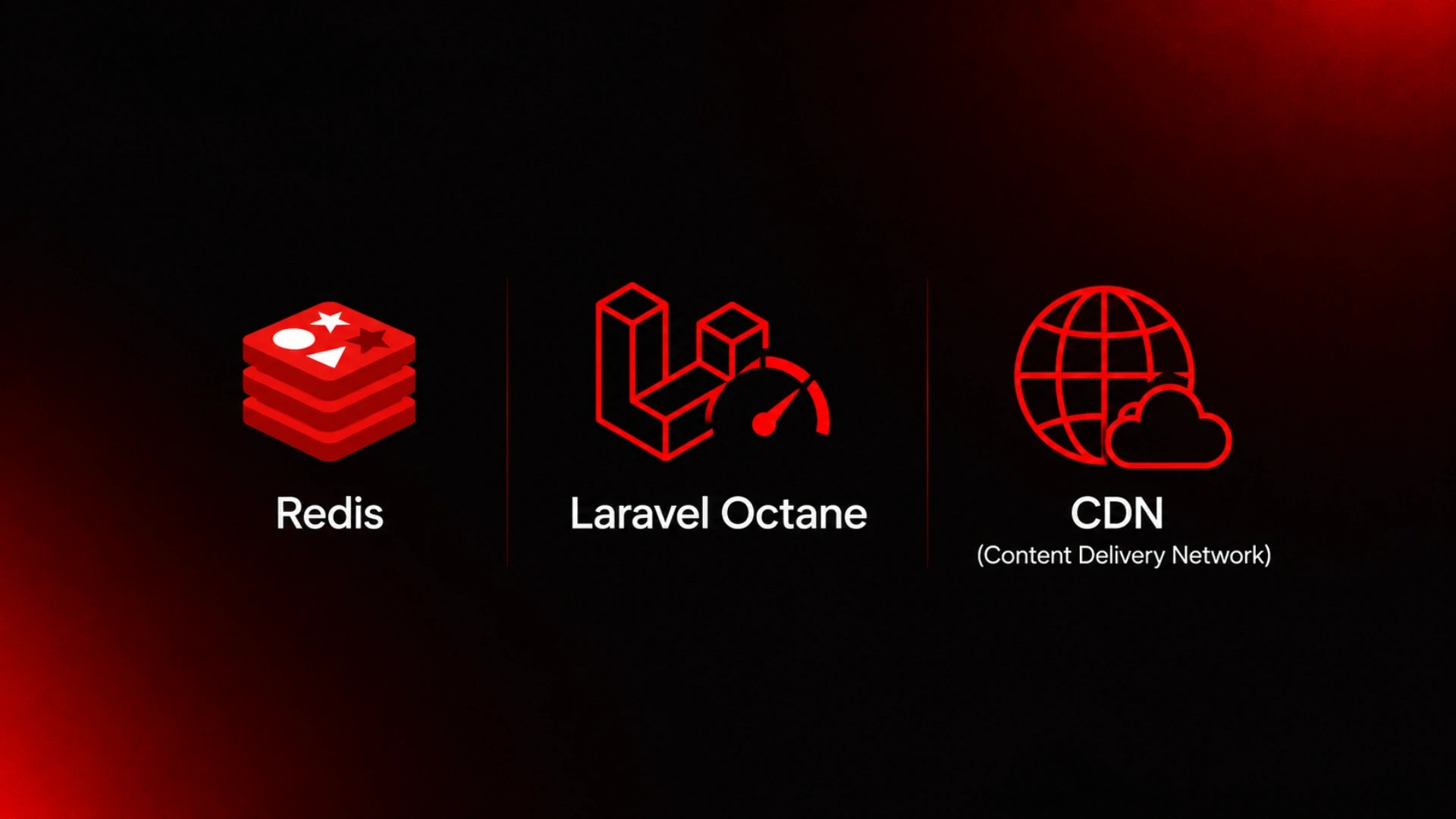
Once you know where the time goes, a handful of levers do most of the work. Delivering them on a live platform without breakage is where a Dedicated Software Team earns its place, owning the changes while your product work continues. Here they are in the order they usually pay off.
Lever | What it fixes | Typical impact |
Eager loading + indexes | N+1 queries, slow filters | 80 to 95% faster pages |
Caching (Redis) | Repeated expensive work | Large drop in DB load |
Queues for heavy work | Slow, blocking requests | Instant responses |
Octane | Low requests per server | Several times throughput |
Scale out + CDN | Single-server limits | Absorbs traffic spikes |
The first lever is the big one. Eliminating N+1 queries with eager loading and adding the right database indexes is almost always the largest single win, and the cheapest to make. After that, caching in Redis takes load off the database, queues move heavy work out of the request, Octane serves more requests per server, and scaling out behind a load balancer with a CDN handles the spikes.
Bringing extra senior hands in only for the optimization phase, then scaling back down, is exactly what Staff Augmentation is for, and teams that need more backend capacity fast often hire MEAN stack developers to speed execution without slowing product delivery.
Not Sure What Is Slowing You Down? Get a Free Performance Audit.
Send us your app and its symptoms (slow pages, timeouts under load, rising hosting bills). A senior engineer returns a one-page audit: the bottlenecks we expect to find, the levers ranked by gain, and an effort estimate, so you fix the right thing first instead of guessing.
Proof point: on N+1-bound platforms this routinely means 80 to 95% faster responses, backed by a 4.9/5 Clutch rating from 50+ verified reviews.
Architecting for Traffic Spikes, Not Just Average Load
Average load is the easy case; business platforms fail on the spike, the launch, the campaign, the seasonal rush. Designing for the peak is a different discipline, and getting the infrastructure right is where a DevOps engineer matters most.
The core move is to make the app stateless: keep sessions and cache in Redis and files in object storage, so you can add servers in minutes during a spike and remove them after. Pair that with graceful degradation, where non-critical features pause and heavy reports queue while the core path stays up, and a spike becomes a non-event instead of an outage.
When a launch needs more capacity fast, Hire Remote Developers who have handled launch-day load join within 48 hours and step back down afterward. Watch p95 and p99 response times, not just averages, because the slowest requests are what users feel and what cascade into failures.
Cost by Region
How much does Laravel performance work cost? It depends on scope and, heavily, on where your team sits, the same scope can differ 3x by region. Often the cheapest first move is to modernize the runtime: Version Upgrade Services can deliver a free speed bump, because newer PHP and Laravel releases are simply faster. The figures below are indicative 2026 ranges to help you budget, not a quote.
Region | Senior Laravel rate (per hour) | Optimization project (typical) |
United States | $100 to $180 | $15k to $60k+ |
United Kingdom | £80 to £140 | £12k to £48k+ |
European Union | €75 to €135 | €13k to €52k+ |
Australia | A$110 to A$190 | A$20k to A$80k+ |
Acquaint (offshore) | $22/hr or $3,200/mo | $6k to $25k |
The pattern holds everywhere: an Official Laravel Partner working offshore delivers the same scope at 50 to 70% less than US, UK, EU, or Australian local rates, with the same seniority. A focused audit is inexpensive and often pays for itself in saved hosting cost; a full scaling program is a larger engagement.
Real Case Study: A High-Transaction Platform Kept Fast
Here is a verified example from our portfolio of performance held under real load, not a demo. A high-transaction B2B payment platform had processed billions of transactions and served more than 200 business clients worldwide, and it needed to stay fast and uninterrupted while it was modernized at scale, exactly the brief that Software Development Outsourcing with a senior partner exists for.
As the platform scaled across jurisdictions at once, parts of it had become slow and hard to extend, while live reporting pipelines could not be interrupted, which ruled out a rewrite. We began with a full audit of the backend flows before writing a single line of new code, and that is where the real bottlenecks surfaced: query patterns that multiplied under volume, missing indexes, and work that belonged in the background.
To support the deep backend work, we also engaged experienced engineers through Hire Python Developers, which helped us move faster on performance fixes without disrupting production stability.
Outcome | Before | After |
Page response time | Slowed under load | 80 to 95% faster (N+1 fixed) |
Throughput | Strained at peak | Steady at scale |
Reporting pipelines | At risk during change | Ran uninterrupted |
Hosting efficiency | Rising cost | More requests per server |
Verified result (Clutch): the platform stayed fast and stable as volume grew, modernized incrementally with the live pipelines running the entire time. Acquaint Softtech holds a 4.9/5 rating from 50+ verified Clutch reviews with Premier Verified status. The lesson maps onto this guide: real performance is found in an audit, fixed at the bottleneck, and delivered without breaking live operations.
How Acquaint Softtech Approaches Laravel Performance

Our method is deliberately boring, because boring keeps a live platform safe. We measure before we touch anything, fix the highest-impact bottleneck first, and change things incrementally so nothing breaks under you. For leadership that needs the plan prioritized and defended, Virtual CTO Services provide the senior steer.
We also treat performance as a partnership, not a one-off fix: Laravel gives you the tools; we bring the judgment about which lever to pull and when, the part that only comes from having done it on platforms processing billions of transactions. Because performance decays again as a product grows, we stay on through Support and Maintenance to keep it fast as you scale, with profiles in 24 hours and engineers onboard in 48.
Ready to Make Your Platform Fast, and Keep It Fast as You Grow?
Book a free 30-minute consultation and we will map your likely bottlenecks, the levers ranked by impact, a timeline, and a fixed price, scoped to keep your platform live the whole time, then deploy your first engineer within 48 hours.
From $22/hour or $3,200/month · Matched in 24 hours · Engineer ready in 48 hours
Frequently Asked Questions
-
Why does my Laravel app slow down as it grows?
Usually N+1 query problems and missing indexes that only hurt once data and traffic grow, plus heavy work running inside the web request. Fixing these often cuts response times by 80 to 95%.
-
What is the single biggest Laravel performance win?
Eliminating N+1 queries with eager loading and adding the right database indexes. It is almost always the largest single improvement and the cheapest to make.
-
Do I need Laravel Octane to scale?
Not always, but it helps a lot at higher traffic. Octane keeps the app in memory so each server handles far more requests. Fix queries and caching first, then add Octane for more throughput per server.
-
How do I handle sudden traffic spikes?
Keep the app stateless so you can add servers fast, move heavy work to queues, cache aggressively, add a CDN, and design features to degrade gracefully so the core path stays up.
-
How much does Laravel performance optimization cost?
A focused audit is roughly $1.5k to $4k, an optimization project $6k to $25k offshore (more at US, UK, EU, or Australian local rates). The audit usually defines the exact scope.
-
Will optimizing performance require a rewrite?
Rarely. Most gains come from targeted fixes (queries, indexes, caching, queues) and incremental architecture changes that keep your platform live throughout.
I am Kalpesh Rajora, a Project Manager at Acquaint Softtech with 8+ years of experience leading Laravel and full-stack delivery teams. I specialise in sprint planning, client communication, and shipping complex software projects on time across distributed teams. I write about the delivery side of software: how projects are scoped, where timelines slip, and what keeps remote teams aligned.
Table of Contents
Get Started with Acquaint Softtech
- 13+ Years Delivering Software Excellence
- 1300+ Projects Delivered With Precision
- Official Laravel & Laravel News Partner
- Official Statamic Partner
Related Reading
How Laravel 13 Helps Developers Build Faster PHP Enterprise Applications in 2026
Laravel 13 (Released March 17, 2026) redefines modern PHP by making AI, modern syntax, standardized APIs, and passwordless security first-party, while keeping upgrades painless: No upgrade-breaking changes and about a ten-minute move from Laravel 12. That combination removes the last reasons enterprises hesitated to standardize on PHP.
Kalpesh Rajora
July 1, 2026.webp "How Laravel Deployment Turns Slow, Risky Releases Into 5-Minute Deploys")
How Laravel Deployment Turns Slow, Risky Releases Into 5-Minute Deploys
Laravel deployment improves scalability and team productivity through automated, zero-downtime pipelines on managed infrastructure like Laravel Cloud, cutting release time from 45 minutes to under 5 and freeing up 20–35 engineer hours monthly.
Kalpesh Rajora
June 24, 2026
Novice vs. Professional - Laravel Security Strategy
Develop a state-of-the-art and high secure Laravel application. Read this article to decide whether you require a novice or a professional developer.

Mukesh Ram
November 5, 2024India (Head Office)
203/204, Shapath-II, Near Silver Leaf Hotel, Opp. Rajpath Club, SG Highway, Ahmedabad-380054, Gujarat
USA
7838 Camino Cielo St, Highland, CA 92346
UK
The Powerhouse, 21 Woodthorpe Road, Ashford, England, TW15 2RP
New Zealand
42 Exler Place, Avondale, Auckland 0600, New Zealand
Canada
141 Skyview Bay NE , Calgary, Alberta, T3N 2K6