

Managing a Dedicated Python Team Across Time Zones
How to manage a dedicated Python development team across time zones in 2026. Overlap windows, async architecture, and the practices that make it work.

Acquaint Softtech
Introduction: Timezones Are a Solved Problem, But Only With Discipline
Every CTO managing a distributed Python team has had the same Sunday-evening realization at some point. The team in San Francisco is asking why the Bangalore team did not respond to a question that was sent at 6 PM Pacific. The Bangalore team is wondering why the San Francisco team scheduled a 4 PM Pacific meeting that lands at 4:30 AM IST. The product manager in London just sent an urgent Slack message at 2 PM London time and is frustrated that it is not getting answered, not realizing that the engineer who owns that area is currently asleep. None of this is a problem with the engineers. It is a problem with how the team operates across timezones, and operating across timezones is genuinely different from operating in a single timezone. The good news is that this is well-understood territory in 2026 and the solutions are not exotic. The bad news is that most teams running distributed Python development are still using single-timezone operating patterns and wondering why they feel constant friction.
The data on what actually matters in distributed team management is unusually concrete. According to a 2026 distributed IT teams management analysis by BayOne, Harvard Business School research finds that losing just one hour of timezone overlap reduces synchronous communication between distributed team members by 19%. For a US company with engineering teams across multiple timezones, that is the difference between a bug clarified in a five-minute call and a bug that sits in an async queue for 36 hours. The human cost is equally measurable: McKinsey reports one in three workers now experiences outright burnout, with always-on communication expectations in distributed environments cited as a primary driver, and Gallup's 2024 State of the Global Workplace recorded global employee engagement at 21%, its first decline since 2020. The same analysis identifies a four-layer communication architecture that high-performing distributed leaders operate on, which we will cover in detail later.
This guide covers exactly how to manage a dedicated Python development team across time zones. It walks through why overlap math actually matters, how to structure overlap windows for each major region pair (US-India, UK-India, US-Eastern Europe, US-LATAM), the four-layer communication architecture that prevents the always-on burnout pattern, the operational practices that distinguish teams that thrive across timezones from teams that quietly degrade, and how Acquaint Softtech structures dedicated Python engagements specifically for sustained distributed delivery. It is written for engineering leaders, CTOs, and product managers running or about to run a Python team across multiple timezones.
If you are still selecting the engagement model that will determine how your distributed team is structured, the complete guide to hiring Python developers in 2026 sets the wider framework for engagement models, rates, and the structural commitments that affect how a distributed team actually operates day-to-day.
The Real Math of Timezone Overlap
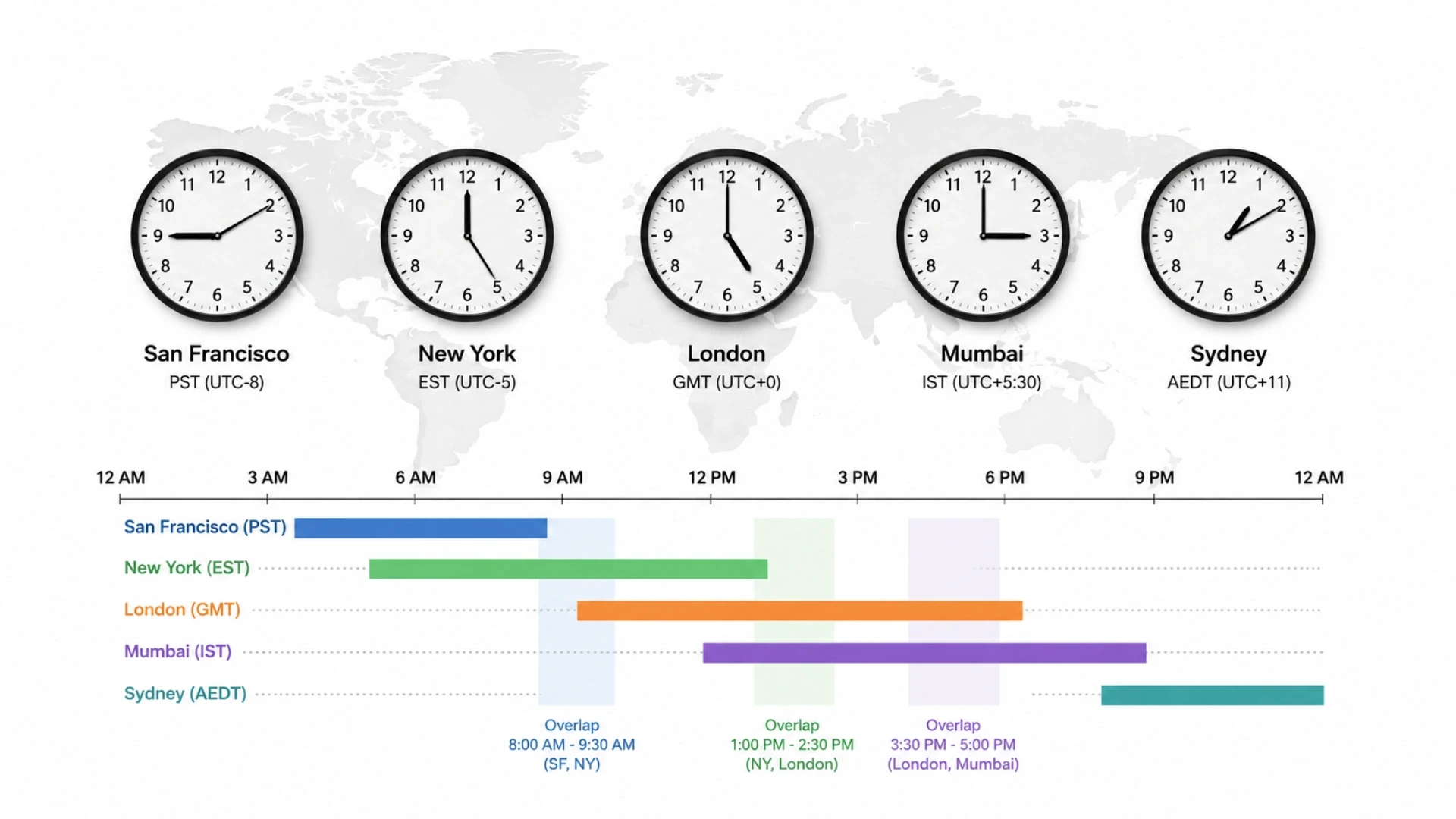
The structural reality of distributed teams in 2026 makes timezone management non-optional. According to the 2026 asynchronous work statistics compiled by Timeeting, 92% of remote teams span at least two time zones and 58% of distributed teams operate across three or more time zones, making synchronous communication structurally difficult for even the smallest distributed teams. Async work delivers productivity gains at an 8-to-1 ratio when implemented well, and AI tools now account for 22.3% of all deep work time for remote workers, a structural shift in how knowledge work gets done across timezones. For distributed Python teams, async communication is not a preference; it is a functional requirement, and the teams that internalize this systematically outperform the ones that try to force synchronous defaults onto a distributed reality.
Why Overlap Hours Are the Single Biggest Lever
One hour of overlap is the minimum, four hours is the comfort zone. Below one hour of daily overlap, the team cannot run real Agile ceremonies or handle live troubleshooting; communication queues build up and small issues become big ones. Above four hours, you have enough overlap for genuine collaborative work, real-time pair programming when needed, and synchronous standups that actually work.
India Standard Time gives 2 to 4 hours overlap with US, 4 to 5 hours with UK, 4 to 5 hours with Europe. IST runs at UTC+5:30, creating a 9.5 to 13.5-hour gap with US time zones. The overlap window is structurally limited, which is why structured offshore partners explicitly commit to overlap hours covering the client's core team time zones, in writing, before the engagement begins. The overlap is real but must be deliberately constructed.
Sub-1-hour overlap is when async-first becomes structural. If your team's timezone math gives you less than an hour of overlap, you cannot run sync-first operations. You must commit to async-first communication, with written decisions, documented context, and explicit handoff protocols. This is not a downgrade; it is a different and often more disciplined operating model that the best distributed teams have moved to deliberately.
The cost of bad overlap is measurable and human. McKinsey's burnout data shows one in three workers now experiences burnout, with always-on distributed work cited as a primary driver. Teams that compensate for poor overlap by stretching working hours into early mornings or late nights pay this cost over months in retention, quality, and engineer wellbeing. The right response to bad overlap is structural async, not heroic synchronous availability.
The Overlap Window Strategy: How to Structure Working Hours
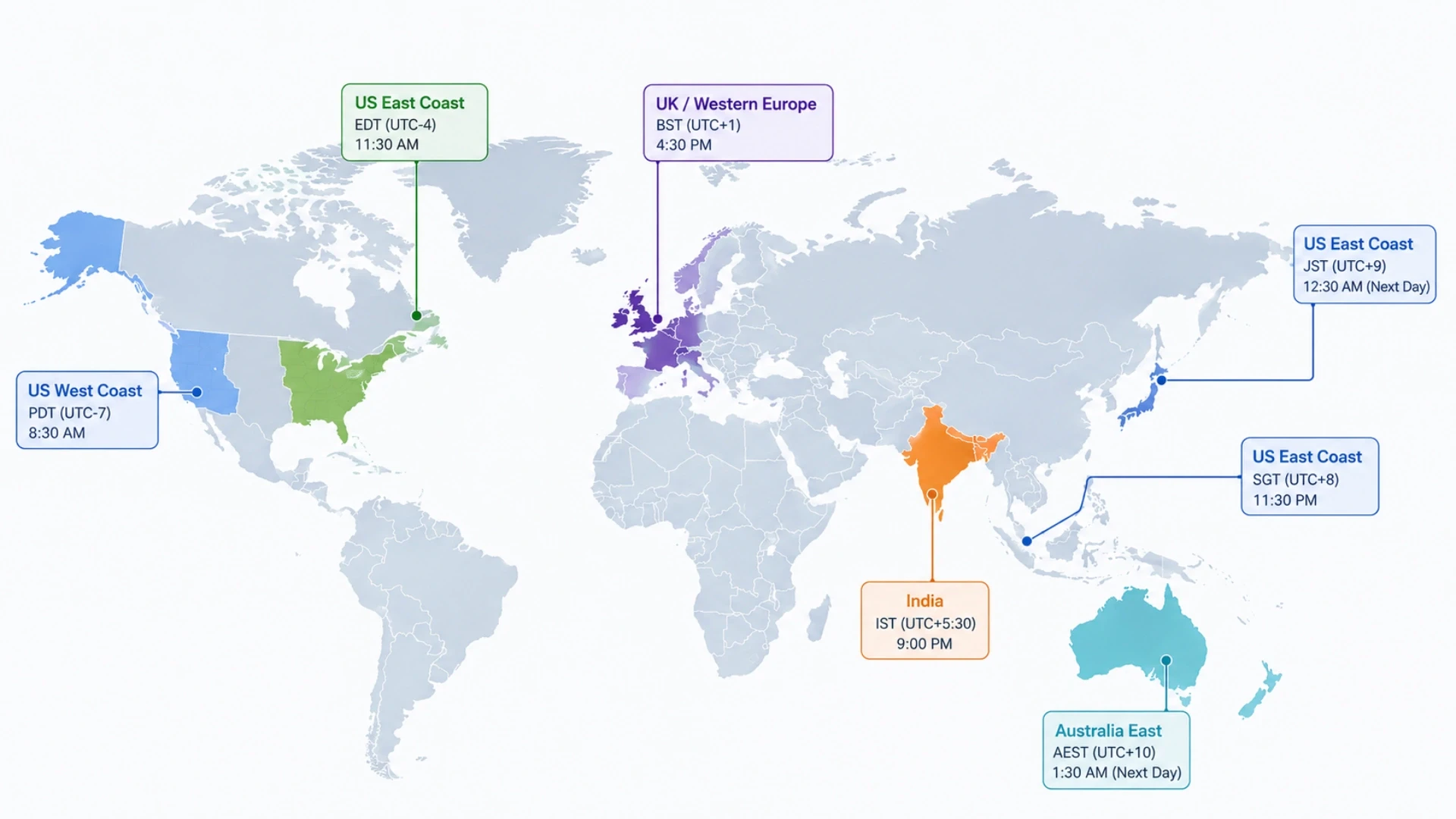
The most common mistake in distributed team management is treating overlap as something that happens by accident. It does not. Overlap is constructed deliberately by choosing working hours on both sides of the engagement so that a defined window exists every working day. The table below maps the practical overlap windows that work for the most common region pairs in distributed Python development, with the engagement structure that produces them.
Practical Timezone Overlap Windows by Region Pair
Client Region | Team Region | Practical Daily Overlap |
|---|---|---|
US East Coast | India (IST) | 2 to 4 hours (mornings ET) |
US West Coast | India (IST) | 2 to 3 hours (mornings PT) |
US East Coast | Eastern Europe | 5 to 7 hours (afternoons ET) |
US East Coast | LATAM | 6 to 8 hours (full overlap many cases) |
UK / Western Europe | India (IST) | 4 to 5 hours (afternoons UK) |
UK / Western Europe | Eastern Europe | 7 to 8 hours (near-full overlap) |
Australia East | India (IST) | 5 to 6 hours (afternoons AEST) |
Structuring the Working Day on Both Sides
Define the overlap window in writing, before engagement starts. The single most important thing a distributed Python engagement can include is an explicit, written commitment to daily overlap hours covering the client's core team time zone. Specific hours, not vague "we'll work it out" language. This commitment must be made before onboarding begins, because retrofitting it later is structurally difficult and usually impossible.
Stagger the team's working day around the overlap window. For a US East Coast client working with India, the offshore engineers' working day might run 1:30 PM IST to 10:30 PM IST, giving roughly 4 hours of overlap during US morning hours. The engineer's day is structured around the overlap, not retrofitted to it.
Reserve overlap hours for what only happens live. Use the overlap window for the work that cannot be async: collaborative debugging, design discussions, live demos, pair programming, sprint ceremonies. Async work (documentation, code review of routine PRs, individual implementation) happens outside the overlap window. Wasting overlap hours on status meetings is the most common misuse of a scarce resource.
Be explicit about what "available" means outside the overlap. Outside overlap hours, the team is async. Slack messages will get answered within the next overlap window, not within 15 minutes. Genuine emergencies have explicit escalation paths (on-call rotation, P0 channel, phone). Without this clarity, both sides build implicit always-on expectations that produce the burnout pattern.
The specific timezone math for the major Python offshore regions, including how IST, Eastern Europe, and LATAM compare for overlap with US, UK, and European business hours, is covered in detail in the analysis on offshore Python developer rates: India vs Eastern Europe vs LATAM, which walks through the structural overlap differences and explains why a partner with structured overlap commitments delivers fundamentally different outcomes from a marketplace freelancer with no defined working hours.
Need a Python Team With Structured Timezone Overlap?
Acquaint Softtech commits explicit daily overlap hours in writing before every dedicated Python engagement begins, covering US, UK, and European business hours depending on the client's primary timezone. Senior engineers, transparent pricing from $20/hour, full IP assignment and NDA from day one.
The Four-Layer Communication Architecture for Distributed Python Teams
Distributed teams that thrive across timezones do not just have good overlap windows. They have a deliberate communication architecture that uses different channels for different purposes, with explicit norms about which channel handles which kind of message. The four-layer architecture below is what high-performing distributed Python teams consistently operate on, and the absence of this structure is what produces the always-on-everywhere chaos that drives the burnout statistics.
The Four-Layer Communication Architecture
Layer | Cadence | Purpose |
|---|---|---|
Daily async check-in | Every working day | Written or video, replaces synchronous standup |
Weekly written team update | Once per week | Progress, blockers, decisions without a meeting |
Bi-weekly video call | Every two weeks | Relationship, complex problems, alignment |
Quarterly gathering | Once per quarter | Strategy, culture, depth that async cannot build |
How Each Layer Actually Operates
Layer 1: Daily async check-in replaces the synchronous standup. Each engineer writes (or records) a short update covering what they shipped yesterday, what they are working on today, and what is blocking them. Posted in a dedicated Slack channel within their first hour of work. The product owner reads them within their own first hour. Blockers get unblocked async or escalated to the overlap window if they require live discussion.
Layer 2: Weekly written team update covers progress without a meeting. One person (rotating tech lead, project manager, or engineering manager) writes a weekly update covering what shipped this week, what is in flight, what decisions were made, and what is coming next. Posted in writing, ten-minute read. Replaces the hour-long status meeting that nobody enjoys and many people sleep through.
Layer 3: Bi-weekly video call for relationship and complex problem-solving. Genuine synchronous time for the things async cannot do well: complex design discussions where back-and-forth matters, alignment on major decisions, relationship maintenance that prevents the team from feeling like strangers. Held during the overlap window. Capped at 60 to 90 minutes.
Layer 4: Quarterly gathering for strategy and depth. In-person if budget allows (significantly more effective), high-production virtual if not. Strategic conversations, retrospective on the quarter, planning for the next, and the relationship depth that async channels cannot build. The annual or quarterly gathering is the investment that prevents the slow corrosion of distributed team cohesion over time.
What This Architecture Replaces
This four-layer architecture replaces the default pattern most distributed teams accidentally fall into, which is some uncoordinated mixture of constant Slack interruptions, ad-hoc Zoom calls scheduled across inconvenient hours, an unwritten expectation that everyone is available all the time, and the occasional emergency in-person gathering that the team waited too long to schedule. When the four layers exist and are respected, the volume of ad-hoc interruptions drops significantly within 30 days, sustained synchronous time becomes available for the work that genuinely benefits from it, and the burnout pattern that drives distributed team attrition decreases measurably.
The structural commitment to defined overlap hours is one of the most important distinctions between dedicated team engagements and marketplace developer arrangements. The detailed analysis on why in-house Python teams outperform marketplace developers walks through how explicit, written overlap-hour commitments translate into the operational predictability that distributed Python teams need, and why marketplace arrangements without these commitments consistently produce the timezone friction that dedicated arrangements solve structurally.
The Operational Practices That Make Distributed Python Teams Work
Beyond overlap math and communication architecture, a small set of operational practices distinguish distributed Python teams that thrive from those that quietly degrade. These are not optional best practices; they are the structural requirements that make the difference between a distributed team that ships and one that constantly feels behind.
Document everything that affects more than one person. Architecture decisions get an ADR (Architecture Decision Record). API contracts get a doc. Important Slack discussions get summarized in writing. The hard rule is: if more than one person needs to know it, it lives in writing in a searchable location, not just in someone's head or in a Slack message that scrolls away. Documentation discipline is what makes async communication possible.
Use written specifications for non-trivial work. Before significant features start, the requirements, design, and acceptance criteria are written down in a single document the entire team can read. This replaces the synchronous "hop on a quick call" pattern that does not scale across timezones. Async-first work begins with async-first specifications.
Standardize the toolchain ruthlessly. One project management tool (Jira, Linear, or similar). One chat tool (Slack, with explicit channel norms). One docs tool (Notion, Confluence, GitHub wikis). One video tool. Standardization removes the friction of "which tool do we use for this?" questions that distributed teams cannot afford to spend mental energy on. AI tools, accounting for 22.3% of deep work time for remote workers in 2026, are increasingly part of this standardized stack.
Make on-call coverage explicit and global. If your Python application has a production presence, on-call coverage needs to span timezones explicitly. A primary on-call in one region, secondary in another, with documented escalation paths and clear handoff protocols. "Follow-the-sun" support is a real operational pattern that distributed teams can leverage, but only with explicit structure.
Make decisions in writing, with explicit decision logs. Distributed teams cannot afford decisions that exist only in someone's memory of a meeting. Every significant decision is recorded in writing (the ADR pattern works well for technical decisions; a separate decision log works for product decisions), with the reasoning, alternatives considered, and decision-maker named. This is what lets the team in one timezone build on decisions made by the team in another timezone without re-litigation.
Schedule synchronous time intentionally, not reflexively. Every synchronous meeting in a distributed team is a small tax on someone's schedule (often a significant tax on someone in a less-convenient timezone). Schedule them deliberately, with clear agendas, the right participants, and a defined output. Cancel them when not needed. The default in a distributed team should be async; synchronous time is reserved for what genuinely requires it.
The structural benefits of well-managed distributed Python teams compound significantly over time when these practices are in place. The analysis on the benefits of remote development teams for startups walks through how distributed teams enable access to global talent, reduced overhead, and faster delivery when the operational discipline that this guide describes is genuinely applied rather than aspirationally claimed.
How Acquaint Softtech Structures Dedicated Python Teams Across Time Zones
Acquaint Softtech is a Python development and IT staff augmentation company based in Ahmedabad, India, with 1,300+ Python projects delivered for clients across the US, UK, Europe, Australia, and the Gulf region. Our distributed team engagements follow the framework in the complete guide to hiring Python developers, with explicit overlap commitments, async-first communication architecture, and the operational practices that distinguish distributed teams that thrive from those that struggle.
Explicit overlap hours committed in writing before engagement starts. Every dedicated Python engagement includes a defined overlap window covering the client's core team timezone (US East Coast, US West Coast, UK, Western Europe, Australia East), committed in writing before onboarding begins, with the engineer's working day structured around that overlap rather than retrofitted to it.
Direct communication, no agency layer. Clients communicate directly with their engineers through the client's tools (Slack, Jira, Linear, GitHub) on the client's schedule. No translation layer, no project-manager intermediary filtering signal, no "we'll get back to you" delays that distributed work cannot afford.
Async-first documentation and communication discipline. Our engineers are trained in the discipline that distributed work requires: written specifications, decision documentation, async PR reviews with explicit context, and the kind of written communication that lets a developer in one timezone build effectively on work done in another.
Transparent pricing from $20/hour with structural continuity. Dedicated Python engineering teams from $3,200/month per engineer, roughly 40% less than equivalent US in-house hiring. Full IP assignment and NDA from day one. Free replacement guarantee on dedicated engagements, which removes the continuity risk that distributed teams especially cannot afford to carry.
The engagement model determines how a distributed team operates structurally, and the staff augmentation versus dedicated team versus outsourcing choice affects timezone management directly. The analysis on Python staff augmentation vs dedicated team vs outsourcing walks through which model fits which distributed-team scenario, and why dedicated teams with structural overlap commitments consistently outperform marketplace and project-outsourcing models for ongoing distributed Python work.
To get senior Python engineers committed to your overlap window, integrated into your tools, and ready to operate distributed work to production quality, you can hire Python developers with profiles shared in 24 hours and a defined onboarding plan within 48.
The Bottom Line
Managing a dedicated Python development team across time zones is a solved problem in 2026, but only with discipline. The teams that thrive treat timezone management as structural engineering work rather than scheduling inconvenience. They construct overlap windows deliberately rather than hoping they happen by accident. They commit to defined overlap hours in writing before onboarding begins.
The teams that struggle do the opposite. They try to operate single-timezone patterns on multi-timezone teams. They schedule synchronous meetings reflexively rather than deliberately. They expect always-on availability and produce the burnout pattern that McKinsey documents in one in three distributed workers. They build implicit norms that contradict explicit working hours, and the friction compounds quarter over quarter until the team's best engineers leave.
Running a Distributed Python Team and Hitting Friction?
Book a free 30-minute consultation. Tell us your current timezone setup, where the friction is showing up, and how your distributed Python team is structured today, and we will give you an honest answer: what is structural versus what is fixable with discipline, how to architect the overlap and async layers for your specific case, and what good distributed delivery should actually look like for your team. No sales pitch.
Frequently Asked Questions
-
How many hours of timezone overlap does a distributed Python team need?
One hour is the bare minimum to run any real synchronous work; four hours is the comfort zone where genuine collaborative development is sustainable. Below one hour, async-first becomes structural because synchronous defaults break down. Above four hours, you have enough overlap for sprint ceremonies, design discussions, and live debugging. Harvard Business School research shows that losing just one hour of overlap reduces synchronous communication between distributed team members by 19%, which is why preserving overlap is the highest-leverage operational decision in distributed team management.
-
What is the practical overlap between US and India for a Python team?
India Standard Time runs at UTC+5:30, creating a 9.5 to 13.5-hour gap with US time zones. Practical daily overlap is roughly 2 to 4 hours for US East Coast (mornings ET, late evenings IST) and 2 to 3 hours for US West Coast (mornings PT, late evenings IST). This overlap is real and workable, but it must be deliberately constructed by staggering the offshore engineer's working day around US morning hours rather than expecting standard 9-to-5 IST hours to magically align with US business hours.
-
What is the four-layer communication architecture?
Four communication layers operating at different cadences for different purposes. Layer 1: Daily async check-in (written or video) replacing the synchronous standup. Layer 2: Weekly written team update covering progress, blockers, decisions without a meeting. Layer 3: Bi-weekly synchronous video call for relationship maintenance and complex problem-solving. Layer 4: Quarterly in-person or high-production virtual gathering for strategy, culture, and the depth that async cannot build. When these four layers exist and are respected, ad-hoc interruption volume drops significantly within 30 days.
-
How do I prevent burnout in a distributed Python team across timezones?
Three structural commitments. First, explicit overlap hours committed in writing, so engineers know exactly when they need to be synchronous and when they can be async. Second, clear norms about what "available" means outside the overlap window (async expectations, response times, explicit escalation paths for genuine emergencies). Third, the four-layer communication architecture so that ad-hoc interruptions stop being the default. McKinsey reports one in three workers experiencing burnout, with always-on distributed expectations as a primary driver, so the structural fixes are not optional.
-
What tools should a distributed Python team standardize on?
One tool per category, used consistently. Project management: Jira or Linear. Chat: Slack with explicit channel norms (one channel per topic, public by default, clear retention policies). Documentation: Notion, Confluence, or GitHub wikis. Video: Google Meet, Zoom, or Microsoft Teams. Version control and code review: GitHub or GitLab. AI tools (ChatGPT, Cursor AI, GitHub Copilot) now account for 22.3% of deep work time for remote workers in 2026, so AI capabilities are increasingly part of the standardized stack. The standardization itself matters more than which specific tool you choose; remove the friction of "which tool for this?" questions.
-
How does Acquaint Softtech handle timezone overlap for US clients?
Every dedicated Python engagement includes explicit, written overlap hours covering the client's core team timezone before onboarding begins. For US East Coast clients, that typically means the engineer's working day runs from late morning IST through late evening IST, giving 3 to 4 hours of overlap during US morning hours. For US West Coast, the schedule shifts to give morning PT overlap. The specific window is committed in writing and held throughout the engagement, with structural backup (free replacement guarantee on dedicated engagements) for the continuity risks that distributed teams especially cannot afford.
-
When should we move from sync-first to async-first operations?
Anytime your team spans more than three timezones or has less than two hours of guaranteed daily overlap, async-first becomes structural rather than optional. Timeeting data shows 58% of distributed teams operate across three or more timezones, where common meeting times become near-impossible to schedule without inconveniencing someone significantly. The async-first transition requires investment in written specifications, decision documentation, written team updates, and clear norms about when synchronous time is genuinely needed. Done well, async-first delivers productivity gains at an 8-to-1 ratio compared to forced synchronous operations.
We’re Acquaint Softtech, your technology growth partner. Whether you're building a SaaS product, modernizing enterprise software, or hiring vetted remote developers, we’re built for flexibility and speed. Our official partnerships with Laravel, Statamic, and Bagisto reflect our commitment to excellence, not limitation. We work across stacks, time zones, and industries to bring your tech vision to life.
Table of Contents
Get Started with Acquaint Softtech
- 13+ Years Delivering Software Excellence
- 1300+ Projects Delivered With Precision
- Official Laravel & Laravel News Partner
- Official Statamic Partner
Related Blog

How to Hire Python Developers Without Getting Burned: A Practical Checklist
Avoid costly hiring mistakes with this practical checklist on how to hire Python developers in 2026. Compare rates, vetting steps, engagement models, red flags, and more.
Acquaint Softtech
March 30, 2026
Total Cost of Ownership in Python Development Projects: The Full Financial Picture
The build cost is just the beginning. This guide breaks down the complete TCO of Python development projects across every lifecycle phase, with real benchmarks, a calculation framework, and 2026 data.
Acquaint Softtech
March 23, 2026
Python Developer Hourly Rate: What You're Actually Paying For
Python developer rates range $20-$150+/hr in 2026. See what experience, specialisation & hidden costs actually determine the price. Save 40% with vetted offshore talent.
Acquaint Softtech
March 9, 2026India (Head Office)
203/204, Shapath-II, Near Silver Leaf Hotel, Opp. Rajpath Club, SG Highway, Ahmedabad-380054, Gujarat
USA
7838 Camino Cielo St, Highland, CA 92346
UK
The Powerhouse, 21 Woodthorpe Road, Ashford, England, TW15 2RP
New Zealand
42 Exler Place, Avondale, Auckland 0600, New Zealand
Canada
141 Skyview Bay NE , Calgary, Alberta, T3N 2K6
Your Project. Our Expertise. Let’s Connect.
Get in touch with our team to discuss your goals and start your journey with vetted developers in 48 hours.