

Why In-House Python Teams Outperform Marketplace Developers for Long-Term Projects
Marketplace developers look cheaper on paper. Dedicated in-house Python teams deliver more at month 6, 9, and 12. This guide breaks down exactly why, with data, real cost comparisons, and 7 compounding advantages.

Acquaint Softtech
Who This Guide Is For
This guide is written for CTOs, VPs of Engineering, and product leaders at growth-stage SaaS companies, data-driven businesses, and digital product teams who are currently using or evaluating marketplace platforms like Upwork, Toptal, or Freelancer.com for Python development, and are questioning whether that model is actually serving them on projects that extend beyond a single sprint or two.
If you are still deciding which engagement structure to use, the Python hiring model comparison at Acquaint Softtech provides the full framework across staff augmentation, dedicated teams, and project outsourcing. This guide zooms in specifically on one critical distinction: why in-house dedicated teams systematically deliver better outcomes than marketplace arrangements when the project horizon exceeds three months.
The Problem with How Most Companies Choose Python Developers
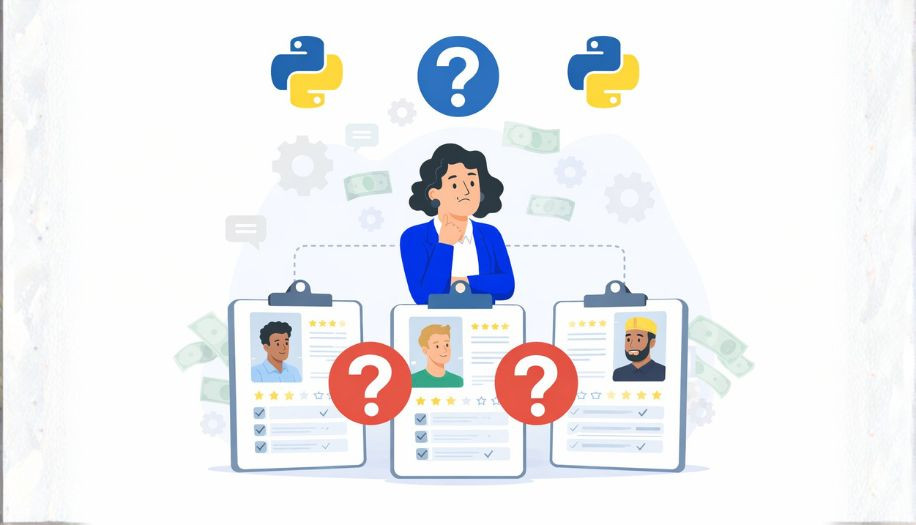
The first thing most companies do when they need a Python developer is open a marketplace. Upwork, Toptal, Freelancer.com. They see a wide pool of profiles, filter by rating, look at the portfolio, check the hourly rate, and make a hire. The process takes a few days. The project starts. Things seem to move.
Then, three months in, something shifts. The developer starts missing context they should have built by now. Architectural decisions made in week two are creating friction in week fourteen. Documentation is sparse. A feature that should take three days takes eight because the developer needs to re-read code they wrote themselves. And when they become unavailable for two weeks because of another client commitment, the project stalls entirely.
This is not a failure of the individual developer. It is a structural failure of the marketplace model applied to the wrong type of project. The freelance market reached an estimated $8.9 billion in 2026 according to Mordor Intelligence, growing at 16.32% CAGR. That growth reflects genuine demand for flexible, task-based talent. What it does not reflect is suitability for long-term, continuity-dependent Python product development.
Research from industry project data shows agencies and dedicated teams demonstrate better success rates for complex projects requiring coordination or long-term maintenance commitments, while freelancers tend to excel at smaller, well-defined projects where scope is limited. At Acquaint Softtech, this distinction is visible across 1,300+ delivered projects: the engagement model is the single biggest predictor of long-term delivery quality, more than technology stack, team size, or even individual developer seniority.
The core thesis of this guideMarketplace developers are optimized for short, bounded tasks. In-house dedicated Python teams are optimized for long-term product development. Using a marketplace model for a long-horizon project is like using a taxi for a six-month commute. The first ride is fine. The accumulating cost in time, context loss, and coordination overhead is what breaks the budget. |
Defining the Terms: What In-House Dedicated Means in 2026
The term in-house dedicated does not mean a full-time employee on your payroll in your office. In 2026, it means something more specific and more accessible: a vetted developer who works exclusively on your project during agreed working hours, is fully embedded in your sprint cadence and tools, operates under a full NDA with IP assigned to you, and is managed through an accountable partner agency rather than a freelance marketplace.
This is distinct from a marketplace developer, who manages multiple client engagements simultaneously, is sourced through a platform algorithm rather than human vetting, works on your project only when their other commitments allow, and operates under platform terms that may not assign IP clearly to you. The IT staff augmentation model from a vetted agency is the closest approximation to an in-house hire without the overheads of direct employment. And it is this model that consistently outperforms marketplace arrangements for projects that run longer than a quarter.
For context on what a truly dedicated Python development team looks like in practice, the dedicated software development teams at Acquaint Softtech describes the specific engagement structure, onboarding timeline, and accountability mechanisms that differentiate this model from marketplace sourcing.
7 Reasons In-House Python Teams Systematically Outperform Marketplace Developers at the 6-Month Mark
These are not advantages that appear on day one. They are compounding advantages that become visible and measurable as a project matures. Marketplace developers often appear competitive in the first sprint. The gap opens in months two through six, and widens from there.
Institutional Knowledge Compounds; Marketplace Context Resets
Every time a developer works on your Python codebase, they build context. They learn which database queries are slow, which modules are fragile, why a particular design decision was made three sprints ago, and where the hidden complexity lives. After six months with a dedicated developer, that accumulated context makes them significantly faster and more accurate than they were in month one. They are not just executing tasks, they are operating from a mental model of your entire system. A marketplace developer, by contrast, operates across multiple client engagements simultaneously. Their context for your project is partial and perpetually interrupted. When they return to your codebase after a week on another client's system, they re-read, re-orient, and re-confirm before they write a line. That re-orientation cost does not appear on their invoice. It appears on your timeline.
The compound effect: A dedicated developer's velocity typically increases 20 to 30% between sprint one and sprint twelve as context accumulates. A marketplace developer's velocity stays flat or decreases as codebase complexity grows faster than their contextual catch-up.
Communication Quality Determines Delivery Velocity More Than Technical Skill
The research is consistent: developers who surface blockers proactively, communicate architectural decisions clearly, and integrate naturally into sprint ceremonies reduce management overhead and rework cycles in ways that outweigh narrow differences in hourly rate or technical benchmark performance. Marketplace developers operate across multiple client communication channels simultaneously. Your Slack is one of several they are monitoring. Your standup is one of several they are attending or declining. The structural incentive for a marketplace developer is to avoid flagging problems until they cannot be ignored, because flagging problems creates friction with the platform rating system that determines their next engagement. A dedicated in-house Python developer, embedded in your team and accountable through an agency with a named resource commitment, has exactly the opposite incentive structure. Surfacing problems early is how they demonstrate value. Absorbing problems silently is how they create the kind of delivery failure that ends the engagement.
The compound effect: Communication patterns set in the first two weeks of an engagement persist for its duration. A developer who surfaces a blocker on day three of the first sprint will surface blockers proactively throughout. A developer who absorbs problems for two weeks before revealing them will do the same in month six.
Code Quality is an Accountability Function, Not a Skill Function
Most companies assume that code quality is determined by the developer's technical ability. It is actually determined by accountability structure. A marketplace developer has weak accountability for the long-term maintainability of their code. They are rated on completion and client satisfaction at the moment of delivery. What happens to the codebase in month seven, when a different developer is trying to extend their work, does not affect their profile score. An in-house dedicated Python developer is accountable for the code they write because they will be the one maintaining and extending it. When they write a function that only they can understand, they are creating technical debt that will cost them time in three sprints. That self-interest alignment produces documentation habits, test coverage discipline, and architectural thinking that marketplace arrangements structurally cannot incentivise.I ndustry data places 66% of project failures at the door of changing requirements and unclear objectives, but the second-order cause is almost always a codebase that has become too fragile or undocumented to absorb those changes cleanly. Dedicated teams prevent this at the source.
The compound effect: Code maintainability is not a technical decision. It is a consequence of whether the developer who writes the code will also be responsible for its future. Dedicated teams create that alignment by default.
IP Ownership Is Not Ambiguous When the Contract Is Right
Marketplace platforms govern intellectual property through their terms of service, which are written to protect the platform and the developer, not the client. Upwork's standard terms, for example, require specific contract structures to ensure IP transfers cleanly to the client. Many companies using marketplace platforms discover IP ambiguity only when they need to enforce ownership, which is always after the fact and always expensive. In-house dedicated Python development through a vetted agency like Acquaint Softtech is structured differently from the first interaction. NDA execution and full IP assignment to the client take effect before any requirements are shared, before any code is written, and before any architecture is designed. There are no platform terms mediating that assignment. The agreement is direct, explicit, and legally clean.
The compound effect: For more on what the right IP clause looks like and what contract red flags signal risk, the guide on evaluating a Python development partner before signing covers every clause that matters.
Developer Continuity Eliminates the Hidden Cost of Rotation
When a marketplace developer becomes unavailable mid-project, the typical sequence is this: the client discovers the unavailability through a missed deadline or an unanswered message. They return to the marketplace. They screen new profiles. They select a candidate. They conduct interviews. They onboard a new developer who spends two to four weeks re-reading code, re-establishing architectural understanding, and reproducing context that the previous developer held in their head. According to the Society for Human Resource Management, replacing a developer costs between 50% and 200% of their annual salary. For a mid-level Python developer at $80,000 per year, that is $40,000 to $160,000 per rotation event. Marketplace projects that rotate through two or three developers over twelve months effectively eliminate the cost advantage of the lower hourly rate many times over.In-house dedicated Python teams through vetted agencies include a replacement guarantee. If a developer becomes unavailable, the agency provides a vetted replacement with continuity documentation, at no additional recruitment cost to the client. The engagement continues without a reset.
The compound effect: Developer rotation is the single largest hidden cost in long-term marketplace Python engagements. It is invisible in the proposal and devastating in the project
Time-zone and Availability Commitments Are Contractual, Not Aspirational
A marketplace developer's availability is self-reported and unverified. They list their time-zone. They indicate their weekly availability. Neither is contractually binding. When a client in New York needs a code review before their 9am standup and their marketplace developer in Eastern Europe is managing three other client commitments across two time-zones, the review does not happen and the standup is blocked. In-house dedicated Python teams through structured IT staff augmentation have contractually committed time-zone overlap windows. The minimum daily overlap, the standup schedule, the code review cadence, and the response time SLA are all documented in the engagement agreement. By mid-2025, over 60% of forward-thinking companies were blending dedicated remote developers with specialist freelancers specifically because dedicated arrangements provide structure that marketplace arrangements cannot. At Acquaint Softtech, every dedicated Python developer engagement includes explicit overlap hours with the client's core team time-zone, covering US, UK, and European business hours, with the specific window committed in writing before onboarding begins.
The compound effect: For a full breakdown of timezone overlap requirements and how to evaluate them before signing, see the 7 red flags to watch for when hiring Python developers remotely.
Long-Term Cost Curves Favour Dedicated Teams Despite Higher Visible Rates
This is the counterintuitive truth that most marketplace comparisons miss. A marketplace Python developer quoted at $40/hr appears cheaper than a dedicated agency developer quoted at $45/hr per month equivalent. At month one, the difference is real. At month six, it has reversed. The dedicated developer's velocity has increased by 20 to 30% as institutional knowledge compounds. The marketplace developer's velocity is flat because they are continuously re-orienting between clients. The dedicated developer's code requires fewer rework cycles because they are accountable for its long-term maintainability. The marketplace developer's code requires periodic major reviews because the accountability is short-term. When you factor in the rotation costs, the re-onboarding delays, the rework budgets, and the management overhead of coordinating a developer who is managing three other clients simultaneously, the total cost of ownership of a marketplace arrangement for a 12-month Python project almost always exceeds the total cost of a dedicated in-house engagement at a nominally higher rate.
The compound effect: The rate on the proposal is not the cost of the engagement. The cost of the engagement is the rate multiplied by hours, plus every hour your team spends managing, re-onboarding, reviewing, and fixing what the model's incentive structure made inevitable.
Side-by-Side: 10 Dimensions That Determine Long-Term Outcomes
Use this table when evaluating your current or proposed Python development arrangement. For each dimension, identify which column describes your current engagement. If more than three rows map to the marketplace column, the model mismatch is costing you delivery performance on a project that requires continuity. The complete model selection framework is available in the staff augmentation vs dedicated team vs outsourcing guide.
Dimension | Dedicated In-House Team | Marketplace Developer |
Codebase context at month 6 | Deep institutional knowledge, owns architecture | Partial, must re-onboard on every engagement |
Communication pattern | Proactive escalation, part of your sprint | Reactive, works around multiple client commitments |
IP ownership clarity | Explicit written assignment from Day 1 | Depends on platform terms, often ambiguous |
Code documentation | Ongoing, part of delivery standards | Inconsistent, often post-project or absent |
Replacement on departure | Agency provides vetted replacement with handoff | You restart the entire hiring process |
Technical debt management | Tracked and budgeted across sprints | Not their concern after project scope ends |
Regulatory compliance depth | Trained and accountable within engagement | Varies widely by individual |
Cost at month 12 | Decreasing effective rate as velocity increases | Flat or increasing as re-onboarding repeats |
Timezone overlap guarantee | Contractually committed windows | Dependent on individual availability |
Post-launch maintenance | Continuation of same engagement | New contract, new negotiation, new onboarding |
The decision point most teams miss
The model that is right for month one is not always the model that is right for month six. Many companies start with a marketplace developer because the project feels bounded and then discover, three months in, that the project has evolved into something that requires continuity. The correct decision is to switch models at that point, not to optimize the current model. The guide on questions to ask before you hire a Python developer provides the evaluation criteria to make that call before it becomes urgent.
The True Cost Comparison: What the Invoice Never Shows
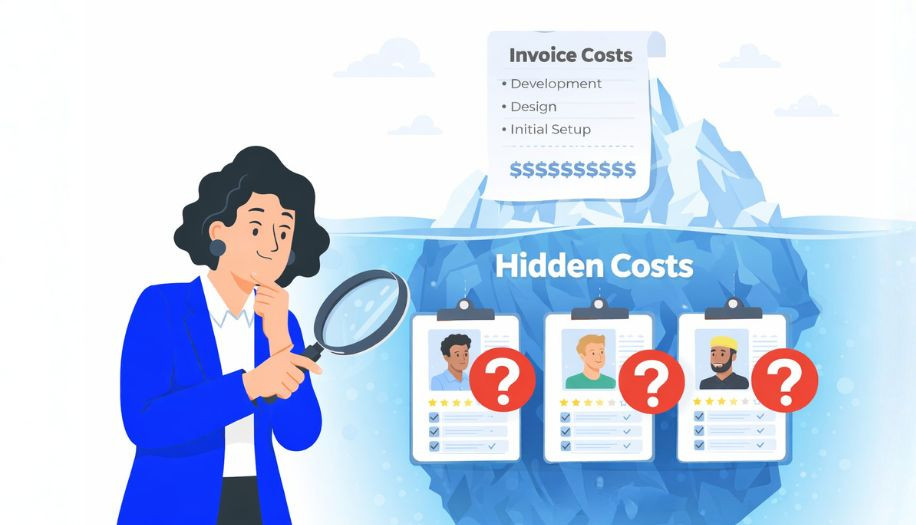
The visible rate is the most frequently cited factor in Python developer hiring decisions and the least useful single metric for long-term projects. Total cost of ownership requires accounting for every cost category that does not appear on the invoice. For a full breakdown of the hidden cost categories that affect both freelancer and agency arrangements, the Python freelancer vs dedicated agency hidden cost analysis provides the complete breakdown with 2026 data.
Cost Dimension | Dedicated In-House Model | Marketplace Model |
Visible rate (mid-level) | $25-$45/hr (agency) | $30-$80/hr (platform headline) |
Platform commission added | None | 10-20% passed to you via inflated rate |
Onboarding time (6-month project) | Once, Days 1-2 | Repeated with every developer rotation |
Rework cost from developer churn | Minimal (replacement guarantee) | High: new developer rebuilds context from scratch |
Knowledge transfer at month 6 | Compound: developer knows your system | Zero: each engagement starts fresh |
True cost at project month 12 | Decreasing per-feature (speed compounds) | Flat or rising (re-onboarding repeats) |
IP dispute risk | None (explicit written assignment) | Moderate to high (platform terms govern) |
Post-project maintenance rate | Same rate, same developer | New negotiation, new rate, new ramp-up |
On the rate side, Acquaint Softtech's dedicated Python developers start at $20/hr with mid-level developers in the $22 to $45 range, which is directly competitive with marketplace rates when the total cost comparison is applied. For the full rate data across India, Eastern Europe, and the US, the Python developer hourly rate guide provides verified 2026 benchmarks by seniority and geography.
When Marketplace Developers Are Still the Right Choice
This guide is not an argument against marketplace platforms. It is an argument for model-to-project alignment. Marketplace developers serve specific use cases well, and companies that use them for those use cases get good results.
Task-based, bounded scope
A single-page scraper, a data cleaning script, a specific API integration with well-defined inputs and outputs. Scope is fixed, context requirement is low, and a marketplace developer can deliver efficiently.
Short-term specialist skill gap
Your team needs a specific capability for three to four weeks that does not justify a longer engagement. A marketplace developer with that specific skill, clearly scoped, works well.
Pre-validation prototype
You are testing whether a technical approach works before committing to a full build. A marketplace developer on a short, fixed-scope prototype is cost-effective and appropriate.
Supplementing a strong internal team
Your internal Python team has the institutional knowledge and you need an additional pair of hands for a defined sprint. The context already exists in-house; the marketplace developer executes within a defined structure.
The signal that the marketplace model has become the wrong fit is when you find yourself spending more time managing, explaining context to, and reviewing the output of your marketplace developer than that overhead is worth relative to the cost of a structured dedicated arrangement. The complete guide to hiring Python developers provides the full decision framework for making this evaluation at any project stage.
How Acquaint Softtech Delivers the In-House Dedicated Advantage
Acquaint Softtech is a software development and IT staff augmentation company headquartered in Ahmedabad, India, with over a decade of experience and 1,300+ projects delivered for clients across the US, UK, Europe, and Australia. Every engagement is structured to deliver the seven advantages described in this guide from day one.
100% In-House Developers
Acquaint Softtech does not subcontract. Every developer on the bench is a direct employee of Acquaint Softtech, not a marketplace-sourced contractor. This means their accountability, their vetting, and their working standards are managed internally rather than mediated through a platform algorithm.
Named Resource Commitment
When you hire Python developers through Acquaint Softtech, the specific developer assigned to your project is named in the contract. Any substitution requires your written approval. The bait-and-switch model, where senior developers pitch and junior developers execute, is contractually prevented.
Full IP Assignment and NDA Before Requirements Are Shared
NDA execution and IP assignment to the client takes effect before any project requirements, system diagrams, or business logic is discussed. You own everything from the first conversation, not from the first commit.
48-Hour Onboarding with 30-Day Trial
Pre-vetted developer profiles are available within 24 hours of receiving your requirements. Onboarding into your sprint, tools, and communication channels begins within 48 hours of profile approval. All dedicated engagements include a 30-day trial period evaluated on communication quality, code quality under review, and timeline adherence before any long-term commitment.
Free Replacement Guarantee
If a developer becomes unavailable or underperforms, Acquaint Softtech provides a vetted replacement with continuity documentation at no additional recruitment cost. The engagement does not reset. Your project continues.
Actionable Takeaways
Before deciding between a marketplace developer and a dedicated in-house Python team for your next project, answer three questions honestly.
Is my project scope fixed or evolving?
If the scope will change as users interact with the product and as your understanding of the problem deepens, the fixed-engagement marketplace model will generate change order costs and context resets that a dedicated team avoids entirely.
Does my project require architectural continuity?
If the decisions made in sprint two will affect what is possible in sprint twenty, you need a developer who is accountable for both. Marketplace developers are accountable for sprint two. Dedicated developers are accountable for the system.
What is the true cost at month twelve, not month one?
Calculate the total cost of ownership including rotation events, re-onboarding cycles, rework budgets, and management overhead. If the marketplace model's total cost at month twelve exceeds the dedicated model's total cost, the decision should be clear.
Build Your Long-Term Python Team the Right Way.
Acquaint Softtech provides dedicated, 100% in-house Python developers who integrate into your sprint, own your codebase, and stay for the duration. Starting at $22/hr. Onboard in 48 hours.
Frequently Asked Questions
-
At what project length does the dedicated team model clearly outperform marketplace developers?
The advantage of dedicated in-house Python teams becomes measurable and significant at the three-month mark, as institutional knowledge begins to compound and the velocity gap between a developer who knows your codebase and one who is perpetually re-orienting becomes visible in sprint performance. By month six, the total cost of ownership comparison has typically reversed in favour of the dedicated model even when the dedicated developer's visible rate was nominally higher. For a full cost model comparison, see the Python development cost breakdown.
-
Is a dedicated Python developer from India actually comparable in quality to a marketplace developer from the US?
Yes, when the developer is properly vetted through a multi-stage technical assessment that covers production system experience, architectural reasoning, communication quality under realistic conditions, and framework depth. The rate difference between India-based dedicated developers ($20 to $45/hr) and US-based marketplace developers ($60 to $150/hr) reflects cost of living and employer structure, not engineering capability. The vetting process determines quality; the geography determines cost.
-
What happens if I need to scale the dedicated team up or down mid-project?
Dedicated team models from vetted agencies are designed for exactly this flexibility. Adding a developer to the engagement typically takes 24 to 48 hours from profile approval. Scaling down requires the notice period specified in the engagement agreement, typically 30 days, with handoff documentation completed before the developer's final sprint. This is structurally faster and less disruptive than marketplace alternatives, where each new developer requires a full re-onboarding cycle. The IT staff augmentation model is built specifically for this kind of elastic scaling.
-
How do I verify that an agency's developers are genuinely in-house and not marketplace-sourced subcontractors?
Ask directly: are the developers on your bench direct employees of your company or contractors sourced from external platforms? Request to see the employment structure and ask whether any developer placed with you can be sourced from Upwork, Toptal, or similar platforms. A genuine in-house team agency will answer this without hesitation and can demonstrate employment contracts, internal assessment records, and ongoing training programmes. The full partner verification framework, including questions to distinguish genuine in-house teams from marketplace resellers, is covered in the guide on questions to ask before hiring a Python developer.
-
Can dedicated Python development still work if my team is fully remote and distributed across time zones?
Yes. Remote-first dedicated Python development is the model that Acquaint Softtech and similar agencies have built their delivery around. The key difference from marketplace arrangements is not location but structure: committed overlap hours, documented communication SLAs, sprint integration from day one, and a single accountable relationship rather than a platform-mediated transaction. By mid-2025, over 60% of forward-thinking companies were blending dedicated remote developers with specialist freelancers specifically because the dedicated model provides structure and accountability regardless of geographic distribution.
-
How does Python architecture and framework choice affect whether I need a dedicated team or a marketplace developer?
Complex architecture decisions, such as choosing between Django, FastAPI, or a microservices pattern, or building a production ML pipeline with model versioning, require a developer who can be accountable for those decisions over time. Marketplace developers who rotate off projects after a few weeks cannot be held accountable for architectural choices that create consequences in month eight. For projects involving significant architectural complexity, dedicated team structures are the correct model. The Python development architecture and frameworks guide helps you map architectural complexity to the right engagement model.
We’re Acquaint Softtech, your technology growth partner. Whether you're building a SaaS product, modernizing enterprise software, or hiring vetted remote developers, we’re built for flexibility and speed. Our official partnerships with Laravel, Statamic, and Bagisto reflect our commitment to excellence, not limitation. We work across stacks, time zones, and industries to bring your tech vision to life.
Table of Contents
Get Started with Acquaint Softtech
- 13+ Years Delivering Software Excellence
- 1300+ Projects Delivered With Precision
- Official Laravel & Laravel News Partner
- Official Statamic Partner
Related Blog

When Is Python Development Too Expensive? Pricing Red Flags That Signal a Bad Vendor
Not all expensive Python development is justified. This guide identifies the exact pricing red flags that signal a bad vendor, with real benchmarks, warning signs, and what fair Python pricing actually looks like in 2026.
Acquaint Softtech
March 26, 2026
How to Hire Python Developers Without Getting Burned: A Practical Checklist
Avoid costly hiring mistakes with this practical checklist on how to hire Python developers in 2026. Compare rates, vetting steps, engagement models, red flags, and more.
Acquaint Softtech
March 30, 2026
Total Cost of Ownership in Python Development Projects: The Full Financial Picture
The build cost is just the beginning. This guide breaks down the complete TCO of Python development projects across every lifecycle phase, with real benchmarks, a calculation framework, and 2026 data.
Acquaint Softtech
March 23, 2026India (Head Office)
203/204, Shapath-II, Near Silver Leaf Hotel, Opp. Rajpath Club, SG Highway, Ahmedabad-380054, Gujarat
USA
7838 Camino Cielo St, Highland, CA 92346
UK
The Powerhouse, 21 Woodthorpe Road, Ashford, England, TW15 2RP
New Zealand
42 Exler Place, Avondale, Auckland 0600, New Zealand
Canada
141 Skyview Bay NE , Calgary, Alberta, T3N 2K6
Your Project. Our Expertise. Let’s Connect.
Get in touch with our team to discuss your goals and start your journey with vetted developers in 48 hours.