

Open Banking Explained: How APIs Are Reshaping Financial Services
Open banking lets customers securely share bank data and payments through approved APIs with their consent. It powers account aggregation, lending, budgeting, and account-to-account payments under regulations like PSD2 and Section 1033.

Sanjay Prajapati
For most of banking's history, your financial data lived locked inside your bank, useful only to the bank itself. Open banking breaks that lock. It lets you securely hand a budgeting app, a lender, or a payment service a read-only view of your accounts, or permission to move money, without ever sharing your bank password, and it does this through standardized APIs that any approved company can build on. Understanding what open banking is and how these APIs work, is the starting point for anyone building modern financial products. Acquaint Softtech's software product development services build open-banking integrations, account-aggregation flows, and payment-initiation features for fintech and banking clients across the USA, UK, Europe, and UAE.
The shift is already enormous. The global open banking market was valued at $35.30 billion in 2025 and is projected to reach $190.94 billion by 2036, with API call volumes expected to surge from 42.10 billion in 2025 to 330 billion by 2027, according to industry market data.

- You keep hearing about open banking and want a clear, jargon-free explanation of what it is.
- You are a founder or product leader exploring whether open banking can power your next product.
- You want to understand the roles of banks, third-party providers, and the customer in the model.
- You need to know the real-world use cases open banking APIs already enable today.
- You want a plain-English view of the regulation and security that make open banking safe.
Acquaint Softtech has delivered 1,300+ software projects across 20+ industries in 13+ years, with 70+ in-house engineers, and clients in the USA, UK, Europe, Australia, and New Zealand deploy fintech and API-driven products within 48 hours of a brief. That blend of fintech-domain depth and rapid deployment is what turns an open-banking idea into a compliant, working product.
This guide explains open banking in plain language: what it is, how the APIs work step by step, who the players are, the real products it already powers, the security and regulation behind it, and where it is heading next. For the broader context on building and scaling fintech products end to end, start with the complete guide to software product development in 2026, the master pillar this article supports.
Open banking is scaling into a financial super-network, set to hit $135B by 2030, powered by an estimated 720B API calls a year by 2029. In the UK alone, it’s already moving fast with 14.5M payments in a single month, proving that API-driven finance isn’t the future anymore; it’s happening right now, at massive scale. |
Exploring an Open Banking Product?
Acquaint Softtech builds open-banking integrations, account aggregation, and payment-initiation features with PSD2-aligned consent and security from sprint one. Deploy your first fintech engineer within 48 hours of a brief.
What Open Banking Actually Is (And What It Is Not)
.webp "What Open Banking Actually Is (And What It Is Not)")
Open banking is the regulated, consent-based sharing of financial data, and increasingly the initiation of payments, between banks and approved third parties through standardized APIs. The keywords are consent and regulated: nothing moves without the customer's explicit permission, and only licensed providers can connect. It is not the bank giving away your data, and it is not the old, insecure practice of screen-scraping where an app stored your login and copied your screen. Teams that hire dedicated developers with fintech experience build on the regulated API path, not the legacy workaround.
The distinction from screen-scraping matters. Open banking APIs share only what is strictly necessary for a specific task, through a secure channel, with permissions the customer can revoke at any time. Screen-scraping, by contrast, handed an app your full credentials and unrestricted access. Open banking replaces that risk with scoped, auditable, revocable access, which is why it is safer and why regulators built it, a principle that underpins every software product engineering services engagement in this space.
In short, open banking rebalances the relationship between you, your bank, and the apps you choose, putting you in control of your own financial data. For a wider view of how fintech delivery partners are evaluated on API and integration work, this roundup of top MERN stack development companies in India, published on acquaintsoft.com, breaks down the criteria that matter.
What is open banking in simple terms?
Open banking is a system that lets you securely share your bank account data, or let an approved company make payments on your behalf, through standardized APIs and only with your explicit consent. It replaces insecure password-sharing with scoped, revocable access, putting you in control of who can see your financial data and what they can do with it.
How an Open Banking API Works, Step by Step
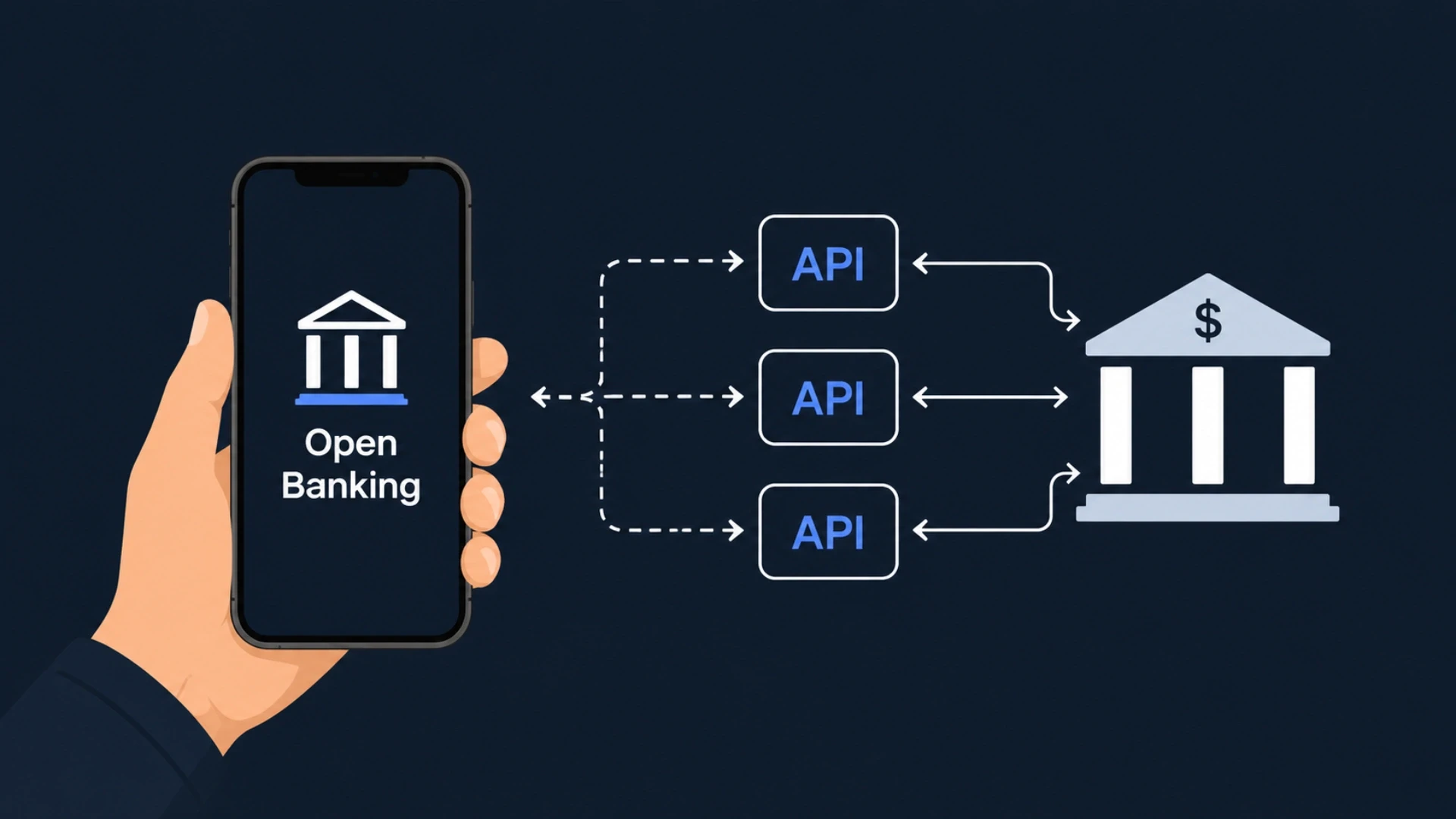
An open banking API is a standardized, secure channel that lets an approved app request specific data from, or send a payment instruction to, your bank, after you have given consent. The flow is consistent across providers because the APIs follow shared standards. Acquaint Softtech's Python developers build the integration layer that connects an app to these bank APIs and manages the consent and token lifecycle.
Consent: you tell an app what you want it to do, and it asks for your permission to access specific accounts or data.
Authentication: you log in directly with your bank using strong customer authentication, never sharing credentials with the app.
Authorization: the bank issues a scoped, time-limited access token granting only the permissions you approved.
Data or payment: the app uses the token to read the agreed data or initiate the agreed payment through the API.
Revocation: you can withdraw consent at any time, instantly cutting off the app's access.
Because the APIs are standardized, a developer can build once and connect to many banks, rather than reverse-engineering each bank's systems. Standardization is what makes the whole ecosystem possible, and it is delivered through software development outsourcing with a team that knows the AISP and PISP API patterns. The architecture behind connecting one app to many bank APIs is explained in this complete MERN stack development guide.
How does an open banking API work?
An open banking API works in five steps: you consent to what an app can do, you authenticate directly with your bank using strong authentication, the bank issues a scoped access token, the app uses that token to read the agreed data or initiate a payment, and you can revoke consent at any time. The app never sees or stores your bank credentials.
The Cast: Banks, TPPs, AISPs, PISPs, and You
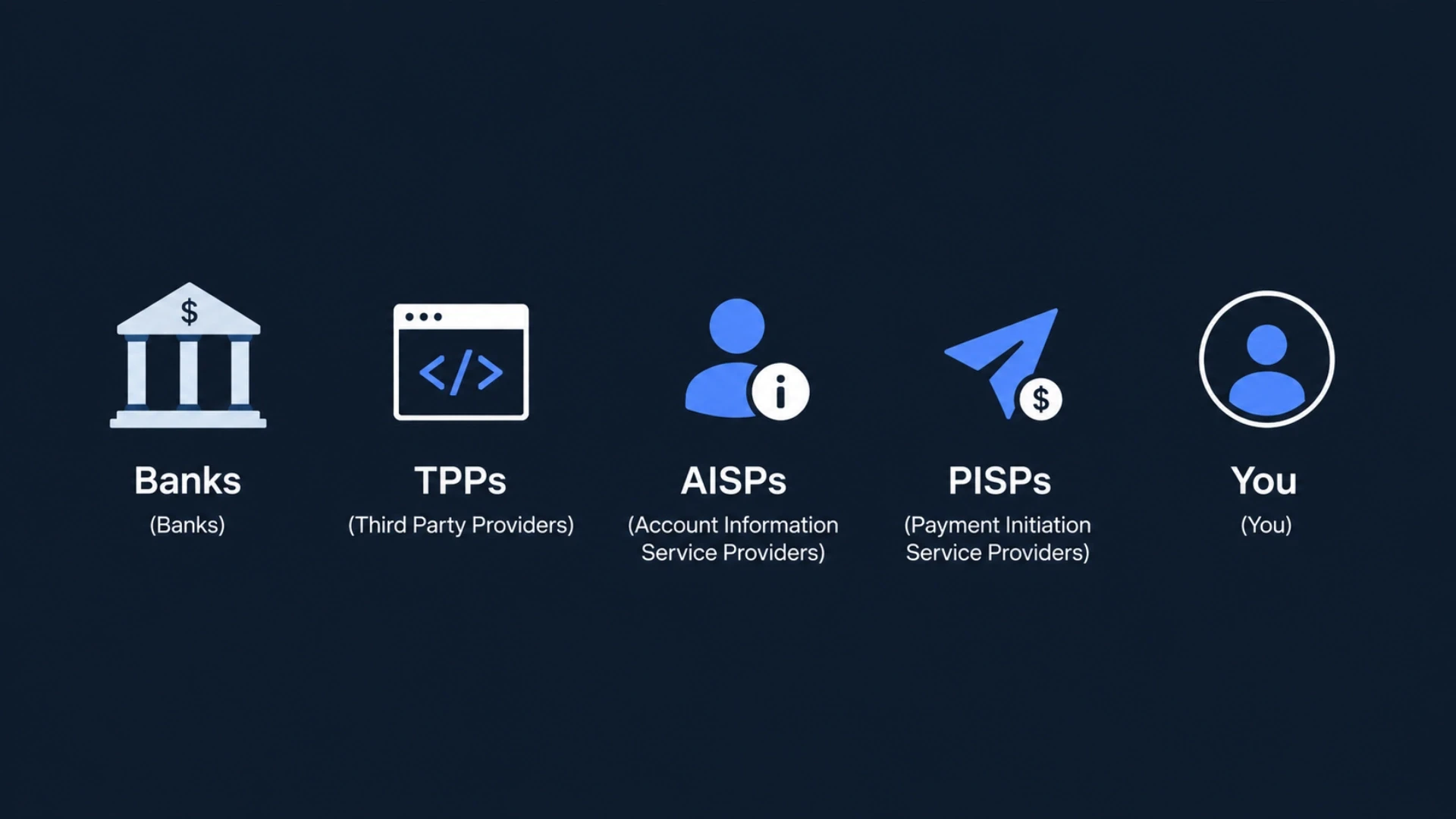
Open banking has a small cast of players, and the acronyms become simple once you map them to roles. The bank that holds your account is the Account Servicing Payment Service Provider (ASPSP); it exposes the APIs. A Third-Party Provider (TPP) is any licensed company that connects to those APIs to build a service. The customer, you, sits at the center, granting and revoking consent. Acquaint Softtech's Node.js development services build the TPP-side integrations that turn bank-API access into a usable product.
TPPs come in two main flavors. An Account Information Service Provider (AISP) can read your account data, the foundation of budgeting apps, account aggregation, and lending decisions. A Payment Initiation Service Provider (PISP) can start a payment directly from your account, the basis of account-to-account payments that bypass card networks. Both must be licensed and meet strict requirements, which is part of why building as, or for, a TPP is best done through software engineering services with regulated-fintech experience.
Understanding which role your product plays- reading data as an AISP, moving money as a PISP, or both, is the first design decision in any open banking build, because it sets your licensing and your API scope. The framework decision that shapes how maintainable a TPP integration stays over time is compared in this guide on Laravel vs MERN stack for startups, published on acquaintsoft.com.
Player | Role | Example |
ASPSP | Bank that exposes APIs | Your high-street bank |
AISP | Reads account data | Budgeting, aggregation app |
PISP | Initiates payments | A2A pay-by-bank checkout |
Customer | Grants and revokes consent | You |
What are AISPs and PISPs in open banking?
An AISP (Account Information Service Provider) is a licensed company that can read your bank account data with your consent, powering budgeting apps, account aggregation, and lending decisions. A PISP (Payment Initiation Service Provider) is a licensed company that can start a payment directly from your account, enabling account-to-account payments that bypass card networks.
Both require regulatory authorization. In many cases, businesses accelerate their market entry using solutions like White Label Software Development, which helps them build compliant financial products faster without developing everything from scratch.
Want to Build on Open Banking APIs?
Acquaint Softtech delivers open-banking and API integration builds at up to 40% lower cost than Western agencies, at $25 to $49 per hour, with 95% on-time sprint delivery and a 4.9/5 rating from 50+ verified Clutch reviews. Deploy your first fintech engineer within 48 hours of a brief.
Real Examples: What Open Banking Powers Today
Open banking is not theoretical; it already powers products millions of people use. The clearest examples cluster around a few high-value use cases that turn shared data or payment access into visible value. Acquaint Softtech's Python developers build these same use cases for clients, from account aggregation to pay-by-bank checkout.
Account aggregation and PFM: apps that pull every account into one view and offer budgeting and savings insights, the model popularized by data platforms like Plaid.
Faster, fairer lending: lenders read verified income and transaction data with consent, replacing weeks of paperwork with an instant, more accurate credit decision.
Account-to-account payments: pay-by-bank checkouts that move money directly between accounts, bypassing card networks and cutting transaction costs.
Embedded finance: platforms like Shopify let merchants access capital and payment tools inside the platform, powered by open banking APIs.
Other examples include cross-currency transfers, expense and cash-flow reporting for SMEs, and faster mortgage applications where a lender reads financial documents directly instead of asking the borrower to upload them. The common thread is that consented data access removes friction, which is the core value that a staff augmentation engagement helps fintech teams capture. For deeper context on the lending use case specifically, see this guide on how to build a digital lending platform.
What can you do with open banking?
Open banking powers account aggregation and budgeting apps that show all your accounts in one place, faster lending decisions using consented income data, account-to-account payments that bypass card networks, embedded finance inside platforms like e-commerce stores, SME cash-flow tools, and faster mortgage applications. The common thread is removing friction by securely sharing data or initiating payments with consent.
The Security Stack: Why Sharing Data Is Safe
Open banking is more secure than the password-sharing it replaced because every connection is protected by overlapping layers of security. The standard authorization framework is OAuth 2.0, which issues short-lived, scoped access tokens, with OpenID Connect adding an identity layer to verify who you are. Strong Customer Authentication (SCA) requires at least two of three factors, something you know, have, or are, for payments and account access. Acquaint Softtech's DevOps engineers build and harden these authentication, token, and consent layers.
On top of OAuth and SCA sit transport security through mutual TLS and, increasingly, the FAPI 2.0 standard from the OpenID Foundation, designed specifically for high-value financial APIs with formal security proofs and fine-grained consent. Tokens are short-lived and must be refreshed, so a compromised token causes limited damage. Implementing this stack correctly is a specialized software development outsourcing task, not a generic web-security exercise.
The result is that an app never sees your bank password, can only do what you approved, and loses access the moment you revoke consent or the token expires. The deployment and infrastructure patterns that keep these secure integrations reliable are detailed in this MERN stack app deployment guide.
Security insight: The security model is layered on purpose. OAuth 2.0 scopes what an app can do, SCA proves who the user is, mTLS protects the connection, and consent management governs the data. No single layer is trusted alone. This defense-in-depth is exactly why open banking is safer than handing an app your login and hoping for the best. |
Is open banking safe?
Yes. Open banking is safer than the password-sharing it replaced because it uses layered security: OAuth 2.0 issues scoped, short-lived access tokens; Strong Customer Authentication verifies the user with two of three factors, mutual TLS secures the connection, and the FAPI standard hardens high-value APIs. The app never sees your bank password and loses access the moment you revoke consent.
The Rulebook: PSD2, PSD3, Section 1033, and More
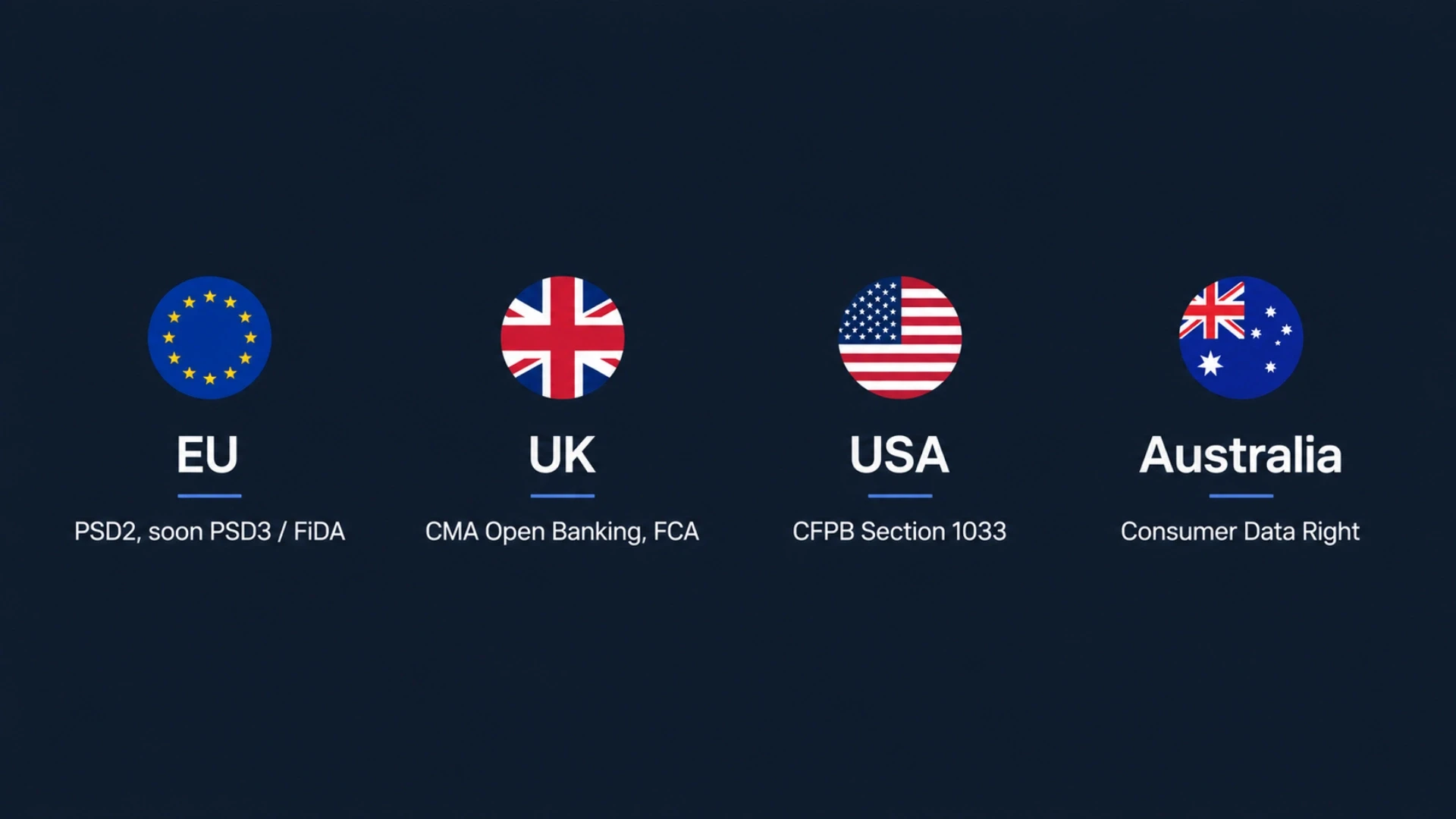
Open banking exists because regulators required banks to open their data through APIs, and the rules vary by region. In Europe, the revised Payment Services Directive (PSD2) is the foundation, mandating that banks provide free API access to licensed third parties and requiring Strong Customer Authentication. In the UK, the Competition and Markets Authority required the nine largest banks (the CMA9) to adopt open banking, overseen by the FCA. Acquaint Softtech's Laravel developers build the consent, disclosure, and reporting features these frameworks require.
The map keeps expanding. In the US, the Consumer Financial Protection Bureau oversees open banking through the Section 1033 data-rights rule, while Australia uses the Consumer Data Right and Brazil runs Open Finance. Standards bodies such as the UK's OBIE, the US Financial Data Exchange (FDX), and the Berlin Group define the technical specifications. Keeping a product compliant across these regimes is ongoing engineering work, best scoped through software product engineering services with a compliance-aware team.
The next wave is already drafted: PSD3 and the EU's Financial Data Access (FiDA) framework will strengthen security, improve API performance, and widen the scope of data. This audit-ready, regulation-tracking discipline is exactly what verified clients highlight about Acquaint Softtech, as covered in this overview of the company's Clutch recognition and verified results, published on acquaintsoft.com.
Region | Framework | Status |
EU | PSD2, soon PSD3 / FiDA | Live, evolving |
UK | CMA Open Banking, FCA | Live |
USA | CFPB Section 1033 | Being finalized |
Australia | Consumer Data Right | Live |
What regulations govern open banking?
Open banking is governed by region-specific rules. The EU uses PSD2, with PSD3 and FiDA coming next; the UK runs CMA-mandated Open Banking under the FCA; the US uses the CFPB's Section 1033 data-rights rule; and Australia uses the Consumer Data Right. Technical standards come from bodies like the UK's OBIE, the US Financial Data Exchange, and the Berlin Group.
Open Banking vs. Open Finance: Where It Is Heading
Open banking focuses on payment-account data: current accounts, credit cards, and transactions. Open finance is the next step, extending the same consented-sharing model to investments, mortgages, pensions, insurance, and more, giving a truly complete picture of someone's financial life. The EU's upcoming FiDA regulation is set to push open banking toward open finance, widening the data scope. Acquaint Softtech's software product development services build products positioned for this broader open-finance future, not just today's open banking.
The 2026 direction is also commercial, not just regulatory. Open banking has moved from compliance to commercialization: banks are becoming data orchestrators, platforms are scaling embedded finance, and account-to-account payments are challenging card networks. AI is layering on top to unlock smarter credit decisions from richer data. Capturing this shift is where an IT staff augmentation engagement with fintech engineers pays off, because the opportunity is moving faster than most in-house teams can hire for.
The strategic takeaway for any financial business is to pick one or two high-value use cases where open data unlocks visible value, then build for the open-finance future. The framework patterns behind these data-rich products are explained in this MERN stack complete guide.
What is the difference between open banking and open finance?
Open banking covers payment-account data such as current accounts, credit cards, and transactions. Open finance extends the same consent-based sharing to a wider range of products, including investments, mortgages, pensions, and insurance, giving a complete picture of someone's finances. Open finance is the next stage of evolution, and regulations like the EU's FiDA are pushing the market toward it.
Building on Open Banking: Tech Stack and Cost
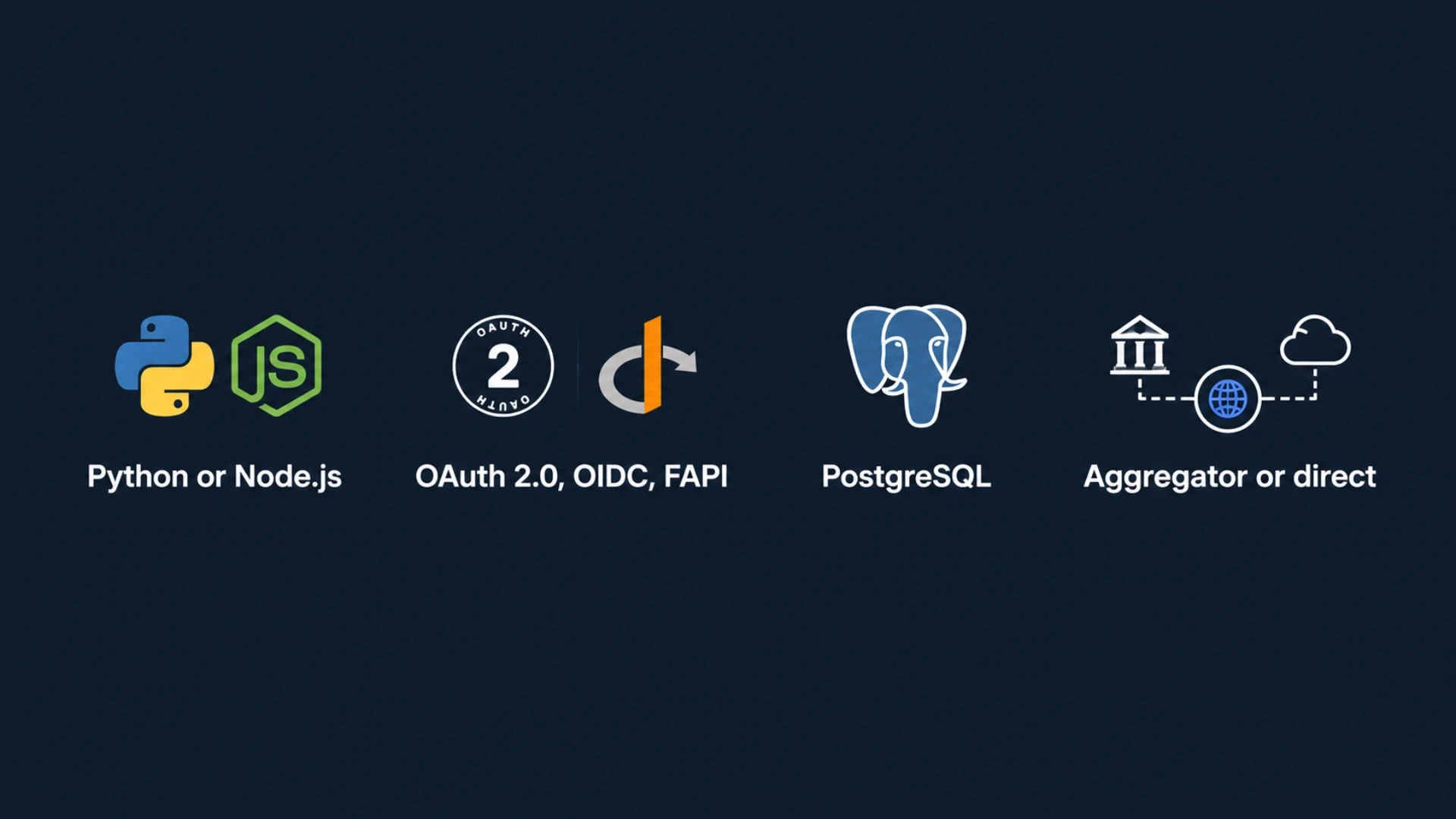
Building an open banking product involves integrating bank APIs (directly or via aggregators), managing consent and tokens, and using a secure API-first architecture with Python or Node.js, PostgreSQL, and standards like OAuth 2.0, OpenID Connect, and FAPI. Acquaint Softtech supports this with end-to-end product engineering and also provides hire MEAN stack developers to help accelerate development and implementation.
Cost depends heavily on whether you connect through an aggregator (faster, with per-call fees) or integrate directly with banks (more control, more effort), plus the number of use cases and markets. A focused open banking integration or product MVP typically costs $30,000 to $120,000, while a broader multi-market platform with payment initiation runs higher. India-based teams deliver the same quality at up to 40% lower total cost, a saving documented in this story on how a startup saved $60K a year on remote hiring. The pragmatic path is to start with one use case through an aggregator, validate the value, then expand to direct integrations and more markets. Founders building these integrations often hire Python developers with open banking experience to move quickly without compromising on the security stack.
Layer | Recommended Tech | Why |
Integration | Python or Node.js | Consent, tokens, API calls |
Security | OAuth 2.0, OIDC, FAPI | Scoped, verified access |
Data | PostgreSQL | Auditable consent records |
Connectivity | Aggregator or direct | Speed vs. control |
How much does it cost to build an open banking product?
A focused open banking integration or product MVP typically costs $30,000 to $120,000, depending on whether you connect through an aggregator or integrate directly with banks, and on the number of use cases and markets. A broader multi-market platform with payment initiation runs higher. India-based teams at $25 to $49 per hour cut total cost by up to 40% versus US agencies.
How Acquaint Softtech Builds Open Banking Products
Acquaint Softtech has delivered 1,300+ software projects across 20+ industries in 13+ years, with 70+ in-house engineers across Python, Node.js, Laravel, React, and DevOps. Open banking, API integration, and fintech engineering are core capabilities, spanning account aggregation, payment initiation, consent and security, and compliance for clients in the USA, UK, Europe, and UAE. Engagements begin with a discovery and scoping phase that maps the use case, the AISP or PISP role, and the regulatory surface before development starts.
Example: Hybopay Finance, Dublin, an AI financial data platform
Hybopay Finance, a Dublin-based financial-technology client led by CEO Gerhard Drobits, engaged Acquaint Softtech to build an AI-driven financial platform with the compliance, explainability, and audit-ready decisioning that data-rich, open-banking-adjacent products require. The engagement sits among Acquaint Softtech's verified banking and fintech projects, collected in the Laravel and fintech case studies.
Verified client review (Clutch): Gerhard Drobits, CEO of Hybopay Finance in Dublin, said in a verified Clutch review that Acquaint Softtech understood the constraints from the start and designed around them, completing every milestone on time and adapting promptly to changes mid-project. A separate verified reviewer noted the team's discipline in access, traceability, and maintainability across banking, card, and crypto operations. |
Read all 50+ verified client reviews, where Acquaint Softtech holds a 4.9/5 rating with Premier Verified status, and for context on how the company ranks among engineering partners, see this list of the best software product engineering companies in 2026, published on acquaintsoft.com.
The Acquaint Softtech 4-Phase Open Banking Framework
Discovery and role mapping (weeks 1 to 2): fix the use case, the AISP or PISP role, the target markets, and the regulatory map before any code is written.
Consent and security (sprints 1 to 2): build the OAuth, SCA, and consent-management layer and the audit logging on API-first foundations.
Integration and use case (sprints 2 to 5): connect to the aggregator or bank APIs and build the aggregation, lending, or payment use case.
Testing, launch, and expansion (sprints 5 onward): test against bank-API edge cases, launch the first use case, then expand to more banks and markets.
Start Your Open Banking Build with Acquaint Softtech
From consent and security to account aggregation and payment initiation, this is the foundation every open banking product needs. Join 200+ tech companies who scaled with Acquaint Softtech: 4.9/5 on Clutch from 50+ verified reviews, 95% on-time delivery, and fintech engineers deployed within 48 hours of brief.
Frequently Asked Questions
-
What is open banking and how does it work?
Open banking lets you securely share your bank data, or let an approved company make payments for you, through standardized APIs and only with your consent. You authenticate directly with your bank, which issues a scoped access token to the app, so the app can read the agreed data or initiate a payment without ever seeing your bank password, and you can revoke access anytime.
-
Is open banking safe?
Yes. Open banking is safer than password-sharing because it uses layered security: OAuth 2.0 issues scoped, short-lived tokens; Strong Customer Authentication verifies the user with two of three factors, mutual TLS secures the connection, and the FAPI standard hardens high-value APIs. The app never sees your bank password and loses access the moment you revoke consent or the token expires.
-
What can you do with open banking?
Open banking powers account aggregation and budgeting apps, faster lending decisions using consented income data, account-to-account payments that bypass card networks, embedded finance inside platforms like e-commerce stores, SME cash-flow tools, and faster mortgage applications. The common thread is removing friction by securely sharing data or initiating payments with the customer's consent.
-
What is the difference between open banking and open finance?
Open banking covers payment-account data such as current accounts, credit cards, and transactions. Open finance extends the same consent-based sharing to investments, mortgages, pensions, and insurance, giving a complete picture of someone's finances. Open finance is the next stage of evolution, and regulations like the EU's FiDA are pushing the market toward it.
-
How much does it cost to build an open banking product
Region
Cost (USD)
🇺🇸 US
$60,000 – $180,000+
🇬🇧 UK
$50,000 – $160,000
🇪🇺 EU
$45,000 – $150,000
🇮🇳 India
$30,000 – $120,000
Note: The US has the highest costs; the UK and EU sit mid to high depending on region, and India is the most cost-efficient with up to 40% savings.
-
What is the best tech stack for open banking?
The best open banking tech stack uses Python or Node.js for the integration, consent, and token logic, PostgreSQL for auditable consent and transaction records, and an API-first design secured with OAuth 2.0, OpenID Connect, and the FAPI standard. Products connect either through an aggregator for speed or directly to bank APIs for more control.
-
What is PSD2 in open banking?
PSD2 is the EU's revised Payment Services Directive and the foundation of European open banking. It requires banks to provide free API access to licensed third parties, mandates Strong Customer Authentication for payments and account access, and shifts liability for unauthorized transactions to banks. Its successor, PSD3, will strengthen security and API performance further.
I am Sanjay Parjapati, a developer at heart and a Head of business by work. My journey started with coding and helped me grow towards becoming a head of business which led me to focus on dual skills, i.e. technical know-hows and the business know-hows. My journey of 10+ years has helped me grow immensely from a professional viewpoint.
Table of Contents
Get Started with Acquaint Softtech
- 13+ Years Delivering Software Excellence
- 1300+ Projects Delivered With Precision
- Official Laravel & Laravel News Partner
- Official Statamic Partner
Related Blog
.webp "How to Build a Digital Lending Platform: Complete 2026 Guide")
How to Build a Digital Lending Platform: Complete 2026 Guide
A digital lending platform is four workflow systems that must all work flawlessly: origination, underwriting, disbursement, and servicing. This guide builds each one, with AI credit scoring, compliance mapping, and real 2026 cost data.

Ahmed Ginani
May 25, 2026
MERN Stack Development: A Complete Guide in 2024 | Part 1
Learn about MERN Stack Development, a versatile toolset for creating dynamic websites and apps using JavaScript for everything.

Mukesh Ram
August 29, 2024
Laravel vs MERN Stack in 2025: The Best Choice for Startups
Struggling to pick between Laravel and MERN Stack in 2025? This startup-focused guide breaks down the pros, cons, and best use cases.

Acquaint Softtech
July 24, 2025India (Head Office)
203/204, Shapath-II, Near Silver Leaf Hotel, Opp. Rajpath Club, SG Highway, Ahmedabad-380054, Gujarat
USA
7838 Camino Cielo St, Highland, CA 92346
UK
The Powerhouse, 21 Woodthorpe Road, Ashford, England, TW15 2RP
New Zealand
42 Exler Place, Avondale, Auckland 0600, New Zealand
Canada
141 Skyview Bay NE , Calgary, Alberta, T3N 2K6