

Platform Engineering vs Traditional DevOps: What Laravel Teams Need to Know in 2026
Gartner predicts that 80% of large engineering organizations will adopt platform engineering by 2026. This guide explains how Laravel teams can apply platform engineering using Forge, Envoyer, and Vapor instead of Kubernetes.

Kalpesh Rajora
As a Project Manager at Acquaint Softtech, an Official Laravel Partner recognized by Laravel's creator Taylor Otwell, the question I hear most from engineering leads is whether they should hire DevOps engineers or build a platform team, because everyone says platform engineering is the answer, but they run Laravel on Forge, and none of the advice seems written for them. It is a fair question. Almost every article on platform engineering assumes hundreds of microservices on Kubernetes.
Meanwhile, a Laravel team of fifteen is watching deploys take longer every quarter, watching the same senior engineer get pulled into every environment problem, and wondering whether the Gartner number everyone quotes is describing their situation or somebody else's.
It is describing theirs, just not in the way the enterprise commentary implies. This guide translates platform engineering into Laravel terms, using the tools your team already runs, and gives you a straight answer on when the shift is worth making.

- You run Laravel on Forge, Envoyer, or Vapor and want a more scalable development workflow.
- Your development team is growing, but deployments are becoming slower.
- One engineer handles all infrastructure and deployment questions.
- You want to onboard new Laravel developers faster.
- You are deciding whether to hire a DevOps engineer or build a platform team.
- You need platform engineering guidance designed for Laravel, not Kubernetes.
The confusion is understandable. Platform engineering is often associated with Kubernetes and large enterprises, so many Laravel teams assume it is not relevant to them. However, the CNCF Platform Engineering Maturity Model explains that platform engineering is designed for organizations of all sizes, not just enterprise environments.
Likewise, Google Cloud's DORA Accelerate State of DevOps Report, based on research from more than 39,000 technology professionals, found that internal developer platforms improve developer productivity, team performance, and overall software delivery. Platform engineering standardizes deployments, environments, and onboarding, making development faster and more reliable.
This article explains how Laravel teams can adopt platform engineering using Forge, Envoyer, and Vapor, with practical implementation steps, costs, and a real-world case study.
What Traditional DevOps Looks Like on a Laravel Team
Before comparing, it is worth being precise about what most Laravel teams actually have today, because it is rarely textbook DevOps.
The typical Laravel setup in 2026
A Laravel team of ten to twenty usually runs something like this: Forge provisions and manages the servers, Envoyer or a GitHub Actions workflow handles zero-downtime deploys, environment variables live in Forge, queues run under Horizon, and one or two senior engineers understand how the whole thing fits together. It works, and for a long time it works well. Laravel's tooling is genuinely excellent at removing infrastructure burden from application developers.
Where it starts to strain
The strain does not come from the tools. It comes from knowledge distribution. Three symptoms show up in order, and I have watched them appear in the same sequence across dozens of client teams.
The bottleneck engineer. One person knows how staging is configured, how the queue workers are tuned, and why that one cron job runs where it does. Every environment question routes through them.
Snowflake environments. Staging drifts from production. A new developer's local setup takes three days and a pairing session. Bugs appear in one environment and not another.
Deploy anxiety. Shipping becomes an event rather than a routine. Releases cluster on Tuesday afternoons because nobody wants to deploy before a weekend.
None of that is a tooling failure. Forge and Envoyer are doing exactly what they promise. It is an ownership and repeatability problem, and that is precisely the gap platform engineering was invented to close.
What Platform Engineering Actually Changes
Platform engineering treats your internal development environment as a product, with your own developers as the customers. Instead of a DevOps engineer being a person you ask for help, the platform is a self-service system your developers use without asking anyone.
The central artefact is the golden path: a paved, opinionated, well-documented route to doing the common things. Spin up an environment. Deploy a branch for review. Add a queue worker. Roll back. On a mature platform, each of those is a command or a button, not a Slack message.
The honest comparison
Dimension | Traditional DevOps on Laravel | Platform engineering on Laravel |
Who owns infrastructure | One or two senior engineers, informally | A platform team owning a product with users |
How a dev gets an environment | Asks someone, waits | Self-service command, minutes |
Knowledge location | In people's heads and Slack history | In code, templates, and documentation |
Success measure | Uptime and deploy success | Developer experience, lead time, self-service rate |
New starter onboarding | Days of pairing | A documented path, often under a day |
Failure mode | Bottleneck person unavailable | Platform gaps, visible and fixable |
Right for | Teams under roughly 10 engineers | Teams above roughly 15 to 20, or multi-product |
Notice the last row. This is not a maturity ladder where platform engineering is the advanced answer. A six-person Laravel team that builds an internal platform has invented overhead it does not need. The question is about scale and pain, not sophistication.
Not Sure Which Side of the Line You Are On?
Tell us your team size, your Laravel setup, and where deploys hurt. A senior engineer will tell you straight whether you need a platform team or better DevOps discipline. This takes 15 minutes.
Does the Gartner 80% Statistic Apply to Laravel Shops?

Partly, and the distinction matters more than the headline.
Where the enterprise framing does not transfer
The Gartner prediction concerns large organisations, and the tooling discussion that follows it assumes Kubernetes, service meshes, and a Backstage-style developer portal. A Laravel team running twelve applications on Forge does not have those problems and should not buy those solutions. Adopting Kubernetes to solve a Laravel deployment problem is one of the more expensive mistakes I see teams talk themselves into.
Where it transfers exactly
The underlying diagnosis transfers completely. Gartner argues that cognitive load on application developers has grown past what individuals can carry, and that self-service abstraction is the fix. That is true whether the complexity comes from three hundred microservices or from six Laravel apps with slightly different queue configurations, four environments each, and no written record of how any of it was set up.
So the honest reading for a Laravel shop is this: you probably will not build an internal developer platform in the enterprise sense. You very likely should build a golden path. And Laravel's own tooling gets you most of the way there.
How Laravel's Own Tooling Supports a Platform Approach
This is where Laravel teams are quietly ahead. Much of what enterprise platform teams build from scratch already exists as first-party or core ecosystem tooling, which means your golden path is mostly assembly rather than invention. Here is what Laravel hands you, and what each piece replaces.
Laravel tool | What it gives your golden path | What it replaces |
Forge | Repeatable server provisioning with consistent PHP, queue, and scheduler config | Manual server setup and config drift |
Envoyer | Zero-downtime deploys with rollback as a routine action | Deploy scripts only one person understands |
Vapor | Serverless deployment where scaling and environment parity come by default | Custom autoscaling infrastructure |
Sail / Docker | Identical local environments so new starters are productive on day one | Three-day onboarding and pairing sessions |
Horizon | Queue visibility and worker config held in code | Queue tuning knowledge living in one head |
Pulse | Application performance signals developers can read themselves | A DevOps ticket to answer a performance question |
Telescope | Local and staging debugging without shoulder-tapping | Interrupting the infrastructure owner |
Artisan commands | The natural place to encode your own self-service operations | Undocumented manual runbooks |
The last row is the one teams overlook. A custom Artisan command that provisions a review environment, seeds it, and prints the URL is a golden path. It needs no portal, no Kubernetes, and no platform engineering vocabulary. It just needs someone to write it down as code instead of doing it manually each time.
If your applications sit on older Laravel releases, several of these tools are unavailable or behave differently across versions, which fragments the platform before you start. Laravel publishes its release and support policy openly, and getting every application onto a consistent supported version is usually the real first task. That is what our version upgrade services exist for.
When Should a Laravel Team Make the Shift?
There is no clean threshold, but there are reliable signals. The trigger is rarely headcount alone. It is headcount combined with multiplication: more applications, more environments, more teams touching the same infrastructure.
Signal | You are ready if | You are not ready if |
Team size | 15+ engineers, or 3+ Laravel apps in production | Under 10 engineers on a single application |
Dependency risk | A named person is required for environment work | Any developer can deploy and roll back safely |
Onboarding | First productive commit takes more than two days | New starters ship within a day |
Environment parity | Staging and production have measurably drifted | Environments are consistent and boring |
Velocity | Shipping less per engineer than a year ago | Deploys are routine and unremarkable |
Ownership | Someone can own the platform as a product | Nobody has capacity to own it |
A half-owned platform is worse than no platform, so that last row is a genuine stop condition rather than a nice-to-have.
If you sit in the middle, the sequencing question is worth an outside opinion before you commit budget, which is what a short discovery workshop or virtual CTO services engagement is designed to settle.
How to Adopt Platform Thinking: A 5-Step Path
Most Laravel teams get the majority of the benefit without ever creating a formal platform team. The trick is to steal the discipline rather than the org chart. Each step below is ordered so it makes the next one cheaper.
Step | What you do | Typical effort |
1. Document the real path | Write down how a deploy actually happens today, including the undocumented steps | 1 to 2 days |
2. Standardise Laravel versions | Get every application onto a consistent supported release so tooling behaves the same | 2 to 6 weeks |
3. Automate the worst step | Turn the step that most often needs the bottleneck engineer into an Artisan command or CI job | 1 to 2 weeks |
4. Make environments disposable | Containerise local, template Forge provisioning, make review environments cheap | 3 to 6 weeks |
5. Measure developer experience | Track lead time, onboarding time, and how often devs need to ask for help | Ongoing |
Step 1: Document the real path
Before automating anything, map how a deploy happens end to end, including the steps nobody wrote down. This is uncomfortable, and it is the highest-value hour you will spend, because it makes the bottleneck visible to everyone at once.
Step 2: Standardise your Laravel versions
A golden path cannot exist across applications running different Laravel releases, because the tooling behaves differently on each. This is usually the largest single line item and the one teams try to skip.
Step 3: Automate the worst step first
Pick the step that most often requires the bottleneck engineer. One automated step, shipped and used daily, teaches the team more than a platform strategy document ever will.
Step 4: Make environments identical and disposable
Environment parity removes an entire category of bug that no amount of testing discipline will catch. When creating a review environment is cheap, developers do it without thinking, and that is when the platform starts paying you back.
Step 5: Measure developer experience, not just uptime
Track lead time from commit to production, time to a new starter's first commit, and how often developers ask for environment help. Those three numbers tell you whether the work is paying off.
Teams running this alongside active product delivery often add a small dedicated software team to own the platform track, or use IT staff augmentation to add capacity for the build-out period only.
Get a Free Laravel Platform Readiness Map
Send us your team size, application count, and current deployment setup. A senior engineer returns a one-page map: your golden path gaps, the first three steps to automate, and whether you need a platform team or just better tooling discipline.
Case Study: Good2Know Vehicle Inspection Platform
This is a verified project from our case studies. Good2Know engaged Acquaint Softtech to turn its AI-powered vehicle inspection tool into an enterprise-ready SaaS product. The headline outcome is an AI accuracy figure, but the reason it belongs in this article is the platform work underneath it.
At a glance
Detail | Summary |
Client | Good2Know, AI vehicle inspection |
Engagement | Platform upgrade to enterprise-ready SaaS |
Core challenge | High-volume inspections at zero latency, from inconsistent real-world image inputs |
Scale target | 1,000 to 1,000,000+ vehicle scans |
Headline result | Up to 99.9% detection accuracy with real-time alerts |
The platform decisions that came first
Decision | Why it was a platform decision | Outcome |
Multi-tenant architecture | Scaling from 1,000 to 1,000,000+ scans is an infrastructure choice, not a feature | Held under high-volume load without redesign |
Secure AI-to-web API boundary | A clean contract between the AI engine and the web app, versionable and testable | Reliable data flow with security standards maintained |
Rebuilt frontend and backend | Designed for scalability and future feature expansion rather than the current release | New features ship without re-architecting |
Image preprocessing pipeline | Repeatable handling of low-light and low-quality inputs | Consistent accuracy from real-world photos |
Ongoing support model | Model tuning, security updates, and performance monitoring as a routine | Performance holds as inspection volume grows |
The lesson for your Laravel team
The 99.9% accuracy number is what gets quoted, but it was not reachable without the platform work in the table above. Every one of those five decisions is about repeatability and boundaries rather than features. That is the pattern worth taking: teams that ship impressive product outcomes are usually the ones that made their delivery environment boring and predictable first.
How Acquaint Softtech Helps Laravel Teams Do This

We rarely recommend that a Laravel team build a formal internal developer platform. After 200+ Laravel projects across SaaS, fintech, healthcare, and enterprise platforms, the pattern we see is that most delivery pain comes from undocumented manual steps and a single knowledge bottleneck, not from a missing platform layer.
Where we help, and with whom
Your situation | How we help | Engagement |
Apps on mixed Laravel versions | Standardise every application onto a supported release | Version Upgrade Services |
No in-house infrastructure capacity | Add engineers who have built Laravel golden paths before | Hire DevOps Engineers |
Platform work stalls feature delivery | A separate team owns the platform track in parallel | Dedicated Software Team |
Short-term build-out only | Senior capacity for the automation push, then out | Staff Augmentation |
Unsure whether to start at all | An architecture and sequencing opinion before budget | Discovery Workshop |
Live platform needing to stay healthy | Monitoring, tuning, and updates as volume grows | Support and Maintenance |
Our approach starts narrow: document the real deploy path, get every application onto a consistent supported Laravel version, move the highest-friction manual step into code, and only then discuss whether a dedicated platform owner is justified.
When you need that capacity, you can hire Laravel developers who have built these paths before, and where the whole modernization should run against a fixed plan, software development outsourcing delivers it that way.
Post-launch, support and maintenance keep it healthy. The goal is not to add a platform team; it is a delivery environment your existing team can run without a bottleneck.
What Platform Work Costs for a Laravel Team
Cost depends on scope and on where your engineers sit. These are indicative 2026 ranges for senior Laravel and DevOps work, to help you budget, not a quote.
Region | Senior DevOps rate | Golden path foundation |
United States | $110 to $190 / hour | $30k to $65k |
United Kingdom | £85 to £145 / hour | £25k to £55k |
European Union | €80 to €140 / hour | €24k to €52k |
Australia | A$120 to A$200 / hour | A$40k to A$85k |
Acquaint (offshore) | $22 / hour or $3,200 / month | $10k to $22k |
An Official Laravel Partner working offshore typically delivers the same scope at 50 to 70% less than US, UK, EU, or Australian local rates, at the same seniority. Here is where that budget goes.
Phase | Share of build | What it covers |
Audit and documentation | 15 to 20% | Mapping the real deploy path and undocumented steps |
Version consistency | 15 to 25% | Every application onto a supported Laravel release |
Environment parity | 25 to 30% | Containerised local and disposable review environments |
Self-service automation | 25 to 30% | Artisan commands, CI jobs, and routine rollback |
Measurement | 10% | Lead time, onboarding time, and self-service tracking |
Ready to Fix Your Laravel Delivery Bottleneck?
Book a 30-minute call with a senior engineer. You leave with a clear plan: your golden path gaps, the automation sequence, whether you need a platform owner, a timeline, and a fixed price for your region and scope.
Frequently Asked Questions
-
What is platform engineering?
It treats your internal development environment as a product, with your developers as users. A platform team builds self-service tools and golden paths so developers deploy without asking anyone.
-
How is it different from DevOps?
DevOps is a person you ask for help. A platform is a system you use directly. Platform engineering productises that help into self-service.
-
Does Gartner's 80% figure apply to Laravel shops?
Partly. It concerns large organisations, and most Laravel shops are smaller. The underlying cognitive-load diagnosis still applies.
-
When should a Laravel team shift?
Around 15+ engineers or 3+ Laravel apps in production. The clearer signal is whether one person is required for environment work.
-
Do we need Kubernetes for this?
No. Forge, Envoyer, Vapor, Sail, and custom Artisan commands cover most Laravel golden paths. Kubernetes solves problems most Laravel shops do not have.
-
What is a golden path in Laravel terms?
The paved, documented way to do a common task, such as an Artisan command that provisions a review environment. The test is whether a new developer can do it unaided.
-
What does it cost?
A golden path foundation runs roughly $30k to $65k at US rates, or $10k to $22k offshore. Application count and version inconsistency drive the range.
-
Can we do this without a platform team?
Yes, and most Laravel teams should. Document the deploy path, automate the worst step, and make environments disposable.
-
What metrics show it is working?
Lead time from commit to production, time to a new starter's first commit, and how often developers ask for environment help.
-
What is the biggest mistake teams make?
Buying enterprise tooling to solve a documentation problem. Writing down the real deploy path first usually reveals cheaper fixes.
I am Kalpesh Rajora, a Project Manager at Acquaint Softtech with 8+ years of experience leading Laravel and full-stack delivery teams. I specialise in sprint planning, client communication, and shipping complex software projects on time across distributed teams. I write about the delivery side of software: how projects are scoped, where timelines slip, and what keeps remote teams aligned.
Table of Contents
Get Started with Acquaint Softtech
- 13+ Years Delivering Software Excellence
- 1300+ Projects Delivered With Precision
- Official Laravel & Laravel News Partner
- Official Statamic Partner
Related Blog

5 Reasons to Upgrade to Laravel 13 Today
Laravel 13, released on March 17, 2026, introduces a first-party AI SDK, passkey authentication, PHP 8.3 performance gains, zero breaking changes, and native JSON:API support. These features make it the most strategically important upgrade in the framework's history for teams building production-grade applications.

Acquaint Softtech
April 15, 2026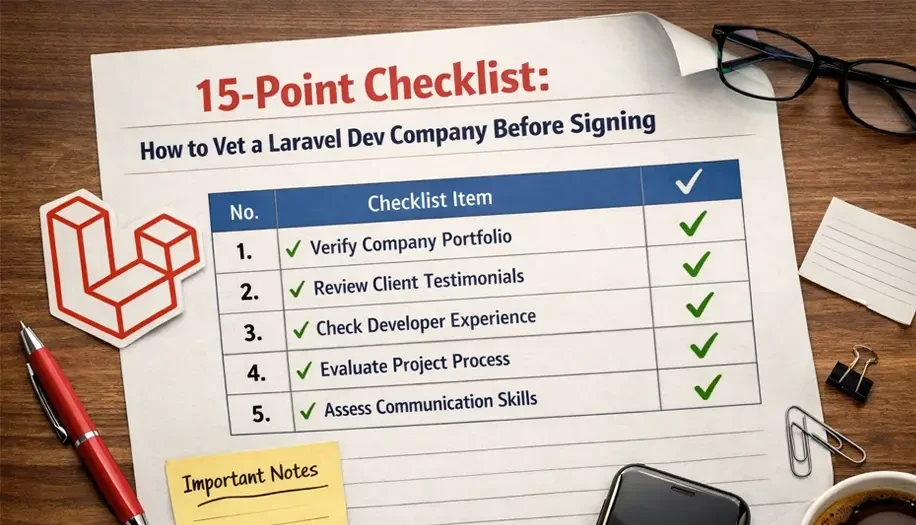
15-Point Checklist: How to Vet a Laravel Dev Company Before Signing
Before you sign with any Laravel dev company, ask these 15 questions. We built this checklist from 1,300+ projects. Most CTOs skip at least 8 of them.
Acquaint Softtech
March 8, 2026
AI-Native Laravel: How Laravel 12/13's Vector Support and Boost v2.0 Are Changing Hiring Needs
Laravel 12 and 13 include built-in AI features like vector embeddings and Boost v2.0. These updates make AI-powered Laravel development faster and more scalable. Businesses now need Laravel developers with practical AI skills.
Kalpesh Rajora
September 1, 2026India (Head Office)
203/204, Shapath-II, Near Silver Leaf Hotel, Opp. Rajpath Club, SG Highway, Ahmedabad-380054, Gujarat
USA
7838 Camino Cielo St, Highland, CA 92346
UK
The Powerhouse, 21 Woodthorpe Road, Ashford, England, TW15 2RP
New Zealand
42 Exler Place, Avondale, Auckland 0600, New Zealand
Canada
141 Skyview Bay NE , Calgary, Alberta, T3N 2K6